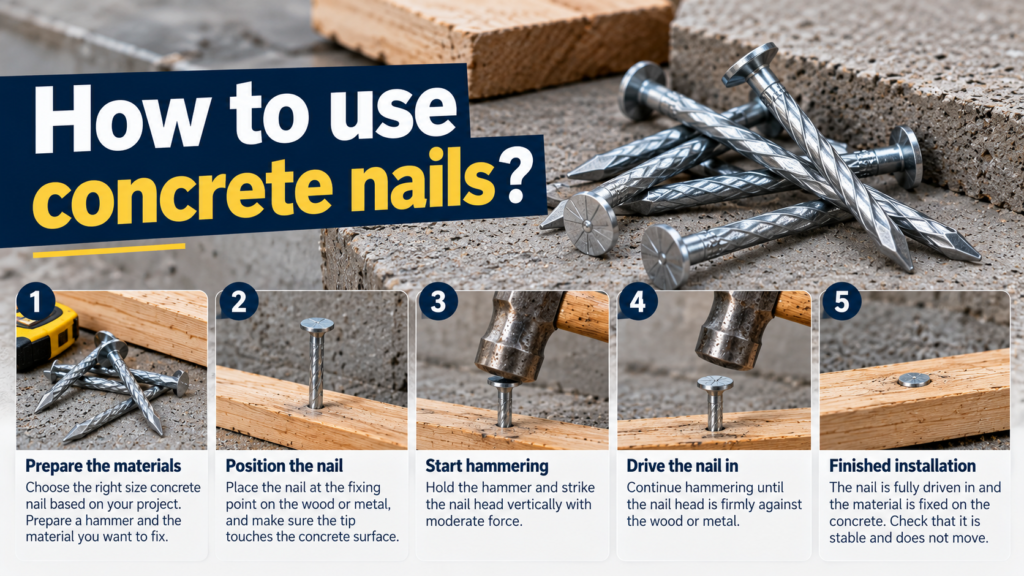
Masonry nails can look similar to regular nails at first glance, but choosing the wrong one can create bent fasteners, weak holding power, cracked material, wasted labor, and safety risk. I often tell buyers that the better choice depends on the base material, installation method, environment, and project cost, not just the nail price.
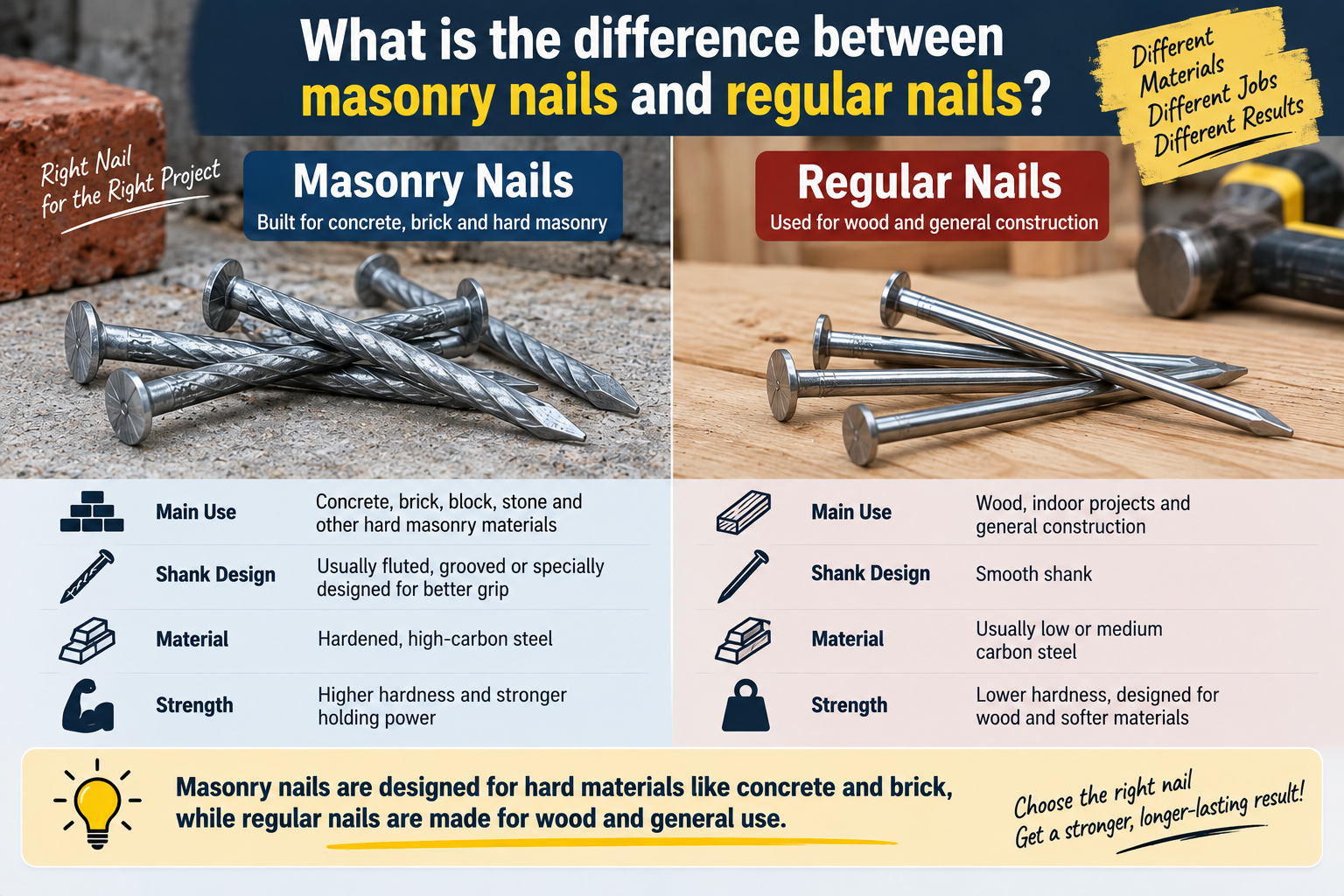
Masonry nails are hardened fasteners designed for concrete, brick, block, and other hard brittle materials, while regular nails are generally made for wood and softer substrates.1 The key differences are material hardness, shank design, holding power, installation tools, and failure risk. For buyers, the correct nail should match the application, not only the budget.
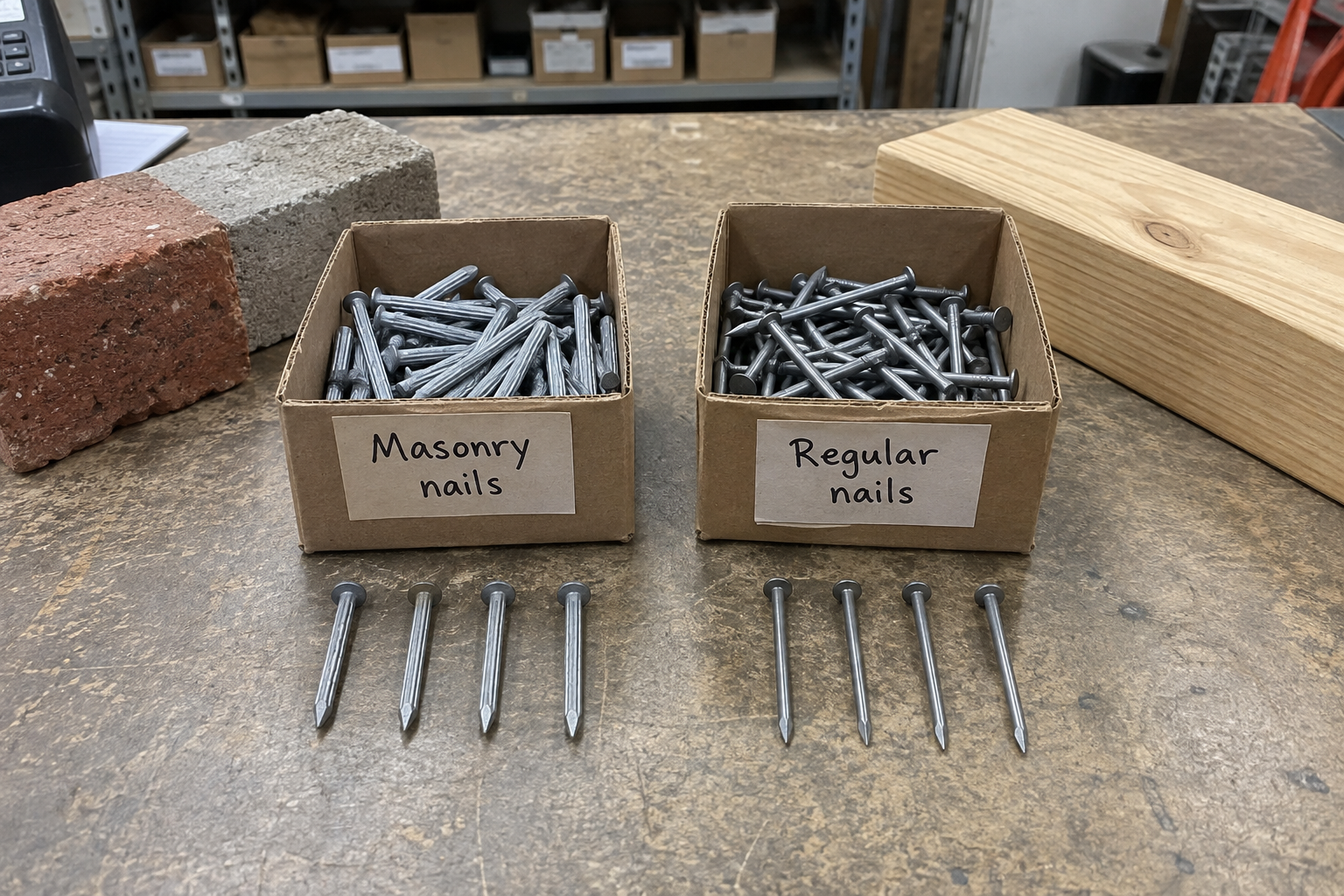
From my experience guiding wholesalers, contractors, and importers, this question usually appears when a buyer wants one nail to cover many jobs. That approach can work for inventory planning, but it can fail badly on site if the application is not checked carefully.
How do masonry nails differ from regular nails in material compatibility?
Material compatibility is the first problem I ask buyers to solve. A nail may look strong, but the wrong substrate can turn a low-cost fastener into an expensive failure. Hard concrete and soft timber behave very differently under impact, pressure, and vibration.
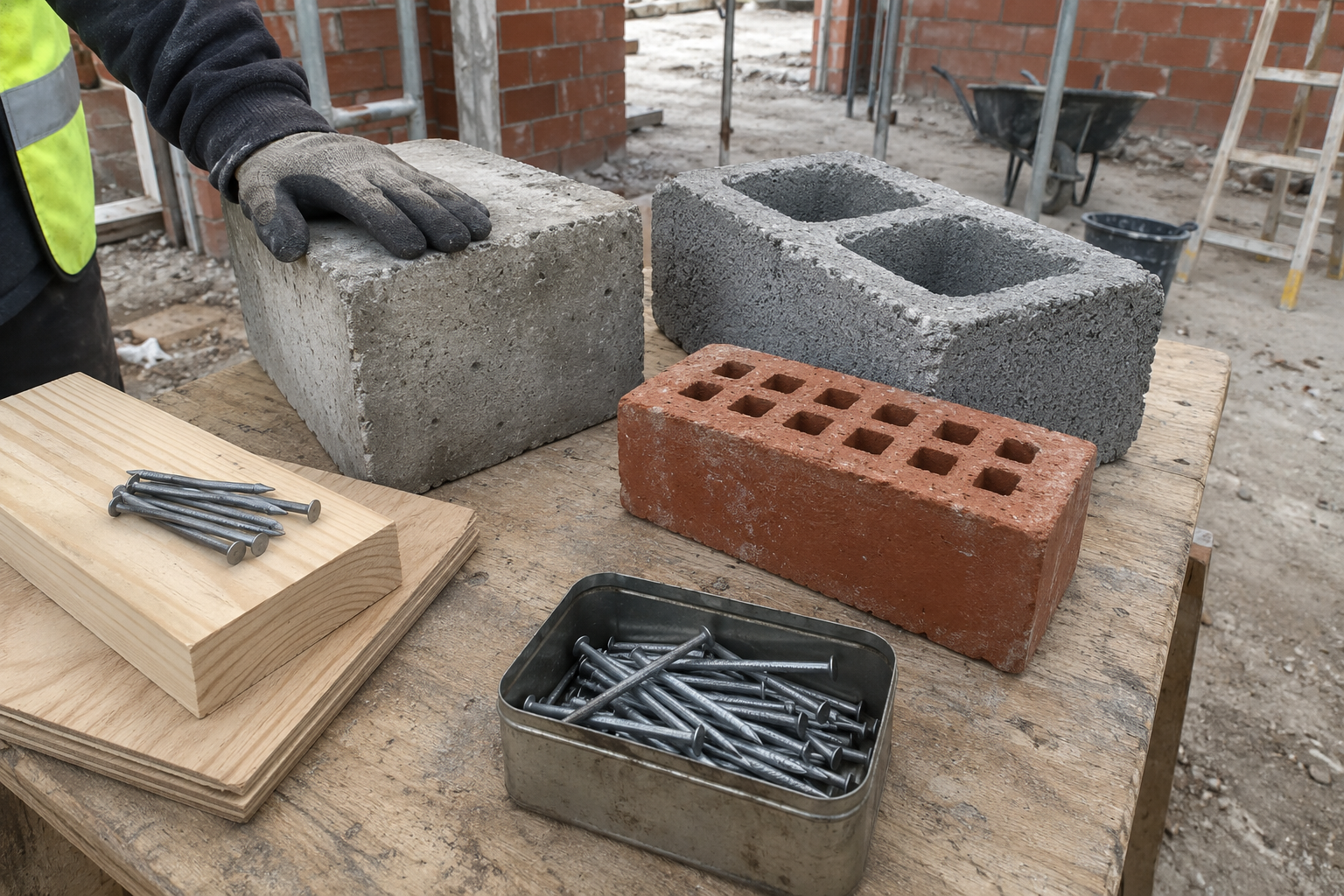
Masonry nails are made for hard and brittle materials such as concrete, brick, and cement block. Regular nails are mainly made for wood, plywood, and other softer materials. The safest selection starts by matching the nail type to the base material, then checking load, environment, and installation method.
Why the base material matters
I usually explain it this way: a nail does not work alone. It works together with the material around it. Wood fibers can compress around a smooth or ring shank nail. Concrete cannot behave the same way.2 Concrete, brick, and block are hard, but they are also brittle.3 If the fastener is too soft, it may bend. If the installation force is too aggressive, the surface may chip or crack.4
Regular nails are commonly used in:
- Wood framing
- Pallet production
- Light carpentry
- Packaging cases
- Roofing timber support
- General household fastening
Masonry nails are commonly used in:
- Fixing wood strips to concrete
- Attaching light fixtures to brick or block
- Securing temporary supports on masonry surfaces
- Fastening mesh, clips, or light hardware to hard substrates
- General construction use where concrete nails are specified
I do not recommend treating regular nails as a universal substitute for masonry applications. The initial saving can disappear quickly when bending, pull-out, breakage, or rework occurs.
Practical comparison for buyers
| Factor | Masonry nails | Regular nails |
|---|---|---|
| Common base material | Concrete, brick, block, mortar joints | Wood, plywood, soft boards |
| Typical steel requirement | Hardened steel, depending on specification | Low carbon or common steel, depending on type |
| Main risk if misused | Cracking, spalling, incorrect embedment | Bending, low holding power, pull-out |
| Best evaluation method | Check substrate hardness and fastening purpose | Check wood density and load requirement |
| Buyer concern | Performance and installation success | Cost, size range, finish, packaging |
A useful purchasing rule
When I advise customers, I ask four simple questions before suggesting a product:
- What material will receive the nail?
- Is the fastening temporary or long-term?
- Will the nail face moisture, vibration, or repeated stress?
- What tool will the installer use?
These questions help buyers avoid a very common mistake: comparing only the price per carton or price per ton. A cheaper nail that does not enter the material correctly is not cheap. It creates lost time, tool damage, extra labor, and possible safety incidents.
For structural or safety-critical fastening, I always suggest professional evaluation. A supplier can guide nail selection, but project engineers or qualified site professionals should confirm application-specific requirements.
Why do masonry nails hold better in concrete, brick, and block?
Poor holding power is a serious problem because it may not appear immediately. A fastener can seem secure at installation, then loosen after vibration, weather exposure, or load changes. This is why I encourage buyers to look beyond appearance and compare design details.
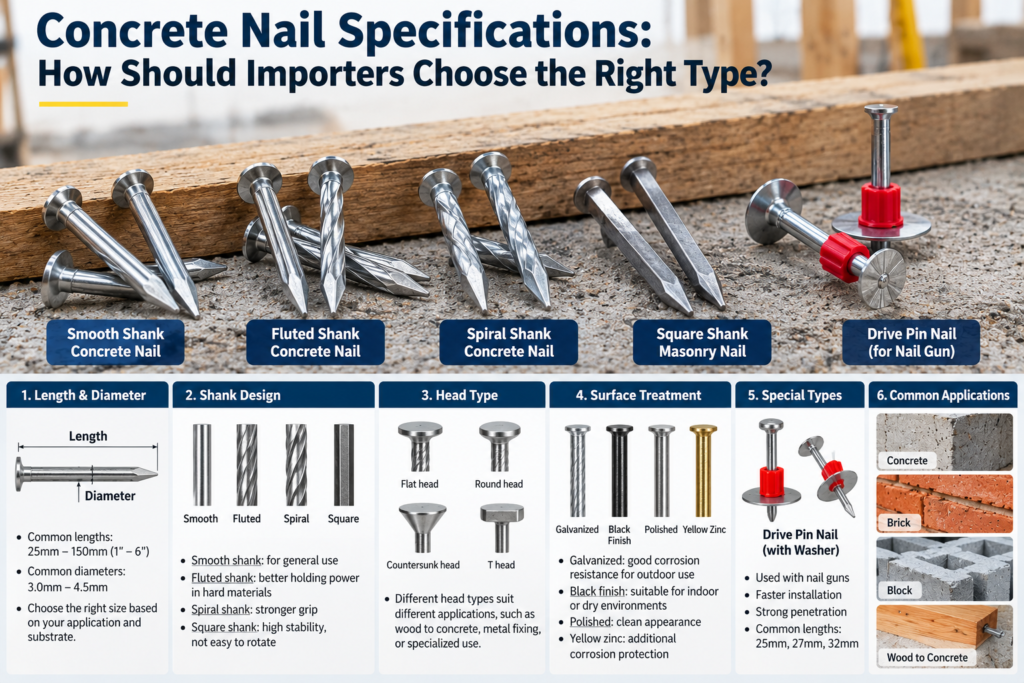
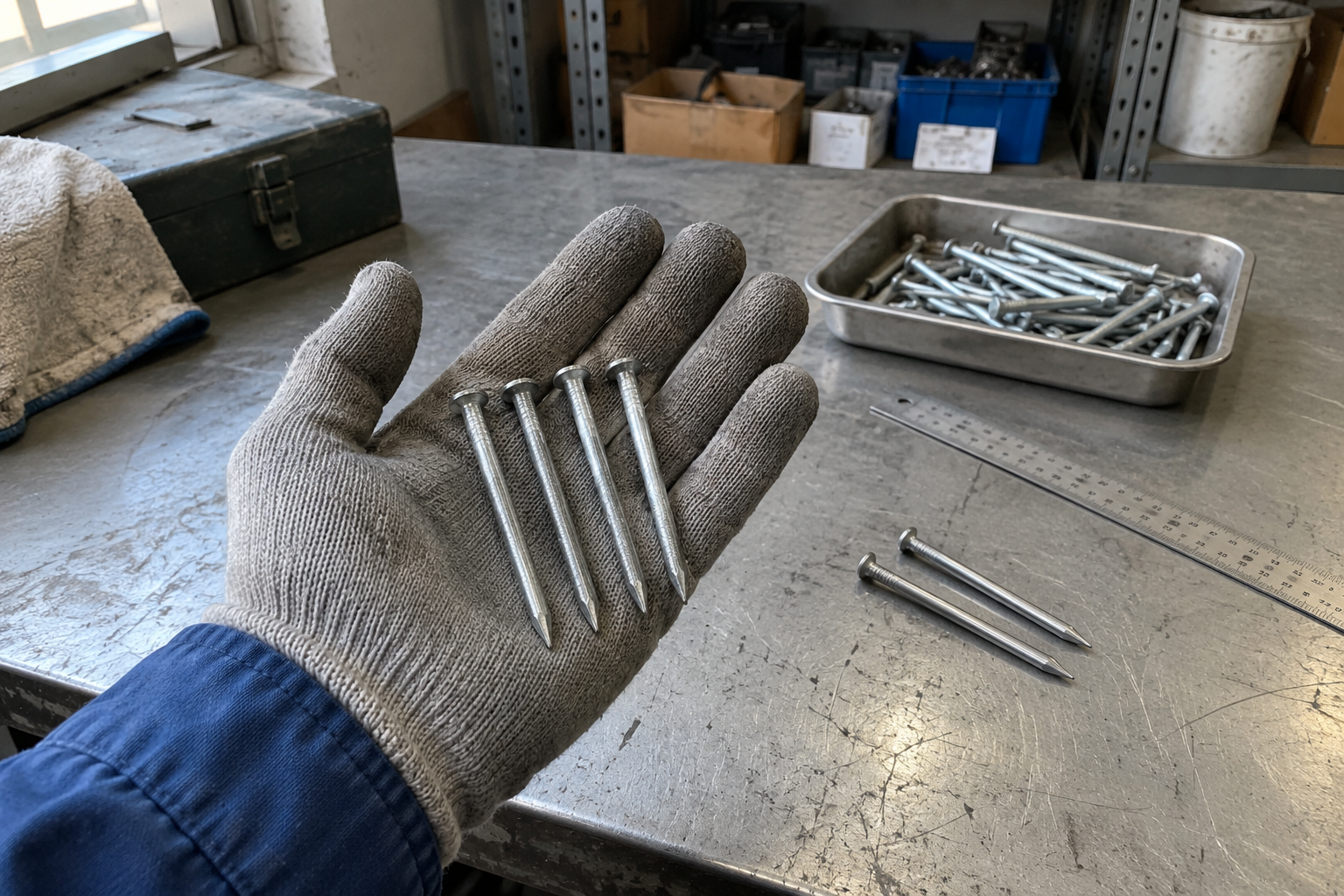
Masonry nails hold better in suitable masonry materials because they are usually harder, stiffer, and designed to resist bending during impact.5 Many types use fluted, grooved, or specially shaped shanks to improve grip in concrete, brick, or block.6 Regular nails usually rely on wood fiber compression for holding power.7
Key design differences buyers should check
Not all concrete nails are the same. I have seen importers request “concrete nail” as one simple item, but there are several design variables that affect performance and market fit.
Important details include:
- Steel hardness: Masonry applications usually require harder steel than common wood nails.
- Shank design: Fluted, grooved, or spiral-like surfaces can improve grip.
- Point shape: A sharp, consistent point helps penetration.
- Head type: Flat, countersunk, or special heads support different fixing needs.
- [Surface finish: Black, bright, galvanized, or other finishes affect appearance and corrosion resistance.](https://pmc.ncbi.nlm.nih.gov/articles/PMC11923840/)[^8]
- Size tolerance: Consistent diameter and length support reliable installation.
Holding power is not only about strength
Many buyers ask me, “Which nail is strongest?” I understand the question, but I think a better question is, “Which nail is suitable for this material and load?” A very hard nail can still perform poorly if the base material is weak, hollow, cracked, or too close to an edge.8
For example, a nail driven into dense concrete may need a different approach than one driven into a mortar joint. A nail used for temporary wooden formwork may not need the same corrosion resistance as a nail used in a humid coastal project. A fastener used indoors may have different requirements from one used outdoors in rainy conditions.
Common nail types in construction purchasing
| Nail type | Main use | Buyer note |
|---|---|---|
| Concrete nail | Concrete and masonry fastening | Check hardness, shank, and finish |
| Black steel nail | General hard-material or industrial fastening, depending on spec | Confirm application and coating requirements |
| Common nail | Wood and general carpentry | Not a substitute for concrete fastening |
| Lost head nail | Finish work and concealed fastening | Best for wood trim, not masonry |
| Roofing nail | Roofing sheets, felt, or timber support | Check head size and corrosion resistance |
What I tell buyers about specifications
I usually recommend that buyers request clear specifications before confirming an order. The specification should include:
- Product name
- Diameter and length
- Surface treatment
- Packaging method
- Quantity
- Application scenario
- Required samples or test standard
At Dingzhou Best, for example, we support sample supply for quality checking. Samples usually carry a basic fee, and buyers can discuss whether that fee is returned or balanced in a formal order. I like this step because it helps both sides avoid assumptions.
A specification sheet does not replace professional project testing, but it gives procurement teams a better starting point. It also helps importers compare suppliers on quality control, not only FOB price.
How should I compare installation methods for masonry nails and regular nails?
Installation method is where many hidden costs appear. A nail that looks correct in a catalog may still fail if the wrong hammer, power tool, pilot hole, or driving method is used. This problem affects labor speed, tool life, and final fastening quality.
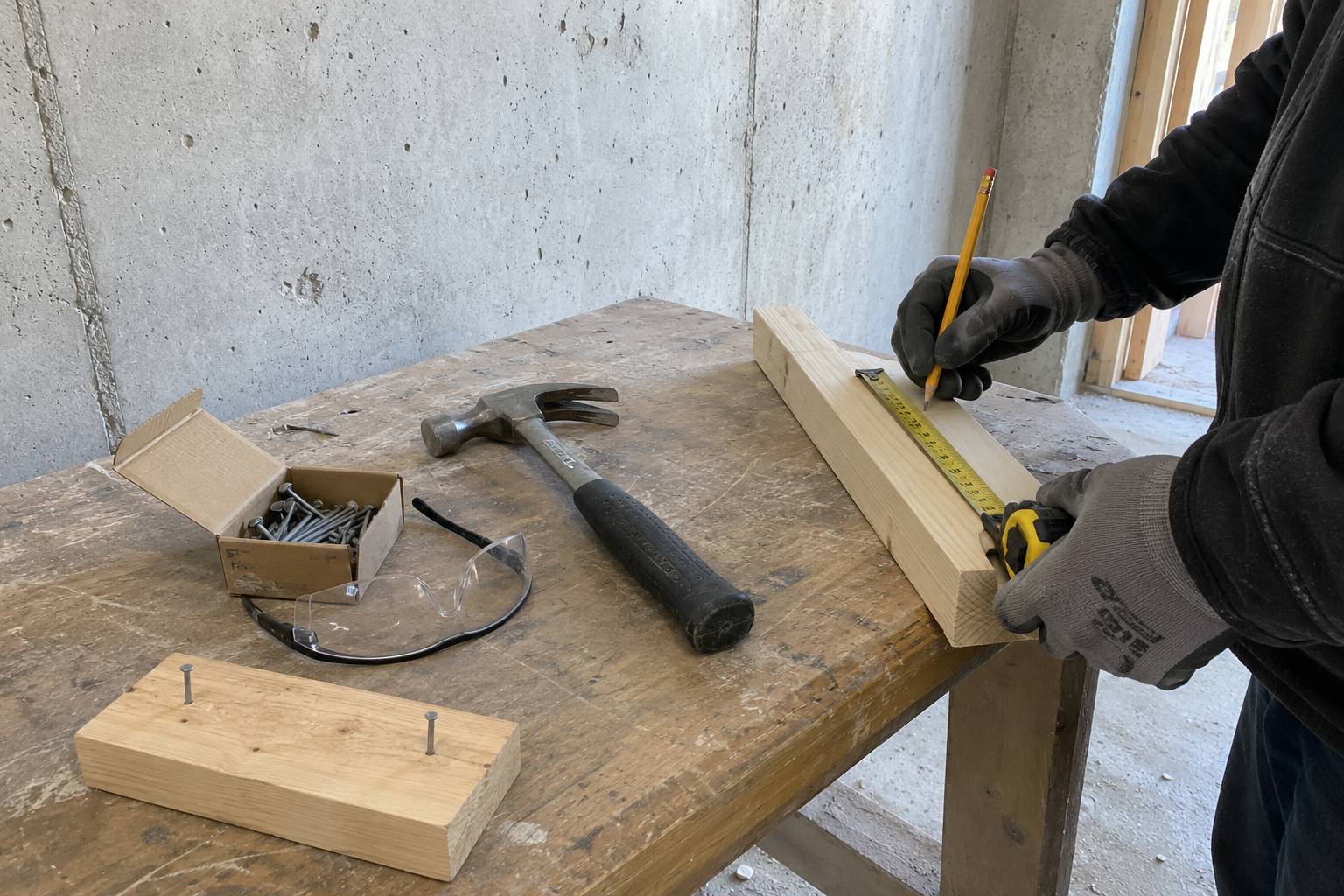
Masonry nails usually require stronger impact, careful positioning, and sometimes pre-drilling or compatible driving tools, depending on the material and job.9 Regular nails are typically installed into wood with a hammer or nail gun. The correct method reduces bending, cracking, tool damage, and wasted labor.
Installation is part of product selection
When advising on projects, I do not separate the nail from the installation method. A buyer may choose the right nail material but still face complaints if workers use it incorrectly. This is especially important for distributors who sell to different contractors across different markets.
Regular nails usually enter wood because the wood fibers allow penetration and grip. If a regular nail bends, the worker may remove it and try another one. The cost is annoying, but the material may not fail dramatically.
With masonry materials, the situation is different. Concrete, brick, and block resist penetration. If the nail is not suitable, several problems can happen:
- The nail bends before reaching the required depth.
- The point breaks or deforms.
- The masonry surface chips.
- The fastening becomes loose.
- The worker uses excessive force and damages the tool.
- The contractor loses time and confidence in the product.
Common installation variables
| Variable | Why it matters | Buyer action |
|---|---|---|
| Base material hardness | Harder material needs a suitable nail and tool | Ask the customer for substrate details |
| Nail length | Too short reduces embedment; too long increases bending risk10 | Match length to fixture and base material |
| Nail diameter | Affects penetration and holding power | Confirm required size range |
| [Edge distance | Too close to edge can crack brick or concrete | Follow project guidance](https://mavmatrix.uta.edu/civilengineering_theses/452/)[^12] |
| Tool type | Hammer, powder-actuated tool, or other system affects performance | Confirm compatible installation method |
| Worker skill | Poor alignment can bend nails | Provide usage guidance where possible |
A practical example from sales conversations
I often meet buyers who want to stock one popular nail size because it is easy to sell. That can be reasonable for wholesale inventory. However, I still ask them to divide demand by application:
- Light-duty fixing
- Temporary construction fixing
- Wood-to-concrete attachment
- Outdoor or humid use
- Packaging and carpentry use
This classification helps the buyer avoid selling regular nails into masonry jobs. It also helps avoid selling heavy concrete nails into simple woodwork where the customer only needs common nails or lost head nails.
Efficiency affects total cost
Many procurement teams compare fasteners using unit price. I understand why. Nails are high-volume products, and small price differences matter when a buyer orders by tons or full containers. However, installation efficiency often matters more than the small difference between two nail grades.
A lower-grade nail can increase cost through:
- Higher bending rate
- More rejected pieces
- Slower installation
- More worker fatigue
- More broken surfaces
- More complaints from end users
For contractors, these problems are direct labor costs. For importers and wholesalers, they become reputation costs. A product that creates field complaints can damage repeat orders, even if the first shipment looked profitable.
That is why I prefer to discuss the application before quoting. For FOB pricing, we usually need the product, specification, quantity, and packaging method. This keeps the quote practical and avoids price comparisons that ignore performance.
Are masonry nails worth the higher upfront cost?
Upfront price is important, especially in price-sensitive markets. However, I have learned that a low price can become expensive when the nail fails in use. Buyers should evaluate the total cost of ownership, not only the purchase price per box.
Masonry nails are often worth the higher upfront cost when the application involves concrete, brick, block, or other hard materials. Their value comes from fewer bent nails, better installation success, stronger holding in suitable substrates, and lower rework risk. Regular nails remain more economical for wood and soft-material applications.
Total cost is more than carton price
When customers compare nails, they often ask for the lowest FOB price first. I understand this because many markets in the Middle East, Africa, Southeast Asia, and South America are highly competitive. Still, I usually remind buyers that the cheapest item on paper may not be the cheapest item on site.
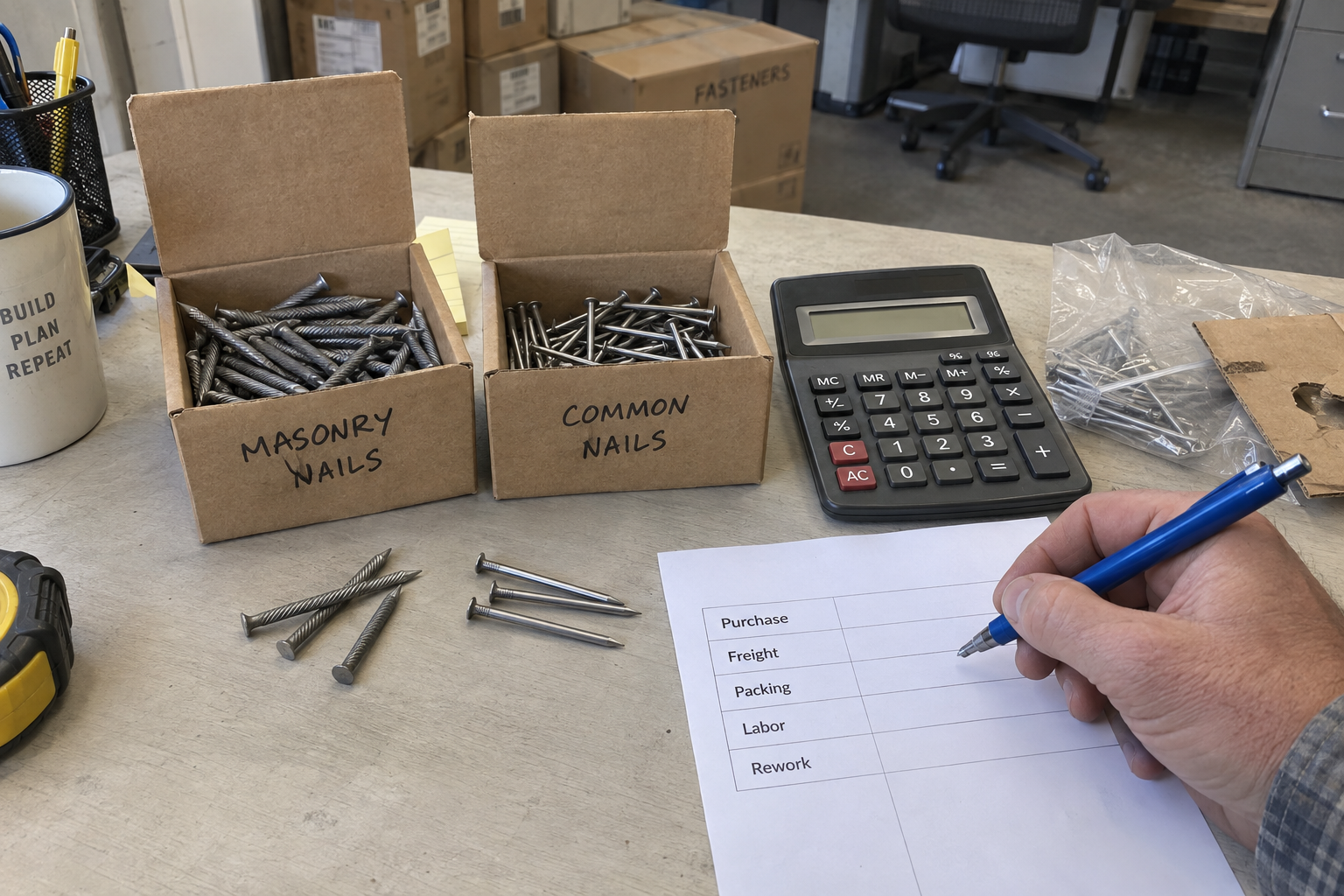
A simple cost evaluation should include:
- Purchase price
- Shipping cost
- Packaging quality
- Damage during transport
- Installation speed
- Bending or breakage rate
- Customer complaints
- Rework cost
- Safety-related risk
- Repeat order potential
Example: why small failures become expensive
Imagine a contractor uses regular nails for fastening wood strips to a concrete wall because the regular nail is cheaper. During installation, many nails bend. Workers spend extra time removing failed nails. Some points damage the wall surface. The contractor buys additional fasteners locally to finish the job. The original savings disappear.
For an importer, the problem continues. If the end users complain, the importer may need to discount remaining stock or replace part of the order. In severe cases, customers stop trusting the brand.
This is why I recommend choosing the product for the use case first, then optimizing the price through quantity, packaging, and shipping method.
Procurement comparison table
| Buying decision | Short-term result | Long-term result |
|---|---|---|
| Choose regular nails for wood | Low cost and suitable performance | Good value when used correctly |
| Choose regular nails for masonry | Lower initial price | High risk of bending, failure, and complaints |
| Choose masonry nails for masonry | Higher initial price | Better fit, lower rework risk |
| Over-specify masonry nails for simple wood use | Unnecessary cost | Poor inventory efficiency |
| Test samples before order | Slower first purchase | Better confidence and fewer disputes |
How I suggest balancing cost and quality
I usually suggest a simple step-by-step approach:
- Define the main application.
- Choose the correct nail category.
- Confirm size, finish, and packaging.
- Request samples for quality checking.
- Test in the target material when possible.
- Place a trial order before large-volume purchasing.
- Adjust specifications based on feedback.
At Dingzhou Best, we support trial orders and OEM/ODM customization. Our common MOQ is 5 tons or 200 boxes, and delivery is usually 15–25 days, depending on order quantity. We ship by sea and support both FCL and LCL.
I mention these details because real procurement decisions involve more than technical selection. Buyers also need a supply plan that fits cash flow, warehouse capacity, local demand, and brand strategy.
How can importers and wholesalers choose the right nail supplier?
Supplier choice can be as important as nail choice. A buyer may select the correct product category, but inconsistent production, unclear packaging, or poor communication can still create problems. I believe a reliable supplier should help buyers reduce uncertainty before shipment.
Importers and wholesalers should choose a nail supplier by checking product range, manufacturing consistency, sample support, packaging options, export experience, lead time, and clear quotation terms. A good supplier explains application differences, supports quality checks, and provides specifications that match the buyer’s market.
What I look for in supplier evaluation
From our experience guiding customers, professional buyers usually care about three things: stable quality, predictable delivery, and sellable packaging. The nail itself matters, but the buying process also matters.
A practical supplier checklist includes:
- Factory background: Is the supplier a manufacturer or trader?
- Product focus: Does the supplier understand concrete nails, black steel nails, roofing nails, and other nail types?
- Sample policy: Can the buyer check samples before placing an order?
- Customization: Can the supplier support OEM/ODM, logo, brand, and packaging?
- Quotation clarity: Is the FOB price based on product, size, quantity, and packaging?
- Lead time: Can the supplier meet the buyer’s sales season?
- Shipping support: Can the supplier handle FCL and LCL sea shipment?
- Market experience: Does the supplier understand price-sensitive construction markets?
Documents and quality checks buyers should request
I recommend buyers verify documents instead of relying only on claims. Depending on the market and buyer requirement, the documents may include:
- Commercial invoice and packing list
- Product specification sheet
- Inspection report if available
- Factory photos or production details
- Packaging artwork confirmation
- Sample approval record
- Shipping documents
Certifications and test documents should be treated as buyer-verifiable records. I do not suggest accepting any certificate blindly. Buyers should check whether the document is relevant to the exact product, batch, and market requirement.
Why packaging matters in nail purchasing
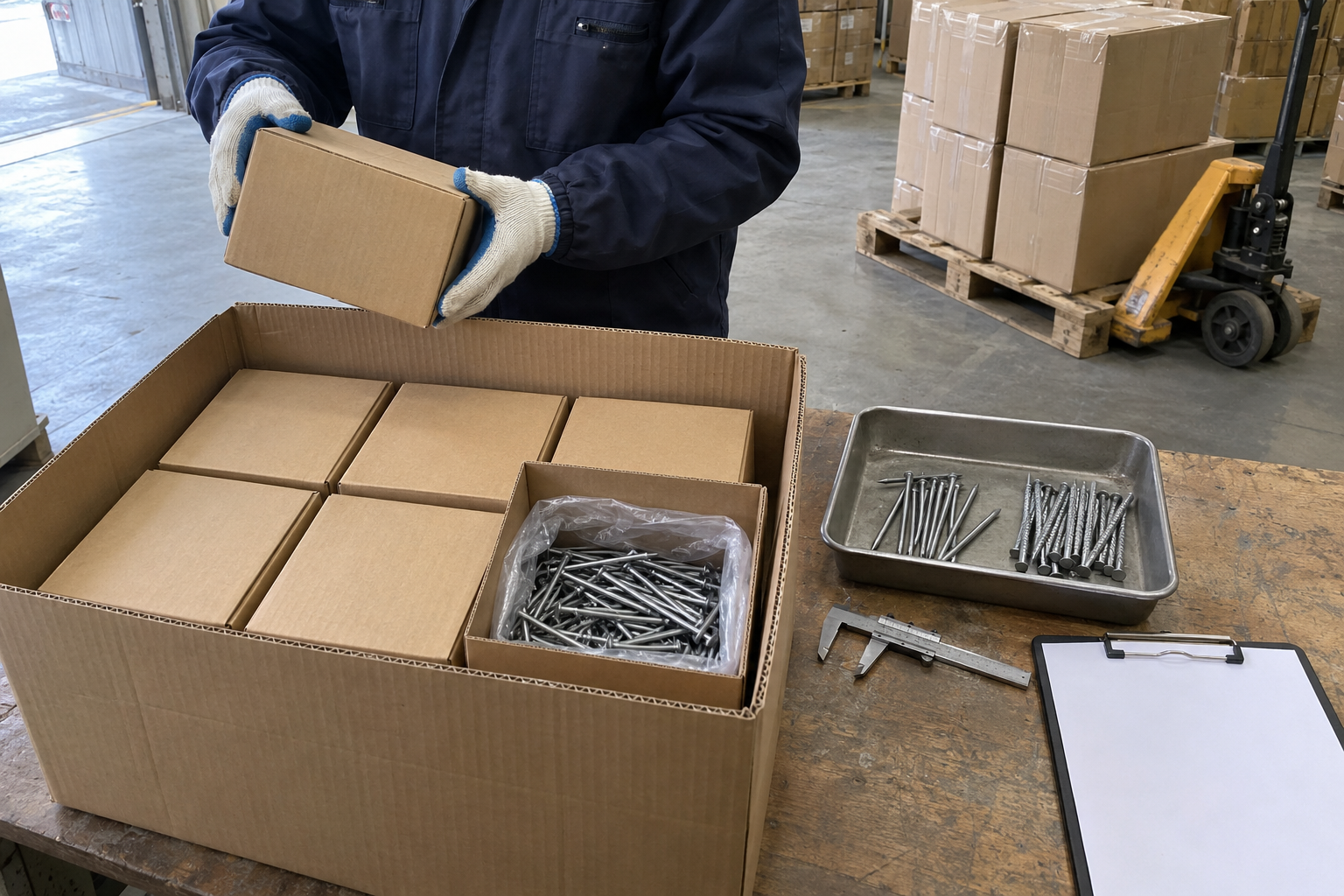
For many nail products, packaging can affect both product protection and sales performance. A strong carton reduces damage during sea transport. Clear labels help warehouse teams and retail customers identify the specification quickly. Good branding helps importers build repeat sales.
Common packaging decisions include:
- Carton weight
- Inner box quantity
- Bag or box style
- Brand logo design
- Language on label
- Barcode or item code
- Pallet or non-pallet loading
At Dingzhou Best, we support customized product, packaging, and brand logo options. This matters for wholesalers who sell under their own brand and need consistent shelf presentation.
Matching supplier capability to market demand
Our main sales regions include the Middle East, Africa, Southeast Asia, and South America. These markets often require a strong balance between price and practical performance. Buyers may not need premium specifications for every project, but they still need nails that match local construction habits and customer expectations.
I suggest importers segment their nail inventory like this:
| Market need | Suggested product direction |
|---|---|
| General carpentry | Common nails, lost head nails |
| Concrete and block fixing | Concrete nails or masonry fastening products |
| Roofing market | Roofing nails with suitable head and finish |
| Budget-sensitive wholesale | Standard sizes with economical packaging |
| Brand development | OEM packaging and consistent specification |
| Contractor supply | Sample-tested sizes for local applications |
This approach helps buyers avoid overstocking one product while missing another important demand category. It also makes supplier communication easier because each product has a clear target use.
Frequently Asked Questions
Can I use regular nails instead of masonry nails?
I do not recommend using regular nails in concrete, brick, or block unless a qualified professional confirms the application. Regular nails are usually designed for wood and may bend, loosen, or fail in masonry. The wrong nail can increase labor cost and safety risk.
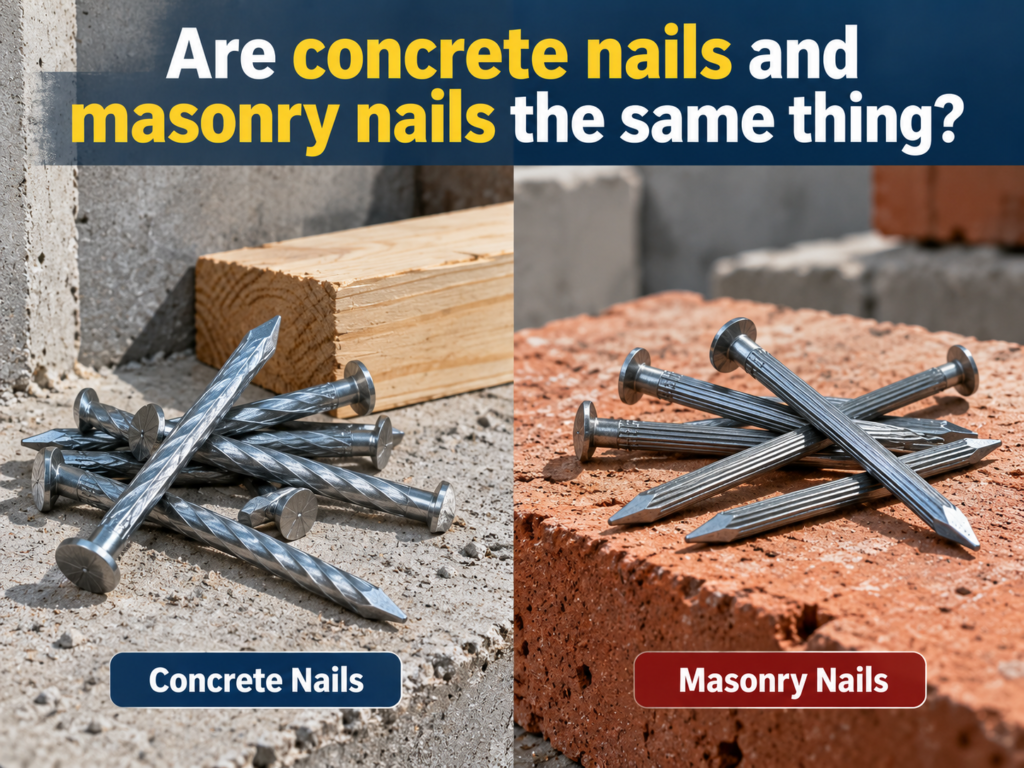
Are concrete nails the same as masonry nails?
Concrete nails are commonly treated as a type of masonry nail. They are designed for hard materials such as concrete, brick, and block. However, specifications can vary by steel type, shank design, finish, and size, so buyers should confirm the exact product before ordering.
What nail is best for attaching wood to concrete?
A suitable masonry nail or concrete nail is often used for light wood-to-concrete fastening, but the best choice depends on load, concrete condition, moisture exposure, and installation method. For structural or safety-critical work, I suggest asking a qualified project professional to confirm the fastener.
Why do masonry nails bend during installation?
Masonry nails can bend if the material is too hard, the nail is low quality, the size is wrong, the tool is unsuitable, or the installer strikes at an angle. Buyers should check samples in the target material before placing large orders.
How should I request a quotation for nails?
I suggest sending the product name, diameter, length, quantity, surface finish, packaging method, and destination port. For FOB quotations, these details help us calculate pricing more accurately. If you need OEM packaging or a trial order, you should mention that early.
Conclusion
Masonry nails and regular nails serve different purposes, and the best choice depends on material compatibility, holding power, installation method, environment, and total project cost. I advise buyers not to select nails by price alone because the wrong fastener can create rework, complaints, and safety risk. If you need concrete nails, black steel nails, roofing nails, or OEM nail packaging for your market, contact Dingzhou Best at [email protected] or WhatsApp +8618331061136 for samples, specifications, and FOB quotation support.
-
"[PDF] Threaded-nail Fasteners – Research and Standardization Needs", https://digitalcommons.georgefox.edu/cgi/viewcontent.cgi?referer=&httpsredir=1&article=1039&context=mece_fac. A neutral reference on nail fasteners defines concrete or masonry nails as hardened steel fasteners intended for masonry substrates and describes common nails as general-purpose nails used primarily in wood framing and carpentry. Evidence role: definition; source type: encyclopedia. Supports: The source should define masonry or concrete nails as hardened fasteners for concrete or masonry and distinguish common nails as fasteners typically used in wood.. Scope note: This supports the product-category distinction but does not verify the performance of any particular nail batch or supplier. ↩
-
"Withdrawal strength of ring-shank nails embedded in southern …", https://research.fs.usda.gov/treesearch/25675. Wood-engineering literature describes nail withdrawal resistance as depending on frictional and mechanical interaction between the shank and surrounding wood fibers, a mechanism that is not directly transferable to concrete or masonry. Evidence role: mechanism; source type: education. Supports: The source should explain that nail holding in wood depends on interaction with wood fibers, friction, and deformation around the shank.. Scope note: The source would provide the wood-side mechanism; a separate concrete or masonry source may be needed for a full comparison. ↩
-
"Materials that fracture", https://sethna.lassp.cornell.edu/SimScience/cracks/advanced/concrete1.html. Civil-engineering materials texts commonly classify concrete and masonry as brittle or quasi-brittle materials, meaning they have limited tensile deformation before cracking. Evidence role: definition; source type: education. Supports: The source should describe concrete and masonry units as relatively brittle materials compared with ductile metals or fibrous wood.. Scope note: This is contextual materials support and does not predict cracking for a specific nail, substrate, or installation method. ↩
-
"I understand that all concrete cracks. How normal is this on 1 month old …", https://www.reddit.com/r/Concrete/comments/15ks3mx/i_understand_that_all_concrete_cracks_how_normal/. Technical guidance on fastening into concrete notes that unsuitable fasteners or excessive driving energy can produce fastener deformation and local concrete damage such as spalling or cracking. Evidence role: mechanism; source type: institution. Supports: The source should document that fasteners driven into concrete or masonry can fail by bending, spalling, chipping, or cracking when the fastener or installation method is unsuitable.. Scope note: This supports the general failure mechanism; actual outcomes depend on concrete strength, edge distance, fastener geometry, and installer technique. ↩
-
"Masonry Nails for Construction Projects", https://grip-rite.com/product/fasteners/hand-drive/nails/masonry-nails/. Technical descriptions of concrete nails identify hardened steel construction as a design feature that enables penetration into concrete or masonry and reduces bending compared with ordinary low-carbon nails. Evidence role: general_support; source type: institution. Supports: The source should state that concrete or masonry nails are made from hardened steel or otherwise designed to penetrate hard masonry substrates without bending as readily as ordinary nails.. Scope note: The support is general and does not quantify holding power for a particular product, substrate strength, or installation tool. ↩
-
"Fluted Masonry | Tempered Hardened Steel", https://grip-rite.com/product/fasteners/hand-drive/nails/masonry-nails/fluted-masonry/. Fastener-engineering literature explains that deformed, grooved, or textured shanks can increase resistance to withdrawal by improving frictional contact or mechanical interlock with the surrounding material. Evidence role: mechanism; source type: research. Supports: The source should explain that textured or deformed fastener shanks can increase mechanical interlock or friction with the surrounding substrate.. Scope note: This provides a mechanism for improved grip but may not test the exact fluted masonry nails discussed in the article. ↩
-
"Effects of intersection angle on the nail-holding performances of …", https://bioresources.cnr.ncsu.edu/resources/effects-of-intersection-angle-on-the-nail-holding-performances-of-pinus-massoniana-and-cunninghamia-lanceolata-dimension-lumber/. The USDA Wood Handbook and related wood-engineering guidance describe nail withdrawal resistance as a function of wood density, shank geometry, and the interaction between the shank and compressed wood fibers. Evidence role: mechanism; source type: government. Supports: The source should explain the mechanics of nail withdrawal resistance in wood, including the role of wood density, fibers, friction, and shank characteristics.. Scope note: This directly supports the wood-fastening mechanism but does not itself evaluate nails driven into masonry. ↩
-
"Why are spacing, edge distance, and embedment …", https://www.engineeringexpress.com/wiki/spacing-edge-distance-embedment-important-concrete-anchors/. Anchor-design guidance treats base-material strength, cracking, embedment, and edge distance as variables that can govern concrete or masonry fastener capacity and failure mode. Evidence role: mechanism; source type: institution. Supports: The source should show that concrete or masonry fastener capacity depends on substrate strength, cracking, hollow sections, and edge distance.. Scope note: Most anchor-design sources address engineered anchors more directly than small masonry nails, so the support is contextual rather than product-specific. ↩
-
"1915.135 – Powder actuated fastening tools.", http://www.osha.gov/laws-regs/regulations/standardnumber/1915/1915.135. Government safety guidance for powder-actuated and impact fastening tools emphasizes that fasteners used in concrete or masonry require appropriate tool selection, operator control, and substrate evaluation. Evidence role: general_support; source type: government. Supports: The source should document that fastening into concrete or masonry requires appropriate tools, controlled driving methods, and safety precautions.. Scope note: This supports the need for compatible installation methods but may focus on power-actuated tools rather than hand-driven masonry nails. ↩
-
"Withdrawal strength of ring-shank nails embedded in southern …", https://research.fs.usda.gov/treesearch/25675. Fastener mechanics literature identifies embedment depth as a contributor to withdrawal or pull-out resistance and recognizes slenderness and installation loading as factors affecting fastener bending. Evidence role: mechanism; source type: research. Supports: The source should explain that embedment depth affects holding capacity and that longer slender fasteners are more prone to bending under driving loads if conditions are unsuitable.. Scope note: The source would support the general engineering relationship rather than provide a universal length rule for every masonry nail application. ↩