Concrete nails are a small product with a big procurement risk. If a buyer treats them as ordinary steel nails, the shipment may arrive too soft, too brittle, or simply unsuitable for the jobsite. I usually explain the answer this way: the material matters, but the heat treatment and finish matter too.
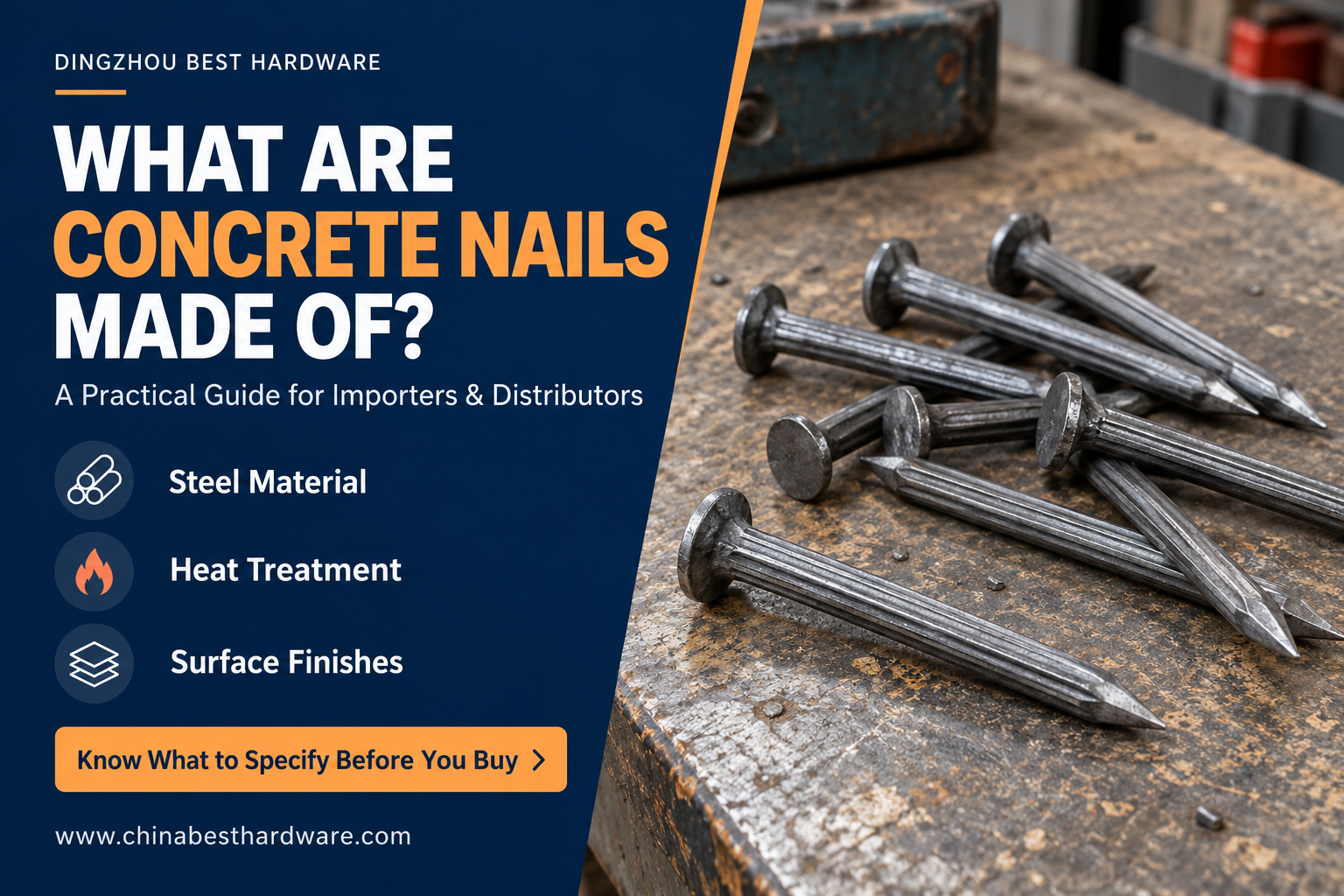
Concrete nails are usually made from high-carbon steel wire, then hardened through heat treatment so they can penetrate harder materials better than ordinary common nails. The full answer includes base steel, hardening process, nail body design, point shape, and surface treatment. Color or coating does not define the core material quality.
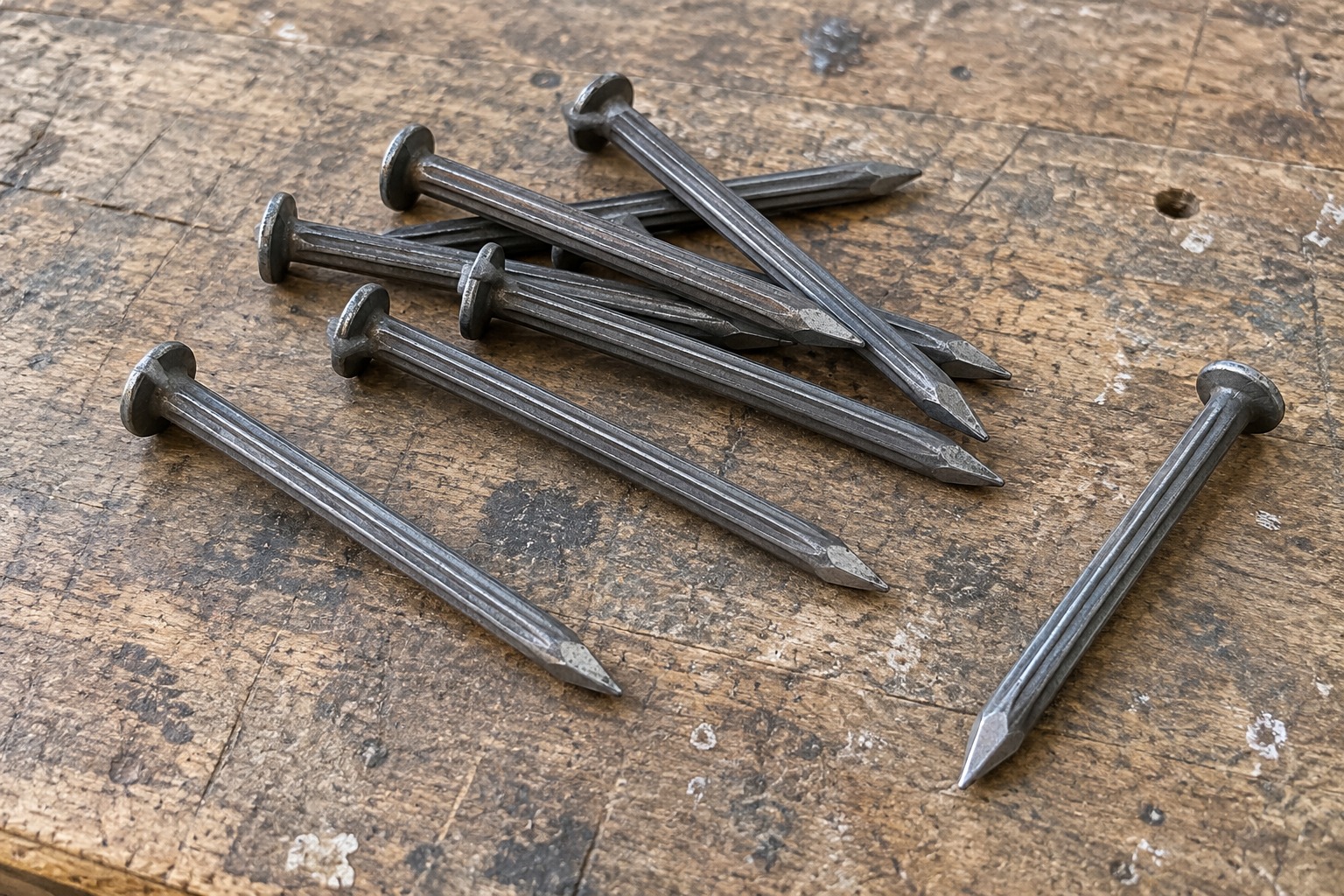
That simple answer helps, but it is not enough for importers, wholesalers, and building-material distributors. In real purchasing conversations, I find that performance depends on how the nail is specified, produced, packed, and matched to the intended use.
What are concrete nails usually made of?
When buyers ask what concrete nails are made of, they often want a quick material name. That is understandable. However, a short answer can hide the real risk. If the base material is wrong or the processing is weak, the nail may bend, snap, or perform inconsistently in the field.
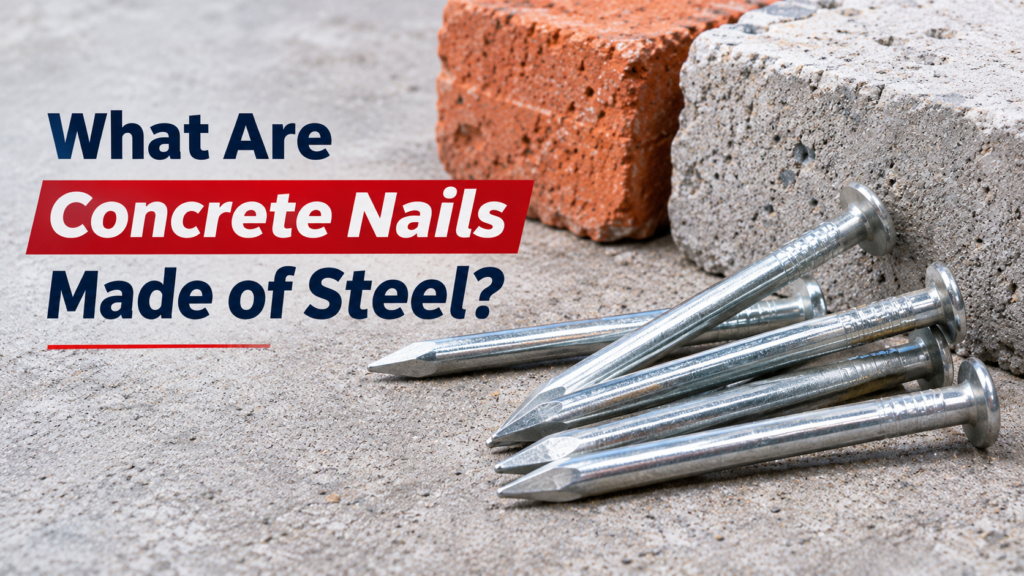
Concrete nails are usually made from high-carbon steel wire and then hardened or heat-treated to improve penetration performance.1 They are not just common nails with a different label. The material and processing are selected to give the nail more hardness than ordinary nails used mainly for wood.2
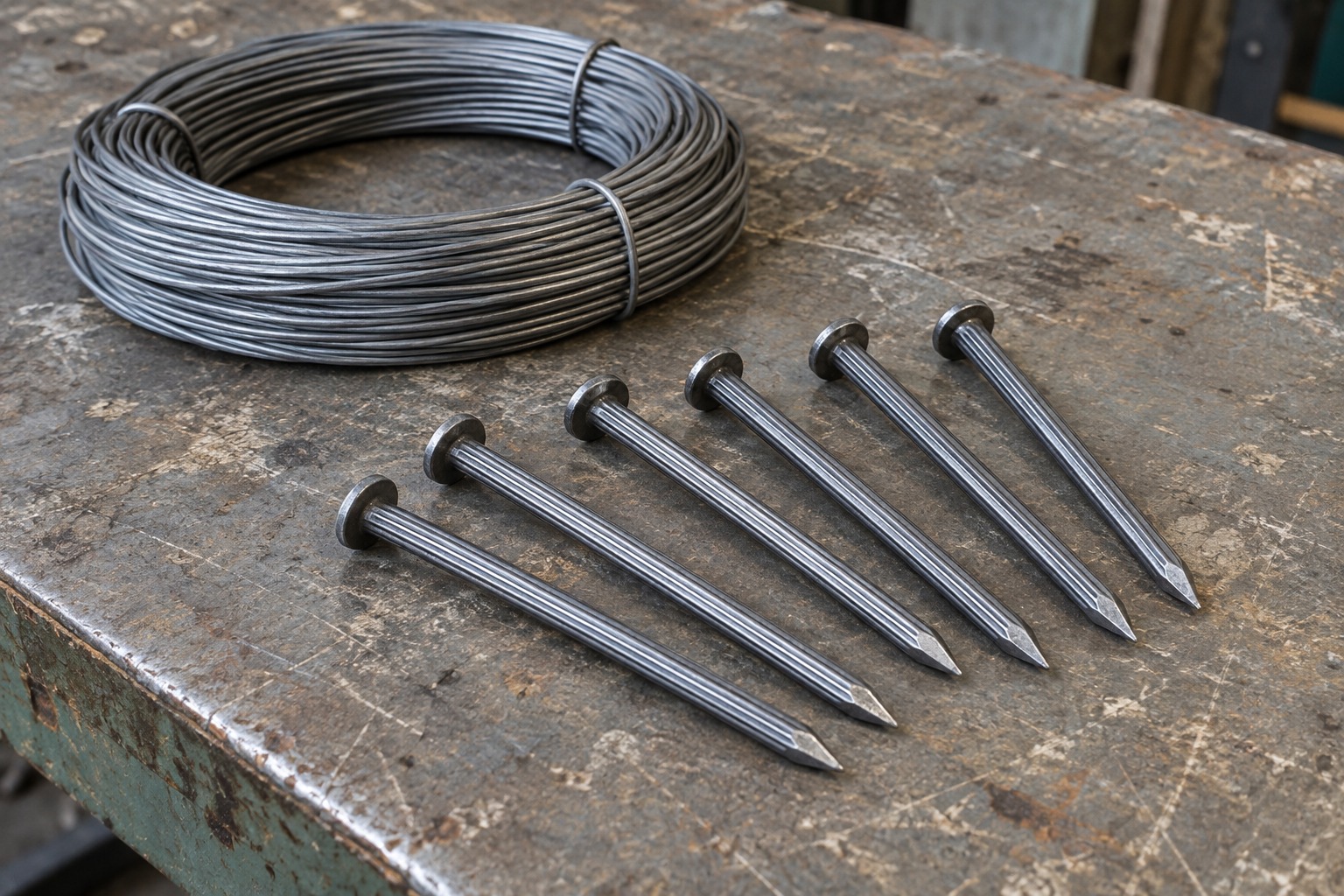
In my manufacturing and supplier discussions, I try to separate the answer into two parts: what the nail starts as and what the factory does to it. The starting point is steel wire. For concrete applications, suppliers usually use higher-carbon steel than the material used for softer, general-purpose nails.3 This gives the nail the potential to become harder after heat treatment.4
However, I do not like to describe concrete nails only by saying “they are made of steel.” That is technically true, but it is not useful enough for procurement. Many nails are steel. Roofing nails, common nails, lost head nails, black steel nails, and concrete nails can all be steel products, but they do not perform the same way.
The base material is only the starting point
The base steel affects:
- Hardness potential
- Resistance to bending
- Risk of brittle fracture
- Consistency across batches
- Suitability for heat treatment
A nail made from unsuitable wire may not become a reliable concrete nail even if it looks correct. I have seen buyers focus on nail color, carton design, or price per ton first. Those details matter in business, but they cannot replace material and process confirmation.
Concrete nail material versus finished nail performance
A better way to think about the product is:
| Procurement Question | Why It Matters |
|---|---|
| What steel wire is used? | The base material affects hardening potential. |
| Is the nail heat-treated? | Heat treatment improves penetration ability.5 |
| Is the nail too brittle? | Over-hard nails may break during use. |
| Is the nail too soft? | Under-hardened nails may bend easily. |
| What finish is applied? | Finish affects appearance and corrosion resistance, not the core steel. |
Concrete nails are normally designed for harder surfaces than wood, but I avoid saying they work for every concrete strength, wall type, or jobsite condition. Actual performance depends on the substrate, installation method, nail size, and application risk.6 For critical work, buyers should ask for samples and, when needed, arrange qualified testing.
In procurement, the key issue is usually not only the steel name. The real question is whether the nail has the right balance of hardness and toughness for its intended use.
How are concrete nails different from common nails?
Many new buyers compare concrete nails with common nails by looking at the shape only. That creates confusion. If the nail looks strong, they assume it will perform well. In practice, the difference is deeper than appearance, and wrong substitution can cause complaints after delivery.
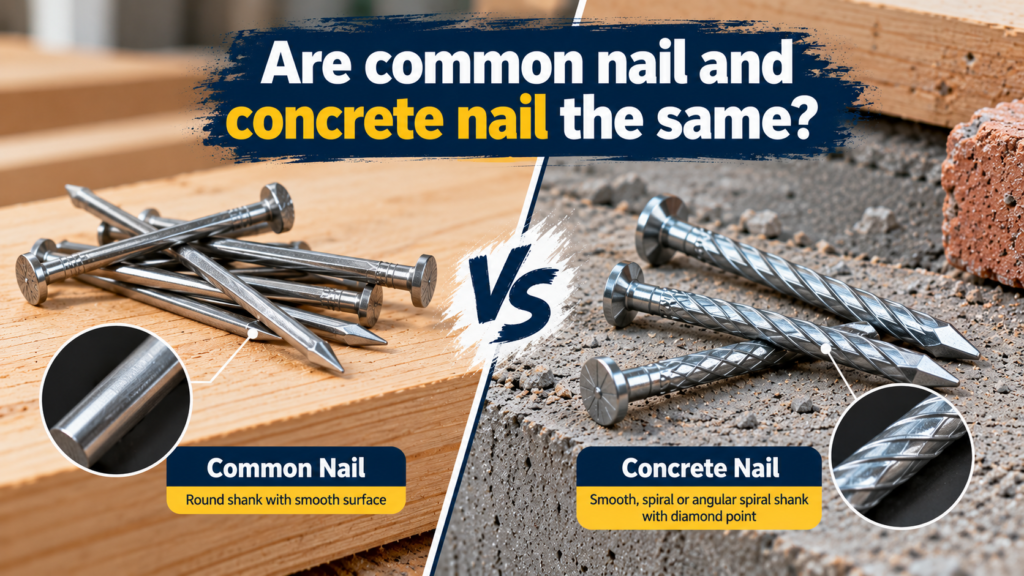
Concrete nails are different from common nails because they are made and processed for harder materials. Common nails are generally used for softer materials such as wood.7 Concrete nails usually require harder steel, heat treatment, and a design that helps penetration without excessive bending or breaking.
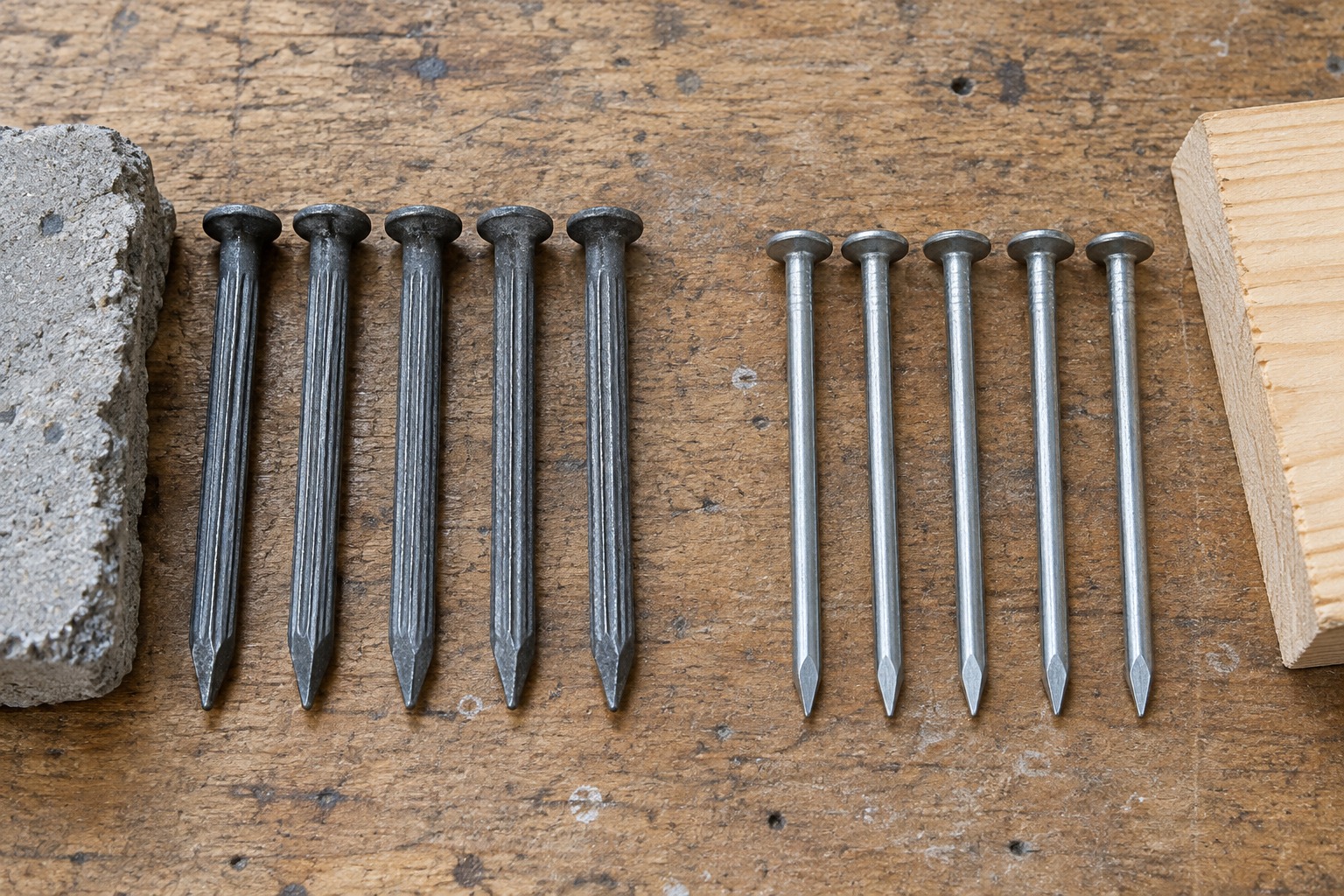
I often explain this difference to importers who buy several types of nails in the same container. A common nail can be a good product when it is used for the right job. It is not a lower-value product by default. It is simply designed for a different use. The problem appears when a buyer expects a common nail to behave like a hardened nail for harder substrates.
The main difference is not only the head or shank
Concrete nails may have different body patterns, points, or finishes depending on the market. Some are fluted. Some are smooth. Some are black. Some are bright or galvanized. However, those visible features do not tell the whole story.
The bigger differences usually include:
-
Steel selection
Concrete nails usually need steel with better hardening potential. -
Heat treatment
The nail is processed so it becomes harder than ordinary soft nails. -
Hardness and toughness balance
The nail should resist bending but should not become dangerously brittle. -
Point design
The point must support penetration into harder surfaces.8 -
Application match
The nail must match the intended material, not just the buyer’s requested size.
Practical comparison for buyers
| Feature | Concrete Nails | Common Nails |
|---|---|---|
| Typical use | Harder masonry-related fixing tasks | Wood and softer materials |
| Usual material direction | High-carbon steel | Lower-carbon or general steel, depending on type |
| Heat treatment | Usually hardened | Usually not hardened in the same way |
| Main risk if wrong | Breaking, bending, poor penetration | Bending or weak holding in wrong applications |
| Buying focus | Material, heat treatment, finish, packaging, use case | Size, shank, head, finish, packaging |
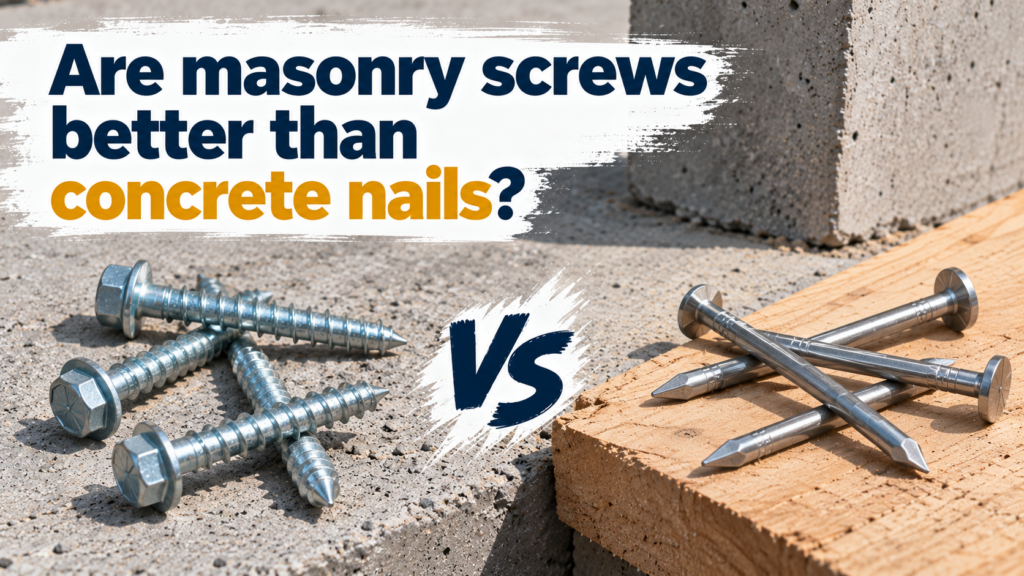
I also remind buyers that “concrete nail” is a product category, not a guarantee for every jobsite. A wall may be too hard, too brittle, too old, too thin, or unsuitable for direct nailing. Some applications may need anchors, screws, or other fasteners instead. A distributor should avoid overpromising performance without understanding the customer’s use.
Why this matters in bulk purchasing
For one small box, a buyer may tolerate some uncertainty. For a 5-ton shipment, uncertainty becomes expensive. A wrong specification can lead to:
- Customer complaints in local markets
- Slow sales because the nail bends too easily
- Returns from contractors
- Price disputes with suppliers
- Damage to the importer’s brand reputation
That is why I suggest buyers describe the intended use clearly before comparing prices. If two suppliers quote the same size but use different processing standards, the cheaper offer may not be the better offer.
Why do heat treatment and hardness matter for concrete nails?
A buyer may think that stronger always means harder. That sounds logical, but it can be misleading. If concrete nails are too soft, they bend. If they are too hard and brittle, they may snap.9 Both problems can hurt your market reputation.
Heat treatment matters because it changes the performance of concrete nails after forming. The process helps the nail gain hardness for penetration, but the result must still keep enough toughness.10 A good nail needs a balanced structure, not maximum hardness at any cost.
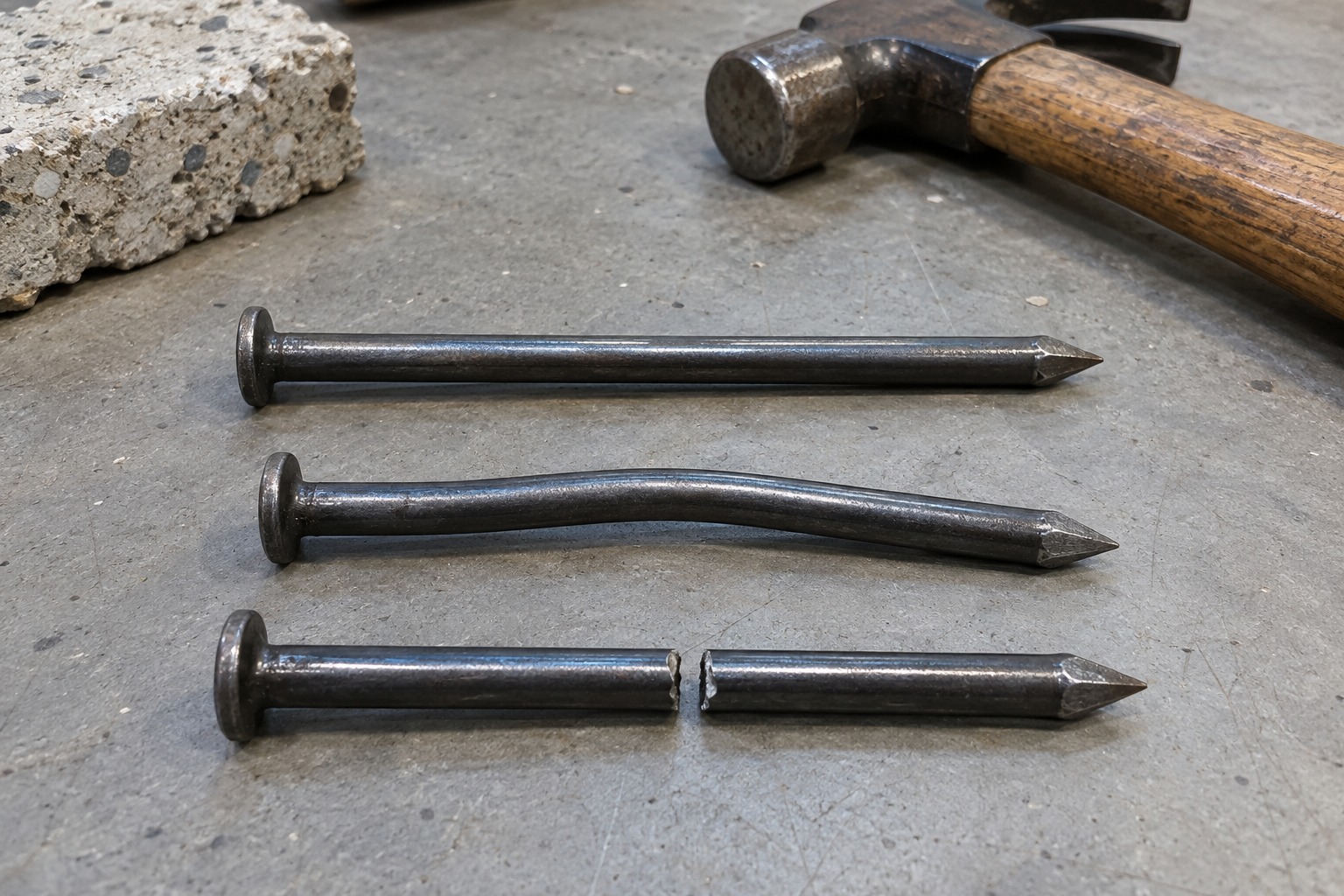
In production discussions, I pay close attention to the balance between hardness and toughness. I do not present myself as a laboratory testing authority, and I do not invent numbers without a buyer’s specification. Still, from a manufacturing and quality-control viewpoint, the principle is clear: performance depends on controlled processing, not only raw material.
What heat treatment tries to achieve
Heat treatment is used to improve the nail’s ability to enter harder material. The process can include heating and controlled cooling steps, depending on the factory method and product type. The goal is to improve hardness while maintaining enough toughness for practical use.
A poor process can create two common defects:
- Too soft: The nail bends before it enters the material.
- Too brittle: The nail breaks suddenly during hammering.
Both defects can appear even when the nail looks acceptable in the carton. This is why sample checking is important before bulk orders.
How buyers can evaluate practical performance
Importers and distributors do not always have advanced testing equipment. That is normal. I suggest a layered approach:
-
Start with supplier communication
Ask whether the nail is hardened and made for concrete-related use. -
Check samples before mass order
Test the nail in realistic local conditions when possible. -
Compare nails from the same size category
Do not compare a thin nail with a heavier nail and blame only material. -
Watch for bending and breaking
Both failure types tell you something about hardness balance. -
Use qualified testing for critical applications
If safety or structural performance is important, ask qualified professionals to evaluate the correct fastener.
Common procurement warning signs
| Warning Sign | Possible Meaning | Buyer Action |
|---|---|---|
| Very low price compared with market | Material or processing may be reduced | Ask for samples and details |
| Supplier cannot explain nail type | Product may be misclassified | Confirm application and specification |
| Focus only on color | Finish may be confused with material | Ask about steel and hardening |
| High breakage in testing | Nail may be too brittle | Review heat treatment and size |
| Frequent bending | Nail may be too soft or wrong for surface | Review material, hardening, and use |
I also recommend that buyers avoid vague requests like “quote concrete nail best price.” That request is too open. A factory can only quote accurately when it knows the nail size, quantity, surface treatment, packaging, and destination terms. For my own quote process, I usually need product + specification + quantity + packing method before giving a serious FOB price.
Hardness is not the only performance factor
Even a well-hardened nail can fail in the wrong situation. The surface may be too hard. The nail may be too thin. The hammering angle may be poor. The user may need a different fastening system. That is why I treat the material question as part of a bigger evaluation.
For distributors, this is useful because it reduces disputes. If you understand the role of heat treatment, you can explain the product better to your customers and avoid selling it as a universal solution.
Do black, galvanized, or polished finishes change what concrete nails are made of?
Many buyers judge concrete nails by color first. I understand why. Finish is easy to see in photos and samples. However, this habit can create mistakes. A black nail is not automatically stronger, and a galvanized nail is not automatically better for every use.
Black, galvanized, polished, or other finishes do not change the core material of concrete nails. They are surface treatments applied after or during production for appearance, corrosion resistance, handling, or market preference. Buyers should evaluate the steel and heat treatment separately from the finish.
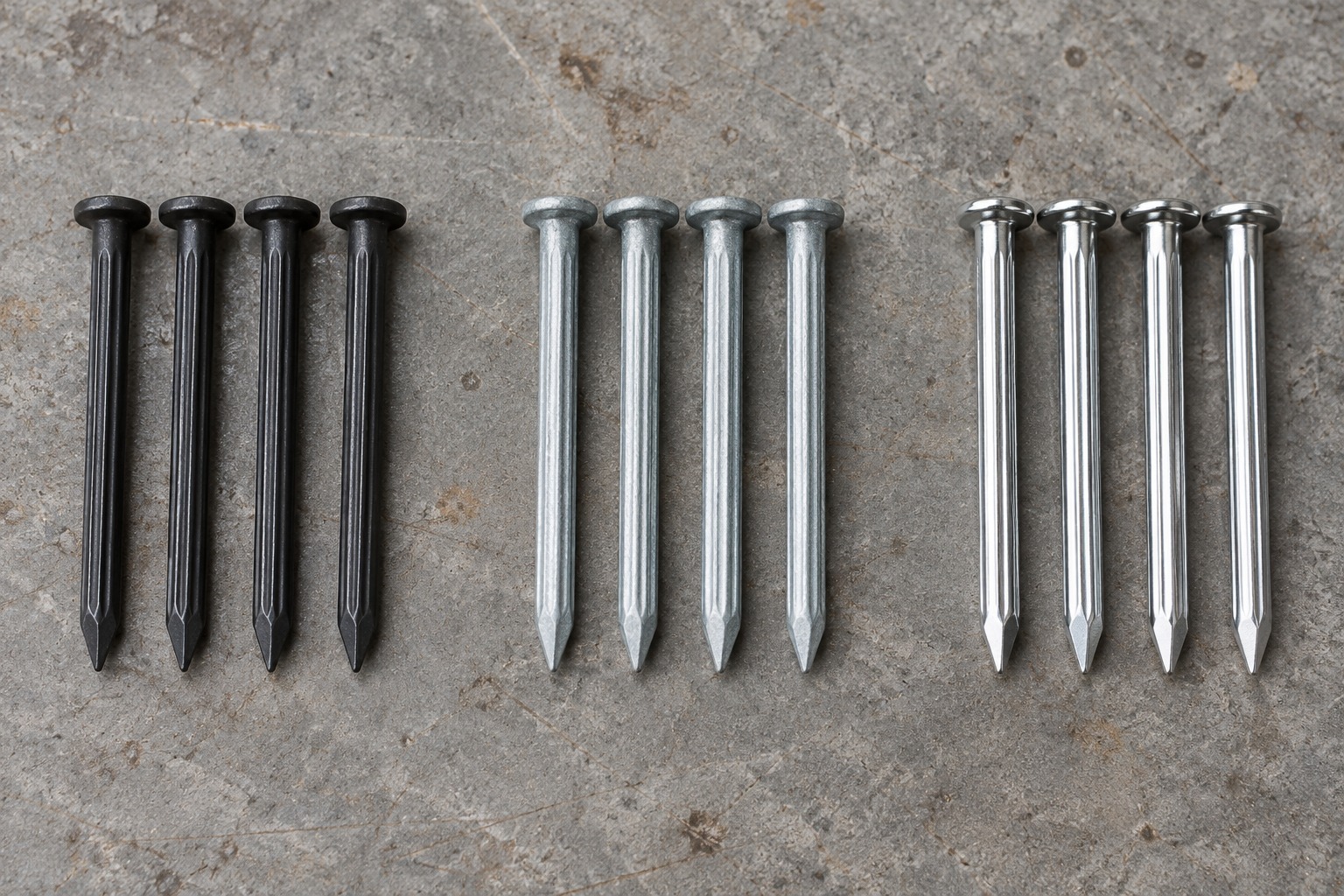
I have seen buyers use terms like “black material” or “galvanized material” when they really mean surface finish. This creates confusion in quotations. If a supplier thinks the buyer only cares about appearance, the offer may not cover the real performance requirement.
Finish is not the same as base steel
A surface treatment can affect the nail’s outside layer. It does not automatically tell you what steel wire was used inside. For example:
- Black finish may be chosen for market preference or appearance.
- Polished finish may give a cleaner bright surface.
- Galvanized finish may improve corrosion resistance compared with plain finishes.11
- Other coatings may be requested for specific distribution markets.
These finishes matter, especially for storage, shelf life, and customer expectations. However, they should not replace material evaluation.
How surface treatment affects procurement
Surface finish can influence:
| Finish Factor | Procurement Impact |
|---|---|
| Appearance | Affects customer acceptance in retail or wholesale markets |
| Corrosion resistance | Important for humid storage or outdoor-related exposure |
| Cost | Galvanizing or special coatings may increase price |
| Packaging needs | Some finishes need better moisture control |
| Market preference | Different regions prefer different appearances |
For buyers in the Middle East, Africa, Southeast Asia, and South America, finish choice often depends on climate, warehouse conditions, customer habits, and price level. In humid markets, corrosion resistance may matter more. In price-sensitive wholesale markets, buyers may prefer a simpler finish if the application allows it.
What buyers should ask instead of “which color is best?”
A better question is:
“What finish is suitable for my market, storage conditions, and customer use?”
Then the buyer should add:
- What material is the nail made from?
- Is it heat-treated?
- What size and shank type do I need?
- What carton or box packing is required?
- Will the product be stored in humid conditions?
- Is the nail for indoor, temporary, or more exposed use?
I do not recommend choosing finish based only on photos. Lighting can change the appearance. Different factories may use slightly different process names. A sample is better than a picture, and a sample tested in local conditions is better than a sample kept on a desk.
Coating quality should be checked separately
If the finish is important, buyers should inspect coating consistency, rust resistance expectations, and packaging protection. However, I keep this separate from the core performance discussion. A well-coated nail that is too soft is still a poor concrete nail. A very hard nail with a poor finish may also create market complaints if it rusts quickly in storage.
This is why I encourage buyers to create a specification sheet. Even a simple one-page document can reduce misunderstanding between buyer and factory.
How should buyers specify concrete nails before comparing prices?
Price comparison can become misleading when the specifications are incomplete. One supplier may quote a hardened nail with stronger packaging, while another may quote a weaker product with lighter packing. The two prices may look comparable, but the products are not the same.
Buyers should specify concrete nails by type, size, quantity, packaging, surface treatment, intended use, and shipping terms before comparing prices. They should also request samples for quality checking, especially before bulk orders. Clear specifications reduce the risk of soft, brittle, or wrongly supplied nails.
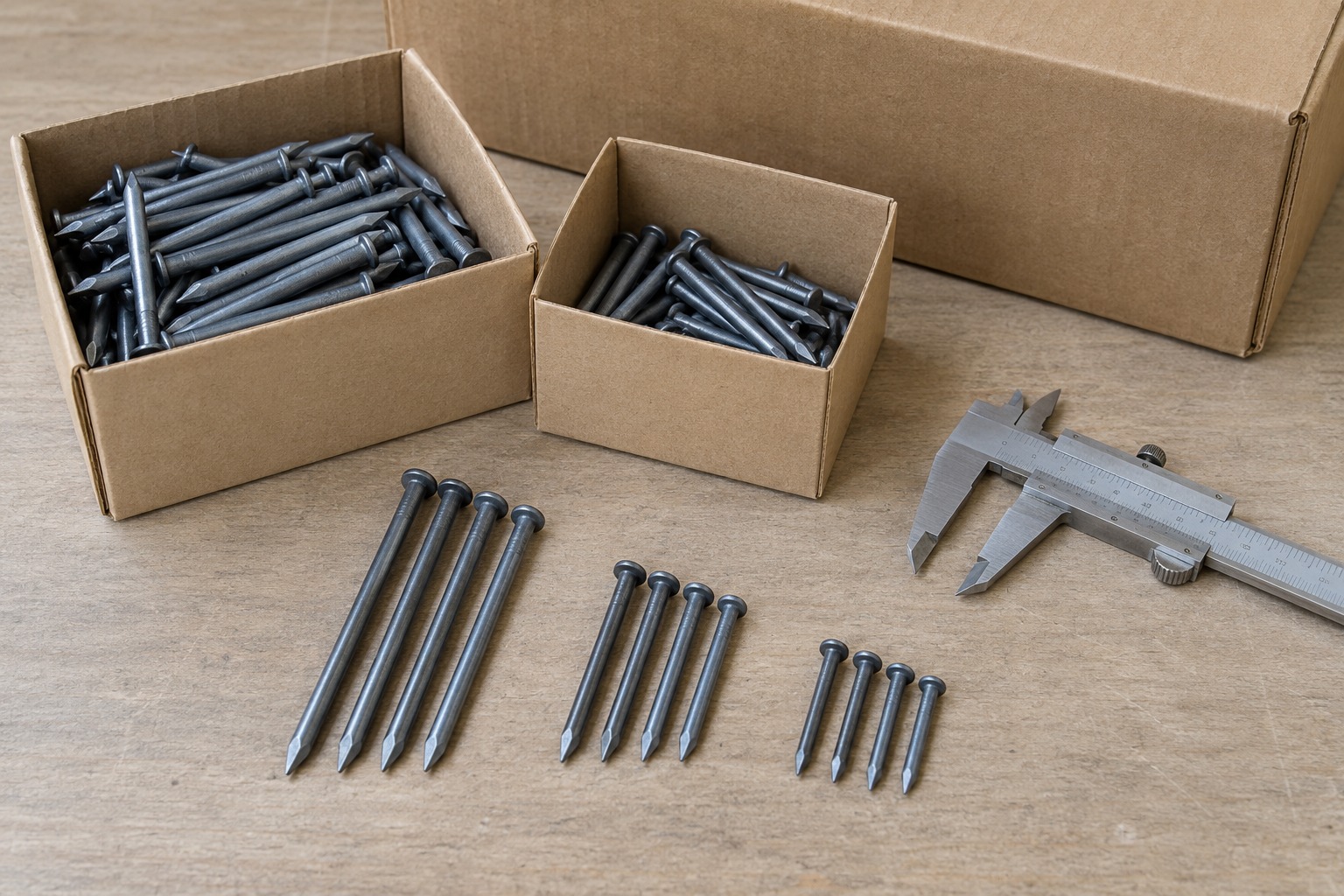
In my buyer-facing work, I prefer practical details over vague descriptions. A clear inquiry saves time for both sides. It also helps the factory quote the correct FOB price and plan production accurately.
A basic concrete nail inquiry checklist
When you request a quotation, include:
-
Product name
Example: concrete nail, black steel nail, or another nail type. -
Size specification
Include length, diameter, head type, and shank type if available. -
Quantity
For my business context, the usual minimum order is 5 tons or 200 cartons/boxes, depending on product and packing. -
Packing method
Examples include small boxes, bulk cartons, branded packaging, or customized OEM cartons. -
Surface treatment
Black, polished, galvanized, or another requested finish. -
Intended use
Describe the material and market application as clearly as possible. -
Destination and shipping need
Sea freight is common, with FCL and LCL12 options depending on volume. -
Brand or OEM/ODM needs
Include logo, carton design, label language, and market requirements.
Why size and packing affect price
Nails are often quoted by weight, carton, or shipment quantity. However, two nails with the same length can have different diameters and weights. Packaging also changes cost. A strong export carton, small inner boxes, printed branding, and pallet requirements can all change the final price.
Here is a simple example of how specifications affect comparison:
| Item | Supplier A | Supplier B | Can You Compare Directly? |
|---|---|---|---|
| Nail size | Same length, thicker wire | Same length, thinner wire | No |
| Treatment | Heat-treated | Unclear | No |
| Finish | Galvanized | Black | No |
| Packing | Small branded boxes | Bulk carton | No |
| Quantity | 10 tons | 2 tons | No |
| Price term | FOB | CIF | No |
This is why I prefer FOB quotation based on product + specification + quantity + packing method. Without those details, the price is only a rough number.
Sample policy and trial orders
For buyers entering a new market or changing suppliers, samples are useful. In my business context, samples can be provided for quality checking, and a basic sample fee may apply. In many cases, the fee can be discussed for return or adjustment in the formal order. This is normal because samples, handling, and international delivery all create cost.
Trial orders can also reduce risk. My business supports trial cooperation, and this is often helpful for distributors who want to test market response before placing larger repeat orders. Standard delivery time is usually 15–25 days, depending on order quantity and production schedule.
Supplier evaluation beyond price
A reliable supplier should help you clarify product requirements. I suggest buyers evaluate:
- Whether the supplier understands concrete nail production
- Whether the supplier asks about intended use
- Whether samples are available
- Whether OEM/ODM packing is supported
- Whether the factory can keep production consistent
- Whether the quotation clearly states finish, packing, and shipping term
- Whether communication is clear before payment
As a factory supplier, Dingzhou Best Hardware focuses on nail products such as concrete nails, black steel nails, lost head nails, and roofing nails. I mention this only after the technical discussion because I believe buyers should understand the product first. A better buyer inquiry leads to a better supplier quotation.
Frequently Asked Questions
Are concrete nails always made from high-carbon steel?
Concrete nails are usually made from high-carbon steel because the material can be hardened for better penetration. However, buyers should not rely on the name alone. They should confirm the nail type, heat treatment, size, finish, and sample performance before placing bulk orders.
Are black concrete nails stronger than galvanized concrete nails?
Black color does not automatically mean stronger. Black and galvanized finishes are surface treatments, not the core material. Strength depends more on the steel, heat treatment, nail size, and production control. Buyers should evaluate finish and mechanical performance as separate issues.
Can concrete nails be used instead of common nails?
Concrete nails can be used for harder applications where common nails may bend, but they are not a universal substitute. Common nails are generally used for wood and softer materials. Buyers should match the nail type to the actual application and request professional evaluation for critical uses.
Why do some concrete nails break during use?
Concrete nails may break if they are too brittle, used on unsuitable material, installed incorrectly, or made with poor process control. Breakage can also happen when the substrate is too hard for that nail size. Buyers should test samples in realistic conditions before bulk purchasing.
What details should I send when requesting a concrete nail quote?
You should send the nail type, size, quantity, surface treatment, packing method, intended use, destination, and any OEM/ODM requirements. For FOB pricing, I usually need the product, specification, quantity, and packaging details before giving an accurate quotation.
Conclusion
Concrete nails are usually made from high-carbon steel and hardened through heat treatment, but the real buying decision goes beyond the material name. I recommend that buyers evaluate steel, hardness balance, surface treatment, size, packing, and intended use together. This approach helps avoid nails that are too soft, too brittle, or wrongly specified. If you need samples or an FOB quotation for your market, contact Dingzhou Best Hardware at [email protected] or WhatsApp +8618331061136 with your specification, quantity, packing, and finish requirements.
-
"Carbon Grades (45#/55#/70#), Sizes and How to Drive Them", https://www.leeter.cn/resources/concrete-nails-carbon-grades-guide/. A standards-based fastener reference supports the characterization of concrete nails as hardened steel fasteners produced for masonry-related use, commonly from wire capable of heat treatment; the source would support the general material description rather than prove the composition of any specific shipment. Evidence role: general_support; source type: institution. Supports: Concrete nails are commonly described in technical or standards-based references as hardened steel fasteners, often made from higher-carbon steel wire for masonry-related applications.. Scope note: Contextual support only; actual alloy and heat treatment must be verified by supplier documentation or testing for a specific batch. ↩
-
"Soil Nail Wall – Reference Manual", https://www.fhwa.dot.gov/engineering/geotech/pubs/nhi14007.pdf. A university or technical handbook on fasteners supports the distinction between common nails for wood and hardened masonry-type nails for harder substrates; the comparison is application-level and does not establish the hardness of any individual product. Evidence role: general_support; source type: education. Supports: Different nail types are manufactured for different substrates, and masonry or concrete nails require higher hardness than common nails used in wood.. Scope note: Contextual comparison; specific hardness values depend on product standard and manufacturer. ↩
-
"Nail 1in Masonry Heat Treated Carbon Steel Flat Head 5 lb …", https://www.zoro.com/maze-nails-nail-1in-masonry-heat-treated-carbon-steel-flat-head-5-lb-heat-treated-h53s530/i/G716210479/. A neutral fastener-manufacturing or metallurgical source supports the general association between hardened masonry nails and higher-carbon steel wire, while noting that nail composition varies by standard, product class, and manufacturer. Evidence role: general_support; source type: research. Supports: Higher-carbon steel is commonly associated with hardened fasteners used for harder substrates, while many general-purpose nails are made from lower-carbon steel or mild steel.. Scope note: General industry support; not direct evidence for all products sold as concrete nails. ↩
-
"Hardenability", https://en.wikipedia.org/wiki/Hardenability. A materials-science reference from a university supports that carbon content is a key factor in the hardness achievable in steel after heat treatment; this explains the mechanism but does not specify the optimal carbon range for concrete nails. Evidence role: mechanism; source type: education. Supports: Carbon content affects the hardness and hardenability of steel after heat treatment.. Scope note: Mechanistic support; product-specific steel grade requirements require a fastener standard or material certificate. ↩
-
"2-1/2 in. x 8 D Hot Dipped Galvanized Cut Masonry Nails 5 …", https://www.homedepot.com/p/PRO-FIT-2-1-2-in-x-8-D-Hot-Dipped-Galvanized-Cut-Masonry-Nails-5-lbs-200-Count-3078155/326206397. A technical fastener reference supports that hardening by heat treatment is used to increase the ability of steel nails to penetrate harder masonry-related substrates; the source supports the mechanism generally rather than a quantified penetration improvement for this article’s product. Evidence role: mechanism; source type: institution. Supports: Heat-treated or hardened steel nails are used where penetration into masonry or concrete-like materials requires greater hardness than ordinary nails.. Scope note: Contextual mechanism; penetration performance also depends on nail geometry, substrate, and installation method. ↩
-
"Load Capacity of Screw Anchor Installed in Concrete … – PMC", https://pmc.ncbi.nlm.nih.gov/articles/PMC10934117/. An engineering reference on fastener performance supports that substrate condition, fastener dimensions, and installation practice materially affect fastening outcomes; this provides general support and does not validate any particular concrete nail for a safety-critical use. Evidence role: general_support; source type: research. Supports: Fastener performance is affected by substrate properties, fastener dimensions, installation method, and intended application.. Scope note: General support; critical applications require project-specific engineering evaluation. ↩
-
"🔩 16 TYPES OF NAILS USED IN CONSTRUCTION AND …", https://www.facebook.com/civiltechtime/posts/-16-types-of-nails-used-in-construction-and-carpentrynails-are-essential-fastene/1461022786156399/. An encyclopedic or construction-reference source defines common nails as general-purpose nails primarily used in wood construction, supporting the article’s contrast with concrete nails while not excluding other occasional uses. Evidence role: definition; source type: encyclopedia. Supports: Common nails are conventionally defined as general-purpose nails used in wood construction or similar carpentry applications.. Scope note: Definition-level support; local trade terminology may vary. ↩
-
"Penetration Force, Geometry, and Cutting Profile of the Novel …", https://pmc.ncbi.nlm.nih.gov/articles/PMC4043432/. A peer-reviewed study on nail or fastener geometry supports that point shape influences penetration or insertion forces in solid materials; the evidence is mechanistic and may come from wood or engineering-material tests rather than concrete-nail field trials. Evidence role: mechanism; source type: paper. Supports: Fastener or nail point geometry can influence insertion force and penetration behavior.. Scope note: Mechanistic support may be indirect if the study substrate is not concrete. ↩
-
"Eli5: Strong yet brittle? : r/explainlikeimfive", https://www.reddit.com/r/explainlikeimfive/comments/1d2j095/eli5_strong_yet_brittle/. An engineering-materials source supports that ductile or insufficiently hardened steel fasteners tend to deform plastically, whereas brittle hardened steel can fracture suddenly under impact; the source explains failure mechanisms rather than documenting a specific concrete-nail batch failure. Evidence role: mechanism; source type: research. Supports: Steel fasteners with insufficient strength may plastically bend, while excessively brittle fasteners may fracture under impact or load.. Scope note: Mechanistic support; actual failures depend on substrate, driving method, dimensions, and defects. ↩
-
"The Effect of Quenching and Tempering Temperatures … – PMC", https://pmc.ncbi.nlm.nih.gov/articles/PMC12986098/. A materials-science source on steel heat treatment supports that hardening processes increase hardness while toughness must be controlled, commonly through appropriate treatment such as tempering; this supports the principle rather than specifying a required nail hardness range. Evidence role: mechanism; source type: education. Supports: Heat treatment can increase steel hardness, but excessive hardness or improper treatment may reduce toughness and increase brittleness.. Scope note: Mechanistic support; acceptable hardness-toughness balance depends on the nail design and intended substrate. ↩
-
"The Effect of Zinc Bath Formulation on the Corrosion Resistance of … – PMC", https://pmc.ncbi.nlm.nih.gov/articles/PMC11923840/. A government or university corrosion reference supports that zinc coatings protect steel from corrosion by barrier and sacrificial action, supporting the statement that galvanized nails may resist corrosion better than plain steel under comparable exposure. Evidence role: mechanism; source type: government. Supports: Zinc galvanizing protects steel from corrosion through barrier and sacrificial mechanisms, often improving corrosion resistance compared with uncoated steel.. Scope note: Corrosion performance varies with coating thickness, environment, storage conditions, and damage to the coating. ↩
-
"FCL vs LCL shipping: How to choose the right one", https://www.maersk.com/logistics-explained/transportation-and-freight/2023/12/15/understanding-ocean-freight. An international trade or logistics reference defines FCL as full-container-load shipping and LCL as less-than-container-load shipping, supporting the article’s use of these procurement terms while not indicating which option is cheaper for a specific order. Evidence role: definition; source type: institution. Supports: FCL means full container load and LCL means less than container load, two common sea-freight shipment arrangements selected according to shipment volume and consolidation needs.. Scope note: Definition-level support; freight choice depends on route, weight, volume, timing, and forwarder pricing. ↩