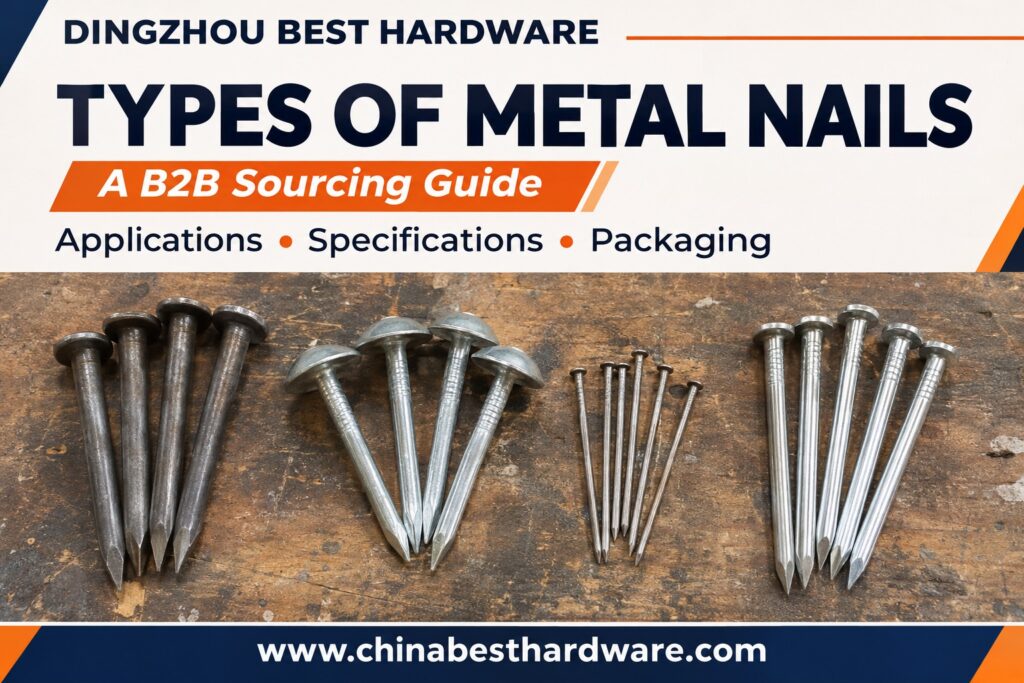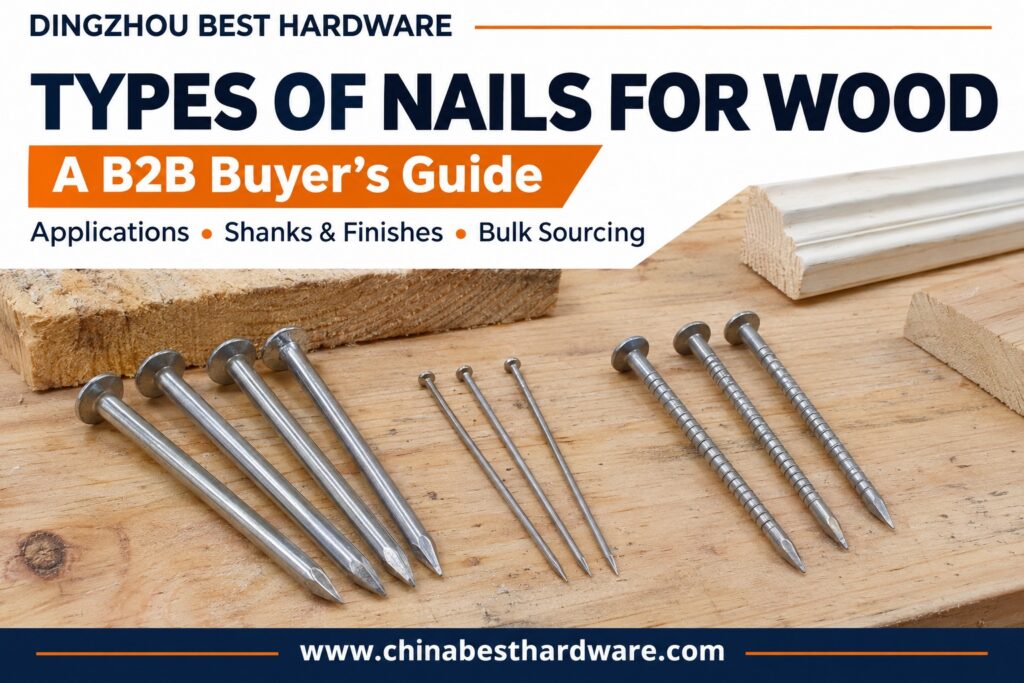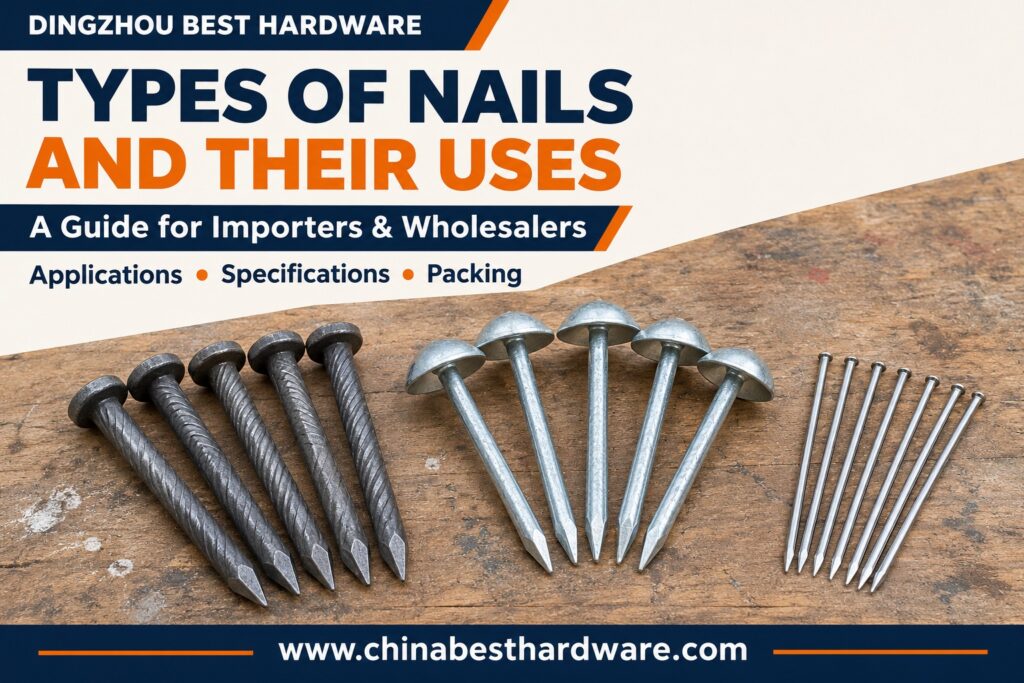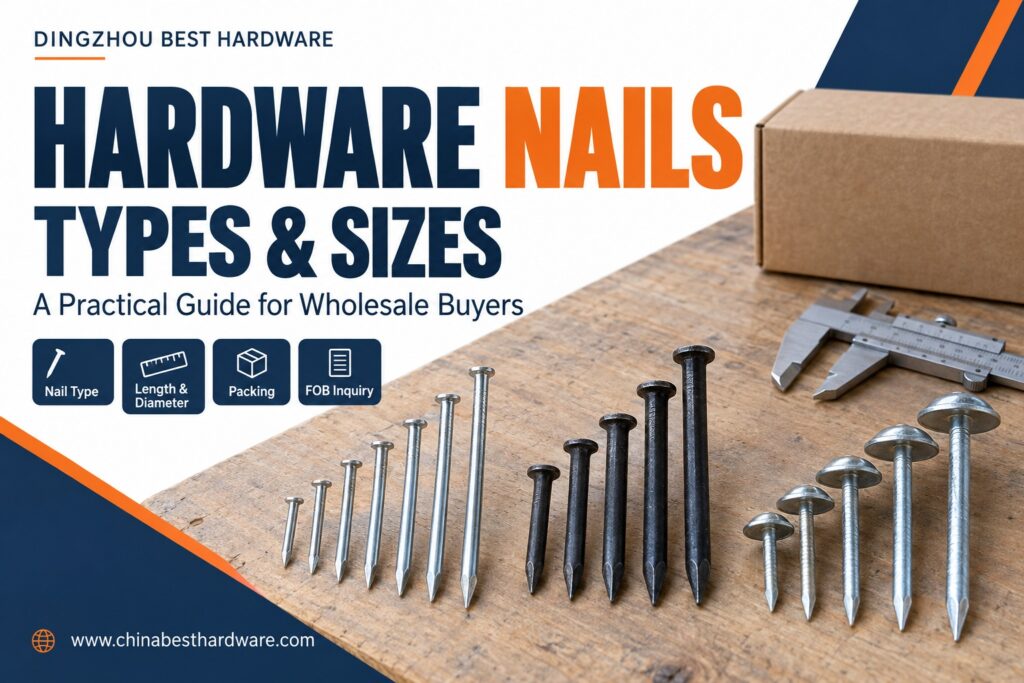
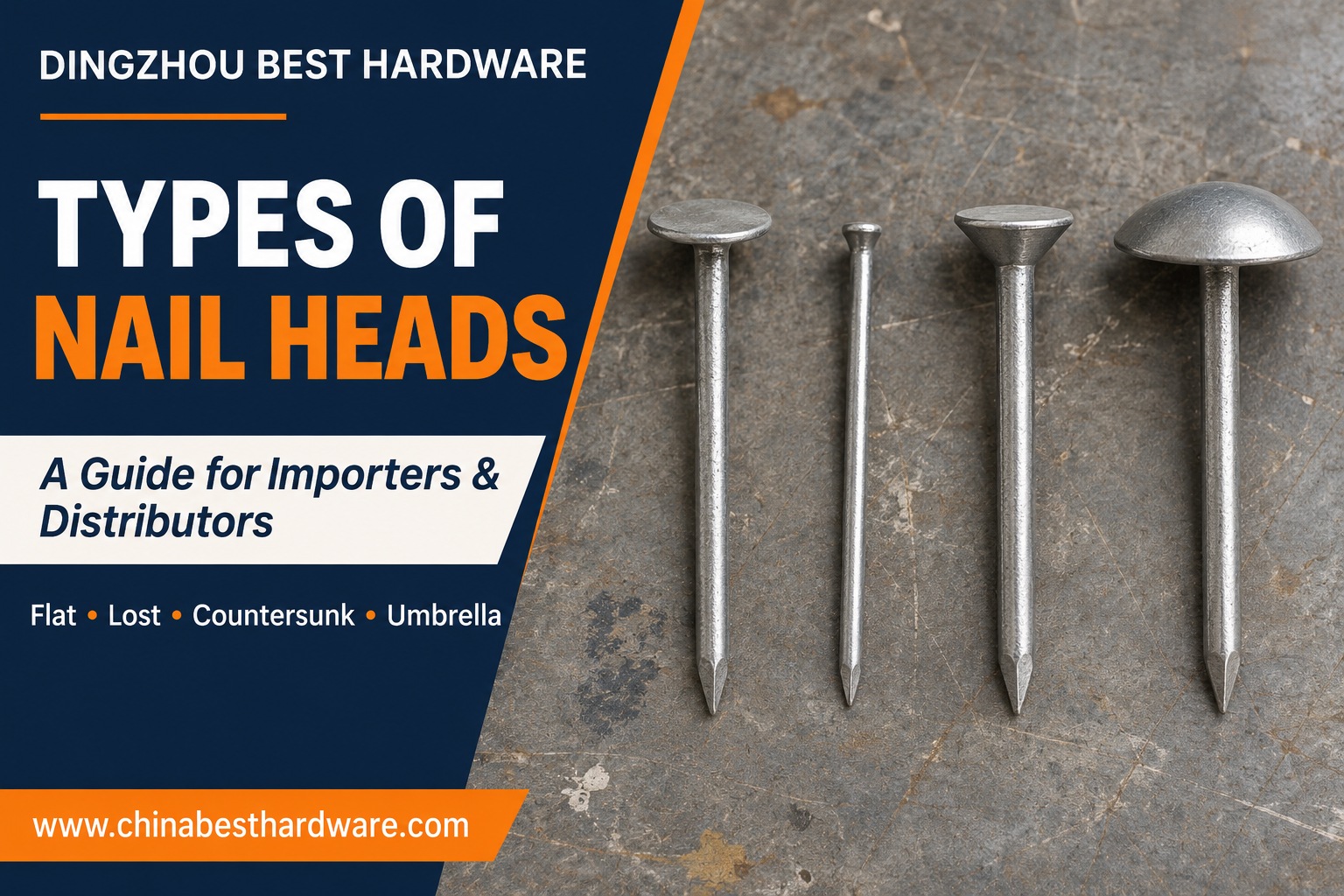
Types of nail heads are a small detail that can create big purchasing problems when buyers treat them as only a visual feature. The wrong head may not suit the local application, packaging plan, or resale market. I look at nail head selection as a practical procurement decision, not just a product description.
Types of nail heads include flat or common heads for general fastening, lost or countersunk heads for a smoother finish, and umbrella heads for roofing or wider surface coverage.1 For importers and distributors, the right choice depends on application, nail size, shank type, surface treatment, packaging, and local market habits.
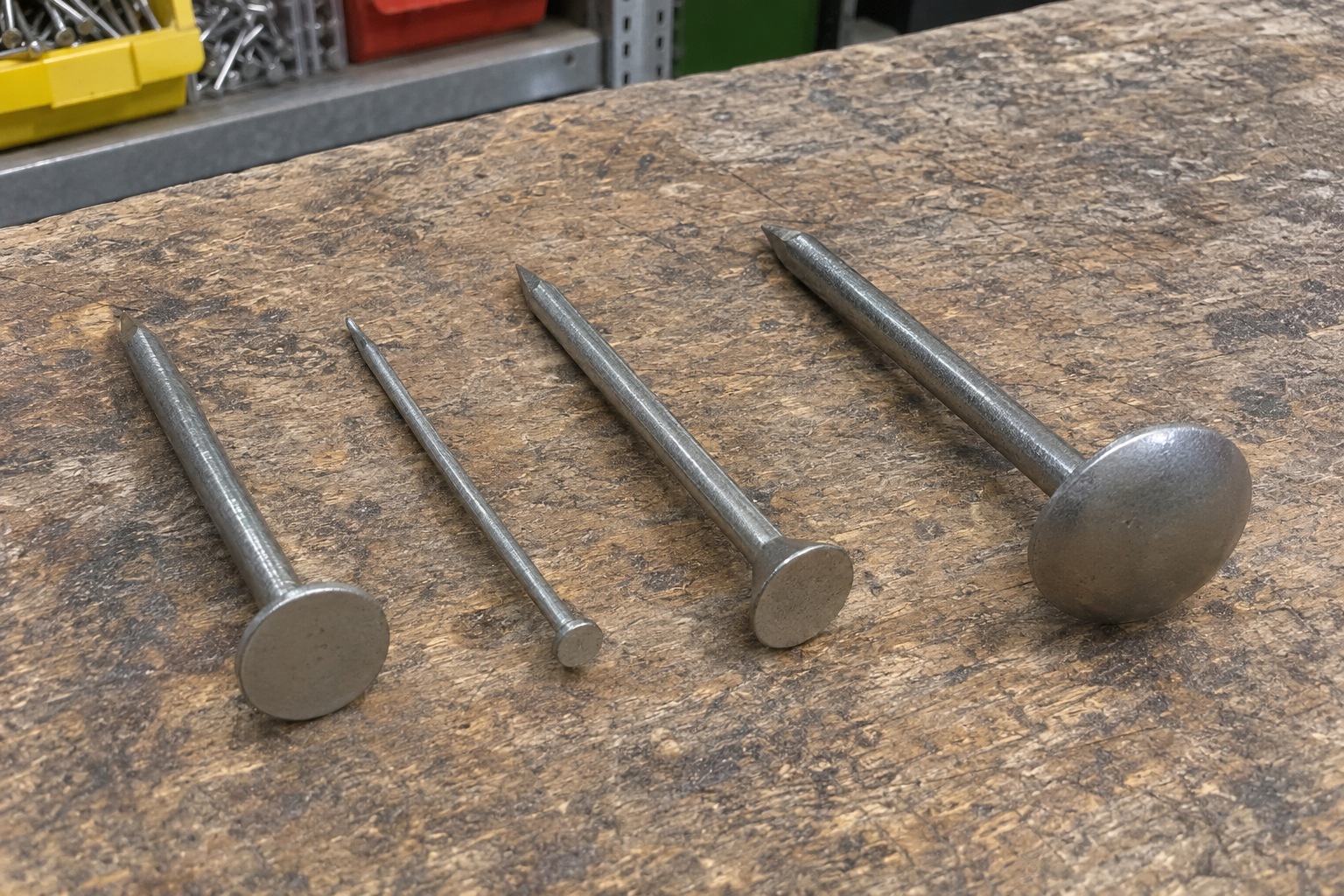
When I discuss nails with overseas buyers, I rarely start with the head shape alone. I usually ask where the nail will be used, what size is needed, how it will be packed, and which market will resell it. That is where the real purchasing decision begins.
Why do types of nail heads matter in bulk purchasing?
Many buyers first ask for a price, but types of nail heads affect more than the quotation. A poor head choice can lead to slow-moving stock, repeated supplier communication, and complaints from local users who expected a different installation result.
The head type matters because it connects the nail to its use case, appearance, packaging, and market demand. In bulk purchasing, buyers should confirm the head type together with nail length, wire diameter, shank, surface treatment, quantity, and packing method before requesting a reliable FOB quotation.
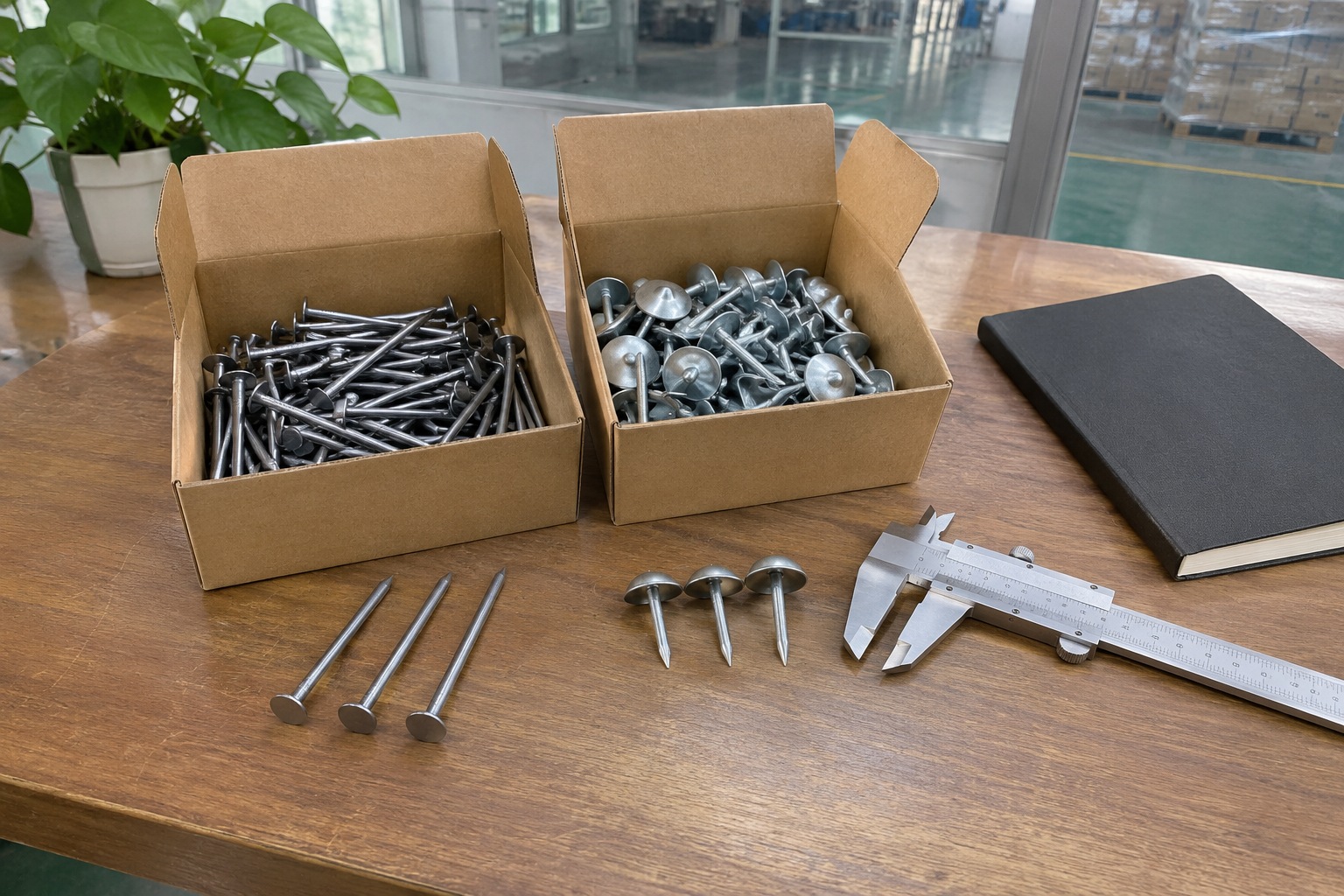
Head shape is part of the full specification
In factory communication, I see that nail head terms can look simple, but they are not always understood the same way in every market. A “flat head” in one inquiry may refer to a common construction nail.2 A “lost head” may be requested for wood finishing. An “umbrella head” may be tied to roofing applications. However, the final product still depends on the complete specification.
A practical nail inquiry usually includes:
- Product type: concrete nail, black steel nail, roofing nail, lost head nail, or another type
- Head type: flat, lost, countersunk, umbrella, or other requested style
- Size: length and wire diameter
- Shank type: smooth, ring, spiral, or other local requirement
- Surface treatment: polished, black, galvanized, or buyer-specific finish
- Quantity: usually in tons, cartons, or boxes
- Packing: bulk carton, small box, plastic bag, branded box, or palletized packing
- Target market: for example, Middle East, Africa, Southeast Asia, or South America
From my production-side experience, head type is one of the first details that affects manufacturing setup and inspection.3 It also affects how the nail looks in the carton and how the distributor explains the product to local buyers.
The commercial risk of choosing the wrong head
The wrong nail head does not always mean the nail is defective. Sometimes the nail is well made, but it is wrong for the market. That difference matters.
For example, if a distributor imports nails with a less visible lost head for a market that expects general flat head nails, the product may move slowly. If a buyer orders roofing nails without confirming the umbrella head style, washer expectation, or surface treatment, the final product may not match the installer’s habit. If a wholesaler orders by name only, the supplier may ask for many follow-up details, which slows the quotation.
Here is a simple procurement view:
| Buyer focus | Why it matters | Risk if ignored |
|---|---|---|
| Head type | Affects application and appearance | Product may not suit local use |
| Size | Affects stocking and resale categories | Wrong item code or poor demand |
| Shank | Affects installation preference | Users may reject unfamiliar style |
| Surface treatment | Affects market expectation and storage condition | Complaints about appearance or suitability |
| Packaging | Affects resale channel | Product may not fit retail or wholesale plan |
I usually tell buyers that head type starts the conversation, but it should not finish it. A quotation based only on head shape is rarely enough for serious purchasing.
Which types of nail heads are commonly used by importers?
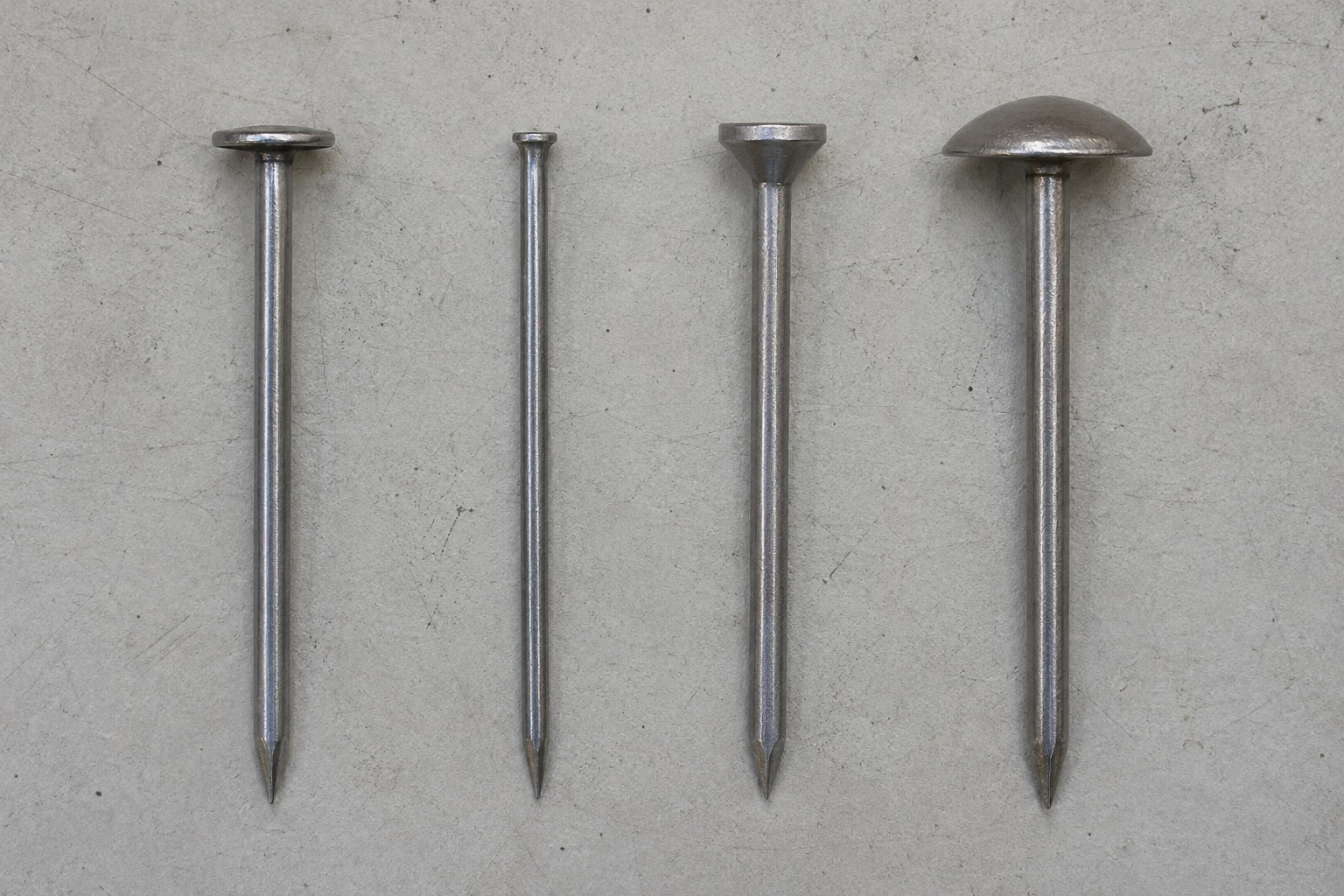
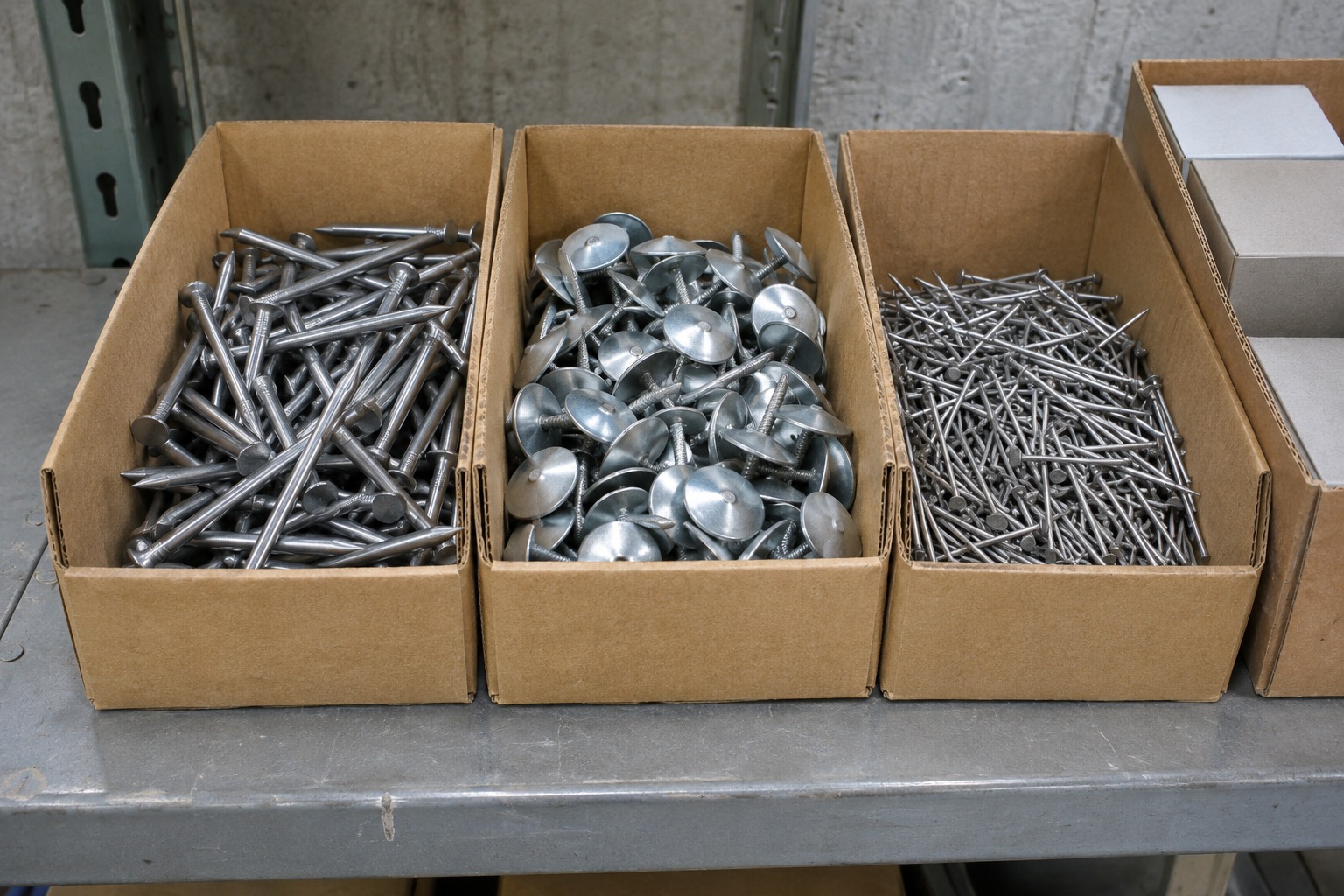
Importers often compare types of nail heads by shape, but the better method is to compare them by task. Flat or common heads are often used for general fastening. Lost or countersunk heads are used when a smoother finish is preferred. Umbrella heads are commonly linked with roofing and wider coverage needs.
The most common nail head types in bulk trade include flat/common heads, lost heads, countersunk heads, and umbrella heads. Each type supports different applications, but buyers should confirm local terminology, nail size, shank, surface treatment, and packaging before placing an order.
Flat or common head nails
Flat head nails are one of the most familiar options in many construction and hardware markets. The head gives a visible top surface and is commonly used for general fastening. In many inquiries, buyers may describe these as common nails or flat head nails, depending on the local naming habit.
From a purchasing view, flat head nails are often chosen when the buyer wants:
- A general-purpose nail category
- A familiar product for hardware shops
- Clear visual identification by local users
- Simple resale in cartons, boxes, or bags
However, even with this common style, buyers still need to confirm size and finish. A flat head nail for one market may be requested in a black finish, while another market may prefer polished or galvanized nails.
Lost head nails
Lost head nails have a smaller head profile, so they are commonly selected when the buyer wants a less visible finish.4 They are often connected with woodwork, trim, and applications where appearance matters more than a large visible head.
I prefer to explain lost head nails carefully because buyers may use different terms. Some may say “lost head,” while others may ask for “finishing nails” or “small head nails.” These terms should be confirmed with photos, drawings, or samples when possible.
Typical buyer concerns include:
- How visible should the head be after installation?
- Will the local market understand this product name?
- Should the nail be packed for retail or bulk users?
- What finish is expected by carpenters or hardware shops?
Countersunk head nails
Countersunk heads are designed so the head can sit more flush with the surface in suitable materials and applications.5 In purchasing communication, buyers usually connect countersunk head nails with a cleaner appearance. However, the exact result depends on the material, installation method, nail specification, and user habit.
I avoid saying one head type always gives the same result everywhere. In real orders, the buyer should check whether the local user expects a countersunk head, a lost head, or another finishing style.
Umbrella head nails
Umbrella head nails are commonly associated with roofing nails. The wider head helps cover more surface area than a small head design.6 In some markets, roofing nails may also involve washer requirements, galvanized finish, or specific packing standards.
For roofing nail inquiries, I usually ask the buyer to confirm:
- Umbrella head diameter or requested style
- Nail length and wire diameter
- Shank type, such as smooth or twisted
- Surface treatment, often galvanized in many markets
- Packing method, such as cartons or smaller boxes
- Whether the target market has a standard sample
Here is a simplified comparison:
| Nail head type | Common purchasing use | Buyer should confirm |
|---|---|---|
| Flat/common head | General fastening and construction resale | Size, finish, shank, packing |
| Lost head | Less visible finishing work | Head size, finish, local product name |
| Countersunk head | Smoother surface appearance | Application, material, sample expectation |
| Umbrella head | Roofing and wider coverage uses | Head diameter, shank, galvanization, packing |
The main point is simple. Do not buy by head name alone. Buy by use case and complete specification.
How should buyers match types of nail heads with applications?
Buyers can match types of nail heads with applications by starting from the end user’s task. General fastening often needs a visible flat head. Finishing work may need lost or countersunk heads. Roofing often needs umbrella heads. The best choice still depends on local construction habits.
A practical matching process starts with the application, then checks the nail head, shank, size, material finish, and packaging. Importers should also compare the selected nail with local samples before confirming a bulk order, especially when terminology varies between regions.

Start with the task, not the product name
When I receive a nail inquiry, I often ask, “What is this nail used for?” That question helps more than a product name alone. The same English term can mean different things across markets. A buyer in one country may use a term based on British English, while another buyer may use a local trade name translated into English.
A better application-first approach looks like this:
-
Identify the work type
Is the nail for construction, woodwork, roofing, packaging, or general hardware resale? -
Confirm the appearance requirement
Should the head remain visible, sit lower, or be less noticeable? -
Check the holding and installation habit
Does the local user expect smooth shank, ring shank, spiral shank, or hardened nails7? -
Select the finish
Should the nail be black, polished, electro-galvanized, hot-dip galvanized, or another finish8? -
Decide the packaging
Will the buyer resell by carton, small box, plastic bag, or branded packaging?
This process prevents many mistakes. It also helps the factory provide a more accurate quotation.
Application examples for common head types
The following table gives a practical view for importers and distributors. It is not a universal rule for every country. It is a starting point for purchasing communication.
| Application need | Common head choice | Why buyers choose it | Notes for procurement |
|---|---|---|---|
| General fastening | Flat/common head | Familiar and easy to resell | Confirm size range and finish |
| Wood finishing | Lost head | Less visible appearance | Confirm local terminology and sample |
| Cleaner surface finish | Countersunk head | Can sit more neatly in suitable use | Confirm material and installer habit |
| Roofing sheets or covering work | Umbrella head | Wider head coverage | Confirm galvanization and shank type |
| Hardware retail assortment | Depends on market | Must match local demand | Confirm packaging and item mix |
Match packaging to the head type
Packaging is not just a logistics detail. It affects how the product sells. A flat head general nail may sell well in larger cartons for wholesalers. A lost head nail may need smaller boxes for hardware shops. A roofing nail may need packaging that protects the finish and supports easy counting or handling.
At Dingzhou Best Hardware, we usually discuss packing together with the quotation. Our MOQ is generally 5 tons or 200 boxes, and our FOB quotation normally depends on product, specification, quantity, and packing method. That does not mean every buyer needs the same packing. It means the packing must match the sales channel.
Common packing questions include:
- Does the buyer sell to wholesalers or retail shops?
- Does the market prefer plain cartons or branded boxes?
- Is OEM/ODM packaging needed for the buyer’s brand?
- Should the nails be packed by weight or by piece count?
- Will the shipment be FCL or LCL by sea freight?
I have seen buyers spend a long time comparing small price differences, but they forget that packaging can decide whether a product looks suitable on the shelf.9 For distributors, the right head type and the right packing should work together.
What details should buyers confirm before requesting a quotation for types of nail heads?
Buyers should not request a quotation for types of nail heads with only a product name. That creates unclear communication and unstable price comparison. The supplier may quote based on assumptions, and those assumptions may not match the buyer’s market or final use.
Before requesting a quotation, buyers should confirm nail type, head type, size, shank, surface treatment, quantity, packing, target market, and any sample or photo reference.10 This information helps the factory quote accurately and reduces revisions before production.

A better quotation checklist
A clear quotation request saves time for both sides. I recommend using a checklist instead of sending only “Please quote nail price.” Nail prices are not meaningful without the full specification.
A practical inquiry can include:
| Quotation detail | Example | Why it matters |
|---|---|---|
| Product name | Roofing nail, concrete nail, lost head nail | Defines the product category |
| Head type | Umbrella head, flat head, lost head | Affects application and production setup |
| Size | 2 inch × BWG 12, or buyer’s local size | Affects material use and packing |
| Shank | Smooth, twisted, ring | Affects user expectation |
| Surface treatment | Black, polished, galvanized | Affects appearance and market fit |
| Quantity | 5 tons, 10 tons, 200 boxes | Affects production and FOB quotation |
| Packing | 25 kg carton, small box, branded carton | Affects cost and resale format |
| Destination or market | Middle East, Africa, Southeast Asia, South America | Helps align market habits |
| Reference | Photo, drawing, or sample | Reduces misunderstanding |
Why head type alone cannot decide price
In nail manufacturing, cost is connected to raw material, wire diameter, length, head forming, surface treatment, packing labor, carton quality, and order quantity.11 So the head type matters, but it is only one part of the price.
For example, two umbrella head roofing nails may have different costs if:
- One is galvanized and the other is black
- One uses a twisted shank and the other uses smooth shank
- One is packed in small branded boxes and the other is packed in bulk cartons
- One order is 5 tons and the other is a full container
- One buyer needs a special head diameter or packaging design
That is why I prefer FOB quotations based on complete specifications. It gives the buyer a more realistic comparison between suppliers.
Samples and quality inspection
For technical industrial products like nails, samples are useful for checking basic appearance, dimensions, packing style, and market suitability.12 At our factory, samples can usually be provided for quality checking. A basic sample fee may apply, and buyers can discuss whether it may be returned or deducted in a formal order.
Buyers should use samples to check:
-
Head shape consistency
The head should match the agreed style. -
Size and tolerance expectations
Buyers should confirm length, diameter, and head dimensions according to the agreed specification. -
Surface appearance
The finish should match the buyer’s requirement and local market expectation. -
Packing sample
The carton, box, label, and brand design should support resale. -
Local user feedback
Importers can ask a few trusted customers or installers to compare the sample with common local products.
I always suggest that buyers verify certifications, inspection documents, and product samples as part of supplier evaluation. For application-specific or regulated uses, buyers should also seek qualified professional evaluation in their own market. A nail factory can provide production information and inspection support, but the buyer must confirm suitability for local standards and end-user conditions.
How can distributors avoid slow-moving stock when choosing types of nail heads?
Distributors can lose money when they import nail head styles that do not match local buying habits. The product may be technically acceptable, but local retailers may not reorder it. This problem often starts when the buyer copies another market’s specification without checking local demand.
Distributors can reduce slow-moving stock by studying local best-selling sizes, confirming common head names, testing samples, starting with trial orders, and matching packaging to resale channels. The goal is not to stock every head type, but to stock the right head types for the target market.
Use local market evidence
Before placing a bulk order, I encourage buyers to collect simple market evidence. This does not need to be complicated. A distributor can visit hardware shops, talk to contractors, compare competitor cartons, and photograph best-selling products.
Useful market checks include:
- Which nail head styles are most visible in local shops?
- What sizes sell repeatedly?
- Do users ask for nails by head type, by use, or by local name?
- Are nails usually sold in small boxes, bags, or large cartons?
- Do buyers prefer black, polished, or galvanized finishes?
- Are roofing nails sold with specific head styles or washer expectations?
This information makes the supplier conversation much easier. It also helps avoid a common mistake: importing a product that looks correct on paper but feels unfamiliar to local users.
Start with a trial order when the market is uncertain
A trial order is useful when the buyer is testing a new head type, size, or packing design. In our business, we support trial orders, and the regular MOQ is usually 5 tons or 200 boxes. The exact arrangement depends on the product and packing plan.
A trial order can help buyers test:
-
Retail response
Shops can see whether the product moves quickly. -
Installer acceptance
Local users can check whether the nail matches their habits. -
Packaging performance
The buyer can see whether cartons and boxes suit storage and resale. -
Specification accuracy
The buyer can compare the received goods with the confirmed sample. -
Reorder potential
The distributor can decide whether to increase quantity in the next shipment.
Build a practical product range
Distributors do not need to carry every nail head style. They need a range that matches their customers. For many markets, a useful starting range may include general flat head nails, roofing nails with umbrella heads, and selected finishing nails such as lost head nails. The exact mix should come from local demand.
A simple stock planning model can look like this:
| Stock category | Possible head type | Commercial purpose |
|---|---|---|
| Core fast-moving item | Flat/common head | General hardware and construction resale |
| Roofing category | Umbrella head | Roofing sheet and covering applications |
| Finishing category | Lost or countersunk head | Cleaner appearance for woodwork or trim |
| Special request item | Buyer-specific head | Serve contractors or regional demand |
The key is to avoid emotional purchasing. A nail may look good in a catalog, but it must also sell in the buyer’s market. That is why I treat types of nail heads as part of inventory planning, not just product vocabulary.
Frequently Asked Questions
What are the main types of nail heads?
The main types of nail heads commonly discussed in bulk trade are flat or common heads, lost heads, countersunk heads, and umbrella heads. Buyers should confirm the exact meaning with photos, samples, or drawings because nail head terms can vary by country and market.
Which nail head is best for roofing nails?
Umbrella head nails are commonly used for roofing applications because the wider head gives broader surface coverage. However, buyers should also confirm shank type, nail length, wire diameter, galvanization, washer requirements, and packaging before ordering roofing nails for a specific market.
Are lost head nails the same as finishing nails?
Lost head nails are often used for finishing work because the smaller head is less visible. Some markets may call similar products finishing nails, but the terms are not always identical. Buyers should confirm size, head shape, surface finish, and sample appearance before bulk purchasing.
Can I request customized nail heads and packaging?
Yes, many factories can support customized products, packaging, and brand logos. At Dingzhou Best Hardware, we support OEM/ODM requests, but buyers should provide clear specifications, artwork, quantity, and target market information so the factory can evaluate production and quotation details.
Why does the supplier ask so many questions before quoting nail prices?
The supplier asks questions because nail price depends on product type, head type, size, shank, surface treatment, quantity, and packaging. A quotation based only on “nail head type” may be inaccurate. Clear specifications help both buyer and supplier avoid repeated revisions.
Conclusion
Types of nail heads should be evaluated as a purchasing decision, not only as a glossary term. Flat heads, lost heads, countersunk heads, and umbrella heads each serve different market needs, but the correct choice depends on application, size, shank, finish, packing, and local demand. If you import or distribute nails in the Middle East, Africa, Southeast Asia, or South America, I can help review your specifications and prepare a clear FOB quotation. Contact Dingzhou Best Hardware at [email protected] or WhatsApp +8618331061136.
-
Wikipedia. Nail (fastener).. An encyclopedia entry on nails and nail types supports the distinction between common/general-purpose nails, finishing nails with less prominent heads, countersunk forms, and roofing nails with broader heads; the source provides general classification rather than evidence about any particular import market. Evidence role: general_support; source type: encyclopedia. Supports: A neutral reference should support that common, finishing, countersunk, and roofing nails differ in head form and typical use.. Scope note: Contextual support only; it does not prove market demand or purchasing suitability in a specific country. ↩
-
Wikipedia. Nail (fastener).. A neutral definition of common nails describes them as general construction nails typically having a flat or broad head, supporting the article’s explanation that flat-head terminology may correspond to common construction nails. Evidence role: definition; source type: encyclopedia. Supports: A reference should define common nails as construction nails with a broad or flat head.. ↩
-
"Standard Specification for Driven Fasteners: Nails, Spikes …", https://store.astm.org/f1667-11ae01.html. ASTM-style driven-fastener specifications treat head form or head dimensions, shank characteristics, coatings, and size as measurable product attributes, supporting the article’s claim that head type is part of manufacturing and inspection control; the standard does not address the author’s factory-specific workflow. Evidence role: mechanism; source type: institution. Supports: A standards source should show that nail head characteristics are specified and inspected as part of driven-fastener requirements.. Scope note: Contextual support only; it supports the technical relevance of head dimensions, not the exact sequence used in one factory. ↩
-
"Types of Nails", https://www.homedepot.com/c/ab/types-of-nails/9ba683603be9fa5395fab909c451e98. A woodworking reference defining lost-head nails as small-headed fasteners used where the nail head is intended to be unobtrusive supports the article’s description of their finishing role. Evidence role: definition; source type: education. Supports: A woodworking or educational reference should support that lost head nails are small-headed nails used for finishing or less visible fastening.. ↩
-
"Countersink", https://en.wikipedia.org/wiki/Countersink. A technical definition of countersinking states that a conical recess or countersunk head permits a fastener to sit flush with or below the surrounding surface, supporting the article’s description of countersunk nail-head function. Evidence role: definition; source type: encyclopedia. Supports: A reference should define countersinking as a geometry that allows a fastener head to sit flush with or below a surface.. ↩
-
"What Are The Different Types of Roofing Nails and …", https://abedward.com/different-types-of-roofing-nails/. Construction education material describing roofing nails as having larger heads to secure roofing materials supports the article’s statement that wider heads provide broader contact or coverage; it does not establish performance for every umbrella-head specification. Evidence role: mechanism; source type: education. Supports: An educational construction source should explain that roofing nails use larger heads to hold roofing materials or distribute force over a larger area.. Scope note: Contextual support only; exact holding performance depends on material, head diameter, shank, and installation method. ↩
-
"Withdrawal strength of ring-shank nails embedded in southern …", https://research.fs.usda.gov/treesearch/25675. The USDA Forest Products Laboratory Wood Handbook discusses how nail withdrawal and fastening behavior depend on nail characteristics such as shank form, supporting the article’s treatment of smooth, ring, spiral, and hardened nails as substantive specification choices. Evidence role: mechanism; source type: government. Supports: A government wood-construction reference should explain that nail withdrawal resistance and fastening behavior vary with shank type and nail characteristics.. ↩
-
"Hot-Dip Galvanized Specifications", https://mazenails.com/resources/hot-dipped-galvanized-nails-specs/. Institutional guidance on galvanized steel explains that zinc coatings provide sacrificial corrosion protection for steel products, supporting the article’s identification of galvanized finishes as a meaningful nail specification; the source does not compare all commercial nail finishes or market preferences. Evidence role: mechanism; source type: institution. Supports: A neutral institution source should explain that zinc galvanizing is used to protect steel fasteners from corrosion and that coating methods differ.. Scope note: Contextual support only; it supports corrosion-related relevance of galvanizing, not buyer preference for black or polished finishes. ↩
-
"Package design as a branding tool in the cosmetic industry", https://pmc.ncbi.nlm.nih.gov/articles/PMC9123395/. Research on packaging and consumer behavior finds that packaging design can influence product perception and purchase decisions at the point of sale, supporting the article’s claim that packaging affects shelf suitability; the evidence is general retail research and not specific to nails. Evidence role: general_support; source type: paper. Supports: A consumer-behavior paper should support that packaging affects product perception and purchase decisions at retail.. Scope note: Contextual support only; the research supports packaging effects broadly, not measured sales outcomes for hardware fasteners. ↩
-
"3.8 Finalize Specs/Scope – Procurement Wizard", https://spo.hawaii.gov/procurement-wizard/manual/finalize-specsscope/?print=print. Procurement guidance from international institutions emphasizes that requests for quotation should contain clear technical specifications, quantities, and relevant delivery or packaging information, supporting the article’s checklist approach to nail quotations; it is general procurement guidance rather than nail-specific evidence. Evidence role: general_support; source type: institution. Supports: A procurement manual should support that requests for quotation require clear technical specifications, quantities, and delivery or packaging conditions.. Scope note: Contextual support only; the source supports RFQ completeness generally, not the exact nail-specification list. ↩
-
"8. Calculate Packaging Cost per Order", https://pressbooks.cuny.edu/packaging/chapter/packaging-cost-per-order/. Manufacturing cost-estimation literature identifies material consumption, processing operations, labor, finishing, overhead, and production volume as major cost drivers, supporting the article’s explanation of why nail price cannot be inferred from head type alone. Evidence role: mechanism; source type: paper. Supports: A manufacturing cost-estimation paper should support that material, processing, finishing, labor, packaging, and production volume affect unit cost.. Scope note: Contextual support only; it supports general manufacturing cost mechanisms, not a quantified nail-pricing formula. ↩
-
"Pre-shipment inspection", https://en.wikipedia.org/wiki/Pre-shipment_inspection. International sampling-inspection standards provide a framework for assessing product attributes and conformity from sampled units, supporting the article’s view that samples can be used to check appearance, dimensions, and packaging; the standard does not by itself verify market acceptance. Evidence role: general_support; source type: institution. Supports: A quality-inspection or sampling standard should support that samples can be inspected for attributes such as appearance, dimensions, and packaging conformity.. Scope note: Contextual support only; sampling standards support inspection practice, not commercial suitability in a specific market. ↩