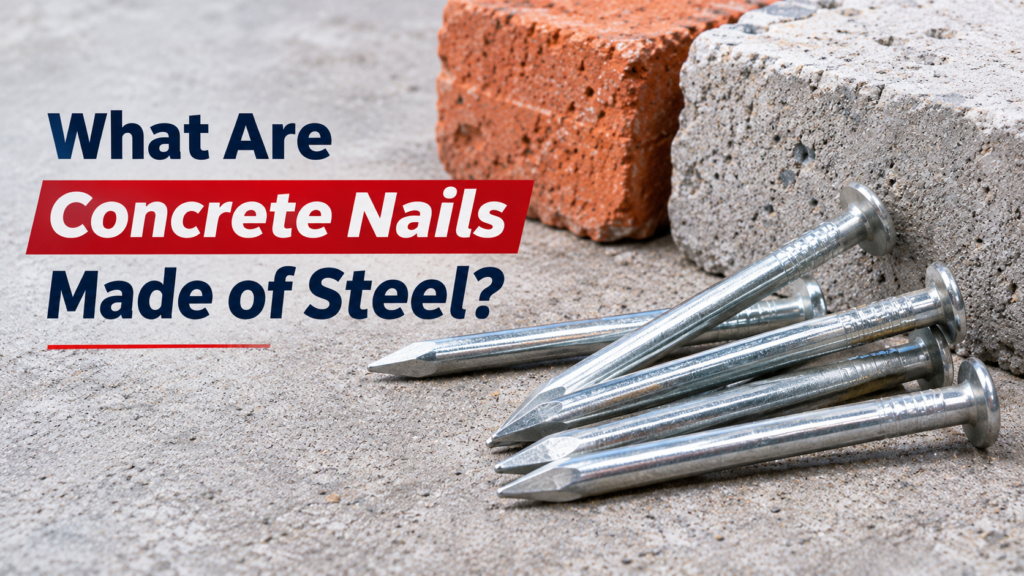
Nails hardware can look simple until a buyer must choose sizes, packaging, and quantities for a real import order. If the specification is incomplete, suppliers may quote different products under the same name. I usually solve this by starting with the buyer’s market, nail type, full size details, and resale packaging plan.
Types of nails hardware and sizes should be selected by use case, local demand, and complete specification. Importers should confirm nail type, length, diameter or gauge, head style, shank, material, finish, quantity, and packaging before asking for an FOB quote. Length alone is not enough for accurate supplier comparison.1
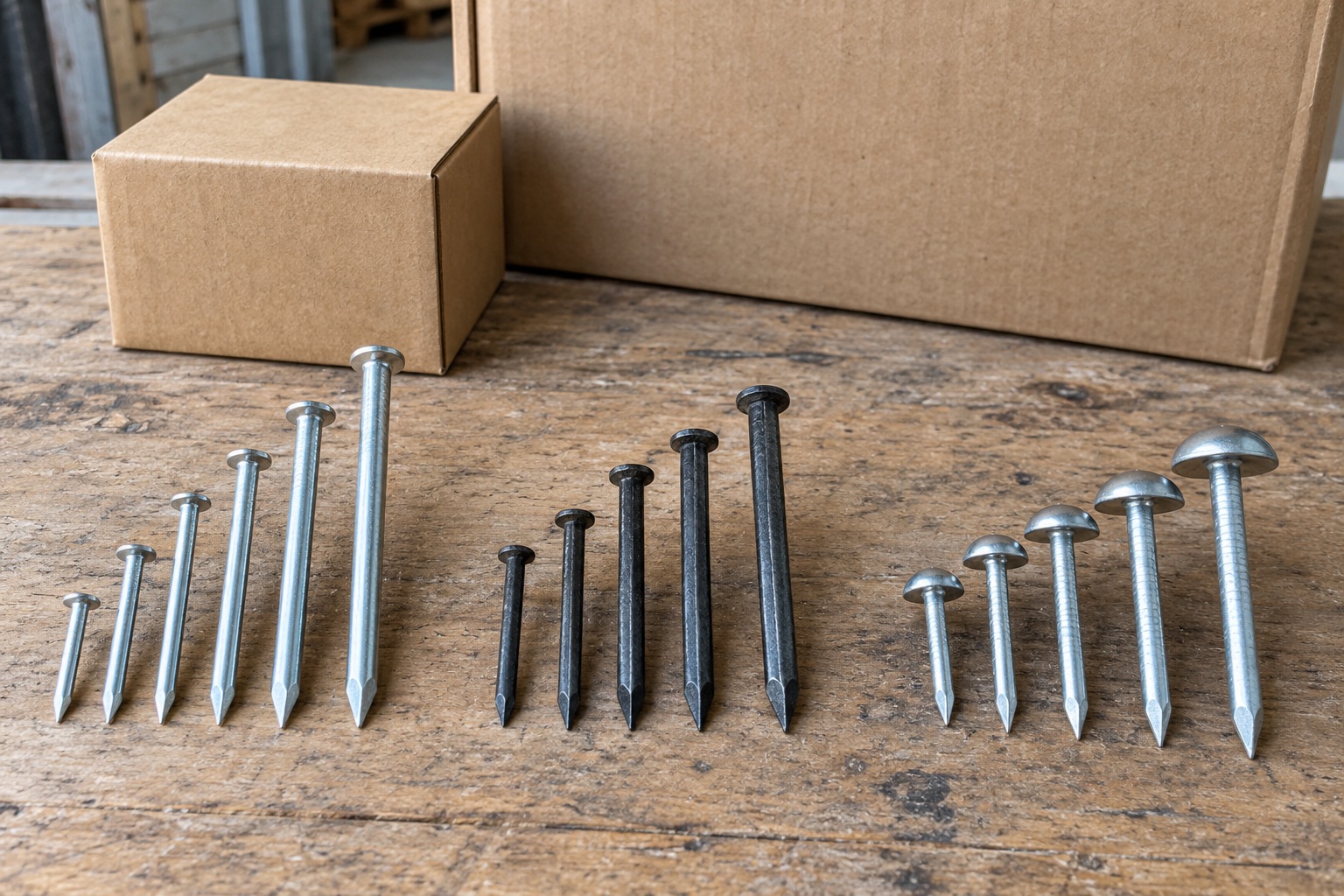
Many importers first ask me, “What sizes do you have?” That question is useful, but it is not enough. A better question is, “Which nail type, size range, packaging, and price level fit my local customers?” The sections below show how I think through that decision with wholesale buyers.
How should importers classify types of nails hardware before choosing sizes?
Choosing nails by size alone creates confusion because different nail types can share similar lengths. A 2-inch nail may be a concrete nail, common nail, roofing nail, or finishing nail.2 If a buyer skips the type, the quote may be fast but unreliable.
Importers should first classify nails hardware by application and product family. The main categories include concrete nails, black steel nails, roofing nails, lost head nails, common wire nails, finishing nails, and specialty nails.3 After the type is clear, buyers can compare size, finish, packaging, and price more accurately.
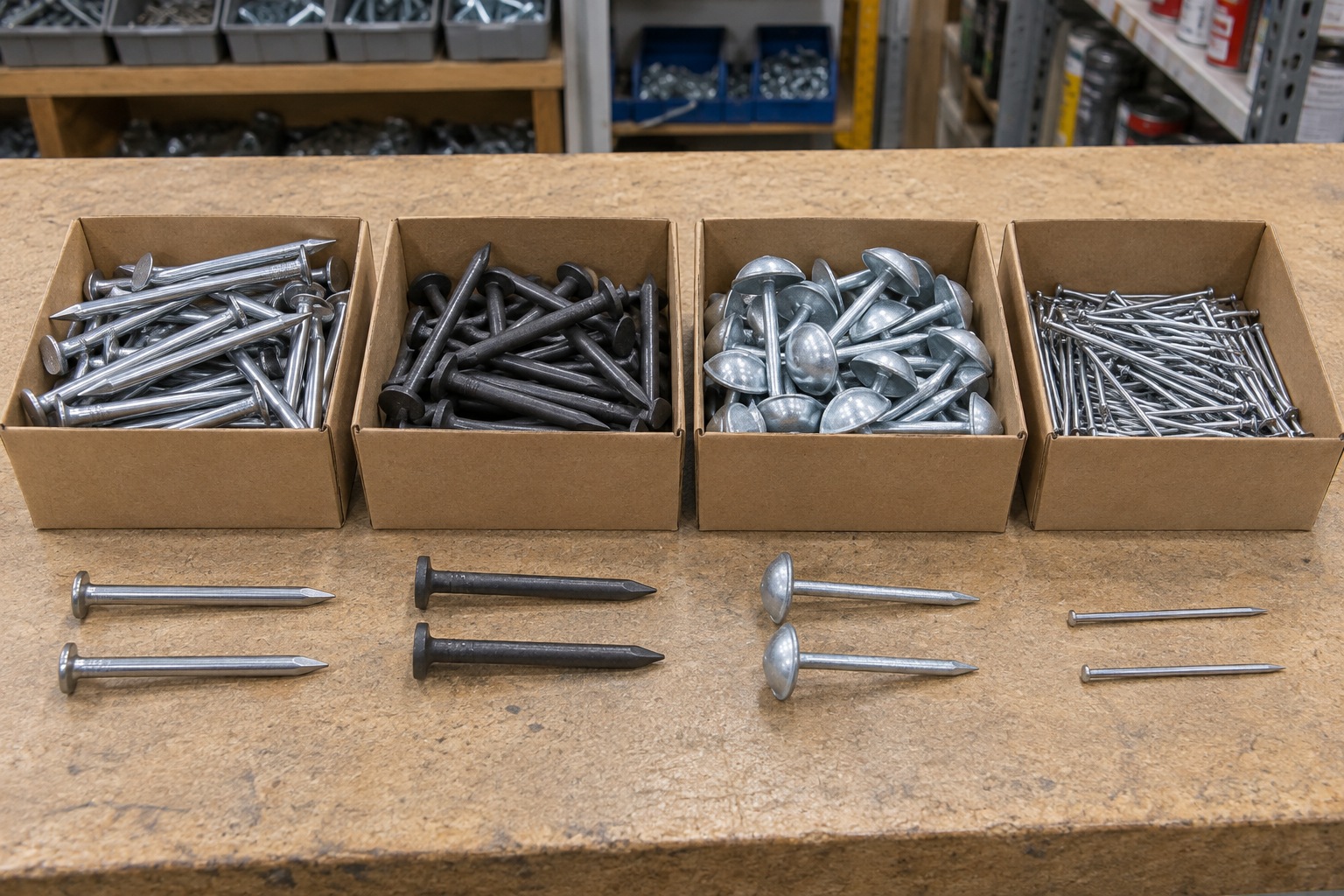
Start with the local selling channel
I always ask buyers where the nails will be sold before I discuss detailed sizes. A wholesaler serving hardware shops has different needs from a distributor selling to construction contractors. A retail box also creates different requirements from a 25 kg bulk carton.
For example, in my export inquiries, I often see three buyer patterns:
- Wholesale distribution buyers want strong cartons, stable weight, and common market sizes.
- Retail hardware buyers care more about small boxes, printed brands, and barcode or label details.
- Project supply buyers may focus on one or two nail types in larger quantities.
These patterns affect both the product and the quotation.
Common types of nails hardware
The table below gives a practical classification. The examples are for procurement discussion only. Buyers should verify local standards, market habits, and customer requirements before ordering.
| Nail type | Common buying purpose | Key size details to confirm | Common finish or feature |
|---|---|---|---|
| Concrete nail | Hard wall or masonry-related fixing markets | Length, diameter, shank, hardness-related product spec | Black, bright, galvanized, fluted or smooth |
| Black steel nail | General construction and hardware resale | Length, diameter, head type, carton weight | Black finish |
| Roofing nail | Roofing sheet and related hardware markets | Length, shank, head diameter, washer if required | Galvanized, umbrella head |
| Lost head nail | Woodwork, finishing, furniture-related markets | Length, wire diameter, head style | Bright, polished, galvanized |
| Common wire nail | General building and carpentry markets | Length, diameter, head type, shank | Bright, galvanized |
| Finishing nail | Interior finishing and light woodwork resale | Length, small head, wire gauge | Bright or galvanized |
Why the name is not enough
A buyer may say, “I need concrete nails.” I still need more information. Concrete nails can vary by length, diameter, surface, shank style, and packing method. Two suppliers may both quote “concrete nail 2 inch,” but one may use heavier wire, another may use lighter wire, and the cartons may not contain the same net weight.
This is why I advise buyers to avoid only sending a product photo and asking for “best price.” A photo helps, but it does not replace specification. A good inquiry should include:
- Nail type
- Length
- Diameter or gauge
- Head type
- Shank style
- Surface finish
- Packing
- Quantity
- Destination port if freight discussion is needed
A supplier-side habit I recommend
When I receive an inquiry, I try to repeat the specification back to the buyer before quoting. This small step prevents many mistakes. For example:
“Please confirm: black steel nail, 2 inch length, 3.0 mm diameter, flat head, smooth shank, 25 kg/carton, OEM carton mark, total 10 tons, FOB Tianjin.”
This format helps both sides. The buyer can check the market fit. The supplier can calculate raw material, production, packaging, and loading details more accurately.
What nail sizes should buyers confirm for nails hardware orders?
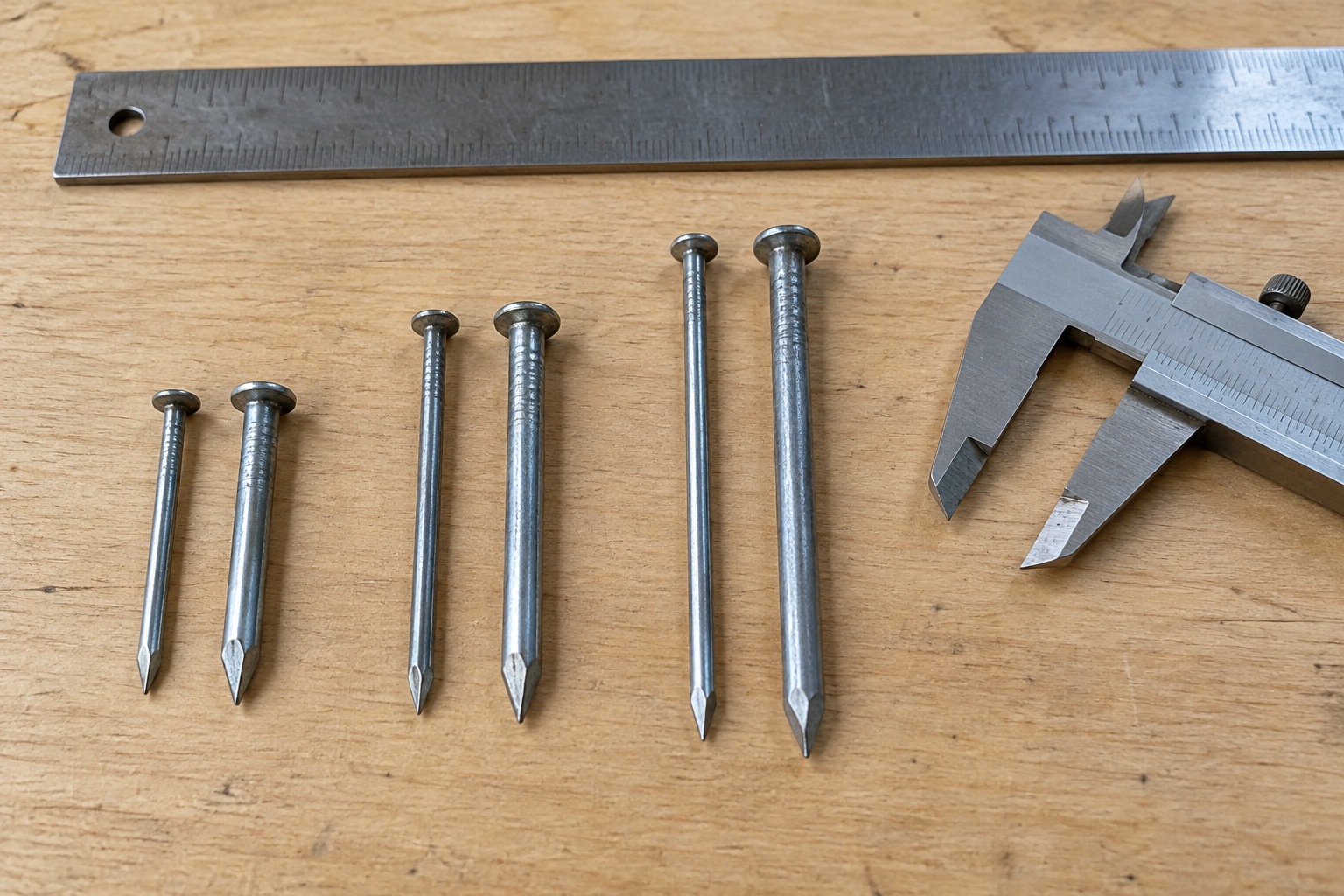
Nail sizes can be misleading when buyers mention only length. A longer nail is not always heavier than another nail if the diameter is different. A correct size inquiry must include length and thickness, and it should also mention head, shank, material, finish, and packing.
Buyers should confirm nail length, diameter or gauge, head diameter, shank style, finish, and unit system. For nails hardware procurement, the most common mistake is asking for a length like “2 inch” without confirming wire diameter, carton weight, or packaging. That makes fair quote comparison difficult.
Length is only the first dimension
Length is usually the easiest detail for buyers to understand. Many markets use inch sizes such as 1 inch, 1.5 inch, 2 inch, 2.5 inch, 3 inch, and 4 inch. Some buyers also use metric sizes such as 25 mm, 40 mm, 50 mm, 65 mm, 75 mm, and 100 mm.
However, length alone does not define the product. I have seen buyers compare two prices for “3 inch nails” and assume one supplier is cheaper. After checking, the cheaper offer sometimes uses a smaller diameter, lighter packing, or different finish. The buyer is not comparing the same product.
Basic inch-to-millimeter reference
The following table is a general conversion guide. Buyers should verify the exact local size naming and supplier specification before purchase.
| Inch length | Approx. millimeter length | Common procurement note |
|---|---|---|
| 1 inch | 25.4 mm | Often discussed for small nails and light use categories |
| 1.5 inch | 38.1 mm | Often rounded to 38 mm or 40 mm in discussion |
| 2 inch | 50.8 mm | Often discussed as 50 mm in many inquiries |
| 2.5 inch | 63.5 mm | Often discussed as 63 mm or 65 mm |
| 3 inch | 76.2 mm | Often discussed as 75 mm |
| 4 inch | 101.6 mm | Often discussed as 100 mm |
Diameter or gauge must be clear
Diameter affects weight, price, carton quantity, and customer perception.4 Some markets use millimeters. Some use gauge. Some buyers send samples instead of exact numbers. A sample can help, but I still prefer written confirmation after measuring.
A complete size line may look like this:
- Concrete nail: 2 inch × 3.0 mm
- Roofing nail: 2.5 inch × 3.5 mm, umbrella head
- Lost head nail: 1.5 inch × 1.8 mm
- Black steel nail: 3 inch × 3.2 mm
These examples are not universal standards. They are practical inquiry formats. The exact size should match the buyer’s local customer habits and resale channel.
Head type changes the product
The head is important because it affects product identity and customer expectation. For example, a roofing nail usually has a larger head than a common nail.5 A lost head nail has a small head that is less visible after fixing.6 A concrete nail may have a specific head shape depending on market preference.
Buyers should confirm:
- Flat head
- Umbrella head
- Lost head
- Checkered head
- Large head
- Small finishing head
If the buyer has an existing sample, I recommend sending clear photos from the side, top, and full carton. I also suggest measuring head diameter if possible.
Shank style and finish matter
The shank is the body of the nail. It may be smooth, ring, spiral, fluted, or grooved depending on product category and market request.7 The finish may be bright, black, polished, electro-galvanized, hot-dip galvanized, or painted.
These details affect price and production planning. For B2B buyers, they also affect how customers recognize the product. A local market may expect a black finish for one nail type and galvanized finish for another. I do not treat finish as decoration only. I treat it as a specification item.
My practical size checklist
Before I quote, I like to see this complete line:
| Specification item | Buyer should provide |
|---|---|
| Product type | Concrete nail, roofing nail, black steel nail, lost head nail, etc. |
| Length | Inch or mm |
| Diameter | mm or gauge |
| Head | Flat, umbrella, lost head, etc. |
| Shank | Smooth, ring, spiral, fluted, etc. |
| Finish | Black, bright, galvanized, polished, etc. |
| Packing | Small box, carton, bag, pallet if required |
| Quantity | Tons, cartons, or container quantity |
| Brand | Neutral, supplier brand, OEM, ODM |
This checklist saves time. It also helps the buyer compare quotations from different suppliers fairly.
Why can the same nails hardware name have different prices?
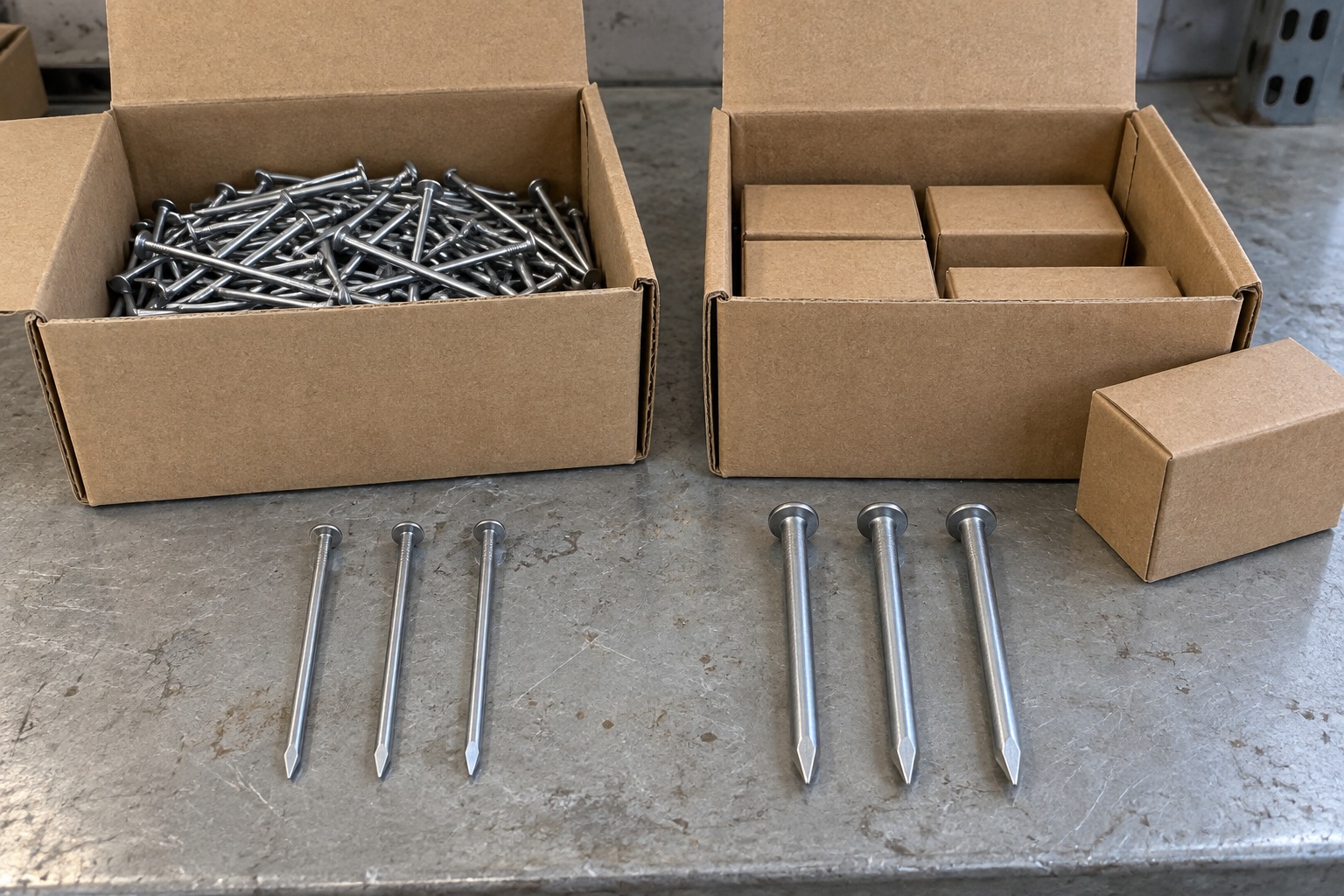
A price difference is not always a supplier margin difference. The same product name can hide different wire diameter, net weight, finish, packing material, carton strength, brand printing, and order quantity. If these details are unclear, the lowest price may not be the best buying decision.
The same nails hardware name can have different prices because suppliers may quote different specifications. Diameter, length tolerance, surface finish, packaging, carton weight, OEM printing, raw material cost, and quantity all affect FOB price. Buyers should compare complete specifications, not just product names.
Price is built from more than steel
In nail exporting, raw material is important, but it is not the only cost. Production speed, nail type, polishing, galvanizing, packing, carton printing, loading, and order volume all influence the final FOB price.
When a buyer asks me for “lowest price concrete nail,” I usually ask more questions before answering. I do this because an extremely low quote may come from a lighter specification or simpler packaging. That may be acceptable for some markets, but it should be a conscious decision.
Main variables behind a nail quotation
| Price variable | Why it matters |
|---|---|
| Wire diameter | Heavier diameter uses more steel and changes carton weight |
| Nail length | Longer nails usually increase material use |
| Surface finish | Galvanizing, polishing, black finish, and other treatments affect cost8 |
| Head and shank | Different machines or production settings may be needed |
| Packing weight | 20 kg, 25 kg, or small box packing changes cost and logistics |
| Carton quality | Stronger export cartons cost more but may reduce damage risk |
| OEM printing | Private label cartons and boxes add design and printing cost |
| Quantity | Larger orders may improve production and packing efficiency |
| Loading method | FCL and LCL planning can affect local handling cost |
The danger of comparing incomplete quotes
A buyer may receive three offers:
| Supplier | Quoted product | Missing detail | Risk |
|---|---|---|---|
| Supplier A | 2 inch concrete nail | Diameter not stated | Product may be lighter or heavier than expected |
| Supplier B | 2 inch concrete nail | Packing not stated | Carton count and resale unit unclear |
| Supplier C | 2 inch concrete nail | Finish not stated | Customer expectation may not match product |
At first, the buyer may choose the cheapest. Later, the buyer may discover that the nails are packed differently, the carton is too weak, or the diameter does not match the local sample. The problem is not always bad faith. Sometimes the inquiry was incomplete from the beginning.
How I suggest buyers compare offers
I recommend making a simple comparison sheet before choosing a supplier. The buyer can place every quotation into the same format.
- Confirm product type.
- Match length and diameter.
- Check head and shank.
- Check finish.
- Compare net weight per carton.
- Compare carton size and packing method.
- Check MOQ and lead time.
- Review sample policy.
- Confirm FOB port and validity period.
This method makes price comparison more transparent. It also reduces argument after production starts.
Certificates and documents should be verified
Some buyers ask for factory documents, business licenses, export records, or quality-related documents. These documents can support supplier evaluation, but buyers should verify them directly. I do not recommend relying only on a sales message or a logo on a document.
For application-specific decisions, buyers should consult qualified professionals in their market. A nail supplier can confirm product specification, production capability, and commercial terms. A supplier should not replace local code consultants, engineers, or project authorities.
How does packaging affect nails hardware procurement?
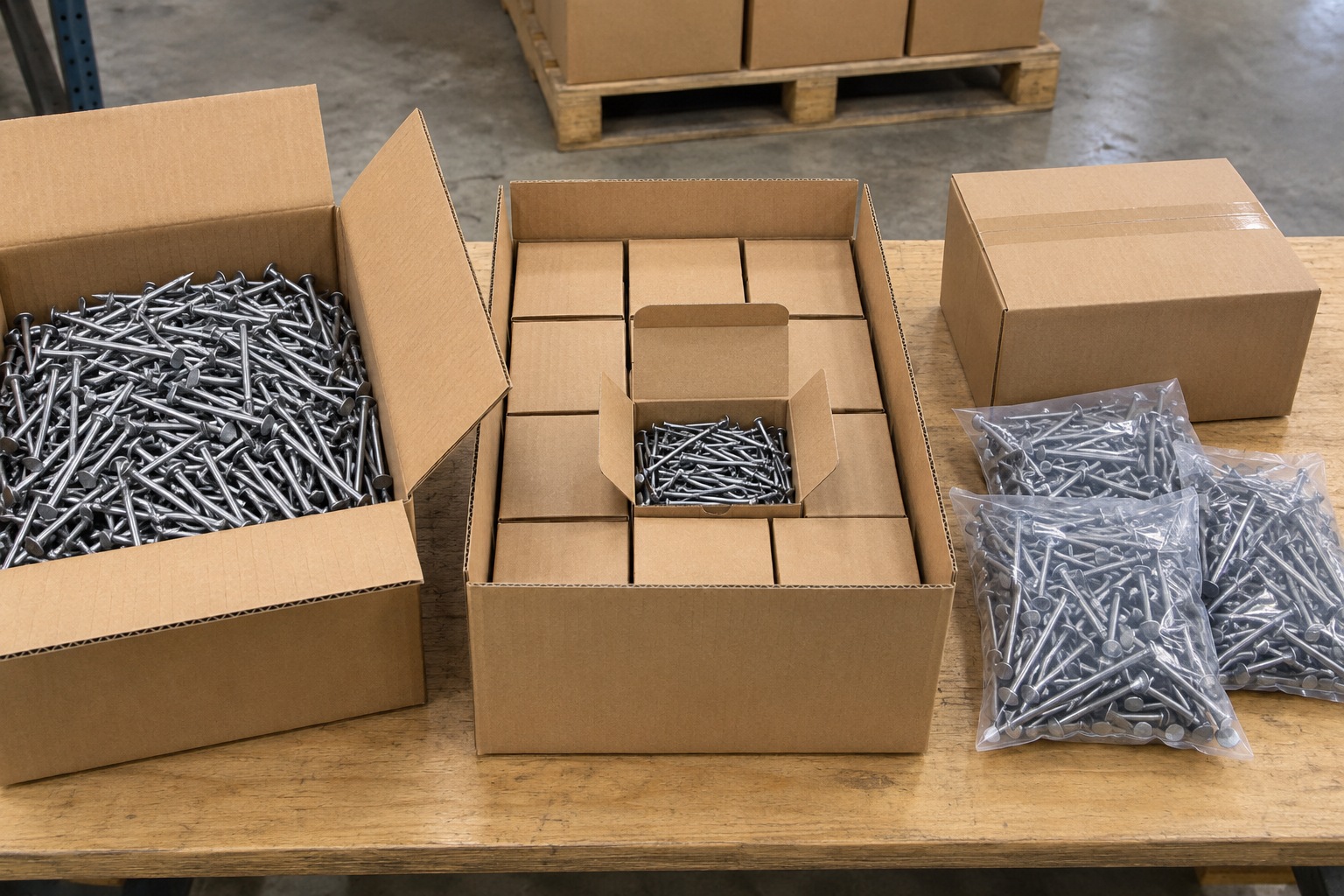
Packaging is part of the product in B2B nail buying. A good nail with the wrong carton, box count, or label may not fit the buyer’s distribution system. It may also create problems in storage, resale, container loading, and customer acceptance.
Packaging affects nails hardware procurement because it controls resale unit, carton strength, shipping efficiency, brand presentation, and warehouse handling.9 Buyers should confirm carton weight, small box count, label language, OEM design, pallet needs, and whether the shipment will move by FCL or LCL.
Bulk packing versus small box packing
Bulk packing is common for wholesale and construction supply channels. Small box packing is common when buyers sell through hardware stores or want private label presentation. Both options can work, but they serve different markets.
| Packaging type | Common use | Advantage | Buyer concern |
|---|---|---|---|
| Bulk carton | Wholesale distribution | Lower packing complexity | Carton strength and net weight must be clear |
| Small box + carton | Retail and hardware shops | Better resale presentation | Higher packing cost and design work |
| Plastic bag + carton | Some local resale channels | Flexible unit sizes | Bag quality and label style matter |
| OEM carton | Brand distribution | Supports private label | Artwork, MOQ, and printing details must be confirmed |
| Palletized packing | Easier warehouse handling | Better loading and unloading | Adds cost and affects container space |
Carton weight affects handling
Many buyers discuss 20 kg or 25 kg cartons. Some markets may prefer other carton weights. The right choice depends on worker handling habits, retail distribution, and shipping plan. A heavier carton can reduce carton count, but it may be harder to handle.10 A lighter carton may be easier to distribute, but it may increase packaging cost per ton.
I usually ask buyers:
- Do your customers buy by carton, box, or kilogram?
- Do local workers prefer 20 kg or 25 kg cartons?
- Do you need neutral cartons or printed brand cartons?
- Do you need inner boxes?
- Do you sell to wholesalers or retail shops?
- Will the shipment be full container or LCL?
These questions are commercial questions, not just packing questions.
OEM and ODM packaging details
For OEM or ODM orders, buyers should prepare brand details early. A supplier may need artwork, logo files, color references, carton marks, barcode details, and label language. If the buyer changes packaging after the price is confirmed, the quote may change.
Common OEM details include:
- Brand logo
- Carton color
- Product name
- Size marking
- Net weight and gross weight
- Country or importer marking if required
- Handling symbols
- Barcode or SKU information
- Inner box design
At 定州百斯特, we can support OEM/ODM requests, but I still treat packaging as a specification that must be confirmed before mass production. I prefer to confirm a packing sample or artwork preview when possible.
FCL and LCL planning
Sea shipping also affects packaging decisions. For large orders, buyers often use full container load, or FCL. For smaller trial orders, buyers may use less than container load, or LCL. Each method has different handling risks.11
Our usual MOQ is 5 tons or 200 boxes, and we support trial orders when the product and packing plan are clear. Lead time is usually 15–25 days, depending on order quantity and production schedule. These numbers are practical planning references, not universal rules.
For LCL shipments, cartons may be handled more often during consolidation. Strong carton quality becomes more important. For FCL shipments, loading plan and carton stacking matter. Buyers should discuss container loading, carton dimensions, and total weight with the supplier before final confirmation.
How should buyers prepare a reliable nails hardware FOB inquiry?
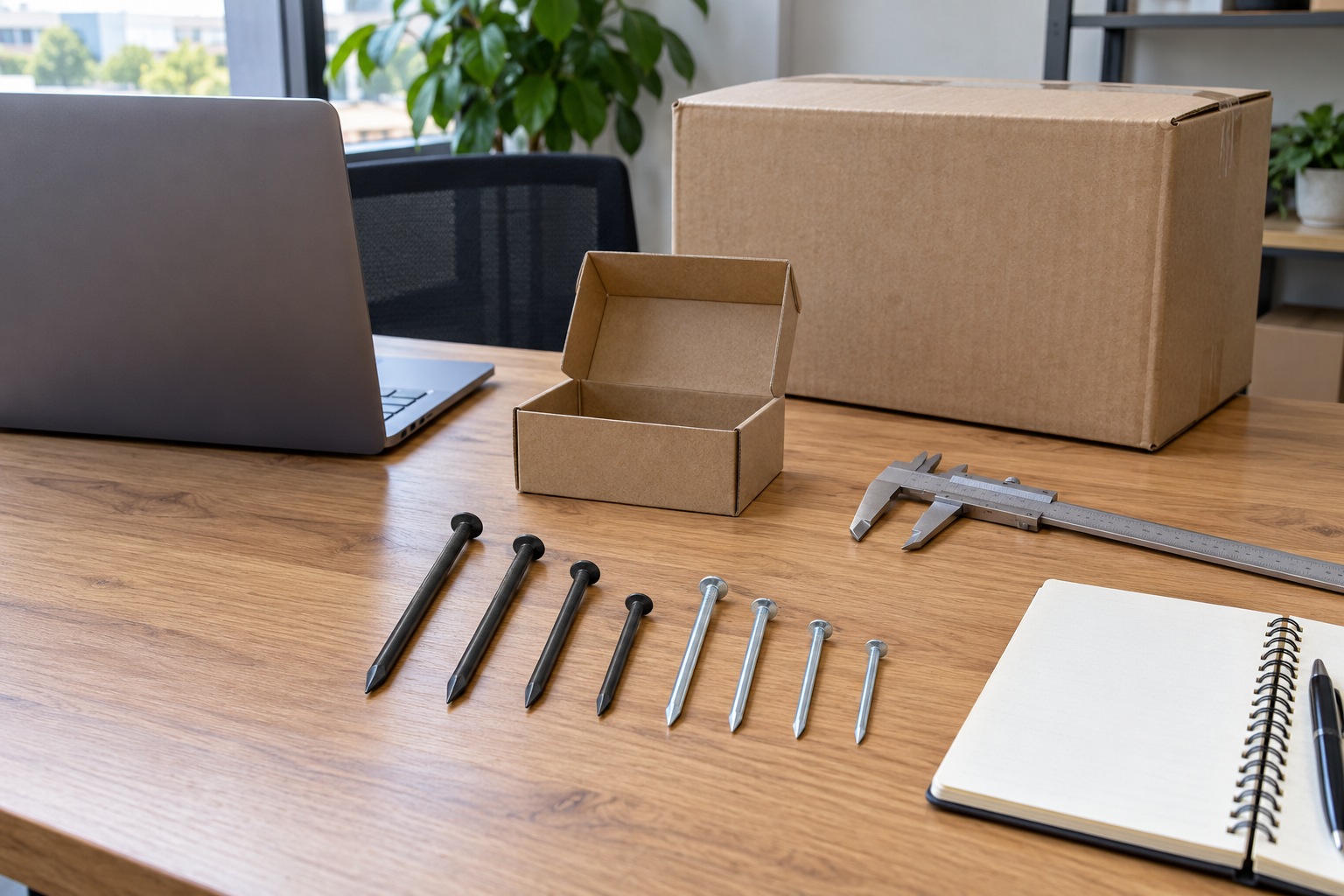
A vague inquiry usually produces a vague quotation. If a buyer sends only “Send price for nails,” the supplier must guess too many details. That wastes time and may lead to a quote that does not match the market or final order.
Buyers should prepare a reliable nails hardware FOB inquiry by listing product type, full size, finish, packing, quantity, destination context, OEM needs, and target market. A complete inquiry lets the supplier calculate a realistic price and helps the buyer compare offers on equal terms.
FOB price needs a clear product formula
For export nail orders, I often think of quotation as a formula:
Product + specification + quantity + packing method = workable FOB quotation
If one part is missing, the quote becomes less reliable. FOB pricing usually means the supplier quotes the goods cost and local export handling to the named port. It does not mean every overseas cost is included.12 Buyers should confirm the exact trade term and port with the supplier.
At 定州百斯特, our common quotation approach follows this logic:
- Product type
- Size and specification
- Quantity
- Packing method
- OEM or neutral packing
- FOB terms
- Production lead time
- Sample arrangement if needed
A strong inquiry template
Buyers can copy this format and adjust it:
| Inquiry field | Example |
|---|---|
| Product | Black steel nail |
| Size | 2 inch × 3.0 mm |
| Head | Flat head |
| Shank | Smooth shank |
| Finish | Black |
| Packing | 25 kg/carton, neutral carton |
| Quantity | 10 tons |
| Brand | No logo for first order |
| Destination market | West Africa wholesale market |
| Shipping | Sea freight, FCL or LCL to be discussed |
| Required documents | Commercial invoice, packing list, other documents to confirm |
| Sample | Need sample for quality checking |
This format makes supplier communication faster. It also shows that the buyer understands procurement details.
Sample checking before order
Samples are useful when a buyer wants to verify size, finish, packaging style, or market acceptance. I recommend sample checking when the buyer is importing a new product, changing supplier, or developing a private label.
Our sample policy allows samples for quality checking. Samples usually have a basic charge, and the charge can be discussed for return or adjustment in a formal order. This is a practical arrangement because sample preparation, packing, and courier handling still create real cost.
When checking samples, buyers should review:
- Length and diameter
- Head shape
- Shank style
- Finish consistency
- Nail straightness
- Packing style
- Carton or box printing
- Label accuracy
- Approximate weight per unit or carton
I do not suggest judging only by appearance. A product can look similar but differ in diameter, packing weight, or finish details.
Supplier selection points
Importers should evaluate suppliers as production partners, not only as price sources. A good supplier should help confirm specifications, explain packing options, and state lead time clearly. The supplier should also be honest when a buyer’s requested specification is unclear.
Useful supplier evaluation points include:
- Factory capability
- Export experience
- Product range
- MOQ flexibility
- Sample support
- OEM/ODM support
- Lead time control
- Packing quality
- Communication speed
- Clear FOB quotation format
We are a manufacturing factory and have overseas factory experience, but I still encourage buyers to verify supplier documents, samples, and order details before placing a large order. This protects both sides.
Markets we often discuss
Many of our inquiries come from the Middle East, Africa, Southeast Asia, and South America. In these markets, buyers often care about practical sizes, strong packaging, competitive FOB price, and flexible trial orders. However, I do not treat any one size as universally “best-selling” for every country. Local demand can change by region, customer group, and price level.
A buyer in one African market may want heavy cartons for wholesale. Another buyer in Southeast Asia may prefer smaller branded boxes. A South American importer may focus on a different finish or head style. This is why I always start with market use case before size selection.
Frequently Asked Questions
What is the most important detail when buying nails in bulk?
The most important detail is the full specification, not only the length. Buyers should confirm nail type, length, diameter or gauge, head style, shank, finish, packing, and quantity. This complete information helps suppliers quote accurately and helps buyers compare offers fairly.
Are inch sizes and millimeter sizes the same in nail orders?
They can describe the same length, but buyers should not assume they are always used the same way in local markets. For example, 2 inch is about 50.8 mm and may be discussed as 50 mm. Buyers should confirm the exact size with the supplier before production.
Why does packaging change the price of nails hardware?
Packaging changes price because cartons, inner boxes, printing, labels, palletizing, and carton strength all create cost. Packaging also affects resale and shipping. A private label small box is usually different in cost from bulk carton packing, even if the nail size is the same.
Can I order OEM nails with my own brand?
Yes, OEM and ODM packaging can usually be arranged when the product, artwork, quantity, and packing details are confirmed. Buyers should prepare logo files, carton design, label content, and brand requirements early. The supplier should confirm printing cost and production lead time before order.
Should I request samples before placing a full order?
I recommend samples when buyers are testing a new supplier, new nail type, new size, or private label packaging. Samples help check size, finish, head style, shank, and packing. Buyers should still confirm written specifications because a sample alone may not include every order detail.
Conclusion
Types of nails hardware and sizes should be chosen through a procurement process, not a simple size list. I recommend starting with local market demand, then confirming nail type, length, diameter, head, shank, finish, packaging, quantity, and FOB terms. This approach reduces quotation mistakes and makes supplier comparison fairer. If you are preparing a bulk nail inquiry for the Middle East, Africa, Southeast Asia, or South America, contact 定州百斯特 at [email protected] or WhatsApp +8618331061136 with your full specification and packing request.
-
"Threaded-nail Fasteners", https://digitalcommons.georgefox.edu/cgi/viewcontent.cgi?referer=&httpsredir=1&article=1039&context=mece_fac. Industry fastener standards and technical references specify nails using multiple dimensional and material attributes, indicating that length alone is not a complete basis for comparing nail products. Evidence role: general_support; source type: institution. Supports: A nail specification normally includes multiple characteristics such as length, diameter, head, shank, material, coating, and intended use.. Scope note: This would support the procurement principle generally; it would not prove that every supplier quotation error results from missing length-independent details. ↩
-
"Nail (fastener)", https://en.wikipedia.org/wiki/Nail_(fastener). Reference descriptions of nail fasteners distinguish nail types by use and form, showing that nominal length does not by itself determine whether a nail is common, roofing, finishing, or masonry-related. Evidence role: definition; source type: encyclopedia. Supports: Common, roofing, finishing, and masonry or concrete nails are distinct nail types that may be described by similar nominal lengths.. Scope note: The source would provide general classification context rather than a market-specific list of all 2-inch products. ↩
-
"Nail (fastener)", https://en.wikipedia.org/wiki/Nail_(fastener). General fastener references identify common nails, roofing nails, finishing nails, and masonry-related nails as distinct nail categories, supporting the article’s use of product-family classification. Evidence role: definition; source type: encyclopedia. Supports: Several listed categories, such as common nails, roofing nails, finishing nails, and masonry or concrete nails, are recognized nail types.. Scope note: The source may not use the exact commercial term “black steel nail” or treat the article’s list as exhaustive. ↩
-
"wire gages", https://nvlpubs.nist.gov/nistpubs/Legacy/circ/nbscircular67.pdf. Engineering references for cylindrical wire show that mass per unit length is determined by material density and cross-sectional area, so changes in nail-wire diameter directly affect material weight. Evidence role: mechanism; source type: education. Supports: For cylindrical wire products, mass per unit length depends on cross-sectional area, which increases with the square of diameter.. Scope note: This supports the weight and material-cost mechanism; customer perception and final pricing also depend on market and supplier-specific factors. ↩
-
"Fastener Overview — Nails", https://www.strongtie.com/products/fastening-systems/technical-notes/nails-overview. Fastener references commonly characterize roofing nails by a broad head used for securing roofing materials, supporting the distinction from ordinary common nails. Evidence role: definition; source type: institution. Supports: Roofing nails are commonly described as having broad or large heads designed to hold roofing materials, unlike standard common nails.. Scope note: Exact head diameter varies by standard, manufacturer, and market specification. ↩
-
"Woodworking", https://en.wikipedia.org/wiki/Woodworking. Reference definitions describe lost head nails as nails with small heads used where the head is intended to be unobtrusive after fixing. Evidence role: definition; source type: encyclopedia. Supports: Lost head nails are defined by a small or reduced head intended to be driven below or close to the wood surface for a less visible finish.. Scope note: The source would support the general product definition, while final visibility depends on installation method and surface material. ↩
-
"Smooth Shank, and Spiral, and Ring Shank Oh My …", https://mazenails.com/blog/smooth-shank-and-spiral-and-ring-shank-oh-my-choosing-the-right-nails-for-your-project/. Fastener reference materials define the shank as the main body of a nail and describe multiple shank styles used to alter installation or holding characteristics. Evidence role: definition; source type: institution. Supports: Technical fastener references describe the shank as the body of a nail and recognize different shank forms, including smooth, ringed, spiral, and fluted designs.. Scope note: The source would verify terminology and general function, not which shank style is preferred in a particular import market. ↩
-
"POWDER COATING OVER GALVANIZING", https://www.das.nh.gov/purchasing/docs/bids/attachments/attachment_2_bid_71-21.pdf. Technical descriptions of steel coating processes show that galvanizing and other surface treatments add preparation, coating, and finishing steps, which can contribute to product cost. Evidence role: mechanism; source type: institution. Supports: Surface treatments require additional process steps and materials, which can affect manufacturing cost for steel products.. Scope note: This supports the general cost mechanism; it does not quantify the price difference for a specific nail order. ↩
-
"Five Ways to Help Reduce Damage to Loads", https://www.packagingcorp.com/resource-hub/industry-insights/five-ways-to-help-reduce-damage-to-loads/. Packaging and logistics references describe packaging as serving containment, protection, handling, distribution, and information functions, supporting its relevance to procurement planning. Evidence role: general_support; source type: education. Supports: Packaging serves logistics functions such as containment, protection, handling, storage, transport efficiency, and product identification.. Scope note: The support is contextual and applies to packaged goods generally, not only to nails hardware. ↩
-
"Revised NIOSH Lifting Equation | Ergonomics", https://www.cdc.gov/niosh/ergonomics/about/RNLE.html. Government occupational-safety guidance identifies load weight as a principal factor in manual material-handling risk, supporting the article’s caution that heavier cartons can be more difficult to handle. Evidence role: expert_consensus; source type: government. Supports: Occupational safety guidance recognizes load weight as a key factor in manual handling difficulty and injury risk.. Scope note: The source would address handling risk, not the commercial calculation of carton count or packaging cost per ton. ↩
-
"Know Your Incoterms", https://www.trade.gov/know-your-incoterms. International freight references distinguish full container load from less-than-container-load shipment and describe LCL cargo as consolidated with other shipments, which can increase handling points. Evidence role: definition; source type: institution. Supports: FCL refers to a full container shipment, while LCL refers to consolidated cargo that shares container space and may involve additional consolidation handling.. Scope note: The source would support the logistics distinction; actual damage risk depends on carrier practices, packaging quality, and route. ↩
-
"Know Your Incoterms", https://www.trade.gov/know-your-incoterms. Incoterms guidance defines FOB as a trade term that allocates seller and buyer obligations at a named port of shipment, supporting the distinction between FOB price and total landed cost. Evidence role: definition; source type: institution. Supports: Under FOB Incoterms, seller and buyer responsibilities are divided at the named port or point according to the trade rule, and downstream costs are not all included in the seller’s price.. Scope note: FOB obligations depend on the specific Incoterms version and the named place agreed in the contract. ↩