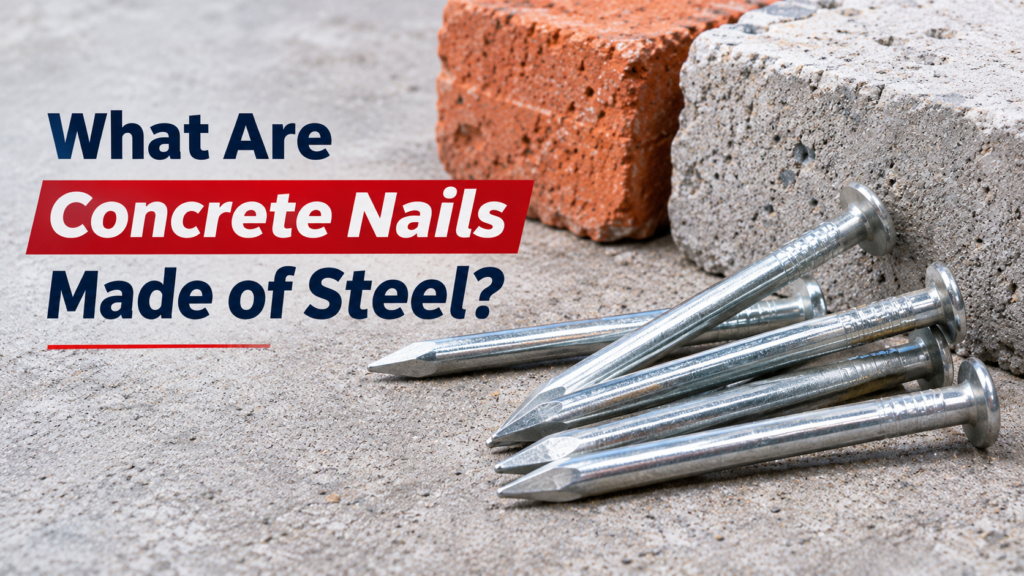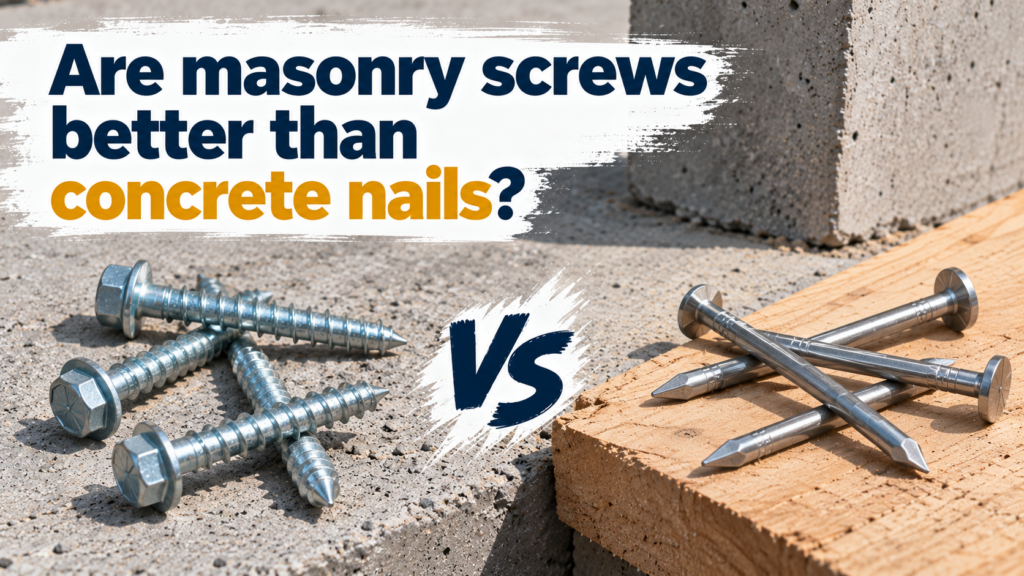
Concrete nails are used when buyers need a hard-steel fastening option for fixing wood or light building materials to concrete, brick, or masonry surfaces. The problem is that many customers treat them like universal fasteners. That creates wrong expectations, returns, and poor repeat sales. The better approach is to match the nail to the actual job, load, and resale market.
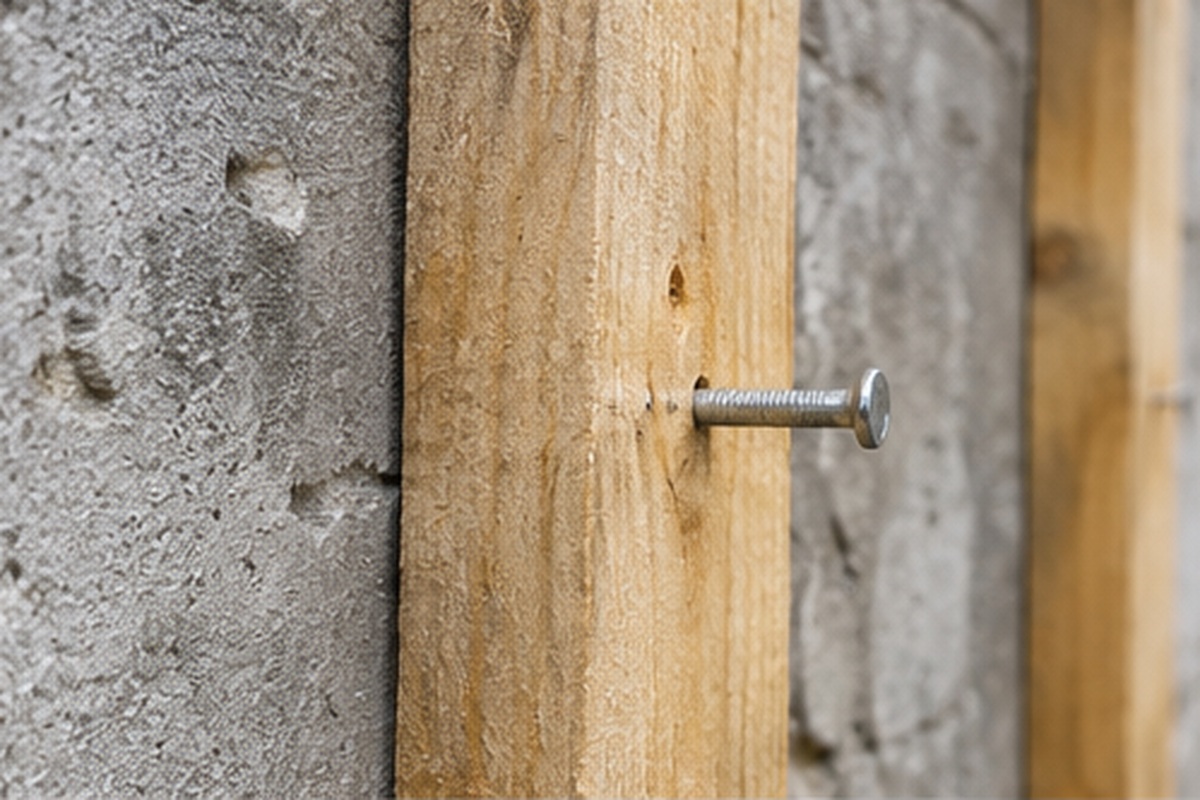
Concrete nails are mainly used to fasten wood strips, wooden battens, wooden frames, temporary formwork pieces, and light construction materials to hard substrates such as concrete, brick, or masonry.1 They are suitable for positioning, repair, and general fixing tasks, but they should not replace anchors, expansion bolts, or screws for heavy-load structural fastening.2
I sell concrete nails to wholesale, import, and hardware retail buyers, so I usually look at this question from the purchasing side. The real issue is not only “where can customers use them?” It is also “which sizes, finishes, packages, and local preferences create repeat orders?”
What are concrete nails used for in construction and repair?
Concrete nails are useful when ordinary nails bend too easily on hard surfaces. The problem appears when customers expect one fastener to solve every fixing need on concrete. That expectation can lead to breakage, poor holding, or unsafe use. A clearer use range helps buyers stock them more responsibly.
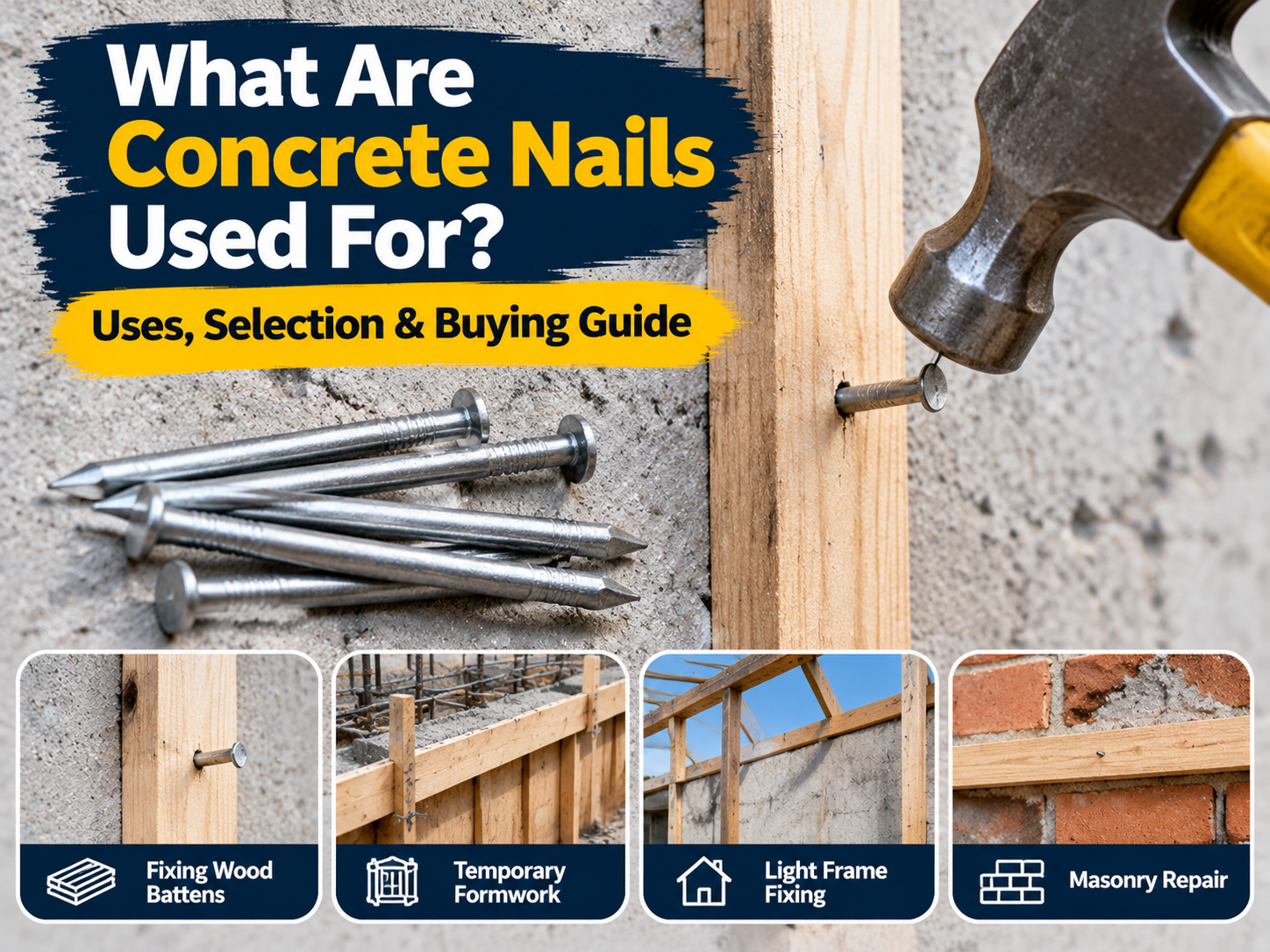
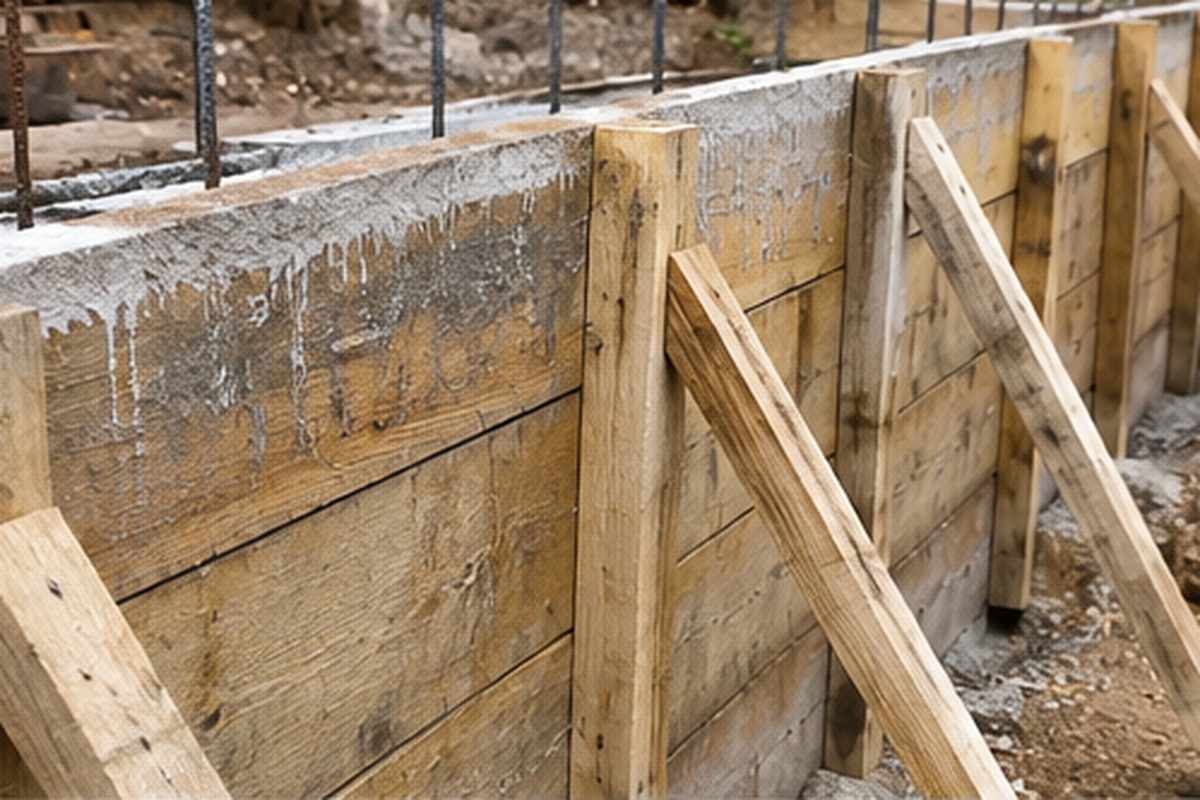
Concrete nails are commonly used for fixing wood strips, wood battens, light frames, temporary formwork, and repair materials to concrete, brick, and masonry. They are best for light to medium positioning and fastening tasks, not for structural loads, suspended systems, or long-term heavy-duty anchoring.
Common practical uses
In my experience as a manufacturer and supplier, the strongest repeat demand comes from markets where contractors and retail customers need simple, low-cost fasteners for daily building work. These are usually not complex engineering applications. They are common site and repair tasks.
Typical uses include:
- Fixing wooden battens to walls
- Attaching wood strips to concrete or brick
- Positioning temporary formwork pieces
- Securing light timber frames during construction
- General repair work on masonry surfaces
- Temporary fixing before a more permanent system is installed
- Light-duty fastening in renovation and maintenance jobs
Concrete nails are made from hardened steel, so they can enter harder substrates better than ordinary low-carbon nails.3 However, substrate condition still matters. A very dense concrete surface, an old brittle brick wall, or a stone surface with uneven hardness can change performance. That is why I avoid telling buyers that one nail works for every concrete, brick, or masonry job.
How buyers should describe the use case
When a wholesaler or importer asks me for a quote, I prefer to know the end use. A simple description helps narrow the product:
| Buyer’s customer need | Suitable product direction | What to verify |
|---|---|---|
| Fixing wood strips to masonry | Standard concrete nail | Length, diameter, finish |
| Temporary formwork positioning | Concrete nail with suitable shank strength | Nail size and ease of removal |
| General repair work | Black or galvanized concrete nail | Local rust-resistance needs |
| Retail hardware resale | Small box or branded pack | Label language and box strength |
| Bulk contractor supply | Carton or bulk packing | Weight per carton and handling |
This is where B2B buying becomes more practical. A retailer does not only sell a nail. The retailer sells a solution that a local contractor understands quickly. If the product is packed in the right size and labeled with the right application, it becomes easier to sell and easier to reorder.
I usually remind buyers that “used for concrete” does not mean “used for every load on concrete.”
That small difference prevents many misunderstandings.
When should buyers choose concrete nails instead of ordinary nails?
Ordinary nails are easy to buy, but they are often too soft for hard substrates. The problem is simple: if a nail bends during installation, the user loses time and confidence. Concrete nails solve part of this issue because they are harder and designed for masonry-type fixing.
Buyers should choose concrete nails instead of ordinary nails when the job involves fastening wood or light materials to concrete, brick, or masonry. They are more suitable than common nails for hard substrates, but the buyer should still consider load, surface condition, nail size, and expected service life.
The practical difference
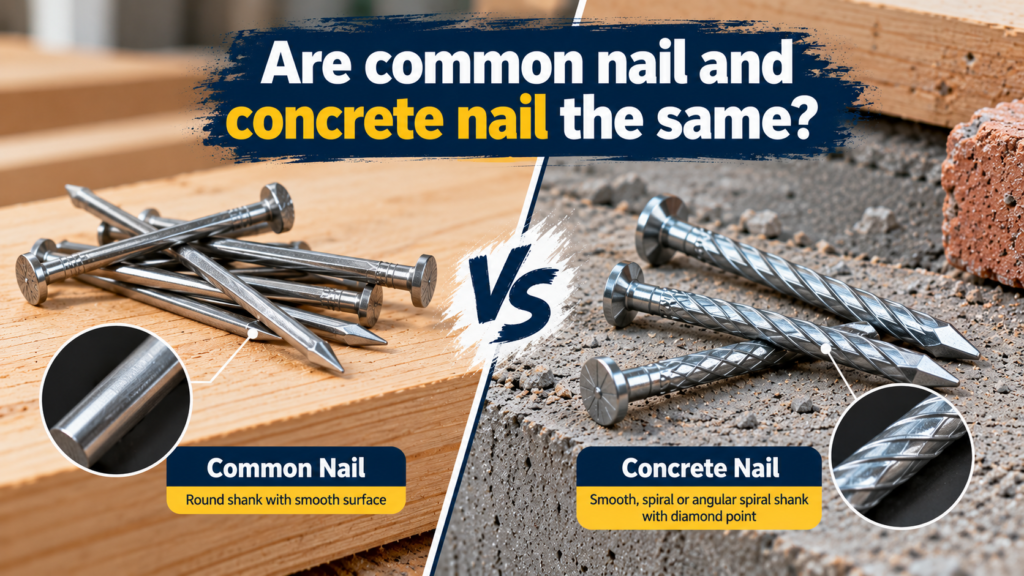
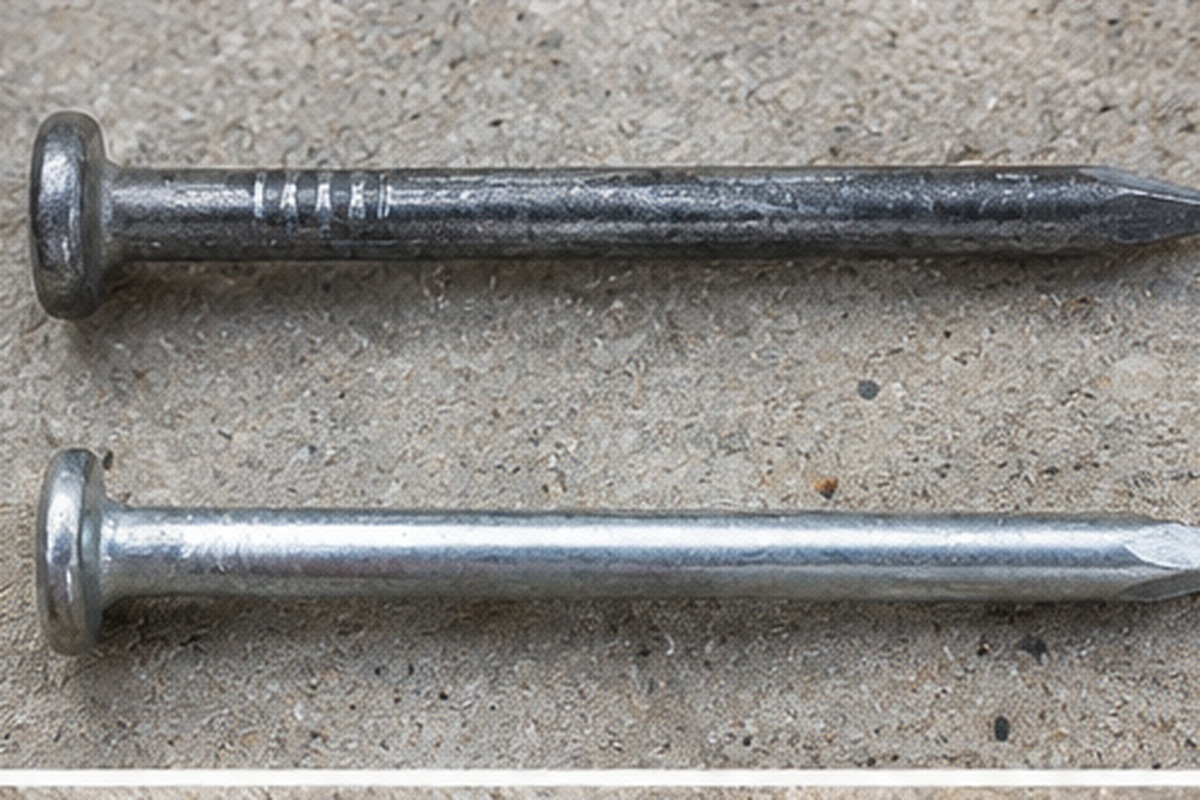
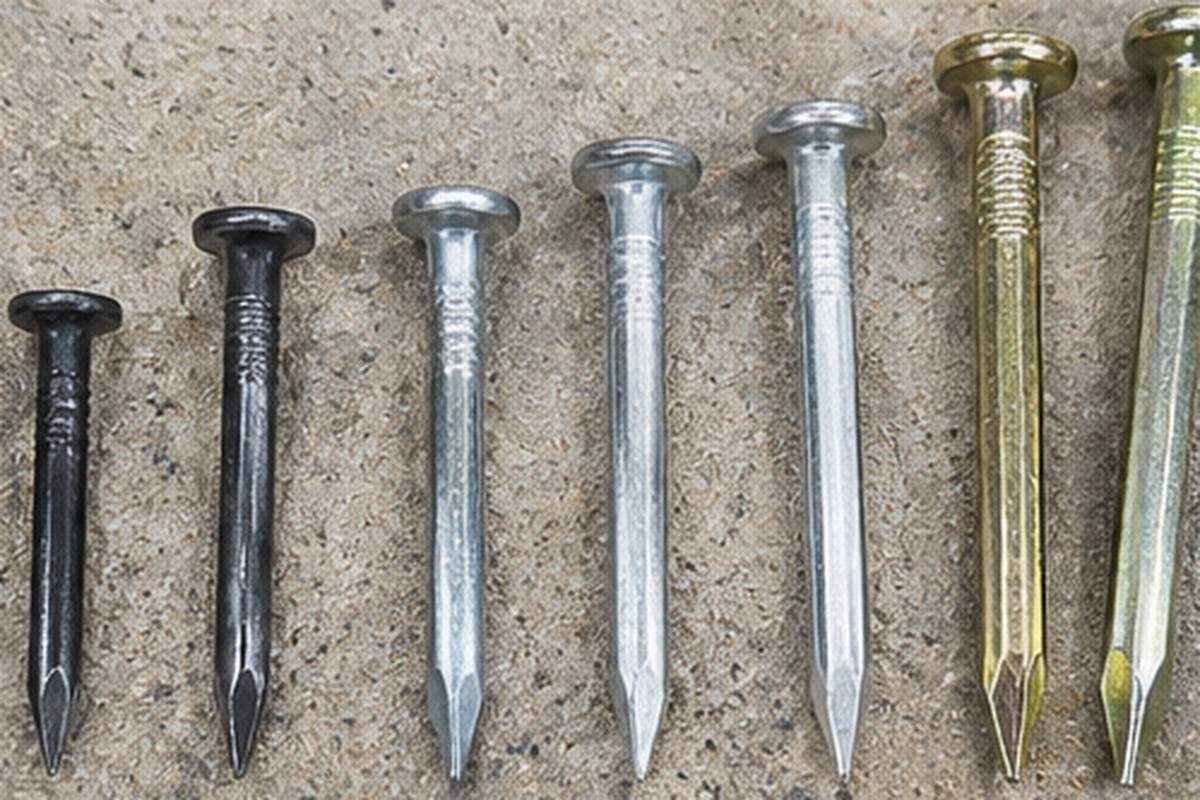
Concrete nails are usually manufactured from harder steel than ordinary nails. This gives them better resistance to bending when driven into hard surfaces. Some are fluted or grooved to improve grip.4 Some are black, bright, or galvanized depending on the target market and storage conditions.
Ordinary nails are commonly used for wood-to-wood work. They perform well when the substrate allows the shank to enter without excessive resistance. Concrete, brick, and masonry are different. They push back harder. If the nail is too soft, it may bend, mushroom at the head, or fail to enter properly.
Here is a simple comparison:
| Feature | Concrete nails | Ordinary nails |
|---|---|---|
| Main material use | Wood/light material to masonry | Wood-to-wood fixing |
| Steel hardness | Higher | Lower |
| Substrate suitability | Concrete, brick, masonry | Timber and soft materials |
| Typical risk | Breakage if misused or overloaded | Bending on hard surfaces |
| Heavy-load use | Not recommended | Not recommended |
| Retail positioning | Masonry fastening product | General carpentry product |
What “harder” does and does not mean
Harder does not mean unlimited strength. A concrete nail may be harder than an ordinary nail, but it is still a nail. It does not expand inside the hole like an expansion bolt.5 It does not provide the same engineered holding system as a mechanical anchor. It does not replace screws and plugs where the application requires controlled holding power.
That distinction is important for wholesalers. If a retail customer asks for something to hang a heavy gate, a suspended ceiling, a large bracket, or structural timber, concrete nails are not the right recommendation. A suitable anchor, bolt, or engineered fastening system should be evaluated by a qualified professional.
Why this matters for repeat orders
I have seen that repeat buyers often care less about the cheapest nail and more about the nail that matches local habits. In some markets, customers prefer black concrete nails because they recognize them as strong construction fasteners. In other markets, galvanized nails sell better because buyers worry about rust during storage or transport.
Common purchasing factors include:
-
Nail size range
Shorter lengths may suit light battens and thin strips. Longer lengths may suit thicker wood pieces, but they also require more installation effort. -
Surface finish
Black finish, bright finish, and galvanized finish each serve different price and market expectations. -
Head shape and shank design
Local users may already prefer a familiar type. Changing that too quickly can affect sales. -
Packaging style
Small boxes support retail resale. Bulk cartons support contractors and wholesalers.
The best product choice is not only technical. It is also commercial.
What applications are not suitable for concrete nails?
Concrete nails can be useful, but they also have limits. The problem starts when customers treat them as a replacement for anchors or bolts. That can create risk in heavy-load or long-term fixing. A responsible buyer should know where the product should not be recommended.
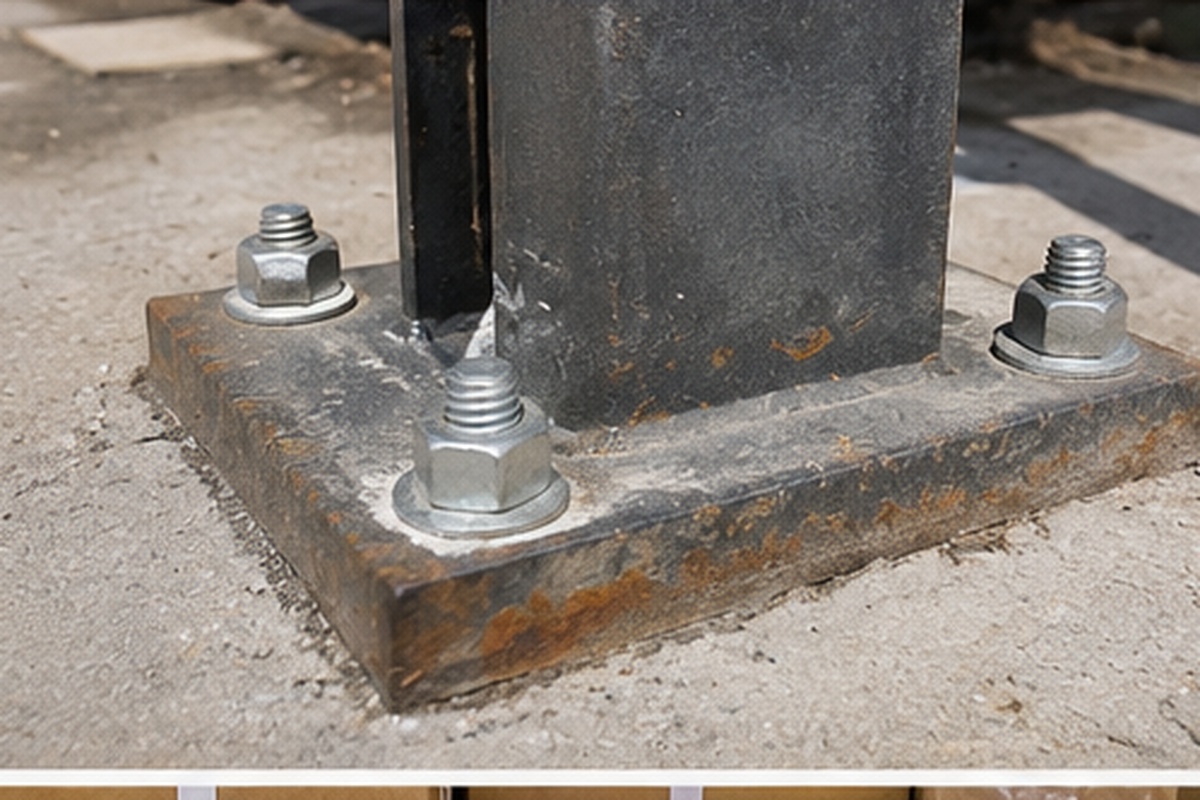
Concrete nails are not suitable for heavy structural fastening, suspended loads, safety-critical installations, or applications that require engineered pull-out values. They should not replace expansion bolts, anchors, screws with plugs, or other fastening systems designed for higher load control and long-term structural performance.
Uses buyers should treat carefully
I keep this point clear with importers because it protects both sides. Concrete nails are useful products, but they are not engineering anchors. If the end user needs verified load performance, corrosion ratings, or code-compliant fastening, the application should be reviewed by a qualified professional.
Concrete nails are generally not the right choice for:
- Heavy shelves or brackets
- Suspended ceilings
- Safety railings
- Structural timber connections
- Machinery fixing
- Large metal frames
- Outdoor load-bearing systems
- Installations exposed to vibration
- Applications requiring certified pull-out values
This does not mean concrete nails are weak or poor quality. It means every fastening product has an intended range. A small nail and an expansion bolt are different tools.
Why heavy-load fixing is different
Heavy-load fixing requires more than penetration. It requires a controlled holding mechanism. Expansion bolts expand inside a drilled hole. Anchors are selected by load, base material, embedment depth, edge distance, and installation method.6 Screws with plugs may provide better control for certain wall materials.
Concrete nails rely on being driven into the substrate. Their holding depends on many variables:
| Factor | Why it matters |
|---|---|
| Concrete density | Dense concrete can resist entry or cause breakage7 |
| Brick quality | Soft or brittle brick may crack or crumble8 |
| Nail diameter | Thicker nails may hold better but need more driving force |
| Nail length | Longer nails may improve embedment but are harder to install |
| Installation angle | Poor angle can reduce holding and damage the surface |
| Load direction | Pull-out, shear, and vibration behave differently9 |
| Surface finish | Coating may affect corrosion resistance and appearance |
Because these variables change from site to site, I avoid making broad performance promises. A buyer can evaluate product consistency, hardness, packing, and finish. But application-specific safety decisions should be handled by qualified engineers or experienced construction professionals.
The buyer’s responsibility in product positioning
For B2B buyers, the product listing should be clear. A good carton label or retail box can say that the nails are for fixing wood to concrete, brick, or masonry. It should not imply that they are for all heavy-duty fixing.
A responsible sales description may say:
- “For fixing wood strips to concrete and masonry surfaces”
- “Suitable for general construction and repair use”
- “For light-duty fastening and positioning”
- “Select size according to substrate and material thickness”
A risky description may say:
- “For all concrete fixing”
- “Replaces anchors”
- “Heavy-duty structural fastener”
- “Suitable for any load”
Clear wording reduces disputes. It also helps retailers train their sales staff. When a product is sold through hardware shops, the label may be the only “salesperson” available at the shelf.
How should wholesalers select concrete nails for local market demand?
Wholesalers often know that concrete nails sell, but they may not know which specifications to stock first. The problem is that a wide size range can create slow-moving inventory. A better purchasing plan connects common applications, local installation habits, packaging style, and price level.
Wholesalers should select concrete nails by matching nail length, diameter, finish, packaging, and branding to local demand. They should start with common sizes for wood-to-masonry fixing, confirm sample quality, test resale packaging, and avoid overstocking unusual specifications before repeat demand is proven.
Start with the customer’s actual job
A wholesale buyer should first ask, “What are my customers fixing?” If local customers mostly fix small wood strips to masonry walls, then short and medium sizes may move faster. If contractors use nails for temporary formwork, they may prefer a different length, stronger shank, or bulk packing.
Common selection points include:
- Length: often selected according to wood thickness and required embedment
- Diameter: affects strength, ease of driving, and substrate damage risk
- Head type: affects holding and user familiarity
- Shank type: smooth, fluted, or grooved designs may suit different preferences
- Finish: black, bright, or galvanized depending on price and corrosion concerns
- Packing: small retail boxes, master cartons, or bulk contractor packing
A practical stocking table
The exact specification depends on the market, but the purchasing logic is usually similar.
| Stocking decision | Best for | Buyer note |
|---|---|---|
| Small boxes | Retail hardware shops | Easier shelf display and resale |
| Bulk cartons | Contractors and wholesalers | Lower packaging cost per kg |
| Black finish | Price-sensitive construction markets | Common in many developing markets |
| Galvanized finish | Humid storage or outdoor resale channels | Better rust resistance expectation |
| OEM brand packing | Importers and distributors | Helps build repeat customer recognition |
| Mixed size range | Retail channels | Useful if demand is broad |
| Focused size range | Project or contractor supply | Reduces slow inventory |
At Dingzhou Best, we usually quote FOB based on product, specification, quantity, and packaging method. That is important because a 25 kg bulk carton and a branded small-box order do not have the same cost structure. Packaging material, printing, labor, and carton strength all affect the final price.
Use samples before scaling orders
For new buyers, I prefer a sample-based process. Samples can be used for buyer inspection and market checking. In our usual policy, samples may carry a basic fee, and that fee can be discussed for return or adjustment in a formal order. This is more practical than relying only on photos.
A simple sample review can check:
- Appearance consistency
- Head shape
- Shank straightness
- Finish quality
- Packing strength
- Label accuracy
- Size tolerance by buyer requirement
This is not the same as certified engineering testing. It is a procurement quality check. If the buyer has special performance requirements, they should use qualified testing or professional evaluation.
Think about regional demand
Our main sales regions include the Middle East, Africa, Southeast Asia, and South America. I have noticed that demand patterns can be different across these markets. Some buyers focus strongly on price and fast-moving sizes. Some care more about branded packaging because retail competition is high. Some need stronger cartons because transport and handling conditions are rough.
For that reason, I usually do not recommend that a new importer buys every size at once. A trial order is often smarter. We support trial orders, and our general MOQ is 5 tons or 200 boxes, depending on the order structure. Standard delivery is usually 15–25 days, adjusted by quantity and packaging details.
Which packaging and customization choices help concrete nails sell better?
A good concrete nail can still sell slowly if the packaging does not fit the channel. The problem is that wholesalers sometimes choose only by unit price. Then cartons break, labels do not match the market, or retailers cannot display the product well. Better packaging improves resale and repeat orders.
Concrete nails sell better when packaging matches the sales channel. Retail shops often prefer small branded boxes, clear labels, and strong outer cartons. Contractors may prefer bulk packing. Importers can use OEM or ODM customization for brand logos, local languages, size markings, and market-specific carton designs.
Packaging is part of the product
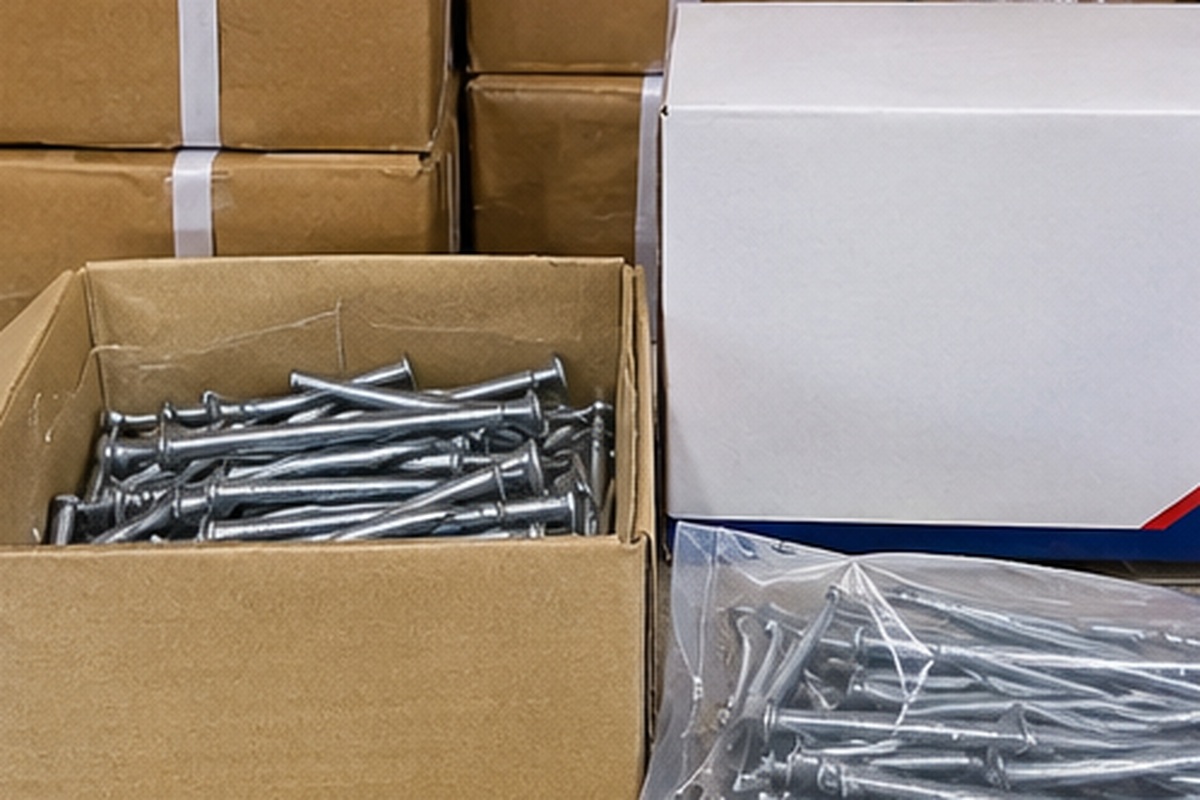
In B2B hardware trade, packaging is not decoration. It affects handling, shelf presentation, product protection, and customer trust. A box that breaks during transport creates complaints even when the nail quality is acceptable.10 A label without clear size information slows retail sales.11
Common packaging options include:
- Bulk carton packing
- Small box packing
- Plastic bag plus carton
- Branded retail box
- Private label carton
- Mixed specification packing by request
For importers, packaging also supports brand memory. If a customer buys one box, likes the nail, and remembers the brand, the retailer has a better chance of repeat sales.
What should be printed on the box?
A clear retail or wholesale label may include:
| Label item | Why it matters |
|---|---|
| Product name | Helps customers identify the fastener quickly |
| Size | Reduces wrong purchase and returns |
| Quantity or weight | Supports transparent resale |
| Finish | Helps customers compare black, bright, or galvanized options |
| Brand logo | Builds importer or retailer recognition |
| Country or factory information | Depends on buyer and market requirement |
| Use description | Helps position the product correctly |
| Safety note | Helps avoid misuse for heavy-load applications |
I often suggest simple wording for application use. For example, “for fixing wood to concrete, brick, and masonry” is clear. I would avoid exaggerated wording such as “for all construction fixing.” Accurate packaging protects the buyer’s reputation.
Customization and procurement planning
At Dingzhou Best, we support OEM/ODM customization, including product selection, packaging, and brand logo. This is useful for importers who already have a local hardware brand or retailers who want private-label shelf products.
However, customization should follow a plan. A buyer should confirm:
-
Target channel
Is the product for wholesalers, contractors, or retail shops? -
Preferred package size
Does the market buy by box, carton, kilogram, or piece count? -
Local language needs
Does the label need Arabic, French, Spanish, Portuguese, or another language? -
Transport method
Will the order ship by FCL or LCL? We support both full container load and less-than-container load by sea. -
Carton strength
Will the goods face long storage, multiple handling points, or inland transport? -
Branding goal
Does the buyer want low-cost resale or long-term brand recognition?
Price is not only the nail
The final FOB quotation usually depends on:
- Product type
- Nail specification
- Order quantity
- Surface treatment
- Packaging method
- Custom printing requirement
- Carton quality
- Delivery schedule
This is why I ask detailed questions before quoting. A buyer may request a low price, but the market may actually need stronger boxes or clearer labels. If packaging fails, the “cheap” order becomes expensive after complaints and damaged goods.
Frequently Asked Questions
Are concrete nails only used in concrete?
No. Concrete nails are often used on concrete, brick, and masonry surfaces, depending on the substrate condition. They are mainly for fixing wood or light building materials to hard surfaces. Buyers should not assume they work equally well on every type of stone, block, or dense concrete.
Can concrete nails replace expansion bolts?
No. Concrete nails should not be positioned as replacements for expansion bolts, anchors, or other heavy-duty fixing systems. Expansion bolts and anchors are designed for specific load requirements. Concrete nails are better suited for light fixing, positioning, temporary work, and general repair applications.
What finish is best for concrete nails?
The best finish depends on the market and storage conditions. Black concrete nails are common in many price-sensitive construction markets. Galvanized concrete nails may be preferred where buyers expect better rust resistance.12 Importers should test local demand before committing to a large customized order.
What information should I provide for a concrete nail quotation?
You should provide the product type, size, quantity, surface finish, packaging method, and any OEM branding requirements. For FOB quotations, these details affect the final price. It also helps to explain your sales channel, such as wholesale, contractor supply, or retail hardware resale.
Can I order samples before buying in bulk?
Yes. Samples can usually be provided for quality checking and market evaluation. In our case, samples normally carry a basic fee, and that fee can be discussed for return or adjustment in a formal order. Buyers should use samples for procurement review, not as a substitute for certified engineering testing.
Conclusion
Concrete nails are used for fixing wood strips, battens, frames, temporary formwork pieces, and light materials to concrete, brick, and masonry surfaces. They are practical fasteners, but they are not universal concrete solutions and should not replace anchors or expansion bolts for heavy-load work. For wholesalers, importers, and hardware retailers, the best choice depends on size, finish, packaging, resale channel, and local demand. If you need concrete nails for your market, contact Dingzhou Best at [email protected] or WhatsApp +8618331061136 for samples, OEM/ODM packaging, and FOB quotation support.
-
"Concrete and Masonry Fasteners", https://www.concretefasteners.com/diy-articles-concrete-and-masonry-fasteners/?srsltid=AYCX9vIBgMzV2ECoqXYyKlwOZxAArMT-xTFoNGKLh9ZZIzE_7WLlh7s9. Neutral fastener references describe concrete or masonry nails as hardened-steel nails intended for fastening materials such as wood to concrete or masonry substrates; this supports the stated use range, though exact suitability depends on nail size and base-material condition. Evidence role: definition; source type: encyclopedia. Supports: Concrete or masonry nails are hardened fasteners used to attach materials such as wood to concrete or masonry.. Scope note: The support is definitional and does not verify every listed application or substrate condition. ↩
-
"5.51 ANCHORAGE TO CONCRETE: CAST-IN ANCHORS", https://dot.ca.gov/-/media/dot-media/programs/engineering/documents/bridgedesignmemos/05/202108-bdm0551-anchoragetoconcrete-castinanchors-a11y.pdf. Concrete anchorage standards and evaluation criteria treat structural fastening as an engineered design problem involving load resistance, embedment, base material, and installation conditions; this supports the warning that concrete nails should not be presented as substitutes for structural anchors or expansion bolts. Evidence role: expert_consensus; source type: institution. Supports: Structural concrete anchorage is designed and evaluated using load, embedment, base material, and installation criteria, unlike simple driven nails.. Scope note: The source would support the engineering distinction generally, not test the specific concrete nails sold by the article’s author. ↩
-
"Mechanical Properties of Cold-Drawn Low Carbon Steel …", https://www.academia.edu/15941466/Mechanical_Properties_of_Cold_Drawn_Low_Carbon_Steel_for_Nail_Manufacture_Experimental_Observation. Materials-science references explain that increasing steel hardness improves resistance to plastic deformation, which is consistent with hardened concrete nails bending less readily than low-carbon common nails when driven into hard substrates. Evidence role: mechanism; source type: education. Supports: Higher steel hardness increases resistance to bending or deformation when driven into hard materials.. Scope note: The source would explain the material mechanism but would not by itself prove performance for every nail geometry or concrete type. ↩
-
"Withdrawal strength of ring-shank nails embedded in southern …", https://research.fs.usda.gov/treesearch/25675. Experimental fastener studies report that deformed nail shanks, including ringed or grooved profiles, can increase withdrawal resistance by improving mechanical interlock with the surrounding material; this provides contextual support for the claim that fluted or grooved shanks improve grip. Evidence role: mechanism; source type: paper. Supports: Surface features such as rings, grooves, or deformations on nail shanks can increase mechanical interlock and withdrawal resistance.. Scope note: Many nail-withdrawal studies focus on wood or specific test materials, so the evidence is contextual rather than direct proof for all concrete-nail applications in masonry. ↩
-
"Anchor bolt", https://en.wikipedia.org/wiki/Anchor_bolt. Standard descriptions of expansion anchors state that they develop holding force by expanding against the sides of a drilled hole, distinguishing their mechanism from driven nails that rely on penetration and frictional or mechanical resistance. Evidence role: mechanism; source type: encyclopedia. Supports: Expansion bolts and expansion anchors develop holding force by expanding against the wall of a drilled hole.. ↩
-
"5.51 ANCHORAGE TO CONCRETE: CAST-IN ANCHORS", https://dot.ca.gov/-/media/dot-media/programs/engineering/documents/bridgedesignmemos/05/202108-bdm0551-anchoragetoconcrete-castinanchors-a11y.pdf. Concrete anchor design provisions identify load effects, concrete or masonry base material, embedment depth, spacing and edge distance, and installation conditions as variables affecting anchor capacity, supporting the article’s list of anchor-selection factors. Evidence role: expert_consensus; source type: institution. Supports: Concrete anchor design and selection require consideration of loads, base material properties, embedment, spacing or edge distances, and installation conditions.. ↩
-
"Penetration resistance of concrete- a review", https://www.govinfo.gov/content/pkg/GOVPUB-C13-efb3647f0f6de8ae6e7bc77a5f652153/pdf/GOVPUB-C13-efb3647f0f6de8ae6e7bc77a5f652153.pdf. Research and technical guidance on fastener installation in concrete indicate that base-material strength and density affect penetration resistance and installation stresses, which supports the statement that dense concrete can resist entry or contribute to fastener failure. Evidence role: mechanism; source type: research. Supports: Concrete strength or density influences fastener penetration and the stresses experienced during installation.. Scope note: Evidence from powder-actuated or tested concrete fasteners may be only partially transferable to hand-driven concrete nails. ↩
-
"Common Problems with Brick Masonry", https://www.nps.gov/articles/common-problems-with-brick-masonry.htm. Masonry conservation and construction guidance notes that weak, deteriorated, or brittle brick can fracture or crumble under drilling or anchorage stresses, supporting the caution that brick condition affects concrete-nail performance. Evidence role: mechanism; source type: education. Supports: Weak, deteriorated, or brittle masonry can fracture, crack, or crumble when subjected to drilling or fastening stresses.. Scope note: The support is strongest for deteriorated or historic masonry and may not describe all modern brick products. ↩
-
"Experimental Analysis of Thread Movement in Bolted …", https://ntrs.nasa.gov/api/citations/19950018571/downloads/19950018571.pdf. Fastener and anchorage studies distinguish tensile pull-out, shear loading, and cyclic or vibration effects as separate performance conditions with different failure mechanisms, supporting the article’s warning that load direction and vibration cannot be treated as equivalent. Evidence role: mechanism; source type: paper. Supports: Fasteners are evaluated differently under tensile pull-out, shear, and cyclic or vibration loads because these modes produce different stresses and failure mechanisms.. ↩
-
"Assessing Consumer Preference for Overpackaging Solutions …", https://pmc.ncbi.nlm.nih.gov/articles/PMC8345421/. Packaging and logistics research links inadequate distribution packaging with transport damage and adverse customer responses, supporting the article’s claim that a broken box can create complaints even when the fastener itself is acceptable. Evidence role: general_support; source type: paper. Supports: Packaging damage during distribution can increase product damage, complaints, or negative customer perception.. Scope note: The evidence is general to packaged goods and logistics, not specific to concrete nails. ↩
-
"The Impact of Interpretive Packaged Food Labels on … – PMC", https://pmc.ncbi.nlm.nih.gov/articles/PMC9690506/. Consumer-packaging studies find that clear product information on labels reduces uncertainty and assists purchase decisions, providing contextual support for the statement that unclear size information can hinder retail sales. Evidence role: general_support; source type: paper. Supports: Clear product information on packaging helps consumers evaluate products and make purchase decisions.. Scope note: The support is based on general retail and packaging research, not a direct study of concrete-nail sales. ↩
-
"Best Practices for Corrosion Control and Mitigation", https://highways.dot.gov/media/51611. Government corrosion-control guidance describes galvanized zinc coatings as providing barrier and sacrificial protection for steel, supporting the article’s statement that galvanized nails may be preferred where rust resistance is expected. Evidence role: mechanism; source type: government. Supports: Zinc galvanizing protects steel from corrosion by acting as a barrier and sacrificial coating.. Scope note: The source would support the corrosion mechanism generally, while actual nail durability depends on coating thickness, exposure, damage during installation, and storage conditions. ↩