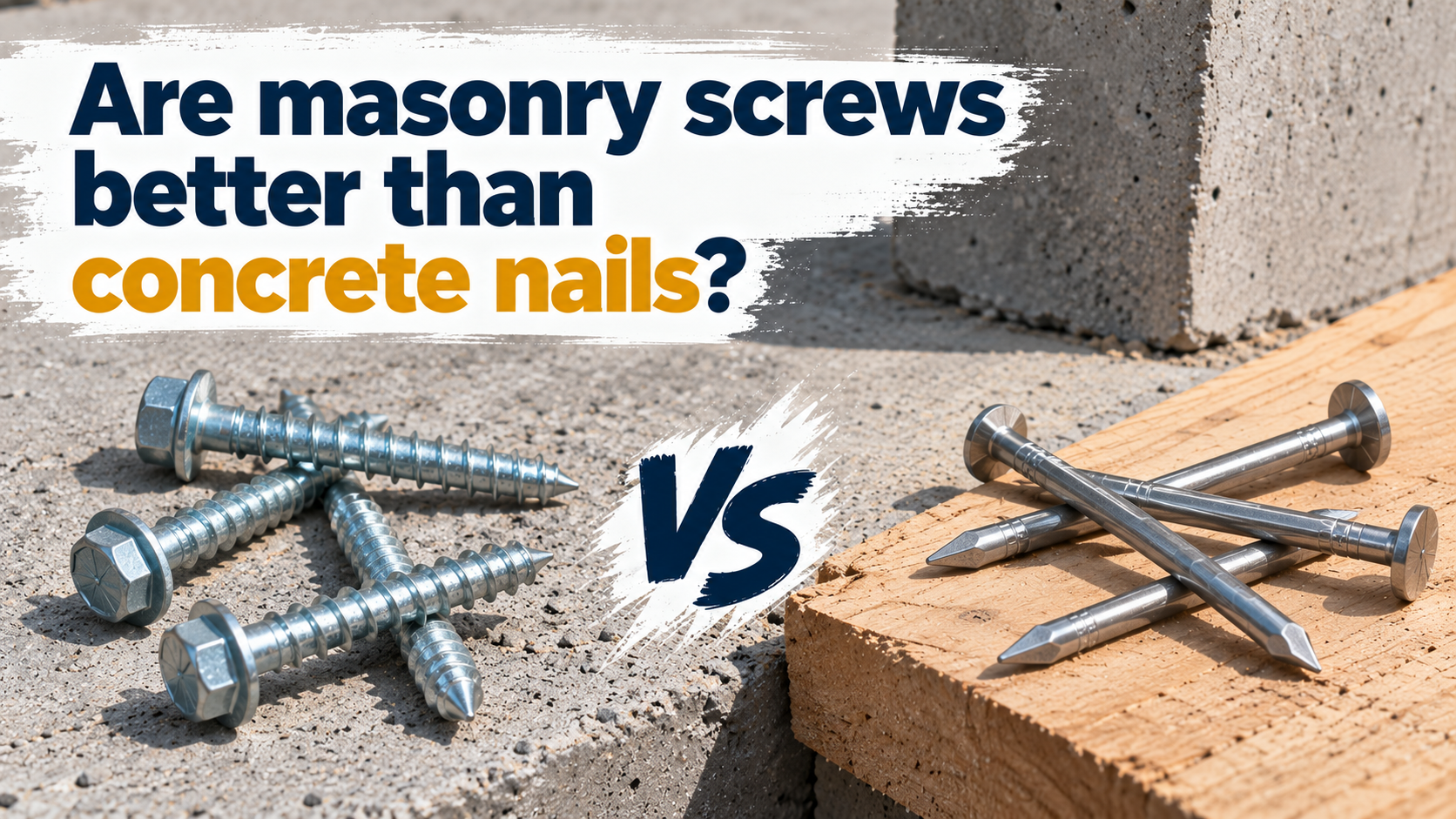
Masonry screws are often compared with concrete nails when buyers want a reliable fixing product for concrete, brick, or block. The problem is that “better” sounds simple, but the wrong choice can create slow installation, poor resale, or unhappy end users. I usually solve this question by matching the fastener to the job, market, and cost structure.
Masonry screws are not better than concrete nails by default. Masonry screws are usually better for removable, controlled, and more precise fixing after drilling a pilot hole.1 Concrete nails are often better for fast, economical, high-volume fixing where simple tools, speed, and low unit cost matter more than removability.2
In my experience as a concrete nail manufacturer and export supplier, importers rarely buy only a “technical winner.” They buy what local contractors understand, what wholesalers can sell quickly, and what fits the price level of the market. That is why the comparison needs a practical B2B view.
When are masonry screws better than concrete nails?
Masonry screws can look like the safer choice when a customer asks for strong, neat, and removable fastening. The problem is that better control also brings extra steps, tools, and cost. I look at masonry screws first when the buyer’s end users need accuracy more than speed.
Masonry screws are usually better when the fixing needs removal, repositioning, controlled torque, or a cleaner finished appearance. They are also useful when installers already use drills and proper bits. However, they may be slower and more expensive than concrete nails in high-volume, price-sensitive jobs.
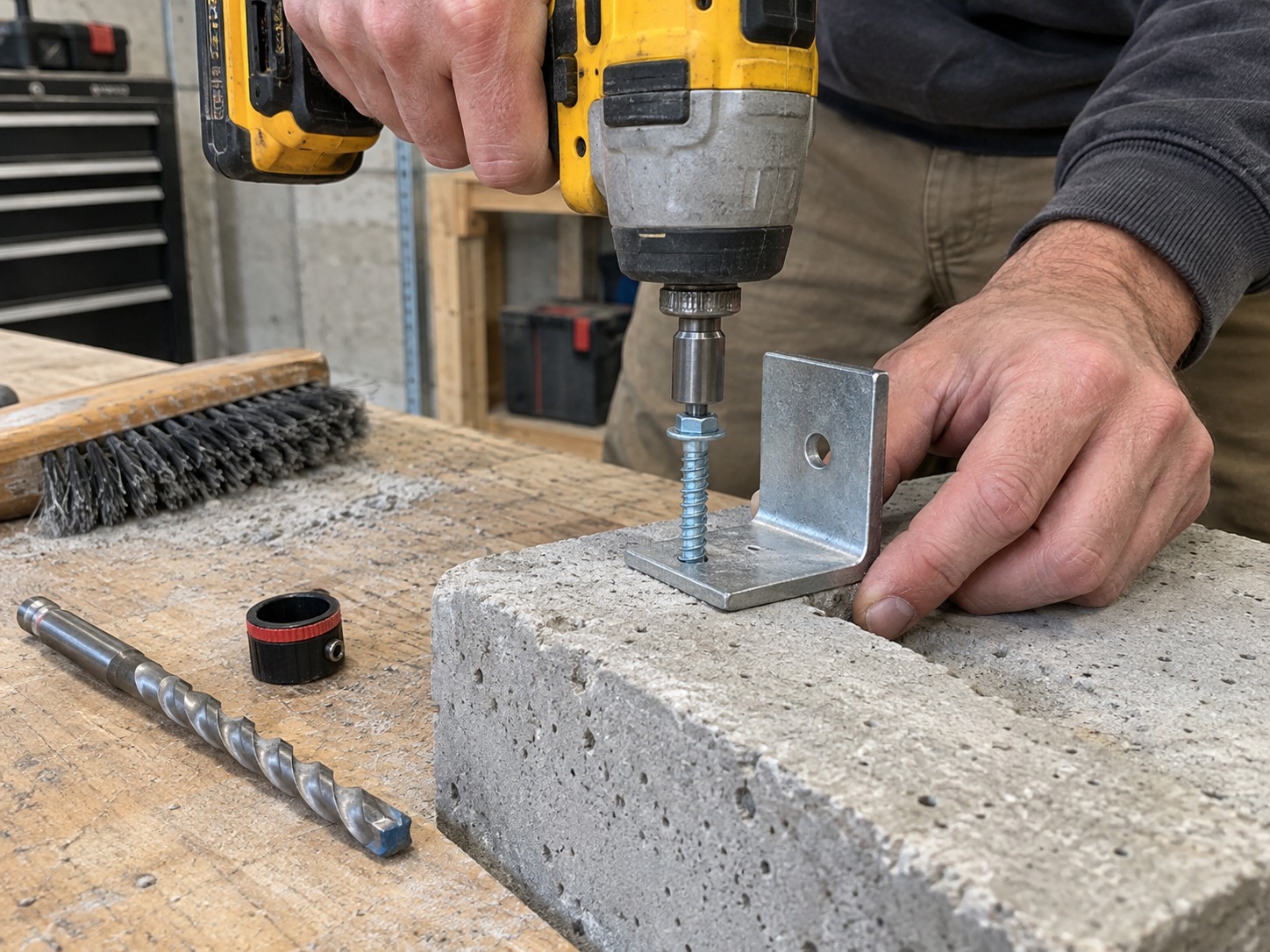
Where masonry screws make practical sense
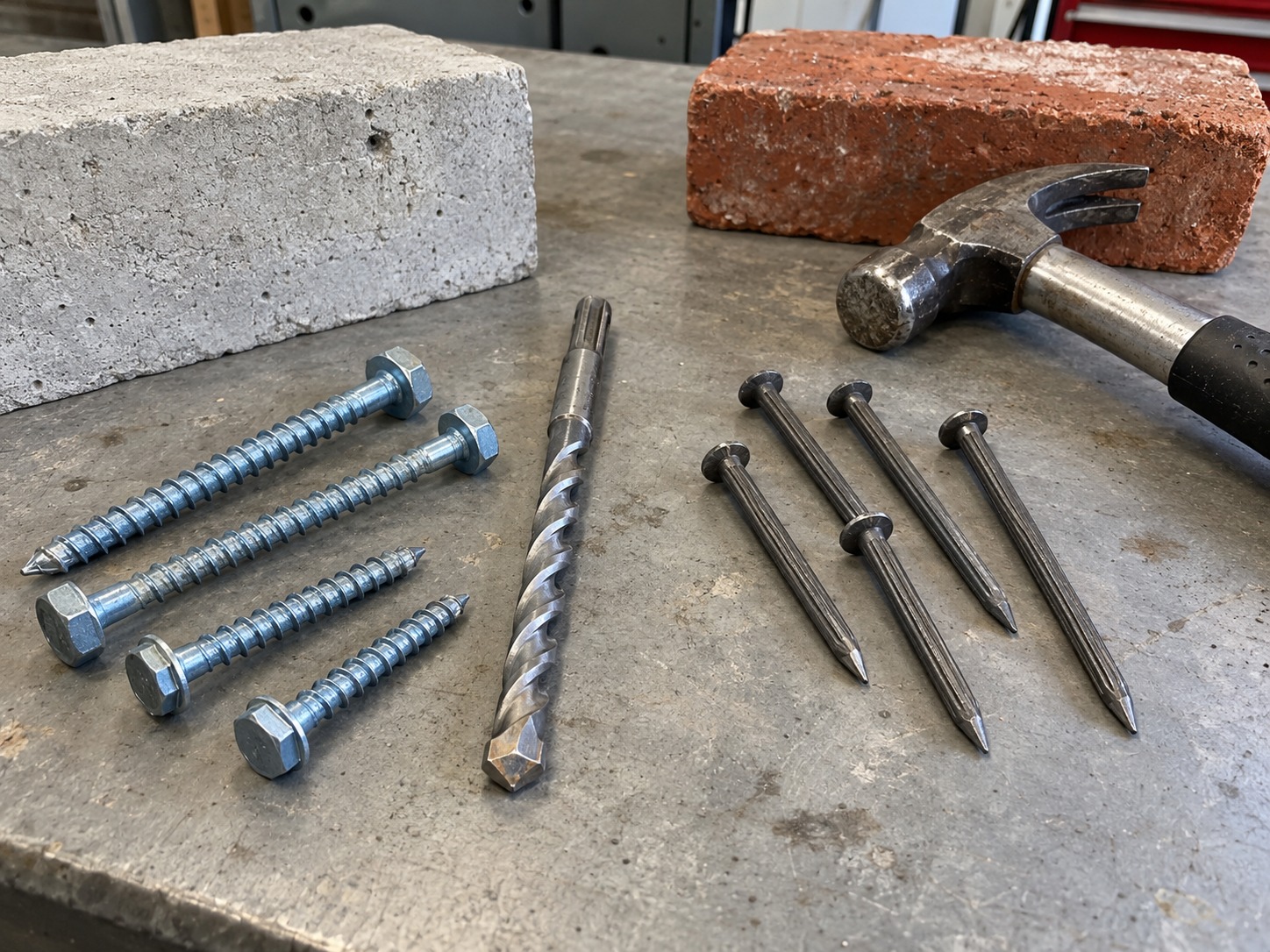
Masonry screws are designed to cut or engage into masonry after a pilot hole is drilled.3 This makes the installation more controlled than hammering a nail directly into concrete. For many buyers, that control is the main reason to stock them.
I usually see masonry screws considered for jobs such as:
- Fixing light brackets, clips, or channels where alignment matters.
- Installing products that may need future removal.
- Jobs where a clean head appearance is important.
- Applications where installers already carry drills and masonry bits.
- Retail packs for users who expect a more “modern” fixing method.
The key point is not only strength. The key point is installation method. A screw allows the installer to tighten gradually. A nail is driven by impact. These two methods feel very different on site.
What buyers should evaluate before choosing masonry screws
For importers and wholesalers, the screw itself is only one part of the product. The end user also needs the correct drill bit, hole diameter, embedment depth, and installation habit.4 If the local market does not commonly drill pilot holes for simple fixing tasks, masonry screws may move slowly on the shelf.
Here is a practical comparison I use during sourcing discussions:
| Evaluation point | Masonry screws | Buyer question |
|---|---|---|
| Installation | Requires drilling before fastening | Do local users have drills and bits? |
| Removability | Usually removable | Does the job require future adjustment? |
| Speed | Slower than direct nailing | Is labor time a major cost? |
| Cost | Higher total installed cost in many markets | Will customers pay for the benefit? |
| Skill level | Needs correct hole size and depth | Are installers trained for this product? |
Why “better” depends on the market
In some markets, end users value precision and are willing to pay for it. In other markets, buyers ask first about carton quantity, FOB price, and fast delivery. I have handled many inquiries where the importer already knew that contractors in their region preferred fast fixing with concrete nails because the labor style and price level supported it.
That does not make masonry screws wrong. It simply means they should match the resale channel. For example, a wholesaler serving electrical installers may need masonry screws for clips and brackets. A distributor supplying general construction sites may still sell more concrete nails because the fixing tasks are faster and less sensitive to future removal.
For any load-critical or safety-related application, I always recommend that buyers ask a qualified professional to evaluate the substrate, load, spacing, and installation method. A supplier can provide product specifications and samples, but project-specific engineering decisions should not be guessed from a catalog.
When are concrete nails more practical than masonry screws?
Concrete nails can be underestimated because they look simple. The problem is that importers sometimes compare only technical features and forget installation speed. In many price-sensitive construction markets, a fast, familiar product can be more practical than a more complex one.
Concrete nails are more practical than masonry screws when buyers need quick installation, low unit cost, simple tools, and strong market familiarity. They are commonly used for high-volume fixing tasks where removability is not the main concern and where local users prefer hammer-driven fastening.
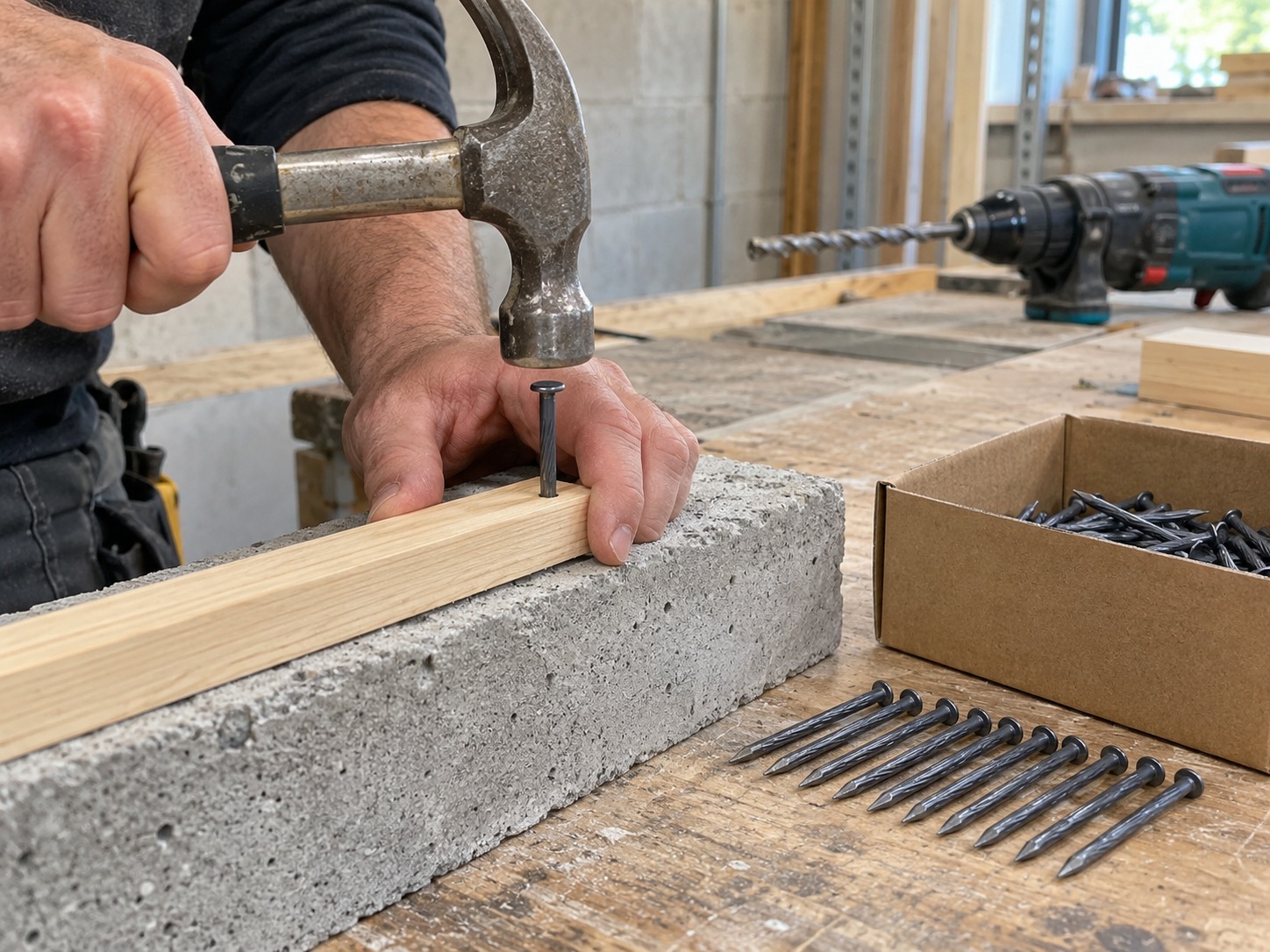
Why concrete nails still sell well
As a concrete nail supplier, I often see buyers focus on a few practical points before anything else:
- Can the nail enter the local concrete or block without bending too much?
- Is the hardness suitable for the expected substrate?
- Does the head and shank style match local user habits?
- Is the surface treatment acceptable for storage and resale?
- Does the packaging match the wholesaler’s normal selling unit?
Concrete nails remain useful because they are simple. Many users only need a hammer and basic experience. That matters in markets where the final customer wants a low-cost fixing product for common construction tasks.
Common product variables for concrete nails
Concrete nails are not all the same. A buyer should check the specification carefully instead of treating all offers as equal. In my factory discussions, these details usually affect both performance and resale:
| Product variable | Common options | Why it matters |
|---|---|---|
| Material | Often high carbon steel for concrete nails5 | Affects hardness and driving behavior |
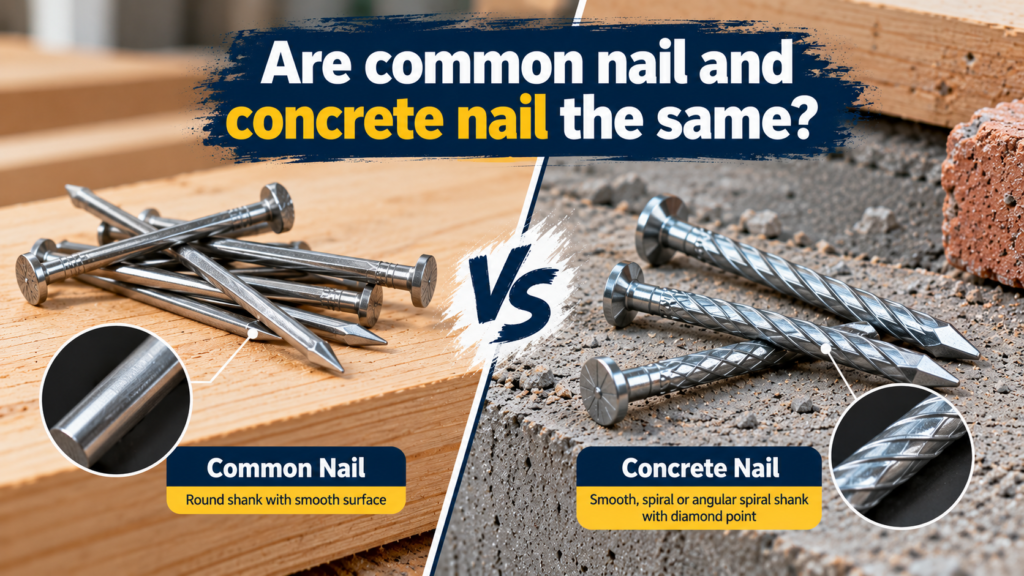
| Shank type | Smooth, fluted, grooved, or twisted depending on market6 | Affects grip and local preference |
| Head type | Flat head, lost head, or special styles | Affects appearance and use case |
| Surface treatment | Polished, black, galvanized, or other finish | Affects corrosion resistance and look |
| Length and diameter | Many market-specific sizes | Affects application and carton assortment |
| Packaging | Bulk carton, small box, branded box, OEM packaging | Affects resale channel and shelf appeal |
I do not suggest choosing only by the cheapest price. A very low price may mean unstable material, poor hardness control, weak packaging, or inconsistent size. These problems are costly for importers because one bad shipment can damage the wholesaler’s reputation.
Where concrete nails are a better commercial fit
Concrete nails often fit well in markets across the Middle East, Africa, Southeast Asia, and South America where buyers need economical products for daily construction use. These markets can be very practical. Customers may accept a simple product if it performs consistently and arrives in the right packaging.
Concrete nails can be suitable for:
- Temporary fixing tasks where removal is not important.
- High-volume site work where speed matters.
- General hardware resale where customers expect low unit prices.
- Markets with limited tool availability where drills are not always used.
- Bulk construction supply where cartons move through wholesalers quickly.
However, I never tell buyers that concrete nails are always better than masonry screws. That would not be accurate. The more useful question is: Will the end user accept the installation method and pay for the result?
If the answer is yes, concrete nails remain a strong commercial product. If the answer is no, masonry screws may be the better stock item for that customer group.
How should importers compare masonry screws and concrete nails by total cost?
Masonry screws may look expensive at first, while concrete nails may look cheaper. The problem is that unit price does not show the full picture. A buyer can make a wrong decision if they ignore drilling time, tool wear, packaging, rejection rate, and local resale expectations.
Importers should compare masonry screws and concrete nails by total installed cost, not only FOB unit price.7 Total cost includes product price, tools, installation time, breakage or bending, packaging, freight efficiency, customer habits, and after-sale complaints. The lower unit price is not always the lower business cost.
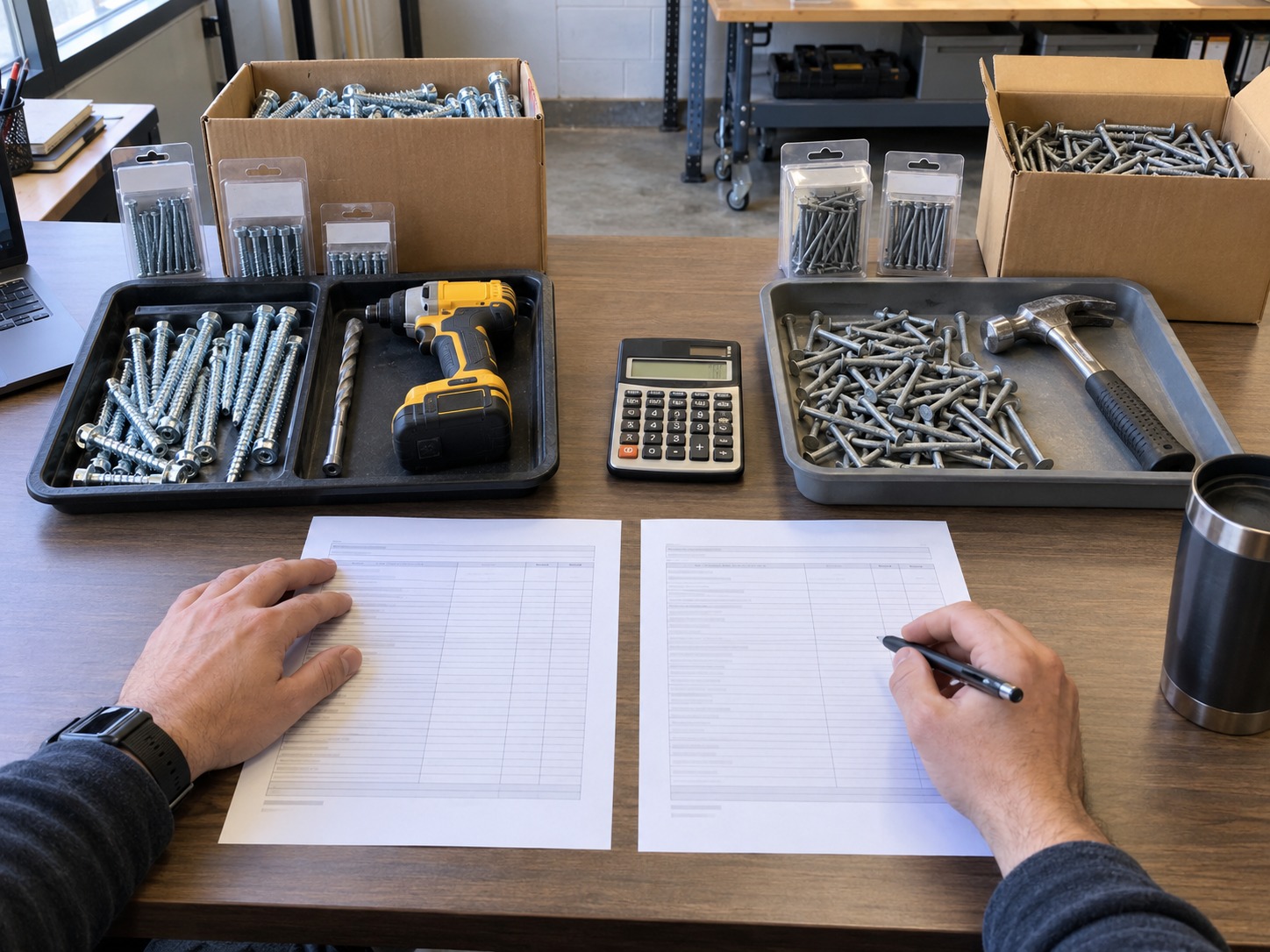
Unit price is only the beginning
FOB price is important, especially in competitive markets. At my factory, a quotation usually depends on:
- Product type
- Size and specification
- Order quantity
- Surface treatment
- Packaging method
- OEM or brand requirements
For concrete nails, importers often ask for quotations based on cartons, weight, and popular sizes. For masonry screws, buyers may also need to consider accessories, drill bits, anchors in some systems, or retail packaging details. These differences change the landed cost and the final shelf price.
A simple buying table can help:
| Cost factor | Masonry screws | Concrete nails |
|---|---|---|
| Product unit cost | Usually higher | Usually lower |
| Installation tool | Drill and correct bit required | Hammer or simple impact tool |
| Installation speed | Slower due to pilot hole | Faster for many simple tasks |
| Removability | Better | Limited |
| Packaging expectation | Often smaller retail packs | Bulk or small boxes both common |
| User training | More important | Usually simpler |
| Market price sensitivity | May face resistance | Often accepted in price-sensitive markets |
The hidden cost of poor market fit
The biggest mistake I see is not choosing the “wrong” fastener technically. The bigger mistake is stocking a product that does not match local demand. A warehouse full of slow-moving stock is more expensive than a product with a slightly higher purchase price.
Importers should ask these questions before placing a bulk order:
-
What substrate is common in the market?
Concrete, brick, hollow block, and dense masonry behave differently.8 A product that works well in one substrate may disappoint in another. -
What tools do end users normally use?
If most customers do not use drills for small fixing work, masonry screws may need more market education. -
What is the expected selling unit?
Some markets prefer bulk cartons. Others prefer small printed boxes with brand logos. -
What price level is acceptable?
A technically better product may fail if the customer will not pay the difference. -
What complaints are most common?
For concrete nails, complaints may involve bending, cracking, or inconsistent size. For masonry screws, complaints may involve stripped heads, wrong pilot holes, or slow installation.
Samples are useful, but they need a test plan
I usually encourage buyers to test samples before a formal order. Samples can help compare surface finish, dimensions, packaging, and practical driving behavior. However, random testing is not enough. The buyer should test the product in the same kind of substrate and installation condition that their customers use.
A simple sample evaluation can include:
- Visual inspection of finish and shape.
- Diameter and length measurement.
- Packaging drop and handling check.
- Driving test in common local substrate.
- Bending or breakage observation during installation.
- Feedback from actual contractors or retail customers.
For application-specific or safety-related decisions, buyers should involve qualified professionals. A supplier can support with specifications, production information, and quality documents, but real job conditions must be evaluated properly.
Should wholesalers stock masonry screws, concrete nails, or both?
Wholesalers often ask whether they should replace concrete nails with masonry screws. The problem is that replacement thinking can be too narrow. In many markets, the smarter choice is not one product only, but a product mix that matches different customer segments.
Wholesalers should stock masonry screws, concrete nails, or both based on local use cases and buyer behavior. Masonry screws serve customers who need controlled and removable fastening. Concrete nails serve customers who need fast, economical fixing. Many importers can carry both if the market has separate demand.
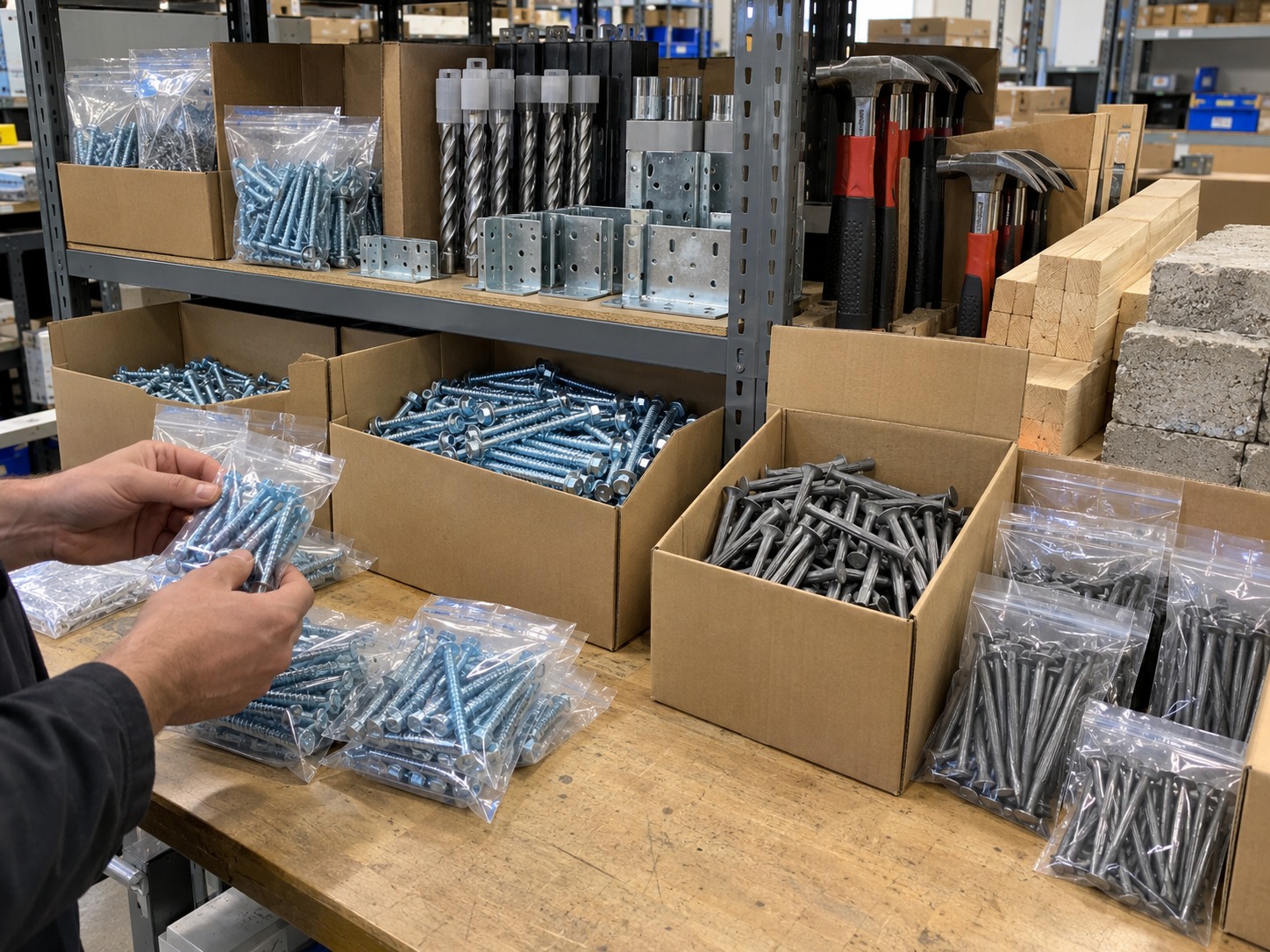
How I think about stocking strategy
When I speak with overseas buyers, I do not start by pushing one product. I first ask where the product will be sold. A distributor selling to construction sites may need different packaging from a hardware shop selling small boxes to walk-in users.
A practical product mix may look like this:
| Customer segment | Likely need | Suitable product |
|---|---|---|
| General contractors | Fast and economical fixing | Concrete nails |
| Electrical installers | Clips, brackets, neat fastening | Masonry screws or both |
| Hardware shops | Small packs and mixed demand | Both |
| Low-price wholesale markets | Fast-moving basic items | Concrete nails |
| Higher-detail installation work | Removable or controlled fixing | Masonry screws |
This approach reduces risk. The importer does not need to claim that one fastener is superior for every job. The importer can sell each product for the task it handles best.
Packaging can decide resale success
Packaging is not a small detail in B2B hardware. A good product in the wrong packaging can sell slowly. For concrete nails, buyers may request:
- 20 kg or 25 kg bulk cartons.
- Small inner boxes inside master cartons.
- Plastic bags or paper boxes.
- OEM brand printing.
- Custom labels in local language.
- Mixed sizes for trial orders.
At Dingzhou Best Hardware, we support OEM/ODM customization for product, packaging, and brand logo. I mention this because importers often use packaging to match their local sales channel. A market that sells mainly through wholesalers may prefer strong bulk cartons. A market that sells through shops may need clear printed boxes.
For masonry screws, packaging often needs more user information because the product depends on correct installation. The package may need to explain pilot hole size, recommended substrate, or bit type. Buyers should verify that any claims on the package match the product and local regulations.
Trial orders reduce stocking risk
For a new market or a new product line, I prefer trial orders. They help buyers avoid overcommitting before they know real demand. Our normal minimum order is 5 tons or 200 boxes, and we support trial cooperation depending on the product and packaging plan.
A trial order can test:
- Which sizes sell fastest.
- Whether customers prefer bulk or small boxes.
- Whether the surface treatment meets expectations.
- Whether the brand label creates trust.
- Whether the product competes well against local alternatives.
Delivery time is usually 15–25 days, depending on order quantity and production plan. Shipping is normally by sea, and buyers can choose FCL or LCL depending on volume. For FOB quotations, I usually need the product, specification, quantity, and packaging method before giving a serious price.
This is also where samples help. We can provide samples for quality checking, usually with a basic sample fee that can be discussed for return or adjustment in the formal order. I see samples as a practical bridge between catalog selection and real market testing.
What quality checks matter before buying concrete nails instead of masonry screws?
Quality problems can turn a low-cost fastener into an expensive complaint. The problem is that many buyers compare price lists but do not compare production control. Whether the buyer chooses concrete nails or masonry screws, quality verification should come before bulk purchasing.
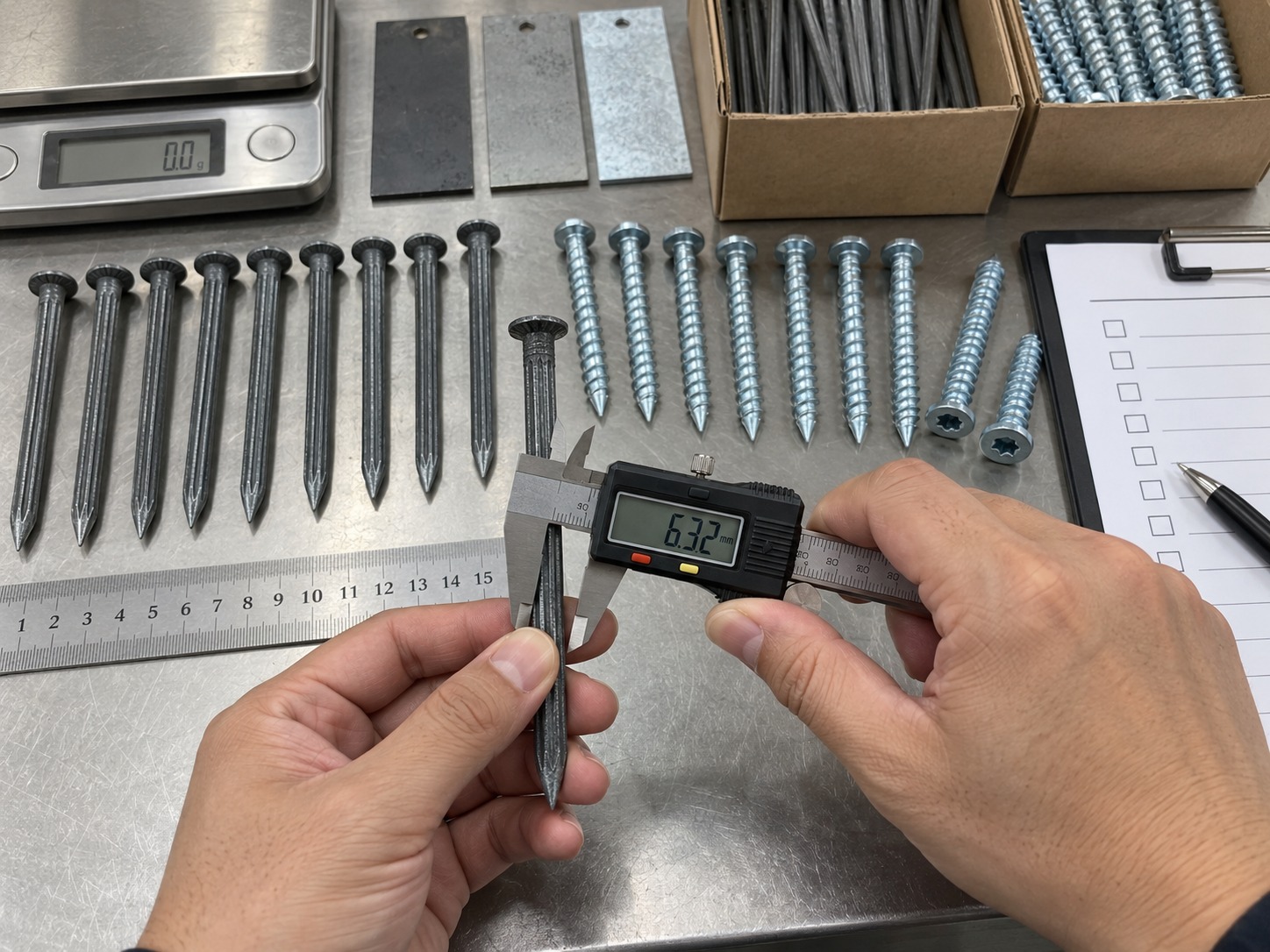
Before buying concrete nails instead of masonry screws, importers should check material consistency, hardness, dimensions, surface treatment, head shape, shank style, packaging strength, and sample performance in local substrate. Buyers should also verify supplier documents and request professional evaluation for critical applications.
Concrete nail quality factors I watch closely
Concrete nails need a balance of hardness and toughness. If the nail is too soft, it may bend easily. If it is too brittle, it may break during driving.9 The correct balance depends on the material, heat treatment, nail diameter, and intended substrate.
When I review concrete nail requirements with buyers, I focus on:
- Material: Buyers should confirm the steel type and production consistency.
- Hardness control: Buyers should request relevant inspection information when needed.
- Point sharpness: A poor point can make driving harder.
- Head shape: A weak or uneven head can cause installation problems.
- Shank design: Smooth, fluted, or grooved shanks may suit different markets.
- Surface finish: Black, polished, or galvanized finish affects appearance and storage.10
- Dimension tolerance: Size consistency matters for packing, resale, and user trust.
- Carton strength: Export packaging must survive handling and sea transport.
I avoid making universal claims about pull-out strength because real performance depends on substrate and installation. Concrete density, aggregate, edge distance, and installer technique all matter.11 A buyer should be careful with any supplier that promises broad performance without test conditions.
Masonry screw quality factors are different
Masonry screws have their own quality risks. A screw may fail commercially if the head recess strips, the thread is inconsistent, or the coating does not meet the buyer’s storage environment. The required pilot hole also adds another variable. If the hole is wrong, even a good screw may perform badly.12
Important checks include:
| Quality area | Why it matters |
|---|---|
| Thread consistency | Affects engagement in masonry |
| Head recess | Affects driving and stripping risk |
| Coating | Affects corrosion resistance and appearance |
| Straightness | Affects installation accuracy |
| Packaging instructions | Helps users install correctly |
| Compatibility with drill bits | Reduces user complaints |
This is why I do not frame masonry screws as an automatic upgrade. They can be excellent when used correctly. They can also create complaints when sold into a market that does not follow the required installation method.
Supplier evaluation matters as much as product type
A good supplier should help buyers match product, packaging, quantity, and market needs. For industrial and construction fasteners, buyers should ask for documents where relevant, but they should also verify those documents. Certifications, inspection reports, and test records are useful only when they are genuine and applicable to the order.
A simple supplier checklist can include:
- Factory production capability.
- Export experience in similar markets.
- Sample availability.
- OEM/ODM packaging support.
- Clear FOB quotation structure.
- Practical minimum order quantity.
- Stable delivery time.
- Willingness to discuss specifications honestly.
As a manufacturer and export supplier, I prefer clear communication before production. A small misunderstanding in nail length, box weight, or label design can become a large problem after sea shipment. Good sourcing starts with detailed specifications.
Frequently Asked Questions
Are masonry screws stronger than concrete nails?
Masonry screws may provide more controlled fastening in some substrates, but “stronger” depends on the material, embedment, pilot hole, load direction, and installation quality. Concrete nails can be practical for many non-removable fixing tasks. Buyers should request product data and use professional evaluation for load-critical applications.
Do concrete nails need pre-drilling like masonry screws?
Concrete nails are usually driven directly with a hammer or suitable impact tool, while masonry screws normally need a drilled pilot hole. This difference affects speed, tool cost, and installer skill. In price-sensitive markets, the simpler installation of concrete nails is often a major commercial advantage.
Which product is better for wholesalers in Africa, the Middle East, Southeast Asia, or South America?
The better product depends on local construction habits, substrate, tool availability, and price level. Many wholesalers in these regions still sell concrete nails well because they are economical and familiar. Masonry screws can also sell when customers need removable, neat, or controlled fastening.
Can I order OEM packaging for concrete nails?
Yes. At Dingzhou Best Hardware, we support OEM/ODM customization for concrete nails, including product specifications, packaging style, and brand logo. Buyers usually need to confirm size, quantity, box design, carton weight, and shipping plan before we quote and produce.
Should I test samples before placing a bulk order?
Yes. I recommend sample testing before bulk purchasing. Samples help buyers check dimensions, surface finish, packaging, and practical installation behavior in local substrates. Samples usually carry a basic fee, which can be discussed for adjustment or return during the formal order.
Conclusion
Masonry screws are not automatically better than concrete nails. They are better when the buyer needs removable, controlled, and precise fastening with the right tools and installation habits. Concrete nails remain practical when speed, simplicity, low cost, and high-volume resale matter most. For importers and wholesalers, the best choice is the product that matches the local substrate, customer habits, packaging expectations, and total installed cost. If you are comparing concrete nails for your market, contact Dingzhou Best Hardware at [email protected] or WhatsApp +8618331061136 to discuss samples, specifications, OEM packaging, and FOB pricing.
-
"Concrete Screw (Tapcon) Pilot Hole Size Chart", https://www.zhonghuantools.com/en/resources/concrete-screw-pilot-hole-chart. A technical source on concrete screw anchors explains that they are installed into drilled holes and engage the base material by threaded action, which supports the article’s distinction between controlled screw installation and impact-driven fastening; the source may not prove that screws are superior in every application. Evidence role: mechanism; source type: institution. Supports: The source should explain that concrete or masonry screws are installed in predrilled holes and tightened by rotation, allowing controlled installation and possible removal compared with driven fasteners.. Scope note: Contextual support only; performance depends on the specific screw, substrate, embedment, and installation conditions. ↩
-
"How To Hammer A Nail In Concrete or Brick. How to hang …", https://www.youtube.com/watch?v=XgkYiXppDug. An educational construction reference describes concrete nails as hardened nails driven directly into masonry or concrete, supporting their characterization as a simple impact-installed fastening method; it does not independently establish total commercial cost in all markets. Evidence role: general_support; source type: education. Supports: The source should describe concrete nails as hardened fasteners driven into concrete or masonry with a hammer or impact tool, supporting the claim that they can be simpler and faster than predrilled screw systems.. Scope note: Contextual support only; economic advantage varies with labor rates, substrate hardness, and product quality. ↩
-
"8 Concrete Screw: Top Heavy-Duty Anchor", https://www.aaanchorbolt.com/blog/hold-on-tight-with-these-heavy-duty-8-inch-concrete-screw-anchors/. Institutional guidance on post-installed concrete screw anchors states that such anchors are placed in drilled holes and rely on thread engagement with the base material, supporting the article’s description of the installation mechanism. Evidence role: mechanism; source type: institution. Supports: The source should state that concrete or masonry screws require a drilled hole and develop holding capacity through threads engaging the base material.. ↩
-
"5.51 ANCHORAGE TO CONCRETE: CAST-IN ANCHORS", https://dot.ca.gov/-/media/dot-media/programs/engineering/documents/bridgedesignmemos/05/202108-bdm0551-anchoragetoconcrete-castinanchors-a11y.pdf. Guidance on post-installed anchors identifies drilled-hole diameter, embedment, and installation procedure as variables affecting anchor behavior, supporting the article’s emphasis on correct bits, hole size, and installation practice. Evidence role: mechanism; source type: institution. Supports: The source should explain that anchor capacity and installation quality depend on drilled-hole dimensions, embedment depth, and adherence to installation instructions.. Scope note: The source may address post-installed anchors broadly rather than every masonry screw product. ↩
-
"Masonry Nails / Hardware Nails – Carbon Steel", https://www.amazon.com/Masonry-Nails-Carbon-Steel-Hardware/s?rh=n%3A17724329011%2Cp_n_material_browse%3A17548936011. A materials or construction fastener reference identifies concrete nails as hardened steel fasteners, often made from high-carbon steel, supporting the article’s statement about common material selection. Evidence role: definition; source type: education. Supports: The source should identify hardened or concrete nails as commonly made from high-carbon steel or hardened steel.. Scope note: Material grades vary by manufacturer, product standard, and market specification. ↩
-
"Withdrawal capacity of plain, annular shank and helical …", https://composites.umaine.edu/publication/withdrawal-capacity-of-plain-annular-shank-and-helical-shank-nail-fasteners-inspruce-pine-fir-lumber/. A fastener reference describing nail shank types documents that nails may use smooth or deformed shanks to alter holding behavior, supporting the article’s treatment of shank style as a meaningful product variable. Evidence role: definition; source type: education. Supports: The source should describe common nail shank variations and their functional purpose in fastening.. Scope note: The reference may discuss nails generally and not only concrete nails. ↩
-
"Project Management for Construction: Cost Estimation", https://www.cmu.edu/cee/projects/PMbook/05_Cost_Estimation.html. Construction cost-estimating guidance treats installed cost as a combination of material, labor, equipment, and related factors, supporting the article’s argument that fasteners should not be compared solely by FOB unit price. Evidence role: general_support; source type: education. Supports: The source should support the principle that construction cost comparisons include material, labor, equipment, and related installation factors, not just unit material price.. Scope note: The source supports the cost-accounting principle rather than a specific numerical comparison between masonry screws and concrete nails. ↩
-
"Masonry Anchors vs Concrete Anchors", https://constructionandelectrical.com/masonry-anchors-vs-concrete-anchors/. Research on anchors in masonry and concrete reports that base-material properties and geometry influence fastening performance, supporting the article’s warning that concrete, brick, hollow block, and dense masonry should not be treated as identical substrates. Evidence role: mechanism; source type: paper. Supports: The source should show that anchor or fastener performance differs by substrate type, such as concrete, brick, hollow block, or dense masonry.. Scope note: Specific results may apply only to the tested anchor types and masonry units. ↩
-
"Ductile-to-Brittle Transition and Brittle Fracture Stress of … – PMC", https://pmc.ncbi.nlm.nih.gov/articles/PMC8037020/. Materials science sources describe hardness, toughness, and ductility as distinct mechanical properties, supporting the article’s explanation that a nail that is too soft may deform while one that is too brittle may fracture under impact. Evidence role: mechanism; source type: education. Supports: The source should explain the tradeoff between hardness, ductility, and toughness in steel, and how these properties affect bending or fracture.. Scope note: The source supports the general mechanical principle rather than test results for a particular concrete nail. ↩
-
"Design Considerations for Galvanizing: Fasteners, Bolts … – AZZ", https://www.azz.com/featured_stories/design-considerations-for-galvanizing-fasteners-bolts-and-nails/. Government or standards-based corrosion guidance explains that zinc galvanizing protects steel by providing a corrosion-resistant coating, supporting the article’s claim that surface treatment can affect storage performance and appearance. Evidence role: mechanism; source type: government. Supports: The source should explain that metallic coatings such as galvanizing can improve corrosion resistance of steel products, while surface finish also affects appearance.. Scope note: The source may not compare black, polished, and galvanized nail finishes under identical warehouse conditions. ↩
-
"5.51 ANCHORAGE TO CONCRETE: CAST-IN ANCHORS", https://dot.ca.gov/-/media/dot-media/programs/engineering/documents/bridgedesignmemos/05/202108-bdm0551-anchoragetoconcrete-castinanchors-a11y.pdf. Concrete anchor design guidance identifies base-material properties, edge distance, embedment, and installation conditions as factors in anchor performance, supporting the article’s caution against broad pull-out-strength claims. Evidence role: expert_consensus; source type: institution. Supports: The source should show that concrete anchor performance is affected by concrete strength or density, aggregate/base material condition, edge distance, embedment, and installation quality.. Scope note: Anchor design guidance may focus on engineered anchors rather than ordinary concrete nails, but the underlying dependence on substrate and installation conditions is relevant. ↩
-
"hole size in concrete for epoxy anchor … tolerance ?", https://www.eng-tips.com/threads/hole-size-in-concrete-for-epoxy-anchor-tolerance.479954/. Research on post-installed anchors reports that installation parameters such as hole diameter, preparation, and embedment influence anchor capacity, supporting the article’s statement that an incorrectly prepared hole can impair screw performance. Evidence role: mechanism; source type: paper. Supports: The source should show that installation errors such as incorrect drilled-hole diameter, depth, or preparation can reduce the performance of post-installed anchors.. Scope note: The evidence may come from anchor systems broader than masonry screws and may not quantify every product type. ↩