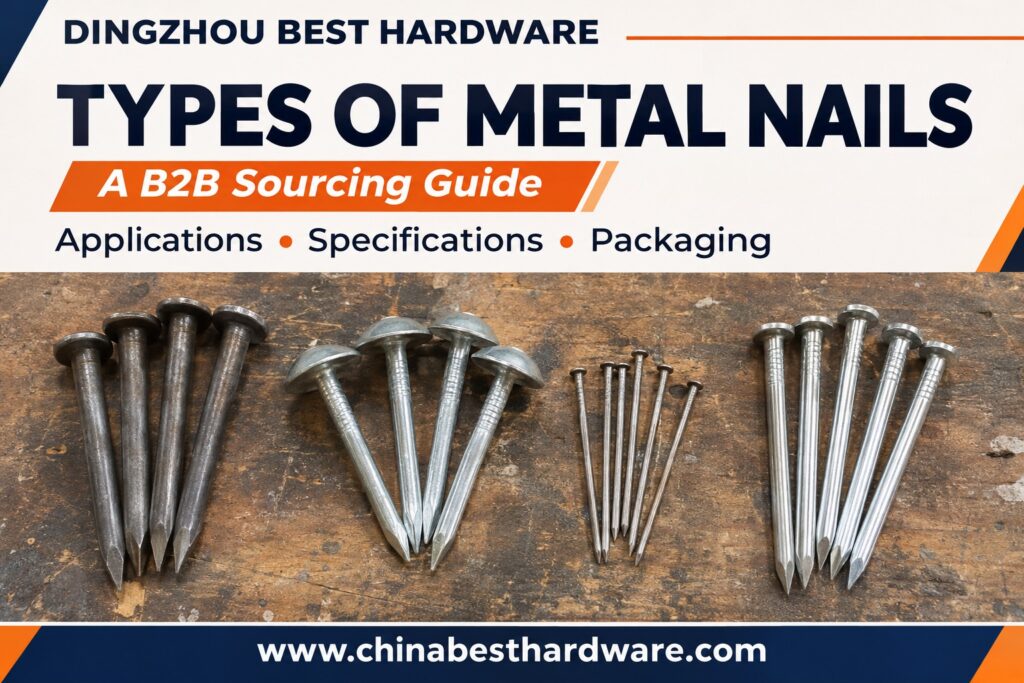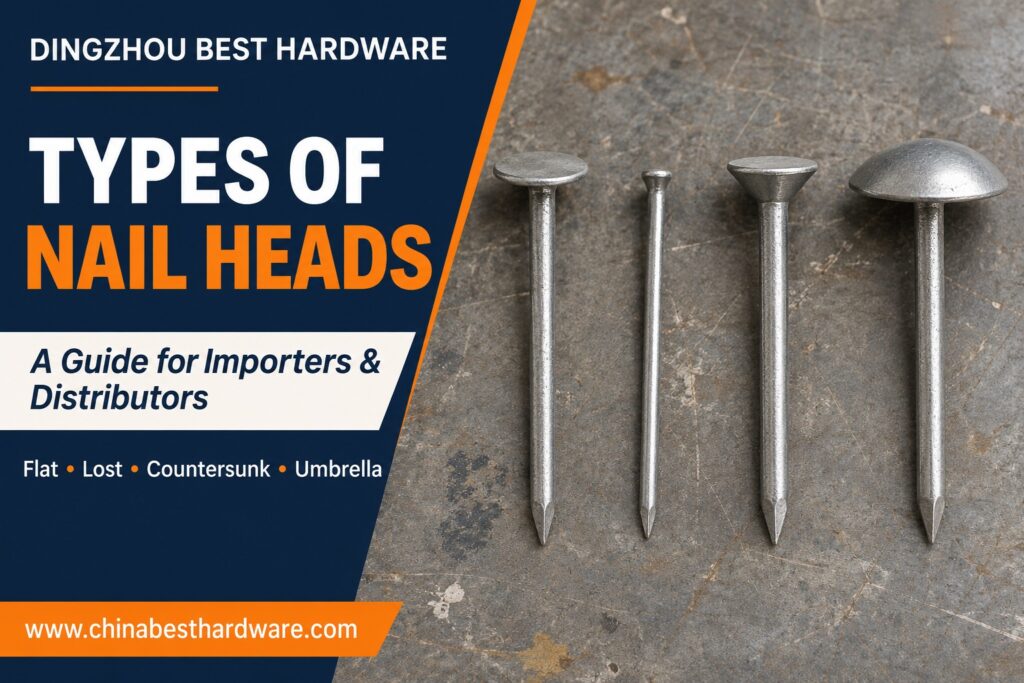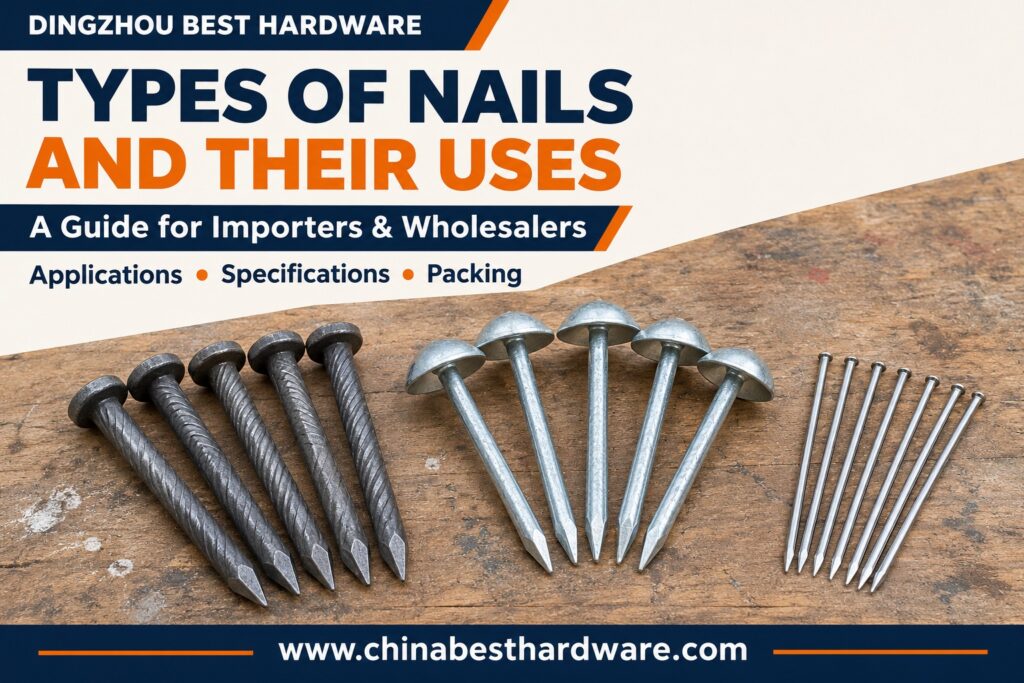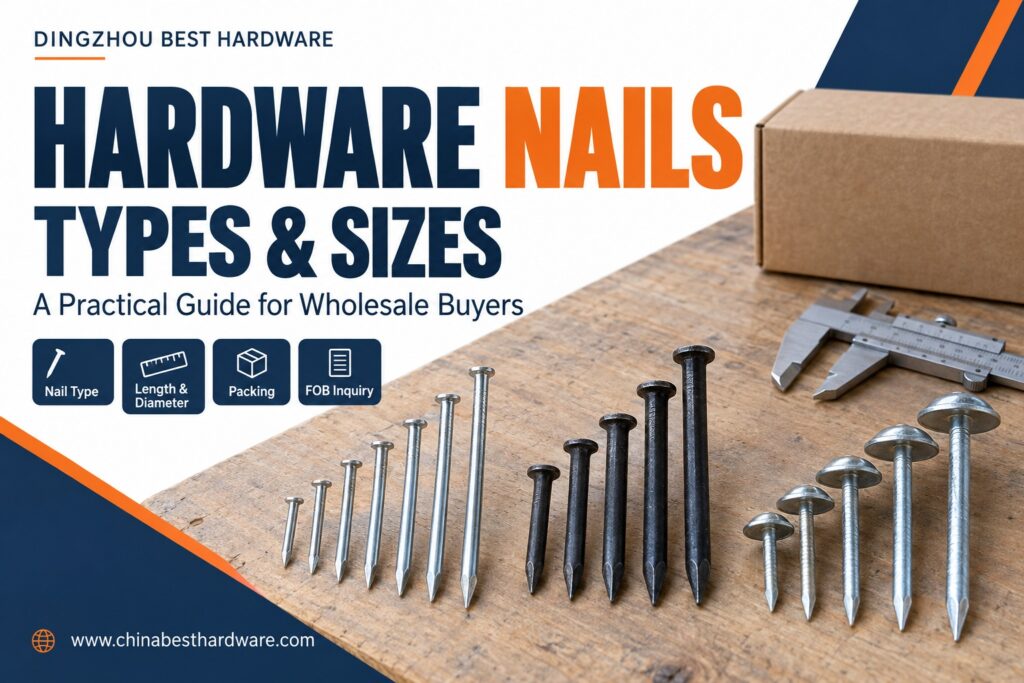
Types of nails for wood can look simple at first, but the wrong choice can cause splitting, rust stains, weak holding power, or costly rework.1 I see this often when buyers ask for “common nails” without explaining the wood, climate, or project. A better approach is to match nail type to risk, use, and supply quality.
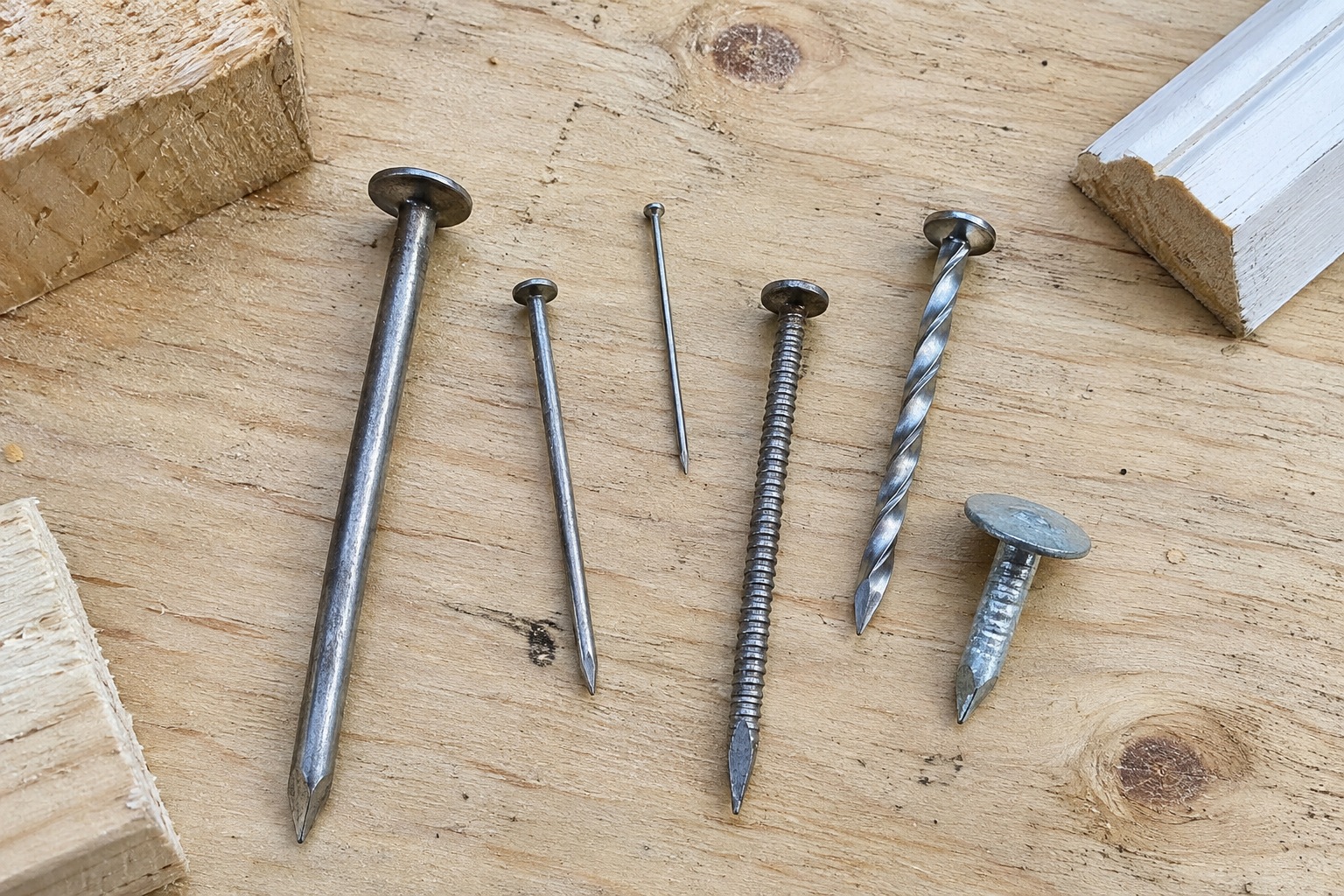
Types of nails for wood include common nails, box nails, finishing nails, lost head nails, brad nails, ring shank nails, spiral shank nails, roofing nails, and galvanized nails. The right choice depends on wood density, load requirement, exposure to moisture, surface appearance, installation method, and the buyer’s quality tolerance.2
A nail is a small product, but it creates a big connection. When I discuss nail orders with customers, the useful question is rarely “Which nail is best?” The better question is: Which nail reduces project risk for this exact use case?
How should buyers compare types of nails for wood by application?
Many buyers compare types of nails for wood only by length and diameter. That is risky because two nails with similar sizes can behave very differently in softwood, hardwood, pallets, roofing, or decorative trim.3 If the application is unclear, the purchase decision becomes guesswork.
The best way to compare types of nails for wood is to start with the application: structural fastening, surface finishing, outdoor exposure, temporary fixing, or packaging. Then check nail head style, shank type, coating, wire material, point shape, and supplier quality control before confirming the order.
Start with the real job, not the product name
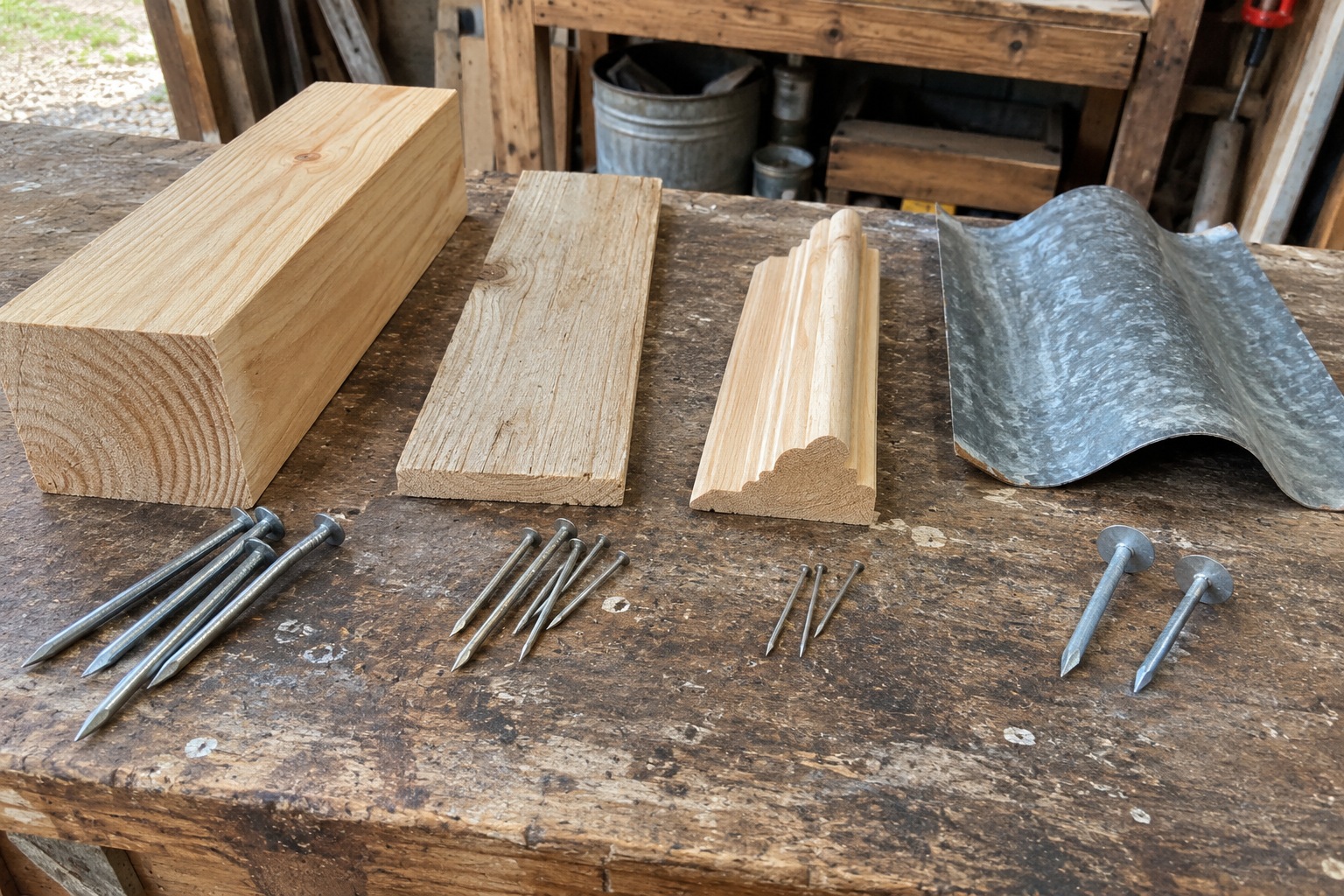
I have handled customer inquiries where the buyer asked for a “wood nail,” but the real use was very different. One buyer needed nails for rough wooden crates. Another needed a cleaner-looking nail for interior trim. A third buyer wanted a nail for roof sheets fixed onto timber battens. These are not the same buying problem.
A simple product name does not describe the risk. Types of nails for wood should be evaluated by function first.
Here is a practical comparison:
| Application | Common nail choice | Main reason | Main risk if wrong |
|---|---|---|---|
| General wood construction | Common nails or smooth shank nails | Good basic holding for framing and rough work | Weak grip if load or movement is high |
| Wooden boxes and crates | Box nails, common nails, or ring shank nails | Faster assembly and acceptable holding | Splitting thin wood or loose joints |
| Furniture or trim | Finishing nails, lost head nails, brads | Smaller head and cleaner appearance | Visible heads or surface damage |
| Roofing on timber | Roofing nails, often galvanized | Large head and weather resistance | Leakage, rust, or pull-through |
| Outdoor wood | Galvanized or coated nails | Better corrosion resistance | Rust stains and reduced service life |
| High-vibration wood joints | Ring shank or spiral shank nails | Improved withdrawal resistance | Nails may back out over time |
Ask these questions before selecting
When I speak with buyers, I usually try to collect the following information before quoting:
- What wood is being used? Softwood, hardwood, plywood, pallet wood, or treated lumber?
- Is the nail visible after installation? A decorative surface needs a smaller head or lost head style.
- Will the nail face moisture? Outdoor, roofing, coastal, or humid conditions need more coating attention.
- What tool will install the nail? Hand hammer, pneumatic nailer, or automated production line?
- What packaging is required? Bulk cartons, small boxes, branded packing, or palletized export packing?
- What is the project’s tolerance for failure? Temporary packaging is different from permanent structural fixing.
Why “same size” does not mean same performance
A buyer may compare only 2-inch nails from two suppliers. However, those nails can differ in:
- Wire hardness
- Shank surface
- Head shape
- Point sharpness
- Galvanizing thickness
- Dimensional tolerance
- Packaging protection during sea transport
These details matter in procurement. For example, a softer nail may bend during installation into dense wood. A nail with poor head forming may not sit correctly. A poorly coated nail may rust before it reaches the job site if ocean freight and humid storage are involved.
My practical rule is simple: nail selection should follow the wood, the environment, and the installation method. The catalogue name comes after that.
For importers and distributors, this also affects stock planning. If your customers are builders, carpenters, roofing installers, or packaging factories, each group may need different types of nails for wood. A mixed product strategy is often safer than pushing one “universal” nail into every application.
Which types of nails for wood fit framing, trim, roofing, and packaging?
Some buyers want one clear list of types of nails for wood. That is understandable, but a list without context can mislead. A finishing nail and a roofing nail are both used with wood, yet they solve completely different problems.
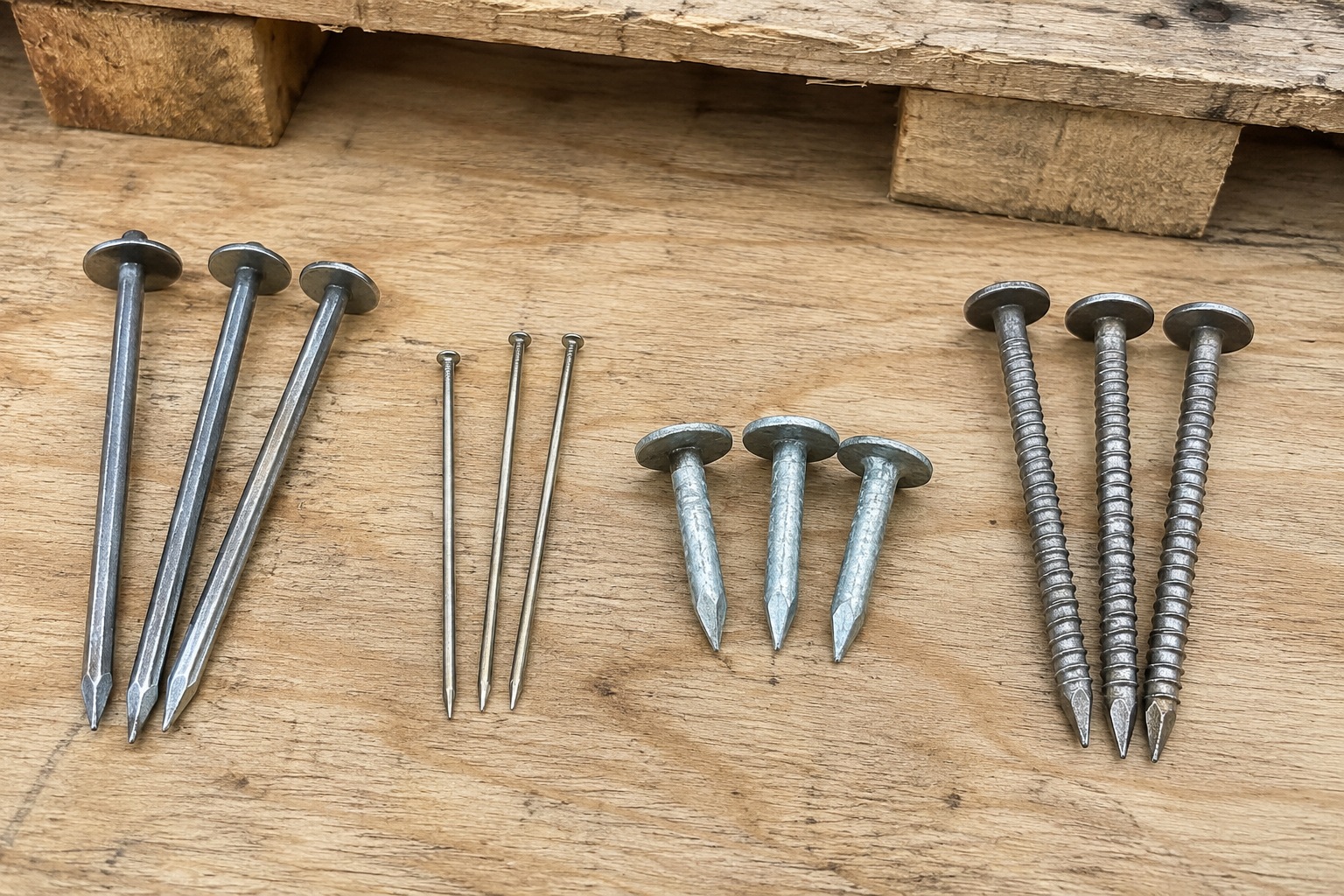
Common types of nails for wood include common nails for rough framing, box nails for crates, finishing nails and lost head nails for trim, roofing nails for roof fixing, and ring shank nails for stronger grip. The right option depends on appearance, load, exposure, and withdrawal resistance.
Common nails
Common nails are often used for general wood work, framing, and rough construction. They usually have a flat head, smooth shank, and diamond point. They are practical when appearance is not the main concern.
Best fit:
- Rough carpentry
- Timber framing
- General wooden structures
- Temporary site work
- Basic wooden assemblies
Main trade-off: They are versatile, but smooth shank nails may not offer the highest withdrawal resistance in wood that moves, vibrates, or shrinks.4
Box nails
Box nails are often thinner than common nails of similar length. They are used for wooden boxes, crates, and lighter assemblies. The thinner shank can reduce splitting in thinner wood, which matters in packaging production.5
Best fit:
- Wooden crates
- Shipping boxes
- Light wood assembly
- Export packaging
Main trade-off: They may not have the same strength as heavier common nails, so buyers should not choose them only because they are easier to drive.
Finishing nails and lost head nails
Finishing nails and lost head nails are used when surface appearance matters. The small head can be set below the wood surface and covered with filler if needed.6 At 定州百斯特, lost head nails are one of the nail categories we discuss with buyers who care about cleaner finishing.
Best fit:
- Trim work
- Molding
- Furniture details
- Interior wood applications
- Decorative panels
Main trade-off: The small head improves appearance, but it also reduces pull-through resistance compared with larger head nails.
Roofing nails
Roofing nails usually have a large flat head. They are designed to hold roofing materials, often onto wood battens or sheathing. For asphalt shingle installations, ARMA guidance identifies corrosion-resistant roofing nails made from galvanized steel, stainless steel, aluminum, or copper7. Buyers should confirm the required nail material and specification against the roofing manufacturer’s instructions and applicable local requirements.
Best fit:
- Roofing sheets
- Asphalt roofing materials in some markets
- Timber roof battens
- Outdoor coverings
Main trade-off: The large head is useful for holding sheet material, but it is not suitable for neat decorative woodwork.
Ring shank and spiral shank nails
Shank design is an important consideration when selecting nails for joints that must resist pull-out. In tests on Southern Pine lumber, ring-shank nails showed higher withdrawal resistance than smooth-shank nails of the same diameter8. Buyers should confirm the performance of ring-shank and spiral-shank options for the intended wood and application.
Best fit:
- Pallets
- Crates
- Flooring underlayment
- High-movement wood joints
- Applications where withdrawal resistance matters
Main trade-off: These nails can be harder to remove, and they may increase splitting risk in some wood if the size is not selected carefully.
Quick selection table
| Nail type | Appearance | Holding power | Typical wood use | Buyer concern |
|---|---|---|---|---|
| Common nail | Low priority | Medium | Framing and rough work | Size consistency |
| Box nail | Low priority | Medium-low | Crates and boxes | Avoiding splits |
| Finishing nail | High priority | Low-medium | Trim and furniture | Head shape and finish |
| Lost head nail | High priority | Low-medium | Decorative woodwork | Clean surface result |
| Roofing nail | Low priority | Medium | Roof fixing on wood | Coating and head diameter |
| Ring shank nail | Low priority | High | Pallets and strong joints | Withdrawal resistance |
| Spiral shank nail | Low priority | High | Dense joints and flooring | Driveability |
A product list is useful, but it is only the first step. The more important step is to connect each nail type with a real operating condition. That is how buyers avoid ordering a technically correct product that performs poorly in the field.
How do material, coating, and shank design change types of nails for wood?
Buyers sometimes treat types of nails for wood as fixed categories, but the same nail type can perform differently depending on wire material, surface coating, and shank design. This is where many quality problems begin, especially in humid markets and long-distance sea shipments.
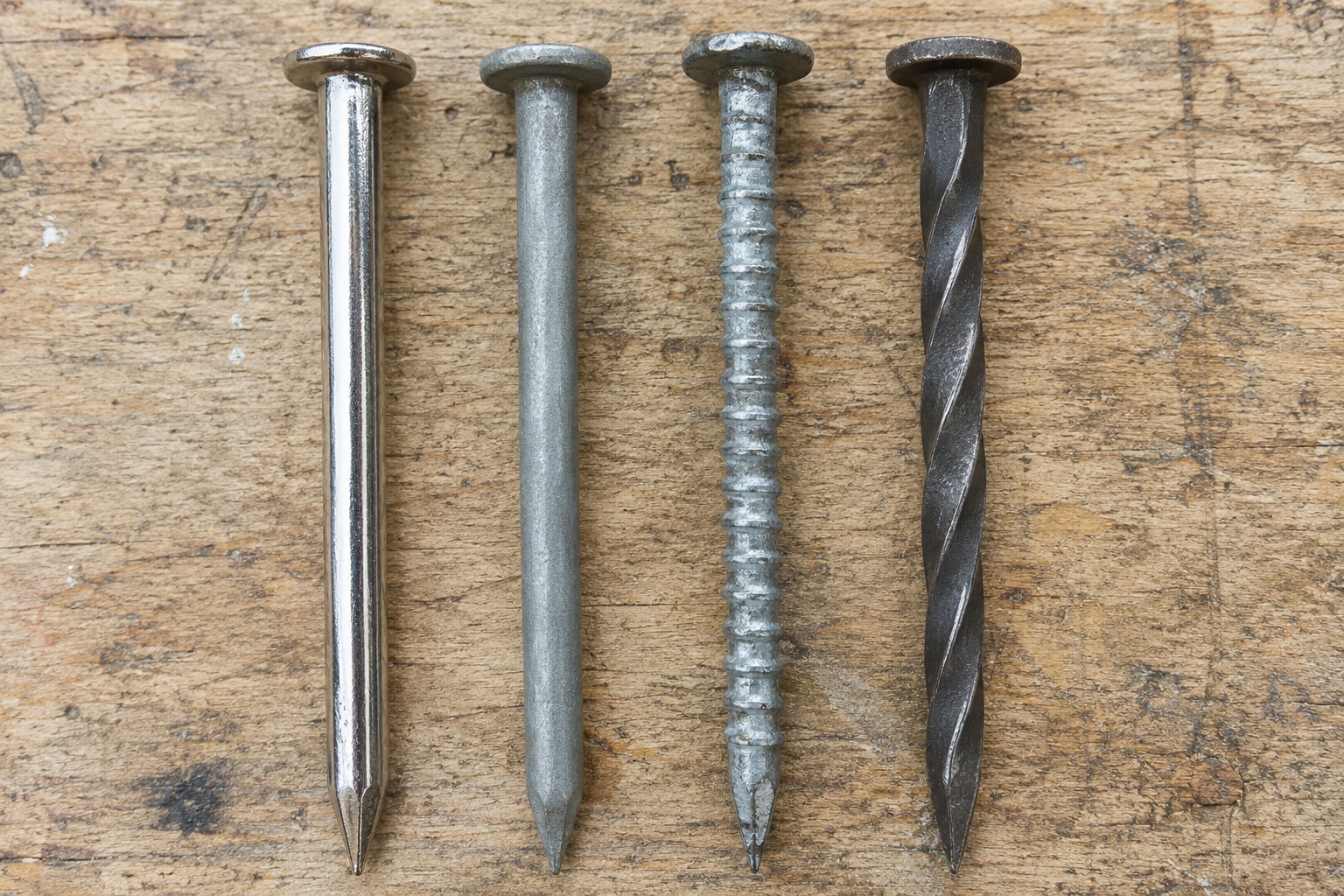
Material, coating, and shank design affect corrosion resistance, bending behavior, withdrawal strength, and installation quality.9 For wood projects, buyers should compare black steel, bright steel, galvanized coating, smooth shank, ring shank, spiral shank, head shape, and point quality before approving bulk orders.
Material: strength and workability matter
Most general wood nails are made from steel wire. However, not every steel nail behaves the same. Wire quality, drawing process, heat treatment if applied, and forming consistency can change the final result.
In customer conversations, bending is one of the most common complaints. A nail bends when several factors combine:
- The wood is dense or knotty.
- The nail diameter is too small.
- The point is not sharp enough.
- The wire is too soft for the application.
- The installer hits at an angle.
- The nail length is excessive for the joint design.
This is why I avoid promising that one nail will work for every wood type. A nail that performs well in soft pine may not behave the same in dense hardwood.10
Coating: corrosion risk is not always obvious
Coating is not only about appearance. It affects storage, transport, and service life. Many buyers in the Middle East, Africa, Southeast Asia, and South America deal with humidity, rain, or coastal air. In those conditions, corrosion risk should be considered early.
Common coating and finish options include:
| Finish or coating | Typical purpose | Practical note |
|---|---|---|
| Bright steel | Indoor or dry use | Lower corrosion resistance |
| Black steel | General use where black finish is acceptable | Surface protection depends on process and storage |
| Electro-galvanized | Light corrosion resistance | Often used where moderate protection is enough |
| Hot-dip galvanized | Zinc-based coating for corrosion protection11 | Confirm coating specification and suitability for the intended exposure |
At 定州百斯特, black steel nails and roofing nails are part of our regular product range. When buyers ask about outdoor wood use, I usually suggest they confirm the coating level instead of relying only on the product name. Buyers should request photos, specifications, and samples for checking.
Shank design: holding power changes the risk profile
The shank is the body of the nail. It controls how the nail interacts with wood fibers.
Smooth shank nails are easier to drive and common in general work. They are practical and cost-effective.
Ring shank nails have rings along the shank. These rings increase withdrawal resistance. They are often used in pallets, crates, and wood joints where movement may loosen smooth nails.
Spiral shank nails twist into the wood as they are driven. They can provide strong holding, but driveability and splitting risk should be checked.
Head and point also matter
Buyers often focus on shank and coating, but head and point quality also affect performance.
A well-formed head helps the hammer or tool transfer force properly. A poor head may deform or create installation problems. A sharp and consistent point reduces driving resistance. However, an overly aggressive point may not solve every splitting issue. In thin or dry wood, pre-drilling or changing nail diameter may still be needed.
Practical buying advice
Before placing a large order, buyers should ask suppliers:
- What wire material is used?
- What is the coating type and expected surface condition?
- What are the length and diameter tolerances?
- Can the supplier provide samples before bulk shipment?
- Can packaging protect nails during sea freight?
- Can the supplier support OEM/ODM packaging or brand logo?
For application-specific safety or engineering requirements, buyers should consult a qualified professional. A nail supplier can help with product selection and manufacturing details, but final suitability depends on the project design, installation conditions, and local standards.
What quality checks should you request when sourcing types of nails for wood?
A buyer can choose the correct types of nails for wood and still face problems if manufacturing quality is inconsistent. Poor head forming, mixed sizes, rust, weak cartons, or inaccurate weight can damage trust with distributors and end users.
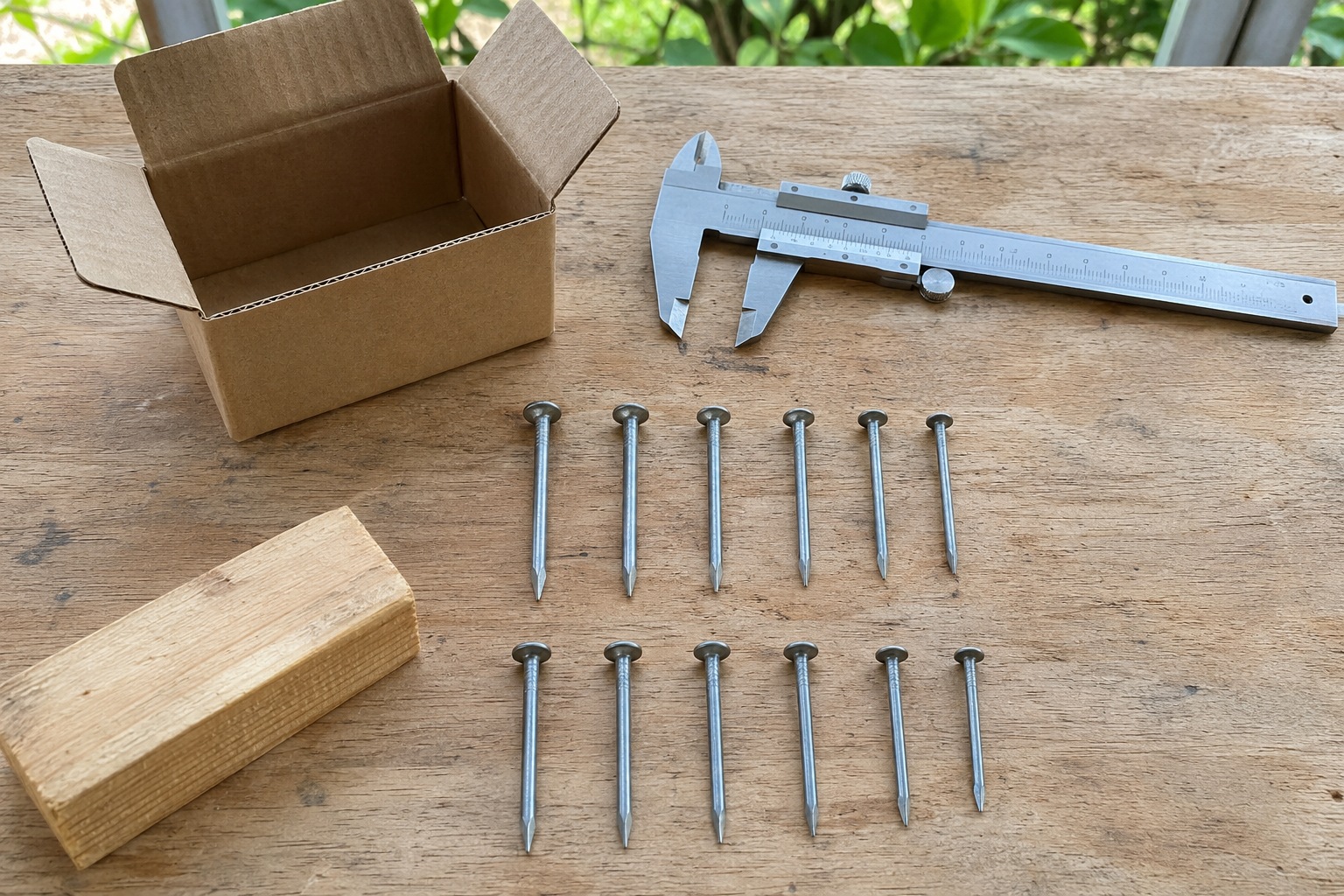
When sourcing types of nails for wood, buyers should request samples, dimensional checks, coating inspection, head and point review, packaging confirmation, carton strength checks, and shipment documentation. For repeat orders, buyers should also compare production consistency between samples and bulk cargo.
Sample approval is useful, but not enough
Samples help buyers confirm size, appearance, head shape, point, coating, and packaging. At DINGZHOU BEST HARDWARE, we can provide samples for quality checking, usually with a basic sample cost. This cost may be discussed for return or adjustment in a formal order, depending on the case.
However, samples are only one checkpoint. A good sample does not automatically guarantee that the full container will match. That is why buyers should define simple acceptance criteria before production.
Key checks for nail quality
Here are practical checks I recommend during procurement:
| Check item | What to look for | Why it matters |
|---|---|---|
| Length | Consistent with order specification | Helps achieve the specified penetration depth; withdrawal resistance depends partly on penetration depth12 |
| Diameter | Within agreed tolerance | Affects splitting and holding |
| Head shape | Full, centered, not cracked | Affects installation and pull-through |
| Point shape | Sharp and consistent | Affects driveability |
| Shank surface | Smooth, ringed, or spiral as ordered | Affects holding power |
| Coating | Even finish, no heavy rust | Affects appearance and corrosion resistance |
| Bend tendency | Check by driving into sample wood | Indicates suitability for the wood type |
| Packaging | Correct box, carton, label, pallet | Protects product and supports resale |
| Weight count | Confirm approximate quantity per box | Prevents commercial disputes |
Packaging is part of quality
For export orders, packaging is not a small detail. Nails are heavy. If cartons are weak, they may break during handling. If inner packing is poor, moisture may enter during sea freight. If labels are unclear, distributors may face warehouse confusion.
Buyers should confirm:
- Carton weight
- Pieces per box or kg per carton
- Inner bag or small box requirement
- Brand logo and artwork
- Palletizing plan
- Container loading method
- FCL or LCL shipment
Our usual shipment method is by sea, and we support both FCL and LCL. For many nail products, our minimum order quantity is 5 tons or 200 boxes, depending on product and packaging. I mention this early because it helps buyers calculate landed cost and stock turnover.
Do a practical use test
A simple field-style test can be very helpful. Buyers can take the sample nail and test it in the actual wood or similar wood. They should observe:
- Does the nail drive straight?
- Does the wood split?
- Does the nail bend?
- Does the head deform?
- Does the coating flake badly?
- Does the nail hold after pulling or vibration?
This test is not a substitute for professional engineering evaluation. Still, it helps buyers avoid obvious mismatch before placing a trial order.
Documentation to request
For procurement control, buyers may request:
- Product specification sheet
- Packing list format
- Commercial invoice format
- Photos before shipment
- Container loading photos
- Supplier business license or factory profile
- Relevant certificates if claimed by the supplier
Certifications should be treated as documents to verify, not as marketing words to accept blindly. Buyers should check whether the certificate is current, relevant to the product, and issued by a credible party.
How can importers choose a supplier for types of nails for wood?
Choosing types of nails for wood is only half of the buying decision. The other half is supplier reliability. A low unit price can become expensive if the supplier cannot control quality, delivery time, packaging, or communication during after-sales issues.
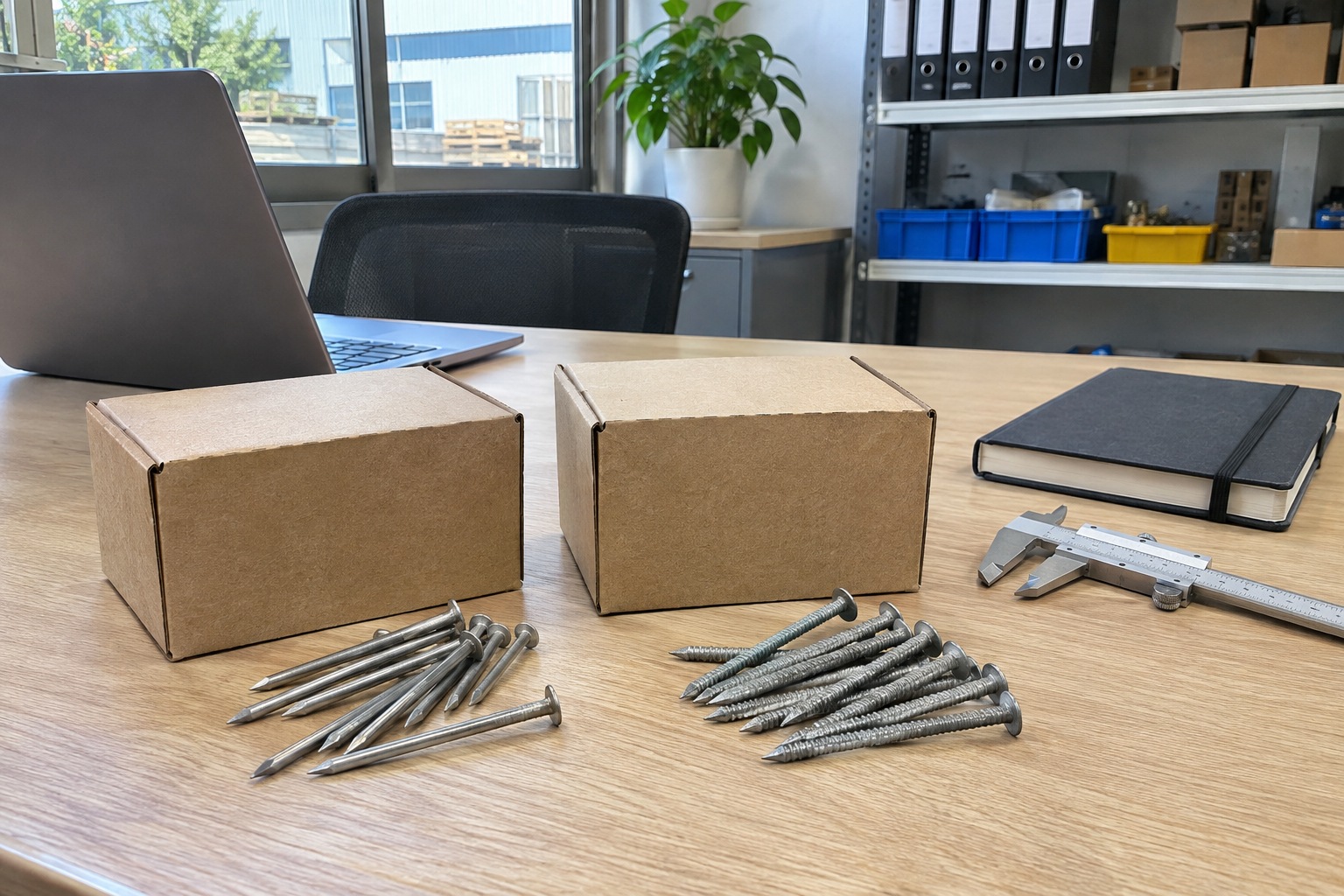
Importers should choose a supplier for types of nails for wood by checking factory capability, export experience, sample policy, customization support, quality control process, delivery time, MOQ, packaging options, and communication speed. A trial order is often a practical way to test cooperation before larger purchasing.
Factory or trading company?
Both factories and trading companies can serve buyers. The important point is transparency. As a production factory, 定州百斯特 focuses on nail manufacturing and export supply. We also have overseas factory experience, which helps us understand different market expectations in regions such as the Middle East, Africa, Southeast Asia, and South America.
A factory may offer advantages such as:
- Better control over production schedule
- More direct communication on specifications
- OEM/ODM support
- Custom packaging and logo options
- Faster adjustment after feedback
However, buyers should still evaluate every supplier carefully. A factory should be able to explain production details in plain language and provide realistic delivery commitments.
Price should be compared correctly
Our FOB quotation is usually based on:
Product + specification + quantity + packaging method
This is important because nail pricing changes when any of these factors change. A buyer cannot compare two offers fairly if one quote uses bulk packing and another uses printed small boxes. A quote for galvanized nails cannot be compared directly with bright steel nails. A quote for 5 tons may not match the unit cost of a full container.
A practical RFQ should include:
- Nail type
- Length and diameter
- Finish or coating
- Shank type
- Head type
- Quantity
- Packing method
- Destination port
- Branding requirement
- Target delivery time
Delivery time and order planning
Our typical delivery time is 15–25 days, depending on order quantity and production schedule. Buyers should also add time for sea freight, customs clearance, and inland delivery. In many markets, the true lead time is not only the factory production time.
Importers should plan around:
- Peak construction season
- Port congestion
- Local holidays
- Currency changes
- Container availability
- Warehouse capacity
Customization and trial orders
We support OEM/ODM customization, including product, packaging, and brand logo. This matters for distributors who sell through hardware stores or regional dealers. Good packaging can improve shelf trust, but it must also protect the nail during transport.
We also support trial orders. I often recommend trial orders when the buyer is testing a new nail type, new wood application, or new market. A trial order gives both sides useful feedback before scaling up.
Supplier questions that reveal professionalism
Before confirming a supplier, ask these questions:
- Can you provide samples for quality testing?
- What is your MOQ for this product and packaging?
- What is your normal delivery time?
- Can you send production and packing photos?
- Do you support FCL and LCL shipment?
- Can you customize cartons and labels?
- What happens if the received goods have a quality concern?
- Which markets do you usually export to?
- Can you explain the difference between similar nail options?
A good supplier should not only say “yes.” A good supplier should also ask you questions. When a supplier asks about wood type, climate, packaging, and use case, that supplier is helping reduce your risk.
Frequently Asked Questions
What are the most common types of nails for wood?
The most common types of nails for wood are common nails, box nails, finishing nails, lost head nails, brad nails, roofing nails, ring shank nails, and spiral shank nails. Each type serves a different purpose, so buyers should match the nail to the wood, exposure, and required holding power.
Are galvanized nails better for wood?
Galvanized nails are better for wood when moisture, outdoor exposure, or humid storage is expected. They offer more corrosion resistance than bright steel nails. However, they are not always necessary for dry indoor use, and buyers should confirm the coating type and quality with the supplier.
Which nails are best for wood trim?
Finishing nails, brad nails, and lost head nails are commonly used for wood trim because they have smaller heads and create a cleaner surface. The best option depends on trim thickness, wood density, installation tool, and whether the nail head will be filled or left visible.
Do ring shank nails hold better in wood?
Ring shank nails usually hold better than smooth shank nails because the rings grip the wood fibers and improve withdrawal resistance. They are useful for pallets, crates, and high-movement joints. However, they can be harder to remove and may not suit every thin or decorative wood application.
How should I request a quote for wood nails?
You should include nail type, length, diameter, coating, shank style, head type, quantity, packing method, branding needs, and destination port. At 定州百斯特, we usually quote on an FOB basis using product, specification, quantity, and packaging method as the core pricing factors.
Conclusion
Types of nails for wood should never be chosen by name alone. Buyers need to consider wood type, load, appearance, moisture exposure, shank design, coating, packaging, and supplier consistency. In my experience, the safest purchase starts with a clear application and a sample check before bulk order. If you are sourcing nails for construction, packaging, roofing, or distribution markets, contact 定州百斯特 at [email protected] or WhatsApp +8618331061136 to discuss specifications, samples, OEM/ODM packaging, and trial order options.
-
"Chapter 8: Fastenings | US Forest Service Research and …", https://research.fs.usda.gov/treesearch/62253. The USDA Forest Products Laboratory’s wood engineering guidance describes how nail size, shank form, wood properties, and exposure conditions affect splitting, corrosion, and withdrawal resistance in wood connections; this supports the general risk statement, although it does not quantify rework costs for a specific project. Evidence role: general_support; source type: government. Supports: A government wood-products reference should support that nail selection influences wood splitting, corrosion behavior, and withdrawal resistance.. Scope note: Contextual support for the technical risks, not direct evidence of project-specific cost outcomes. ↩
-
"Wood Handbook, Chapter 08: Fastenings", https://research.fs.usda.gov/download/treesearch/37424.pdf. Wood-connection design references from engineering institutions identify wood species or density, load demand, exposure conditions, and fastener geometry as relevant variables in nail connection performance; this supports the selection framework, though it does not address the article’s commercial phrase ‘buyer quality tolerance’ directly. Evidence role: expert_consensus; source type: institution. Supports: An engineering or wood-products institution should confirm that fastener selection depends on material properties, loading, exposure, and installation conditions.. Scope note: Direct support for engineering variables; commercial tolerance is inferred from procurement practice. ↩
-
"Determination of screw and nail withdrawal resistance …", https://pubmed.ncbi.nlm.nih.gov/19325775/. Government wood-products literature explains that nail performance varies with wood species, density, moisture content, and fastener characteristics, supporting the statement that similarly sized nails can behave differently across wood applications. Evidence role: mechanism; source type: government. Supports: A technical source should explain that wood species, density, and use conditions influence nail withdrawal and driving performance.. ↩
-
"Withdrawal strength of ring-shank nails embedded in southern …", https://research.fs.usda.gov/treesearch/25675. Experimental studies of nailed wood joints generally report higher withdrawal resistance for deformed-shank nails than for smooth-shank nails under comparable conditions; this supports the performance distinction, although exact values depend on wood species, moisture content, nail dimensions, and test method. Evidence role: mechanism; source type: paper. Supports: A research paper should document comparative withdrawal resistance of smooth, ring, or deformed shank nails in wood.. Scope note: Comparative support; the magnitude of improvement is application-specific. ↩
-
"Wood Handbook: Wood as an Engineering Material", https://research.fs.usda.gov/fpl/wood-handbook. Wood fastening guidance notes that larger fastener diameters and close placement in thin members can increase splitting risk, supporting the use of thinner nails where reduced splitting is important; the source is contextual and may not discuss packaging production specifically. Evidence role: mechanism; source type: government. Supports: A wood engineering reference should support the relationship between nail diameter, member thickness, and splitting risk.. Scope note: Supports the mechanism in wood members, not a packaging-industry-specific performance standard. ↩
-
"Nail Set Guide | How to Choose & Use", https://lumberama.com/tool-guides/nail-set. Educational carpentry references describe finishing nails as small-headed fasteners intended to be driven or set below the wood surface and concealed with filler, supporting the article’s description of their finishing function. Evidence role: definition; source type: education. Supports: An educational woodworking or construction source should define finishing nails as small-headed nails that can be set below the surface for concealed fastening.. ↩
-
Asphalt Roofing Manufacturers Association (ARMA). Nail Application of Asphalt Shingles. July 18, 2024. Provides guidance on corrosion-resistant roofing nail materials and installation requirements for asphalt shingles. ↩
-
Skulteti, M. J.; Bender, D. A.; Winistorfer, S. G.; and Pollock, David (1997). Withdrawal Strength of Ring-shank Nails Embedded in Southern Pine Lumber. Transactions of the ASAE, 40(2), 451–456. ↩
-
"Fastenings – Forest Service Research and Development", https://research.fs.usda.gov/download/treesearch/62253.pdf. The USDA Forest Products Laboratory and similar wood engineering references discuss fastener material, coatings, shank form, and nail geometry as factors affecting corrosion, withdrawal capacity, and installation behavior in wood connections; this supports the article’s general performance claim. Evidence role: general_support; source type: government. Supports: A comprehensive wood or fastener reference should support that fastener material, coating, and geometry affect corrosion and mechanical performance.. ↩
-
"Determination of Screw and Nail Withdrawal Resistance of …", https://pmc.ncbi.nlm.nih.gov/articles/PMC2635684/. Wood science references show that wood density and species influence nail driving resistance and withdrawal strength, supporting the caution that a nail performing well in soft pine may not behave identically in dense hardwood. Evidence role: mechanism; source type: research. Supports: A wood science source should support that density and species affect nail driving resistance, bending risk, and withdrawal performance.. ↩
-
American Galvanizers Association. What is Galvanizing?. Explains how hot-dip galvanizing forms a zinc-based coating that protects steel against corrosion. ↩
-
Rammer, D. R. (2021). Chapter 8: Fastenings. In Wood Handbook—Wood as an Engineering Material. General Technical Report FPL-GTR-282. USDA Forest Service, Forest Products Laboratory. Discusses how nail withdrawal resistance depends on wood density, nail diameter, and penetration depth. ↩