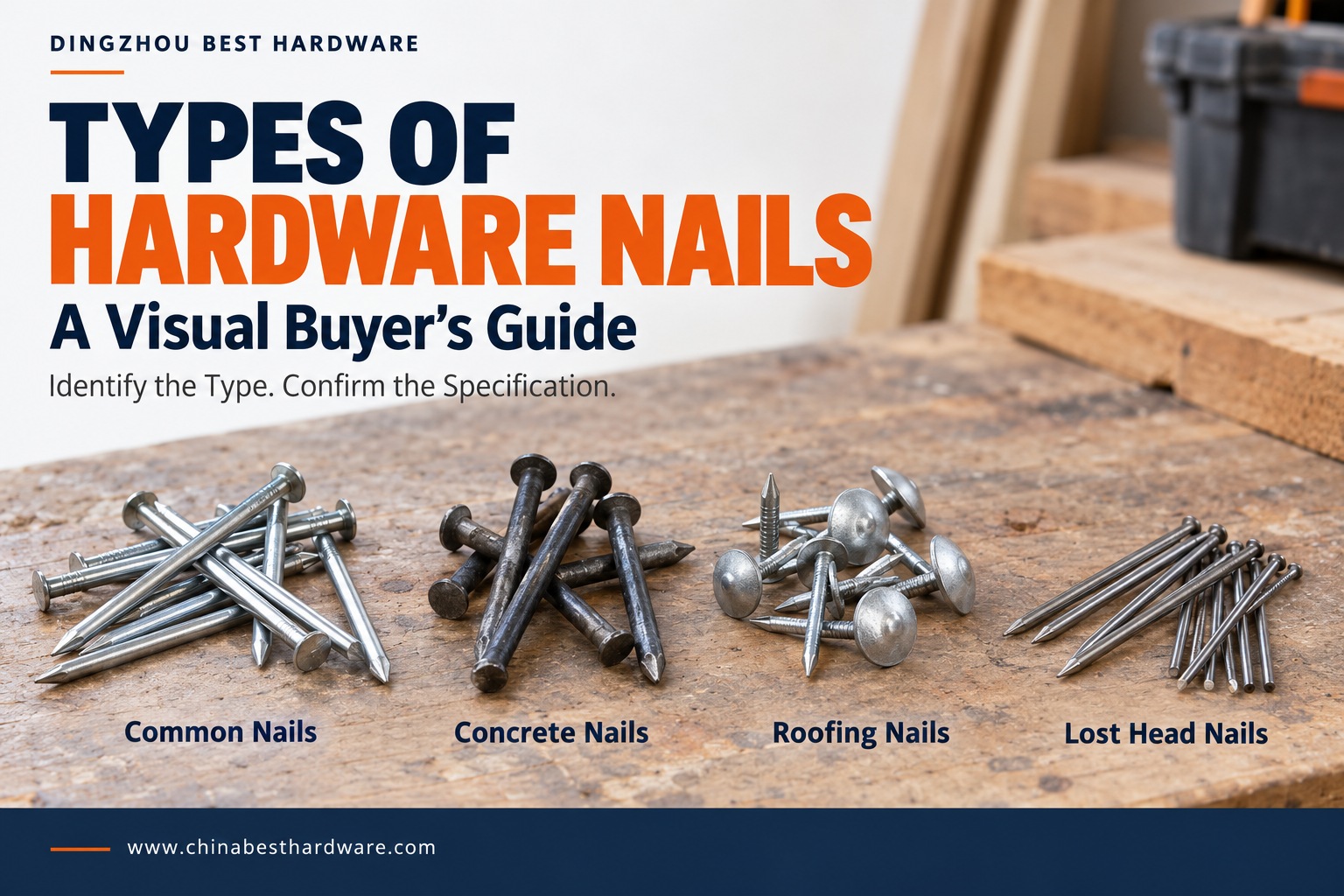
Types of nails hardware can look simple in pictures, but catalog teams often run into trouble when similar nails have different applications, materials, and specification requirements. A wrong name can lead to wrong quotations, repeated supplier questions, or poor product listings. I use pictures as a starting point, then confirm structure, usage, and specs.
Types of nails hardware should be identified by visible features and practical use together. Pictures help show head type, shank type, finish, point style, and packaging, but buyers should also confirm application, material, size, coating, packing method, and customization needs before listing products or requesting a bulk quotation.
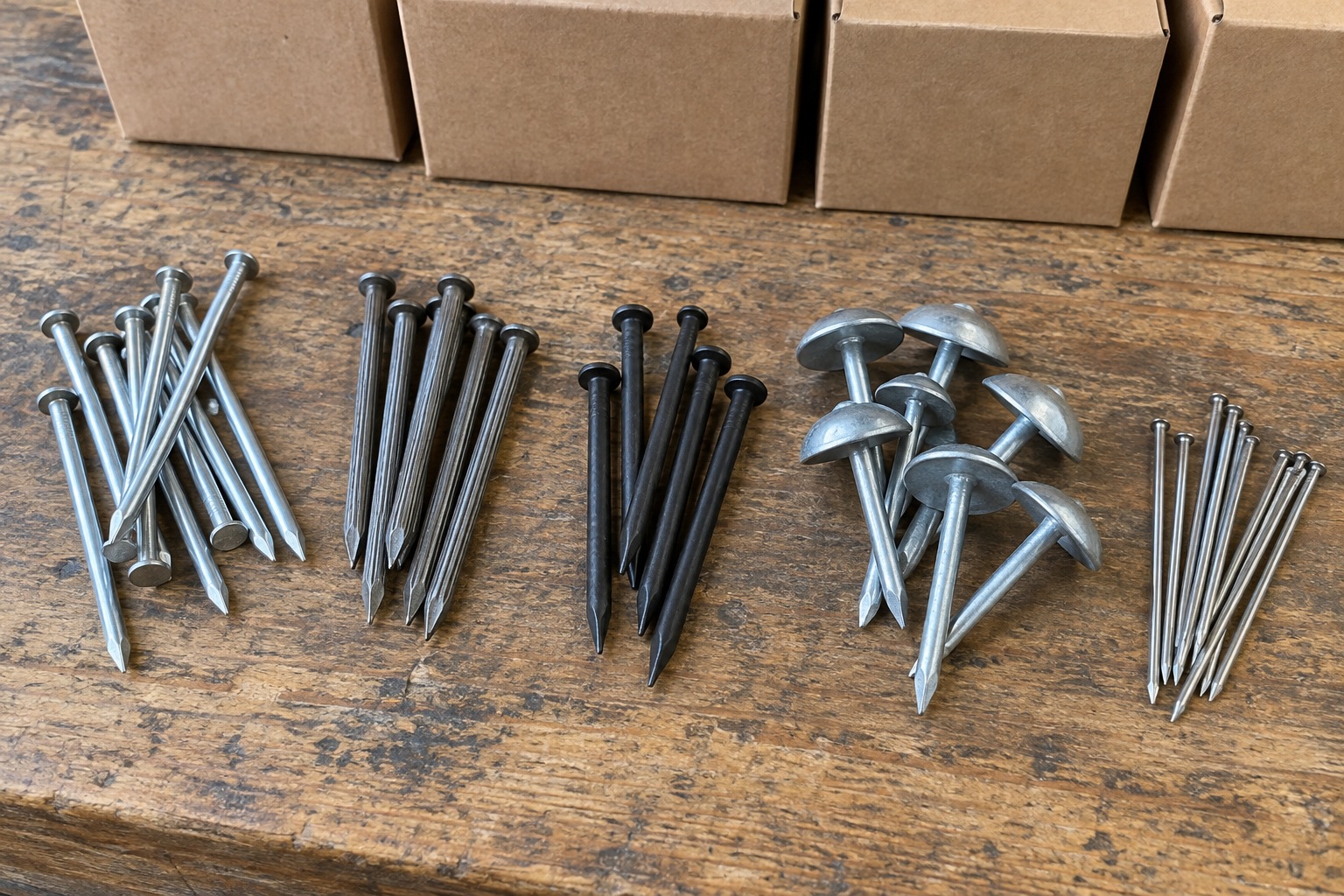
In actual export inquiry communication, I often see one photo sent with only “nails price?” written beside it. That is rarely enough. The sections below explain how I classify nail products for clearer catalogs, ecommerce pages, and B2B supplier inquiries.
How should types of nails hardware be classified for product listings?
A visual gallery can attract attention, but it can also create confusion. Many nails look similar from one angle, especially in small product photos. If a catalog manager classifies by appearance only, the listing may miss the actual use case, material, or packing requirement.
Types of nails hardware should be classified by application, installation material, visible structure, material grade, finish, size range, and packaging. A strong listing should connect the nail name with how it is used, not just how it looks in a picture.
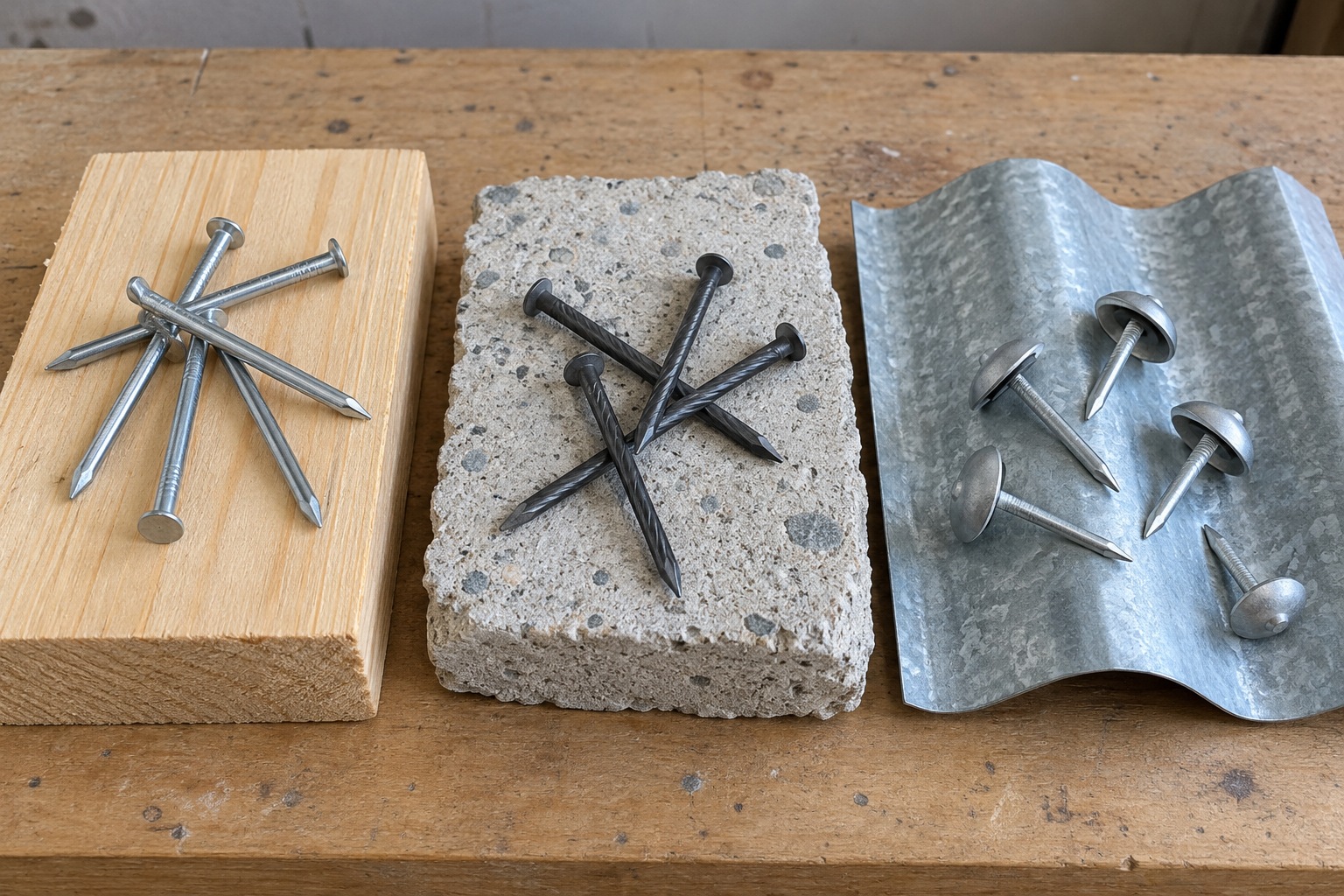
Pictures show the visible differences, not the full specification
Pictures are useful because they help buyers notice the parts that can be seen immediately:
- Head type: flat head, umbrella head, lost head, checkered head
- Shank type: smooth shank, ring shank, spiral shank, fluted shank
- Finish: bright, black, galvanized, polished, coated
- Point style: diamond point, blunt point, sharp point
- Packing: carton, box, bag, bulk packing, branded packaging
However, a picture cannot fully confirm the steel material, hardness, zinc coating thickness, exact wire diameter, tolerance, or packing weight. In my own inquiry work, I may receive two pictures that look almost the same, but one customer needs nails for concrete fixing and another needs nails for wood packing. Those are not the same buying decision.
A practical classification framework
For B2B catalogs, I prefer to classify nail hardware with this simple framework:
| Classification field | What it means | Why it matters |
|---|---|---|
| Product name | Concrete nail, roofing nail, common nail, lost head nail | Prevents naming confusion |
| Application | Concrete, wood, roofing sheet, furniture, packaging | Connects product to actual use |
| Material | Low carbon steel, high carbon steel, iron wire, steel wire | Affects strength and hardness |
| Head type | Flat, umbrella, countersunk, lost head | Affects holding and appearance |
| Shank type | Smooth, ring, spiral, fluted | Affects grip and installation |
| Finish | Bright, black, galvanized, painted | Affects appearance and corrosion resistance |
| Size range | Length and diameter | Needed for quotation and packing |
| Packing | Box, carton, bag, pallet | Affects cost, shipping, and retail display |
| Customization | OEM logo, brand packing, special size | Important for distributors and sellers |
Why English names are not always universal
One important point is that nail names are not always used the same way in every market. A seller in Africa, the Middle East, Southeast Asia, or South America may use a local trade name that differs from a Chinese export catalog name. Even within English listings, terms can overlap.
For example:
- “Steel nail” may mean a general steel-made nail in one catalog.
- “Concrete steel nail” may mean a hardened nail for masonry in another catalog.
- “Common nail” may be used for general wood construction nails.
- “Iron nail” may be used casually for several low carbon wire nails.
I do not treat one naming system as universal. I always connect the name to application and specification before confirming a quote.
What catalog teams should include
A product listing should not stop at “2 inch nail” or “galvanized nail.” It should include enough detail for a buyer to understand the product and enough structure for a supplier to quote.
A good listing format can be:
- Product name: Galvanized roofing nail
- Application: Roofing sheet fixing
- Material: Steel wire
- Head type: Umbrella head
- Shank type: Smooth or twisted shank
- Finish: Electro galvanized or hot dipped galvanized
- Size: Length × shank diameter × head diameter
- Packing: 1 kg box, 25 kg carton, or customized packing
- Customization: Brand logo, color box, carton marks
This approach makes a product page more useful for buyers and reduces unnecessary back-and-forth with suppliers.
Which types of nails hardware are most often confused in B2B inquiries?
Confusion usually starts when one short product name is used for several real products. A buyer may ask for “steel nails,” while the intended product may be concrete nails, black steel nails, or general common nails. This creates delays before pricing can even begin.
The most commonly confused types of nails hardware include common nails, concrete nails, black steel nails, roofing nails, and lost head nails. They may look similar in small pictures, but they differ by application, material, head design, finish, and installation surface.
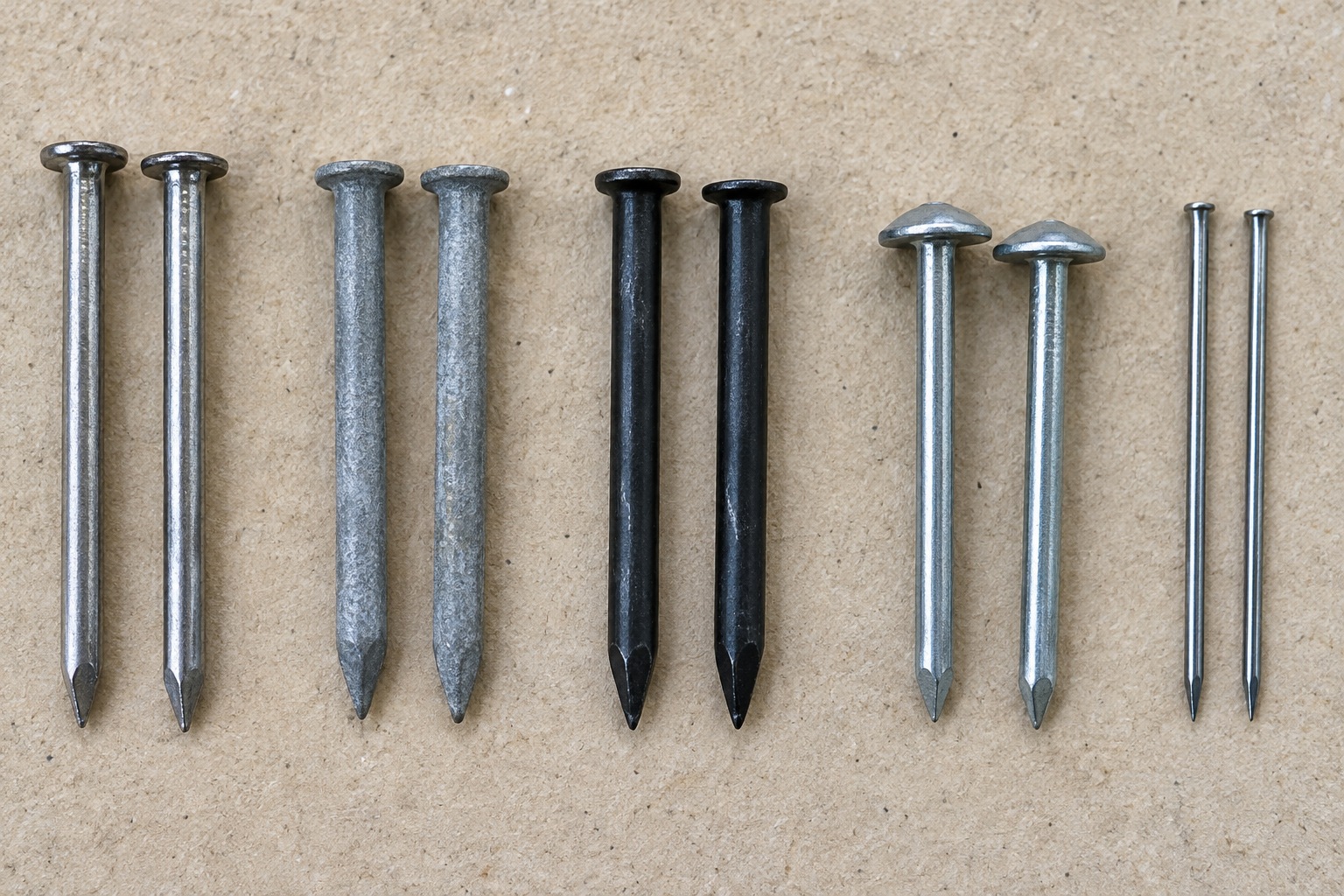
Common nails
Common nails are usually general-purpose nails used for wood construction, pallet making, crate assembly, and basic carpentry. They normally have a flat head and smooth shank, although size and finish can vary by market.
In product listings, common nails should not be described only by length. The buyer also needs:
- Wire diameter
- Length
- Head diameter
- Finish
- Packing weight
- Carton details
A listing like “common nails 2 inch” is too incomplete for accurate procurement. A clearer inquiry would be: common nail, bright finish, 50 mm length, 2.8 mm diameter, 25 kg carton packing, trial order quantity 5 tons.
Concrete nails
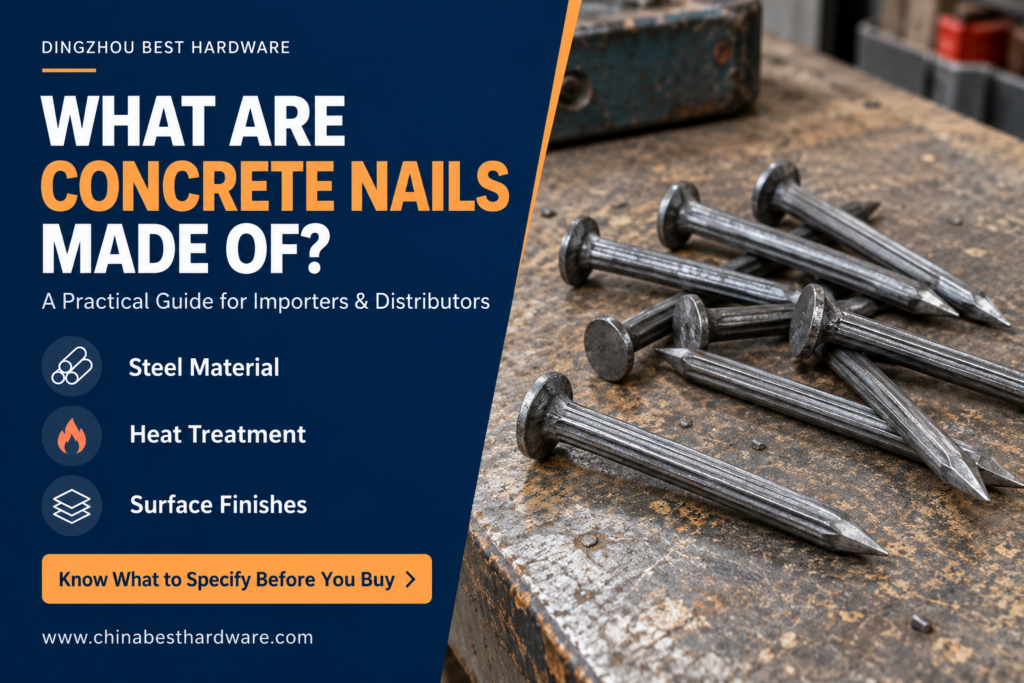
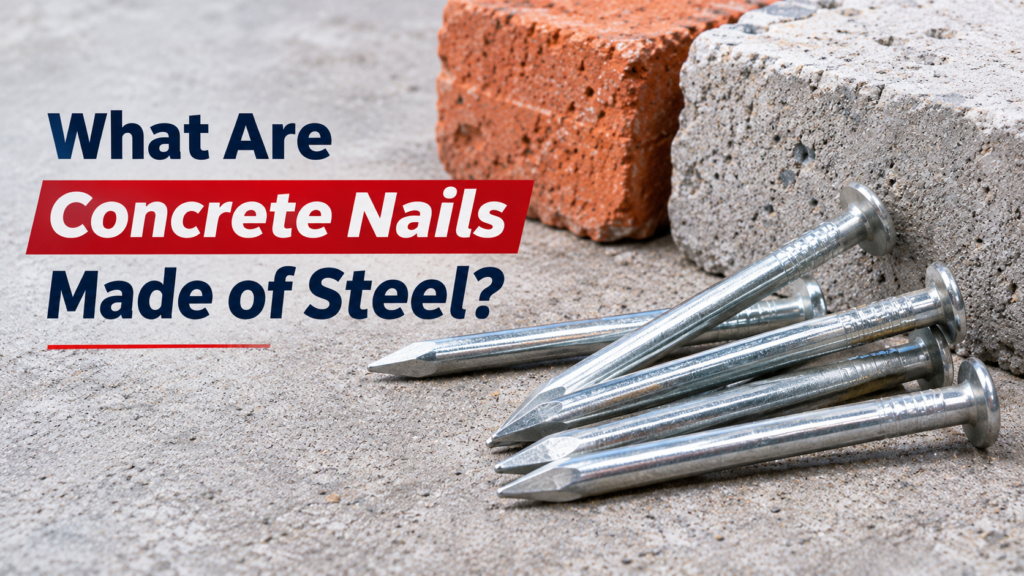
Concrete nails are used for fixing into harder materials such as concrete, masonry, or brick. In many catalogs, they are described as hardened steel nails or steel concrete nails. They often have higher hardness than general common nails, but buyers should verify the supplier’s specification and quality documents rather than assuming performance from the name only.
Concrete nails may come in:
- Black finish
- Galvanized finish
- Fluted shank
- Smooth shank
- Different head shapes
For procurement teams, the important point is the installation material. If the nail is intended for concrete or masonry, the inquiry should say so clearly.
Black steel nails
Black steel nails are often confused with concrete nails because many concrete nails have a black surface. However, “black steel nail” can be used differently by different sellers. It may refer to the surface finish, the product category, or a market-specific name.
This is why I usually ask follow-up questions when a buyer requests black steel nails:
- Is the nail used for concrete, wood, or another material?
- Do you need hardened steel?
- What shank type do you need?
- What length and diameter are required?
- Do you have a sample or previous packing photo?
These questions are not meant to slow the buyer down. They help prevent the wrong product from being quoted.
Roofing nails
Roofing nails are easier to identify when the umbrella head is visible. They are commonly used for roofing sheets, especially in construction and agricultural buildings. They may have smooth, twisted, or ring shanks depending on market preference.
A proper roofing nail listing should include:
| Field | Example |
|---|---|
| Product name | Galvanized umbrella roofing nail |
| Head | Umbrella head |
| Shank | Smooth or twisted |
| Finish | Galvanized |
| Washer | With or without washer |
| Size | 2.5 mm × 50 mm, or required size |
| Packing | Box, carton, or bulk packing |
Pictures are very useful here because the head shape is distinctive. Still, the washer, finish, and shank must be confirmed.
Lost head nails
Lost head nails have a small head designed to sit less visibly in woodwork or furniture applications. They are often used where a cleaner surface appearance is desired. They should not be mixed with common nails just because the body shape looks similar.
For ecommerce teams, the key product angle is appearance and finishing work. A lost head nail listing should mention:
- Small or minimal head
- Woodwork or furniture use
- Length and wire gauge
- Bright, polished, or galvanized finish
- Packing method
When these distinctions are clear, buyers can compare products more accurately.
What visible features should pictures show for types of nails hardware?
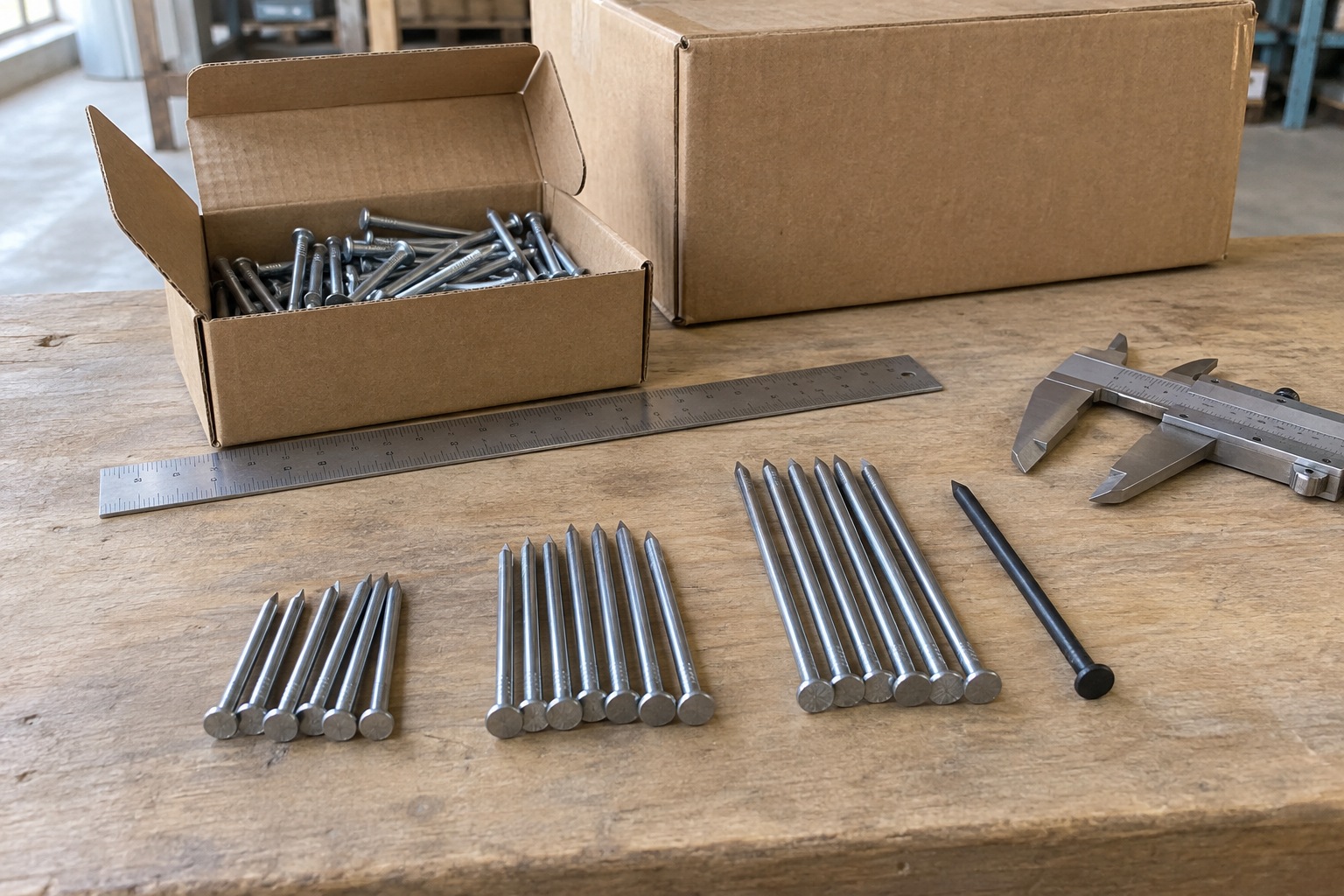
A product picture should help the buyer identify visible differences quickly. But if the picture is too far away, too dark, or taken from only one angle, it will not support accurate classification. Good nail pictures should show structure, finish, and scale.
Pictures for types of nails hardware should show the head, shank, point, surface finish, size comparison, and packaging. The best product pages use close-up images and specification tables together, because pictures identify appearance while tables confirm measurable details.
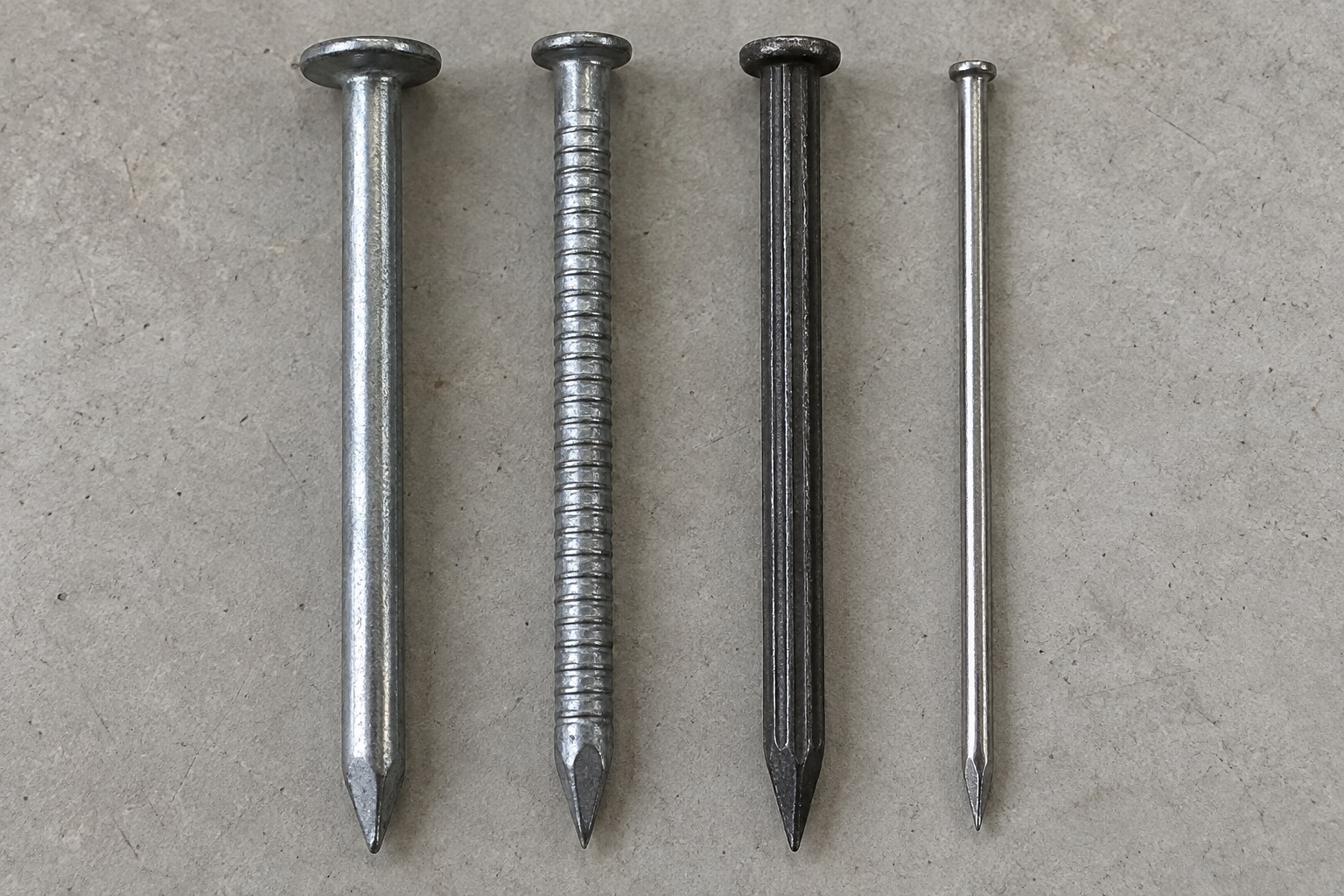
Head type
The head is one of the easiest visible features to compare. It affects holding power, final appearance, and application.
Common head types include:
- Flat head: common in general construction and wood use
- Umbrella head: common in roofing nails
- Lost head: used where the head should be less visible
- Checkered head: provides hammer grip during installation
- Countersunk head: allows the nail to sit closer to the material surface
A good picture should include a top view and side view of the head. A top view shows shape and surface texture. A side view shows head thickness and profile.
Shank type
The shank is the long body of the nail. It is easy to overlook in small images, but it is one of the most important classification points.
Common shank types include:
| Shank type | Visible appearance | Common purpose |
|---|---|---|
| Smooth shank | Plain straight body | General use and easier driving |
| Ring shank | Rings around body | Better holding in wood |
| Spiral shank | Twisted body | Improved grip in some applications |
| Fluted shank | Grooved body | Often seen in concrete nails |
In inquiry communication, shank type can change the price and production process. If a buyer sends only a front photo, the supplier may not clearly see whether the shank is smooth, twisted, or ringed.
Surface finish
Surface finish affects appearance, market preference, and corrosion resistance level. It also affects quotation. A product page should not rely only on color because lighting can make bright, polished, or galvanized nails look similar.
Common finishes include:
- Bright finish
- Polished finish
- Black finish
- Electro galvanized
- Hot dipped galvanized
- Painted finish
For application-specific corrosion decisions, buyers should verify supplier documents and, when needed, request qualified professional evaluation. A photo cannot prove coating quality by itself.
Point style
Most buyers do not ask about point style first, but it still matters. The point affects how the nail starts entering the material. A sharp diamond point is common, but some applications may use different point styles.
A useful photo should show the point close up. This is especially helpful when buyers compare samples from different suppliers.
Packaging pictures
Packaging is not just a visual detail. It affects shipping, warehousing, retail display, and buyer expectations. For bulk export orders, packaging can influence final cost and container loading.
A good nail product page may show:
- Inner box
- Outer carton
- Woven bag or bulk bag
- Pallet packing
- Carton marks
- OEM brand label
At Dingzhou Best, for example, I often discuss packaging along with product specs because many customers in the Middle East, Africa, Southeast Asia, and South America have established local packing preferences. Some buyers want simple bulk packing. Others need branded boxes for resale. Both are valid, but they require different quotations.
Recommended image set for product pages
For catalog and ecommerce teams, I recommend using at least five image types:
- Main product image on a clean background
- Head close-up
- Shank close-up
- Finish comparison image
- Packing image
This structure makes the listing more useful than a simple visual gallery. It also helps the sales team answer inquiries faster.
What specifications should buyers confirm before quoting types of nails hardware?
Many quotation delays come from missing specification fields. A buyer may provide a nail name and photo, but the supplier still needs size, material, finish, packing, and order quantity. Without these details, the price may be inaccurate or impossible to confirm.
Before quoting types of nails hardware, buyers should confirm product name, application, material, length, diameter, head type, shank type, finish, packing method, quantity, destination port, and customization needs. These fields help suppliers calculate production cost, packaging cost, and FOB pricing more accurately.
Basic product information
The first information set should describe what the nail is and how it will be used.
A clear inquiry can start with:
- Product name
- Application
- Installation material
- Required size
- Surface finish
- Sample picture, if available
For example:
“We need black concrete nails for masonry use, 40 mm length, 3.0 mm diameter, black finish, carton packing, trial order 5 tons.”
This message is much more useful than:
“Please send best price for black nail.”
The second message may seem simple, but it forces the supplier to ask many follow-up questions.
Size and measurement fields
Length and diameter are essential, but they are not always expressed the same way. Some buyers use millimeters. Others use inches or wire gauge. Catalog teams should list both if the target market uses both.
Important measurements may include:
| Measurement | Why it matters |
|---|---|
| Length | Main size reference |
| Shank diameter | Affects strength, weight, and price |
| Head diameter | Important for holding surface |
| Head thickness | Useful for special applications |
| Wire gauge | Common in some markets |
| Weight per carton | Affects packing and shipping |
Small changes in diameter can change the weight per carton and total price. This is why accurate measurement matters in bulk orders.
Material and finish
Material and finish should be confirmed separately. A buyer should not assume that all nails with the same finish have the same material. For example, a black finish does not automatically confirm that the product is suitable for concrete.
Common material descriptions may include:
- Low carbon steel wire
- Steel wire
- Hardened steel
- Iron wire, depending on local naming
Common finish descriptions may include:
- Bright
- Polished
- Black
- Galvanized
- Painted
If corrosion resistance is important, buyers should request relevant documents, samples, or third-party testing based on their project needs. I keep this point practical because a factory photo or catalog statement alone should not replace application-specific evaluation.
Packing and quantity
For export business, packing can be just as important as the nail itself. A buyer may need a small box for retail, a 25 kg carton for wholesale, or customized packing with a brand logo.
At our factory, common quotation logic usually depends on:
Product + specification + quantity + packing method
This is especially important for FOB pricing. If the packing changes, the cost may change. If the order quantity changes, production planning and unit cost may also change.
Useful packing details include:
- Pieces per box
- Weight per box
- Boxes per carton
- Carton weight
- Carton size
- Pallet requirement
- Brand label or neutral packing
- Shipping marks
Our usual minimum order quantity is 5 tons or 200 boxes, depending on product and packing. Trial orders can be discussed, and samples can be provided for quality checking. Sample fees may apply, and buyers can discuss whether the fee is returned in a formal order.
Delivery and shipping details
Shipping method also matters. For nail hardware, sea freight is common because the goods are heavy. Buyers may use:
- FCL: full container load
- LCL: less than container load
The delivery time often depends on quantity, production schedule, and packaging requirements. In our normal export communication, a common lead time range is 15–25 days, but buyers should confirm timing for each order.
A complete inquiry should also include:
- Destination country
- Destination port
- Required trade term, such as FOB
- Expected order quantity
- Packing requirements
- Any inspection or document requirements
This information allows a supplier to respond with a realistic quotation instead of a rough guess.
How can catalog teams avoid naming mistakes in types of nails hardware?
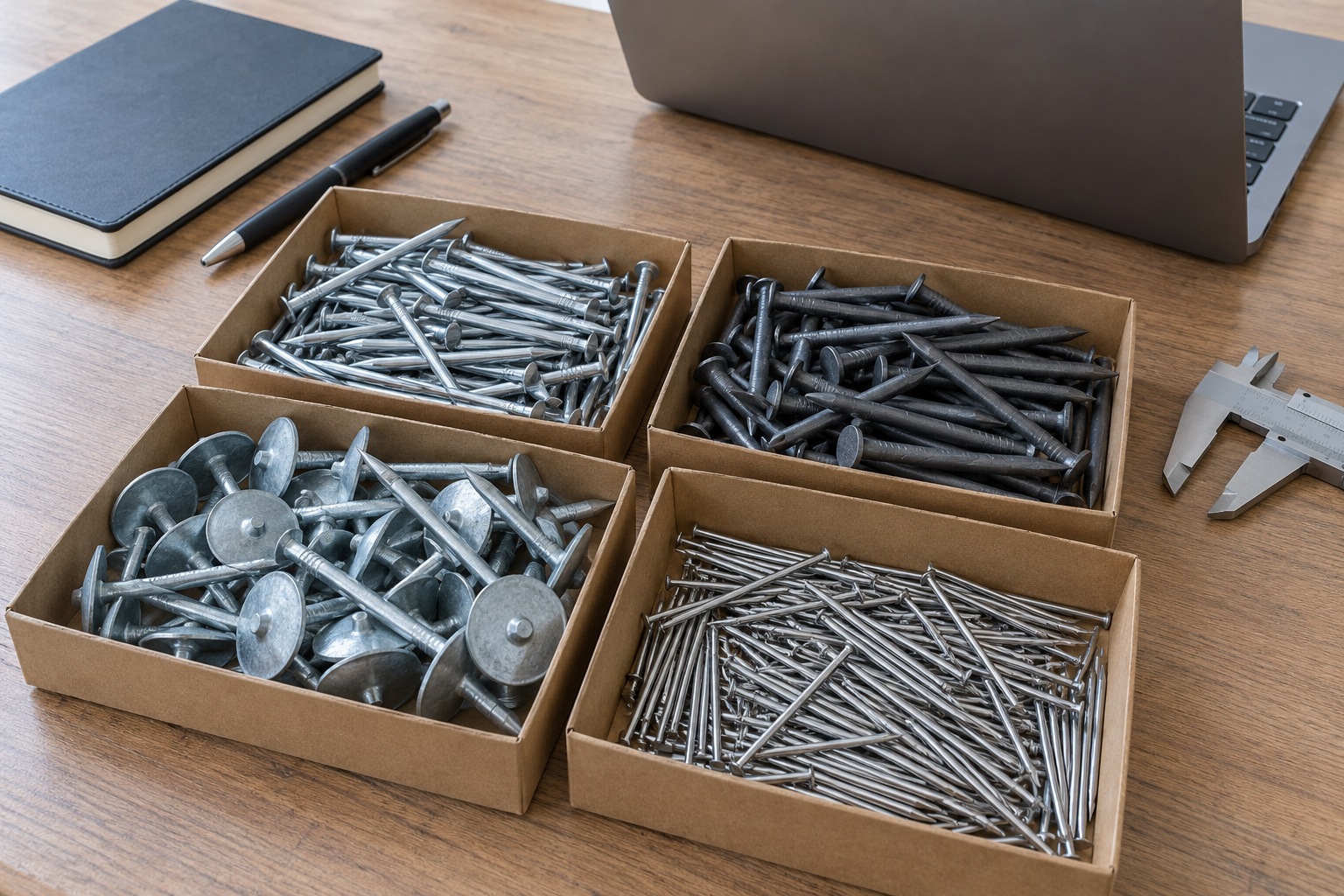
Naming mistakes happen because different markets use different terms, and similar nails can share visible features. If a catalog team copies names from another website without checking application and specs, the final product page may mislead buyers.
Catalog teams can avoid naming mistakes in types of nails hardware by building listings around use case, material, structure, and specification fields. They should also keep supplier confirmation records, compare samples, and avoid using one photo as the only source of truth.
Build a product naming rule
A clear naming rule makes catalogs easier to manage. I suggest using a structure like this:
Finish + product type + head or shank feature + size
Examples:
- Galvanized umbrella roofing nail 50 mm
- Black fluted concrete nail 40 mm
- Bright common nail 2 inch
- Polished lost head nail 30 mm
This rule is not universal, but it helps internal teams keep a consistent format. It also helps buyers scan product pages faster.
Keep a specification table on every product page
A picture may attract the click, but a specification table supports the buying decision. Every nail product page should include a table like this:
| Field | Example content |
|---|---|
| Product name | Black concrete nail |
| Application | Concrete and masonry fixing |
| Material | Hardened steel, subject to supplier confirmation |
| Head type | Flat head |
| Shank type | Fluted or smooth |
| Finish | Black |
| Size range | 20 mm–100 mm, depending on supplier |
| Packing | Box, carton, or customized |
| MOQ | Based on supplier policy |
| Customization | OEM/ODM packing, logo, size options |
This table also helps sales teams. When a buyer asks for a quote, the team can quickly check which fields are missing.
Use images as evidence, not as the full answer
I like to treat pictures as evidence. They show what the nail appears to be. They do not prove every specification.
For example, a photo can show:
- The nail has an umbrella head.
- The surface looks galvanized.
- The shank appears twisted.
- The product is packed in a branded box.
But the photo cannot fully prove:
- Material grade
- Hardness
- Zinc coating weight
- Exact diameter tolerance
- Actual carton weight
- Factory production process
This difference matters for procurement evaluation and supplier selection. A buyer should verify documents, request samples, and check whether the supplier can meet the required specification.
Create an inquiry template for buyers
Catalog and ecommerce teams can also reduce confusion by adding an inquiry form beside product listings. The form should guide buyers to submit complete information.
A useful inquiry template includes:
- Product name or photo
- Application
- Size
- Material requirement
- Finish
- Head type
- Shank type
- Packing method
- Quantity
- Destination port
- Custom brand or logo requirement
- Sample requirement
This template helps both sides. The buyer receives a more accurate quotation, and the supplier avoids repeated confirmation.
Compare samples before bulk purchase
For bulk purchasing, samples are valuable. They help buyers compare actual weight, finish, head shape, shank shape, and packing quality. Samples should not replace full inspection, but they are a practical first step.
In our factory export work, we can provide samples for quality checking. Usually, samples involve a basic fee, and buyers can discuss the fee return arrangement in the formal order. This policy helps both sides treat sample requests seriously while still supporting trial cooperation.
Avoid copying competitor titles blindly
This is a common ecommerce problem. A competitor may use a title that ranks well, but the name may not match your product. If a team copies that name, the listing may attract the wrong buyers.
Instead, catalog teams should check:
- Does the name match the application?
- Does the image match the structure?
- Does the specification table match the product?
- Does the supplier use the same name?
- Does the target market use another common term?
This extra check can prevent costly confusion later.
Frequently Asked Questions
Are pictures enough to identify nail types?
Pictures are helpful, but they are not enough for accurate nail identification. A picture can show head shape, shank style, finish, and packing, but buyers still need to confirm material, size, application, hardness requirements, coating, packing weight, and order quantity before procurement.
What is the difference between concrete nails and common nails?
Concrete nails are generally intended for harder materials such as concrete, masonry, or brick, while common nails are usually used for wood construction, crates, pallets, and general carpentry. Buyers should confirm material, hardness, shank type, and finish with the supplier before ordering.
Why do suppliers ask for packing details before quoting nails?
Packing affects material cost, labor cost, carton size, shipping weight, and retail presentation. A 25 kg bulk carton and a branded small box can have different costs. For FOB quotations, suppliers usually need product specification, quantity, and packing method before giving an accurate price.
What information should I send for a nail hardware quotation?
You should send the product name, application, length, diameter, head type, shank type, finish, packing method, quantity, destination port, and any OEM or logo requirements. A clear photo or sample reference also helps the supplier confirm the correct product faster.
Can nail hardware be customized for brand sales?
Yes, many nail products can be customized by size, finish, packaging, carton mark, and brand logo. OEM/ODM options depend on product type, order quantity, and packing design. Buyers should confirm artwork, packing format, MOQ, and lead time with the supplier before placing an order.
Conclusion
Types of nails hardware should be explained through more than pictures. A good catalog connects the photo with application, material, head type, shank type, finish, size, packing, and customization details. This approach helps ecommerce teams avoid naming mistakes and helps B2B buyers send clearer inquiries. If you need help confirming nail specifications for concrete nails, black steel nails, roofing nails, lost head nails, or related products, contact Dingzhou Best at [email protected] or WhatsApp +8618331061136 for sample and FOB quotation discussion.