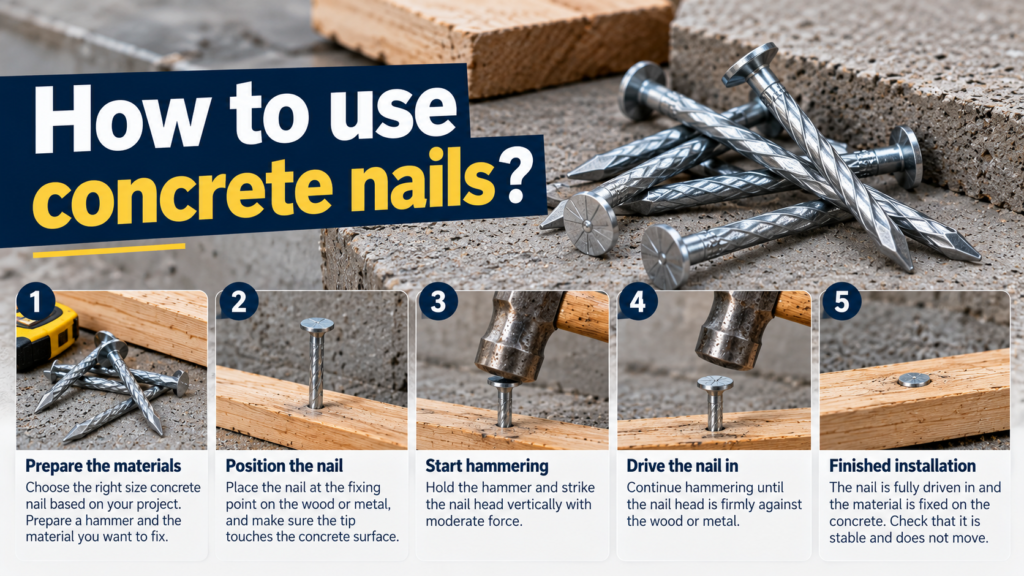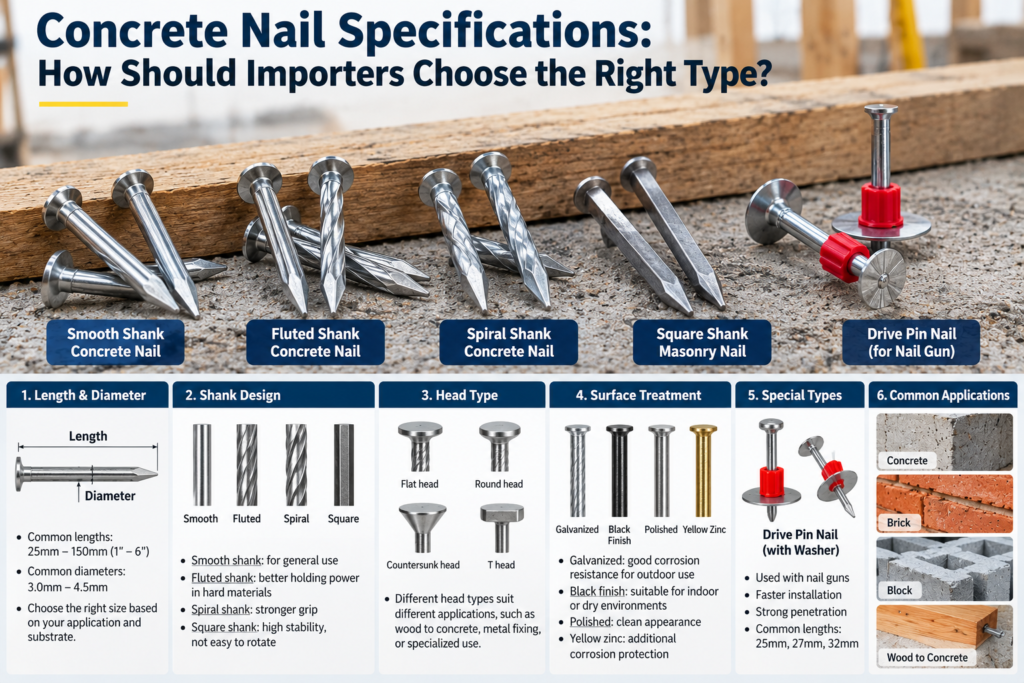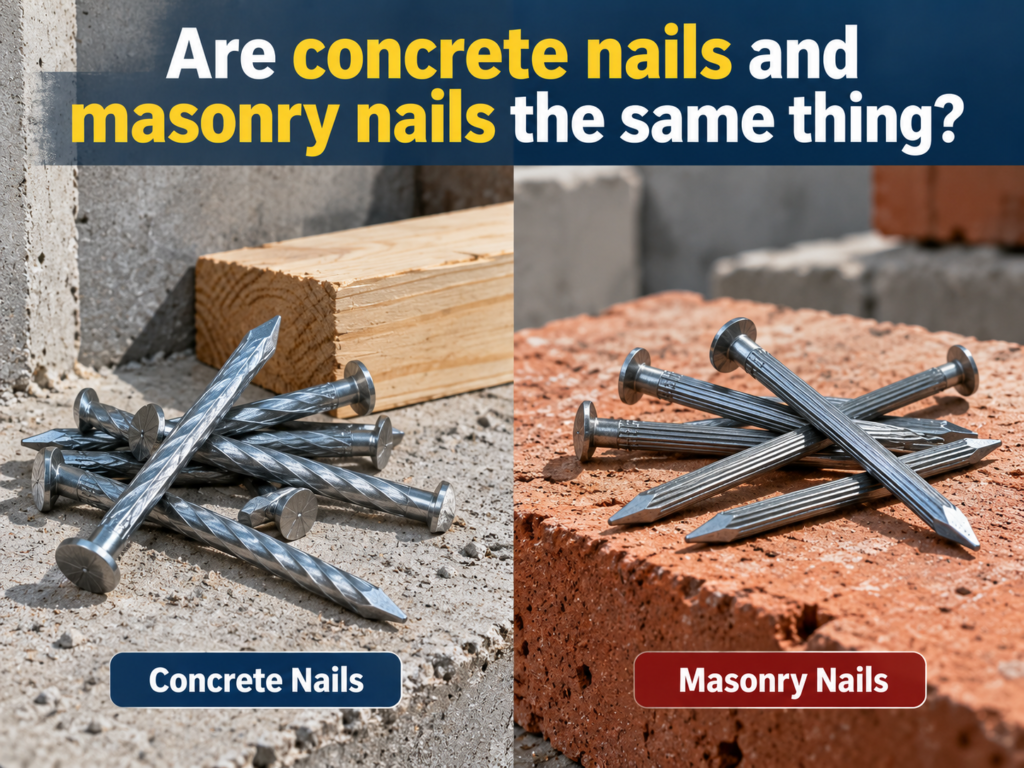
The difference between a wire nail and a concrete nail can look small on paper, but the wrong choice can cause bent nails, cracked surfaces, loose fixing, and customer complaints. I often see buyers compare them only by size or price. The better solution is to match the nail to the substrate, load requirement, and end-user application.
A wire nail is a general-purpose steel fastener mainly used for wood, packaging, furniture, and light construction. A concrete nail is a hardened steel fastener designed for concrete, brick, block, and masonry.1 They are not interchangeable because concrete nails need higher hardness, stronger penetration, and better resistance to bending in dense materials.2
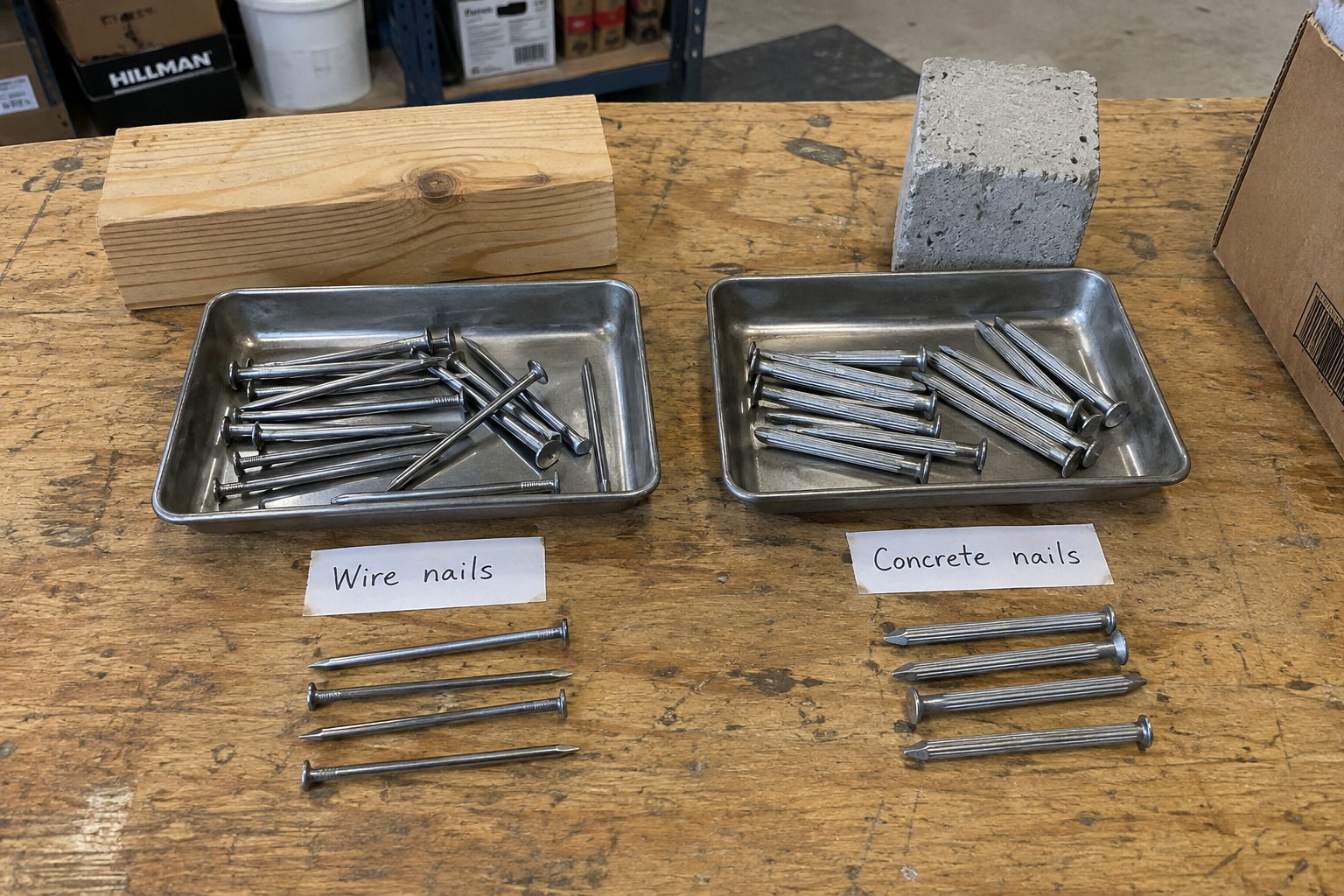
This difference matters more for wholesalers and purchasing managers than many people expect. A wrong stocking decision can lead to slow inventory, failed applications, and returns. So, I will break down the selection logic in a practical way, based on the kinds of questions I hear from hardware buyers.
What is the basic difference between a wire nail and a concrete nail?
Many buyers first notice that a wire nail and concrete nail may both be made of steel and may look similar in simple product photos. That similarity can create confusion. The problem starts when the nail is used in the wrong material. Then the real performance gap becomes obvious.
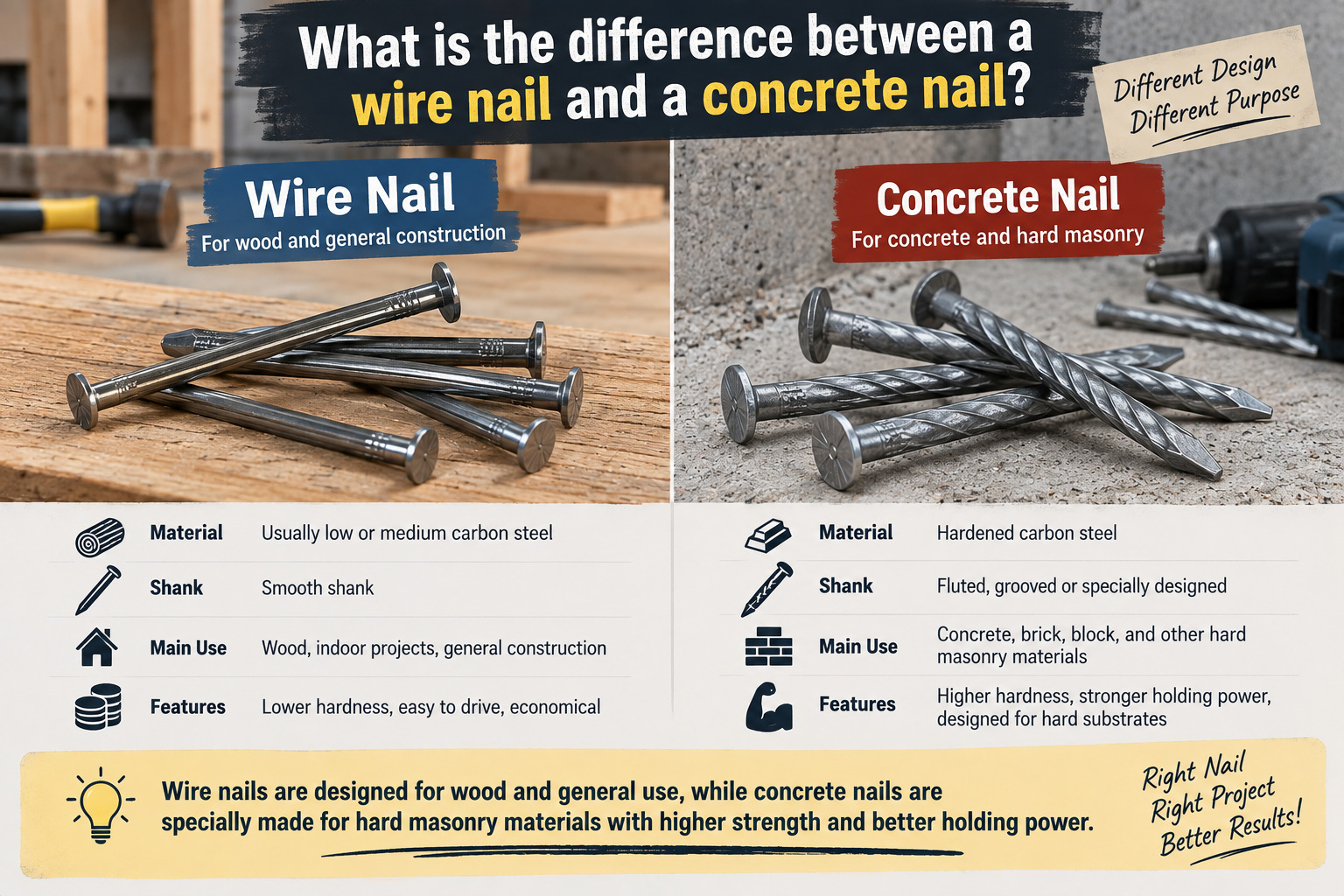
A wire nail is made for softer materials like wood, while a concrete nail is made for hard masonry surfaces. The biggest differences are material hardness, heat treatment, shank design, point sharpness, and intended substrate. These differences decide whether the nail drives smoothly or bends, breaks, or damages the surface.
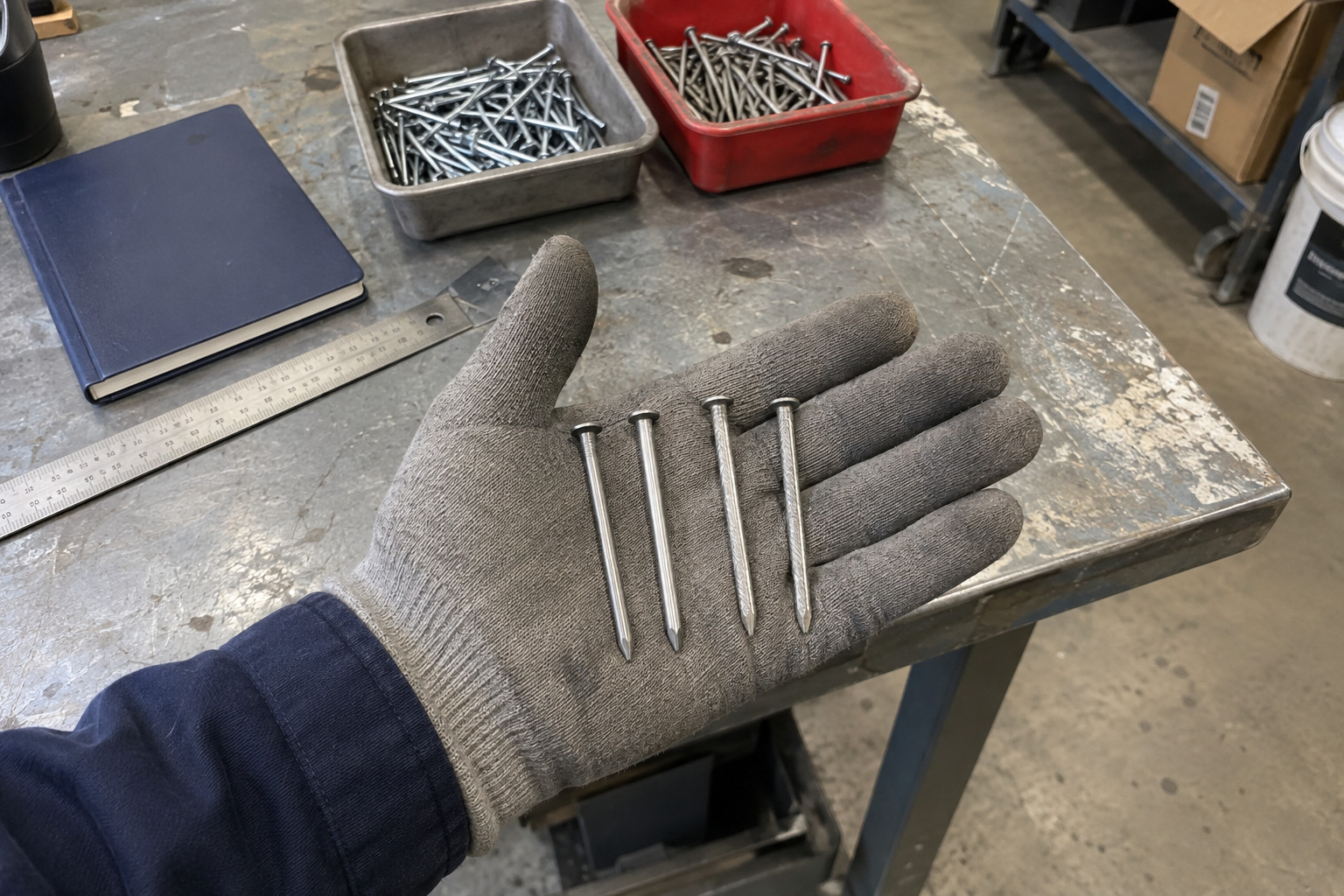
Wire nails are general-purpose fasteners
A wire nail is usually produced from drawn steel wire. It is cut, headed, pointed, and sometimes polished or surface-treated.3 In common trade language, buyers may call it a common wire nail, round wire nail, or simply a wood nail.
Wire nails are mainly used for:
- Wooden frames
- Pallets and crates
- Furniture assembly
- Light carpentry
- Temporary fixing
- General construction woodwork
- Packaging and case making
The key idea is simple: a wire nail performs best when the base material allows penetration without extreme resistance.
Wood fibers move and compress around the nail. That gives the nail holding power.4 A standard wire nail does not need the same hardness as a concrete nail because it is not expected to pierce dense masonry.
Concrete nails are purpose-built masonry fasteners
A concrete nail is usually made from higher-carbon steel or hardened steel, depending on the product grade and market requirement. It is commonly heat-treated to increase hardness.5 Many concrete nails also have a fluted, grooved, or specially shaped shank to improve grip in masonry.6
Concrete nails are mainly used for:
- Concrete walls
- Brick walls
- Cement blocks
- Masonry surfaces
- Fixing wood strips to concrete
- Installing light clips, battens, or frames
- Certain renovation and repair jobs
The main purpose is penetration into hard mineral-based materials. A concrete nail must resist bending when hammered into a dense surface.
Practical comparison table
| Feature | Wire Nail | Concrete Nail |
|---|---|---|
| Main use | Wood and light materials | Concrete, brick, block, masonry |
| Steel type | General steel wire | Hardened or heat-treated steel |
| Hardness | Moderate | Higher |
| Shank style | Usually smooth | Often fluted, grooved, or reinforced |
| Point | Sharp enough for wood | Designed for masonry penetration |
| Typical risk if misused | May not hold in masonry | May split light wood or cost more than needed |
| Buyer focus | Size, finish, price, packaging | Hardness, straightness, shank, consistency |
Why the distinction matters for procurement
Based on direct customer feedback, I find that many complaints do not come from “bad nails” alone. They often come from wrong nail selection. A buyer may order a general wire nail because it is cheaper, then the end user tries to drive it into a concrete wall. The nail bends. The user blames the supplier. The wholesaler receives a complaint.
That is why I usually advise buyers to separate inventory by application, not only by diameter and length.
For example:
- Wood packaging customer? Stock common wire nails.
- Construction customer fixing into brick or cement? Stock concrete nails.
- Mixed hardware shop? Stock both, but label cartons clearly.
- Price-sensitive market? Do not replace concrete nails with wire nails just to reduce cost.
- Professional contractor customers? Ask about substrate before confirming specs.
The difference between a wire nail and a concrete nail is not just a technical detail. It affects safety, labor time, customer satisfaction, and reorder stability.
How should buyers choose between a wire nail and concrete nail?
Choosing between a wire nail and concrete nail can feel simple until a customer says, “I need strong nails.” Strength alone is not enough information. A nail that is strong in wood may fail in concrete. A nail that penetrates masonry may be unnecessary or unsuitable for lighter wood applications.
Buyers should choose between a wire nail and concrete nail by first identifying the substrate. Use wire nails for wood and light materials. Use concrete nails for concrete, brick, cement block, and masonry. Then confirm length, diameter, head type, finish, packaging, and expected holding power.
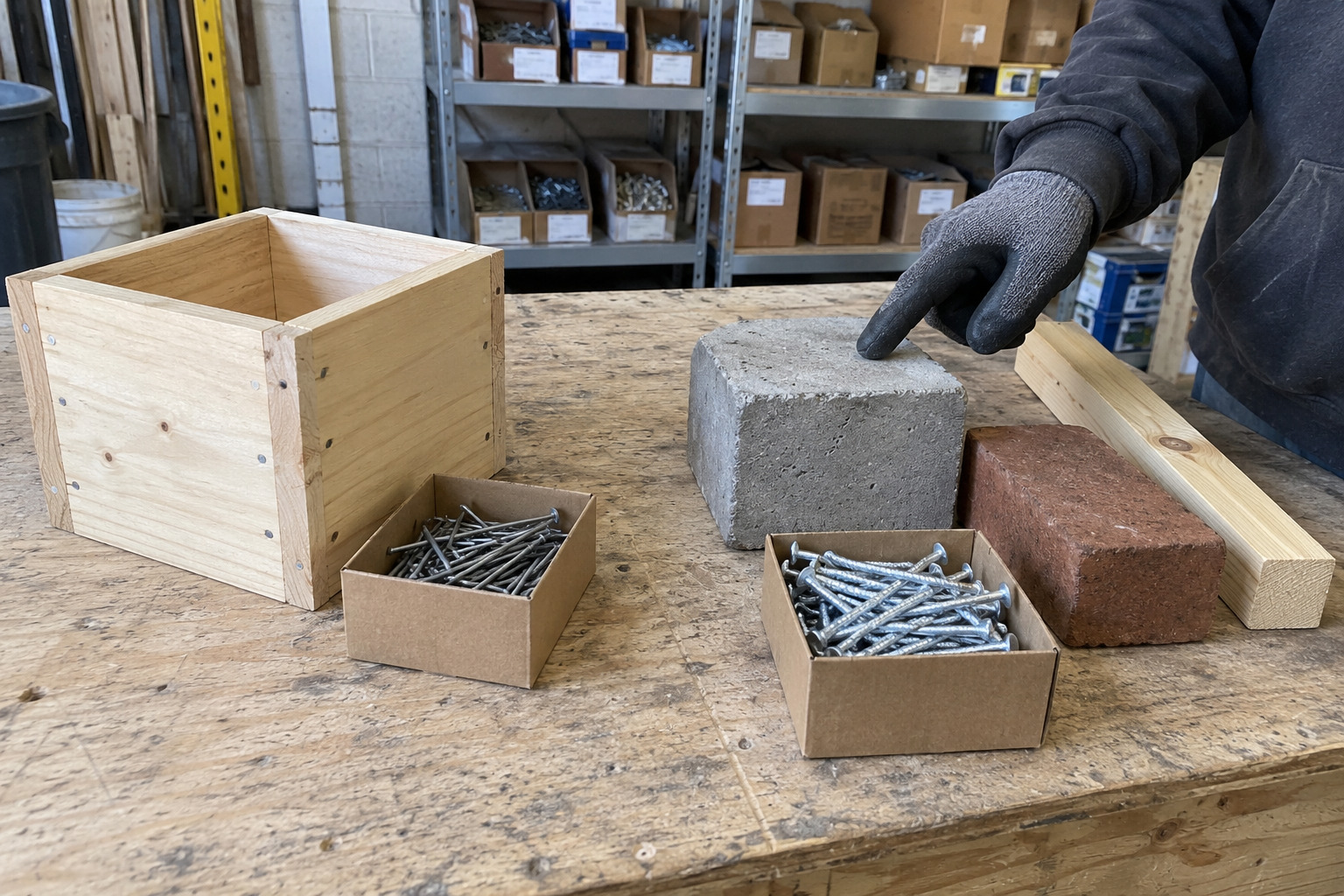
Start with the substrate
The first question should always be:
“What material will the nail be driven into?”
This question prevents many purchasing mistakes. I have seen many clients mistakenly assume that a thicker nail is automatically better. In reality, the substrate decides the correct nail family first7, and the size comes second.
Here is a simple selection guide:
| End-user application | Recommended nail type | Reason |
|---|---|---|
| Wooden pallet assembly | Wire nail | Wood accepts normal steel nails well |
| Furniture repair | Wire nail | Easy driving and suitable holding |
| Timber framing | Wire nail or specialized framing nail | Depends on structure and local practice |
| Fixing wood batten to concrete wall | Concrete nail | Needs hardened steel penetration |
| Hanging light hardware on brick | Concrete nail | Brick requires higher hardness |
| Packaging crates | Wire nail | Cost-efficient and suitable for wood |
| Masonry repair fixing | Concrete nail | Better resistance to bending |
Do not choose only by “strength”
In daily sales conversations, buyers often ask for a “strong nail.” I understand what they mean, but I usually ask more questions before suggesting a product. “Strong” can mean different things:
- Strong against bending
- Strong holding power
- Strong head that does not break
- Strong corrosion resistance
- Strong enough for hammering into hard material
- Strong enough for rough transportation and storage
A concrete nail is usually harder than a wire nail. However, hardness is not the same as universal usefulness. If an end user uses a hard concrete nail in thin or delicate wood, it may split the wood or create unnecessary cost. If an end user uses a wire nail in concrete, it may bend before it penetrates.
Match nail size to the job
After confirming the nail type, buyers should check:
-
Length
The nail must penetrate deeply enough into the base material. Longer is not always better, because excessive length may increase bending risk or damage the other side of the material. -
Diameter
Thicker nails can provide more holding power, but they also need more driving force. In wood, too much diameter may split the material.8 In masonry, improper diameter may increase surface damage. -
Head type
A larger head gives better bearing area. A smaller or lost head gives a cleaner appearance in woodwork. Concrete nails often need a head that tolerates hammer impact well. -
Surface finish
Finish affects appearance and corrosion behavior.9 Buyers may consider bright, polished, galvanized, black, or other finishes depending on market demand and storage conditions. -
Packaging
Wholesalers should not ignore packaging. Strong cartons, clear labels, and suitable small boxes can reduce damage and improve retail turnover.
Practical purchasing questions for wholesalers
Before placing an order, I suggest buyers ask their customers or sales team these questions:
- Is the nail mainly for wood, concrete, brick, or mixed use?
- Will the end user hammer manually or use tools?
- Is the application temporary or long-term?
- Is rust resistance important in the local climate?
- What carton or box size sells fastest in the market?
- Does the customer need OEM branding or neutral packaging?
- Is a trial order needed before a larger purchase?
For my own business communication, I normally request product + specification + quantity + packaging method before quoting FOB prices. This avoids vague pricing and helps the buyer compare offers fairly.
For example, a useful inquiry is not just:
“Please quote concrete nails.”
A better inquiry is:
“Please quote hardened concrete nails, 3 inch, 5 tons, packed in 1 kg boxes and export cartons, FOB price.”
That level of detail protects both sides. It also helps a wholesaler build a more reliable product line.
What risks come from confusing a wire nail and concrete nail?
Confusing a wire nail and concrete nail may look like a small mistake at the purchasing stage. The real cost appears later. The end user wastes labor, the retailer handles complaints, and the wholesaler may lose trust. In price-sensitive markets, this hidden cost can be larger than the original product saving.
Using the wrong nail can cause bending, breakage, poor holding power, cracked surfaces, material waste, rework, and customer dissatisfaction.10 For wholesalers, the risks include returns, slow-moving stock, damaged reputation, and lower repeat orders. Correct nail selection reduces both technical and commercial risk.
Immediate job-site failures
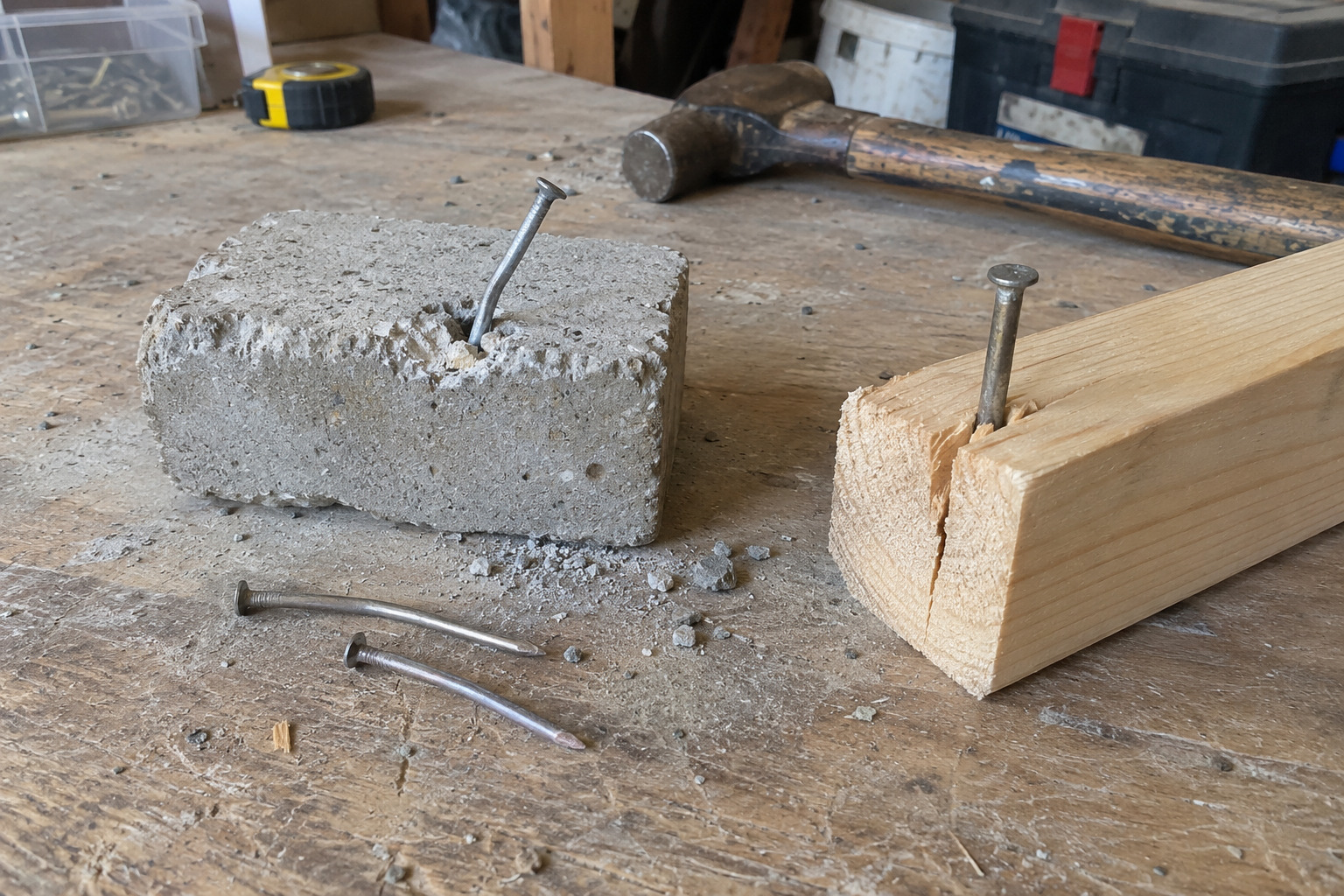
The most visible problems happen during installation. If someone uses a wire nail on hard concrete, the nail may fail before the work even begins properly.
Common immediate failures include:
- Bending during hammering
- Head deformation
- Point flattening
- Nail breakage
- Concrete surface chipping
- Wood splitting
- Poor penetration
- Unsafe fixing
These failures waste time. They also frustrate workers. In many markets, users judge product quality quickly. If the nail bends several times, they may reject the entire box or brand.
Long-term performance problems
Some mistakes are not obvious immediately. A nail may appear to hold at first, but the fixing may loosen later. This is especially risky when the wrong nail is used for a load-bearing or vibration-prone application.
Possible long-term issues include:
-
Loosening under movement
A nail that does not grip properly may move with vibration, impact, or weather changes. -
Reduced holding power
A wire nail in masonry may not create enough mechanical grip. -
Rust-related weakening
If the finish is not suitable for the environment, corrosion may reduce performance over time.11 -
Substrate damage
A nail that is too hard, too thick, or poorly matched may crack brittle material. -
Customer safety concerns
Even in light fixing jobs, poor fastening can create risk if an object falls.
Commercial costs for wholesalers
For hardware wholesalers and distributors, the wrong nail selection affects more than one sale. It can affect account relationships.
Here are the hidden business costs I often remind buyers to consider:
| Problem | Technical cause | Commercial impact |
|---|---|---|
| High return rate | Wrong nail used for substrate | Extra handling and lost margin |
| Customer complaints | Bending or poor holding | Lower trust in supplier |
| Slow inventory | Stocked wrong nail type | Cash tied up in warehouse |
| Price disputes | Buyer compared unlike products | Difficult negotiation |
| Brand damage | Product blamed for misuse | Lower repeat orders |
| Rework cost | End user must redo fixing | Customer may switch supplier |
Low price can become expensive
I understand that many distributors serve competitive markets in the Middle East, Africa, Southeast Asia, and South America. Price matters. However, price should be evaluated together with application fit.
A cheaper wire nail is not a cheaper concrete nail. It is a different product.
If a buyer tries to satisfy masonry demand with low-cost general nails, several costs may appear:
- More nails are wasted per job.
- Workers spend more time fixing mistakes.
- Retailers receive complaints.
- Contractors lose confidence.
- The wholesaler must replace stock or discount it.
- The next order may go to another supplier.
Risk management through clearer product separation
A practical way to reduce confusion is to separate SKUs clearly.
Wholesalers can use:
- Different carton colors
- Clear product names
- Local-language labels
- Simple application icons
- Separate warehouse locations
- Sales team training
- Sample boards for customer education
Even simple labeling can help. For example:
- “Wire Nails — For Wood / Packaging / Carpentry”
- “Concrete Nails — For Concrete / Brick / Masonry”
This approach helps retailers explain the product to end users. It also reduces false claims that “the nail is weak” when the real issue is wrong application.
In my experience, buyers who handle product education well often get fewer complaints. They also sell with more confidence because their sales team can explain why one nail costs more than another.
How can wholesalers identify quality in a wire nail and concrete nail order?
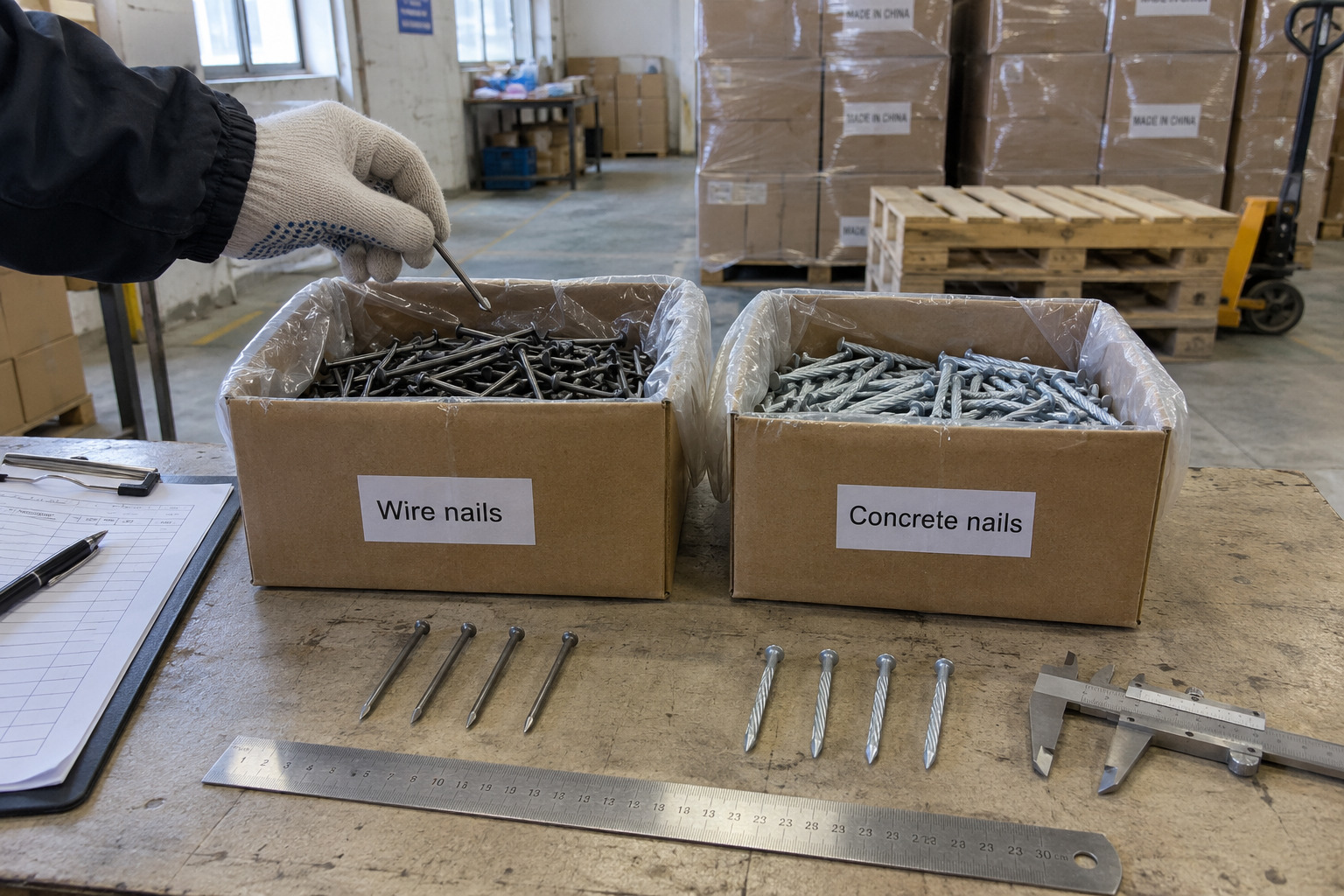
Quality evaluation for a wire nail and concrete nail order should not rely only on photos or the lowest quotation. Poor consistency may cause problems even when the nail type is correct. Buyers need practical inspection points before shipment, especially when ordering by container or repeated wholesale batches.
Wholesalers can identify quality by checking straightness, head shape, point sharpness, shank consistency, surface finish, packaging strength, and batch uniformity. For concrete nails, buyers should also verify hardness performance, fluting quality, and resistance to bending through samples or third-party inspection when needed.
Check what can be observed first
A buyer does not need a laboratory to notice many quality problems. Visual inspection and sample testing can reveal a lot.
For wire nails, check:
- Are the nails straight?
- Are the heads centered and complete?
- Are the points sharp and consistent?
- Is the surface clean?
- Are there excessive burrs?
- Is the length consistent?
- Is the carton weight accurate?
- Is the packing strong enough for sea transport?
For concrete nails, check the same points, plus:
- Is the shank fluted or shaped as specified?
- Is hardness consistent enough for masonry use?
- Does the nail bend too easily during sample driving?
- Does the head crack or deform under hammering?
- Is the point strong enough for penetration?
- Are there visible heat-treatment defects?
- Is the nail brittle or too easy to snap?
Be careful with “looks similar” products
Some lower-grade nails may look close to concrete nails in photos. However, they may not perform like true hardened concrete nails. This is a common purchasing pitfall.
A genuine concrete nail should usually show practical signs of masonry suitability:
| Quality point | What buyers should look for | Why it matters |
|---|---|---|
| Hardness | Sample should resist bending in proper test use | Supports masonry penetration |
| Shank design | Fluted, grooved, or specified profile is consistent | Improves grip and identification |
| Head shape | Head should tolerate hammer impact | Reduces failure during driving |
| Point quality | Point should be sharp and centered | Improves starting penetration |
| Straightness | Nail should not be visibly curved | Reduces bending and mis-hits |
| Batch consistency | Same size, finish, and weight across cartons | Protects resale reliability |
Use samples before full orders
For procurement risk control, I strongly recommend sample checking before large orders. In our own business context at Dingzhou Best Hardware, samples can be provided for quality testing. They usually carry a basic sample fee, and that fee can often be discussed for return or adjustment in a formal order.
Samples are useful because they allow buyers to test:
- Driving performance
- Surface finish
- Packaging appearance
- Size tolerance
- Market acceptance
- Retailer feedback
For application-specific safety decisions, buyers should ask qualified professionals or engineers to evaluate the fastening method. Nail suppliers can help with product selection, but project conditions vary. Concrete strength, wall age, moisture, load, and installation method can all affect performance.12
Check supplier capability, not only unit price
Supplier selection is also part of product quality. A low quotation is attractive, but buyers should ask whether the supplier can maintain consistency over repeated orders.
Important supplier questions include:
- Is the supplier a factory or only a trading company?
- Can the supplier support OEM or ODM packaging?
- Can the supplier provide samples before order?
- Can the supplier handle 5 tons or 200 boxes MOQ?
- What is the normal delivery time?
- Can the supplier support FCL and LCL sea shipment?
- Can the supplier handle trial orders?
- Are product specifications clearly confirmed before production?
In our case, Dingzhou Best Hardware works as a production factory and supports customized products, packaging, and brand logos. Normal lead time is often around 15–25 days, depending on quantity and order details. For export, sea shipment can be arranged by FCL or LCL, depending on buyer requirements.
Use a clear purchase specification
A clear purchase specification reduces misunderstanding. I suggest buyers prepare a simple sheet like this:
| Item | Example requirement |
|---|---|
| Product name | Concrete nail or wire nail |
| Size | Length x diameter |
| Material | Steel type or requested grade |
| Finish | Bright, black, galvanized, etc. |
| Shank | Smooth, fluted, grooved |
| Head | Flat, countersunk, lost head, etc. |
| Packaging | Small box, bulk carton, branded carton |
| Quantity | 5 tons, 200 boxes, or container quantity |
| Shipment term | FOB |
| Sample request | Yes or no |
| Inspection | Buyer inspection or third-party check |
This document helps both sides. It also allows buyers to compare quotations more fairly. If two suppliers quote different prices, the buyer can check whether they are quoting the same nail, same packaging, and same weight basis.
Frequently Asked Questions
Can I use a wire nail instead of a concrete nail?
You should not use a wire nail instead of a concrete nail for concrete, brick, or masonry. A wire nail is usually not hard enough for dense surfaces and may bend or fail. Use wire nails for wood and light materials, and use concrete nails for masonry applications.
Are concrete nails always stronger than wire nails?
Concrete nails are usually harder and more resistant to bending in masonry, but they are not “better” for every job. Wire nails are often more suitable and cost-effective for wood, packaging, and carpentry. The correct choice depends on substrate, holding requirement, and installation method.
How can I tell if a concrete nail is good quality?
A good concrete nail should be straight, sharp, consistent in size, and hard enough for proper masonry use. Many concrete nails also have fluted or grooved shanks. Buyers should request samples, test driving performance, and verify packaging and batch consistency before larger wholesale orders.
What information should I provide when asking for a nail quotation?
You should provide product type, size, quantity, finish, shank style, head type, packaging method, and shipping term. For example, “concrete nail, 3 inch, fluted shank, 5 tons, 1 kg box packing, FOB price” is much clearer than simply asking for “nail price.”
What is the usual MOQ for wholesale nail orders?
MOQ depends on supplier and packaging requirements. In our business context, the usual minimum order quantity is 5 tons or 200 boxes. Trial orders can be supported, and OEM or ODM customization is available for product, packaging, and brand logo requirements.
Conclusion
The difference between a wire nail and concrete nail is mainly about application, hardness, and risk. Wire nails are practical for wood, packaging, and light construction. Concrete nails are made for concrete, brick, block, and masonry. For wholesalers, the best decision starts with the substrate, then moves to size, finish, packaging, and supplier consistency. If you need samples or a clear FOB quotation for wire nails, concrete nails, roofing nails, black steel nails, or custom packaging, contact Dingzhou Best Hardware at [email protected] or WhatsApp +8618331061136.
-
"Glossary of bridge terminology–W", https://sdrc.lib.uiowa.edu/eng/bridges/WaddellGlossary/glossw.htm. A university or technical fastener reference describes common wire nails as general-purpose wood fasteners and masonry or concrete nails as hardened steel nails intended for concrete, brick, or similar mineral substrates. Evidence role: definition; source type: education. Supports: A neutral source should define common wire nails as general-purpose nails used mainly in wood and concrete or masonry nails as hardened fasteners intended for concrete or masonry substrates.. Scope note: Such a source would support the product-category distinction, but it may not address every regional trade name or all nail grades sold commercially. ↩
-
"Withdrawal Strength and Bending Yield Strength of Stainless …", https://www.fpl.fs.usda.gov/documnts/pdf2015/fpl_2015_rammer001.pdf. Technical fastener literature explains that hardened masonry nails are used for concrete and masonry because the dense substrate requires greater penetration resistance and bending strength than ordinary nails used in wood. Evidence role: mechanism; source type: research. Supports: A technical source should explain that nails driven into concrete or masonry require hardened steel and resistance to bending because dense substrates impose higher penetration forces than wood.. Scope note: This supports the mechanical rationale in general terms; exact interchangeability depends on nail grade, substrate strength, and installation method. ↩
-
"Design of nail making machine for various industrial work", https://www.academia.edu/43368124/Design_of_nail_making_machine_for_various_industrial_work. Manufacturing references describe wire nails as products made from drawn wire that is cut to length, headed, pointed, and then optionally polished, coated, or otherwise finished. Evidence role: general_support; source type: education. Supports: A manufacturing source should describe nail production from drawn wire, including cutting, forming the head, sharpening the point, and optional finishing or coating.. Scope note: The source would support the conventional process, while specialized nails may use additional heat treatment, coating, or forming steps. ↩
-
"Wood handbook: Wood as an engineering material", https://research.fs.usda.gov/treesearch/62200. Wood engineering guidance, such as the USDA Wood Handbook, relates nail holding capacity to withdrawal resistance created by the interaction of the nail shank with surrounding wood fibers. Evidence role: mechanism; source type: government. Supports: A wood engineering source should explain how nail holding power in wood relates to withdrawal resistance, friction, and the interaction between the nail shank and surrounding wood fibers.. Scope note: This supports the general mechanism of holding in wood, not the holding capacity of a particular nail size, coating, or wood species. ↩
-
"Heat Treating Nails…a Beginner’s (possibly dumb) Question", https://www.iforgeiron.com/topic/38209-heat-treating-nailsa-beginner39s-possibly-dumb-question/. Technical descriptions of masonry nails commonly identify them as hardened or high-carbon steel fasteners, often heat-treated to obtain the hardness needed for driving into concrete or masonry. Evidence role: general_support; source type: research. Supports: A technical source should support that masonry or concrete nails are commonly produced from high-carbon or hardened steel and may be heat-treated to improve hardness for driving into masonry.. Scope note: This is category-level support; product specifications can vary by manufacturer, grade, and local market standard. ↩
-
"Fluted Masonry | Tempered Hardened Steel", https://grip-rite.com/product/fasteners/hand-drive/nails/masonry-nails/fluted-masonry/. Fastener design references note that deformed, grooved, or fluted shanks can increase mechanical engagement with the surrounding substrate, which explains their use on many masonry nails. Evidence role: mechanism; source type: research. Supports: A fastener engineering source should explain that fluted, grooved, or deformed shanks can improve mechanical interlock or holding in hard substrates such as masonry.. Scope note: This supports the design principle, but it does not quantify the holding improvement for a specific concrete nail or masonry type. ↩
-
""Wind Uplifting Performance of Roof-to-Wall Connections and Roof …", https://scholarworks.wmich.edu/dissertations/3660/. Construction fastening guidance generally treats the base material or substrate as a primary selection factor because fastener type, embedment, and holding mechanism differ between wood, concrete, masonry, and other materials. Evidence role: expert_consensus; source type: education. Supports: A construction or engineering source should state that fastener selection depends on the base material or substrate, load, and installation conditions.. Scope note: The source would support the selection principle, while final fastener choice still depends on load, code requirements, and manufacturer test data. ↩
-
"Wood Handbook–Chapter 7–Fastenings – US Forest Service …", https://www.fpl.fs.usda.gov/documnts/fplgtr/fplgtr113/ch07.pdf. Wood construction guidance notes that nail size, spacing, edge distance, and pilot-hole practice influence splitting risk, with larger-diameter nails increasing splitting tendency in susceptible wood members. Evidence role: mechanism; source type: government. Supports: A wood construction source should confirm that nails that are too large, too close to edges, or driven without proper spacing can split wood.. Scope note: This supports the general risk; actual splitting depends on wood species, moisture content, grain direction, edge distance, and installation technique. ↩
-
"Guidelines for Selecting Materials & Coatings", https://www.strongtie.com/products/connectors/wood-construction-connectors/technical-notes/corrosion-info/materials-and-coatings. Corrosion and fastener references explain that surface finishes and coatings, including zinc galvanizing, affect the appearance and corrosion resistance of steel nails and other fasteners. Evidence role: mechanism; source type: research. Supports: A corrosion or fastener source should explain that surface coatings such as zinc galvanizing alter the corrosion performance of steel fasteners.. Scope note: This supports the general coating effect, not the durability of any specific finish in a specific climate or exposure category. ↩
-
"5 Fastener Mistakes that Cost Contractors Time and Money", https://grip-rite.com/blog/5-fastener-mistakes-that-cost-contractors-time-and-money/. Construction fastener guidance indicates that using a fastener not suited to the base material can produce installation failures such as poor penetration, bending, inadequate holding capacity, or damage to the substrate. Evidence role: general_support; source type: education. Supports: A construction fastener source should support that unsuitable fastener selection can cause poor penetration, bending, low holding capacity, or damage to the base material.. Scope note: This supports the technical failure modes; customer dissatisfaction and rework are business consequences inferred from those failures rather than directly proved by the source. ↩
-
"Atmospheric corrosion of hot-dip galvanized bolts for …", https://www.osti.gov/biblio/6441237. Government and building-materials guidance explains that steel fastener corrosion is exposure-dependent and can reduce the effective section or serviceability of fasteners over time when the coating or finish is unsuitable for the environment. Evidence role: mechanism; source type: government. Supports: A government or standards-oriented source should explain that corrosion of steel fasteners depends on environmental exposure and can reduce cross-section, strength, or serviceability over time.. Scope note: This supports the durability mechanism broadly; the rate of degradation depends on coating thickness, moisture, chemicals, temperature, and the specific fastener application. ↩
-
"Load Capacity of Screw Anchor Installed in Concrete Substrate …", https://pmc.ncbi.nlm.nih.gov/articles/PMC10934117/. Concrete fastening guidance from engineering institutions describes anchor or fastener performance as dependent on base-material strength and condition, loading, environmental exposure, and installation procedure. Evidence role: mechanism; source type: institution. Supports: An engineering institution or concrete-anchor guidance source should state that fastener or anchor performance in concrete is influenced by base-material strength, condition, moisture, loading, and installation quality.. Scope note: This source would most directly support engineered concrete anchors; its relevance to small hammered concrete nails is contextual but reflects the same substrate-and-installation dependency. ↩