Black Steel Nails vs Common Nails is not a small product-name difference when your customers care about holding power, bending behavior, rust exposure, and price. If you buy the wrong type, stock may move slowly or create complaints. The better approach is to match nail performance with real market demand before placing a wholesale order.
Black steel nails are usually selected when buyers need harder, stronger nails for masonry-related or tougher fixing jobs1, while common nails are better for general wood construction, packing, and everyday carpentry2. For wholesalers, the right choice depends on end-user application, local demand, price sensitivity, and how clearly you position each product in your market.
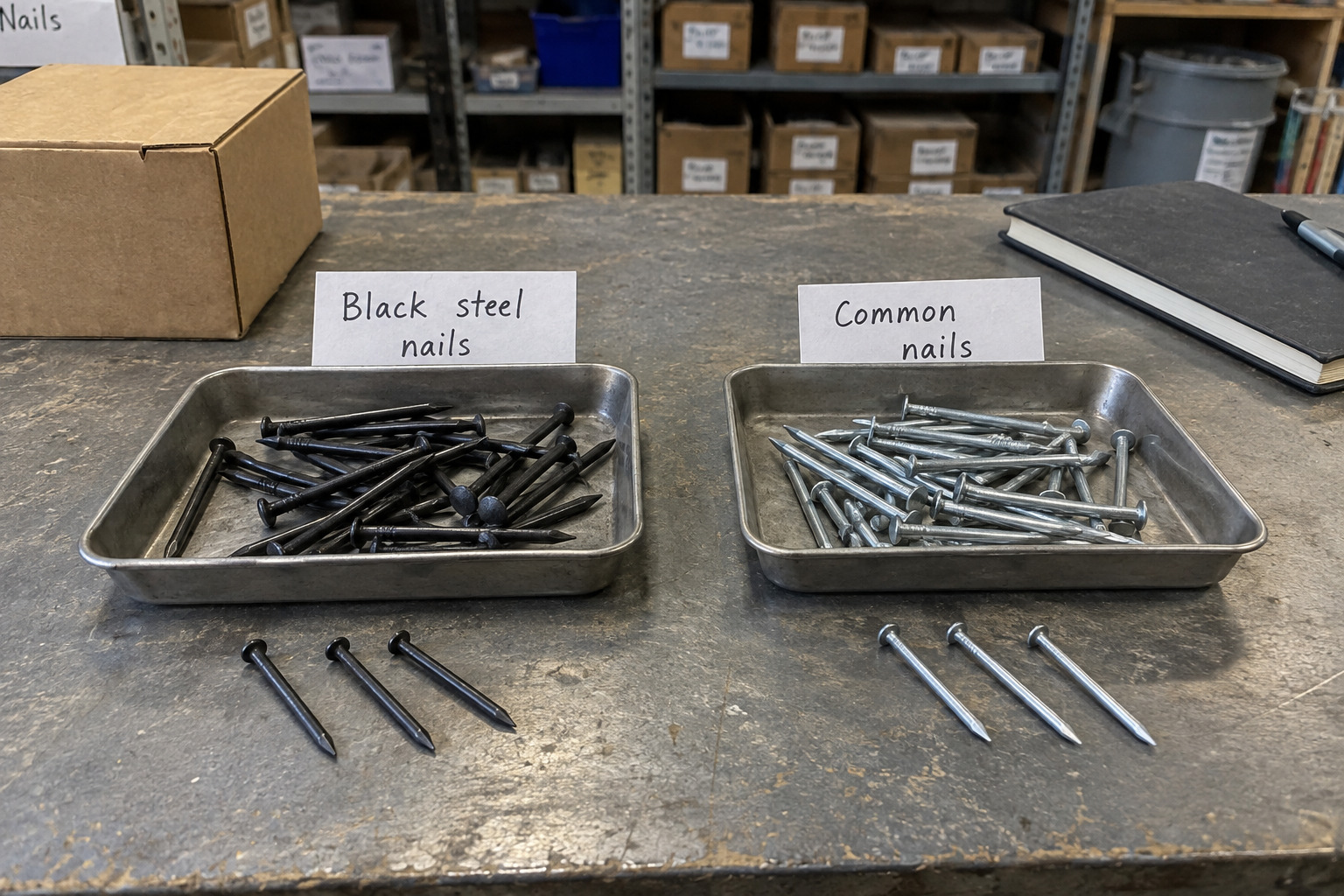
I often see buyers compare nails only by size and carton price. That is understandable, but it misses the commercial point. A nail that looks similar can serve a very different customer group, create a different margin, and require a different sales explanation.
What Is the Real Difference in Black Steel Nails vs Common Nails?
Many buyers first notice the color difference, then they assume the products are interchangeable. That assumption can create problems. If your customer uses a softer general nail in a tougher fixing job, performance may disappoint. If they use a higher-positioned nail for simple woodwork, cost may be wasted.
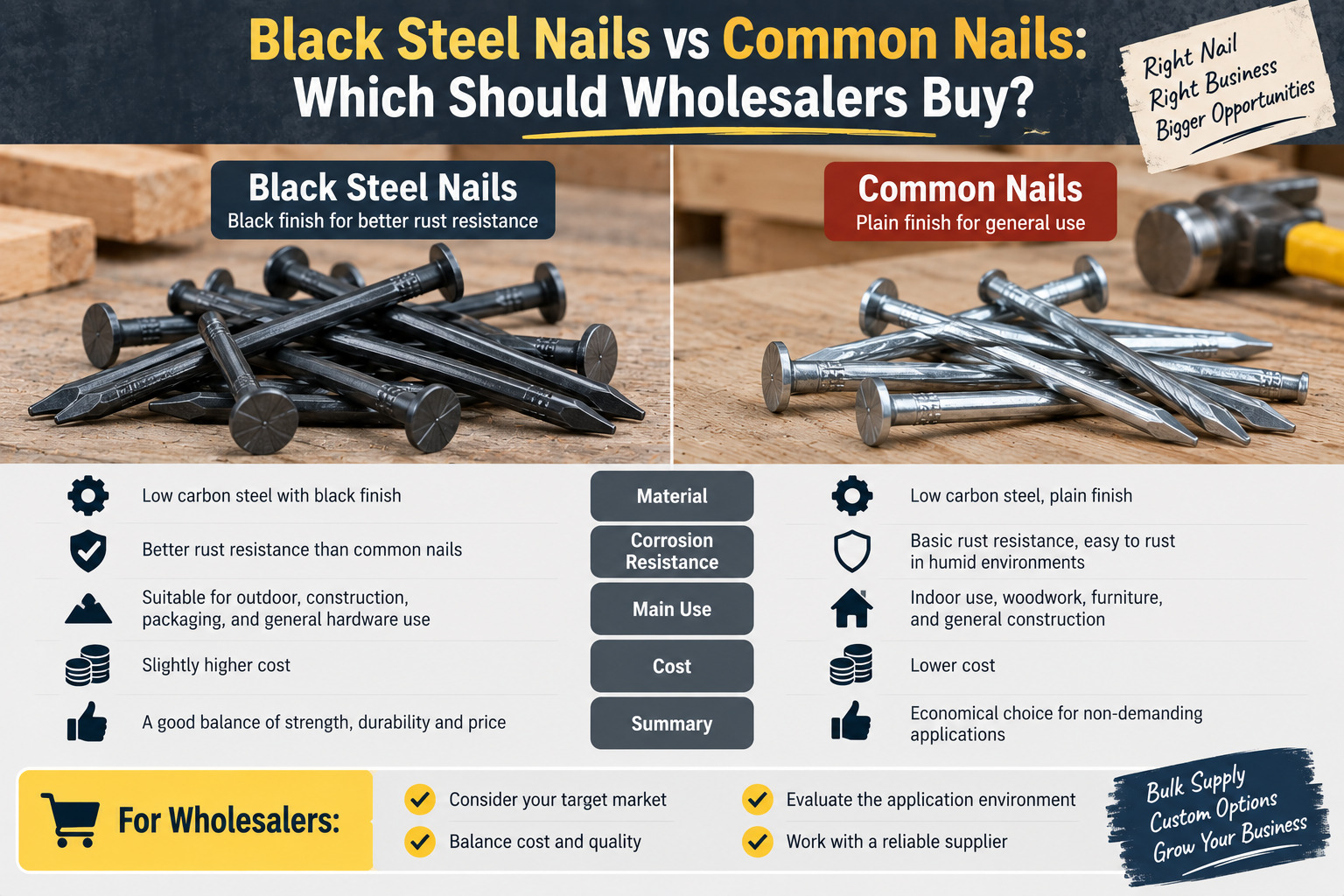
Black Steel Nails vs Common Nails mainly differs in material behavior, surface treatment, typical application, and market positioning3. Black steel nails are often associated with harder steel and black treatment for tougher fixing tasks, while common nails are standard general-purpose nails commonly used in wood, packaging, and construction.
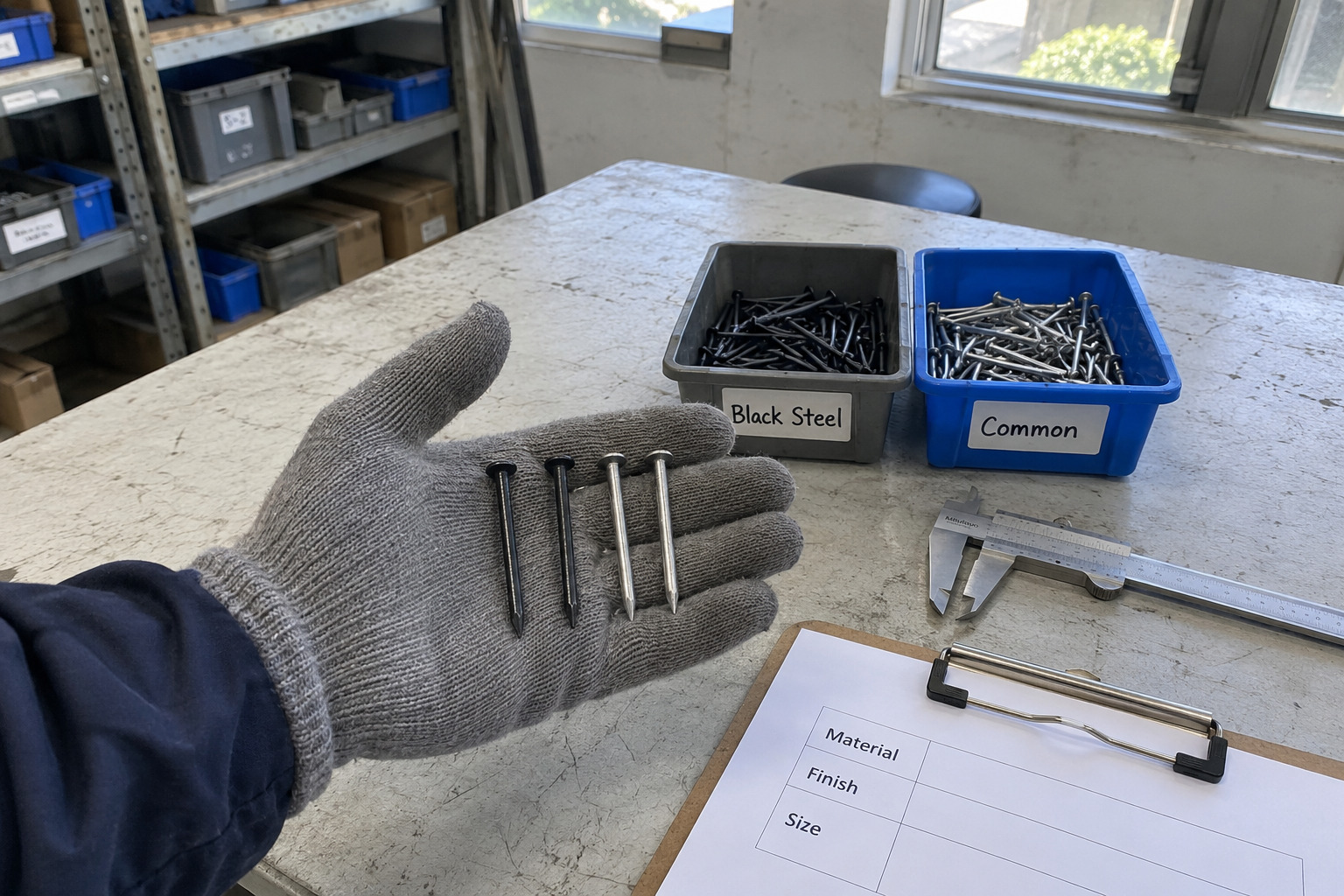
The “black” part is not only about appearance
In wholesale conversations, I like to explain that “black” is not just a color label. In many markets, black steel nails are connected with a treatment or finish, such as black annealing or black oxide-style appearance4, depending on the supplier and product specification. Buyers should confirm the actual process with the manufacturer because names can vary across markets.
The commercial point is simple: the black finish signals a product category with different expected performance and use cases. It may affect:
- Perceived strength in the market
- Flexibility or brittleness expectations depending on production route
- Resistance to light surface oxidation compared with untreated bright nails
- Customer confidence for tougher fastening applications
- Selling price position in hardware shops and project supply channels
However, I avoid telling customers that black steel nails are “rust-proof.” That is too broad and can create risk. Black treatment may offer some surface protection, but it is not the same as hot-dip galvanizing or a dedicated anti-corrosion coating5. If a project requires outdoor exposure, coastal use, or long-term corrosion resistance, buyers should verify coating type, samples, and local standards before purchasing.6
Common nails serve a different role
Common nails are usually positioned as general construction nails. In many wholesale markets, they are used for timber work, formwork, crates, pallets, temporary fixing, and basic building jobs7. Their value is not that they are the “strongest” option. Their value is that they are familiar, affordable, easy to sell, and suitable for wide daily demand.
Here is a practical comparison for procurement decisions:
| Comparison Point | Black Steel Nails | Common Nails | Why It Matters for Wholesalers |
|---|---|---|---|
| Main market image | Stronger, tougher, more specialized | General-purpose and familiar | Helps you position stock correctly |
| Typical use | Harder fixing tasks, masonry-related jobs, tougher materials | Woodwork, packaging, carpentry, construction | Reduces customer complaints |
| Surface appearance | Black treated finish | Bright, polished, or other standard finish depending on order | Affects shelf appeal and customer expectation |
| Price position | Often higher than basic common nails | Usually more price-sensitive | Influences margin strategy |
| Sales explanation | Performance and application focused | Volume and daily-use focused | Helps shop owners sell faster |
The buying mistake I often notice
Some wholesalers buy only the cheapest common nail because it moves in high volume. That can work for basic markets. But if local contractors ask for nails for harder walls, concrete-related fixing, or tougher use, the cheapest general nail may not protect your reputation.
On the other side, some buyers overstock black steel nails without checking whether their customer base understands the value. That can slow down turnover. So the real decision is not “which nail is better?” The better question is:
Which nail fits the end-user job, the local price level, and your channel’s ability to explain the difference?
For a wholesaler, product knowledge becomes commercial protection. It helps you avoid dead stock, reduce after-sales disputes, and build a more profitable nail category.
Where Should Black Steel Nails and Common Nails Be Used?
Wrong product matching creates hidden cost. A contractor may blame the wholesaler if a nail bends, breaks, rusts too fast, or feels overpriced for the job. This is why application choice matters more than product appearance when comparing black steel nails and common nails.
Black steel nails are better positioned for tougher fastening needs where stronger holding and harder use are expected. Common nails are better for ordinary woodwork, construction support, packing, and general fastening where price and availability matter more than specialized performance.
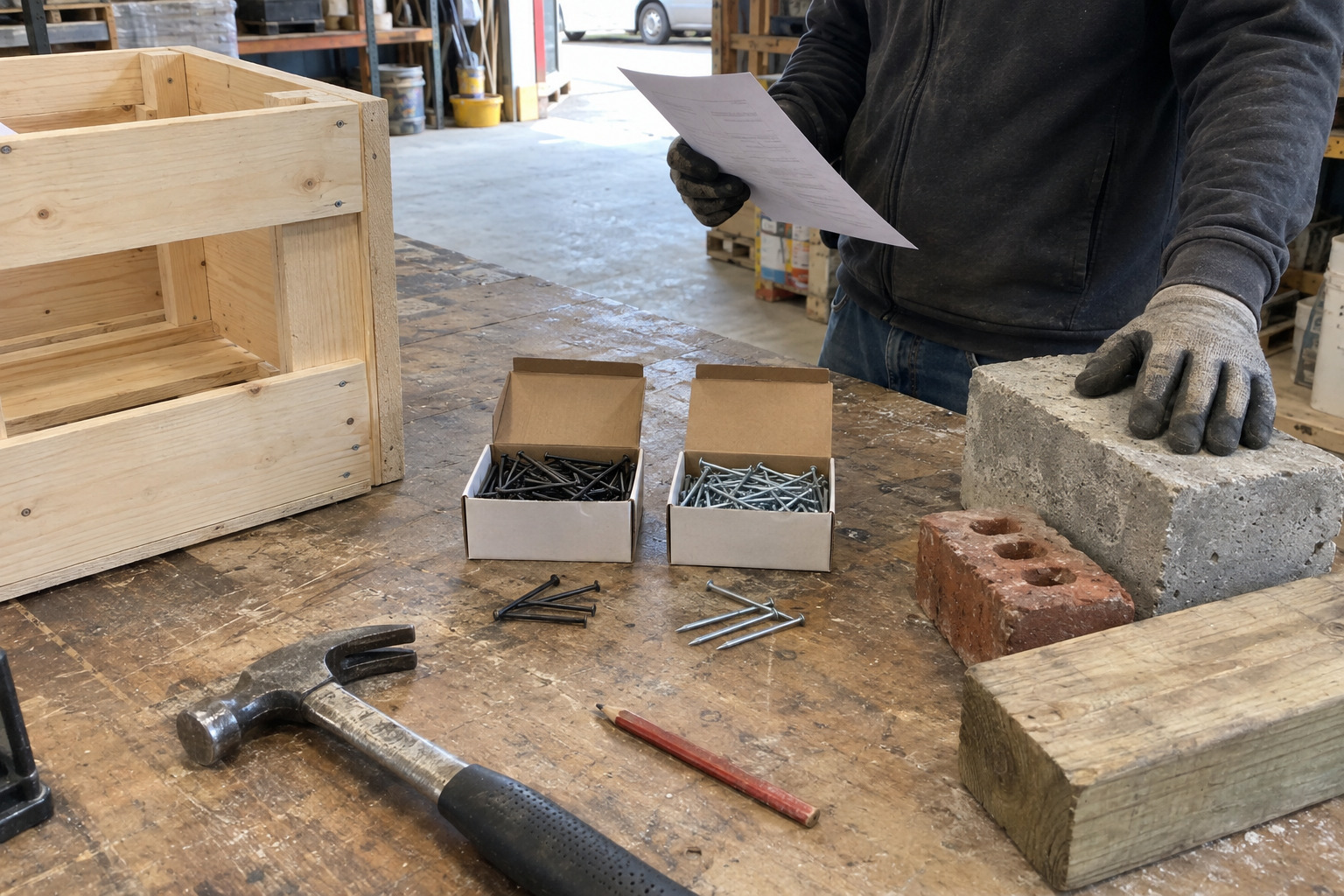
Common use scenarios
I recommend that wholesalers divide customer demand by application environment, not just by nail diameter or length. This makes purchasing decisions clearer.
| End-User Need | Better Product Direction | Commercial Reason |
|---|---|---|
| General carpentry | Common nails | Customers expect low cost and easy availability |
| Wood crates and packaging | Common nails | High-volume, price-sensitive demand |
| Temporary construction fixing | Common nails | Function matters, but premium finish may not be needed |
| Tougher fixing tasks | Black steel nails | Stronger market positioning supports better value |
| Masonry-related jobs | Black steel nails or concrete nails, depending on actual substrate | Customers expect harder nails |
| Humid outdoor exposure | Verify coating; consider galvanized options if needed | Black finish alone may not be enough |
Black steel nails are not automatically concrete nails
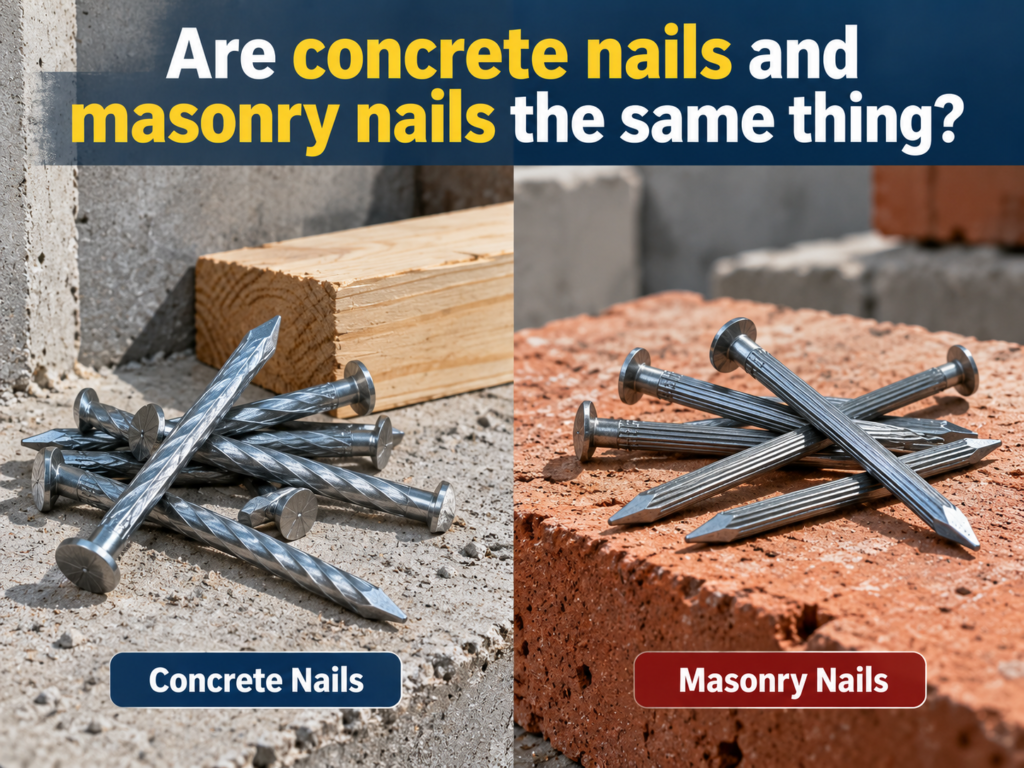
This point is important. Some markets use product names loosely. A buyer may say “black steel nail” when they mean a hardened nail for stronger fixing. Another buyer may mean a black-finished nail for specific market preference. Concrete nails are their own product category and should be evaluated separately by shape, hardness, shank design, and intended substrate8.
Since my company supplies products such as Concrete Nails, Black Steel Nails, Lost Head Nails, and Roofing Nails, I prefer to clarify the exact application before quoting. For example, I would ask:
- What material will the nail enter? Wood, brick, concrete, or mixed material?
- Is the job indoor or outdoor? Moisture exposure changes the recommendation.
- Is the customer price-sensitive or performance-sensitive? This affects product tier.
- What packaging does the market expect? Cartons, small boxes, or branded packing?
- Is the buyer selling to contractors, retailers, or project suppliers? Each channel values different features.
Why interchangeability is risky
Black Steel Nails vs Common Nails becomes a business issue when wholesalers treat both products as substitutes. They may look like simple steel fasteners, but customers judge them by performance in the field.
If a customer uses common nails for a job that needs harder penetration, the nail may bend or fail to enter properly9. That customer may return to the shop and complain. Even if the nail was not “defective,” the product was poorly matched to the application.
If a customer uses black steel nails for simple packaging work, the nail may perform well, but the extra cost may reduce competitiveness. A packing factory usually cares about unit cost, consistent supply, and carton quantity. It may not pay more for features it does not need.
A practical stock mix approach
For many wholesalers in the Middle East, Africa, Southeast Asia, and South America, I usually think in terms of category balance:
- Common nails for steady volume and broad customer reach
- Black steel nails for better-positioned demand and specialized users
- Concrete nails when the market clearly needs stronger fixing into hard surfaces
- Roofing nails when building-material channels serve roof installation
- Lost head nails when finish appearance matters in woodworking
This structure helps wholesalers avoid depending on one low-margin item. It also gives sales teams a reason to upsell based on application, not pressure.
How Does Black Steel Nails vs Common Nails Affect Wholesale Profit?
A cheap buying price can look attractive, but it does not always create the best profit. If a product has weak positioning or generates complaints, the real cost rises. Wholesalers need to compare product value, stock turnover, local demand, and margin potential.
Black Steel Nails vs Common Nails affects profit because each product serves a different price segment. Common nails usually support volume sales, while black steel nails can support stronger application-based selling and potentially better margins when the market understands their value.
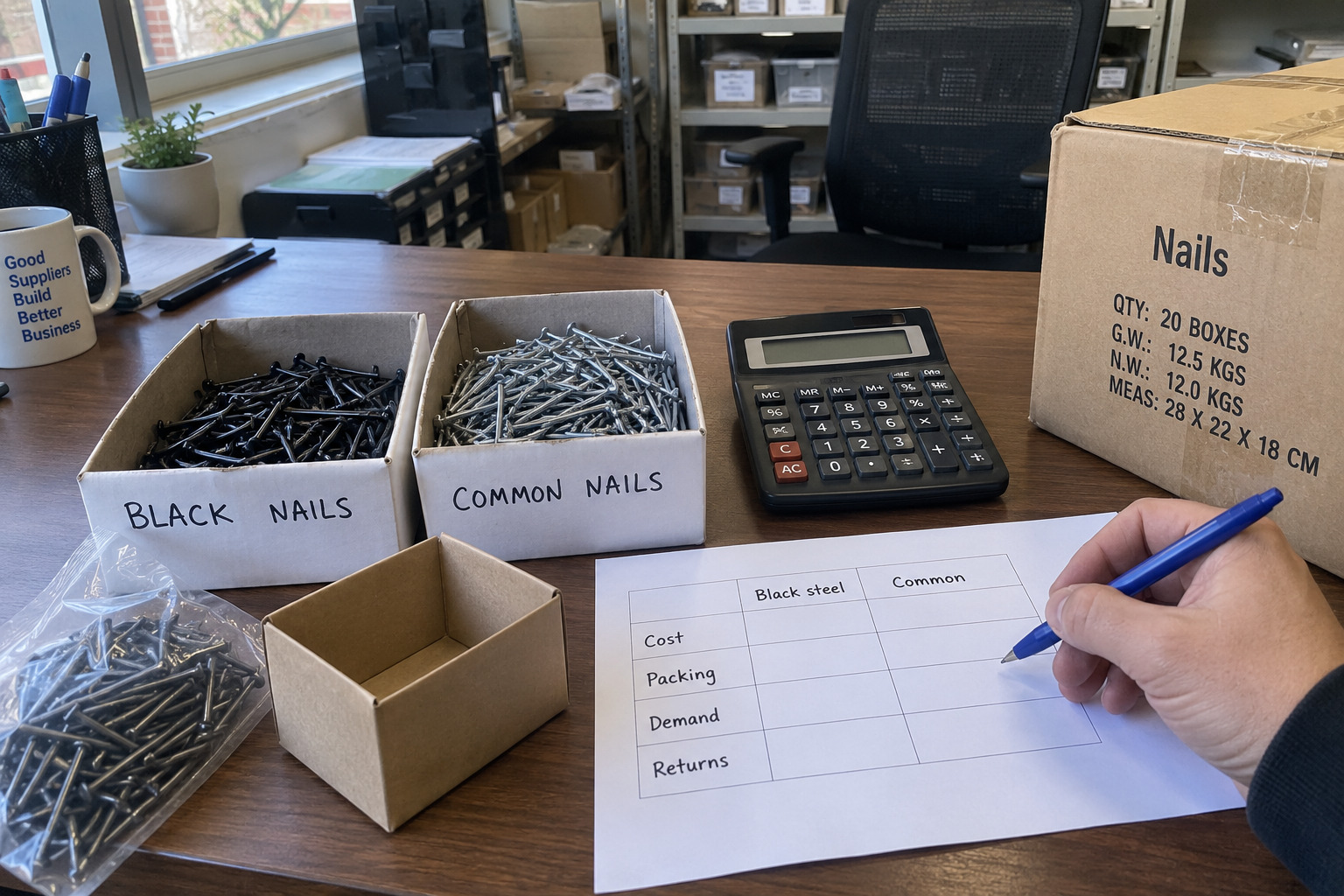
Profit is not only the FOB price
Our quotations are usually based on FOB pricing, and the standard quote depends on:
- Product type
- Specification
- Quantity
- Packaging method
For wholesale buyers, the visible unit price is only one part of the decision. You also need to calculate the commercial effect after import, warehousing, distribution, and resale.
A lower-priced common nail may sell quickly, but the margin per carton can be limited because many competitors offer similar products. A black steel nail may have a higher cost, but it can create a better selling story if your market has contractors or retailers who ask for tougher nails.
How product choice changes your margin structure
Here is a simple way to think about the commercial difference:
| Factor | Common Nails | Black Steel Nails | Wholesale Impact |
|---|---|---|---|
| Market demand | Broad and regular | More specific | Common nails support stable volume |
| Competition | Usually high | Varies by market | Black steel nails may face less direct price comparison |
| Customer education needed | Low | Medium | Sales teams must explain use cases |
| Margin potential | Often lower but steady | Potentially higher if positioned well | Depends on local market demand |
| Stock risk | Lower if specifications are popular | Higher if buyers misjudge demand | Trial orders reduce risk |
Trial orders can protect cash flow
For new markets or new specifications, I prefer a careful trial-order strategy. Dingzhou Best supports trial orders, with typical minimum order quantities of 5 tons or 200 cartons, depending on the product and packaging plan. This allows buyers to test:
- Which sizes move fastest
- Which packaging customers prefer
- Whether retailers can explain black steel nail value
- Whether contractors repeat purchase
- Whether price difference is accepted
This matters because nail buying is often specification-heavy. A product may be correct, but the size mix may be wrong. For example, if your market mainly uses certain lengths for timber fixing, importing slow-moving sizes will lock cash in the warehouse.
Packaging affects both sales and profit
Many wholesalers focus on nail quality but underestimate packaging. In hardware distribution, packaging affects trust, retail display, and price negotiation10.
Dingzhou Best supports OEM/ODM customization, including:
- Product customization
- Packing customization
- Brand logo customization
This matters because the same nail can sell differently under different packaging formats. A plain bulk carton may suit project buyers. A branded box may suit retailers. A smaller pack may work for DIY-style markets, although our main sales regions are not developed Western markets.
When I review product positioning, I often ask myself:
“Will the end-user recognize why this product deserves its price?”
If the answer is no, then the wholesaler may need better packaging, clearer labeling, or a different product mix.
Samples help reduce quality uncertainty
For technical and procurement decisions, I recommend buyers request samples for checking before large orders. Samples can help wholesalers review appearance, packaging, size consistency, and suitability for their target customers. Sample fees are usually basic costs and can sometimes be discussed for return or deduction in formal orders.
I do not present samples as a replacement for professional testing. If your end-user project has strict requirements, you should arrange qualified evaluation or third-party inspection. But for normal wholesale evaluation, samples are a practical first step.
How Should Wholesalers Explain Black Steel Nails vs Common Nails to End-Users?
Many wholesalers lose margin because their sales teams explain products only by size and price. That makes every nail look like a commodity. If your staff can explain application differences clearly, customers can choose better and accept a more suitable price.
Wholesalers should explain Black Steel Nails vs Common Nails by focusing on application, expected performance, and cost efficiency. Common nails are for broad general use, while black steel nails are for tougher or more specialized fastening needs where the customer values strength and reliability.
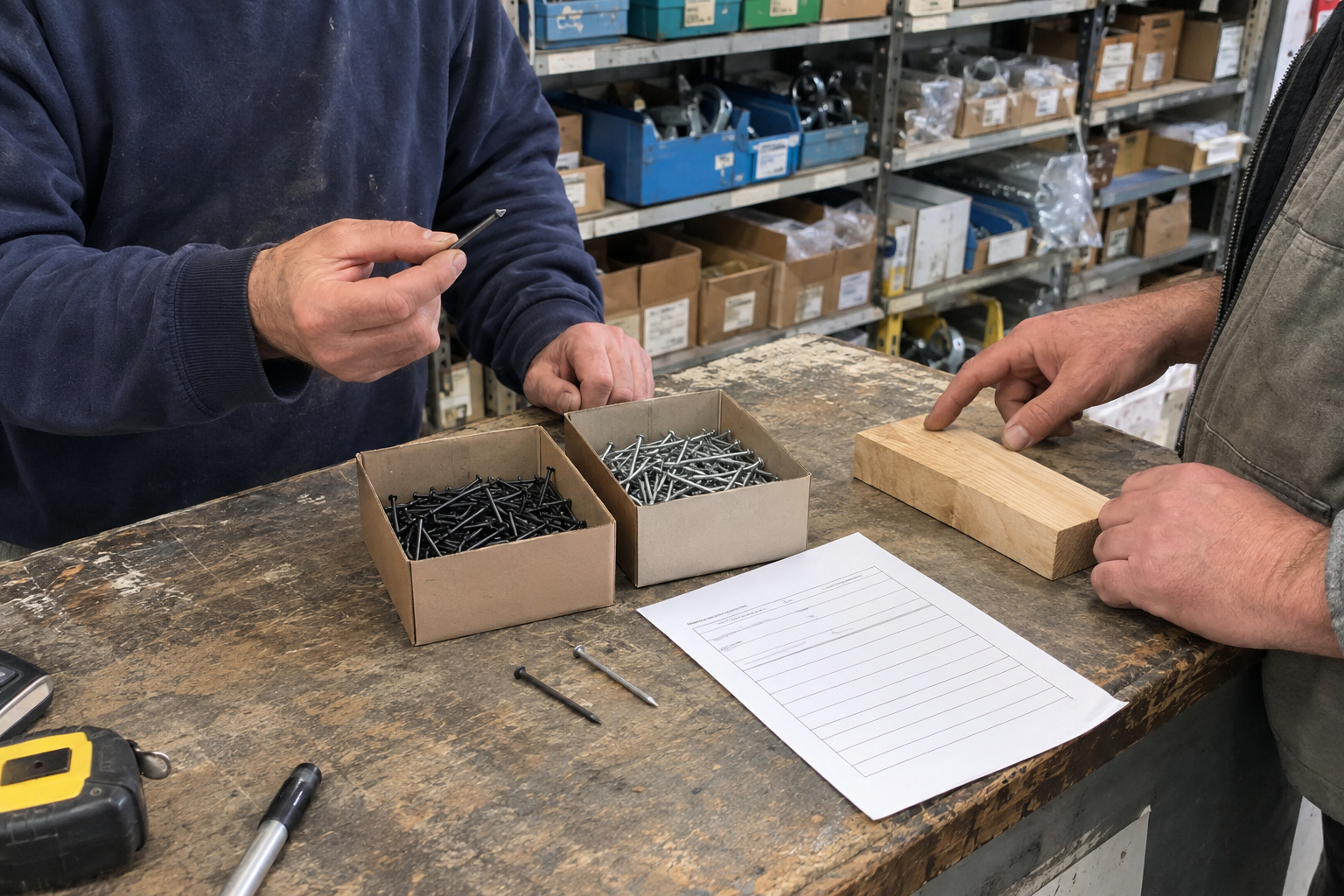
Use simple sales language
End-users do not always want technical lectures. They want to know which nail works for their job. I suggest using short, practical explanations.
For example:
- For common nails: “This is the economical choice for normal woodwork, crates, and general construction use.”
- For black steel nails: “This is better when the job needs a stronger nail and the customer wants better performance for tougher fixing.”
- For outdoor use: “Please check the coating requirement. If corrosion resistance is important, we may need a galvanized or specialized option.”
- For hard surfaces: “If the job is concrete or masonry, we should confirm whether concrete nails are more suitable.”
This kind of explanation helps your team avoid overpromising. It also builds trust because the recommendation is linked to the real job.
Teach customers to choose by job type
A simple three-question method works well in wholesale sales:
-
What material are you nailing into?
Wood, packing material, brick, concrete, or mixed construction surfaces? -
Where will the nail be used?
Indoor dry space, humid environment, roof area, or outdoor exposure? -
What matters more: lowest cost or better performance?
This question helps separate commodity demand from value demand.
When customers answer these questions, the product choice becomes clearer. Your sales team can then recommend common nails, black steel nails, concrete nails, roofing nails, or another item.
Avoid these risky sales claims
Because nail terminology and treatments can vary, I recommend avoiding absolute claims unless your supplier documents support them.
Avoid saying:
- “Black steel nails never rust.”
- “Common nails can replace concrete nails.”
- “All black nails have the same hardness.”
- “This product is suitable for every construction job.”
- “No testing is needed.”
Better phrasing is:
- “This product is commonly chosen for this type of application.”
- “Please verify the surface treatment if corrosion resistance is important.”
- “We can provide samples for your checking.”
- “For project-specific requirements, professional evaluation is recommended.”
This protects the wholesaler and improves customer confidence.
Turn product knowledge into a sales advantage
In price-sensitive regions, many buyers believe the cheapest nail wins. Sometimes that is true. But a wholesaler with better product education can serve more customer levels.
A strong nail category can include:
- Entry-level common nails for high-volume buyers
- Better-positioned black steel nails for tougher use
- Concrete nails for hard surface fixing
- Roofing nails for roof installation markets
- Custom packaging for retailers and distributors
This gives your business more than one price point. It also gives your customers a reason to return when they need advice.
From my market analysis work, I have learned that product education does not need to be complicated. Even a small shelf label or sales script can help:
| Customer Question | Suggested Answer |
|---|---|
| “Why is this black nail more expensive?” | “It is positioned for tougher fixing needs, so it is not only judged by color.” |
| “Can I use common nails for everything?” | “Common nails are good for general jobs, but tougher surfaces may need a stronger nail type.” |
| “Will black steel nails rust?” | “The black finish may offer some surface protection, but please confirm coating needs for outdoor or wet use.” |
| “Which one sells faster?” | “Common nails usually have broader demand, while black steel nails depend more on application demand.” |
When your team uses this approach, Black Steel Nails vs Common Nails becomes more than a comparison. It becomes a tool for better sales positioning.
Frequently Asked Questions
Are black steel nails stronger than common nails?
Black steel nails are often positioned for tougher applications, but strength depends on material, production process, and specification. Buyers should not judge only by color. For wholesale purchasing, I recommend requesting samples and confirming product details with the supplier before ordering large quantities.
Can common nails replace black steel nails?
Common nails can replace black steel nails only in basic general-use applications where performance demands are low. They are not always suitable for tougher fixing jobs. Wholesalers should match the nail to the end-user material, environment, and price expectation.
Are black steel nails rust-proof?
Black steel nails should not be described as completely rust-proof unless the supplier provides clear coating documentation. A black finish may offer some surface protection, but outdoor, humid, or coastal applications may require galvanized or specially coated nails.
Which nail type is better for wholesale profit?
Common nails often support stable volume because they are widely used. Black steel nails may support better margins when your market understands their value. The best profit usually comes from a balanced stock mix, correct size selection, and clear product positioning.
Can I order customized packaging for black steel nails and common nails?
Yes, customized packaging is possible with suitable suppliers. Dingzhou Best supports OEM/ODM options, including product, packaging, and brand logo customization. Buyers should confirm MOQ, artwork, carton design, and delivery time before placing the final order.
Conclusion
Black Steel Nails vs Common Nails is a practical wholesale decision, not only a product comparison. Common nails are usually the better choice for broad, price-sensitive general use. Black steel nails are better positioned for tougher applications and value-based selling. The most profitable choice depends on your market demand, customer education, packaging plan, and quality verification. If you want to compare specifications, packaging, samples, or FOB pricing, contact Dingzhou Best Hardware at [email protected] or WhatsApp +8618331061136.
-
"Types of Nails", https://www.homedepot.com/c/ab/types-of-nails/9ba683603be9fa5395fab909c451e98. Technical construction references describe hardened steel nails as being used where greater penetration resistance is encountered, such as masonry or concrete-related fastening, supporting the distinction between tougher-use nails and ordinary wood nails. Evidence role: general_support; source type: education. Supports: A university or technical construction reference should support that harder or hardened steel nails are used for harder substrates and tougher fastening tasks than ordinary wood nails.. Scope note: This would support the general performance distinction; it may not prove that every product sold as a black steel nail has the same hardness or masonry suitability. ↩
-
"Types of Nails", https://www.homedepot.com/c/ab/types-of-nails/9ba683603be9fa5395fab909c451e98. Reference works define common nails as general-purpose fasteners widely used in wood framing and other carpentry applications, supporting their description as ordinary construction nails. Evidence role: definition; source type: encyclopedia. Supports: A neutral reference should define common nails as general-purpose nails used primarily in wood construction and carpentry.. ↩
-
"Nail Guide: Nail Types, Materials & Finishes", https://www.lowes.com/n/buying-guide/choose-nails-for-your-project. Fastener references classify nails according to material, finish, form, and intended application, providing context for comparing black-finished steel nails with common nails across technical and use-related dimensions. Evidence role: general_support; source type: institution. Supports: An institutional fastener or construction reference should show that nails are classified by material, finish, geometry, and intended use.. Scope note: Such a source may not directly address wholesale market positioning, which is a commercial interpretation based on the technical distinctions. ↩
-
"Black oxide", https://en.wikipedia.org/wiki/Black_oxide. Materials references describe black oxide and related blackening processes as surface treatments that produce a dark iron-oxide finish on steel, supporting the article’s explanation that the black appearance may reflect a treatment rather than paint or color alone. Evidence role: definition; source type: research. Supports: A metallurgical or materials reference should explain that black oxide and related processes create a dark surface finish on steel.. Scope note: This supports the nature of black oxide-style finishes but does not establish that all black steel nails are produced by the same process. ↩
-
"Hot-dip galvanization", https://en.wikipedia.org/wiki/Hot-dip_galvanization. Corrosion-protection references explain that hot-dip galvanizing protects steel through a zinc coating with barrier and sacrificial action, distinguishing it from blackened finishes that do not provide the same corrosion-protection mechanism. Evidence role: expert_consensus; source type: institution. Supports: A galvanizing association, standards body, or corrosion authority should support that hot-dip galvanizing provides zinc-based corrosion protection that differs from black oxide or cosmetic black finishes.. ↩
-
"for Metal Connectors – and Fasteners in Coastal Areas", https://charlestownri.gov/vertical/sites/%7BDF68A5B8-A4F3-47A1-AE87-B411E21C6E1C%7D/uploads/TB8_-_Corrosion_Protection_for_Metal_Connectors_in_Coastal_Areas%282%29.pdf. Building and corrosion guidance recognizes that steel fastener durability depends on exposure conditions such as moisture, weathering, and coastal salts, supporting the need to verify coating type and applicable standards for outdoor or coastal use. Evidence role: expert_consensus; source type: government. Supports: A government building-code or corrosion guidance source should support that fastener coating selection depends on environmental exposure, especially moisture and coastal conditions.. ↩
-
"Looking At the Effect of Pallet Fastener Quality on Pallet …", https://unitload.vt.edu/education/white-papers/6-wp-effect-of-fastener-quality-on-pallet-durability.html. Wood construction references identify common nails as general-purpose timber fasteners, supporting their use in ordinary wood assemblies such as temporary construction, crates, pallets, and basic building work. Evidence role: general_support; source type: education. Supports: A construction or woodworking educational source should support that common nails are used in general timber fastening, temporary construction, crates, and similar wood assemblies.. Scope note: The source may support the general category of uses rather than each listed application in every regional market. ↩
-
"Concrete Nails & Masonry Nails for Concrete and Other Hard …", https://www.ironwirenails.com/products/concrete-nails.html. Fastener references describe concrete and masonry nails as hardened fasteners with designs selected for hard substrates, indicating that hardness, shank form, and intended substrate are relevant criteria when distinguishing them from ordinary nails. Evidence role: definition; source type: institution. Supports: A fastener standards or construction reference should support that masonry or concrete nails are a distinct fastener type with features designed for hard substrates.. ↩
-
"Withdrawal Strength and Bending Yield Strength of Stainless …", https://research.fs.usda.gov/treesearch/49146. Engineering studies of driven fasteners show that penetration resistance and fastener geometry affect bending or buckling during driving, supporting the warning that ordinary nails may deform when used in harder substrates than intended. Evidence role: mechanism; source type: paper. Supports: An engineering or fastener mechanics source should support that nail bending during driving depends on nail stiffness, hardness, geometry, and substrate resistance.. Scope note: This explains the mechanical risk generally; actual failure depends on nail size, steel grade, driving method, and substrate. ↩
-
"The Impact of Visual Elements of Packaging Design on Purchase …", https://pmc.ncbi.nlm.nih.gov/articles/PMC11851823/. Marketing research finds that packaging cues can influence perceived product quality, trust, shelf attention, and willingness to pay, providing contextual support for the claim that hardware packaging can affect retail presentation and pricing discussions. Evidence role: general_support; source type: paper. Supports: A marketing or consumer behavior paper should support that packaging influences perceived quality, trust, display effectiveness, and willingness to pay.. Scope note: Most packaging studies address consumer goods broadly, so the evidence would be contextual rather than direct proof for wholesale nails. ↩