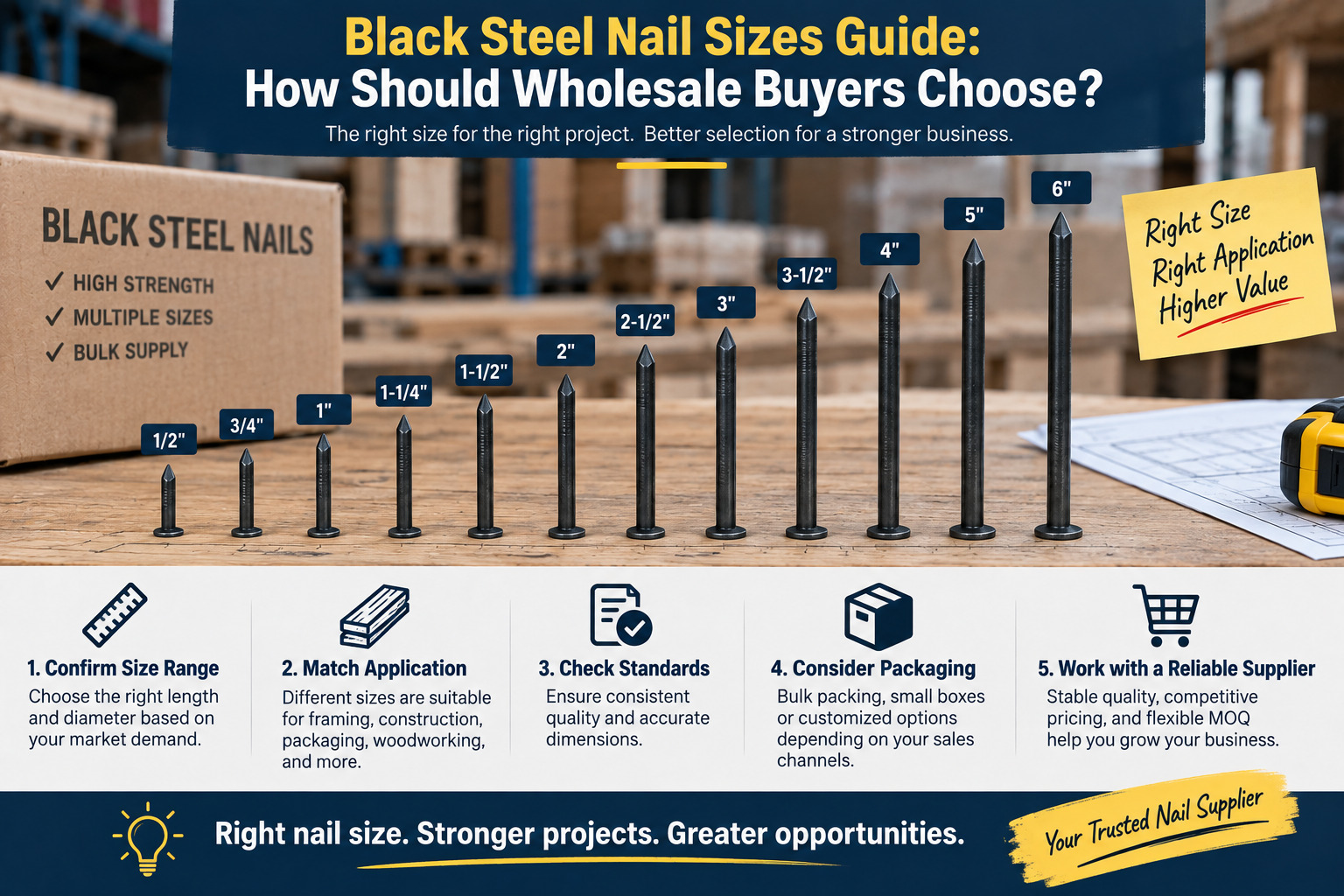
Black steel nail sizes can look simple on a quotation sheet, but the wrong choice can create weak fixing, customer complaints, and slow-moving inventory. If buyers focus only on length, diameter, or the lowest FOB price, they may miss the real application need. I use this guide to help distributors choose sizes more commercially and practically.
Black steel nail sizes should be selected by matching nail length, wire diameter, head type, packing method, and local market preference to the final application. For wholesale buyers, the best size is not always the cheapest or longest option. It is the size that performs reliably, sells quickly, and fits local user habits.
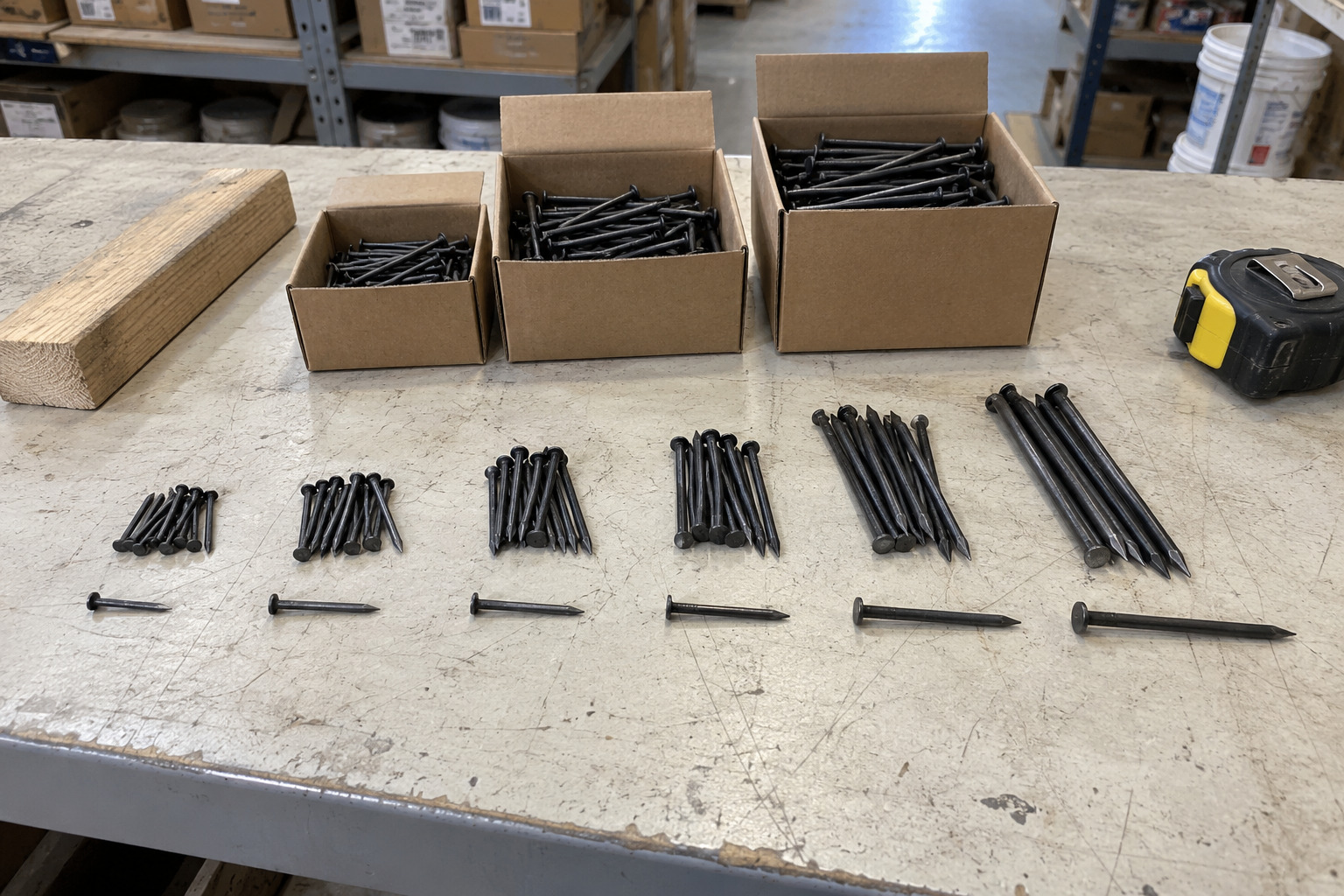
Many buyers ask me for “common sizes” first. That is a good starting point, but it is not enough. In real orders, I have found that market demand, carpenter habits, concrete hardness, and packaging expectations often matter as much as the technical specification.
What Do Black Steel Nail Sizes Actually Mean for Buyers?
Black steel nail sizes can be confusing because different markets describe them in different ways. Some buyers use length in inches. Others ask by millimeters, wire gauge, or carton weight. If these details are not clear, a buyer may receive a product that looks correct but performs poorly.
Black steel nail sizes usually describe length, shank diameter, head style, point sharpness, and sometimes packing weight1. For procurement, buyers should confirm all these details before ordering. A small difference in wire diameter or head type can change holding strength, user experience, and final selling price.
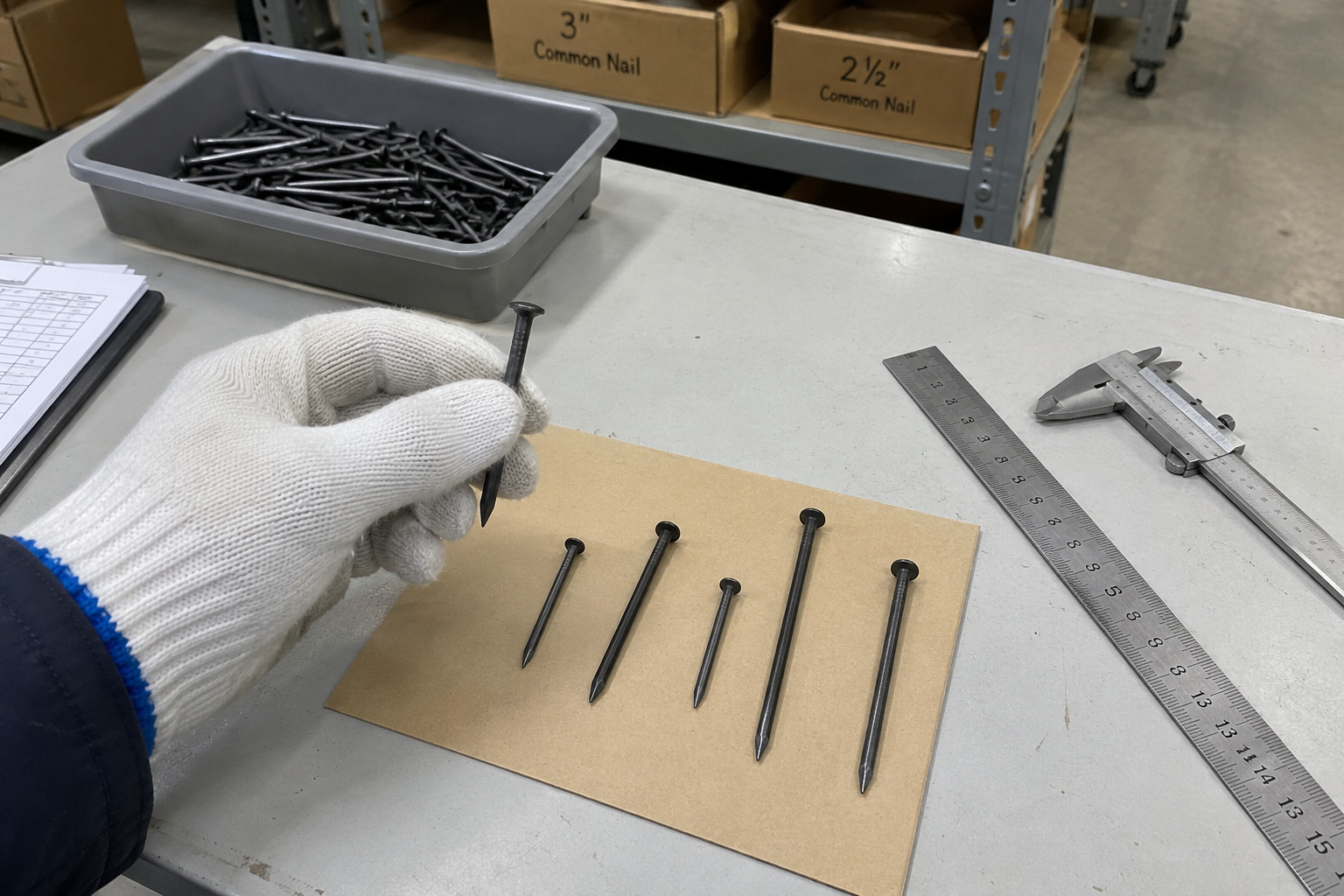
The three size factors that matter most
When I discuss black steel nail sizes with distributors, I usually start with three points:
-
Length
Length decides how deep the nail can enter the base material.2 Longer nails can give stronger fixing, but only when the material can accept them. -
Diameter or gauge
Diameter affects strength, bending resistance, and price.3 A thicker nail usually costs more because it uses more steel wire. -
Head type
Head size affects holding power and surface finish. A larger head holds better. A smaller head gives a cleaner appearance.
These three points must work together. A long nail with a thin shank may bend during use.4 A thick nail may split light wood.5 A large head may not suit decorative carpentry. This is why I rarely recommend choosing by length alone.
Common black steel nail size references
Different markets may use different measurement habits. For export orders, I prefer to confirm both metric and inch sizes. This reduces misunderstanding between factory, buyer, and end user.
| Length in Inches | Approx. Length in mm | Common Use Case | Buyer Note |
|---|---|---|---|
| 1 inch | 25 mm | Light carpentry, small wood work | Fast-moving in retail packs |
| 1.5 inch | 38 mm | General wood fixing | Common for mixed hardware demand |
| 2 inch | 50 mm | Furniture, crates, medium wood | Often requested by wholesalers |
| 2.5 inch | 65 mm | Heavier timber fixing | Check wire diameter carefully |
| 3 inch | 75 mm | Construction wood, framing support | Needs stronger shank |
| 4 inch | 100 mm | Heavy-duty timber work | More project-based demand |
The table gives a useful reference, but buyers should not treat it as a universal rule. A 2-inch nail in one market may be expected with a different wire gauge than in another market. Also, some customers may call a product “black steel nail” when they actually expect a hardened concrete nail. This point matters because black steel nails and concrete nails are not always interchangeable6.
Why diameter changes the business result
Many wholesale buyers first negotiate price by carton or ton. That makes sense. However, diameter strongly influences both cost and performance.
A slightly thicker wire can:
- Improve resistance to bending.
- Increase steel consumption.
- Raise the FOB price.
- Reduce the number of pieces per carton at the same weight.
- Improve customer satisfaction in harder materials.
A slightly thinner wire can:
- Lower unit cost.
- Increase piece count.
- Suit light-duty applications.
- Bend more easily in demanding use.
- Create complaints if sold for the wrong job.
In my experience with emerging markets, price-sensitive customers sometimes accept thinner nails for light wood or temporary fixing. However, professional carpenters and project users often prefer a more reliable shank. A distributor should decide whether the product line is aimed at retail turnover, contractor use, or project supply before fixing the size.
My practical rule is simple: I do not compare black steel nail sizes only by length. I compare them by length, diameter, application, and local selling habit together.
Which Black Steel Nail Sizes Fit Common Applications?
Black steel nail sizes must match the job, not only the catalog. A nail used for thin wood, crates, or furniture does not need the same length and diameter as one used for heavier timber. If buyers stock the wrong mix, some sizes sell fast while others stay in the warehouse.
For light carpentry, shorter and medium black steel nail sizes such as 25 mm to 50 mm7 are often practical. For heavier woodwork, 65 mm to 100 mm sizes may be needed. Buyers should match the size with base material thickness, required holding strength, and user habits.
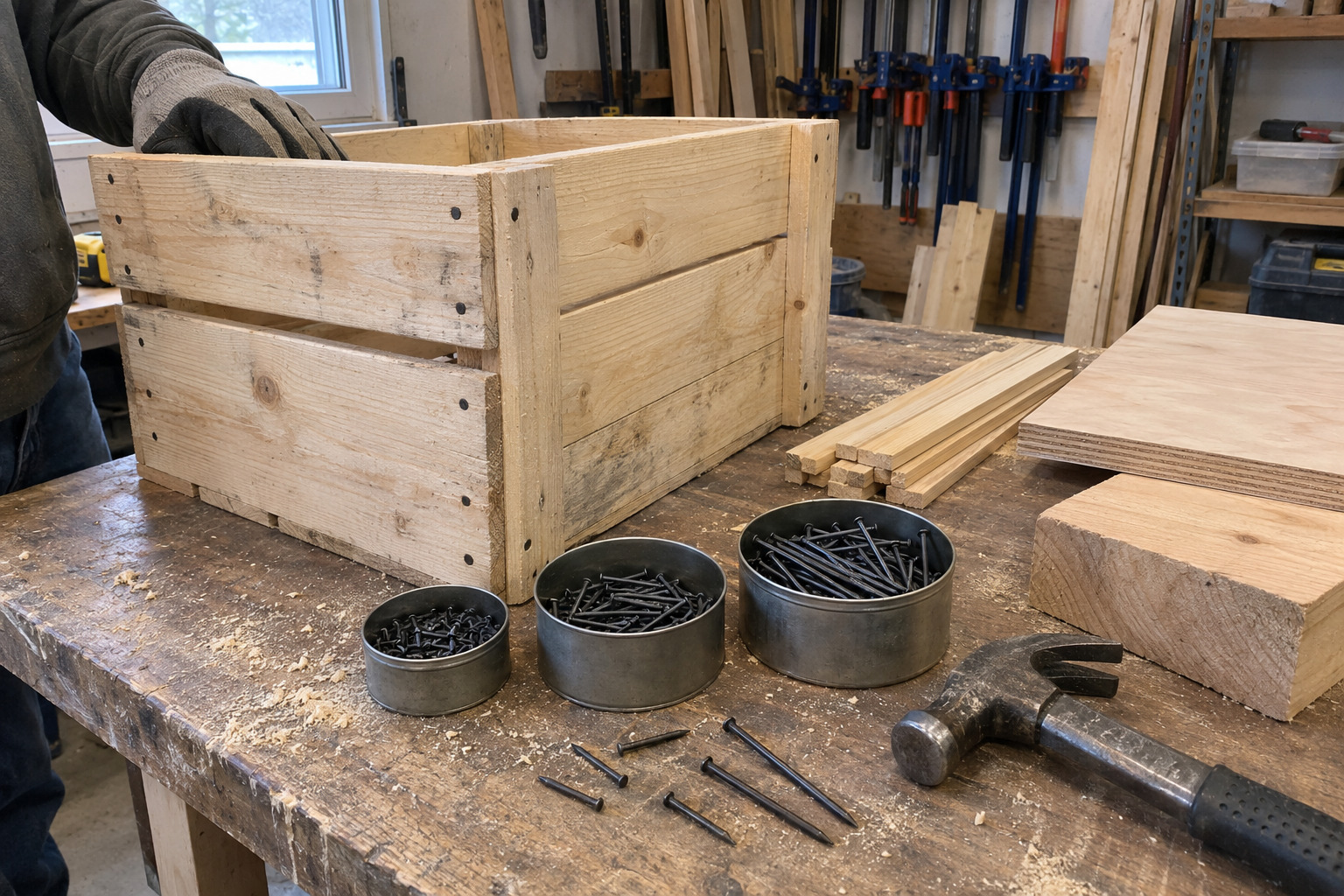
Application-based size selection
In wholesale trade, the “best” size usually means the size that solves a local problem and moves through the market smoothly. I often separate black steel nail sizes by application category.
| Application | Suggested Length Range | Typical Buyer Concern | Practical Advice |
|---|---|---|---|
| Light carpentry | 25–38 mm | Clean fixing, low splitting | Avoid overly thick shanks |
| Furniture repair | 25–50 mm | Smooth finish, stable hold | Consider smaller head types |
| Wooden crates | 38–65 mm | Speed, holding power, price | Medium diameter works well |
| General construction wood | 50–75 mm | Strength and bending resistance | Confirm wire diameter |
| Heavy timber | 75–100 mm | Deeper holding | Use stronger shank |
| Mixed retail hardware | 25–75 mm | Fast turnover | Stock popular sizes first |
This table is not a laboratory specification. It is a procurement guide. I use it to help buyers narrow the discussion before we confirm final samples, packaging, and carton details.
Do not ignore the material
A nail performs differently in softwood, hardwood, and dense construction material.8 Even when the length is correct, the shank can bend if the material is too hard. This is one reason I ask buyers to explain the final use before quoting.
For example:
- Soft wood may accept a thinner nail easily.
- Hard wood may need better shank strength and a sharper point.
- Crates and pallets need speed and holding power.
- Temporary site work may prioritize price and availability.
- Finish work may require a smaller head or lost head style.
Black steel nails are commonly used in carpentry and general fastening. For concrete or very hard surfaces, buyers should carefully check whether a concrete nail is the better product. At Dingzhou Best Hardware, we also supply concrete nails, so I usually separate the recommendation clearly. This helps avoid mismatched orders.
Head style and finish expectations
Head type is not just a small appearance detail. It affects how the nail holds the surface. A larger head spreads pressure and helps prevent pull-through.9 A smaller or lost head style can be more suitable when users want a cleaner surface.
Buyers should confirm:
- Flat head or common head for general holding.
- Lost head for cleaner finish work.
- Head diameter if local users are sensitive to appearance.
- Surface color and oiling if the market expects a particular look.
- Point sharpness if users often work with harder wood.
I once discussed a repeat order with a distributor who said his customers did not complain about length, but they complained about bending. After checking the details, the issue was not the stated size. The wire diameter was too light for the way local users applied the nail. That kind of feedback is valuable because it turns a basic size request into a better product decision.
How Do Regional Markets Influence Black Steel Nail Sizes?
Black steel nail sizes are not chosen in a vacuum. A size that sells well in one country may move slowly in another because users have different building habits, income levels, and retail expectations. If distributors copy another market blindly, they may build the wrong inventory.
Regional demand influences black steel nail sizes through construction habits, wood types, packaging customs, retail price points, and contractor preferences. Wholesale buyers should review local sales data, competitor products, and end-user feedback before finalizing a size range for import.
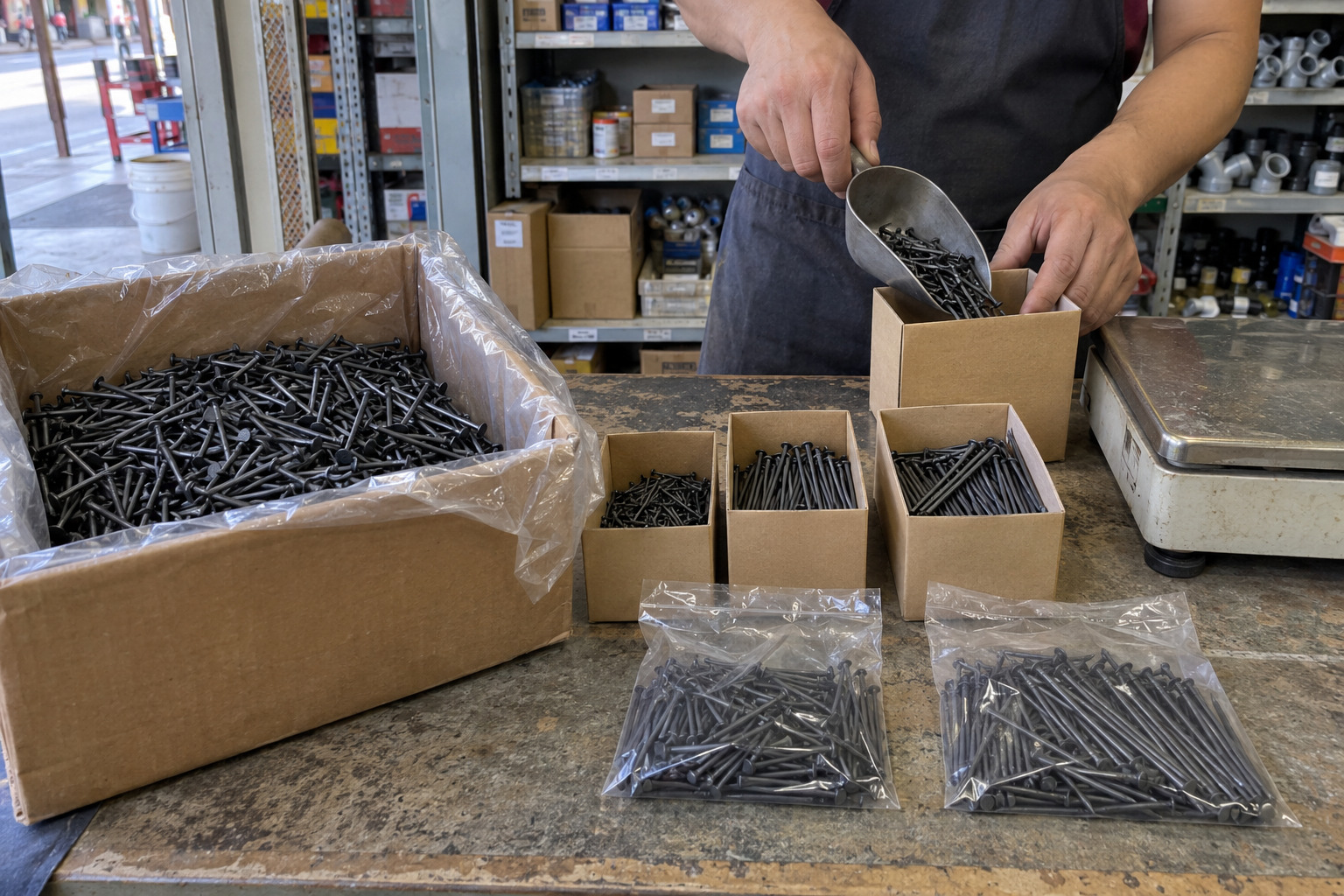
Why local habits matter
I work mainly with buyers from the Middle East, Africa, Southeast Asia, and South America. These markets are not identical. Even within the same region, two countries may prefer different nail lengths or packing styles.
Common regional differences include:
- Preferred measuring system: inches, millimeters, or local trade names.
- Common retail pack: small boxes, bags, or bulk cartons.
- Typical project type: housing, repair, furniture, crates, or site work.
- Price sensitivity: strong focus on piece count or carton price.
- Material availability: softwood, hardwood, plywood, or mixed timber.
- Brand expectations: plain packing or OEM branded cartons.
For example, some African distributors prefer a practical range that covers daily construction and retail demand. Many buyers want reliable sizes that small hardware shops can sell quickly. In parts of Southeast Asia, users may be more sensitive to woodworking finish, especially where furniture repair and light carpentry are active. In South American markets, product mix may depend strongly on local construction cycles and distributor channels.
How I read market signals
When a buyer asks me what to stock, I do not only look at a size chart. I ask several commercial questions:
- Which sizes sold fastest in your last season?
- Which sizes did customers return or complain about?
- Do your customers buy by box, carton, or weight?
- Are they contractors, retailers, or project buyers?
- Do competitors sell thinner or thicker nails at the same length?
- Does your market prefer branded or neutral packaging?
These questions help translate black steel nail sizes into business decisions. A distributor may think the problem is price, but the real problem may be the product mix. Another distributor may stock too many slow-moving large sizes while missing fast-moving 2-inch and 2.5-inch demand.
Regional stocking example
Here is a simple example of how a distributor might think about size mix. This is not a fixed formula. It is a planning framework.
| Buyer Type | Suggested Size Focus | Inventory Goal | Risk to Watch |
|---|---|---|---|
| Retail hardware distributor | 25–75 mm | High turnover | Too many niche sizes |
| Construction supplier | 50–100 mm | Project suitability | Weak diameter selection |
| Furniture supply channel | 25–50 mm | Clean finish | Wrong head type |
| Rural mixed market | 38–75 mm | Broad daily use | Confusing packaging |
| Trial order importer | 38–65 mm | Test demand | Limited market data |
At Dingzhou Best Hardware, we support trial orders, and our usual MOQ is 5 tons or 200 boxes. This helps distributors test a practical size mix before scaling into larger shipments. We usually quote by FOB price, based on product, size, quantity, and packing method. I prefer this approach because it keeps the comparison clear and avoids hidden assumptions.
Use feedback as a purchasing tool
End-user feedback is one of the most useful tools for black steel nail procurement. I suggest that distributors collect simple feedback after each shipment:
- Which size sold out first?
- Which size had complaints?
- Was bending reported?
- Was the head acceptable?
- Did the packaging help resale?
- Did customers ask for a longer or thicker option?
This feedback does not need to be complicated. Even a simple WhatsApp message from local retailers can guide the next container. Over time, this information becomes a market advantage. Buyers who understand local size demand can negotiate better, reduce dead stock, and serve customers more accurately.
How Should Buyers Balance Price and Suitability in Black Steel Nail Sizes?
Black steel nail sizes affect cost directly because length and diameter change steel consumption. A cheaper nail may look attractive on the quotation, but it can become expensive if it bends, fails, or does not match customer expectations. Low price without suitability creates hidden cost.10
Buyers should balance price and suitability by comparing black steel nail sizes against real application needs, wire diameter, packing weight, expected complaints, and resale speed. The lowest FOB price is not always the best value if the product does not perform in the target market.
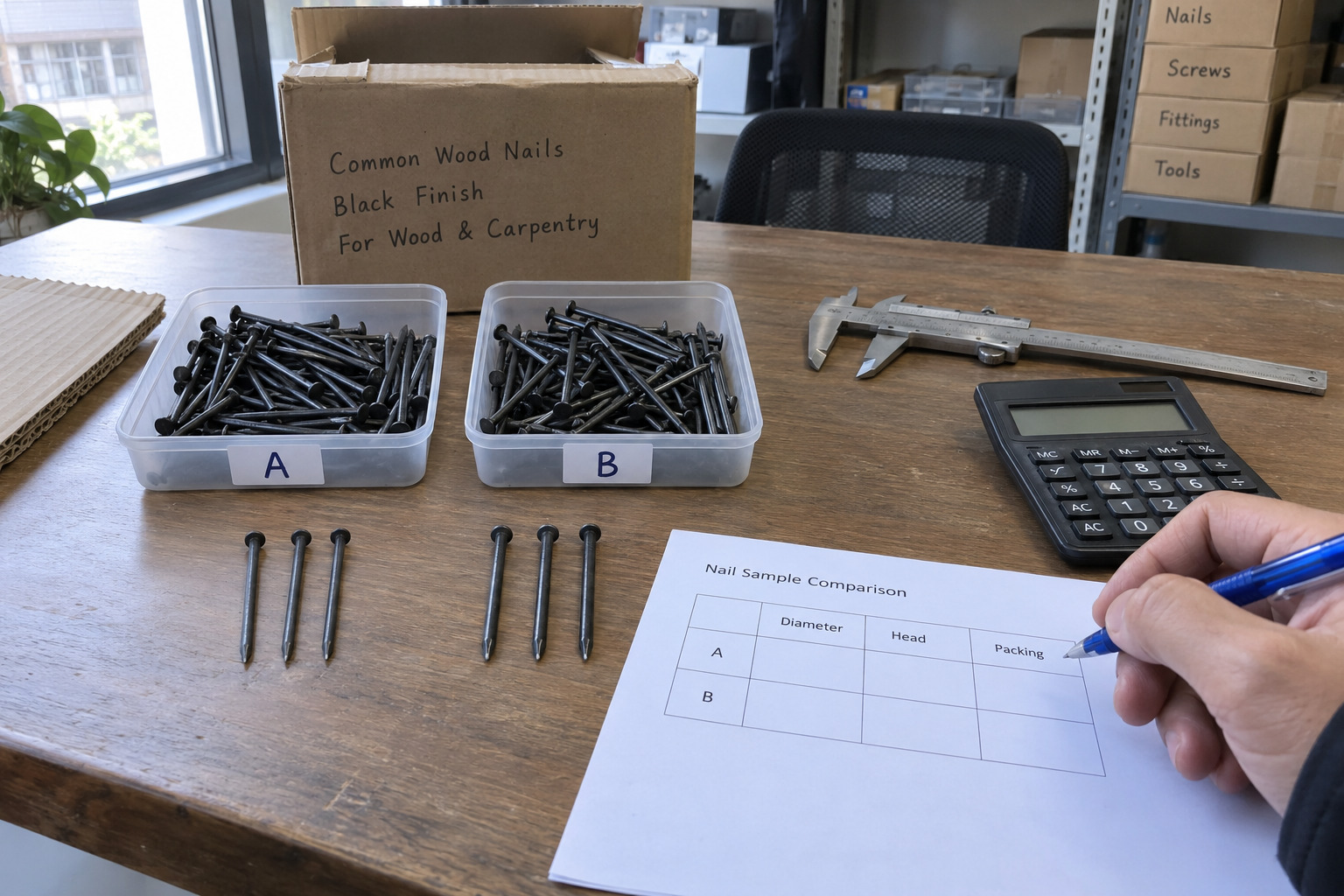
The hidden costs of mismatched sizes
In procurement, the invoice price is only one part of the total cost. A mismatched nail size can create several hidden costs:
- Customer complaints
- Returns or discounts
- Slow-moving inventory
- Lost repeat orders
- Higher sales effort
- Brand reputation damage
- Project delays for end users
These costs are hard to see before shipment, but distributors feel them after the goods arrive. I have seen buyers save a small amount per ton, then struggle because the selected diameter did not suit local use. The product was not “bad” in a general sense. It was simply wrong for that market and application.
Price comparison must be fair
When comparing suppliers, buyers should make sure the quoted black steel nail sizes are truly comparable. Two offers may both say “2 inch black steel nail,” but the real product can differ.11
Buyers should compare:
| Comparison Point | Why It Matters |
|---|---|
| Exact length | Confirms application suitability |
| Wire diameter | Affects strength and steel cost |
| Head diameter | Affects holding and appearance |
| Packing weight | Changes piece count and resale value |
| Carton strength | Affects transport and storage |
| Surface condition | Influences buyer perception |
| MOQ and lead time | Affects cash flow and planning |
| Sample policy | Supports quality checking before order |
At our factory, samples can be provided for quality checking. Samples usually carry a basic fee, and the fee can be discussed for return in the formal order. I recommend sample checking because it gives buyers a physical reference before they commit to a larger shipment.
When paying more makes sense
Paying slightly more can make sense when the end users need better performance. For example, a thicker shank may reduce bending during harder work. A better head shape may improve holding. Stronger packaging may reduce damage during sea transport.
A higher cost may be justified when:
- The market has professional contractors.
- The product will be used in harder wood.
- The distributor wants fewer complaints.
- The nail is sold under a private label.
- The buyer wants long-term repeat sales.
However, I do not suggest over-specifying every product. Some markets need economical options for light use. The key is to separate product grades and applications clearly. A buyer may stock both a value line and a stronger line. This helps serve different customer groups without confusing the market.
FOB quotations and real planning
Our normal price mechanism is FOB. A practical inquiry should include:
- Product name
- Size or size range
- Quantity
- Packing method
- Branding requirement
- Destination port if needed for planning discussion
- Trial order or regular order status
A clear inquiry reduces back-and-forth communication. It also helps the factory quote more accurately. For customized orders, we support OEM/ODM, including product details, packaging, and brand logo. Buyers should confirm artwork and packaging early because these details can affect lead time.
Our general lead time is 15–25 days, depending on order quantity and production schedule. Sea shipping is common, and we support both FCL and LCL. For importers in emerging markets, this flexibility helps with trial orders and inventory planning.
How Can Distributors Plan Inventory Around Black Steel Nail Sizes?
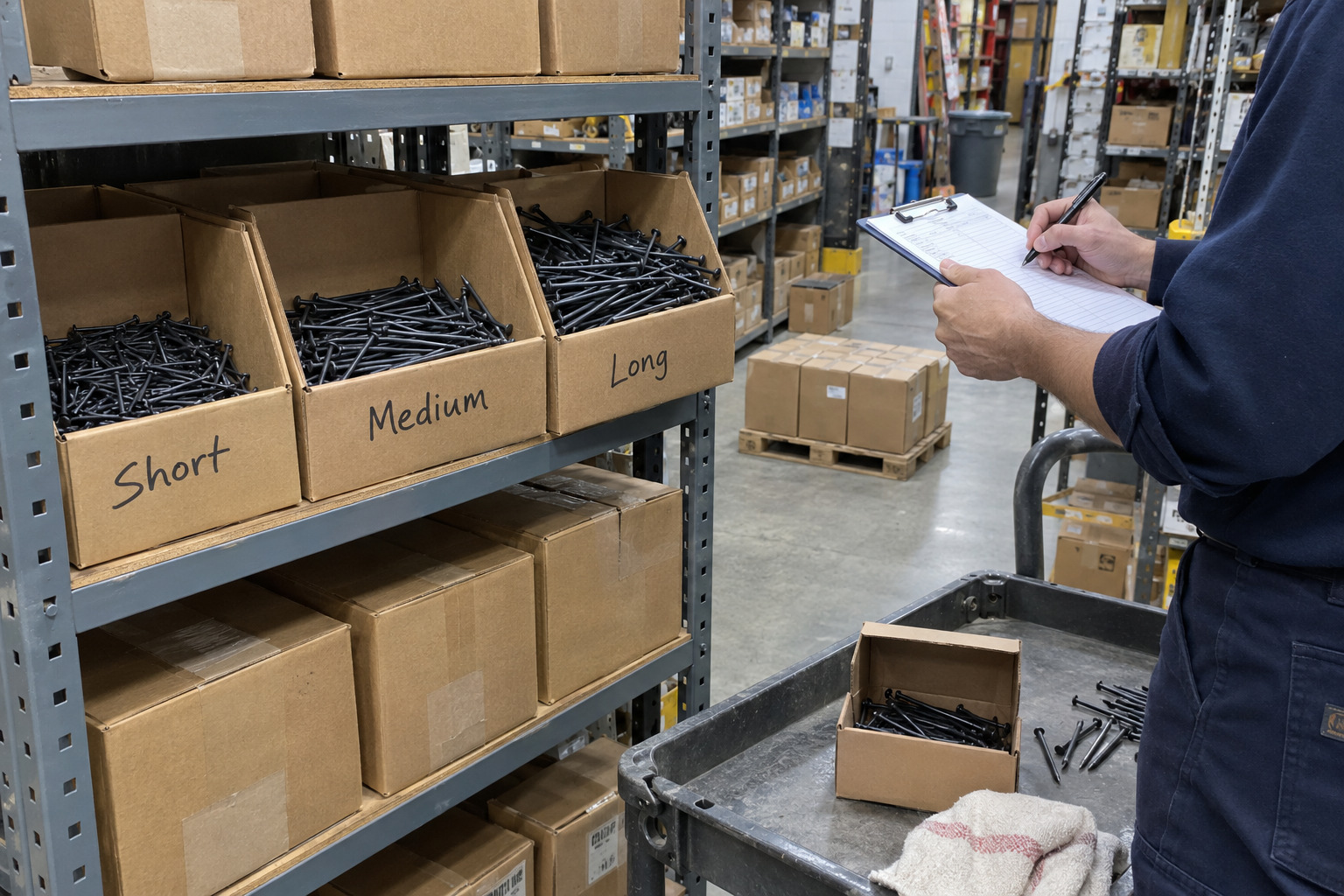
Black steel nail sizes are also an inventory decision. A distributor can buy the right product but still lose money if the size mix is wrong. Too many slow-moving sizes tie up cash. Too few fast-moving sizes cause stockouts and lost customers.
Distributors should plan inventory by grouping black steel nail sizes into fast-moving, medium-demand, and project-based categories. They should use sales history, retailer feedback, seasonal demand, and trial orders to build a balanced product mix that protects cash flow and supports repeat sales.
Build a size mix, not a random list
Many buyers ask for one or two popular sizes first. That is understandable. But as a wholesale distributor grows, the better approach is to build a size mix. A good mix supports different users and reduces dependence on one item.
A simple structure can look like this:
| Category | Size Range | Stocking Role | Suggested Action |
|---|---|---|---|
| Fast-moving core | 38–65 mm | Daily sales | Keep stable stock |
| Support sizes | 25–38 mm and 65–75 mm | Broader coverage | Review monthly |
| Project sizes | 75–100 mm | Contractor demand | Buy based on orders |
| Trial sizes | Market-specific | Test new demand | Start small |
| Custom packed sizes | Selected items | Brand building | Use after demand is proven |
This structure helps a buyer avoid two common mistakes. The first mistake is buying only cheap sizes. The second mistake is importing too many sizes without knowing demand.
Use cartons, boxes, and piece count carefully
Black steel nails are often sold by weight, carton, or box. Buyers should understand how packing affects resale. A heavier carton may look efficient for shipping, but local retailers may prefer smaller boxes. A smaller box can improve retail movement but may increase packing cost.
Important packing questions include:
- How many kilograms per carton?
- How many boxes per carton?
- What is the expected retail unit?
- Does the market prefer plain or branded packing?
- Does the carton need stronger paper for long sea shipping?
- Will the goods be stored in humid conditions?
Packaging is part of product strategy. For OEM buyers, branded cartons and labels can improve market recognition. However, I usually suggest testing the size first before investing heavily in custom packaging. Once a buyer confirms demand, packaging customization becomes more valuable.
Plan around sales cycles
Demand for black steel nail sizes can change with construction seasons, agricultural cycles, government projects, or local holidays.12 A distributor should not only look at last month’s sales. They should also look at upcoming demand.
A basic planning method is:
- Review the last 3–6 months of sales.
- Identify the top 3 fast-moving sizes.
- Check complaint records by size.
- Ask retailers what customers request but cannot find.
- Prepare trial quantities for new sizes.
- Place replenishment orders before stock reaches a critical level.
This is where lead time matters. If production takes 15–25 days and sea shipping takes additional time, buyers need to plan early. Running out of fast-moving sizes can push customers to competitors. Overstocking slow sizes can block cash for the next order.
A practical trial order strategy
For new buyers, I usually recommend a focused trial order. The goal is not to buy every possible size. The goal is to confirm what the market accepts.
A practical trial may include:
- 2–3 fast-moving lengths.
- One lighter-duty option.
- One stronger option.
- Standard packaging for easier cost control.
- Clear sample approval before mass production.
After the goods arrive, the distributor should track sell-through speed and feedback. The next order can then adjust the mix. This is a safer strategy than guessing a full container of untested sizes.
At Dingzhou Best Hardware, we are a manufacturing factory, and we also have overseas factory experience. We mainly serve markets such as the Middle East, Africa, Southeast Asia, and South America. This background helps us discuss not only production, but also practical stocking questions. Still, buyers should always verify samples and confirm application suitability for their own market before placing large orders.
Frequently Asked Questions
What are the most common black steel nail sizes for wholesale buyers?
Common black steel nail sizes often range from 25 mm to 100 mm, with 38 mm, 50 mm, 65 mm, and 75 mm being practical options in many markets. The best mix depends on local carpentry habits, wood type, contractor demand, and retail packaging preferences.
Are black steel nails suitable for concrete?
Black steel nails are mainly used for carpentry and general fastening. For concrete or very hard surfaces, buyers should evaluate concrete nails instead. The final choice should depend on the base material, application conditions, and user requirements. Samples should be tested before large procurement.
How should I compare black steel nail quotations from different suppliers?
You should compare exact length, wire diameter, head type, packing weight, carton details, MOQ, lead time, and sample availability. Two quotations with the same length may not represent the same product. A fair comparison requires matching specifications and intended application.
Can I customize black steel nail packaging for my market?
Yes. Packaging can often be customized with OEM/ODM options, including brand logo, carton design, box style, and labeling. I suggest testing market demand first, then developing custom packaging for the fastest-moving sizes to reduce risk and improve brand recognition.
What is a good trial order strategy for black steel nails?
A good trial order should focus on a few proven sizes, usually medium-demand lengths, plus one or two options for testing. Buyers should collect retailer and end-user feedback after delivery. This helps adjust the next order and avoid slow-moving inventory.
Conclusion
Black steel nail sizes are more than technical numbers on a quotation. They affect holding strength, bending resistance, customer satisfaction, inventory turnover, and long-term competitiveness. Buyers should evaluate length, diameter, head type, application, regional habits, and packaging before ordering. If you need help building a practical size mix for your market, Dingzhou Best Hardware can support samples, OEM/ODM packaging, FOB quotations, trial orders, and sea shipment planning. Contact us at [email protected] or WhatsApp +8618331061136.
-
"Threaded-nail Fasteners", https://digitalcommons.georgefox.edu/cgi/viewcontent.cgi?referer=&httpsredir=1&article=1039&context=mece_fac. Standards for driven fasteners specify nails by physical characteristics such as length, shank dimensions, head form, and point type, supporting the article’s treatment of nail size as a multi-parameter specification rather than a length-only description. Evidence role: definition; source type: institution. Supports: A technical standard or standards-based reference should support that nail specifications commonly include length, shank diameter, head characteristics, point form, and related packaging or quantity information.. Scope note: Such standards define nail terminology and dimensions generally; they may not address the commercial term “black steel nail” or local packing customs directly. ↩
-
"Wood handbook: Wood as an engineering material", https://research.fs.usda.gov/treesearch/62200. The USDA Forest Products Laboratory explains that nail performance in wood connections depends in part on penetration depth into the receiving member, which is governed by nail length and joint geometry. Evidence role: mechanism; source type: government. Supports: A wood-fastening reference should support that nail length affects the depth of penetration into the member and is a factor in nailed-joint performance.. Scope note: This evidence concerns nails in wood connections generally and does not test every black steel nail size or every local material. ↩
-
"Fastenings | US Forest Service Research and Development", https://research.fs.usda.gov/treesearch/7144. Engineering references on fasteners and beam bending show that diameter affects cross-sectional area and bending resistance, while wood-fastening guidance also treats nail diameter as a factor in connection strength. Evidence role: mechanism; source type: research. Supports: A technical source should support that increased nail diameter changes mechanical resistance and increases the amount of steel per nail.. Scope note: The source would support the physical mechanism; actual FOB price also depends on labor, energy, packaging, freight, and supplier pricing. ↩
-
"Withdrawal Strength and Bending Yield Strength of Stainless …", https://research.fs.usda.gov/download/treesearch/49146.pdf. Studies of driven fasteners and general mechanics of slender members indicate that longer, smaller-diameter shanks have lower bending stiffness and can be more susceptible to bending during driving, especially in resistant materials. Evidence role: mechanism; source type: paper. Supports: A research or engineering source should support that a nail’s slenderness, length, shank diameter, and material resistance affect its tendency to bend during driving.. Scope note: This is a mechanics-based inference for nails generally; bending frequency for a specific black steel nail depends on steel grade, heat treatment, point geometry, and the substrate. ↩
-
"NAILED MORTISED-PLATE CONNECTIONS FOR SMALL …", https://research.fs.usda.gov/download/treesearch/33698.pdf. Wood-fastening guidance from the USDA Forest Products Laboratory notes that nail size, placement, and wood characteristics influence splitting, supporting the article’s caution that an overly thick nail can damage lighter wood. Evidence role: mechanism; source type: government. Supports: A wood science source should support that larger nails or inadequate spacing can contribute to splitting in wood members.. Scope note: The source describes wood behavior broadly; the specific splitting risk varies by species, moisture content, pilot holes, and distance from edges or ends. ↩
-
"Nail (fastener)", https://en.wikipedia.org/wiki/Nail_(fastener). Reference descriptions of concrete nails identify them as hardened fasteners intended for concrete or masonry, which supports the distinction between concrete nails and ordinary black steel nails used for carpentry or general fastening. Evidence role: definition; source type: encyclopedia. Supports: A neutral reference should support that concrete nails are designed for driving into concrete or masonry and are different in intended use from ordinary steel nails used mainly in wood fastening.. Scope note: The evidence establishes the product-category distinction; it does not prove that every product sold as a black steel nail lacks hardness suitable for masonry. ↩
-
"Fasteners", https://www.cityofminnetrista.gov/media/176. Carpentry guidance commonly relates nail length to the thickness of the pieces being joined, providing contextual support for using shorter nails, including roughly 25–50 mm sizes, in light carpentry and thin woodwork. Evidence role: general_support; source type: education. Supports: A carpentry or woodworking education source should support the general principle that smaller nails are used for thinner stock and light-duty carpentry, with nail length selected according to material thickness.. Scope note: This supports the sizing logic rather than proving that 25–50 mm is the correct range in every market or for every black steel nail design. ↩
-
"Wood handbook: Wood as an engineering material", https://research.fs.usda.gov/treesearch/62200. The USDA Forest Products Laboratory relates nail withdrawal and connection behavior to wood properties such as density and specific gravity, supporting the article’s statement that nails perform differently in softwood, hardwood, and dense materials. Evidence role: mechanism; source type: government. Supports: A wood science source should support that substrate density and wood species characteristics affect nail holding and driving performance.. Scope note: The source is strongest for wood substrates; dense non-wood construction materials may require separate masonry or concrete-fastener references. ↩
-
"Withdrawal capacity of plain, annular shank and helical …", https://composites.umaine.edu/publication/withdrawal-capacity-of-plain-annular-shank-and-helical-shank-nail-fasteners-inspruce-pine-fir-lumber/. Fastener design references describe head bearing area as a factor in resisting pull-through, which supports the article’s explanation that a larger nail head distributes load over a wider surface. Evidence role: mechanism; source type: research. Supports: A fastener mechanics source should support that the head provides bearing area and affects pull-through resistance.. Scope note: The relationship is general; actual pull-through resistance also depends on the connected material, head shape, shank type, and loading direction. ↩
-
"Beyond Price: Why Total Cost of Ownership Should Anchor …", https://purchasing.collegebuys.org/beyond-price-why-total-cost-of-ownership-should-anchor-every-strategic-sourcing-agreement/. Procurement literature on total cost of ownership treats purchase price as only one element of sourcing cost and includes quality failures, handling, returns, and service consequences as downstream costs. Evidence role: expert_consensus; source type: paper. Supports: A procurement or operations-management source should support that purchase price is only one component of total cost and that quality, suitability, returns, and service consequences affect value.. Scope note: This evidence supports the general purchasing principle; it does not quantify hidden costs for black steel nails in a particular distributor’s market. ↩
-
"49 CFR Part 178 — Specifications for Packagings", https://www.ecfr.gov/current/title-49/subtitle-B/chapter-I/subchapter-C/part-178. Driven-fastener standards specify multiple attributes, including shank, head, point, and dimensional tolerances, supporting the article’s warning that two quotations with the same nominal length may not describe equivalent nails. Evidence role: definition; source type: institution. Supports: A standards-based fastener reference should support that nominal length alone is insufficient to define a nail product and that other dimensions and attributes are part of the specification.. Scope note: Standards establish specification categories; commercial quotations may include additional variables such as packaging, branding, and supplier-specific tolerances. ↩
-
"Facilities and construction", https://www.gsa.gov/buy-through-us/products-and-services/facilities-and-construction. Research on construction activity and materials supply chains documents seasonal and project-based fluctuations in demand, providing contextual support for planning nail inventories around local construction and purchasing cycles. Evidence role: general_support; source type: research. Supports: A construction economics or operations source should support that construction activity and material demand can be seasonal and influenced by project timing.. Scope note: The evidence is contextual for building materials broadly and may not isolate black steel nails or the specific regional cycles named in the article. ↩