Black Steel Nails Applications can look simple on a product sheet, but they become risky when a wholesaler stocks the wrong size, finish, or strength for the real job. One poor recommendation can cause bending, rust complaints, or slow sales. I use this guide to help buyers match black steel nails to practical construction and resale needs.
Black steel nails are best used for strong, economical fastening in wood, light framing, plasterboard support, packaging, temporary construction, and some lighter masonry-related tasks where hardened concrete nails are not required. They are valued for grip, toughness, and cost efficiency, but buyers must check size, surface finish, moisture exposure, and material compatibility before ordering.
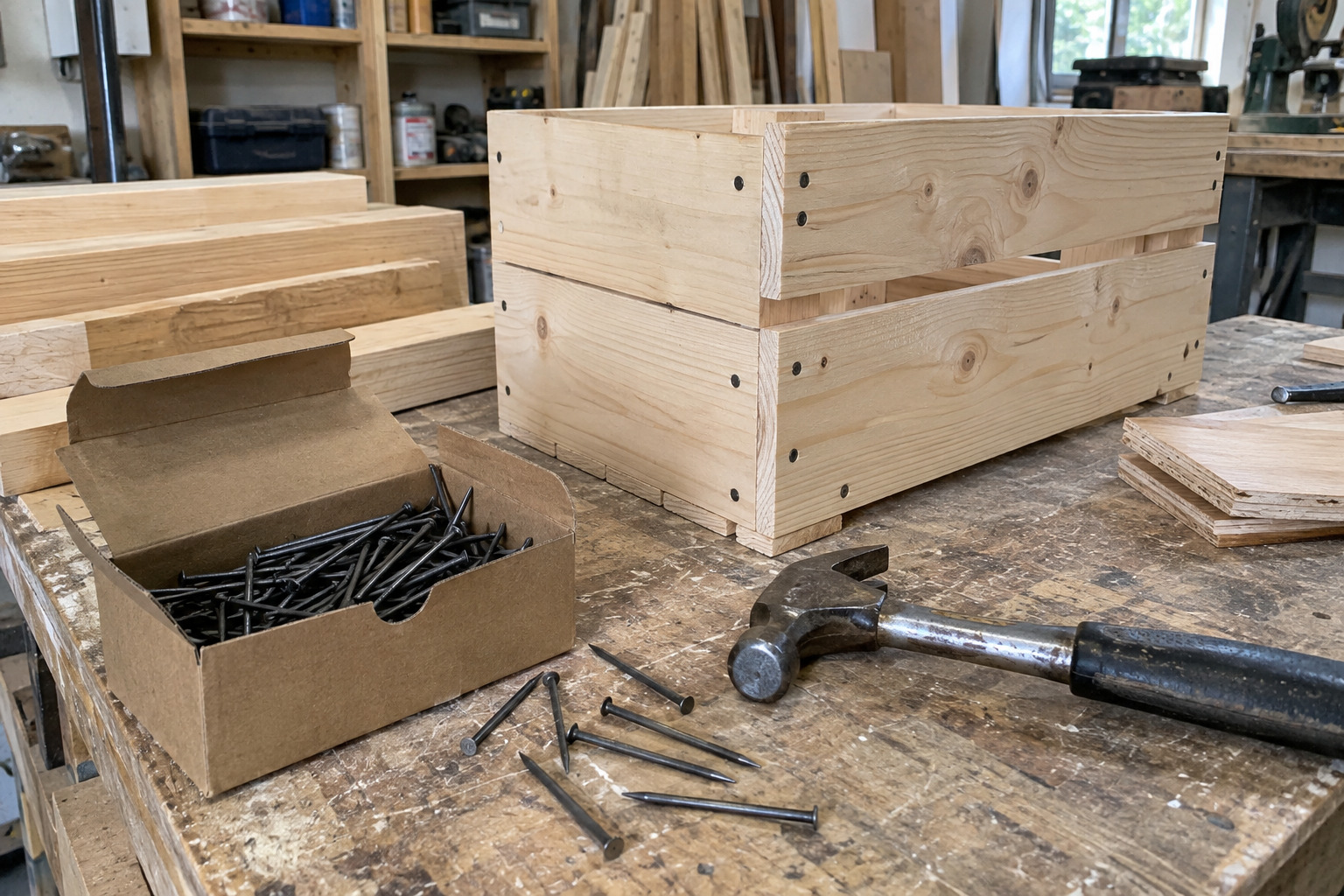
I often tell distributors that black steel nails are not “one nail for every job.” They sit between light common nails and harder specialty fasteners. When you understand that position, you can advise contractors better, reduce dead inventory, and sell with more confidence.
What Do Black Steel Nails Applications Really Mean for Wholesalers?
Many wholesalers first ask for black steel nails by weight, carton quantity, or price. That is normal, but it is not enough. If you sell only by price, your customer may use the nail in the wrong place and blame your stock later.
Black Steel Nails Applications mean the practical uses where black steel nails give the right balance of holding power, bend resistance, surface grip, and cost. For wholesalers, the key is to connect each application with material type, load level, environment, and customer expectation before choosing specifications.
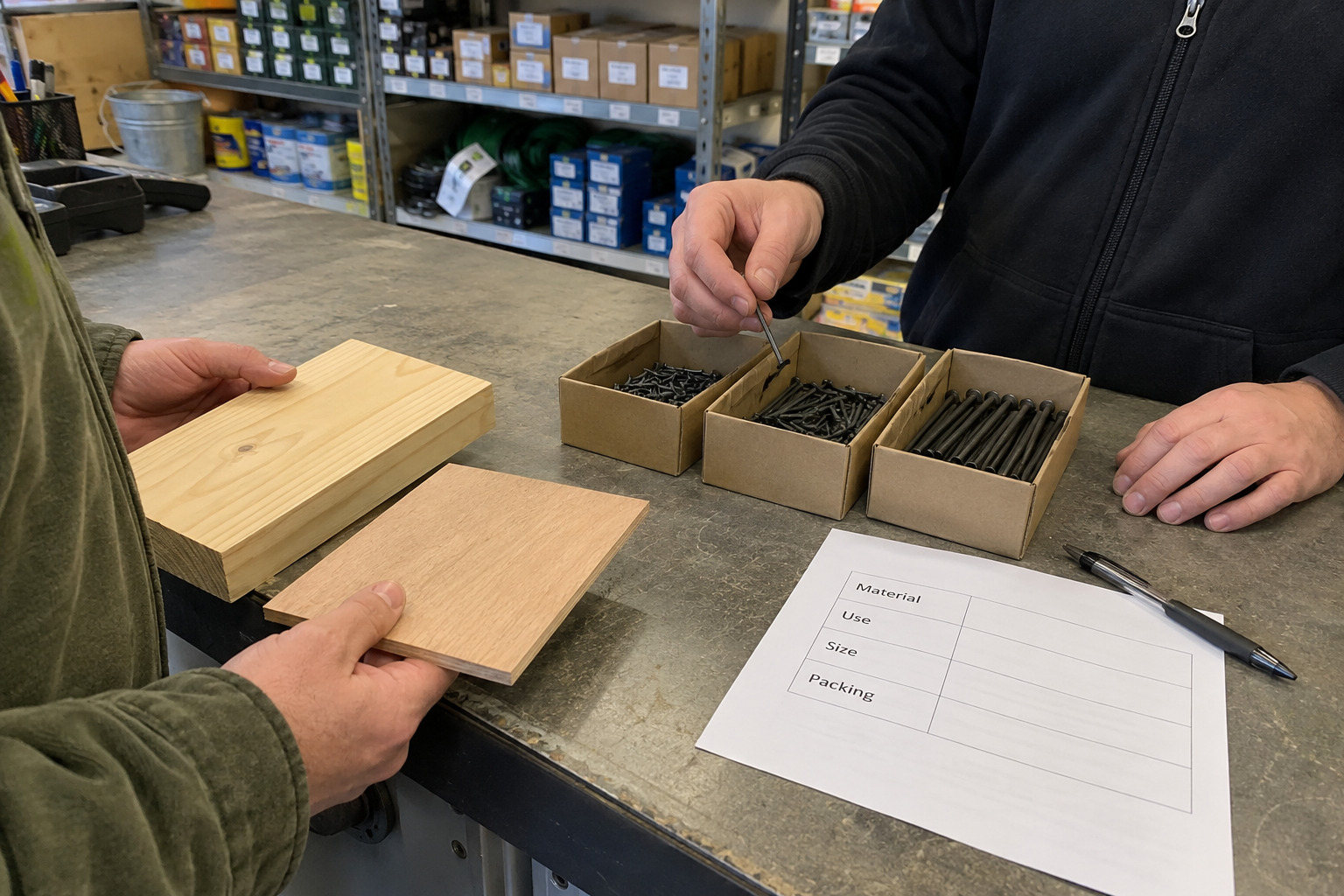
Why “black steel” is not just a color
In many markets I serve, customers use the term black steel nail to describe a steel nail with a dark surface finish. Depending on the factory process and order requirement, this dark finish may come from blackening, coating, oil treatment, or another surface process. Buyers should always confirm the exact surface treatment with the supplier.
The “black” surface matters because it can influence:
- Grip in wood or board materials
- Basic handling and storage performance
- Appearance in exposed or semi-exposed work
- Short-term resistance to surface oxidation
- Cost compared with galvanized or specialty coated nails
However, black steel nails are usually not the first choice for long-term outdoor exposure, wet coastal projects, or chemical environments unless the surface treatment is specifically designed and verified for that use.
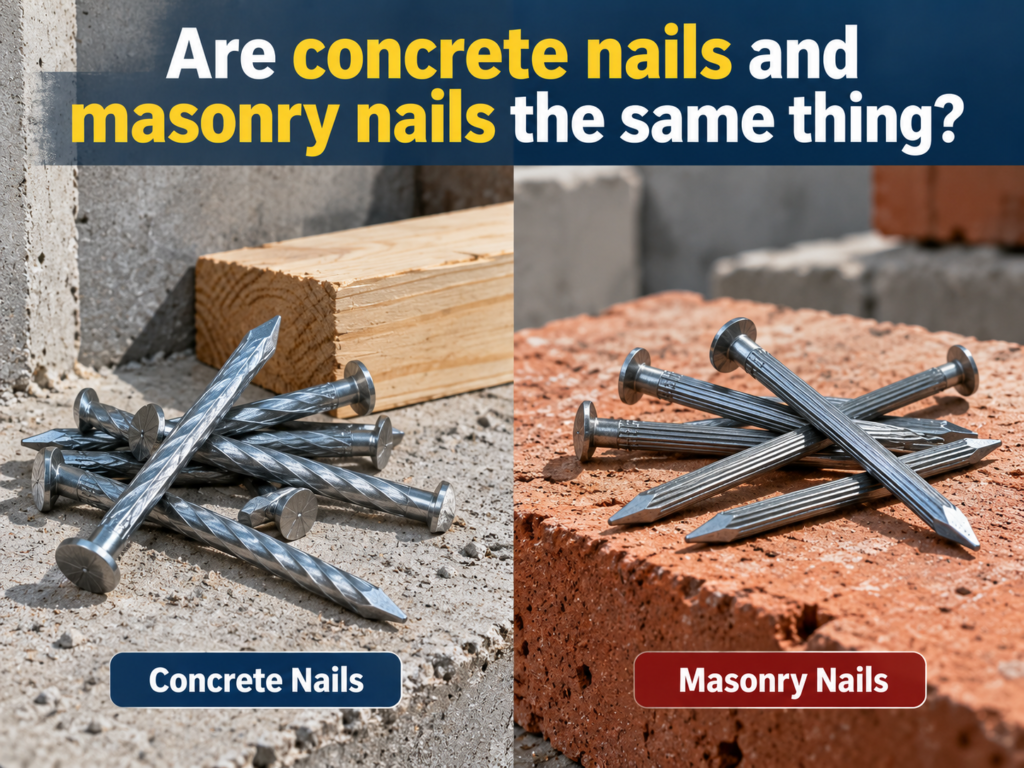
How black steel nails differ from concrete nails and common iron nails
Wholesalers often compare black steel nails with concrete nails, common nails, and roofing nails. That comparison is useful, but the difference must be clear.
| Nail Type | Main Strength | Typical Use | Key Limitation |
|---|---|---|---|
| Black steel nail | Good toughness and grip | Wood, board, light construction, packaging, temporary works | Not ideal for wet outdoor exposure without suitable coating |
| Concrete nail | High hardness | Concrete, brick, hard masonry | Can be too hard or brittle for some wood tasks |
| Common iron nail | General low-cost fastening | Basic carpentry and temporary fixing | May bend more easily in harder material |
| Roofing nail | Large head and weather-focused use | Roofing sheets, felt, insulation boards | Not designed for general structural fastening |
In a contractor discussion, I once heard a buyer say, “My customer wants the strongest nail.” I asked what material they were fastening. The answer was softwood packaging frames, not concrete. A hardened concrete nail would have increased cost and could split thinner wood. A properly sized black steel nail was the better choice.
Why wholesalers should think in application groups
I suggest grouping inventory by use, not only by size. This makes sales conversations easier.
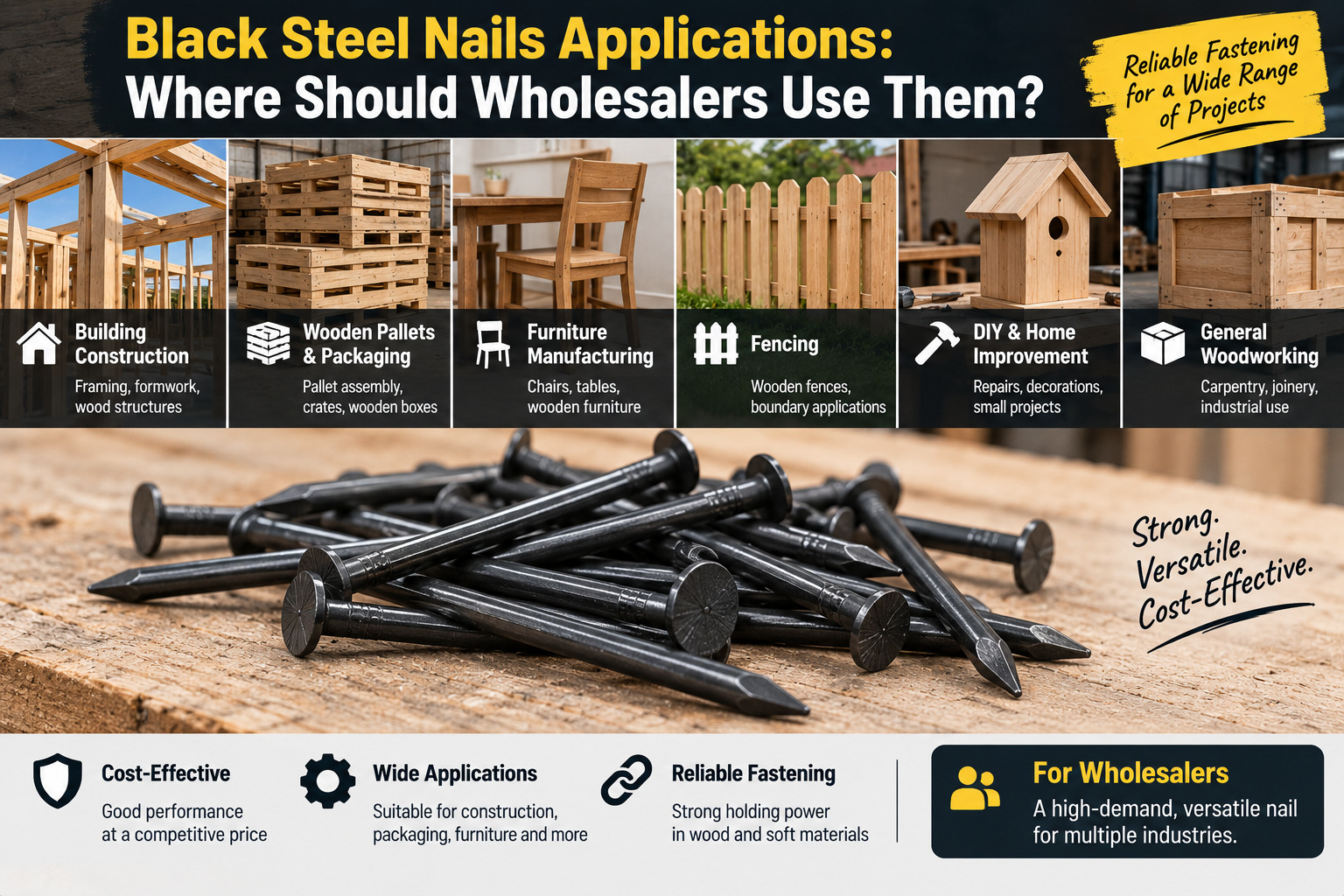
Common black steel nail use groups include:
-
Wood fastening
- Pallets
- Crates
- Formwork
- Light framing
- Temporary wooden structures
-
Board and panel support
- Plasterboard support frames
- Thin plywood
- Fiberboard
- Interior partition work
-
General construction support
- Temporary fixing
- Layout work
- Non-critical fastening
- Site preparation
-
Light masonry-adjacent tasks
- Fixing timber strips into softer blocks
- Temporary holding around plaster or wall preparation
- Non-structural fastening where hard concrete nails are unnecessary
The important point is simple: black steel nails are useful where strength and grip matter, but extreme hardness or high corrosion resistance is not the main requirement.
My practical rule for wholesalers: if the downstream customer says “wood, board, frame, packing, or temporary fixing,” black steel nails may be suitable. If they say “hard concrete, permanent outdoor roofing, or wet marine area,” you need to evaluate alternatives.
Which Black Steel Nails Applications Fit Wood, Plasterboard, and Light Masonry?
A wholesaler may lose trust when a nail bends, splits wood, or leaves rust stains. The problem is usually not the nail alone. The problem is often poor matching between the nail, the base material, and the job environment.
Black Steel Nails Applications fit best in wood, plasterboard support, plywood, light construction, and selected softer masonry-related tasks. They work well when the nail diameter, length, head type, and surface finish match the material thickness, load requirement, and indoor or semi-dry conditions.
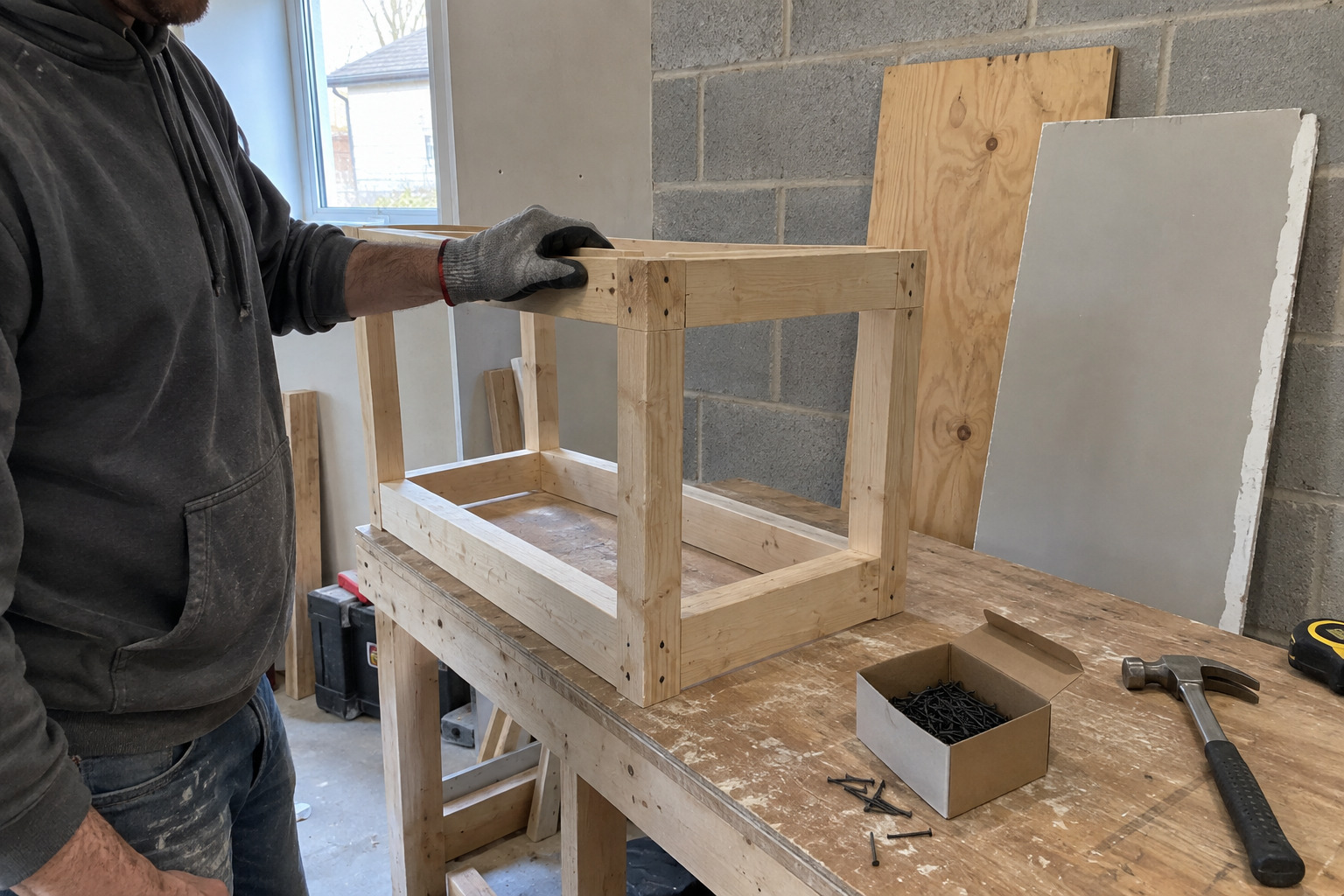
Wood fastening: where black steel nails often perform well
Wood is one of the most common application areas. Black steel nails can offer good holding power when the surface has enough grip and the shank diameter is suitable.
Typical wood uses include:
- Wooden pallets
- Export crates
- Construction formwork
- Temporary site fencing
- Interior wooden frames
- Small furniture support parts
- Packaging boxes for industrial goods
For pallet and crate buyers, the main question is not just “Will it enter the wood?” The better question is: Will it hold during transport, vibration, stacking, and unloading?
In one selection case from a distributor serving packaging workshops, the end users complained that low-cost nails bent during repeated hammering into dense timber. They did not need a concrete nail. They needed a black steel nail with better diameter consistency and suitable tensile strength. After adjusting the size and checking sample performance, the distributor reduced complaints and kept the price competitive.
Plasterboard and interior board support
Black steel nails can be used around interior board systems, especially where they fasten into timber battens or support frames. Here, the nail must hold without damaging the board or creating visible surface problems.
For these jobs, wholesalers should ask:
- Is the nail going into wood, metal, or masonry behind the board?
- Is the board area decorative or hidden?
- Will the location be dry?
- Does the customer need a small head, lost head, or standard flat head?
- Will screws be better for removal or adjustment?
Plasterboard work often requires neat fixing. If the head is too large, the result may look rough. If the nail is too short, the holding strength may be weak. If the nail surface rusts, the wall finish may show stains later. So, wholesalers should not treat plasterboard as a simple low-demand application.
Light masonry-related tasks
I use cautious language here because black steel nails are not a direct replacement for hardened concrete nails. However, in some markets, contractors use them for softer blocks, plaster layers, timber strips, and temporary wall preparation tasks.
Examples may include:
- Fixing temporary guide strips
- Holding timber against soft blockwork
- Light-duty plaster support work
- Non-load-bearing interior fixing
The limitation is important. If the wall is hard concrete, dense brick, or structural masonry, a concrete nail or other anchor system may be required. The wholesaler should never promise performance without knowing the base material.
Application matching table
| Application | Recommended Buyer Focus | Why It Matters |
|---|---|---|
| Pallets and crates | Length, shank strength, bend resistance | Nails face shock during handling and transport |
| Interior wood frames | Head type, length, finish | Finish and neatness may matter |
| Plasterboard support | Head size, rust behavior, base material | Wrong nail may stain or damage board |
| Temporary construction | Cost, pack size, easy driving | Contractors need speed and economy |
| Soft block fixing | Nail hardness and field testing | Base material varies greatly by region |
Practical advice for distributors
When I speak with wholesalers in Africa, the Middle East, Southeast Asia, or South America, I often recommend a sample test before large purchase. At Dingzhou Best, we can provide samples for quality checking, usually with a basic sample fee that may be discussed for return in a formal order.
A simple buyer-side test can include:
- Drive the nail into the real customer material.
- Check whether the nail bends.
- Check whether the head deforms too much.
- Pull or pry the fastened parts to compare holding.
- Store a few nails in the expected warehouse condition.
- Review rust or surface change after several days.
This is not a laboratory certification. It is a practical screening method. For structural, safety-critical, or regulated applications, buyers should request documentation and arrange qualified professional evaluation.
How Do You Match Black Steel Nails Applications to Size, Shank, and Head?
Many ordering mistakes happen because buyers choose black steel nails by price per ton only. That looks efficient, but it hides the most important details. A small difference in length, diameter, shank, or head can change how the nail performs.
To match Black Steel Nails Applications correctly, wholesalers should connect nail length with material thickness, diameter with bending resistance, shank style with grip, and head type with surface requirement. The right specification helps contractors fasten faster, reduce waste, and avoid using expensive nails where they are not needed.
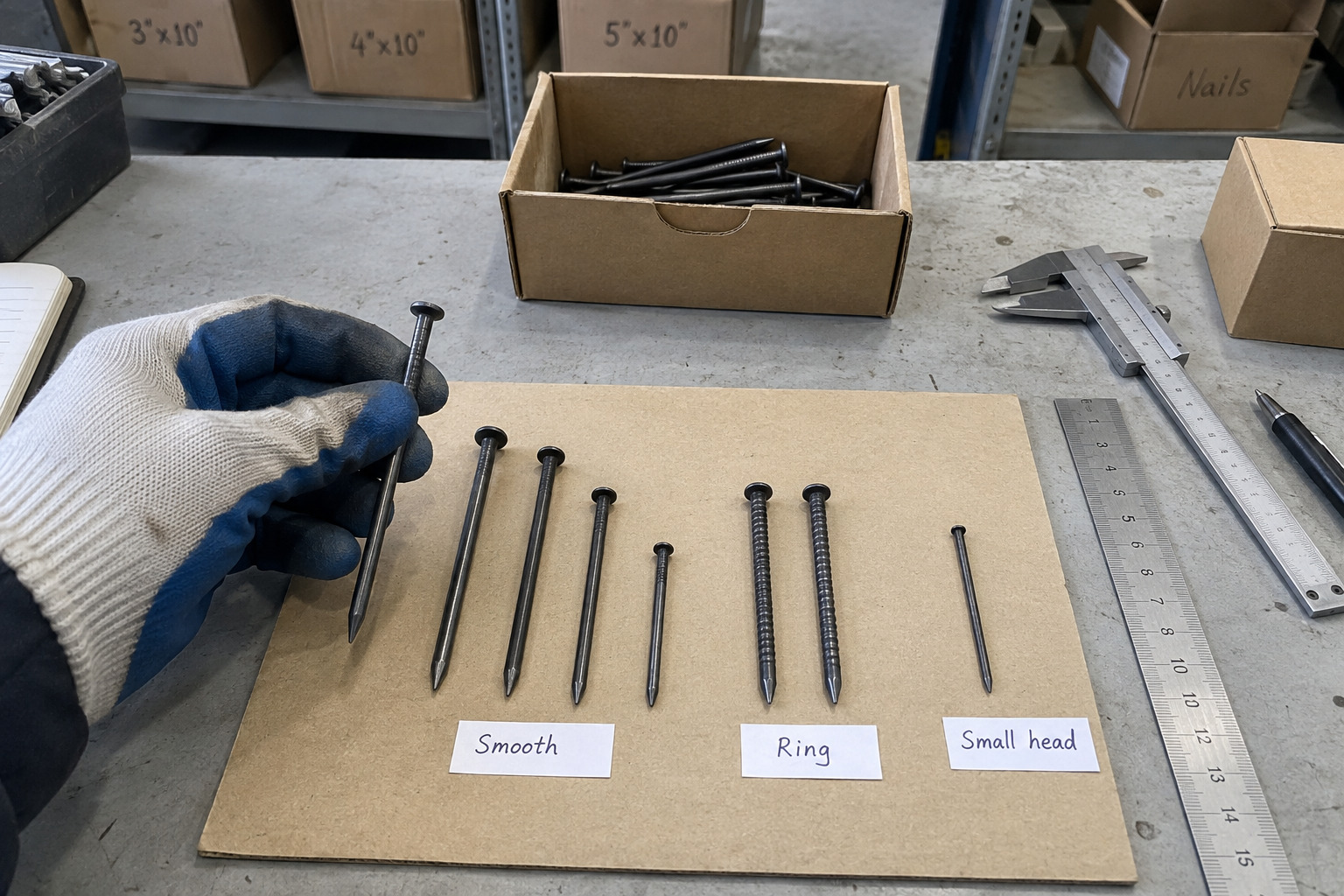
Length: deeper is not always better
Length affects holding power, but longer does not always mean better. A nail that is too short may pull out. A nail that is too long may split thin wood, penetrate through the backside, or slow the worker.
A practical rule in wood fastening is that the nail should enter the base material deeply enough to hold. Many contractors prefer the nail to penetrate the receiving wood by roughly two-thirds of the nail length or at least a practical multiple of the attached board thickness. Exact requirements depend on material density and load.
For wholesalers, the key is to ask:
- What is the thickness of the first material?
- What is the receiving material?
- Will the fastened part carry weight?
- Will the nail be exposed or hidden?
- Will fasteners be installed by hammer, nail gun, or another method?
Diameter: the balance between strength and splitting risk
Diameter affects bend resistance and holding. A thicker nail often handles harder driving better. However, it can split thin timber or board.
For example, a customer buying for export crates may prefer a stronger diameter because crates face stacking pressure. A customer fixing thin wooden strips may need a slimmer nail to prevent splitting. The best size depends on the trade-off.
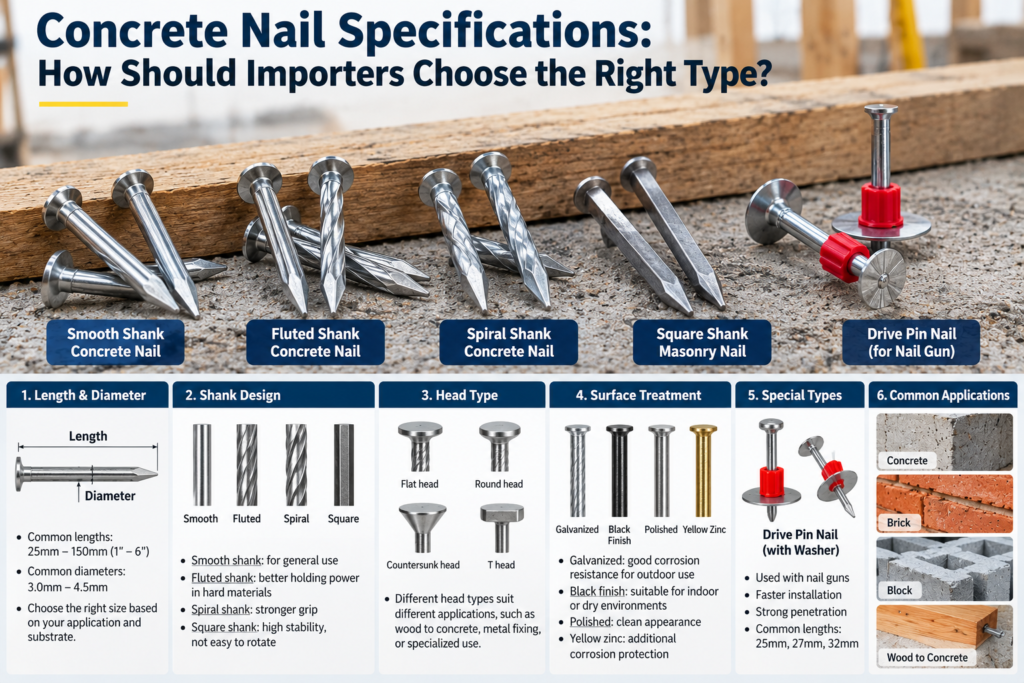
Shank style: smooth, ring, or other grip-focused designs
Not every market uses the same terminology, but the shank is the body of the nail. It affects how the nail grips material.
| Shank Style | Practical Benefit | Common Buyer Concern |
|---|---|---|
| Smooth shank | Easy driving and economical | Lower withdrawal resistance |
| Ring shank | Better grip in wood fibers | Higher driving resistance |
| Twisted or special shank | Improved holding in selected materials | May cost more and require testing |
If a wholesaler sells mainly to pallet makers or crate manufacturers, stronger grip can be a selling point. If the customer only needs temporary fixing, a smooth shank may be more cost-effective.
Head type: holding, appearance, and removal
Head shape matters more than many buyers think.
Common head considerations include:
- Flat head: better surface holding and general construction use.
- Small head or lost head style: better for neat finish or hidden work.
- Larger head: better bearing surface, but not always attractive.
- Special head forms: useful when customers have a specific project requirement.
I once worked with a buyer who wanted the cheapest black steel nails for decorative interior trim. The samples held well, but the head was too visible. The issue was not strength. The issue was appearance. In that case, a smaller head or lost head nail made more sense.
Packaging specification also affects the application
For wholesale, packaging is not only logistics. It affects resale speed and customer convenience.
At Dingzhou Best, quotations usually follow this structure:
Product + specification + quantity + packaging method
This matters because the same nail may sell differently in different markets.
Examples:
| Market Need | Packaging Idea | Reason |
|---|---|---|
| Small hardware shops | Smaller boxes or cartons | Easier resale to contractors |
| Project supply | Larger cartons or bulk packing | Lower handling cost |
| Trial order | Mixed sizes by negotiation | Helps test demand |
| OEM/ODM distribution | Custom brand logo and carton | Builds distributor identity |
Our usual minimum order quantity is 5 tons or 200 cartons, and we support trial orders when the project and packaging plan are suitable. Lead time is commonly 15–25 days, depending on quantity and production schedule.
What wholesalers should include in an inquiry
A good inquiry saves time and reduces mistakes. I recommend including:
- Nail type: black steel nail
- Length and diameter
- Head type
- Shank type
- Surface finish expectation
- Quantity
- Packing method
- Destination port
- Application description
- Any sample or documentation requirement
This information allows the supplier to give a more accurate FOB quotation and avoid guesswork.
When Are Black Steel Nails More Cost-Effective Than Alternatives?
Price pressure is real in wholesale hardware. Still, the cheapest nail is not always the lowest-cost nail. If contractors waste time on bending, splitting, or poor holding, the real cost becomes higher than the purchase price.
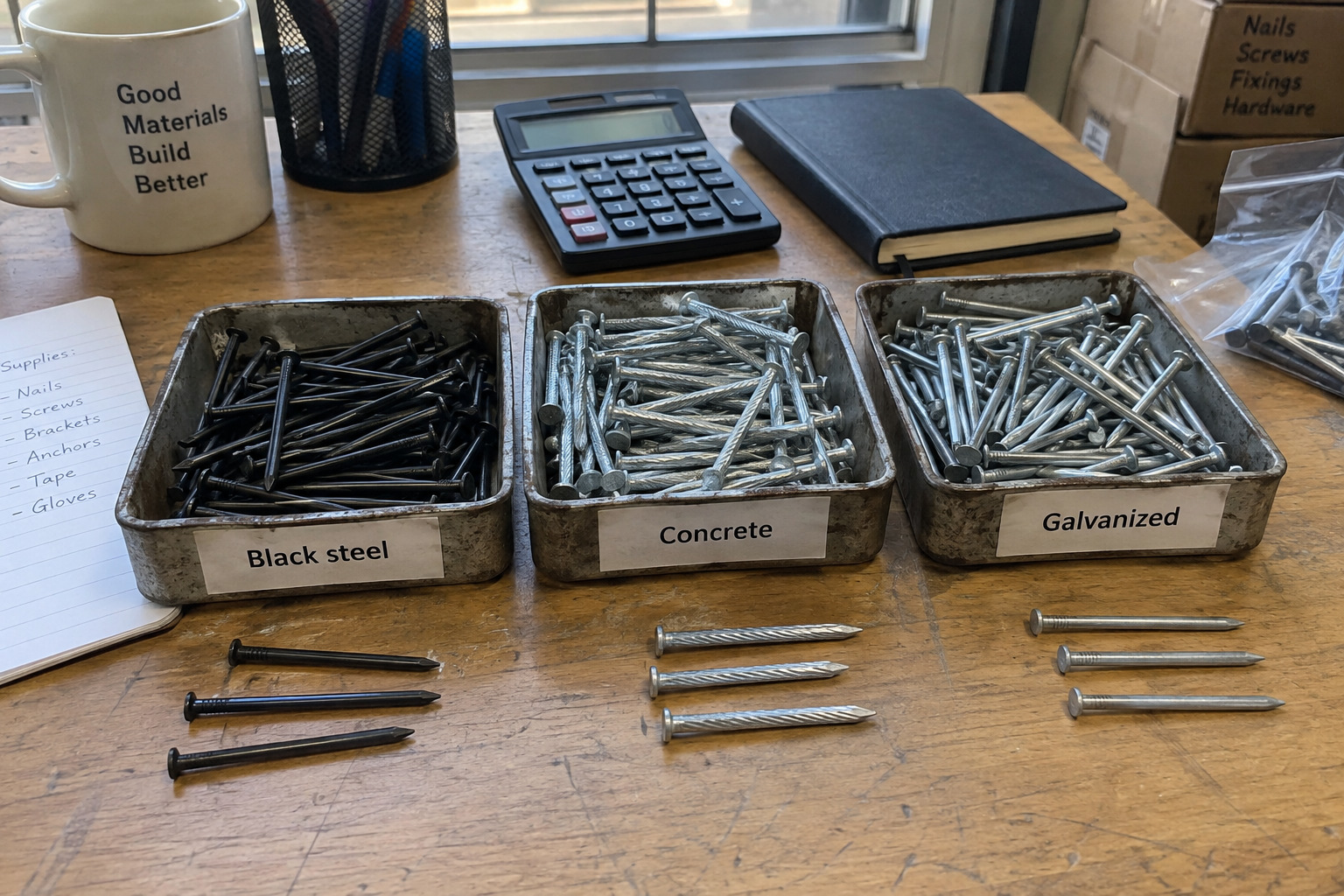
Black steel nails are more cost-effective when the job needs strong general fastening, good grip, and reasonable durability in dry or controlled environments, but does not need the hardness of concrete nails or the corrosion resistance of galvanized, stainless, or roofing-specific fasteners.
The cost question buyers should ask
The right question is not only: How much per ton?
The better question is:
“What is the lowest total cost nail that performs correctly in my customer’s real application?”
Total cost includes:
- Purchase price
- Broken or bent nail waste
- Worker time
- Customer complaints
- Return risk
- Inventory turnover
- Reputation risk
- Packaging damage during resale
- Rust complaints in storage or use
A black steel nail may cost more than a very low-grade common nail, but it may reduce bending complaints. It may cost less than a concrete nail, while still performing well in wood or board applications.
When black steel nails beat concrete nails
Concrete nails are designed for hard base materials. They usually have higher hardness. That is useful in concrete, but it can be unnecessary in wood.
Black steel nails may be more economical when:
- The base material is wood, plywood, or board.
- The job does not require penetration into hard concrete.
- The customer wants easier hammering.
- The nail should have toughness rather than extreme hardness.
- The project is large and price sensitivity is high.
If a distributor buys concrete nails for all customers, inventory cost may rise. Also, downstream users may not value the extra hardness in wood applications.
When black steel nails beat low-grade common nails
Low-grade nails can look attractive on price. However, wholesalers should test consistency. If many nails bend, have uneven heads, or vary in length, the distributor may lose more than they save.
Black steel nails may offer better value when:
- Contractors work with denser wood.
- Packaging frames face transport stress.
- Customers complain about bending.
- Appearance and surface consistency matter.
- The wholesaler wants a stronger middle-grade product line.
When galvanized or stainless nails are better
Black steel nails have limits. I do not recommend overselling them.
Choose galvanized, coated, or stainless options when:
- The application is outdoors for a long time.
- The project is in a humid, coastal, or rainy area.
- The nail touches treated wood or chemicals.
- Rust staining would damage the finished surface.
- The buyer needs documented corrosion performance.
For example, a buyer in a humid coastal market once asked for black steel nails for outdoor wooden shade frames. I suggested they evaluate galvanized nails instead. The initial cost was higher, but the risk of rust complaints was lower. That is how a wholesaler protects long-term customer relationships.
Practical comparison table
| Job Condition | Best Fit | Why |
|---|---|---|
| Dry indoor wood frame | Black steel nail | Strong, economical, easy to stock |
| Hard concrete wall | Concrete nail or anchor | Needs higher hardness or anchoring |
| Outdoor roof work | Roofing nail or galvanized nail | Weather exposure requires protection |
| Temporary site fixing | Black steel nail | Cost-effective and easy to use |
| Decorative trim | Lost head or small head nail | Better appearance |
| Coastal outdoor structure | Galvanized/stainless option | Better corrosion resistance |
How wholesalers can use value language in sales
Instead of saying, “This nail is cheap,” a distributor can say:
- “This black steel nail is suitable for dry wood and board fastening.”
- “This size gives better holding than a very thin nail.”
- “This option avoids the higher cost of concrete nails when the customer is not fastening into concrete.”
- “For outdoor wet use, I recommend a galvanized alternative.”
- “We can test samples before a larger order.”
This kind of language builds trust. It also helps younger sales teams explain product value without sounding too technical.
How Should Wholesalers Evaluate a Black Steel Nail Supplier?
Even if the application is correct, a poor supplier can create serious problems. Inconsistent size, weak cartons, unclear surface finish, and unstable delivery can damage a distributor’s reputation in the local market.
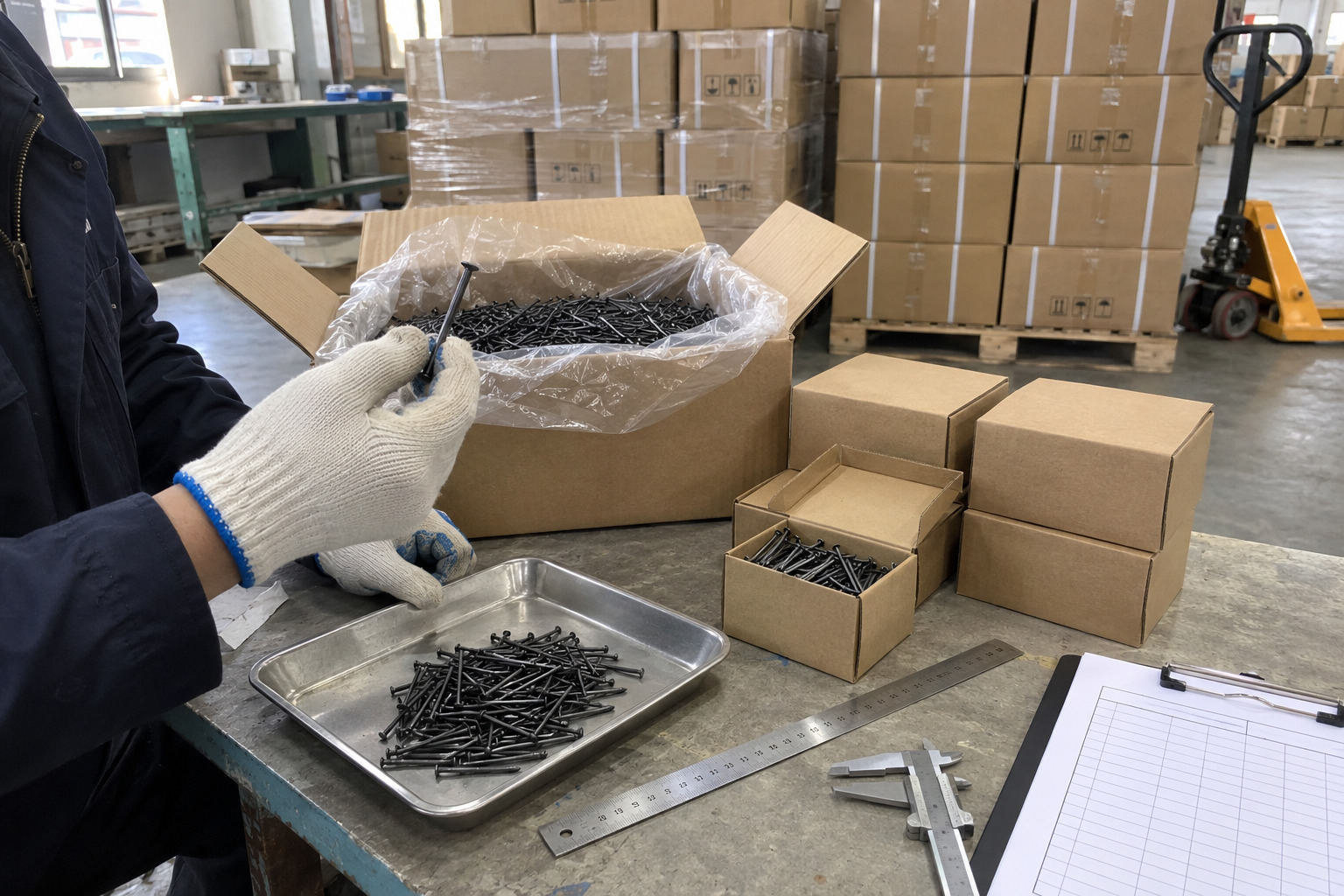
Wholesalers should evaluate a black steel nail supplier by checking factory capability, sample quality, specification consistency, packaging options, delivery time, export experience, and documentation. Buyers should verify any certificates or test reports and use samples before placing large or repeat orders.
Factory capability and production consistency
A good supplier should understand that wholesale buyers need repeatable quality. One good shipment is not enough. The next shipment must match the approved sample as closely as possible.
When I discuss black steel nail orders with purchasers, I usually focus on these quality control points:
- Length tolerance
- Diameter consistency
- Head shape
- Point sharpness
- Surface appearance
- Bending behavior during driving
- Carton strength
- Weight accuracy
- Packing cleanliness
These details affect real use. For example, uneven points slow workers. Weak cartons break during sea freight or warehouse handling. Poor surface condition creates complaints before the nails are even used.
Sample testing before purchase
Samples are one of the safest ways to reduce risk. At Dingzhou Best, we can provide samples for quality inspection. A basic sample fee usually applies, and buyers may discuss sample fee return in a formal order.
I suggest wholesalers test samples in the same conditions their customers will face:
- Use the same wood, board, or base material.
- Ask an actual worker to drive the nails.
- Count bending or head damage.
- Compare grip with existing products.
- Check carton and small box presentation.
- Store samples in local warehouse conditions.
- Confirm whether rust resistance matches the intended environment.
A sample does not replace professional engineering review. However, it gives buyers practical confidence before committing to 5 tons or 200 cartons.
Documentation and certification checks
Some buyers ask for certificates, quality reports, or production documents. These can be useful, but buyers should verify them. A document is not a guarantee of suitability for every application.
Wholesalers should request and check:
- Product specification sheet
- Packing list format
- Material or quality statement where available
- Photos or videos of production and packing
- Sample approval record
- Export documents required by destination market
- Any relevant test reports, if the project requires them
For regulated or safety-critical projects, buyers should consult qualified professionals and local requirements. A nail used in temporary packaging is not evaluated the same way as a nail used in a structural or public safety application.
Export and logistics experience
For emerging markets, shipping and packing matter. Many buyers serve areas where inland transport is rough, warehouses are hot, and cartons may be handled many times before reaching retailers.
Dingzhou Best is a production factory, and we also have overseas factory experience. Our main sales regions include the Middle East, Africa, Southeast Asia, and South America. We usually quote by FOB terms, based on product, specification, quantity, and packing method. We support sea freight shipment through FCL and LCL arrangements.
Practical logistics questions include:
| Question | Why It Matters |
|---|---|
| Can the supplier support full container and LCL? | Buyers may start small and scale later |
| Can cartons survive long-distance handling? | Broken cartons reduce resale value |
| Can packing be customized? | OEM/ODM helps distributors build a brand |
| Is the lead time stable? | Stockouts can lose customers |
| Can the supplier support trial orders? | New market testing becomes easier |
OEM/ODM and local market branding
Many wholesalers want more than a generic nail. They want a product line that local shops recognize. OEM/ODM support can help.
Customization may include:
- Nail specification
- Carton size
- Box design
- Brand logo
- Label language
- Market-specific packing weight
- Mixed specification plan by negotiation
This is useful when a distributor wants to separate product grades. For example:
- Economy line for temporary construction
- Standard line for general woodwork
- Better-grade line for pallet and crate makers
- Custom branded line for retail channels
The goal is not to create a complicated catalog. The goal is to make product selection easier for downstream customers.
My practical supplier checklist
Before placing an order, I recommend this checklist:
- Have I confirmed the real application?
- Have I selected the correct nail size and head type?
- Have I checked whether black steel is suitable for the environment?
- Have I tested samples or arranged customer testing?
- Have I confirmed packing and carton strength?
- Have I received a clear FOB quotation?
- Have I checked lead time and shipping mode?
- Have I verified documents that matter for my market?
- Have I discussed OEM/ODM needs early?
- Have I planned a trial order before scaling?
This checklist may feel simple, but it prevents many expensive mistakes.
What Common Mistakes Should Buyers Avoid in Black Steel Nails Applications?
A buyer can understand the product and still make poor purchasing decisions. The most common mistakes come from assumptions: assuming all black nails are the same, assuming bigger is better, or assuming indoor nails will survive outdoor conditions.
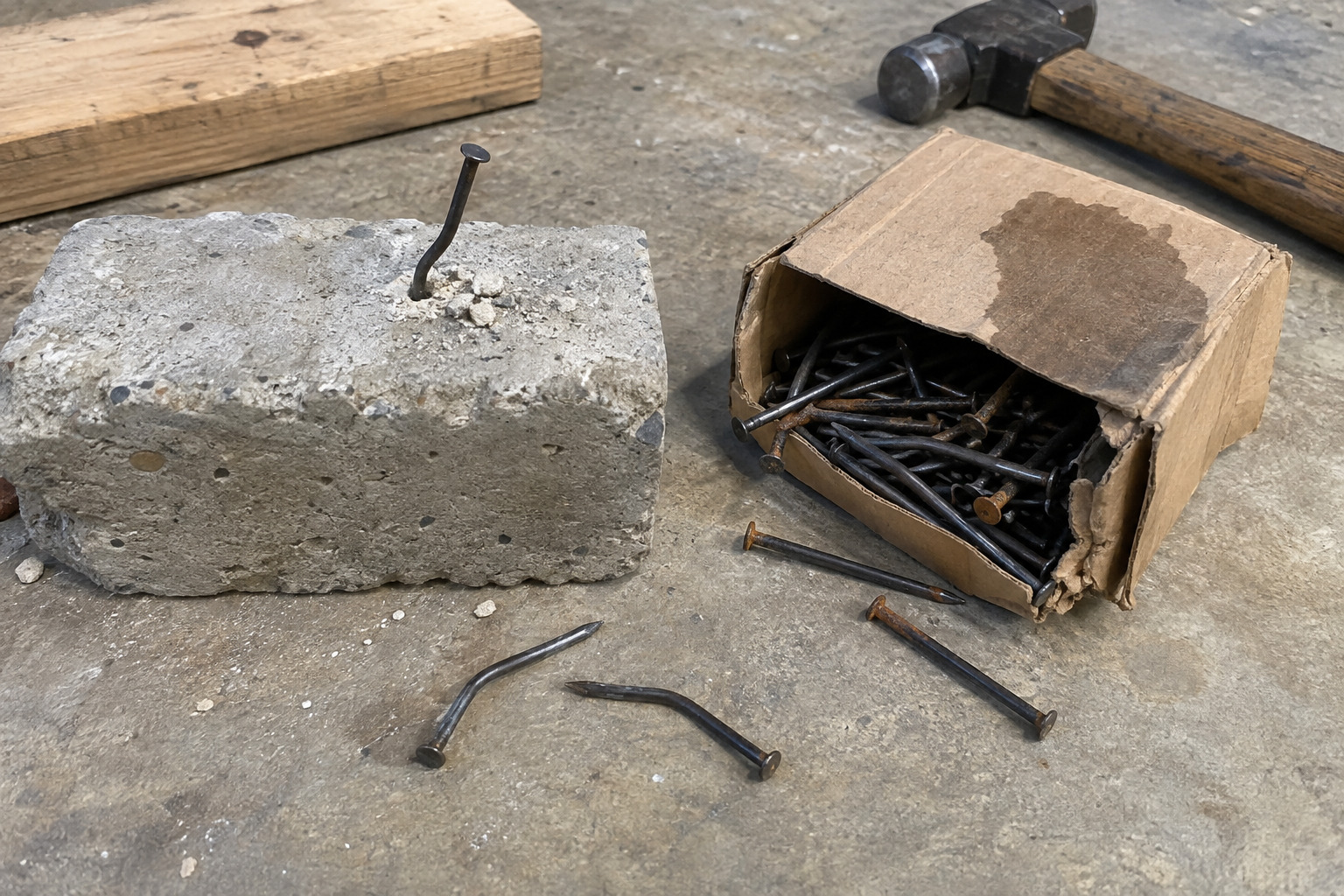
Wholesalers should avoid using black steel nails in hard concrete, wet outdoor areas, or safety-critical applications without proper evaluation. They should also avoid buying only by price, ignoring sample tests, choosing unsuitable packaging, or stocking sizes that do not match local contractor habits.
Mistake 1: Treating black steel nails as concrete nails
This is one of the most important points. Black steel nails are useful, but they are not always hardened like concrete nails. If a customer wants to fasten into hard concrete, the nail may bend or fail to enter properly.
A wholesaler should ask:
- Is the base material concrete, brick, block, wood, or board?
- Is the fixing temporary or permanent?
- Is the load light or heavy?
- Is an anchor system more suitable?
If the answer is hard concrete or structural fixing, evaluate concrete nails, screws, or anchors instead.
Mistake 2: Ignoring rust risk
The word “black” can create a false sense of protection. Some black finishes offer basic surface protection, but they are not equal to hot-dip galvanized, electro-galvanized, stainless, or specialized coated fasteners.
Rust risk increases when:
- Warehouses are humid
- Cartons get wet during unloading
- Nails are used outdoors
- Projects are near the sea
- The nail contacts treated wood or chemicals
- Finished surfaces are light-colored and stain easily
A distributor should store nails in dry conditions and recommend suitable alternatives for wet use.
Mistake 3: Over-specifying inventory
Some buyers stock only stronger or larger nails because they believe they are safer. However, over-specifying creates problems.
Larger nails may:
- Cost more
- Split thin wood
- Move slower in retail
- Increase freight cost per useful application
- Fail to match common local habits
The best inventory mix should match actual market demand. A trial order helps identify fast-moving sizes before scaling.
Mistake 4: Under-specifying to win on price
The opposite mistake is also common. A buyer may choose a very low-cost option that looks fine in photos but bends easily in real use. Then retailers complain, and the distributor must replace stock or lower prices.
Low price is valuable only when performance fits the application. I always prefer to help buyers compare samples, not just quote numbers.
Mistake 5: Forgetting packaging
For wholesalers, packaging can decide whether a product sells smoothly. A strong nail in a weak carton still creates losses.
Packaging issues include:
- Cartons breaking during sea freight
- Labels not matching local language needs
- Box weights not matching shop habits
- Poor branding for retail resale
- Loose nails damaging packaging from inside
For export buyers, I recommend discussing packaging early. It affects price, container loading, customer perception, and resale convenience.
Frequently Asked Questions
What are black steel nails mainly used for?
Black steel nails are mainly used for wood fastening, pallets, crates, light framing, plasterboard support, temporary construction, and selected light-duty fixing tasks. They are a cost-effective choice when the job does not require hardened concrete nails or high corrosion resistance.
Are black steel nails suitable for outdoor use?
Black steel nails are usually better for dry or controlled environments. They may rust outdoors or in humid locations unless the surface treatment is suitable and verified. For long-term outdoor use, wholesalers should evaluate galvanized, coated, or stainless alternatives.
How do black steel nails differ from concrete nails?
Black steel nails usually focus on toughness, grip, and economical fastening in wood or board materials. Concrete nails are harder and designed to penetrate concrete or hard masonry. Using concrete nails for wood may be unnecessary, while using black steel nails for hard concrete may cause bending.
Can I order custom black steel nails with my own brand?
Yes. Dingzhou Best supports OEM/ODM customization, including product specifications, packaging, and brand logo. Buyers should confirm nail size, carton design, quantity, and application needs before production. The usual MOQ is 5 tons or 200 cartons.
Should wholesalers test samples before ordering?
Yes. Sample testing helps buyers confirm driving performance, bending resistance, grip, surface appearance, and packaging suitability. Dingzhou Best can provide samples for quality checking, usually with a basic sample fee that may be discussed for return in a formal order.
Conclusion
Black Steel Nails Applications are not just a list of uses. They are a purchasing and sales decision system for wholesalers who want to match the right nail to wood, board, light construction, packaging, and suitable temporary fixing tasks. The best results come from checking material, environment, size, head type, surface finish, packaging, and supplier consistency. If you need black steel nails for your market, contact Dingzhou Best at [email protected] or WhatsApp +8618331061136 to discuss specifications, samples, FOB pricing, and trial order options.