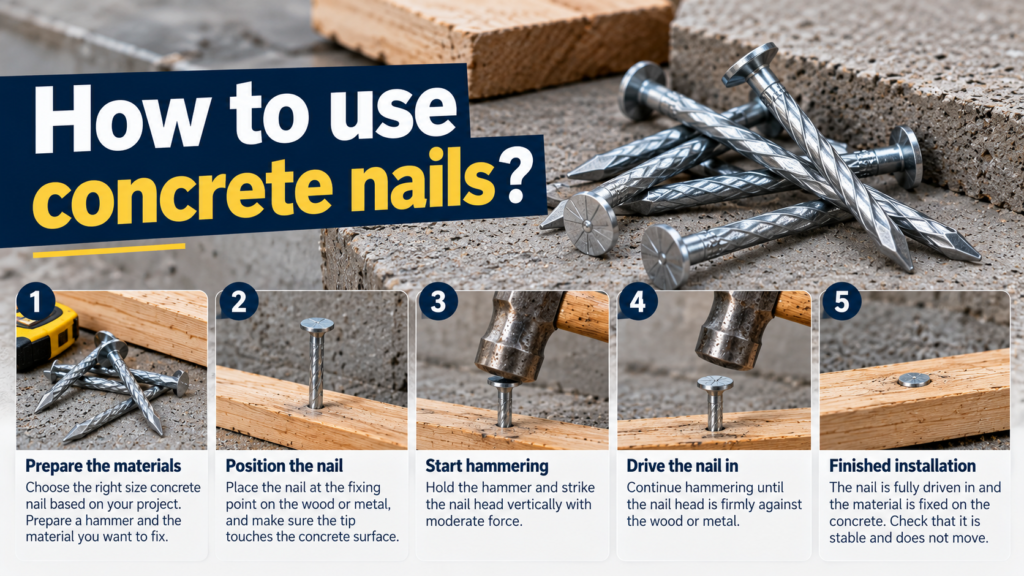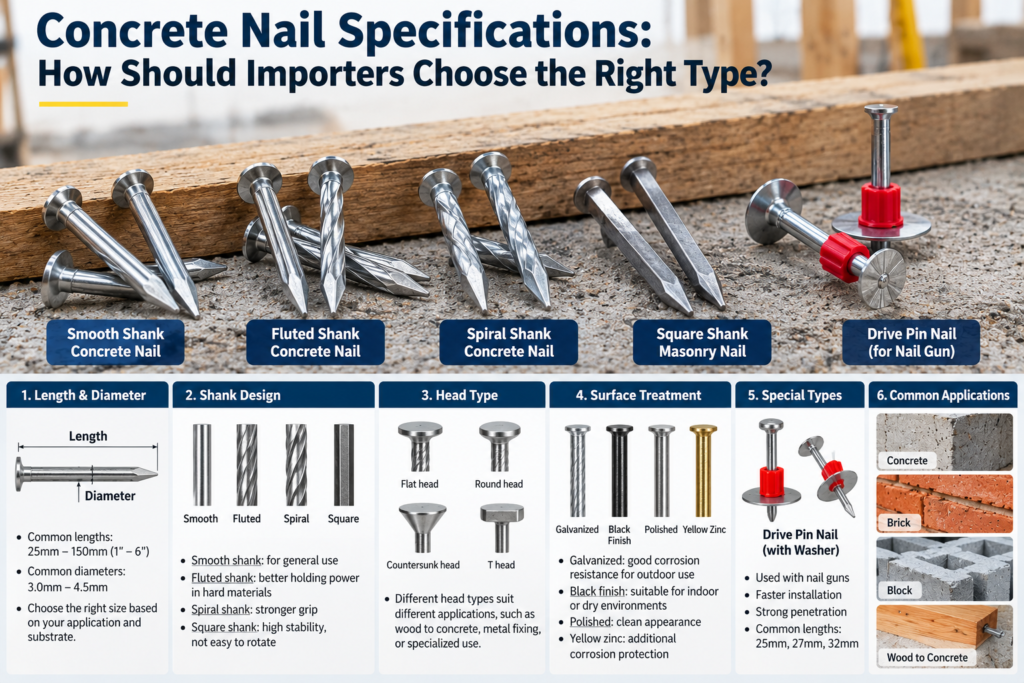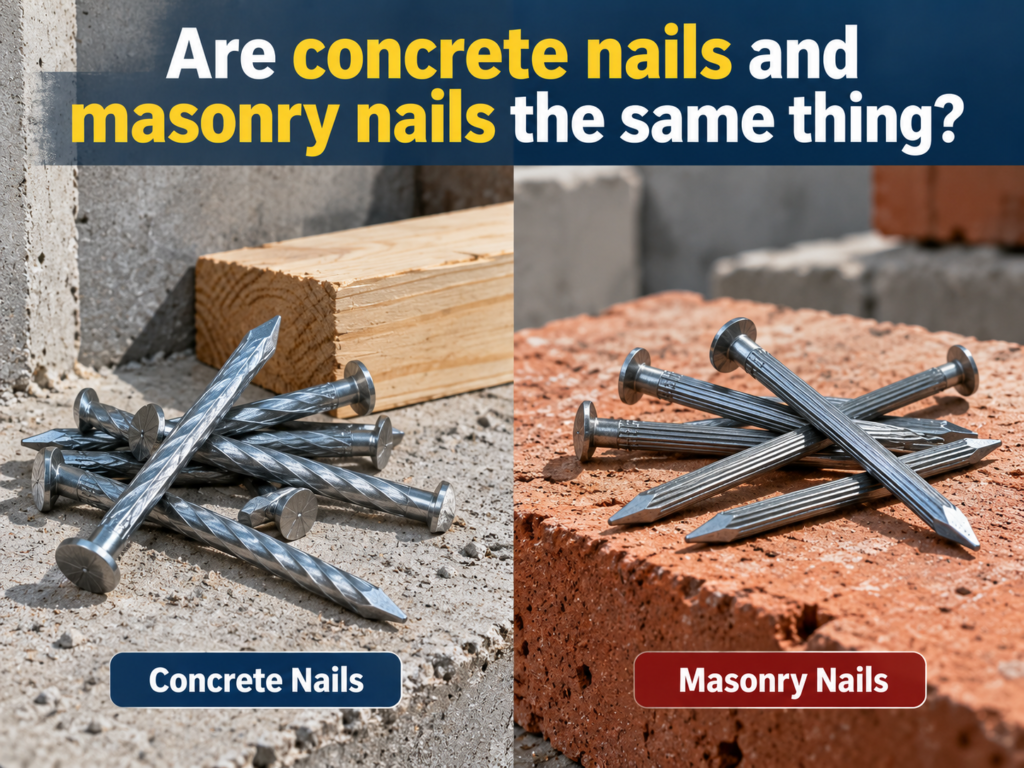
Concrete nails and regular nails are often compared only by length, diameter, or price, but that can lead to the wrong product being sold. When a customer uses the wrong nail, it may bend, break, or fail to hold well. I usually solve this by asking one question first: what material will you nail into?
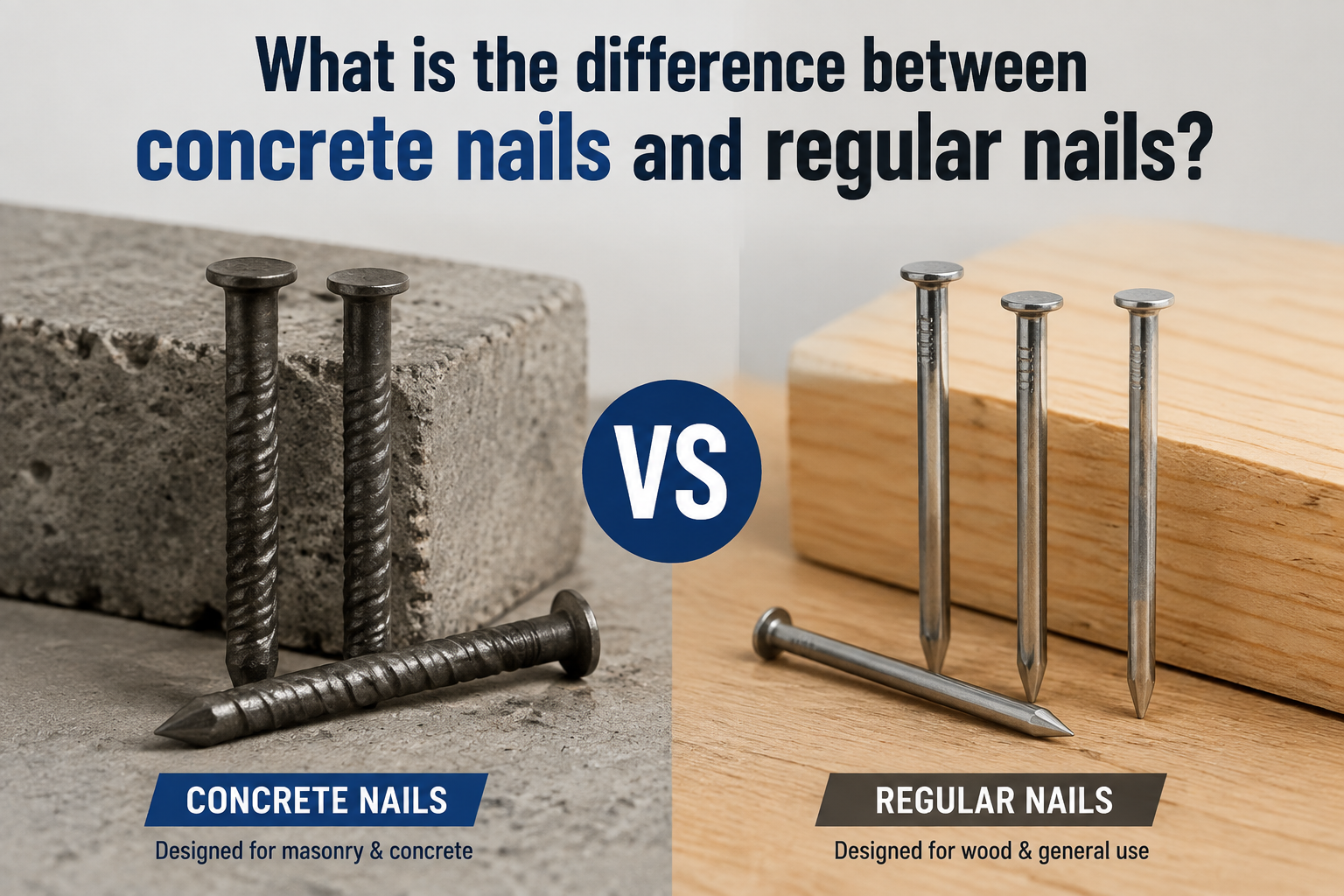
The main difference between concrete nails and regular nails is the base material they are designed to fasten into. Concrete nails are made for harder surfaces such as concrete, brick, or masonry, while regular nails usually mean ordinary iron or woodworking nails for softer materials like wood.1 The right choice depends on application first, then size, quantity, and price.
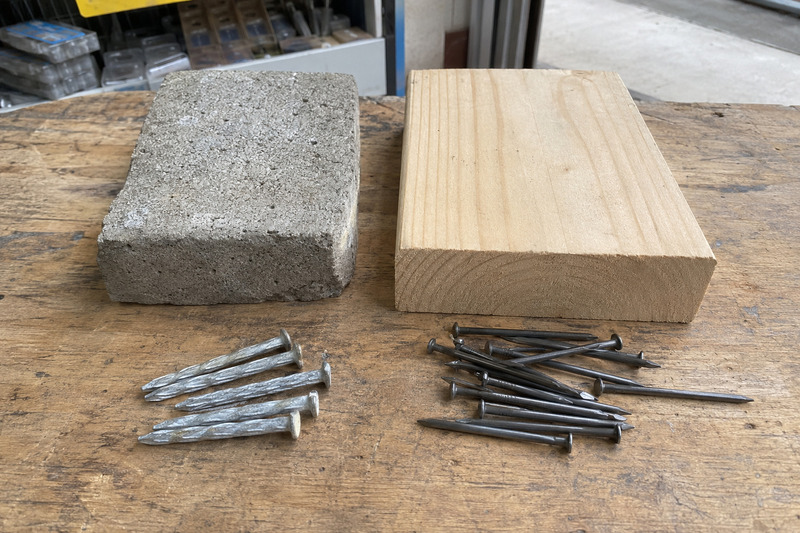
Many retailers ask me for “the cheapest nail” or “the same size nail,” but size alone does not tell the full story. In nail procurement, the product name matters less than the fastening surface, hardness requirement, packaging, and end-user application.
Why are concrete nails and regular nails used for different materials?
Choosing concrete nails and regular nails only by appearance creates a simple but costly problem. The products can look similar in a box or on a shelf, so staff may assume they are interchangeable. Then the customer tries to drive a soft nail into a hard wall, and the nail fails.
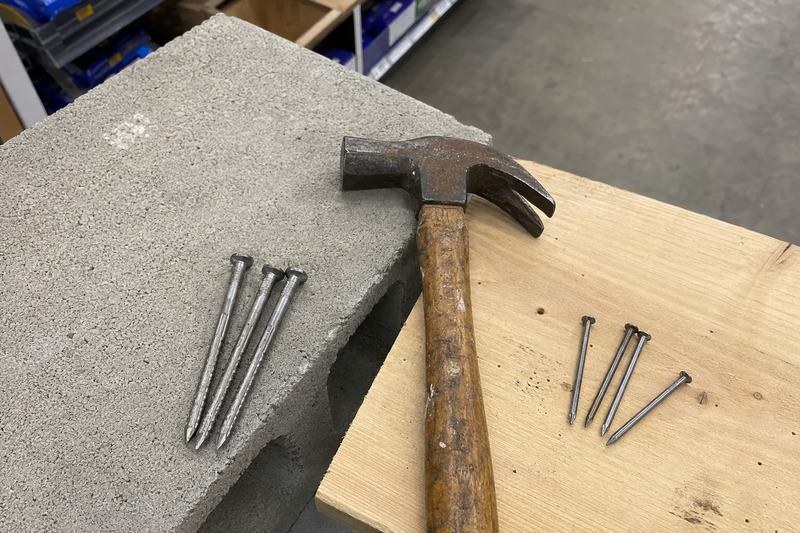
Concrete nails are intended for harder base materials such as concrete, brick, and masonry. Regular nails, in this article, refer mainly to ordinary iron nails or woodworking nails used for wood and other softer materials. The practical selection rule is simple: match the nail to the material being fastened into before comparing price.
The base material decides the product category
When I answer pre-sales inquiries from hardware wholesalers and building-material retailers, I often hear the same first request: “Please quote 2-inch nails.” That information is useful, but it is not enough. A 2-inch nail for wood and a 2-inch nail for concrete are not the same procurement item.
The base material decides the product category because every surface resists the nail differently.2
Common base materials include:
- Wood: softer, easier to penetrate, common for carpentry and general fixing.
- Concrete: hard and dense, needs a nail designed for impact and penetration.
- Brick or masonry: hard but sometimes brittle, still requires a suitable hardened nail.
- Light boards or packaging wood: usually suitable for common nails or other regular nails.
- Roofing or sheet materials: may require roofing nails, not concrete nails.
For retailers, the important question is not “which nail is stronger?” It is:
“What will your customer nail into?”
That one question prevents many wrong recommendations.
A simple retail selection table
| Customer application | Likely base material | Better product direction | Retail note |
|---|---|---|---|
| Fixing wood frame to wood | Wood | Regular nails / common iron nails | Size and surface finish matter |
| Fixing items to concrete wall | Concrete | Concrete nails | Check hardness and length |
| Temporary fixing into brick | Brick / masonry | Concrete nails or masonry-type nails | Ask about wall condition |
| General woodworking | Wood | Regular nails | Do not over-specify concrete nails |
| Roofing sheet fixing3 | Wood/roof structure | Roofing nails | Head type is important |
Why “better” is the wrong question
Concrete nails are not automatically “better” than regular nails. They are better for hard surfaces. Regular nails are often better for ordinary wood use because they are practical, familiar, and cost-effective for that application.
If a shop sells concrete nails for every job, customers may pay more than needed. If a shop sells regular nails for concrete work, customers may complain that the nail bends or cannot enter the wall. Both mistakes hurt retail trust.
How I guide inquiries
In my factory sales work, I prefer to collect four details before quoting:
- Intended use: wood, concrete, brick, masonry, or another surface.
- Size: length and diameter, usually in mm or inches.
- Quantity: for us, the usual minimum order is 5 tons or 200 cartons.
- Packaging: bulk carton, small box, branded package, or OEM/ODM design.
This keeps the discussion practical. It also helps me quote the correct product instead of only sending a low price for the wrong nail.
How do material and hardness separate concrete nails and regular nails?
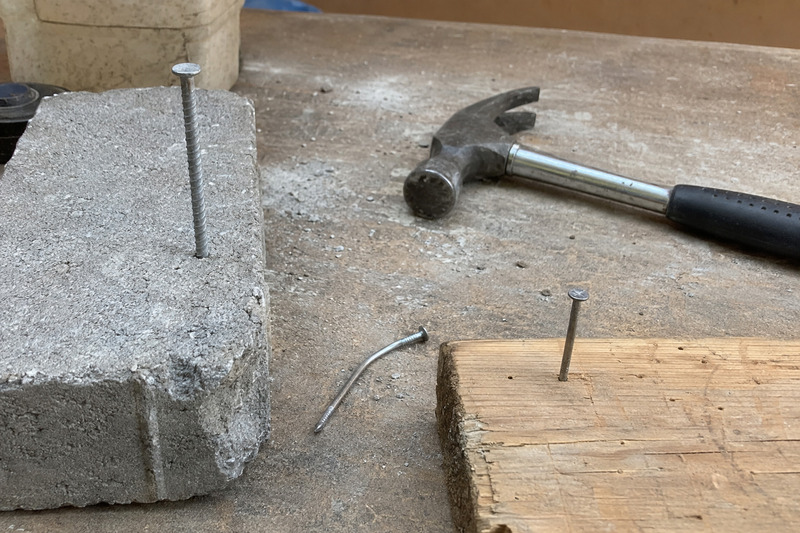
A buyer may hold concrete nails and regular nails of the same length and think they should perform the same. The problem appears only during use. If the nail material and hardness do not match the surface, the nail may bend, mushroom, crack, or fail to penetrate.
The key technical difference is that concrete nails are generally made and treated for harder surfaces, while regular nails are commonly made for softer fastening work. Buyers should compare material, hardness, shank design, surface treatment, and application, not just length or carton price.
Material affects penetration
Concrete nails are usually associated with harder steel and suitable treatment for masonry-type fastening. Regular nails, such as common iron nails or woodworking nails, are generally designed for easier penetration into wood. This difference matters because concrete offers much more resistance than timber.4
I avoid giving one universal hardness number in normal sales discussions because standards, factory processes, and buyer requirements can vary. For procurement, the better approach is to ask the supplier for the specification and sample confirmation when the application is important.
Important product factors include:
- Wire material
- Heat treatment or hardening process5
- Shank diameter
- Point sharpness
- Surface finish
- Head type
- Packing method
- Quality inspection documents
Same size does not mean same performance
A common mistake is to compare only size:
| Specification point | Why it matters |
|---|---|
| Length | Affects embedment and application fit6 |
| Diameter | Affects bending resistance and holding behavior7 |
| Material | Affects strength and workability |
| Hardness/treatment | Affects penetration into hard surfaces |
| Surface finish | Affects appearance and corrosion resistance expectations8 |
| Packaging | Affects retail sales and warehouse handling |
Two nails can both be 50 mm long, but they may not be interchangeable. A regular nail may be suitable for wood but unsuitable for concrete. A concrete nail may enter a hard surface better, but it may be unnecessary for simple woodwork.
What can go wrong in the wrong material?
When a nail is used in the wrong base material, the failure is usually obvious to the end user.
Possible problems include:
- The nail bends before entering the wall
- The point becomes damaged
- The head deforms under hammering
- The surface cracks or chips
- The nail does not hold as expected
- The customer blames the shop or brand
Retailers may not control how every customer uses the product. However, they can reduce complaints by asking about the application before selling.
How retailers can explain the difference simply
Store staff do not need to give a long technical lecture. A simple explanation works better:
“If you are nailing into concrete or brick, use concrete nails. If you are nailing into wood, use regular nails. The size is important, but the wall or base material is more important.”
This sentence is easy for counter staff to remember. It also gives customers confidence that the store understands product use.
Quality control points for wholesale buyers
For B2B procurement, I suggest checking samples before a large order. Samples can usually be used for basic quality checking. In our business, samples may carry a basic fee, and that fee can sometimes be discussed for return or adjustment in a formal order.
Buyers can check:
- Appearance consistency
- Head shape and shank straightness
- Point sharpness
- Surface finish
- Carton strength
- Small-box printing if retail packaging is required
- Actual use feedback from local workers or retailers
For critical or engineered applications, I always recommend qualified professional evaluation. Nail suppliers can support product selection, but we should not replace structural engineers or local code requirements.
Are concrete nails and regular nails interchangeable if the size is the same?
Many customers believe concrete nails and regular nails are interchangeable when the diameter and length match. This belief creates stock confusion for retailers. It also makes price comparison unfair because the buyer may be comparing two different products made for different surfaces.
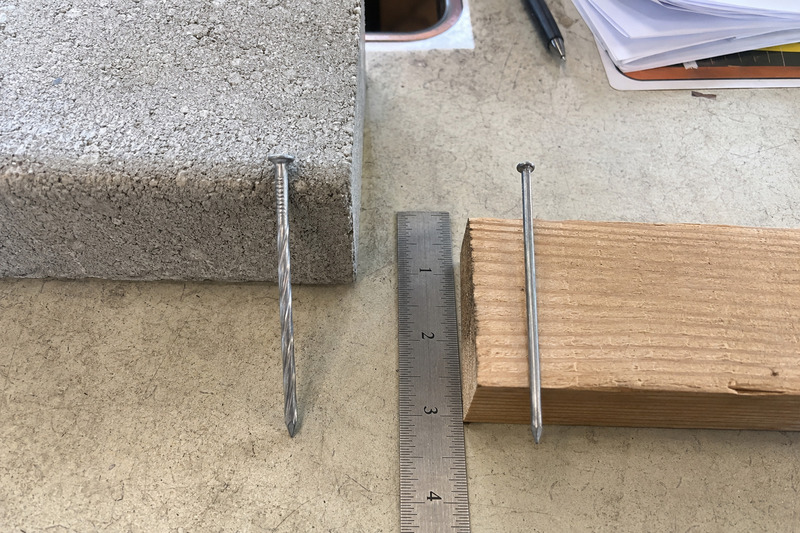
Concrete nails and regular nails should not be treated as interchangeable only because they share the same size.9 Size is only one specification. The intended base material, nail hardness, wire material, point, and finish all affect whether the nail performs correctly in use.
Why size is only the starting point
Size is easy to quote. That is why many inquiries start with size. A customer may ask for:
- 1 inch nails
- 1.5 inch nails
- 2 inch nails
- 2.5 inch nails
- 3 inch nails
- 4 inch nails
These sizes matter, but they do not answer the application question. A 2-inch regular nail may be useful for woodworking. A 2-inch concrete nail may be useful for masonry fixing. The length is the same, but the purpose is not.
When I receive an inquiry that only says “send nail price,” I usually ask follow-up questions. I do this not to slow the order, but to avoid quoting the wrong product. A good supplier should help the buyer define the product clearly.
Practical interchangeability guide
| Situation | Can regular nails replace concrete nails? | Can concrete nails replace regular nails? | Better retail advice |
|---|---|---|---|
| Wood-to-wood fixing | Usually not needed | Sometimes possible but often unnecessary | Sell regular nails |
| Concrete wall fixing | No, not recommended | Yes, this is the intended direction | Sell concrete nails |
| Brick or masonry fixing | Usually not suitable | Often more suitable | Ask about wall type |
| General household repair | Depends on surface | Depends on surface | Ask what material is being nailed |
| Low-price bulk use | Only if surface is soft | Only if cost is acceptable | Match product to application |
Why wrong substitution damages retail reputation
Retailers in markets such as the Middle East, Africa, Southeast Asia, and South America often serve many types of buyers. Some customers are contractors. Some are small shop owners. Some are walk-in users who only describe the job briefly.
If the retailer sells the wrong nail, the product complaint may come back quickly. The customer may say:
- “The nail is too soft.”
- “The nail bends.”
- “The head breaks.”
- “This brand is not good.”
- “The box says nail, but it does not work.”
Sometimes the product is not the real problem. The mismatch is the problem.
This is why I encourage wholesalers to train sales staff around application questions. A simple counter checklist can prevent many complaints.
Suggested questions for store staff
Before recommending a nail, store staff can ask:
- Are you nailing into wood, concrete, brick, or another material?
- Is the nail for indoor or outdoor use?
- Do you need small retail boxes or bulk quantity?
- What length do you normally use?
- Do you need a specific brand label or plain packaging?
These questions are simple. They also help the retailer separate concrete nails, regular nails, roofing nails, lost head nails, and other nail types.
Pricing should follow product selection
Price matters. I know most wholesale buyers compare suppliers closely. However, price should come after the product is correctly identified.
For example, an FOB quotation usually depends on:
- Product type
- Specification
- Quantity
- Packaging method
- Brand or OEM/ODM requirement
- Current raw material cost
- Loading and shipping arrangement
In our normal quoting process, I prefer this format:
Product + size + quantity + packaging + destination/shipping requirement
This helps both sides compare quotations fairly. A low price for the wrong nail is not a saving. It becomes a complaint, return, or slow-moving stock item.
How should retailers quote and stock concrete nails and regular nails?
Retailers often lose margin when concrete nails and regular nails are stocked without clear product positioning. If staff cannot explain the difference, customers buy by price only. Then the store carries too many similar-looking items and too few products that match actual local demand.
Retailers should stock and quote nails by application category first, then by size, packaging, and price level. A practical nail range usually separates concrete nails for masonry use, regular nails for wood use, roofing nails for roofing work, and other special nails by customer demand.
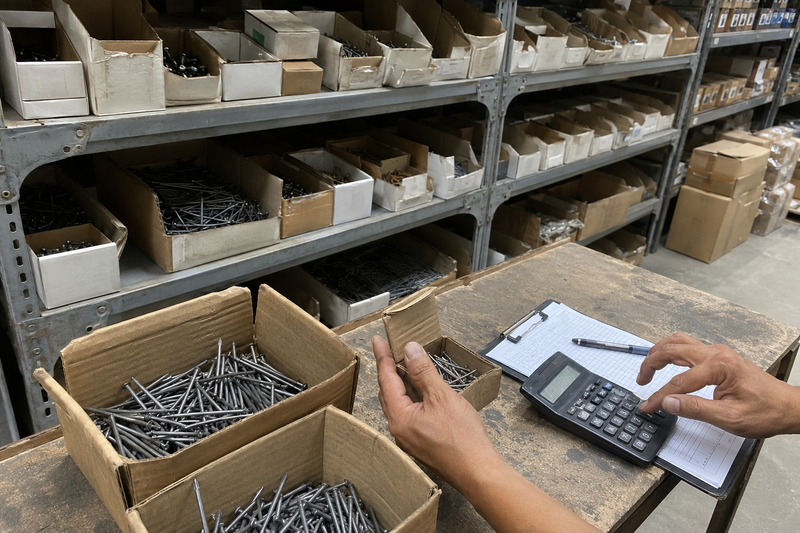
Build the shelf around customer jobs
A good retail shelf is not only a product display. It is a decision tool. If a customer can quickly find “for concrete wall” and “for woodwork,” the store reduces confusion.
A simple nail category plan may look like this:
| Category | Main use | Typical buyer question | Retail display wording |
|---|---|---|---|
| Concrete nails | Concrete, brick, masonry | “Can this enter the wall?” | For concrete and masonry |
| Regular nails | Wood, general fixing | “I need common nails.” | For wood and general use |
| Roofing nails | Roofing sheet and roof work | “Do you have big head nails?” | For roofing application |
| Lost head nails | Finish work | “I need less visible head.” | For finishing and carpentry |
| Black steel nails | Market-specific demand | “Do you stock black nails?” | Check local application |
This structure helps staff recommend faster. It also helps wholesalers decide what to reorder.
Match packaging to retail channel
Packaging affects sales more than many buyers expect. In markets where shops sell to small contractors and walk-in customers, small boxes may move faster. For wholesale distribution, bulk cartons may be more economical.
Common packaging options include:
- Bulk cartons
- Small inner boxes
- Plastic bags
- Plain neutral packing
- Custom brand packing
- OEM/ODM logo and carton design
For our factory, custom packaging and brand logo support can be discussed. Buyers should confirm artwork, carton strength, box weight, and language needs before production. This is especially important for retailers who sell under their own brand.
Stocking logic for mixed hardware retailers
Many of my typical customers run building-material or hardware wholesale businesses with many product categories. Some have agents in Yiwu. Some sell under their own local brand. Their challenge is not only finding a nail supplier. Their challenge is choosing a range that sells steadily.
I suggest using three levels:
-
Fast-moving basic sizes
- Common regular nails for wood use
- Popular concrete nail sizes for wall fixing
- Standard retail packing
-
Application-specific items
- Roofing nails
- Lost head nails
- Black steel nails
- Market-preferred finishes
-
Brand-building items
- Custom cartons
- Small boxes with logo
- Consistent specification range
- Repeatable quality control
This approach keeps inventory practical. It also prevents the buyer from importing many sizes that look similar but serve unclear demand.
Procurement checklist before asking for FOB price
A clear inquiry saves time and improves quotation accuracy. Before asking a supplier for FOB price, I recommend preparing:
- Nail type: concrete nail, regular nail, roofing nail, etc.
- Application: concrete, masonry, wood, roofing, or finishing.
- Size: length and diameter.
- Quantity: tons, cartons, or container plan.
- Packaging: bulk, small box, OEM/ODM, logo, carton marks.
- Quality expectation: finish, strength, sample approval, documents to verify.
- Shipping plan: FCL or LCL by sea.
- Trial order needs: whether the buyer wants to test the market first.
Our usual minimum order is 5 tons or 200 cartons, and we support trial orders depending on product and packing. Lead time is normally 15–25 days, adjusted by order quantity and packaging details.
Supplier selection points
Retailers should not choose a nail supplier by price alone. A supplier should help the buyer avoid product mismatch.
Useful supplier evaluation points include:
| Supplier factor | Why it matters |
|---|---|
| Factory production capability | Supports stable supply and specification control |
| Sample availability | Helps buyers check quality before order |
| OEM/ODM support | Helps retailers build local brands |
| Clear quotation format | Reduces misunderstanding |
| Export market experience | Helps with practical packing and shipping |
| Communication speed | Matters when solving specification questions |
| Document support | Allows buyers to verify claims and shipment details |
I also recommend that buyers verify any certificates, inspection documents, or test reports directly. Documents should support procurement decisions, but application-specific performance should still be evaluated by qualified people when needed.
What inquiry details help suppliers recommend concrete nails and regular nails correctly?
A vague inquiry makes it difficult to recommend concrete nails and regular nails accurately. If the buyer only asks for “best price,” the supplier may quote a common item that does not match the buyer’s market. Then both sides waste time.
The best inquiry includes the intended use, base material, size, quantity, packaging, and shipping preference. With these details, a supplier can separate concrete nails for hard surfaces from regular nails for wood use and prepare a more accurate FOB quotation.

A strong inquiry template
Buyers can use this simple message when contacting a supplier:
“Hello, I need nails for [wood/concrete/brick/roofing]. Please quote [nail type], size [length x diameter], quantity [tons/cartons], packing [bulk/small box/OEM brand], FOB price. Please also advise sample cost, lead time, and loading options for sea shipment.”
This message is short, but it gives the supplier enough information to respond properly.
Example inquiry comparison
| Weak inquiry | Better inquiry |
|---|---|
| “Send nail price.” | “Please quote concrete nails for masonry use, 2 inch, 5 tons, small box packing, FOB.” |
| “Need cheap nails.” | “Need regular nails for wood, 3 inch, bulk carton, 200 cartons, neutral packing.” |
| “Quote all sizes.” | “Please send common sizes for Tanzania retail market, concrete nails and regular nails, MOQ and packing options.” |
| “Same as last time.” | “Repeat order: regular iron nails, 50 mm, 10 tons, same carton marks, FOB.” |
The better inquiry reduces mistakes. It also helps the buyer compare quotations from different suppliers on the same basis.
Why application details protect the buyer
When buyers provide application details, the supplier can identify whether the requested product makes sense. For example, if a buyer asks for ordinary nails but says the end customer will use them in concrete walls, the supplier should clarify the risk.
This protects the buyer in several ways:
- It reduces customer complaints
- It avoids wrong inventory
- It improves quotation accuracy
- It supports better packaging decisions
- It helps the supplier recommend samples
- It makes repeat orders easier
For retailers, this is especially important because they sell to many end users with different levels of product knowledge. A clear procurement process helps the shop staff later.
Samples and quality checks
I support the use of samples for quality checking because samples create a practical reference before mass production. A buyer can check size, appearance, packaging, and basic application suitability. Sample fees are usually basic costs, and they can often be discussed when a formal order is placed.
However, samples should be used correctly. A sample is not a universal engineering approval. For demanding applications, buyers should arrange suitable testing or professional evaluation.
Basic sample checks can include:
- Measure length and diameter
- Check head and point consistency
- Inspect surface finish
- Check packing weight and box strength
- Confirm label, logo, and carton marks
- Test in the intended local material when appropriate
How I prefer to quote
For export orders, I usually work with FOB quotation logic. The quotation depends on product details, specification, order quantity, and packaging method. Sea shipping can be arranged through FCL or LCL depending on volume and buyer plan.
A clear quote request helps me reply faster and more accurately. It also helps the buyer avoid comparing different products as if they were the same.
For direct communication, buyers can contact:
- Website: https://www.chinabesthardware.com/
- WhatsApp: +8618331061136
- Email: [email protected]
I always prefer to start with the application. Then I can recommend the right nail category before discussing price.
Frequently Asked Questions
Are concrete nails stronger than regular nails?
Concrete nails are usually designed for harder surfaces, but that does not mean they are always “better.” Regular nails are more suitable for many wood applications. The correct choice depends on the base material, application, size, and required performance.
Can I use regular nails in concrete?
I do not recommend using regular nails in concrete. Ordinary iron or woodworking nails are mainly for softer materials like wood. In concrete or masonry, they may bend, deform, or fail to penetrate properly. Use concrete nails when the base material is hard.
Can I use concrete nails in wood?
Concrete nails can sometimes enter wood, but they may be unnecessary and less economical for normal woodworking. For wood-to-wood fixing, regular nails are usually the practical choice. Retailers should recommend based on the customer’s actual application.
What information should I send to get a correct nail quotation?
You should send the nail type, intended use, size, quantity, packaging method, and shipping preference. For example: “Concrete nails for brick wall, 2 inch, 5 tons, small box packing, FOB.” This helps the supplier quote the correct product.
Do concrete nails and regular nails have the same packaging options?
They can have similar packaging options, such as bulk cartons, small boxes, neutral packing, or OEM/ODM brand packing. However, the best packaging depends on the sales channel, product weight, local retail habits, and customer price level.
Conclusion
The difference between concrete nails and regular nails is mainly about application, not just name, size, or price. Concrete nails are for harder materials like concrete, brick, and masonry. Regular nails are mainly for wood and general softer-material use. If you are a retailer or wholesaler, ask what surface the customer will nail into first. Then compare specification, packing, quantity, and FOB price. For samples, OEM/ODM packaging, or trial order discussion, contact us at [email protected] or WhatsApp +8618331061136.
-
"Nail (fastener)", https://en.wikipedia.org/wiki/Nail_(fastener). A general fastener reference distinguishes common nails used in wood construction from masonry or concrete nails designed for harder substrates such as concrete, brick, and masonry. Evidence role: definition; source type: encyclopedia. Supports: A neutral reference should define common nails as general wood fasteners and masonry or concrete nails as fasteners intended for hard masonry substrates.. Scope note: The source would support the category distinction, not the performance of every nail sold under those names. ↩
-
"Wood Handbook, Chapter 08: Fastenings", https://research.fs.usda.gov/download/treesearch/37424.pdf. Technical guidance on mechanical fasteners explains that penetration, withdrawal resistance, and lateral resistance vary with the properties of the receiving material, supporting substrate-based nail selection. Evidence role: mechanism; source type: government. Supports: A technical source should explain that fastener performance depends on the mechanical properties of the material into which the fastener is driven.. Scope note: Many government sources discuss wood fasteners in greatest detail, so the support may be contextual for masonry applications. ↩
-
"A Guide to Roofing Nails for Shingles: Nail Sizes & Types", https://www.iko.com/na/blog/roofing-nails-for-asphalt-shingles/. Roofing installation standards describe dedicated roofing fasteners with specified head and corrosion-resistance requirements, supporting the article’s separation of roofing nails from general-purpose nails. Evidence role: general_support; source type: institution. Supports: A roofing or building-standard source should explain that roofing applications use specific nails or fasteners with appropriate heads, corrosion resistance, and installation requirements.. Scope note: The exact fastener requirements vary by roofing material, local code, and manufacturer installation instructions. ↩
-
"Mechanical Properties of Wood", https://www.fpl.fs.usda.gov/documnts/fplgtr/fplgtr190/chapter_05.pdf. Government and technical materials references report substantially different density and strength ranges for concrete and timber, supporting the conclusion that concrete presents greater resistance to driven fasteners. Evidence role: mechanism; source type: government. Supports: A materials reference should provide comparative mechanical-property context showing that concrete and timber have very different density and strength characteristics.. Scope note: The comparison is indirect because penetration resistance also depends on aggregate, moisture, wood species, nail geometry, and driving method. ↩
-
"Galvanized concrete steel nails for all masonry fixing work. Heat …", https://www.facebook.com/shandongdebei/videos/galvanized-concrete-steel-nails-for-all-masonry-fixing-work-heat-treatment-boost/992139670397551/. Metallurgical studies of heat-treated steel show that heat treatment can increase hardness and alter deformation behavior, supporting its relevance to nails used against hard substrates. Evidence role: mechanism; source type: paper. Supports: A metallurgy or fastener paper should explain that heat treatment changes steel hardness, strength, and deformation behavior.. Scope note: A general metallurgy paper would support the mechanism but may not test commercial concrete nails directly. ↩
-
"Wood Handbook, Chapter 08: Fastenings", https://research.fs.usda.gov/download/treesearch/37424.pdf. The USDA Forest Products Laboratory’s Wood Handbook explains that nail withdrawal resistance is related to penetration into the receiving member, supporting the importance of nail length and embedment. Evidence role: mechanism; source type: government. Supports: A wood-fastener reference should explain that nail penetration or embedment depth affects withdrawal resistance and application suitability.. Scope note: The evidence is strongest for wood fasteners and only contextually supports embedment considerations in masonry. ↩
-
"Wood Handbook–Chapter 7–Fastenings", https://research.fs.usda.gov/download/treesearch/7144.pdf. Wood-fastener design guidance identifies nail diameter as a variable in withdrawal and lateral resistance calculations, supporting the statement that diameter affects bending resistance and holding behavior. Evidence role: mechanism; source type: government. Supports: A technical source should show that nail diameter affects bending strength, lateral resistance, or withdrawal behavior.. Scope note: The source may address wood connections specifically rather than concrete or masonry fastening. ↩
-
"Corrosion of Fasteners in Wood Treated with Newer Wood …", https://research.fs.usda.gov/download/treesearch/43848.pdf. Government corrosion and wood-fastener guidance notes that steel fastener coatings, including zinc galvanizing, are used to improve corrosion resistance, supporting the relevance of surface finish in nail selection. Evidence role: mechanism; source type: government. Supports: A corrosion or fastener reference should explain that coatings such as zinc galvanizing affect steel fastener corrosion resistance.. Scope note: The source supports corrosion behavior; appearance expectations are more market-dependent and may not be quantified. ↩
-
"Standard Specification for Driven Fasteners: Nails, Spikes, and Staples", https://store.astm.org/f1667-11ae01.html. Driven-fastener standards and engineering references specify nails by multiple characteristics beyond length and diameter, including material, finish, and form, supporting the article’s warning against treating same-size nails as interchangeable. Evidence role: general_support; source type: institution. Supports: A standards or engineering source should show that driven fasteners are specified by multiple attributes, including material, dimensions, finish, and intended use.. Scope note: A standard may define specification categories rather than directly compare concrete and regular nails in field use. ↩