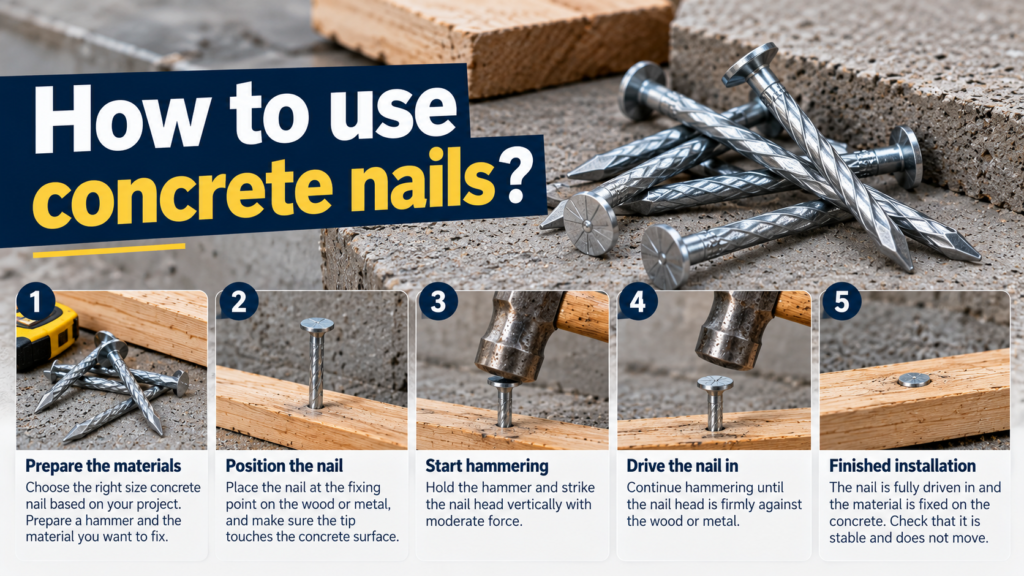
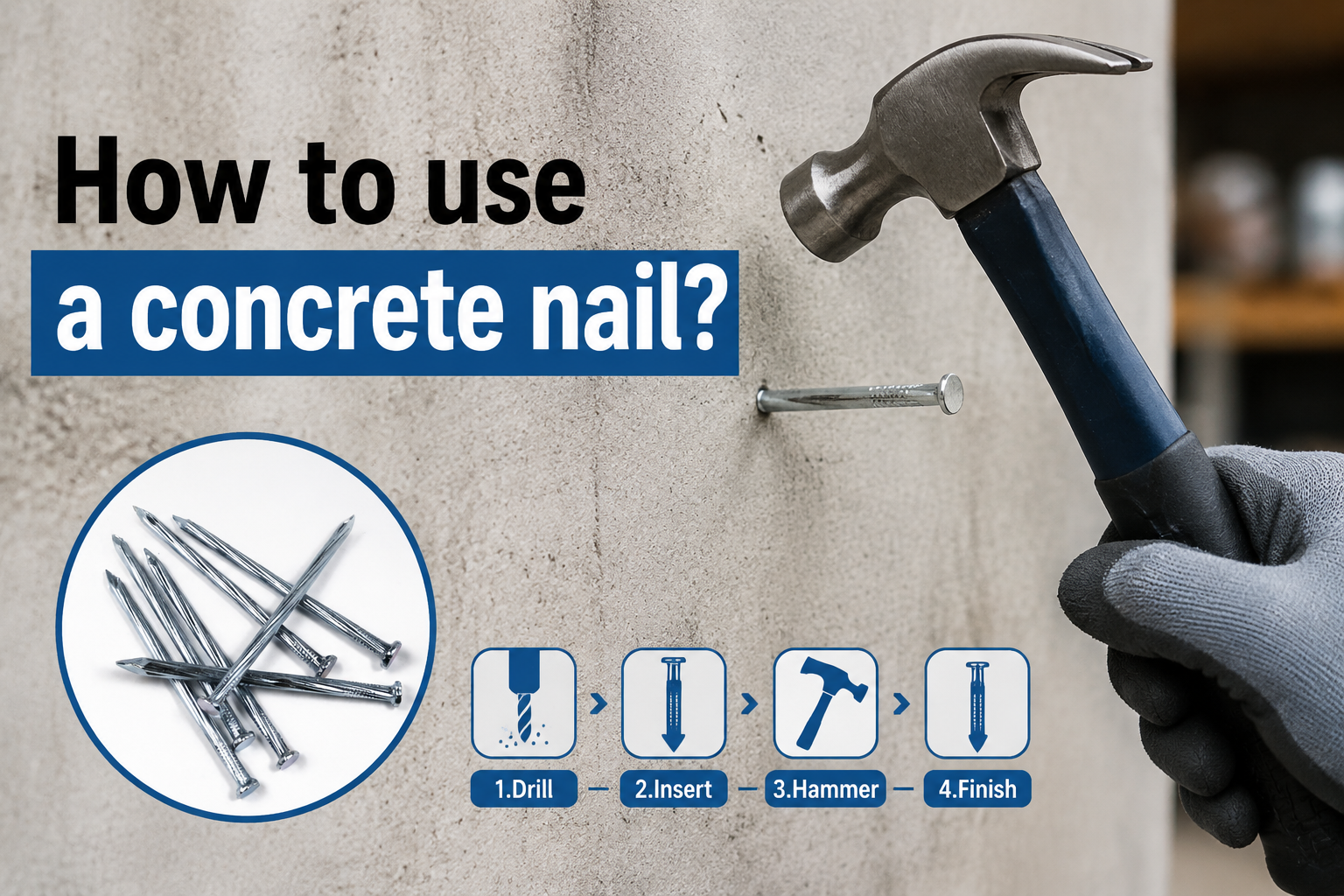
A concrete nail can look simple, but buyers can lose money when the nail does not match the wall material, packaging channel, or customer expectation. The problem grows when a full container arrives with the wrong finish or size. I use a safer approach: confirm “fit for use” before scaling the order.
To use a concrete nail correctly in B2B purchasing, you should first verify the target base material, nail size, hardness consistency, surface treatment, packaging format, and local customer use case. Then you should test samples or a trial order before placing a larger order, especially for wholesale, retail, or private-label markets.
Many people think the question is only about hammering technique. I see it differently from the supplier side. For importers, wholesalers, and brand buyers, “use” means the product must sell well, perform consistently, store safely, and match the local market.
How should a concrete nail be evaluated before use?
A concrete nail may fail in the market even if it looks correct on paper. Buyers often feel pressure to order quickly, and small mistakes in size, finish, or packing can become expensive. I usually suggest slowing down and checking the real-use scenario first.
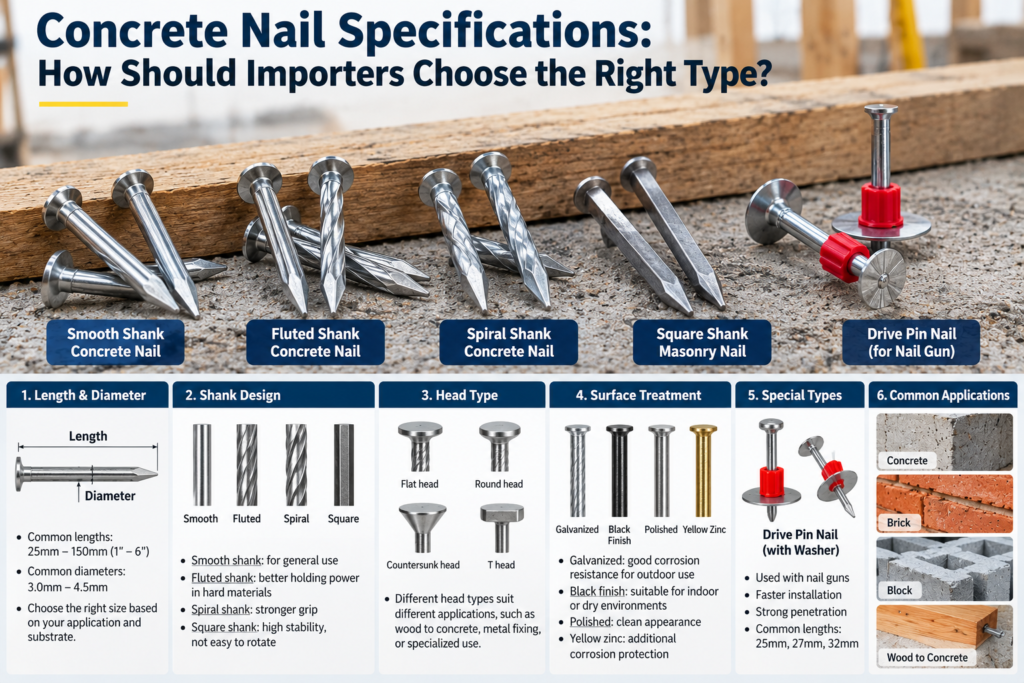
A concrete nail should be evaluated by matching the nail specification to the local base material, end use, sales channel, and packaging requirement. Buyers should confirm length, wire diameter, head style, hardness consistency, finish, and carton or box packing before placing a bulk order.
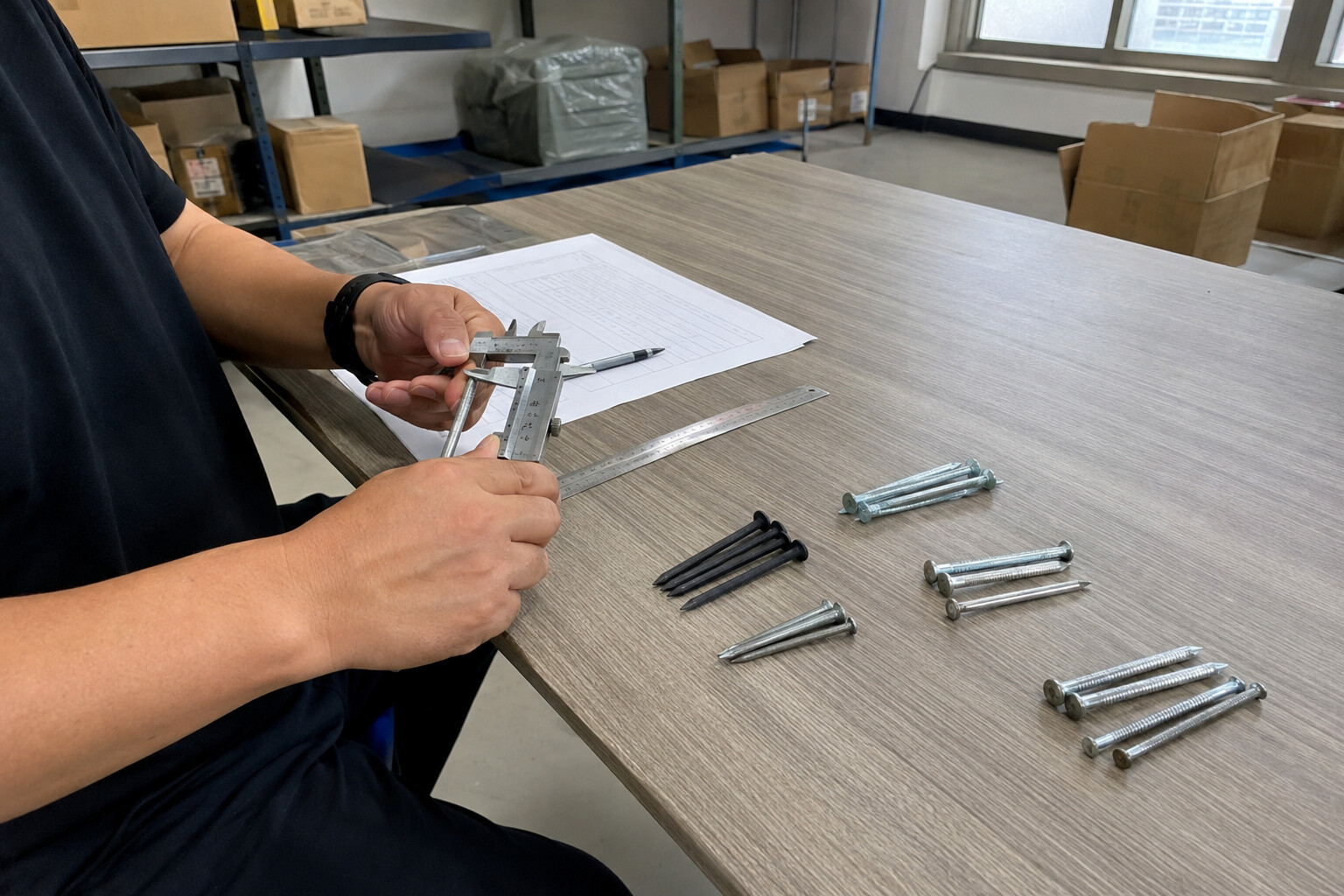
Start with “fit for use,” not only the size table
When I communicate with hardware wholesalers, many buyers first ask for a price list. That is normal. However, I usually ask several questions before I quote:
- What wall or base material do your customers usually use?
- Do they sell to construction workers, small shops, or general households?
- Which sizes move fastest in your local market?
- Do your customers prefer black finish, galvanized finish, or another surface?
- Do you sell by small box, plastic bag, bulk carton, or private-label packing?
- Do you need OEM/ODM branding or neutral packaging?
- Do you want samples before trial order?
These questions matter because a concrete nail is not a universal product. One market may prefer shorter nails for light fastening. Another market may prefer a stronger-looking product with heavier packaging. Some customers pay attention to the nail head. Others judge quality by finish, straightness, and breakage rate.
Key specification points buyers should confirm
| Evaluation point | Why it matters | Buyer action |
|---|---|---|
| Nail length | It affects local customer acceptance and practical use | Compare with your best-selling sizes |
| Wire diameter | It affects strength, weight, and price | Request exact specification in quotation |
| Hardness consistency | It affects bending and breakage risk | Test samples in local conditions |
| Surface treatment | It affects storage, shelf display, and perceived quality | Compare black and galvanized samples |
| Head style | It affects fastening and market habit | Confirm with existing local products |
| Packing method | It affects retail sales and wholesale handling | Test box quantity and carton strength |
| Brand label | It affects private-label positioning | Confirm artwork before mass production |
Do not treat “use” as only installation
I am a supplier, not a structural engineer or site supervisor. I do not tell customers that one nail is suitable for every wall, concrete grade, brick type, or safety-related application. For high-risk or load-bearing uses, buyers should ask local qualified professionals to evaluate the application.
However, I can help buyers reduce procurement risk. In my experience, the most practical method is simple:
- Confirm the target use case.
- Choose 2–3 possible specifications.
- Request samples for checking.
- Test them with local users or sales agents.
- Start with a trial order.
- Scale up after market feedback.
This process is slower than guessing. But it is much cheaper than importing a container of unsuitable nails.
What concrete nail size should buyers choose?
A concrete nail size should not be selected only because another importer buys it. Buyers often compare prices by length, but price alone can hide differences in wire diameter, weight, hardness, and packing. The safer choice starts with local demand.
Buyers should choose concrete nail size by checking common local applications, popular retail sizes, wire diameter, package quantity, and customer feedback. The best size is the one that fits the target base material and sales channel, not simply the longest or cheapest option.
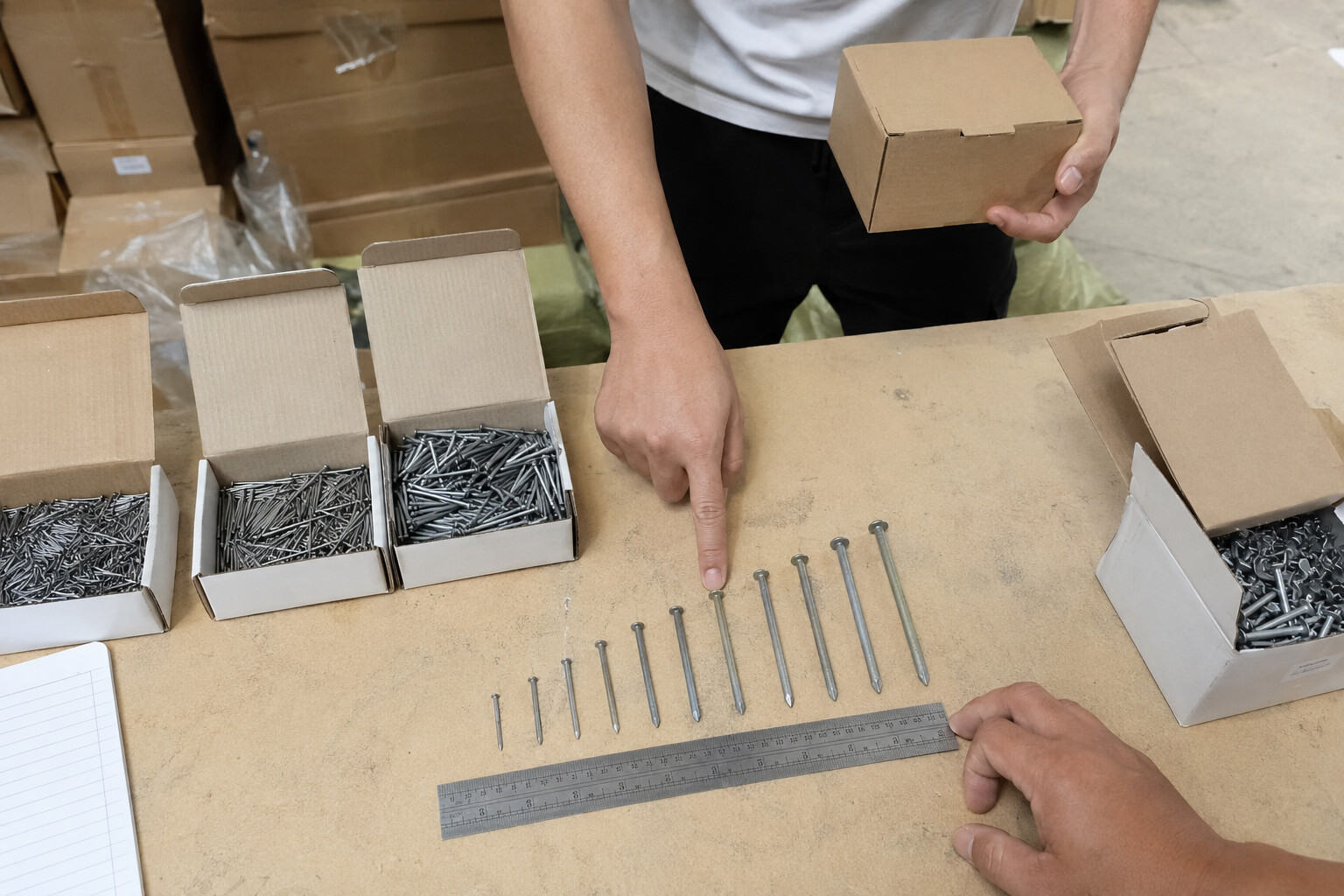
Why size selection is a commercial decision
In procurement, size affects more than product function. It affects:
- FOB price
- Carton weight
- Shipping volume
- Shelf display
- Retail unit price
- Customer repeat purchase
- Complaint rate
For example, a buyer in a general hardware wholesale market may need mixed sizes because his downstream customers are small shops. A private-label brand buyer may prefer fewer sizes but stronger package design. A project-supply buyer may focus more on consistent specification and carton marking.
I often see buyers ask for “popular sizes.” That is a useful starting point, but it is not enough. A size that sells well in one country may not move fast in another. Local construction habits, wall materials, and retail habits change the decision.
Common size factors to compare
The exact size range depends on production plan and customer market. However, buyers usually compare these factors:
| Factor | Procurement meaning | Risk if ignored |
|---|---|---|
| Length | Determines product positioning and common use | Customer may reject unsuitable size |
| Wire diameter | Affects strength, weight, and cost | Buyer may compare unequal products |
| Head diameter | Affects appearance and holding behavior | Local users may dislike the design |
| Shank straightness | Affects perceived quality | Retail customers may complain |
| Weight per carton | Affects shipping and handling | Cartons may be too heavy or weak |
| Pieces per box | Affects retail price point | Shop owners may avoid the pack |
A practical buyer-side selection method
I suggest a simple three-step approach.
Step 1: Collect local samples.
Buy several concrete nail samples from your local market. Check the sizes, packaging, finish, labels, and retail price.
Step 2: Compare supplier specifications.
Send the local sample details to your supplier. Ask for a matching quotation with clear specification, quantity, and packing method.
Step 3: Test alternative options.
Ask for samples in one similar size, one slightly upgraded option, and one cost-focused option. This gives you room to compare market response.
Why “same length” may not mean “same product”
Two nails with the same length can perform and sell differently. One may have a thicker wire diameter. One may have better head consistency. One may have a finish that stores better in humid conditions. One may come in stronger cartons that survive sea shipping and inland transport.
That is why I prefer quotations based on product + specification + quantity + packaging method. Our FOB quotations usually follow that structure because it reduces misunderstanding. Buyers can compare offers more fairly when the details are clear.
Does concrete nail surface treatment affect use?
A concrete nail finish is not only about color. Some buyers choose black or galvanized nails based on shelf appearance, but surface treatment can also influence storage, customer trust, and market acceptance. A wrong finish may make a good product harder to sell.
Concrete nail surface treatment affects perceived quality, storage behavior, shelf display, and local buyer preference. Black, galvanized, or other finishes should be validated through samples because different markets may judge appearance, corrosion resistance, and product value in different ways.
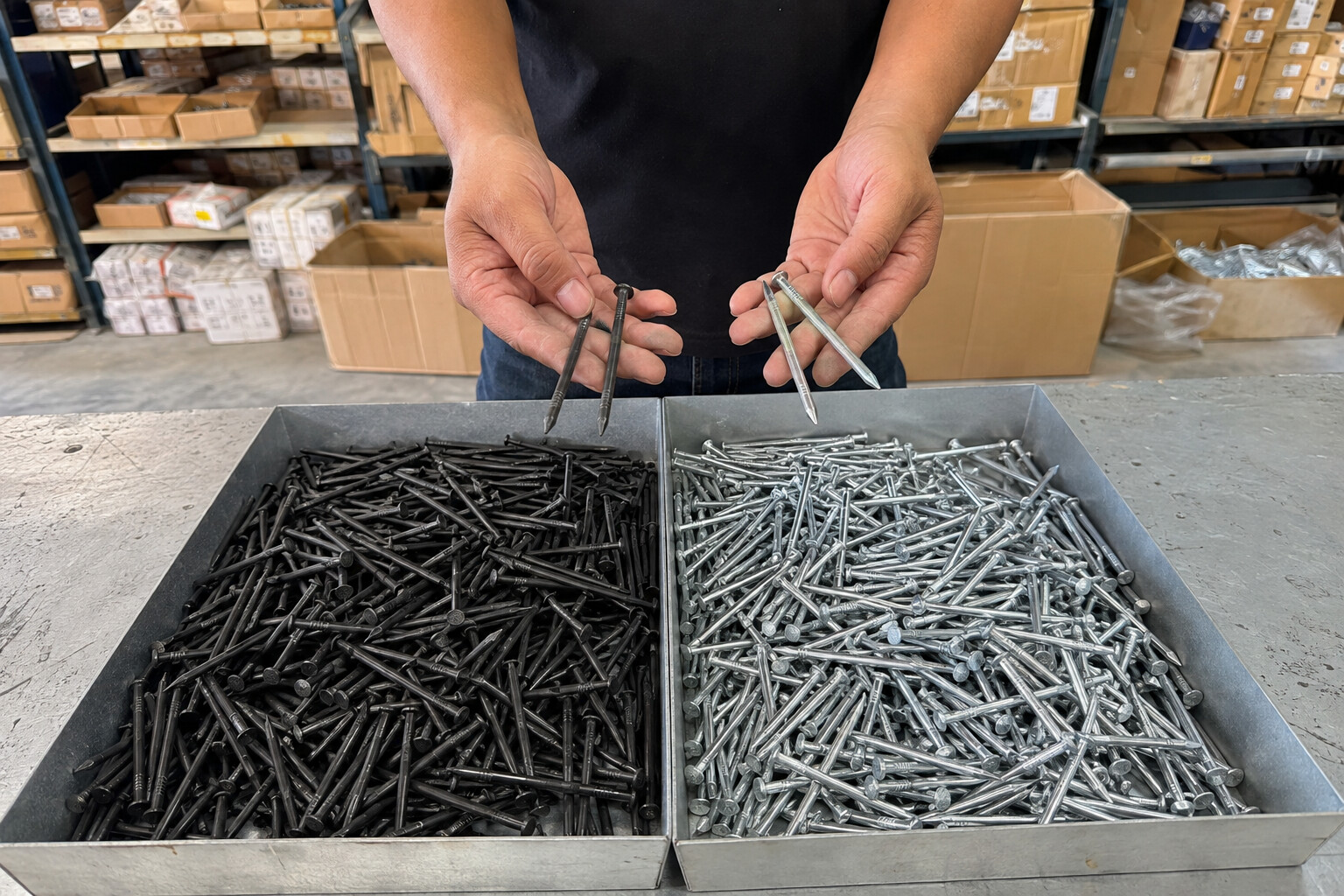
Surface treatment is part of the market fit
In my supplier-side communication, buyers often ask, “Which is better, black or galvanized?” I usually avoid giving one universal answer. The better choice depends on the market.
Some markets like black concrete nails because they look familiar, strong, and cost-effective. Some markets prefer galvanized concrete nails because they look cleaner on the shelf and may be perceived as more resistant to storage conditions. Some buyers choose based on brand positioning, not only end use.
Common surface treatment considerations
| Finish type | Buyer perception | Commercial consideration |
|---|---|---|
| Black finish | Traditional, strong-looking, common in many markets | Check oiliness, carton condition, and local acceptance |
| Galvanized finish | Clean appearance and brighter shelf display | Check customer willingness to pay higher price |
| Other finishes | May support specific brand positioning | Confirm MOQ, cost, and sample approval |
I do not recommend selecting finish only from a photo. Photos can hide important differences. Buyers should hold the samples, check the carton, review storage conditions, and compare how local customers react.
What buyers should check in samples
When buyers request samples, they can check these points:
- Surface uniformity: The finish should look consistent.
- Rust or stain signs: Buyers should check before and after short storage.
- Oil residue: Some markets accept it, but others dislike it.
- Carton cleanliness: Surface treatment can affect packing presentation.
- Retail display: The product should look acceptable in local shops.
- Private-label match: The finish should match the brand image.
A simple example from procurement communication
I once discussed packaging and finish options with a brand customer who wanted retail-ready boxes. The customer was not only buying nails. The customer was building shelf trust. We compared how different finishes looked with the label design and carton print. The final decision was based on the sales channel, not only the nail itself.
This is common in developing markets where wholesalers sell to many small retailers. The product must survive transport, look acceptable on shelves, and fit the price level. Surface treatment supports all three points.
Why sample testing matters more than assumptions
A surface finish may look attractive in the supplier’s warehouse but behave differently after sea shipping and local storage. Heat, humidity, handling, and carton quality can affect the final presentation. Buyers should verify these details before buying large quantity.
For this reason, I usually support sample checking before bulk orders. Samples may carry a basic cost, and the cost can often be discussed for return or adjustment in the formal order. This makes the decision more practical and less risky.
Is a harder concrete nail always better?
A concrete nail should be strong enough for the intended use, but higher hardness is not always better. Buyers sometimes request “the hardest nail” because they fear bending. That idea can create another risk: breakage, brittleness, or poor suitability for local use.
A harder concrete nail is not automatically better. Buyers should evaluate practical performance, consistency, bending risk, breakage risk, and suitability for the local base material. The best nail balances hardness, toughness, straightness, finish, and cost for the target market.
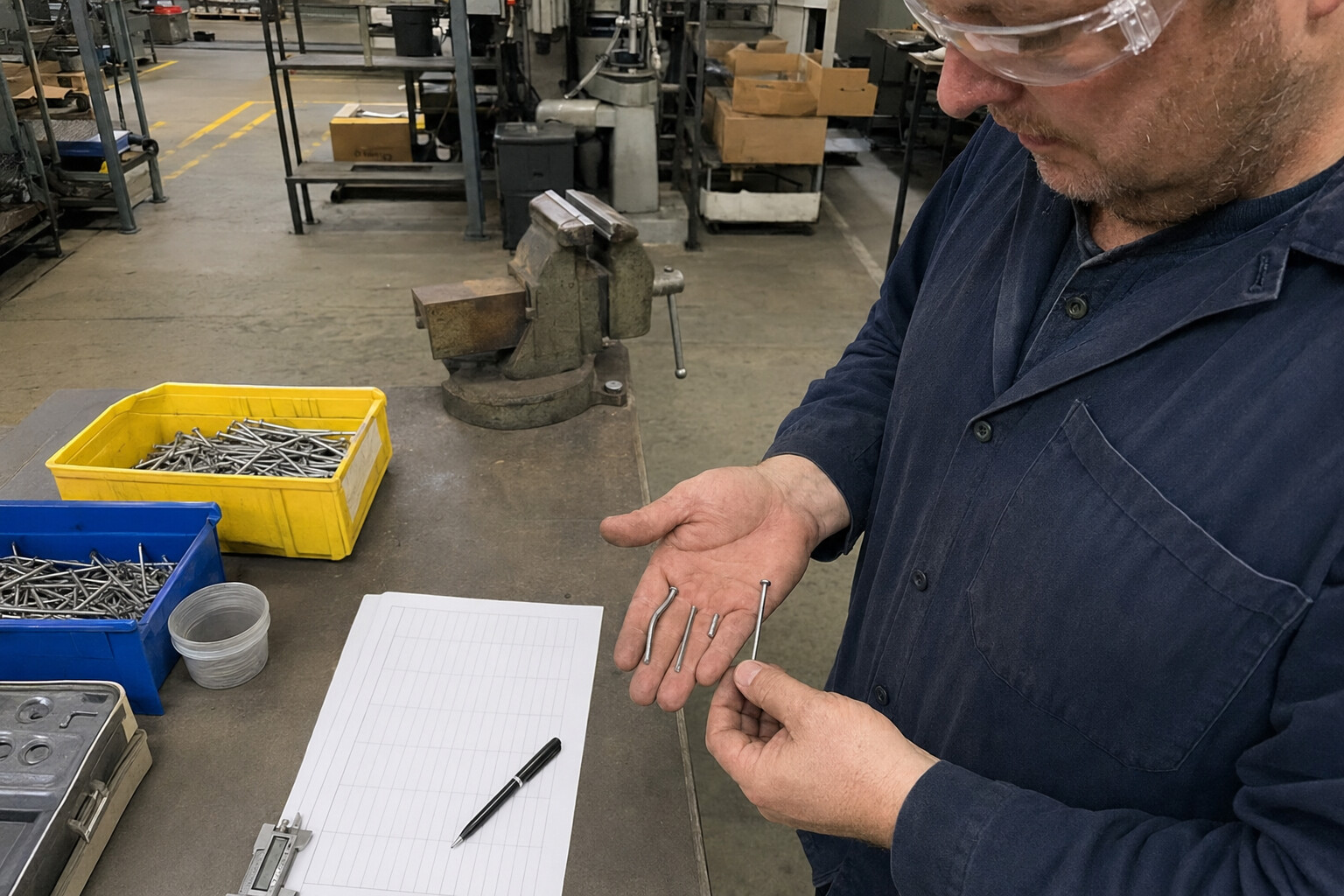
Quality is not one number
In many procurement conversations, “quality” becomes a single word. But in nails, quality has several parts:
- Hardness
- Toughness
- Straightness
- Point sharpness
- Head consistency
- Surface treatment
- Packing strength
- Batch consistency
A buyer may say, “I need high hardness.” That request is understandable. However, the real question is: high hardness for which wall material, which user, which price level, and which complaint standard?
I do not claim to provide structural engineering conclusions. I also do not recommend using product hardness alone to decide safety-related applications. Buyers should verify special or high-risk applications with local professionals.
The bending versus breaking issue
A nail that bends too easily creates complaints. Users may feel the product is weak. However, a nail that is too brittle may break under impact. That can also create complaints and safety concerns.
This is why buyers should not chase only maximum hardness. They should look for stable performance.
| Quality issue | Possible customer complaint | Procurement response |
|---|---|---|
| Bending | “The nail is too soft.” | Review hardness, diameter, and base material |
| Breaking | “The nail is too brittle.” | Review hardness balance and test samples |
| Head deformation | “The nail looks poor.” | Check head forming consistency |
| Uneven finish | “The quality looks unstable.” | Confirm surface treatment standard |
| Mixed sizes | “The box is not reliable.” | Strengthen QC and packing inspection |
How I suggest buyers discuss hardness with suppliers
Buyers can ask better questions than “Is it hard?”
They can ask:
- What specification do you recommend for my market?
- Can you provide samples for local testing?
- Can you keep the same standard for trial order and repeat order?
- What surface treatment options are available?
- Can you support custom packing and brand logo?
- How do you pack the cartons for sea shipment?
These questions move the discussion from abstract quality to real procurement control.
Consistency matters for wholesalers
Hardware wholesalers do not sell one nail. They sell boxes, cartons, and repeat orders. A small variation may be acceptable in one sample, but unstable batches can damage trust. That is why trial orders are useful.
A trial order lets the buyer check:
- Local user feedback
- Retail shop response
- Carton strength after transport
- Label accuracy
- Finish appearance after storage
- Repeatability of specification
- Complaint rate from downstream customers
For my business, trial orders are welcome because they help both sides confirm expectations before scaling. Our usual minimum order quantity is 5 tons or 200 boxes, depending on the product and packing plan. Buyers who are building a new market can use a trial order to reduce risk before committing to a full container.
How should concrete nail samples and trial orders be tested?
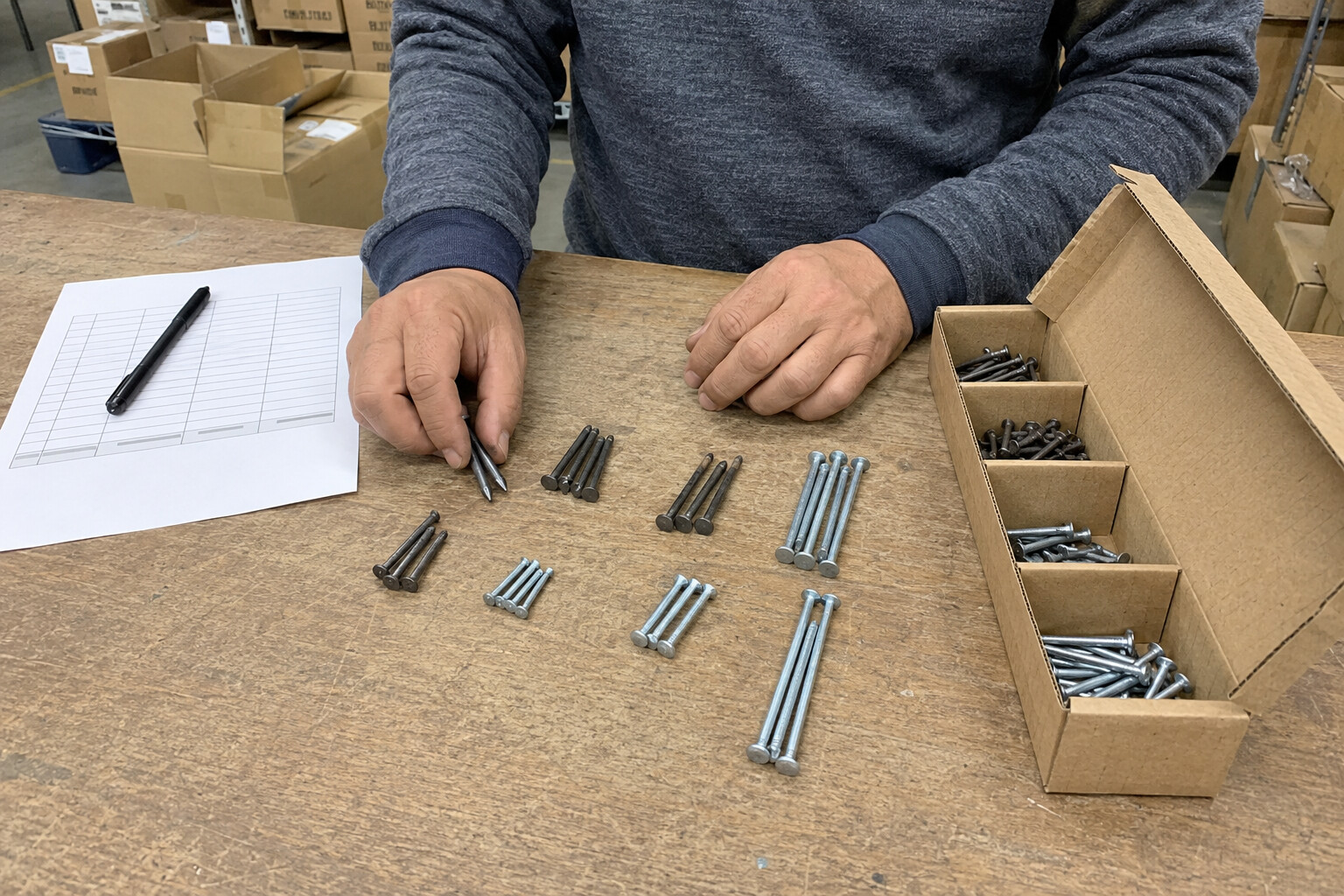
A concrete nail sample is one of the best risk-control tools for importers. A buyer may save time by skipping samples, but that shortcut can create problems later. Samples help confirm both product performance and commercial presentation.
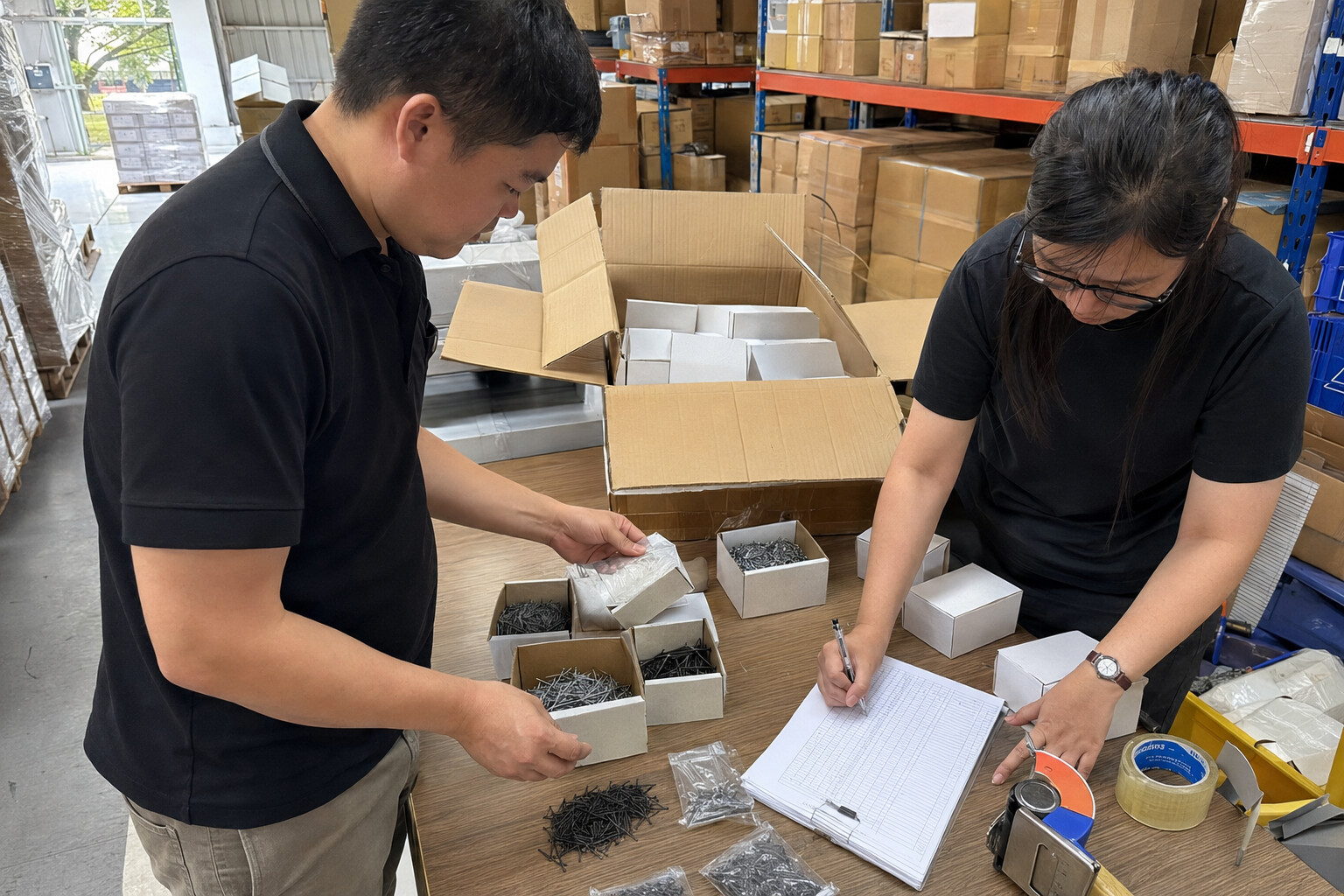
Concrete nail samples and trial orders should be tested by checking local base-material suitability, finish, size consistency, packing strength, label accuracy, retail display, and customer feedback. Buyers should document results before increasing order quantity or launching private-label packaging.
Samples should test more than the nail itself
Many buyers only test whether the nail can enter a wall. That is useful, but it is not the full procurement test. For B2B buying, samples should answer several questions:
- Will local users accept this size?
- Will small retailers like the package?
- Does the finish match the price level?
- Does the carton protect the goods?
- Does the label design look professional?
- Does the piece count match the sales habit?
- Does the product support repeat purchase?
A buyer who sells in Dar es Salaam, for example, may have a mixed hardware business and a local brand. That buyer may also work with an agent in Yiwu. In that case, the sample should be checked by several people: the buyer, the agent, and maybe one or two local shop customers.
A practical sample testing checklist
| Test item | What to check | Who should check |
|---|---|---|
| Size | Length, diameter, head style | Purchasing manager |
| Finish | Color, uniformity, storage appearance | Buyer and sales team |
| Use feedback | Bending, breakage, user acceptance | Local users or professionals |
| Packing | Box count, carton strength, label clarity | Warehouse and sales team |
| Branding | Logo, colors, barcode, product name | Brand owner |
| Shipping readiness | Carton marking, gross weight, pallet needs | Import team |
| Price fit | Retail margin and wholesale margin | Business owner |
Trial orders reduce scaling risk
A trial order is not only a small purchase. It is a market test. It helps buyers confirm if the selected concrete nail specification can move through the sales channel.
For example, a wholesaler may test:
- One black finish option
- One galvanized finish option
- One private-label box design
- One bulk carton option
- Two or three best-selling sizes
After one sales cycle, the buyer can compare customer feedback. The buyer can then decide which specification deserves larger quantity.
What buyers should document
I recommend buyers keep a simple record during sample and trial order testing.
They should record:
- Product specification
- Finish type
- Packing method
- Supplier batch information
- Local test comments
- Retailer feedback
- Complaints, if any
- Sales speed
- Margin level
- Reorder intention
This record makes the second order much better. It also helps the supplier adjust the offer. If the customer says the box is too large, we can adjust packing. If the retailer says galvanized looks better but price is high, we can compare alternatives. If the local user reports bending or breakage, we can review specification and quality requirements.
How my factory supports this process
As a production factory, we support OEM/ODM customization, including product specification, packaging, and brand logo. We usually quote on an FOB basis by confirming product + specification + quantity + packing method. Our normal lead time is around 15–25 days, depending on order quantity and customization.
We support sea shipment by FCL or LCL, and we can provide samples for quality checking. Samples usually require a basic cost, and the sample cost can be discussed in the formal order. This approach helps buyers compare options without guessing.
How can concrete nail packaging improve local sales?
A concrete nail package can decide whether the product looks cheap, professional, or trustworthy. Buyers may focus only on unit price, but weak packaging can damage cartons, confuse retailers, or make the product harder to sell under a private label.
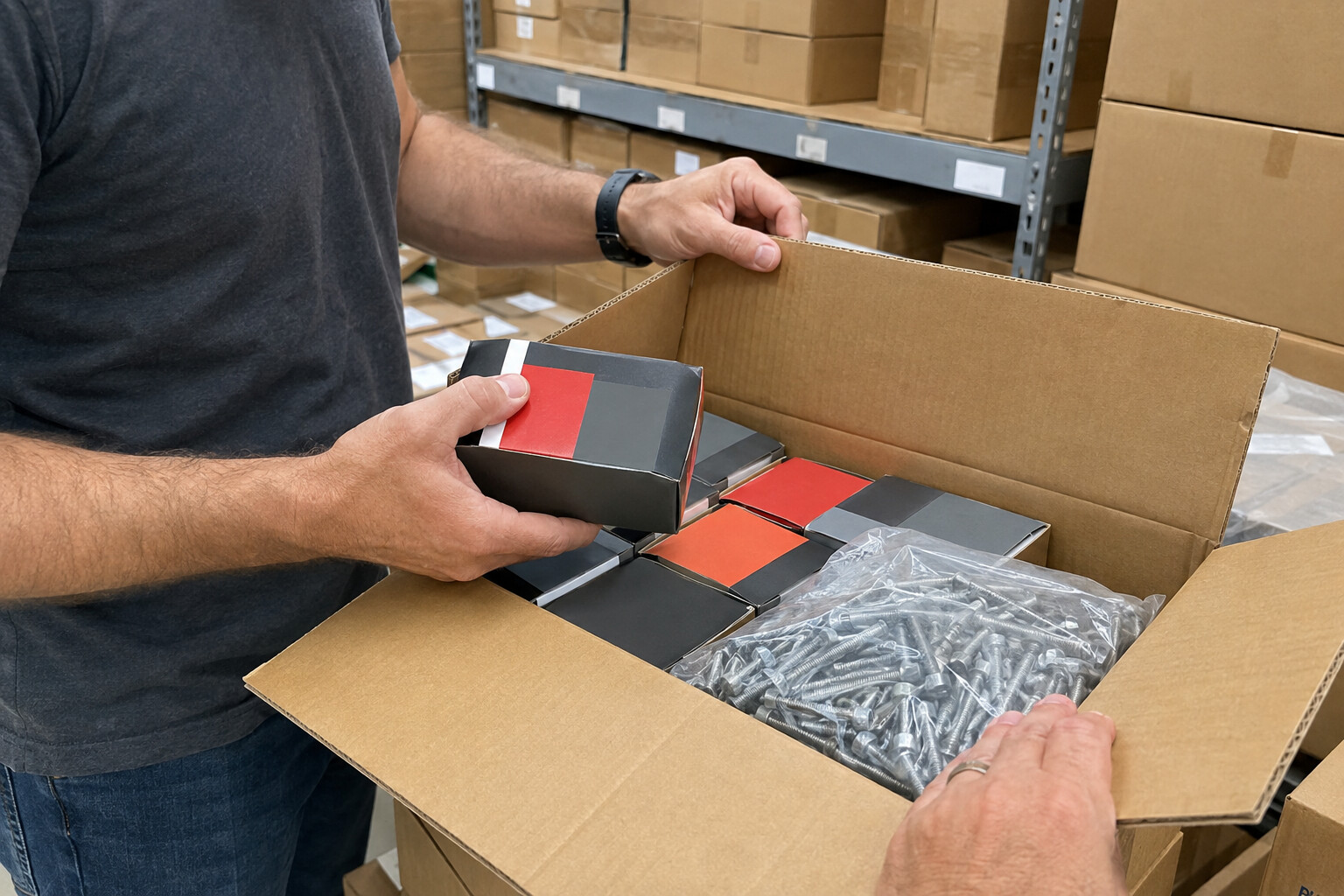
Concrete nail packaging improves local sales by matching the buyer’s channel, brand image, retail price point, and handling conditions. Good packaging should protect the product, show clear specifications, support shelf display, and make wholesale or retail counting easier.
Packaging is part of the product
In hardware wholesale, packaging is not decoration. It affects the whole supply chain. The same nail can perform differently in the market if the packaging changes.
A buyer who sells to small shops may need smaller boxes with clear labels. A buyer who sells mainly by wholesale carton may care more about carton strength and simple marking. A private-label customer may want branded inner boxes, strong color design, and consistent product naming.
Common packaging options
| Packaging option | Best for | Main benefit |
|---|---|---|
| Small box packing | Retail shops and branded sales | Easy display and clear unit price |
| Bulk carton packing | Wholesale distribution | Lower packing cost and faster handling |
| Plastic bag packing | Certain local channels | Flexible quantity and simple resale |
| OEM/ODM branded box | Private-label buyers | Stronger brand recognition |
| Mixed-size carton | Test market or broad distribution | More flexible for small retailers |
What should appear on the package
A professional package should usually show:
- Product name
- Size specification
- Quantity or weight
- Brand logo, if required
- Country or buyer-required marking, if applicable
- Safety or usage notes, where appropriate
- Carton number and product code
- Clear printing that matches the order
Buyers should verify any required local marking or import requirement with their own customs broker or local consultant. I can support printing and customization, but the buyer should confirm local compliance requirements.
Packaging and surface treatment should match
Packaging and finish should work together. A black concrete nail in a simple box may fit a price-sensitive market. A galvanized nail in a well-designed branded box may support a higher retail price. However, this depends on local customer habits.
I have seen brand buyers spend real time comparing label colors with product finish. That may sound small, but it matters when the product sits on a shop shelf beside many similar items. The buyer wants the customer to pick up the box, trust the brand, and reorder later.
Shipping and storage also matter
Concrete nails are heavy. Carton strength matters because sea shipping, port handling, and inland transport can damage weak packing. A good quotation should include packing details, not only product price.
Buyers should confirm:
- Carton size
- Gross weight
- Net weight
- Inner box quantity
- Carton marking
- Label design
- Shipping method
- FCL or LCL plan
Our factory supports sea shipping for both full container and less-than-container loads. For many customers in the Middle East, Africa, Southeast Asia, and South America, this flexibility helps them start with a manageable volume and scale when sales become stable.
Frequently Asked Questions
Can one concrete nail be used for all wall materials?
No, one concrete nail should not be assumed suitable for all concrete, brick, block, or wall materials. Buyers should test samples with local materials and ask qualified local professionals to evaluate high-risk or safety-related applications before making large purchase decisions.
What information should I send for a concrete nail quotation?
You should send the product name, size, wire diameter if available, quantity, surface treatment, packaging method, brand logo requirement, and destination port. I usually prepare FOB quotations based on product, specification, quantity, and packing method.
Is galvanized concrete nail better than black concrete nail?
Galvanized is not always better than black. The better choice depends on local storage conditions, customer preference, shelf display, and price level. Buyers should compare samples and check whether their retailers and end users prefer the finish before ordering bulk quantity.
Should I order samples before buying concrete nails?
Yes, I strongly recommend samples before a large order. Samples help buyers check size, finish, hardness balance, packing, and local acceptance. A trial order is also useful when buyers want to test private-label packaging or compare black and galvanized options.
What is the usual MOQ for concrete nail orders?
Our usual MOQ is 5 tons or 200 boxes, depending on product specification and packaging. We also support trial orders, OEM/ODM packaging, and customized brand logos, so buyers can test market response before increasing volume.
Conclusion
A concrete nail should be used only after buyers confirm the product is fit for the local material, sales channel, finish preference, and packaging plan. The best procurement decision is not simply choosing the hardest or cheapest nail. It is choosing a consistent product that your customers will accept and reorder. If you want to compare concrete nail specifications, samples, black or galvanized finishes, or OEM packaging, contact me at [email protected] or WhatsApp +8618331061136.