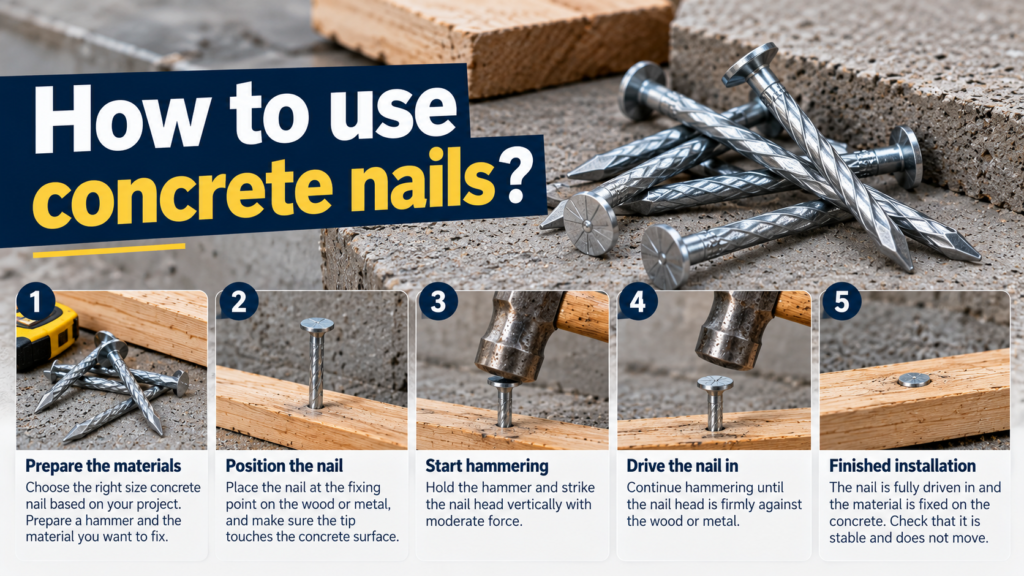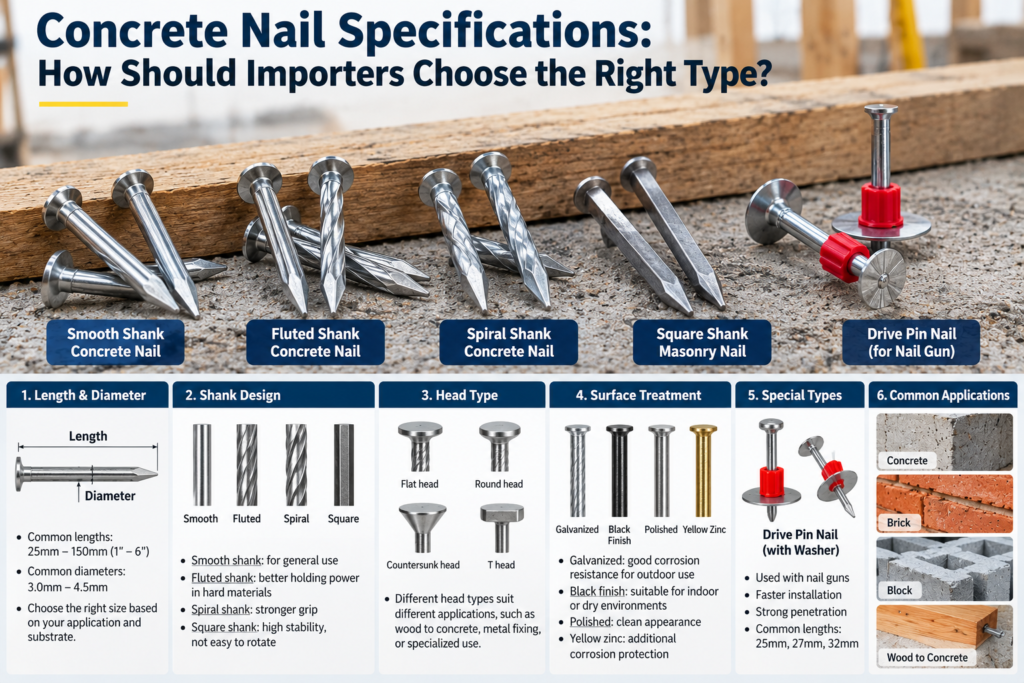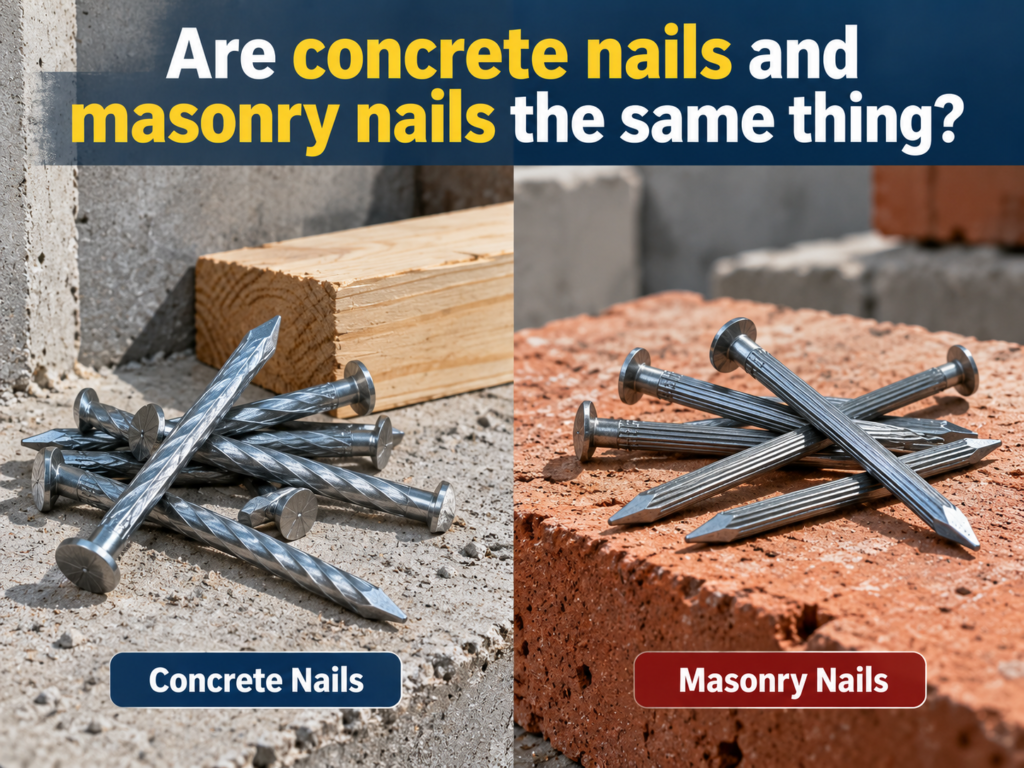
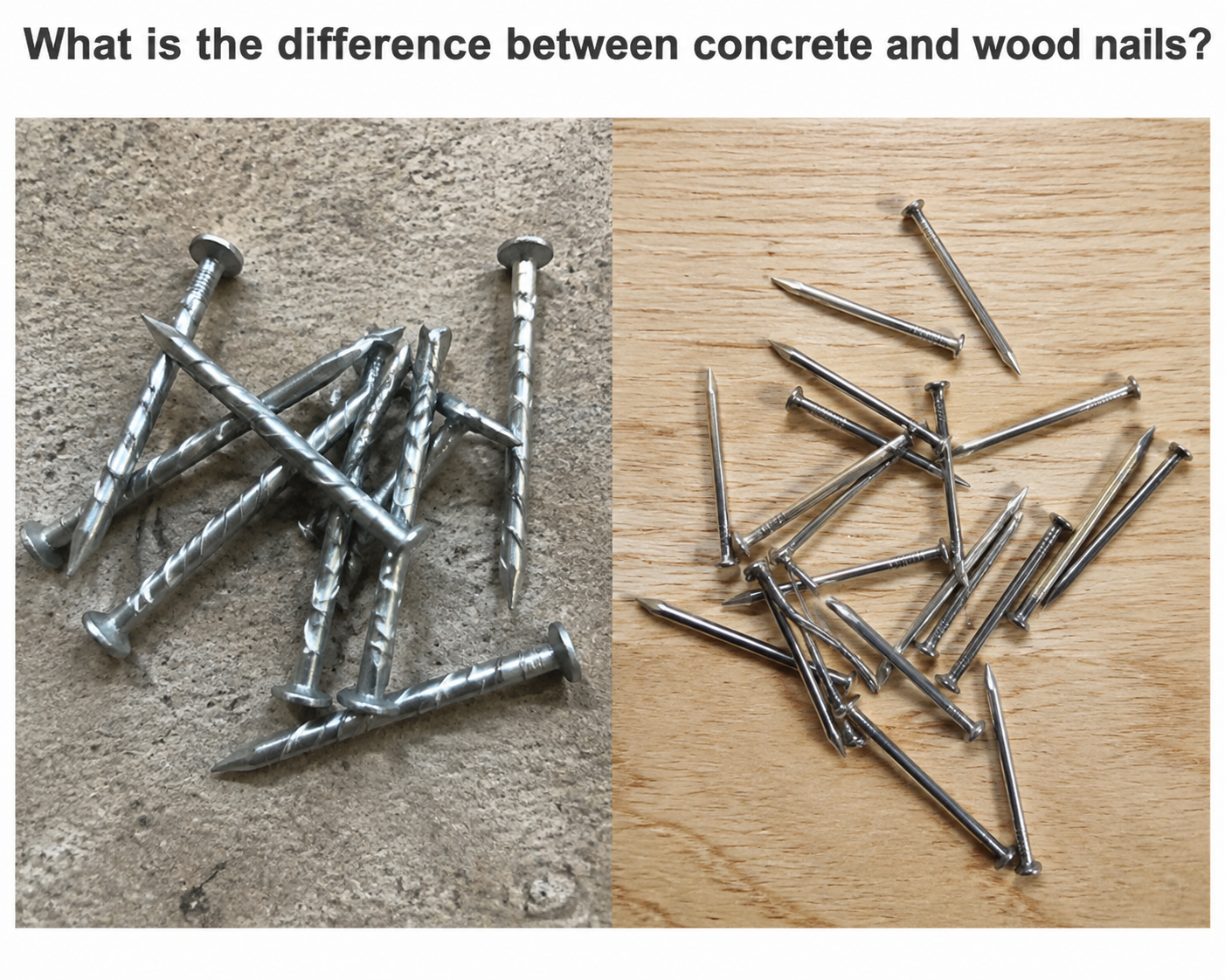
The difference between concrete and wood nails matters when a buyer wants fewer bent nails, fewer complaints, and more accurate inventory. If a wholesaler chooses only by price or size, the nail may fail in the real application. I usually explain it this way: choose the nail by the substrate first, then compare specifications.
Concrete nails are designed for hard substrates such as concrete, cement blocks, and brick, while wood nails are designed for fastening wood to wood or wood to softer materials.1 The main differences are hardness, strength, shank design, point, surface treatment, and application.2 Buyers should not replace one with the other only because the size looks similar.
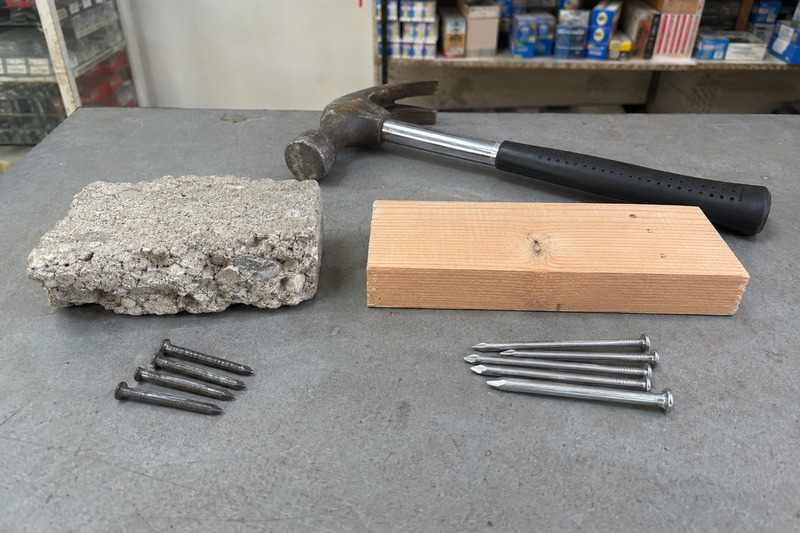
Many overseas buyers ask me for “steel nails” without saying whether the end user will fix into a concrete wall, brick, timber, or wooden crate. That small missing detail can change the whole quotation. So, I want to break the topic down in a practical way for importers, wholesalers, and retail buyers.
Why does the difference between concrete and wood nails matter for wholesalers?
A wholesaler is not only asking about the difference between concrete and wood nails. I think the real question is more commercial: which nail will reduce returns, wrong stock, and customer complaints? If the wrong nail reaches the wrong end user, the price saving can disappear quickly.
The difference between concrete and wood nails matters because each nail is made for a different fastening environment. Concrete nails need higher hardness and impact resistance for hard masonry surfaces.3 Wood nails need holding performance in timber without damaging the wood unnecessarily.4 A buyer should match nail type to use, not just compare weight and price.
Dive deeper
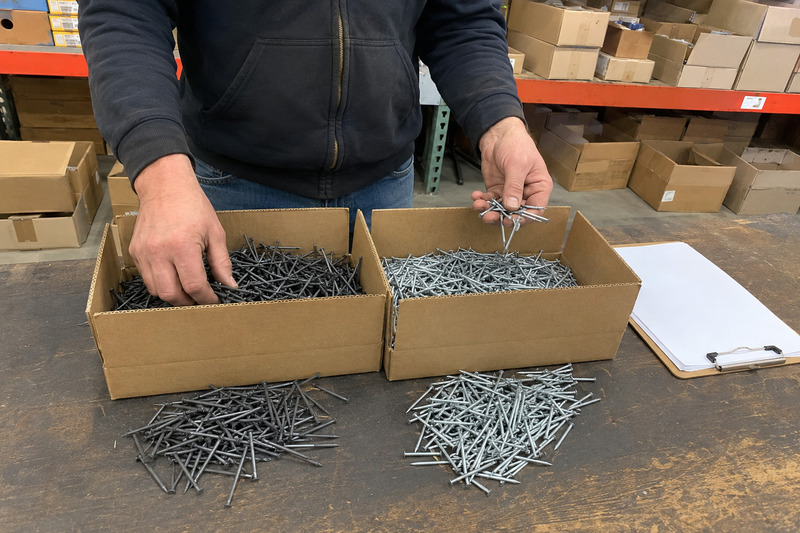
In export sales, I often receive inquiries that say only: “Please quote steel nail, 2 inch, best price.” I understand why buyers do this. Many hardware wholesalers sell mixed categories, and their downstream customers may use simple names in the local market. However, this kind of inquiry can create confusion because “steel nail” may refer to several products:
- Concrete nail
- Black steel nail
- Common nail
- Lost head nail
- Roofing nail
- Wood nail
- Special packaging nails for retail shops
The problem is not only the name. The problem is the application behind the name.
For example, a nail used on a concrete wall must resist bending when hammered into a hard surface.5 A nail used in wood must enter the grain and hold the materials together.6 If a buyer stocks the wrong product, retail customers may complain that the nail bends, breaks, splits the wood, or does not hold properly.
Here is the way I suggest wholesalers think about it:
| Buyer question | Better buying question |
|---|---|
| What is the cheapest nail? | What nail matches the local application? |
| Is it steel? | Is it for concrete, brick, or wood? |
| What is the size? | What is the diameter, length, shank, head, and finish? |
| Can one nail cover all uses? | Which nail types should I stock separately? |
| Can I compare by carton price? | Are the weight, quantity, packaging, and quality level comparable? |
For wholesalers in markets such as the Middle East, Africa, Southeast Asia, and South America, nail selection is also an inventory decision. A retail shop may want fast-moving sizes and simple packaging. A construction material distributor may care more about strength, cartons, and container loading. A brand owner may care about OEM packaging and stable supply.
I do not recommend treating concrete nails as “better wood nails” just because they are harder. Hardness is useful in concrete or brick, but it can be unnecessary or even unsuitable for some wood applications. In the same way, wood nails should not be treated as cheaper concrete nails. The substrate decides the product.
My simple rule is this: first confirm where the nail will be used, then compare size, surface, packaging, and price.
That rule makes the difference between concrete and wood nails easier to understand and easier to quote correctly.
What is the difference between concrete and wood nails in material and hardness?
The difference between concrete and wood nails in material and hardness starts with the job they must do. Concrete nails must enter hard masonry materials without bending too easily. Wood nails must fasten timber effectively, so the best choice is not always the hardest nail.
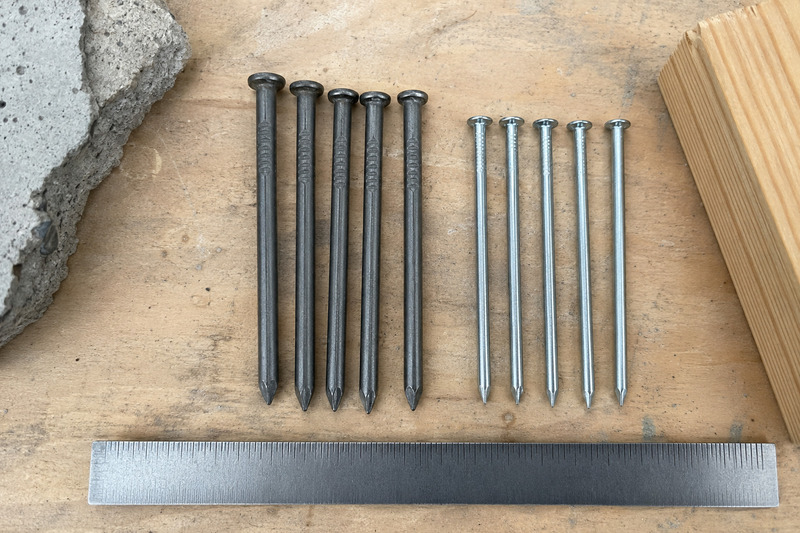
Concrete nails are commonly made with harder steel and designed for impact into concrete, cement, or brick. Wood nails are generally selected for penetration and holding power in wood. Their performance depends on diameter, length, shank type, head style, point, and surface finish. Harder does not automatically mean more suitable.
Dive deeper
When I explain nail types to importers, I usually begin with the working surface. Concrete and wood behave differently under hammering.
Concrete, cement blocks, and brick are hard and brittle.7 A nail for these materials needs enough hardness and strength to resist bending at the tip or along the shank. Wood is fibrous. It compresses, grips, and sometimes splits.8 A nail for wood needs proper geometry and enough holding area, but it does not always need the same hardness as a concrete nail.
Main technical differences buyers should compare
| Feature | Concrete nails | Wood nails |
|---|---|---|
| Main use | Concrete, brick, cement wall, masonry surface | Wood connection, timber fixing, crates, general carpentry |
| Key requirement | Hardness and bending resistance | Penetration and holding power |
| Typical material focus | Harder steel | Steel suitable for wood fastening |
| Risk if misused | May not suit wood, may split material in some uses | May bend or fail in hard concrete |
| Buying focus | Strength, point, shank, finish, exact size | Length, diameter, head, shank, finish, holding needs |
Why hardness is not the whole answer
Many buyers believe a harder nail is always better. I understand this thinking because concrete nails are often seen as stronger. But in procurement, “stronger” must be linked to the application.
A harder nail may be useful when the end user fixes into concrete or brick. However, for wood connection, the nail must work with the wood fibers. The nail should enter smoothly and hold well. If the nail is not suitable for the wood type or fixing method, the user may face splitting, poor grip, or unnecessary cost.
Surface treatment also matters
Buyers should also consider surface finish. Common options may include:
- Black finish
- Polished finish
- Galvanized finish
- Other market-specific surface requirements
Surface finish affects appearance, basic corrosion resistance9, and customer preference. For example, a wholesaler selling to coastal or humid regions may ask more questions about finish. However, I always recommend that buyers verify suitability for their exact environment, because corrosion performance depends on coating type, thickness, storage, and use conditions.10
Practical buying point
When I receive a quotation request, I prefer to know:
- Application: concrete, brick, wood, or mixed use
- Length and diameter: for example, inch size or metric size
- Head type: flat head, lost head, or other requirement
- Shank: smooth, fluted, twisted, or other style if applicable
- Surface finish: black, polished, galvanized, etc.
- Packing: bulk carton, small box, bag, brand packaging
- Quantity: carton quantity, tonnage, or container plan
These details help the supplier quote the correct product. They also help the buyer compare offers fairly. Without them, two quotations may look similar but refer to different nails.
That is why the difference between concrete and wood nails should be evaluated through material, hardness, shank, point, finish, and real use together.
How does the difference between concrete and wood nails guide application choice?
The difference between concrete and wood nails should guide the buyer before any price discussion. If the application is unclear, the quotation becomes weak. A nail that looks right in a catalog may not work well on the job, and the wholesaler may carry the complaint.
Buyers should choose concrete nails for hard mineral substrates such as concrete, cement surfaces, and brick. Buyers should choose wood nails for timber, wooden frames, packaging, and similar wood-based uses. The right choice depends on the base material, the attached material, the fixing strength needed, and the user’s installation method.
Dive deeper
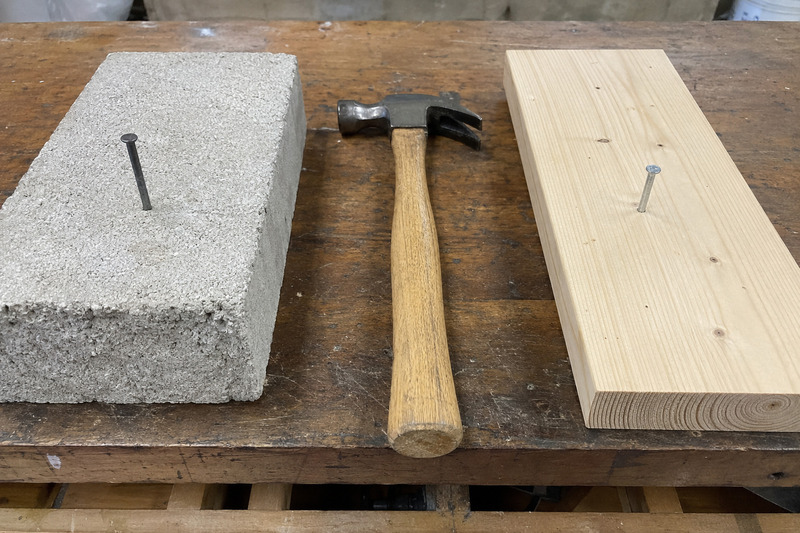
I like to ask one simple question before quoting: “What material will the nail go into?” This question sounds basic, but it prevents many mistakes.
Some wholesalers want one nail to cover several uses. That is understandable when shelf space is limited or when retail customers ask for low prices. However, one nail cannot perform equally well in every material.11 If the user hammers a wood nail into hard concrete, the nail may bend. If the user uses a concrete nail in a delicate wood application, the result may not be ideal either.
Application-based selection guide
| Application | Better nail direction | Why it matters |
|---|---|---|
| Fixing into concrete wall | Concrete nail | Needs higher resistance to bending |
| Fixing into brick wall | Concrete nail, depending on brick type | Brick can be hard and brittle |
| Fastening wood to wood | Wood nail | Needs proper holding in timber |
| Wooden crates or packaging | Wood nail or common nail | Cost and holding balance matters |
| Temporary fixing in hard surface | Concrete nail | Needs impact strength |
| Retail mixed household use | Separate SKUs are safer | Prevents wrong customer selection |
Questions I suggest wholesalers ask downstream customers
If a retail buyer or contractor asks for nails, I recommend asking:
- Will the nail go into concrete, brick, or wood?
- Is the fixing temporary or permanent?
- What size does the market commonly use?
- Does the customer need black, polished, or galvanized finish?
- Will the product be sold in bulk cartons or small retail boxes?
- Does the customer care about brand logo packaging?
These questions make the buying process clearer. They also help wholesalers reduce dead stock.
Why wrong substitution creates commercial risk
Wrong substitution is common in price-driven markets. A buyer may think, “This nail is cheaper, and the size is close.” But nails are not only size-based products. The steel, hardness, shank, point, and finish all affect performance.
Wrong substitution can lead to:
- Bent nails during hammering
- Broken nails under hard impact
- Poor holding performance
- Customer complaints at retail shops
- Inventory that cannot serve the intended users
- Unfair supplier comparison because specifications are not equal
I do not claim that every wrong nail will fail in every situation. Real performance depends on the exact material, installation method, and user skill. However, from a procurement perspective, the safer path is to match the product to the application.
Stocking advice for wholesalers
A wholesaler with mixed hardware categories can stock concrete nails and wood nails as separate product lines. The shop can then guide customers by use. This approach is usually better than trying to sell one “universal” nail.
A simple retail display can separate:
- Concrete nails: for wall, brick, and cement-related use
- Wood nails: for timber, carpentry, and packaging use
- Roofing nails: for roofing-related applications
- Lost head nails: for finishing or furniture-related uses, depending on market demand
This classification helps sales staff explain products quickly. It also makes repeat buying easier because customers remember the correct nail type.
In my experience, clear application-based stocking is one of the easiest ways to turn the difference between concrete and wood nails into better inventory control.
What specifications show the difference between concrete and wood nails when buying?
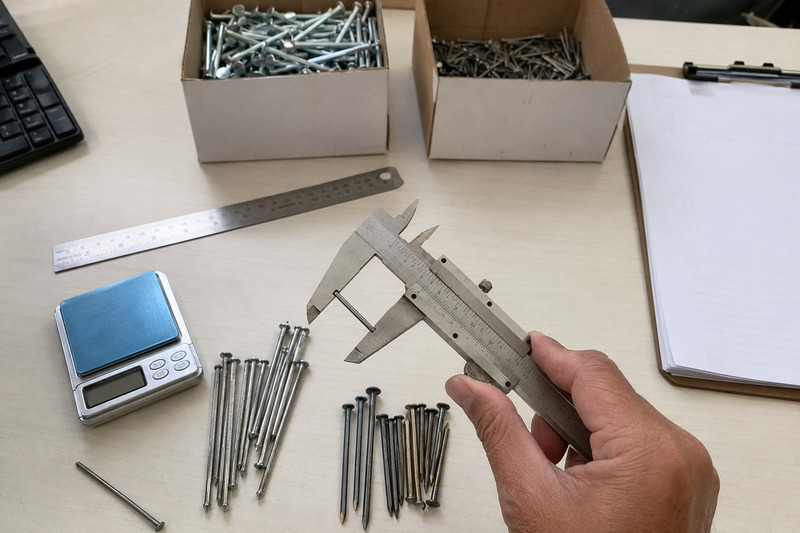
The difference between concrete and wood nails becomes clearer when the buyer compares specifications, not only product names. If two suppliers quote “2 inch steel nail,” the products may still differ in diameter, material hardness, finish, weight per carton, packing method, and intended application.
Buyers should compare concrete nails and wood nails by length, wire diameter, head type, shank design, point, surface treatment, packing, carton weight, and intended use.12 A reliable quotation should state the nail type, size, quantity, packaging, and finish clearly so the buyer can compare like with like.
Dive deeper
A good nail inquiry is specific. A vague inquiry often creates a vague quotation. When I receive full details, I can respond faster and more accurately. When the inquiry only says “send price for nail,” I need to ask follow-up questions before giving a meaningful FOB quotation.
Key specifications to confirm
| Specification | Why it matters |
|---|---|
| Nail type | Confirms concrete nail, wood nail, roofing nail, lost head nail, etc. |
| Length | Affects penetration depth and application |
| Diameter | Affects strength, holding power, and weight |
| Head type | Affects contact area and appearance |
| Shank type | Affects grip and installation behavior |
| Point type | Affects penetration |
| Surface finish | Affects appearance and corrosion resistance expectations |
| Packing | Affects retail sale, wholesale handling, and brand presentation |
| Quantity | Affects production planning, unit cost, and shipping |
| Application | Prevents wrong product selection |
Example of a weak inquiry
“Please quote steel nail 2 inch, lowest price.”
This inquiry is common, but it leaves many questions open. Is the buyer asking for concrete nails or wood nails? What diameter? What packing? What surface finish? How many cartons? Which market? Does the buyer need OEM packaging?
Example of a stronger inquiry
“Please quote concrete nails, 2 inch length, black finish, packed in small boxes, total 5 tons, FOB price. End use is concrete and brick wall fixing.”
This second inquiry is much better. It gives the supplier enough information to recommend the right product direction and calculate a realistic price.
Packaging is part of the product
For wholesalers and retail buyers, packaging is not just decoration. It affects sales, storage, and customer recognition. Common packaging questions include:
- Do you need bulk cartons or small boxes?
- What is the preferred box weight or piece count?
- Do you need brand logo printing?
- Do you need language or market-specific labels?
- Will the goods be sold through wholesale channels or local retail shops?
OEM/ODM packaging can be useful for buyers who already have a local brand. It can also help retail shops build recognition. However, the nail specification should come first. Nice packaging cannot solve a wrong application match.
Sample checking before bulk buying
I believe sample checking is a practical step for importers. A sample cannot replace professional engineering evaluation for demanding applications, but it can help buyers check:
- Appearance
- Size consistency
- Surface finish
- Packing quality
- Basic handling
- Market acceptance
- Comparison with current stock
For application-specific performance, especially where safety or structural fixing matters, buyers should seek qualified professional evaluation. As a supplier, I can provide product information and samples for checking, but the final suitability depends on the user’s exact material, installation method, and local requirements.
Quotation comparison checklist
Before choosing a supplier, I suggest buyers compare offers using a simple checklist:
- Are both quotes for the same nail type?
- Are the length and diameter the same?
- Is the finish the same?
- Is the packing method the same?
- Is the carton weight or piece count the same?
- Is the quote based on the same FOB terms?
- Is the supplier a factory or trading source?
- Can the supplier support trial orders?
- Can samples be checked before bulk order?
- Can the supplier support future custom packaging or logo needs?
This process keeps buying decisions clear. It also helps avoid the mistake of comparing a concrete nail quotation with a wood nail quotation as if they were the same product.
For me, this is the most practical way to turn the difference between concrete and wood nails into a cleaner procurement decision.
Frequently Asked Questions
Can I use concrete nails in wood?
You can sometimes drive concrete nails into wood, but I do not recommend treating them as the normal replacement for wood nails. Concrete nails are made for harder substrates. Wood applications need suitable holding performance, size, head, and shank. The better choice depends on the wood and fastening task.
Can I use wood nails in concrete?
I do not recommend using wood nails in concrete. Wood nails are not designed for hard masonry surfaces, so they may bend, fail to penetrate, or perform poorly. For concrete, cement, or brick applications, buyers should choose concrete nails or another fastening solution suitable for the substrate.
Are concrete nails always stronger than wood nails?
Concrete nails are usually designed with higher hardness and bending resistance for hard surfaces. However, “stronger” does not mean “better for every use.” Wood nails can be more suitable for wood because they are designed around penetration, holding, and the behavior of timber.
What information should I provide when asking for a nail quotation?
You should provide the nail type, application, length, diameter, surface finish, packing method, quantity, and any brand or logo requirement. I also suggest sharing whether the nail will be used for concrete, brick, or wood. This helps the supplier quote the correct product.
Should I check samples before ordering concrete nails or wood nails?
Yes, sample checking is useful for importers and wholesalers. Samples can help you review appearance, size, finish, packaging, and general suitability. For demanding or safety-related applications, I recommend qualified professional evaluation because real performance depends on the substrate and installation conditions.
Conclusion
The difference between concrete and wood nails is not only the name, size, or price. Concrete nails are made for hard substrates such as concrete and brick, while wood nails are made for fastening in wood. I suggest buyers choose by application first, then compare specifications, finish, packaging, and quantity. If you need a clear quotation, please prepare the product type, size, quantity, packing method, and end use. For sample checking, OEM/ODM packaging, or FOB nail quotations, you can contact us at [email protected] or WhatsApp +8618331061136.
-
"Nail (fastener)", https://en.wikipedia.org/wiki/Nail_(fastener). The cited source defines concrete or masonry nails as fasteners intended for hard masonry substrates and describes ordinary nails as fasteners commonly used in wood construction; this supports the article’s substrate-based distinction rather than any specific product grade. Evidence role: definition; source type: encyclopedia. Supports: The source should define concrete or masonry nails as fasteners intended for hard masonry materials and distinguish ordinary wood nails as fasteners used in timber or softer construction materials.. Scope note: The support is definitional and contextual; it does not verify the performance of any individual manufacturer’s nail. ↩
-
"Standard Specification for Driven Fasteners: Nails, Spikes, and Staples", https://store.astm.org/f1667-13.html. The cited standard or technical reference identifies nail dimensions, shank form, point, material, coating, and application as relevant specification variables, supporting the article’s claim that nail types differ by more than size alone. Evidence role: general_support; source type: institution. Supports: The source should show that nail standards or technical specifications classify nails by dimensions, head, shank, point, material, coating, and intended use.. Scope note: The source supports the categories of comparison generally; it may not provide a direct side-by-side comparison of concrete nails and wood nails. ↩
-
"4 Inch Masonry Concrete Nails – 34-Pack, Hardened Carbon Steel, Zinc …", https://www.tenutanunziata.com/Masonry-Concrete-Nails-34-Pack-Hardened-Carbon-Steel-Zinc-316939. The cited technical source explains that masonry or concrete nails are made or treated to resist deformation when driven into hard mineral substrates, supporting the article’s statement about hardness and impact resistance. Evidence role: mechanism; source type: research. Supports: The source should explain that nails used in concrete or masonry are commonly hardened or otherwise designed to resist deformation during impact against hard mineral substrates.. Scope note: The source supports the general design rationale; actual hardness and impact performance vary by steel grade, heat treatment, and manufacturing specification. ↩
-
"Wood Handbook, Chapter 08: Fastenings", https://research.fs.usda.gov/download/treesearch/37424.pdf. The cited wood-engineering reference describes nail holding capacity and splitting behavior in timber connections, supporting the article’s statement that wood nails must balance retention with avoidance of unnecessary wood damage. Evidence role: mechanism; source type: government. Supports: The source should explain nail withdrawal resistance, lateral resistance, and splitting behavior in wood connections.. Scope note: The source gives general wood-fastener principles; it does not determine suitability for every wood species, moisture condition, or installation method. ↩
-
"Cement Nail Manufacturing Process Despite the name …", https://www.instagram.com/reel/DS7ZvaQAPu1/?hl=en. The cited construction or engineering source explains that fasteners driven into concrete or masonry must resist deformation under impact, supporting the article’s claim that bending resistance is important for concrete-wall use. Evidence role: mechanism; source type: education. Supports: The source should explain that driving nails into concrete or masonry imposes high impact and deformation loads, requiring fasteners that resist bending.. Scope note: The support is mechanical and contextual; it does not establish that every concrete nail will perform adequately in all concrete strengths. ↩
-
"Wood Handbook: Wood as an Engineering Material", https://research.fs.usda.gov/fpl/wood-handbook. The cited wood-engineering reference explains that nail fasteners develop holding capacity through penetration and interaction with wood fibers, supporting the article’s description of how nails hold wood members together. Evidence role: mechanism; source type: government. Supports: The source should describe how nails develop resistance in wood through penetration, friction, withdrawal resistance, and interaction with wood fibers.. Scope note: The source supports the general mechanism; holding capacity still depends on nail diameter, penetration depth, wood species, moisture content, and loading direction. ↩
-
"Mechanical Properties of Unreinforced Brick Masonry, Section1", https://www.osti.gov/servlets/purl/966219. The cited civil-engineering source characterizes concrete and masonry materials as hard, brittle, or low-ductility construction materials, supporting the article’s explanation of why they require different fastener behavior than wood. Evidence role: definition; source type: education. Supports: The source should describe concrete and masonry materials as hard, brittle, or low-ductility mineral-based construction materials.. Scope note: The characterization is general; hardness and brittleness vary with mix design, aggregate, curing, brick type, and masonry condition. ↩
-
"Wood Handbook: Wood as an Engineering Material", https://research.fs.usda.gov/fpl/wood-handbook. The cited wood-science reference describes wood as a fibrous material and explains that nailed connections involve compression around the fastener and possible splitting, supporting the article’s account of wood behavior under nailing. Evidence role: mechanism; source type: government. Supports: The source should explain that wood is a fibrous biological material and that fasteners can cause compression, withdrawal resistance, and splitting depending on geometry and placement.. Scope note: The source supports the general mechanism; actual splitting risk varies with species, grain direction, moisture content, edge distance, and nail size. ↩
-
"FHWA-RD-98-088-Chapter 5. Results-CORROSION …", https://www.fhwa.dot.gov/publications/research/infrastructure/structures/98088/results.cfm. The cited corrosion or coating reference explains that surface treatments such as zinc galvanizing alter the appearance of steel fasteners and provide corrosion protection, supporting the article’s statement about the role of nail finish. Evidence role: general_support; source type: institution. Supports: The source should show that metallic coatings or surface treatments, especially zinc galvanizing, influence steel fastener corrosion resistance and appearance.. Scope note: The source supports the general relationship between finish and corrosion resistance; it does not specify the durability of any particular coating batch or nail product. ↩
-
"Corrosion Protection of Steel", https://orf.od.nih.gov/TechnicalResources/Documents/Technical%20Bulletins/18TB/Corrosion%20Protection%20of%20Steel%20February%202018%20Technical%20Bulletin_508.pdf. The cited corrosion reference states that coating type, coating thickness, exposure environment, moisture, and handling or storage conditions influence corrosion behavior, supporting the article’s caution about nail finish suitability. Evidence role: mechanism; source type: research. Supports: The source should explain that corrosion rates and coating service life depend on coating system, coating thickness, atmospheric exposure, moisture, storage, and environmental conditions.. Scope note: The source provides general corrosion principles; it cannot predict service life without specific coating data and exposure conditions. ↩
-
"Wood Handbook, Chapter 08: Fastenings", https://research.fs.usda.gov/download/treesearch/37424.pdf. The cited construction-fastener reference explains that fastener selection depends on substrate, loading, and installation conditions, supporting the article’s statement that one nail type should not be assumed to perform equally in all materials. Evidence role: expert_consensus; source type: education. Supports: The source should explain that fastener type and performance depend on the substrate, load, installation method, and intended application.. Scope note: The support is contextual and based on general fastening principles; it does not test every nail type across every substrate. ↩
-
"Standard Specification for Driven Fasteners: Nails, Spikes, and Staples", https://store.astm.org/f1667-11ae01.html. The cited driven-fastener standard identifies dimensions, head form, shank characteristics, point, material or finish, and product type as specification elements, supporting the article’s advice to compare nails by technical details rather than name alone. Evidence role: general_support; source type: institution. Supports: The source should show that nail standards and specifications commonly identify dimensions, head, shank, point, material or finish, and intended use as important descriptors.. Scope note: The source supports the technical specification elements; commercial details such as carton weight and packing are procurement practices rather than engineering requirements. ↩