Concrete and masonry nails can look similar, so buyers often feel unsure when they prepare an inquiry or stock list. The problem grows when local customers use both names loosely. If the specification is unclear, the quotation may be wrong. The better solution is to match the nail to the base material, size, finish, and packaging requirement.
The main difference between concrete and masonry nails is their usual application scope. A concrete nail normally refers to a hardened nail used for harder concrete surfaces1, while a masonry nail may refer more broadly to nails used in brick, block, mortar joints, or masonry materials2. However, market names often overlap, so buyers should confirm specifications before ordering.
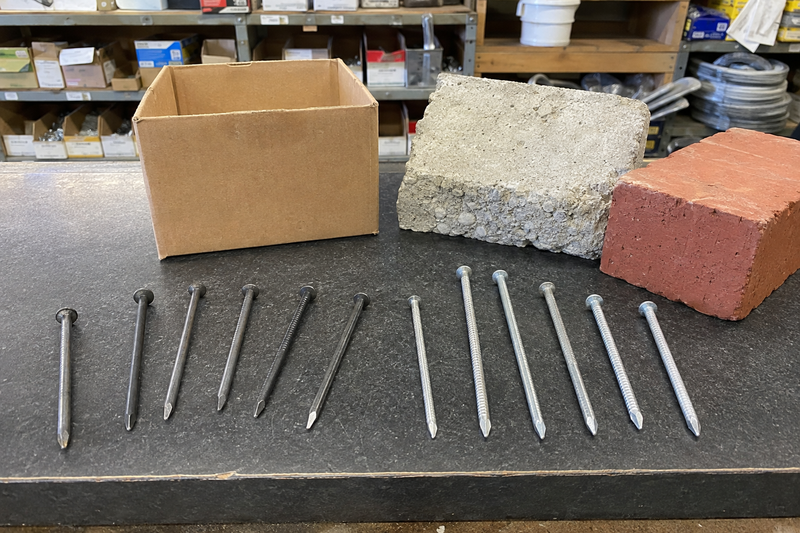
In export inquiries, I often see customers ask for “concrete nail” or “masonry nail” as if the name alone is enough. It is not. The real buying decision depends on the fixing task, nail size, surface treatment, packing method, and the expectations of the customer’s local market.
What is the basic difference between concrete and masonry nails?
Concrete and masonry nails cause confusion because both are sold for hard building materials. A buyer may think the product name gives a complete answer. But if the base material is not clear, the supplier cannot judge the correct specification, and the buyer may receive stock that is hard to sell.
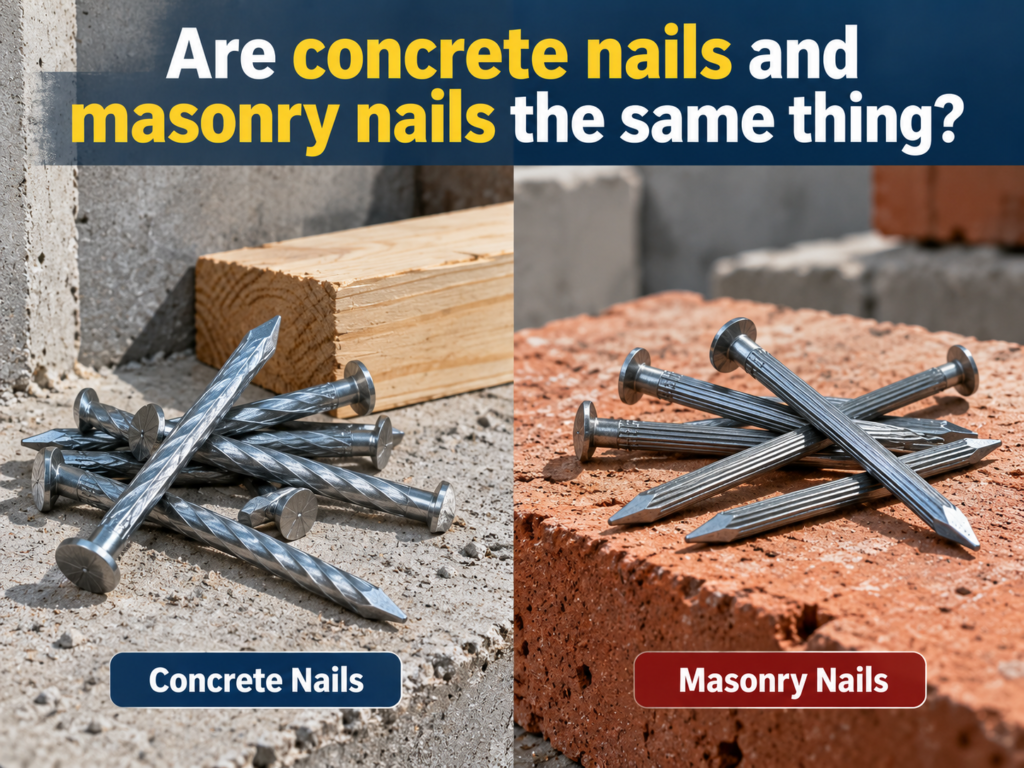
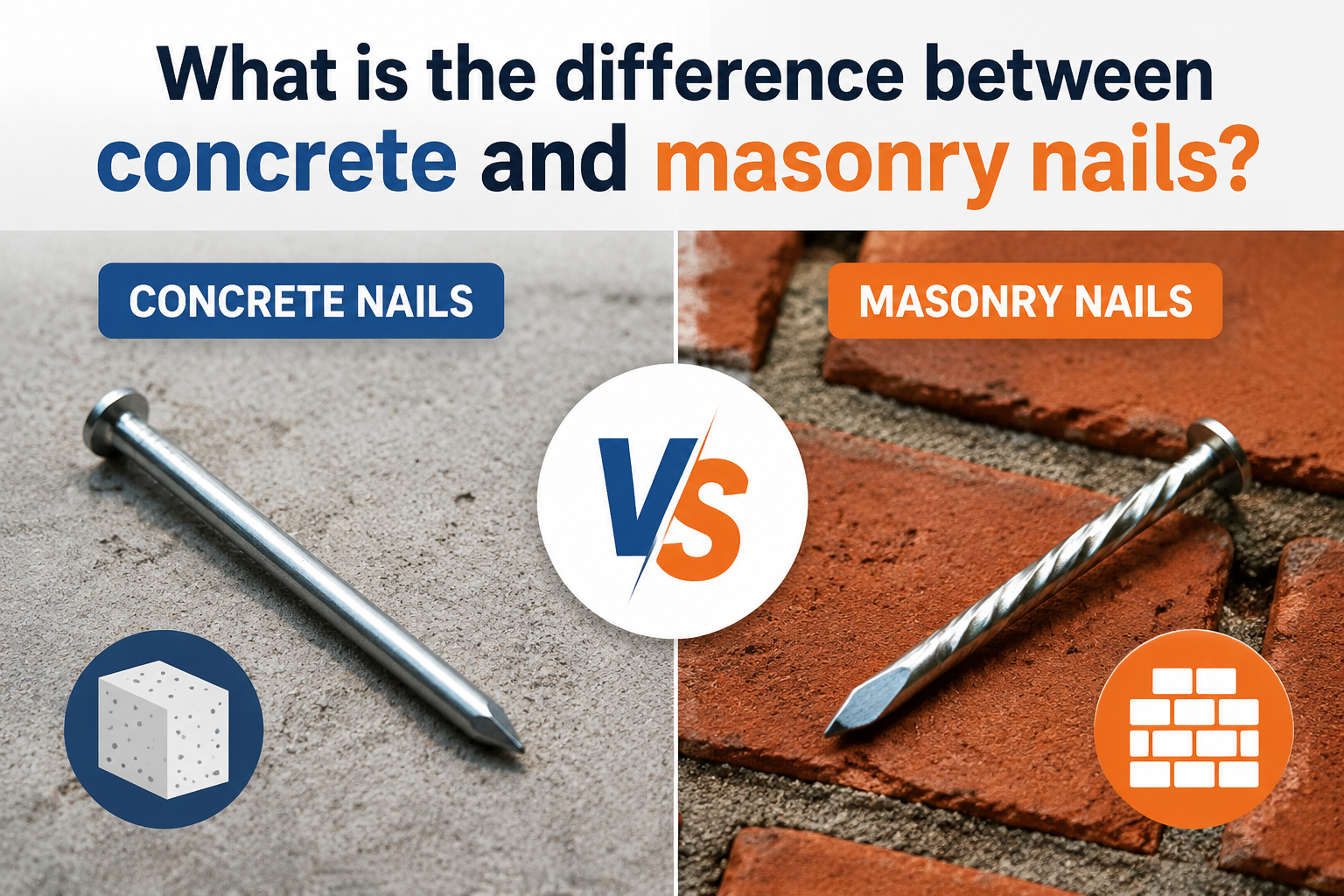
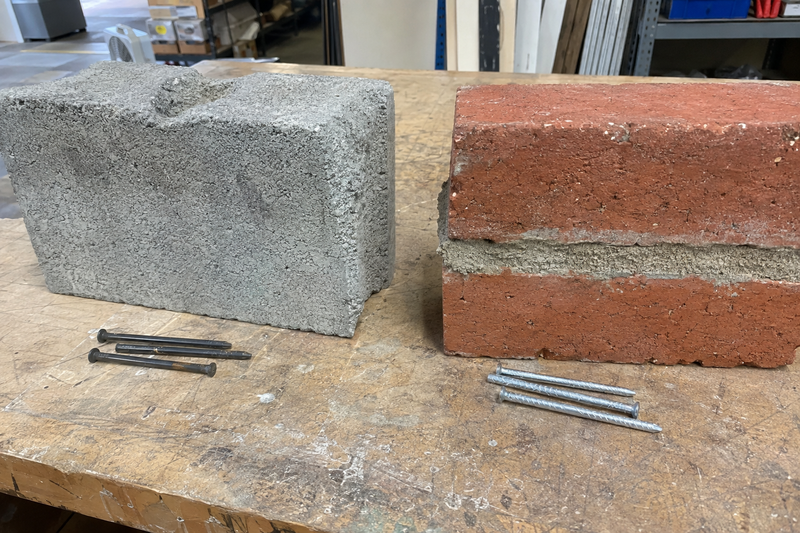
Concrete and masonry nails differ mainly by common usage, not by one fixed global rule. Concrete nails are usually requested for harder concrete surfaces. Masonry nails may be requested for brick, block, mortar joints, or other masonry work. Buyers should treat the name as a starting point, not a complete product specification.
The names are useful, but they are not enough
From my experience handling overseas nail inquiries, the phrase “concrete nail” is often used when the buyer wants a strong hardened nail for concrete walls, floors, or related hard surfaces. The phrase “masonry nail” can be broader. It may include nails used for brick, cement block, mortar joints, and general masonry fixing.
However, I do not treat these names as absolute. Different markets use different terms. A wholesaler in Africa may call one item a concrete nail. A buyer in Southeast Asia may call a similar item a masonry nail. A customer in the Middle East may describe the same product by length and finish instead of application name.
That is why I usually guide the conversation back to practical questions:
- What material will the nail be fixed into?
- What item will be fixed?
- What nail length and diameter do you need?
- Do you require black finish, galvanized finish, or another surface treatment?
- What packing style does your market prefer?
Simple comparison for buyers
| Point | Concrete Nail | Masonry Nail |
|---|---|---|
| Common meaning | Nail for harder concrete surfaces | Nail for brick, block, mortar, or general masonry |
| Market usage | Often more specific | Often broader and more flexible |
| Inquiry risk | Buyer may omit size and finish | Buyer may use name too generally |
| Best buying method | Confirm base material and specification | Confirm base material and specification |
| Supplier focus | Size, hardness expectation, finish, packing | Size, shank type, finish, packing, local naming |
A better way to think about the difference
The question should not only be, “Which name is correct?” A better question is:
“What material is my customer fixing into, and what nail specification will match that job and my local market?”
This thinking helps importers and hardware wholesalers avoid wrong stock. It also helps suppliers quote accurately. If I only receive the words “masonry nail,” I still need more details before I can prepare a responsible FOB quotation. I need the product size, quantity, packing method, and finish.
In short, the basic difference matters, but the buying specification matters more.
Why do concrete and masonry nails get mixed up in export inquiries?
Concrete and masonry nails get mixed up because buyers, sellers, contractors, and local retailers may use different names for similar products. This creates a small communication problem at first. But it can become a serious purchasing problem if the final order does not match customer expectations.
Concrete and masonry nails are often confused because market terminology is not standardized everywhere3. Importers may use one name for several hard-material nails, while suppliers may classify products by size, finish, head type, and shank. Clear specification confirmation prevents wrong quotations, wrong packing, and slow order decisions.
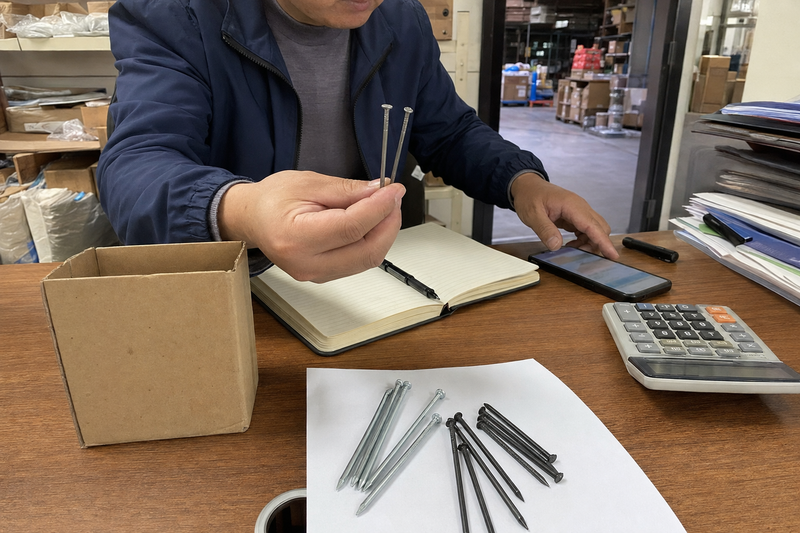
Export buyers often use product names loosely
In real export conversations, buyers often start with a short message:
- “Send price for concrete nail.”
- “Need masonry nail 1 container.”
- “Quote black steel nail for wall.”
- “Do you have hard nail for cement?”
These messages are normal. I understand them because many buyers are busy. Some buyers run hardware wholesale businesses and manage many categories. They may sell nails, screws, hinges, locks, tools, and other hardware items at the same time. They need fast prices, but fast prices still need enough detail.
If a buyer only sends the name, I cannot know whether they want:
- Concrete nails with black finish
- Galvanized masonry nails
- A specific length like 1 inch, 1.5 inch, or 2 inch
- A certain carton weight or box quantity
- OEM packing with their own brand logo
- Loose packing, small boxes, or retail-friendly packaging
The cost of unclear wording
Unclear inquiries cause several problems in procurement.
| Missing Detail | Possible Problem |
|---|---|
| Length | Nail may be too short or too long for local customers |
| Diameter | Strength expectation and weight calculation may be wrong |
| Finish | Customer may expect galvanized but receive black finish |
| Packing | Retailers may reject packing that does not fit shelf sales |
| Quantity | Supplier cannot calculate FOB price correctly |
| Brand requirement | OEM/ODM cost and lead time may be missed |
| Destination or loading plan | FCL/LCL planning may be delayed |
For importers, the biggest risk is not only buying the wrong product. The bigger risk is buying a product that your customers do not recognize as the product they asked for. If your market uses “masonry nail” to mean one specific finish or packing style, the supplier needs to know that.
Local market language matters
A buyer in Dar es Salaam, for example, may have customers who ask for familiar local names. The importer then sends those names to a factory. The factory may understand the product differently. This is why pictures, samples, and exact sizes are very useful.
I have seen buyers solve this problem quickly by sending:
- A photo of their current product
- A photo of the box label
- Nail length and diameter
- Carton weight or pieces per box
- Surface finish requirement
- Their target quantity
- Their brand or neutral packing preference
That information changes the conversation. The supplier no longer guesses. The buyer also receives a more accurate quotation.
Professional use still needs local judgment
I write from a manufacturing and export perspective, not from the position of a construction engineer. For application-specific safety decisions, buyers should ask qualified building professionals or follow local standards. As a supplier, I can help confirm product specifications, production options, packing, and export order details. That is the correct role in procurement.
Which specifications matter most when sourcing concrete and masonry nails?
Concrete and masonry nails are not purchased by name alone. Buyers may lose time if they ask for a general product without the details that affect production and quotation. The key is to confirm the practical specification before discussing final price.
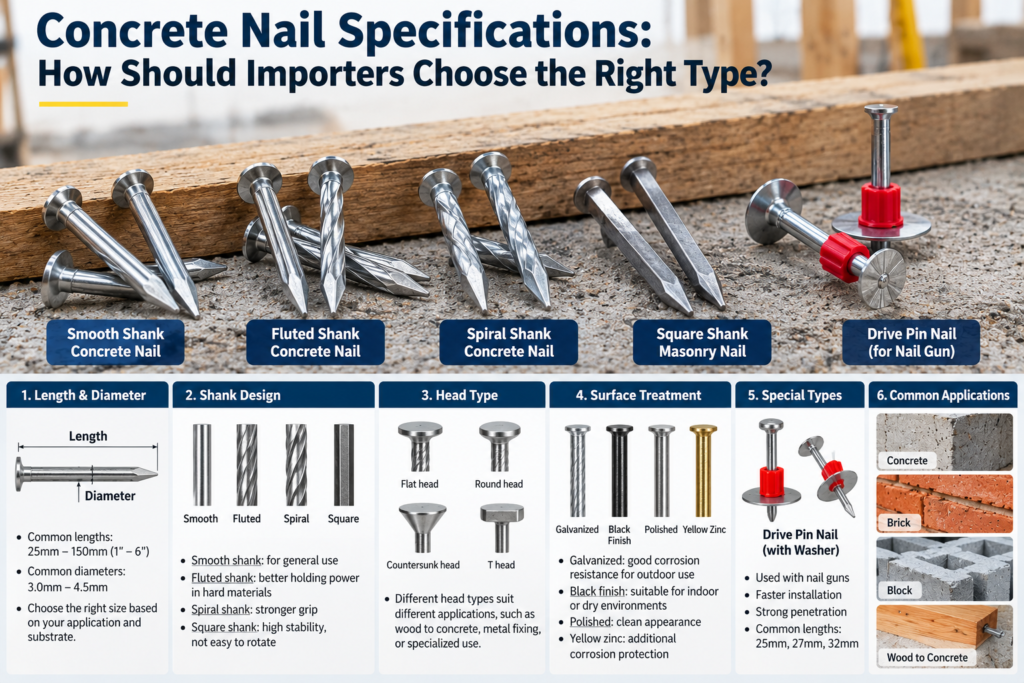
The most important specifications for concrete and masonry nails are length, diameter, head type, shank form, surface treatment, packing method, quantity, and branding requirement.4 These details affect product matching, unit weight, carton design, FOB quotation, lead time, and whether the final stock fits the buyer’s local market.
Length and diameter
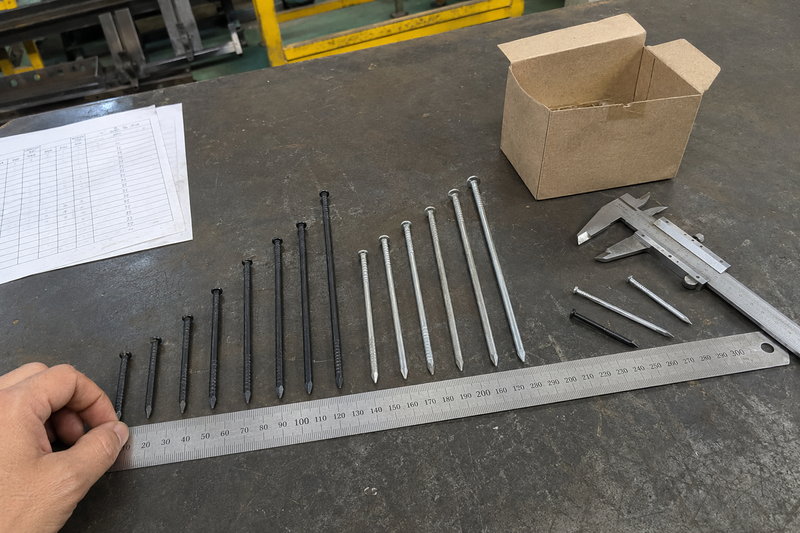
Length and diameter are the first details I ask for. They affect material usage, carton weight, and customer application expectations. A small change in diameter can affect the product feel and the final cost.5 A change in length also changes the weight per carton and the quantity per box.
Common inquiries may include sizes such as:
- 1 inch
- 1.5 inch
- 2 inch
- 2.5 inch
- 3 inch
- Other customized sizes
I recommend that buyers confirm both inch size and metric size if possible. This avoids misunderstanding. Some customers describe length in inches. Some use millimeters. Some only send a sample. A sample is helpful, but written dimensions are still important for quotation records.
Head type and shank form
Head type affects how the nail sits against the fixed item.6 Shank form affects how the product is described and recognized in the market.7 I avoid making broad performance claims without testing, but I do pay attention to these features when confirming production.
Buyers may need to confirm:
- Flat head or other head style
- Smooth shank or fluted/grooved shank
- Straightness and visual appearance
- Point shape
- Market-preferred design
For wholesalers, the important point is simple. Your customers may expect the nail to look like the products already sold in your market. If the head or shank looks different, they may question it even if the product name is similar.
Surface treatment
Surface treatment is another major specification.8 In inquiries, I often see buyers ask for black concrete nail or galvanized masonry nail. These terms should be confirmed clearly.
| Surface Treatment | Common Buyer Reason | Procurement Note |
|---|---|---|
| Black finish | Traditional market demand, familiar appearance | Confirm color expectation and packing protection |
| Galvanized finish | Corrosion-resistance expectation in general use9 | Confirm zinc appearance and buyer requirement |
| Other finish | Special market or brand requirement | Confirm feasibility and MOQ |
I do not recommend choosing finish only by price. Buyers should consider local climate, customer preference, storage conditions, and the way the product is displayed in shops.
Packing method
Packing affects sales. This is especially true for hardware importers who sell to wholesalers, small shops, and retailers. A good nail with the wrong packing may still be difficult to move.
Common packing options include:
- Bulk carton packing
- Small box packing
- Plastic bag packing
- Inner box plus outer carton
- OEM brand box
- Neutral packing
- Customized label or logo
For my own export quotation process, packing is part of the price mechanism10. A typical FOB quote depends on product + specification + quantity + packing method. If the packing is missing, the quotation is incomplete.
Quantity and MOQ
Quantity also matters because nails are heavy products. Production planning, packaging material, and shipping method all depend on order volume. For our factory context, the usual minimum order quantity is 5 tons or 200 boxes, depending on the product and packing. Trial orders can be discussed, but the buyer should still provide a clear specification.
For shipping, sea freight is the common method. Buyers can choose:
[- FCL: Full container load
- LCL: Less than container load](https://www.trade.gov/know-your-incoterms)[^11]
The right choice depends on order quantity, destination, and the buyer’s stock plan.
How should buyers request a quotation for concrete and masonry nails?
Concrete and masonry nails are easy to quote when the inquiry is complete. But when a buyer sends only a product name, the supplier must ask many follow-up questions. This slows the process and can delay stock planning.
Buyers should request a quotation for concrete and masonry nails by providing the intended base material, nail length, diameter, head type, shank form, surface treatment, packing method, quantity, destination port, and branding needs. Photos or samples make the quotation more accurate and reduce misunderstanding.
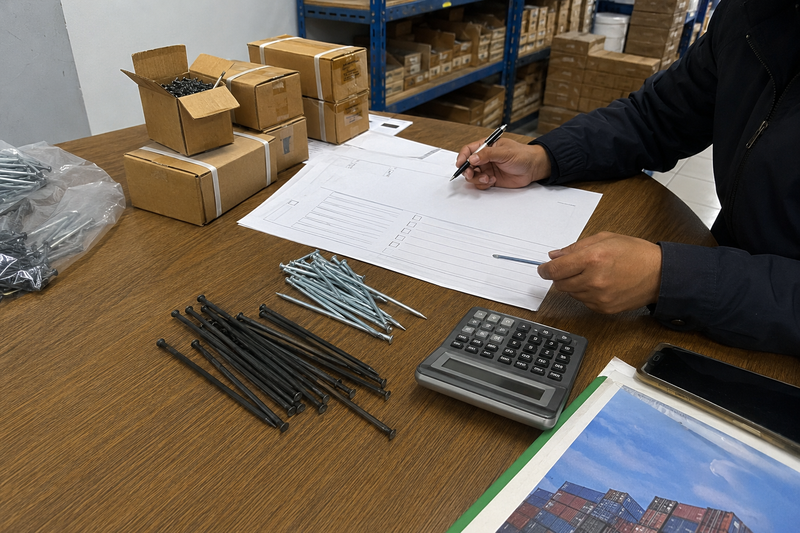
A practical inquiry template
When buyers ask me how to send a clear inquiry, I suggest a simple format. It does not need to be complicated. It just needs to include the details that affect production and price.
Example inquiry format:
Hello, we need concrete/masonry nails for our hardware wholesale market.
Base material: concrete wall / brick / block / mortar joint
Size: length mm, diameter mm
Head type:
Shank: smooth / grooved / other
Finish: black / galvanized / other
Packing: pcs per box, boxes per carton, or kg per carton
Brand: neutral / OEM logo
Quantity: tons or cartons
Destination port: ___
Please quote FOB price and lead time.
This format saves time for both sides. The buyer receives a clearer price. The supplier can check production feasibility and packing cost faster.
Why photos and samples help
Photos are useful because names vary by market. A photo of the nail, box, carton mark, or existing stock can prevent confusion. If the buyer has a sample, the factory can use it for quality checking and specification confirmation.
In our business practice, samples can be provided for quality checking. A basic sample fee may apply, and the fee can sometimes be discussed for return in the formal order. This is common because sample preparation, packing, and courier costs require time and resources.
A sample is especially useful when:
- The buyer does not know the exact diameter
- The local market uses a special name
- The packing style is important
- The buyer wants to match existing stock
- OEM or ODM customization is required
FOB quotation details
For export orders, I usually treat FOB quotation as a combination of four main parts:
| Quotation Element | Why It Matters |
|---|---|
| Product type | Concrete nail, masonry nail, black steel nail, etc. |
| Specification | Length, diameter, head, shank, finish |
| Quantity | Affects production planning and unit cost |
| Packing method | Affects carton cost, labor, volume, and retail value |
If the buyer asks only, “What is your price for concrete nail?” the answer cannot be precise. The price for a small box with OEM printing will not be the same as bulk carton packing. A galvanized finish may not be the same price as black finish. A 1-inch nail will not have the same material weight as a 3-inch nail.
Lead time and shipping planning
Lead time should also be discussed early. For our factory context, normal lead time is usually 15–25 days, depending on order quantity and packing details. Customized packaging or brand logo work may need additional confirmation time.
Shipping is usually by sea. Many buyers in the Middle East, Africa, Southeast Asia, and South America plan stock by container schedule. If the order is urgent, the buyer should tell the supplier early. This helps the supplier check production timing, packing material availability, and loading plan.
What I like to confirm before production
Before production, I prefer to confirm the final order details in writing. This protects both buyer and supplier.
A clear confirmation should include:
- Product name used in the order
- Full size and specification
- Surface finish
- Packing details
- Carton mark and label
- Brand logo artwork if needed
- Quantity
- FOB port and shipment method
- Lead time
- Sample or pre-production confirmation if required
This process may look detailed, but it prevents expensive mistakes. Nails are heavy goods. If a full shipment is wrong, the cost of correction can be high.
How can hardware wholesalers choose the right stock of concrete and masonry nails?
Concrete and masonry nails can become slow-moving stock if the buyer chooses only by low price. A product may look cheap on the quotation sheet, but it may not match the sizes, finishes, or packaging that local shop customers prefer.
Hardware wholesalers should choose concrete and masonry nails by studying local demand, confirming common sizes, checking preferred finishes, comparing packaging styles, and testing samples before large orders. The best stock choice balances price, usability, market familiarity, and reliable supply.
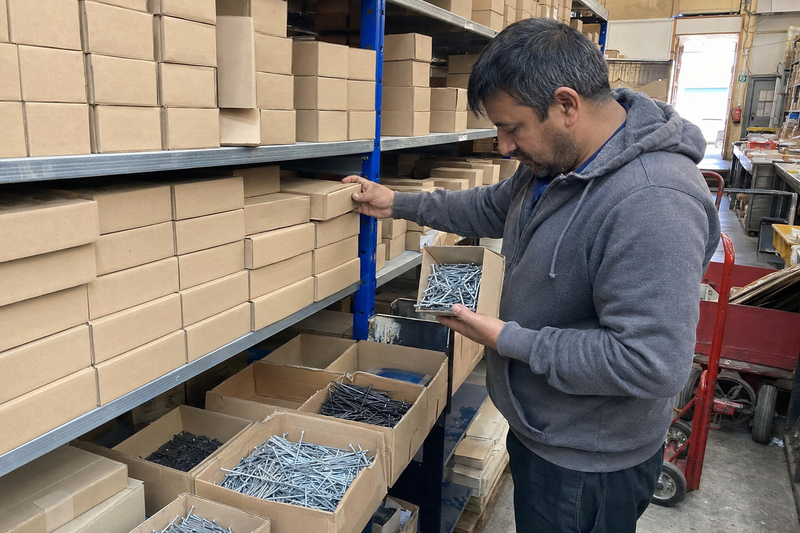
Start with your local market
For importers and wholesalers, the best product is not always the most technical product. The best product is the one your customers understand, trust, and buy repeatedly.
Before placing an order, buyers should ask:
- Which sizes sell fastest in my market?
- Do customers ask for black or galvanized finish?
- Do retailers prefer small boxes or bulk cartons?
- Do contractors ask for a specific head or shank style?
- Do customers use the word concrete nail, masonry nail, or another local name?
- What price range can the market accept?
This is practical information. It helps the supplier match your order to your market.
Compare stock options
| Buyer Situation | Suggested Focus | Reason |
|---|---|---|
| New importer | Start with common sizes and trial order | Reduces stock risk |
| Established wholesaler | Match existing fast-moving sizes | Protects repeat sales |
| Brand owner | Confirm OEM packing and label design | Builds market recognition |
| Mixed hardware distributor | Choose simple packing and stable sizes | Easier to sell across channels |
| Project supplier | Confirm application with qualified professionals | Avoids wrong product selection |
Do not let price hide specification differences
Two quotations may look different because the products are not actually the same. One supplier may quote a different diameter. Another may quote a different carton weight. One may include OEM printing, while another uses neutral packing. One may quote galvanized finish, while another quotes black finish.
When comparing prices, buyers should compare the same details:
- Same length
- Same diameter
- Same finish
- Same packing
- Same quantity
- Same shipping term
- Same branding requirement
This is the only fair way to compare suppliers.
Supplier selection matters
A good supplier should not only answer with a price. A good supplier should help confirm details. In my own work as a nail manufacturer and exporter, I prefer to ask more questions at the beginning because it reduces trouble later.
Buyers should look for suppliers who can:
- Explain specification options clearly
- Provide samples for checking
- Support OEM/ODM if needed
- Confirm packing details before production
- Offer realistic lead time
- Communicate clearly about MOQ and shipping
- Understand export documentation and container planning
For buyers in the Middle East, Africa, Southeast Asia, and South America, stable supply and correct packing can be as important as the product itself. Many wholesalers sell through relationship-based channels. If the product quality, size, or packing changes without notice, local trust can suffer.
Frequently Asked Questions
Are concrete nails and masonry nails the same product?
Concrete nails and masonry nails can overlap in some markets, but they are not always used as identical terms. Concrete nail usually suggests use in harder concrete surfaces. Masonry nail may refer more broadly to brick, block, mortar joints, or masonry materials. Buyers should confirm size, finish, and application.
What details should I send when asking for a concrete or masonry nail price?
You should send nail length, diameter, head type, shank type, surface finish, packing method, quantity, destination port, and branding needs. A photo or sample is also helpful. These details allow the supplier to quote accurately and avoid misunderstanding.
Is galvanized finish better than black finish?
Galvanized finish and black finish serve different market expectations. Galvanized nails are often requested when buyers expect better corrosion resistance. Black finish is common in many traditional markets. The better choice depends on your local demand, storage conditions, application, and customer preference.
Can I order concrete and masonry nails with my own brand?
Yes, OEM or ODM packing is possible when the order quantity and packaging design are confirmed. Buyers should provide logo artwork, box design requirements, carton marks, and target packing style. Custom packaging may affect cost, lead time, and minimum order requirements.
Should I test samples before placing a large order?
Yes, sample checking is a practical step, especially when the market name is unclear or the buyer wants to match existing stock. Samples help confirm size, appearance, finish, and packing expectations. For application-specific decisions, buyers should also consult qualified local professionals.
Conclusion
The difference between concrete and masonry nails is important, but buyers should not stop at the product name. In many export markets, the terms overlap. The safer approach is to confirm the base material, nail length, diameter, head type, shank form, surface treatment, packing, quantity, and branding needs. If you are sourcing concrete and masonry nails for wholesale or retail distribution, send your specifications, photos, target quantity, and packing request. I can help review the details and prepare a clear FOB quotation. Contact us at [email protected] or WhatsApp +8618331061136.
-
"The Science Of Fastening: How A Nail Works Explained", https://shibboleth.idm.home.nyu.edu/how-a-nail-works. Construction fastener guidance describes concrete nails as hardened steel nails used for fastening into concrete or similarly hard mineral substrates, supporting the article’s basic definition while not resolving all regional trade-name variations. Evidence role: definition; source type: education. Supports: A neutral construction or engineering source should describe concrete nails as hardened steel nails intended for use in concrete or hard masonry-like materials.. Scope note: The support is definitional and may not cover every export-market naming practice. ↩
-
"Mason – TEAMS Titles – University of Florida", https://teams-titles.hr.ufl.edu/teams-title/mason/. Educational construction references commonly classify masonry fastening as fastening into brick, block, mortar joints, or related masonry substrates, which supports the article’s broad use of the term “masonry nail” but does not prove that all markets use the term identically. Evidence role: definition; source type: education. Supports: A construction reference should support that masonry fasteners or masonry nails are associated with brick, block, mortar joints, and masonry substrates.. Scope note: The source would contextualize the substrate category rather than prove global commercial terminology. ↩
-
"Building material", https://en.wikipedia.org/wiki/Building_material. Terminology guidance for construction products distinguishes standardized technical specifications from market or regional trade names, supporting the article’s caution that product labels may not be used uniformly across markets. Evidence role: historical_context; source type: institution. Supports: A standards, trade, or terminology source should explain that product names and construction terms can vary by region and may differ from standardized technical specifications.. Scope note: The evidence would be contextual and may not document the exact terms “concrete nail” and “masonry nail” in every region. ↩
-
"Fastener Design Manual", https://ntrs.nasa.gov/api/citations/19900009424/downloads/19900009424.pdf. Fastener standards and specification guides commonly identify dimensions, head form, shank characteristics, and coatings as core descriptive properties of nails, supporting the article’s list of technical purchasing details while not addressing branding as a technical requirement. Evidence role: general_support; source type: institution. Supports: A fastener specification source should show that dimensions, head form, shank type, and coating or finish are standard descriptive characteristics for nails or similar fasteners.. Scope note: The source would directly support the technical items but only indirectly support commercial items such as branding. ↩
-
"What is the manufacturing cost of a wire nail?", https://www.quora.com/What-is-the-manufacturing-cost-of-a-wire-nail. Basic geometry and materials calculations show that increasing wire diameter increases cross-sectional area, volume, and mass for a given nail length, supporting the article’s claim that diameter changes can affect weight-related cost. Evidence role: mechanism; source type: education. Supports: A source should support that diameter changes alter cross-sectional area and material volume, which affects weight and material cost for steel nails.. Scope note: This supports the material-weight mechanism; perceived “product feel” remains partly market- and user-dependent. ↩
-
"Bearing surface", https://en.wikipedia.org/wiki/Bearing_surface. Fastener design references explain that head geometry determines bearing area and seating against the attached material, supporting the article’s statement that head type affects how the nail sits after installation. Evidence role: mechanism; source type: education. Supports: A fastener design or construction source should explain that head shape affects bearing area, seating, and surface finish against the fastened material.. ↩
-
"Fasten-Ating Facts: Understanding Nail Shank Type", https://www.nailgundepot.com/nail-gun-network/understanding-nail-shank. Construction fastener references classify nails by shank form, including smooth and deformed or grooved varieties, supporting the article’s treatment of shank form as a recognizable specification feature. Evidence role: definition; source type: education. Supports: A construction or fastener source should classify nails by shank types such as smooth, ringed, fluted, or grooved.. Scope note: This supports shank form as a technical identifier, not the specific preferences of any one local market. ↩
-
"Durable, Hydrophobic Surface Treatment for Enhanced Corrosion …", https://www.waru.edu/sites/default/files/Migrated/CopDocuments/Durable%2C%20Hydrophobic%20Surface%20Treatment%20for%20Enhanced%20Corrosion%20Protection%20of%20Landing%20Gear.pdf. Materials and corrosion references describe surface coatings as a key factor in the appearance and corrosion behavior of steel fasteners, supporting the article’s inclusion of surface treatment as a major sourcing specification. Evidence role: general_support; source type: research. Supports: A materials or corrosion source should show that coatings and surface treatments affect corrosion behavior, appearance, and suitability of steel fasteners.. ↩
-
"Corrosion of Galvanized Steel in Soils", https://nvlpubs.nist.gov/nistpubs/jres/049/5/v49.n05.a02.pdf. Materials guidance on galvanized steel explains that zinc coatings provide corrosion protection to steel by acting as a barrier and, when exposed, as a sacrificial layer, supporting the article’s association of galvanized nails with corrosion-resistance expectations. Evidence role: mechanism; source type: government. Supports: A government or materials source should explain that zinc galvanizing protects steel against corrosion through a protective coating and sacrificial behavior.. Scope note: Actual service life depends on coating thickness, environment, handling, and installation conditions. ↩
-
"PACKAGING COST", https://jmc.edu/econtent/pg/2993_Packaging%20cost%20jas.pdf. Logistics and packaging cost studies treat packaging materials, packing labor, handling, and transport efficiency as components of total product cost, supporting the article’s statement that packing is part of the quotation mechanism. Evidence role: general_support; source type: paper. Supports: A logistics or cost-accounting paper should support that packaging materials, labor, handling, and logistics requirements contribute to total product cost.. Scope note: The evidence supports the general cost relationship, not a specific FOB price calculation for this supplier. ↩