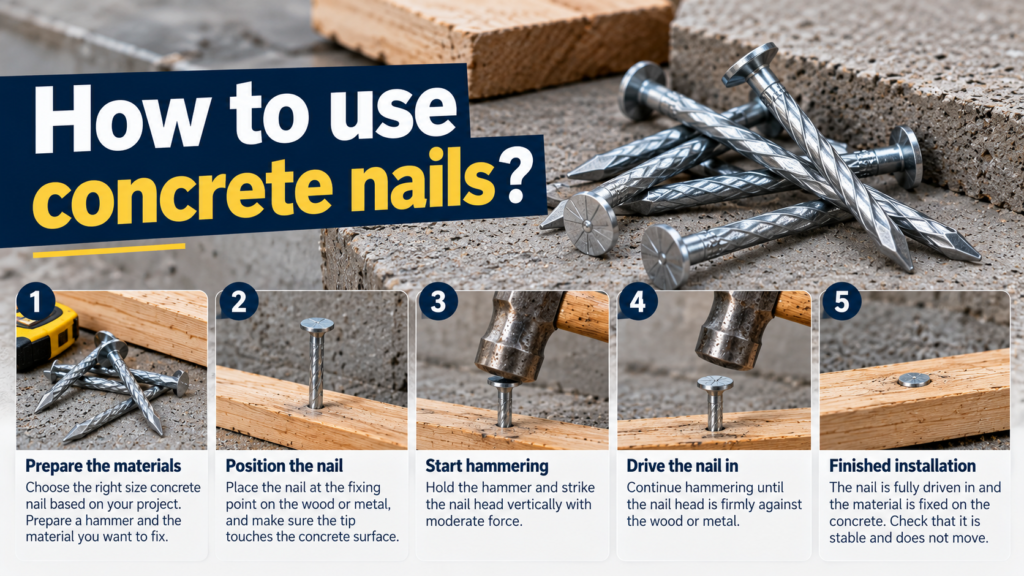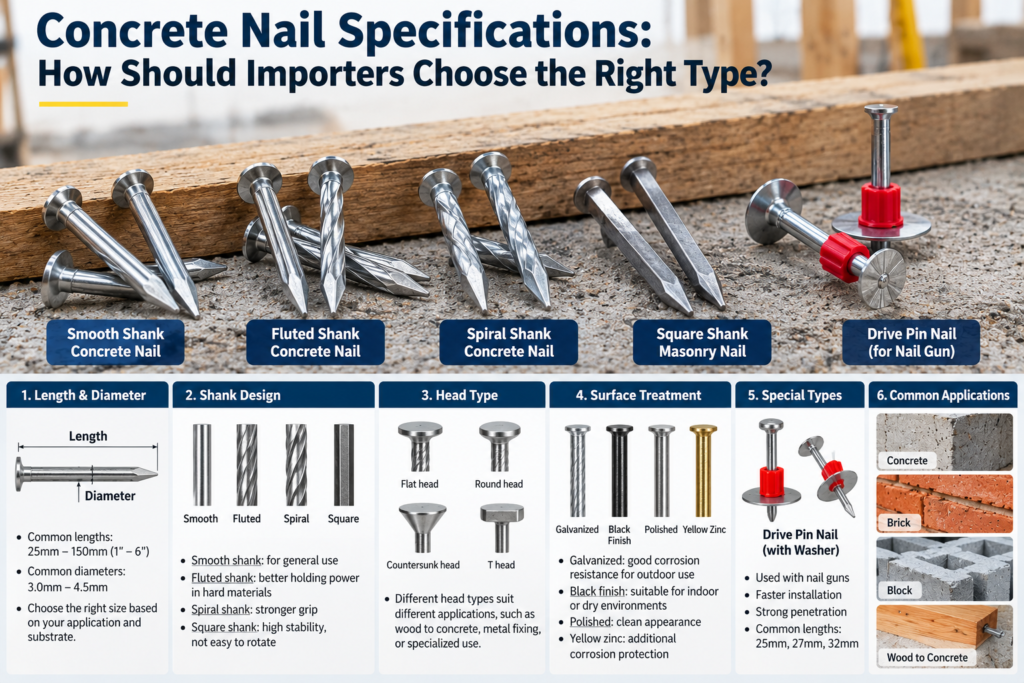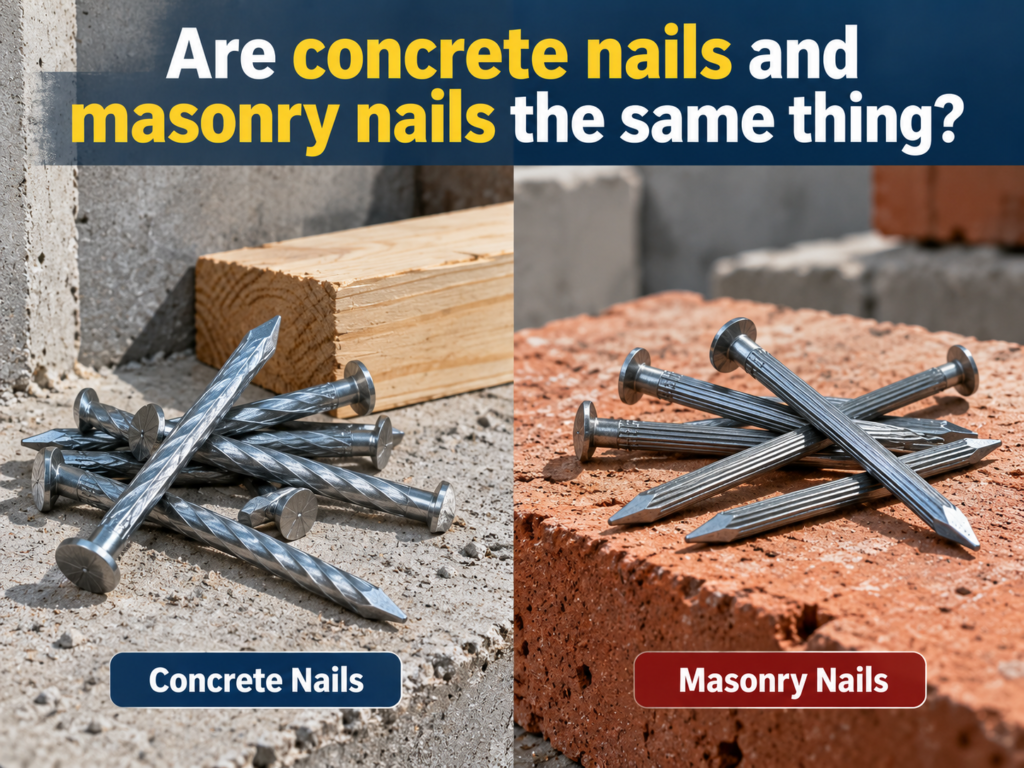
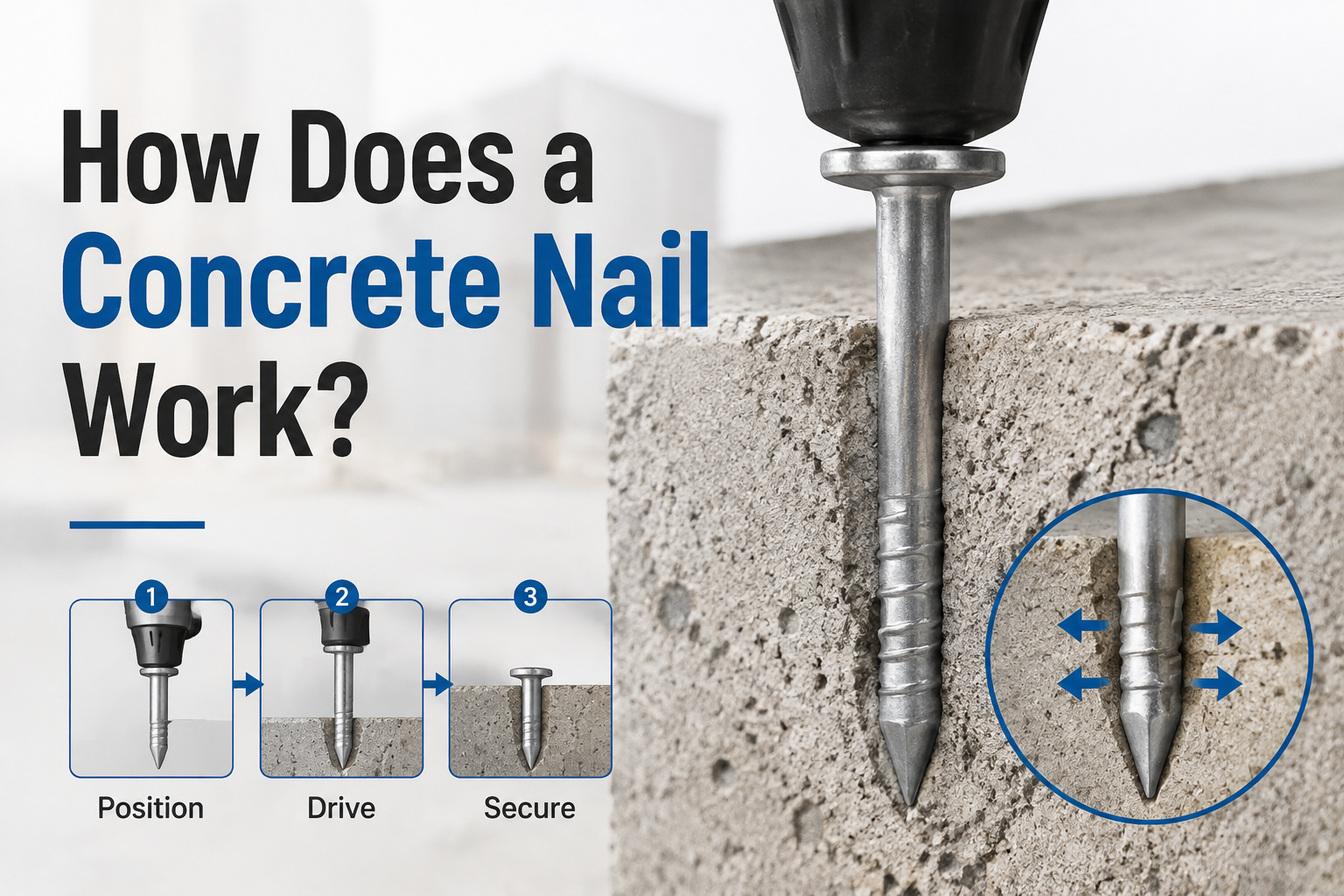
A concrete nail works well only when the nail, substrate, and application match. Many importers compare size and price first, but they later face bent nails, broken tips, and customer complaints. I usually explain that the solution is not “buy the hardest nail,” but buy the right nail for the right surface.
A concrete nail works by using hardened steel, controlled heat treatment, and impact resistance1 to penetrate or grip hard masonry surfaces during hammering. It is designed for light to medium fixing tasks in suitable concrete, brick, or masonry, but it is not a universal replacement for anchors, expansion bolts, or heavy-duty fastening systems2.
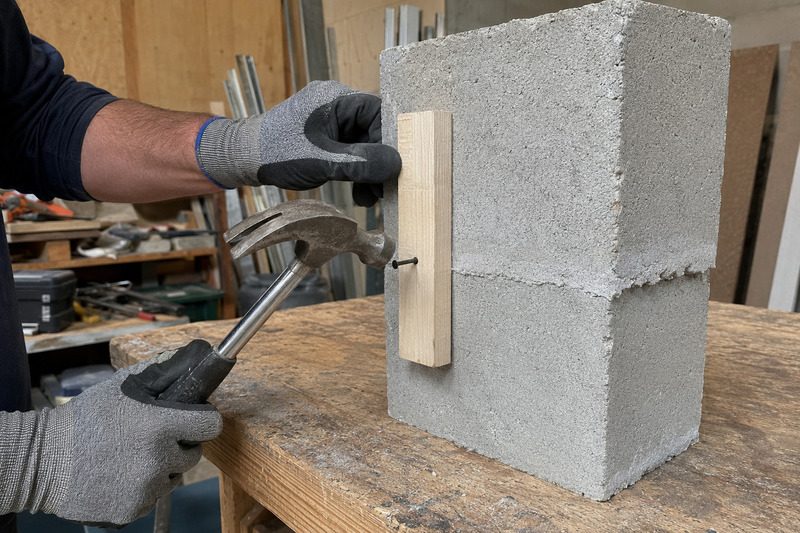
When buyers understand the basic working principle, they can compare suppliers more clearly. They can also explain product limits to their own customers. That matters because the same nail size can perform very differently on different walls, bricks, and concrete grades3.
Why Does a Concrete Nail Work Differently From an Ordinary Nail?
Many buyers ask me why a concrete nail costs more than a common nail of similar size. The problem is that both products look simple. The risk is that an end user may treat them as interchangeable. The solution is to understand the steel, hardness, and impact behavior.
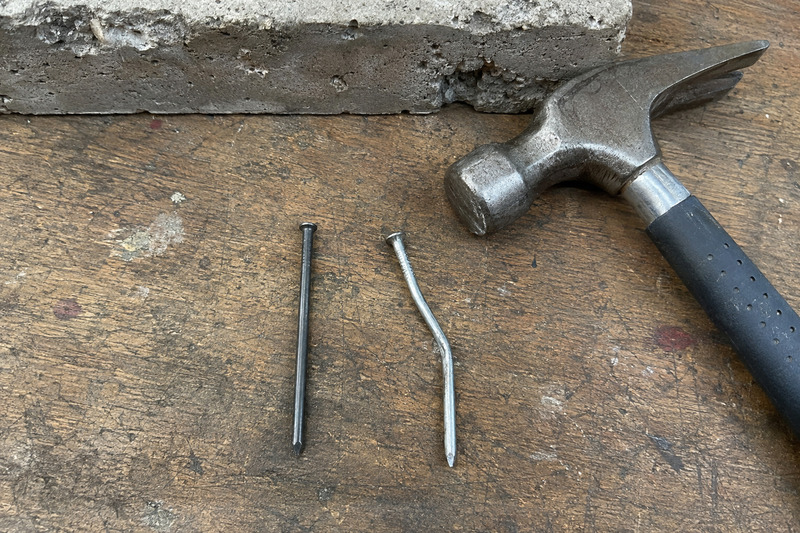
A concrete nail works differently because it is made for harder substrates, while ordinary nails are mainly designed for wood or softer materials4. Its body must resist bending under hammer impact, and its tip must keep enough strength to enter suitable masonry without deforming too quickly.
The Real Difference Is Not Only the Shape
When I speak with wholesalers in Africa, the Middle East, Southeast Asia, and South America, I often hear one request: “Please quote the same size at the lowest price.” I understand this request because hardware trading is competitive. However, I always ask one more question:
“What substrate will your customer use it on?”
That question changes the whole evaluation.
An ordinary nail is usually used for wood, packing, light carpentry, or soft materials. It can be tough enough for those uses, but it is not normally designed to take repeated impact against hard masonry5. If an end user drives it into concrete, it may bend quickly. It may also damage the surface or fail before the fixing is complete.
A masonry nail is different because the product design focuses on hardness, heat treatment, and shock resistance. These factors help the nail maintain its form during hammering. However, the product still has limits. It does not “drill” like a bit, and it does not create the same holding system as an expansion anchor.
Simple Comparison for Buyers
| Feature | Concrete Nail | Ordinary Nail |
|---|---|---|
| Typical use | Concrete, brick, masonry fixing | Wood, soft boards, packing |
| Steel requirement | Harder steel, impact resistance | More general-purpose steel |
| Main risk if misused | Breakage, surface damage, poor holding | Bending in hard surfaces |
| Buying focus | Material, treatment, substrate match | Size, length, head type, finish |
| Suitable for heavy structural fixing | No, professional evaluation needed | No |
Why This Matters in B2B Trade
For importers and wholesalers, the product risk is not only technical. It is also commercial. If the nail is too soft, customers may complain that it bends. If the nail is too brittle, customers may complain that it breaks. If the nail is used on an unsuitable substrate, customers may blame the supplier even when the application is wrong.
That is why I do not like selling only by size. A buyer may ask for 2 inch, 2.5 inch, or 3 inch nails. That information is useful, but it is not enough. I also want to know:
- Will the user fix wood strips to concrete?
- Will the user work on brick walls?
- Will the wall be old, soft, dense, or very hard?
- Will the product be sold to construction workers, hardware shops, or household users?
- Does the buyer need bulk packing, small boxes, or private label packaging?
These questions help me recommend a more suitable product range. They also help wholesalers reduce after-sales pressure. A clear product explanation often prevents unrealistic expectations.
What Materials and Heat Treatment Help a Concrete Nail Work?
A buyer may think that a concrete nail works only because the steel is hard. That idea is partly true, but it is incomplete. If the material is poorly selected or the treatment is unbalanced, the nail may bend, crack, or break during use.
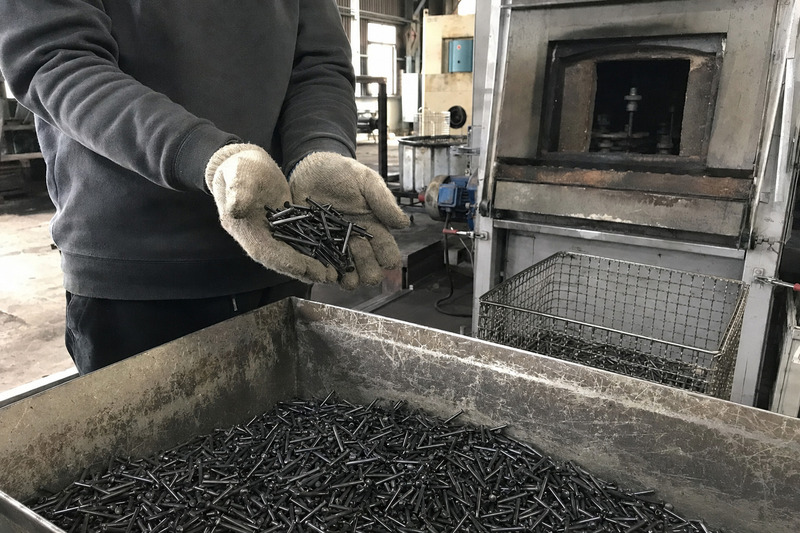
A concrete nail usually works through a combination of harder steel, proper heat treatment, controlled toughness, and a sharp working point. The goal is not maximum hardness alone.6 The goal is a practical balance between penetration, bending resistance, and impact durability for suitable masonry applications.
Hardness Must Be Balanced With Toughness
In hardware buying, I often hear the phrase “make it harder.” I understand why buyers say this. They want fewer bent nails and fewer complaints. But hardness alone is not a complete answer.
A very hard nail may resist bending, but it can become too brittle if the process is not controlled.7 A brittle nail can snap under impact. That failure is also serious because it creates waste, frustration, and possible user complaints.
So I usually explain the balance in simple terms:
- Too soft: the nail bends easily.
- Too brittle: the nail may break under hammering.
- Balanced treatment: the nail resists deformation while keeping enough toughness.
I do not present myself as a testing laboratory or structural engineer. My role is practical procurement support. I help buyers compare product parameters, request samples, and check whether the nail fits their market needs.
Main Product Parameters Buyers Should Check
For importers, several parameters matter more than just the listed size.
| Parameter | Why It Matters | Buyer Checkpoint |
|---|---|---|
| Material | Affects strength and deformation behavior | Ask supplier for steel type or production standard used |
| Heat treatment | Affects hardness and toughness balance | Request samples for practical comparison |
| Point shape | Affects starting penetration | Check tip consistency and sharpness |
| Shank diameter | Affects strength and fixing feel | Compare actual diameter, not only nominal size |
| Surface treatment | Affects appearance and corrosion resistance | Choose black, polished, galvanized, or other finish based on market |
| Packaging | Affects resale and brand image | Confirm box weight, carton strength, logo, and label |
Surface Treatment Also Affects Buying Decisions
Surface treatment does not make the nail magically suitable for every substrate. However, it does affect appearance, storage, and market positioning. Common options may include black finish, polished finish, or zinc coating8 depending on the product type and buyer requirement.
For example, some markets prefer black steel nails because customers recognize the look. Other markets may prefer a cleaner finish for retail packaging. A wholesale buyer may also care about carton strength because nails are heavy and cartons can break during sea transport.
Why Samples Are Useful
I usually recommend samples when a buyer is comparing several suppliers. A sample cannot replace a full laboratory test, but it can help buyers check practical details:
-
Visual consistency
The nails should look uniform in length, head shape, point shape, and finish. -
Basic handling feel
The product should not look weak, poorly formed, or inconsistent. -
Market suitability
The buyer can show the sample to local customers before placing a larger order. -
Packing quality
If the buyer sells under a private brand, box printing and carton strength matter.
At CHINABEST Hardware, we can provide samples for quality checking. Samples usually carry a basic charge, and the cost can be discussed for return or adjustment in a formal order. I prefer this approach because it helps both sides reduce risk before bulk production.
Which Substrates Can a Concrete Nail Work In?
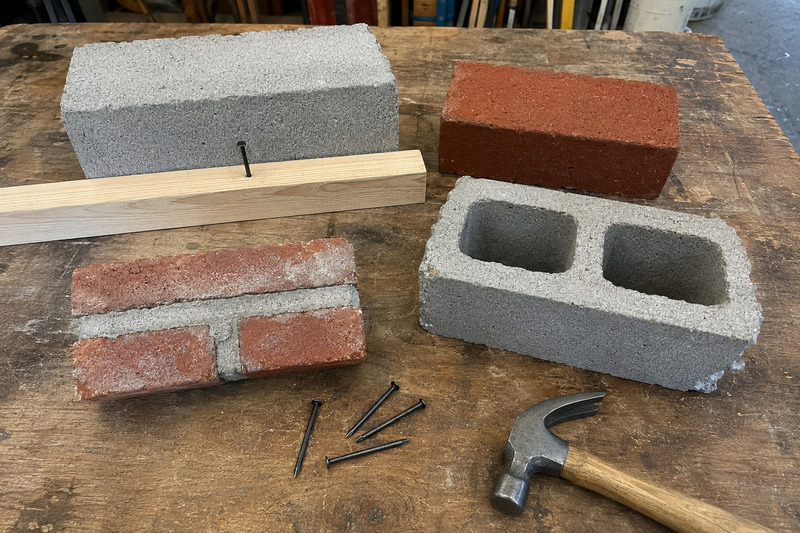
A concrete nail can fail even when the nail itself is good. The problem is often the surface. Dense concrete, brittle brick, soft mortar, and old walls behave differently.9 If a seller ignores the substrate, the customer may use the product in the wrong place and complain.
A concrete nail can work in suitable concrete, brick, masonry, and similar hard surfaces for light to medium fixing tasks. It should not be promoted as suitable for all walls or all construction conditions. For heavy-duty or safety-critical fixing, buyers should consider anchors or professional fastening advice.
Substrate Match Is the Hidden Risk
In real trade conversations, many buyers say, “My customer uses it for walls.” That answer is still too broad. A wall can mean many things. It can be poured concrete, block, hollow brick, solid brick, mortar joint, plaster layer, or old masonry.
Each surface changes how the nail behaves.
- Dense concrete may be too hard for easy hand nailing.
- Soft brick may not hold strongly10.
- Hollow block may crack or give weak grip11.
- Old masonry may crumble around the nail.
- Plaster layers may hide the real base material.
This is why I always avoid saying that one product works everywhere. That kind of claim may help make a sale today, but it can create complaints tomorrow.
Practical Substrate Guide
| Substrate | Possible Performance | Buyer Note |
|---|---|---|
| Suitable concrete | Can work for light to medium fixing | Confirm local user expectations |
| Solid brick | Often used for light fixing | Check cracking risk and holding behavior |
| Mortar joint | May be easier to penetrate | Holding may be weaker |
| Hollow block | Can be risky | User may need different fastening solution |
| Very dense concrete | May be difficult by hand | Consider tools, anchors, or professional advice |
| Heavy structural fixing | Not recommended as a simple nail solution | Use qualified evaluation |
What Concrete Nails Are Commonly Used For
In many markets, these nails are sold for practical, everyday fastening jobs. Examples may include:
- Fixing wood strips to masonry
- Holding light brackets
- Installing temporary supports
- Securing mesh or light materials
- General repair and household fixing
- Small construction and decoration tasks
These examples are not structural recommendations. They are only common market applications. If the job involves load-bearing, safety, overhead installation, public projects, or engineering requirements, the buyer should get qualified professional advice12.
How Wholesalers Can Explain Limits to Customers
A wholesaler does not need to become an engineer. However, a wholesaler should give clear guidance. I suggest using simple wording such as:
“This nail is for suitable masonry and light to medium fixing. Please choose anchors, expansion bolts, or professional fasteners for heavy loads or safety-critical installation.”
That sentence protects the seller and educates the customer. It also reduces the chance that a user will expect a simple nail to perform like a mechanical anchor.
Why Misuse Creates Complaints
Customer complaints often sound simple: “The nail bent,” “The nail broke,” or “The wall cracked.” But the cause may be different each time.
Possible causes include:
- The nail was too soft.
- The nail was too brittle.
- The wall was too hard.
- The substrate was hollow or weak.
- The user selected the wrong length.
- The hammering angle was poor.
- The job needed an anchor, not a nail.
A good supplier should help the buyer separate product quality issues from application issues. That is why I prefer to discuss end use before quoting. It saves time later.
How Should Importers Compare Concrete Nail Suppliers?
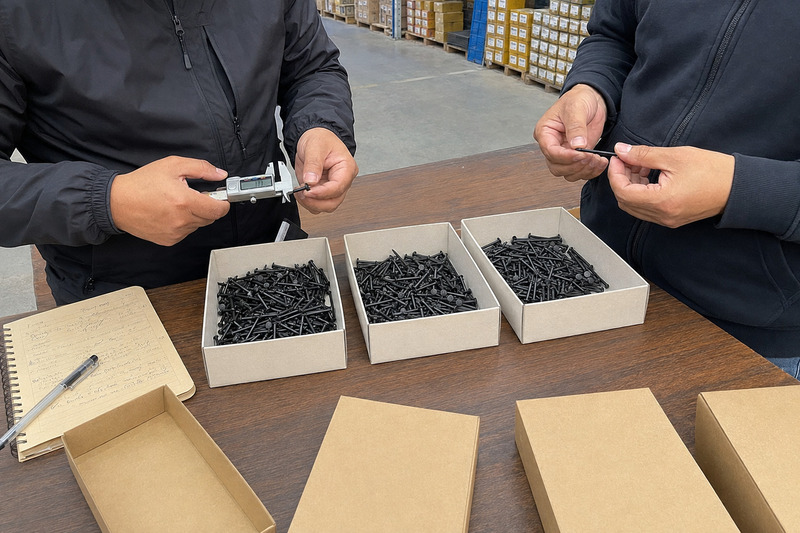
Many importers compare a concrete nail by price per carton or price per ton. The problem is that low price can hide differences in steel, treatment, size tolerance, packing, and after-sales risk. A better comparison starts with clear specifications and realistic application needs.
Importers should compare concrete nail suppliers by checking material, heat treatment control, size consistency, surface finish, packaging, sample policy, delivery time, and export experience. The best supplier is not always the lowest offer. The best supplier is the one who reduces quality risk and supports stable resale.
Start With a Clear RFQ
A clear quotation request helps both buyer and supplier. Our FOB price is usually based on:
Product + specification + quantity + packaging method
For example, a useful RFQ may include:
- Product name: concrete nail
- Size: length and diameter
- Head type: flat head, lost head, or required style
- Surface: black, polished, galvanized, or other requirement
- Packing: bulk carton, small box, buyer brand, or OEM packing
- Quantity: tons, cartons, or container load
- Destination port
- Target market and common application
If the buyer only says “send price for concrete nails,” the quotation may not match the real need. The supplier may quote a different diameter, different packing, or different finish. Later, the buyer may think one supplier is cheaper, but the comparison is not equal.
Supplier Evaluation Checklist
| Evaluation Point | Why It Matters | What I Suggest Buyers Do |
|---|---|---|
| Factory background | A factory can control production better than a pure trader | Ask for production details and product range |
| Export markets | Similar markets may share packing and price needs | Check experience in Africa, Middle East, Southeast Asia, South America |
| Sample support | Reduces first-order uncertainty | Test samples before bulk order |
| OEM/ODM ability | Helps wholesalers build a brand | Confirm logo, box design, and carton marking |
| MOQ | Affects trial order planning | Confirm minimum order early |
| Delivery time | Affects stock planning | Ask realistic lead time by quantity |
| Shipping method | Affects landed cost | Compare FCL and LCL options |
Why Packaging Is Not a Small Detail
Nails are heavy. A weak carton can break during loading, unloading, or inland transport. For wholesalers, broken cartons mean dirty stock, lost nails, unhappy retailers, and extra labor.
Good packaging should consider:
- Carton strength
- Inner box quality
- Label clarity
- Gross weight control
- Pallet or container loading plan
- Brand printing accuracy
- Moisture protection during sea transport
If the buyer has a local brand, OEM packaging can make the product easier to sell. We support OEM/ODM customization, including product, packaging, and brand logo. This is useful for wholesalers who already sell mixed hardware products and want a more professional shelf image.
MOQ, Trial Orders, and Lead Time
Our usual minimum order quantity is 5 tons or 200 boxes, depending on product and packing. We also support trial orders because many importers want to test sales before committing to larger volume.
Typical delivery time is 15–25 days, but the final schedule depends on order quantity, packaging, and production plan. Sea shipping is the normal method. We support both:
- FCL: full container load for larger orders
- LCL: less than container load for smaller shipments
Many of our customers sell hardware wholesale in markets such as Dar es Salaam and other growing trade hubs. Some have Yiwu agents, and some already own a local brand. For these buyers, a trial order with clear packing and stable quality is often better than chasing the lowest first quote.
How Can Wholesalers Reduce Complaints About Concrete Nail Use?
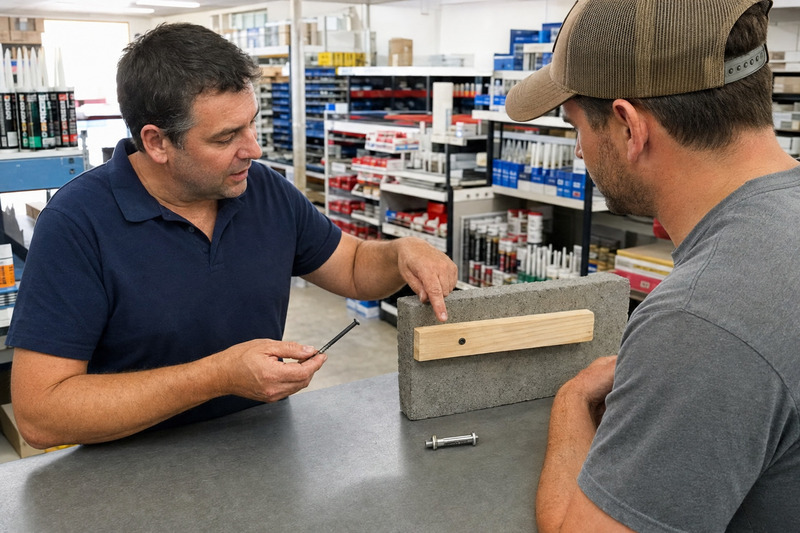
A concrete nail may be a small product, but complaints can become expensive when buyers sell by carton, pallet, or container. The problem is that end users often blame the product first. The solution is to control both product quality and usage explanation.
Wholesalers can reduce concrete nail complaints by choosing suitable specifications, checking samples, using clear packaging labels, and explaining application limits. They should avoid promising universal performance. They should also guide customers toward anchors or professional fastening systems when the job is heavy-duty or safety-critical.
Complaints Usually Come From Two Sources
In my experience, complaints often come from either product problems or application mismatch. A good buyer should manage both.
Product-related issues may include:
- Inconsistent length
- Uneven point shape
- Poor head forming
- Weak surface finish
- Excessive bending during normal use
- Breakage from poor treatment balance
- Poor carton packing
Application-related issues may include:
- Wrong substrate
- Wrong nail size
- Heavy load expectations
- Very dense concrete
- Hollow brick or weak block
- Poor installation angle
- Use where an anchor is more suitable
If a wholesaler cannot separate these causes, every complaint becomes a supplier dispute. That wastes time and damages trust.
Use Better Product Education
I suggest that wholesalers give simple guidance to retailers and end users. This guidance does not need to be technical. It only needs to be clear.
For example, packaging or sales staff can explain:
-
Use on suitable masonry only.
The nail is not for every wall condition. -
Choose the correct size.
Longer is not always better if the substrate is unsuitable. -
Do not use as a heavy-duty anchor.
Heavy or safety-related fixing needs proper fasteners. -
Check the surface before use.
Hollow, cracked, or very hard surfaces may need another solution. -
Stop if repeated bending or breakage happens.
The user should review the substrate and fastening method.
Build a More Defensible Product Line
A wholesaler can also reduce complaints by offering more than one fastening option. For example, the buyer may stock:
| Product | Better For | Important Limit |
|---|---|---|
| Concrete nail | Light to medium masonry fixing | Not for all substrates |
| Roofing nail | Roofing sheets and related applications | Not a masonry fastener |
| Black steel nail | General hardware applications | Must match use case |
| Lost head nail | Finishing work | Not for hard masonry |
| Expansion bolt | Heavier fixing | Requires correct installation |
| Plastic anchor and screw | Wall plug applications | Load and substrate matter |
This kind of product range helps retailers guide customers. It also prevents one product from being forced into every application.
Why Supplier Communication Matters
A reliable supplier should not only quote. A supplier should also ask questions. I often ask buyers about their sales market, packaging preference, and customer application. These questions help me avoid recommending the wrong item.
For example, if a buyer sells mainly to small hardware shops, box design and carton strength may be very important. If a buyer supplies construction distributors, consistent specification and delivery schedule may matter more. If a buyer wants to develop a private brand, OEM packaging becomes part of the product value.
At CHINABEST Hardware, we manufacture nails including concrete nails, black steel nails, lost head nails, and roofing nails. We focus on developing markets such as the Middle East, Africa, Southeast Asia, and South America. I mention this because market fit matters. Buyers in these regions often need practical quality, competitive FOB pricing, and flexible packing support.
Frequently Asked Questions
Can a concrete nail be used instead of an expansion bolt?
A concrete nail should not be treated as a full replacement for an expansion bolt. It is mainly for light to medium fixing in suitable masonry. Expansion bolts are usually chosen for stronger fixing systems, but the correct option depends on load, substrate, and professional evaluation.
Why do concrete nails bend during use?
Concrete nails may bend because the nail is too soft, the substrate is too hard, the size is wrong, or the user applies poor hammering technique. The issue is not always supplier quality. Buyers should check samples, specifications, and the real application before making conclusions.
Is a harder concrete nail always better?
A harder concrete nail is not always better. If the product becomes too brittle, it may break under impact. Buyers should look for a balanced product with suitable hardness, toughness, consistent forming, and proper heat treatment rather than asking only for maximum hardness.
What information should I send to get an accurate concrete nail quotation?
You should send product size, diameter, surface treatment, packing method, quantity, destination port, and target market application. Our FOB quotation usually depends on product, specification, quantity, and packaging. Clear information helps us quote accurately and avoid mismatched comparisons.
Can I order concrete nails with my own brand packaging?
Yes. We support OEM/ODM customization, including product requirements, packaging design, and brand logo. This is useful for hardware wholesalers who sell under their own brand. Buyers can request samples first to check quality, packing, and market suitability before bulk orders.
Conclusion
A concrete nail works because its material, heat treatment, hardness balance, and substrate match allow it to handle impact better than an ordinary nail. However, it is not suitable for every wall or every fixing job. Importers should compare suppliers by more than price. They should check samples, specifications, packaging, and real customer use. If you need concrete nails for wholesale, trial orders, or OEM packaging, contact CHINABEST Hardware at [email protected] or WhatsApp +8618331061136.
-
"Nail (fastener)", https://en.wikipedia.org/wiki/Nail_(fastener). A neutral reference on masonry nails describes them as hardened steel fasteners designed for driving into concrete, brick, or other masonry, supporting the article’s explanation of their material basis and impact function. Evidence role: definition; source type: encyclopedia. Supports: Masonry or concrete nails are made from hardened steel and intended to withstand impact when driven into masonry materials.. Scope note: Contextual support: the source may define the product category rather than verify the specific heat-treatment process of any individual manufacturer. ↩
-
"Selection Guide Anchors for Concrete Applications", https://www.itwredhead.com/Portals/0/Documents/Catalog/61-101_Mechanical_Anchoring_Systems_Section.pdf. Institutional guidance on concrete and masonry anchorage treats anchors and expansion fasteners as load-designed systems whose suitability depends on substrate, embedment, and loading conditions, supporting the distinction between concrete nails and heavy-duty fastening systems. Evidence role: expert_consensus; source type: institution. Supports: Load-rated anchors and expansion fasteners are selected and evaluated differently from simple nails, especially for heavy-duty or safety-critical fastening.. Scope note: Contextual support: such guidance may not compare concrete nails directly but supports the broader engineering distinction between light-duty nails and rated anchorage systems. ↩
-
"High-Performance Concretes, 1989-1994 – FHWA-RD-97-030", https://www.fhwa.dot.gov/publications/research/infrastructure/structures/hpc/97030/chap4.cfm. Experimental studies of fasteners and anchors in concrete and masonry show that substrate strength and material type affect pull-out resistance and failure behavior, supporting the article’s claim that identical nail sizes can perform differently in different walls or concrete grades. Evidence role: general_support; source type: paper. Supports: Concrete or masonry substrate properties influence fastener penetration, holding capacity, and failure mode.. Scope note: Contextual support: many studies focus on anchors rather than hand-driven concrete nails, but the substrate-dependence principle is directly relevant. ↩
-
"Wood Handbook, Chapter 08: Fastenings", https://research.fs.usda.gov/download/treesearch/37424.pdf. The USDA Wood Handbook discusses nails as conventional fasteners for wood construction, supporting the article’s statement that ordinary nails are primarily associated with wood or similarly softer materials. Evidence role: general_support; source type: government. Supports: Common nails are standard mechanical fasteners used in wood construction and carpentry applications.. Scope note: Contextual support: the source supports ordinary nail use in wood but may not explicitly state that all ordinary nails are unsuitable for masonry. ↩
-
"Withdrawal Strength and Bending Yield Strength of Stainless Steel Nails", https://research.fs.usda.gov/download/treesearch/49146.pdf. Research on steel fasteners and impact loading shows that deformation and fracture behavior depend on material strength, toughness, and the resistance of the receiving material, supporting the article’s discussion of repeated impact against masonry. Evidence role: mechanism; source type: paper. Supports: Steel fasteners subjected to impact loading can bend, deform, or fracture depending on material properties and substrate resistance.. Scope note: Contextual support: the source may address fasteners or steel impact behavior generally rather than concrete nails specifically. ↩
-
"Rapid Thermal Processing to Enhance Steel Toughness – PMC", https://pmc.ncbi.nlm.nih.gov/articles/PMC5765117/. University materials-science sources explain that heat treatment changes steel hardness and toughness and that increasing hardness without adequate toughness can reduce resistance to impact fracture, supporting the article’s statement that maximum hardness alone is not the design goal. Evidence role: mechanism; source type: education. Supports: Steel heat treatment involves balancing hardness with toughness because excessive hardness can increase brittleness or reduce impact resistance.. ↩
-
"Impact Fracture Surfaces as the Indicators of Structural Steel …", https://pmc.ncbi.nlm.nih.gov/articles/PMC10146829/. Materials-science teaching references describe the hardness-toughness tradeoff in steel and note that insufficiently controlled hardening can increase brittleness, supporting the article’s explanation of why a very hard nail may fracture under hammering. Evidence role: mechanism; source type: education. Supports: Higher hardness in steel can be associated with reduced toughness or increased brittleness if heat treatment is not properly controlled.. ↩
-
"Corrosion of Galvanized Steel in Soils", https://nvlpubs.nist.gov/nistpubs/jres/049/5/v49.n05.a02.pdf. Government or standards-based corrosion references explain that zinc coatings protect steel through barrier and sacrificial mechanisms, supporting the article’s claim that zinc coating affects corrosion resistance. Evidence role: mechanism; source type: government. Supports: Zinc coatings protect steel by acting as a corrosion-resistant barrier and sacrificial coating.. ↩
-
"Determination of Mortar Strength in Historical Brick Masonry Using the …", https://pmc.ncbi.nlm.nih.gov/articles/PMC7345265/. Research on masonry materials documents substantial differences in mechanical properties among concrete, brick, mortar, and aged masonry, supporting the article’s statement that these substrates behave differently during fastening. Evidence role: general_support; source type: research. Supports: Concrete, brick, mortar, and aged masonry can differ in strength, brittleness, porosity, and failure behavior.. Scope note: Contextual support: the source may describe masonry properties generally rather than testing concrete nails in each substrate. ↩
-
"A comparative analysis of compression bearing capacity in …", https://pmc.ncbi.nlm.nih.gov/articles/PMC10684658/. Studies of anchorage in masonry show that the strength and condition of the masonry unit influence pull-out resistance and failure mode, supporting the article’s caution that soft brick may not provide strong holding. Evidence role: general_support; source type: paper. Supports: Lower-strength masonry units can reduce fastener or anchor holding capacity.. Scope note: Contextual support: the cited work may measure anchors or screws rather than concrete nails, so it supports the substrate-strength principle rather than a specific nail rating. ↩
-
"Can You Use Concrete Anchors in Brick or Block? (What Actually Works)", https://buildtoolhq.com/post/can-you-use-concrete-anchors-in-brick-or-block. Institutional masonry-fastening guidance notes that hollow masonry units require fasteners suited to voided substrates and that inappropriate anchorage can lead to weak holding or unit damage, supporting the article’s warning about hollow block. Evidence role: expert_consensus; source type: institution. Supports: Hollow masonry units require appropriate fastening methods because thin webs, voids, and brittle units can reduce grip or cause cracking.. Scope note: Contextual support: the source may address anchors in hollow concrete masonry units rather than concrete nails specifically. ↩
-
"Federal requirements for the anchorages and connectors …", http://www.osha.gov/laws-regs/standardinterpretations/2011-02-08. Government construction-safety guidance commonly requires qualified evaluation for anchorage and safety-critical installations, supporting the article’s statement that load-bearing or overhead fixing should involve qualified professional advice. Evidence role: expert_consensus; source type: government. Supports: Safety-critical fastening and anchorage decisions should be evaluated by qualified personnel because loads, substrate conditions, and installation methods affect safety.. Scope note: Contextual support: the source may address construction anchorage and fall-protection systems broadly rather than concrete nails in retail masonry fixing. ↩