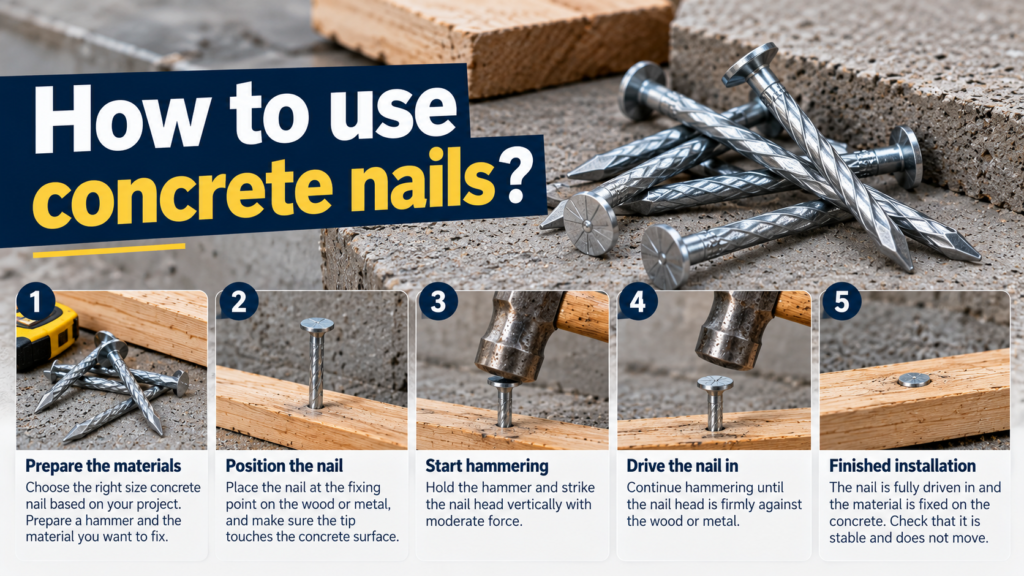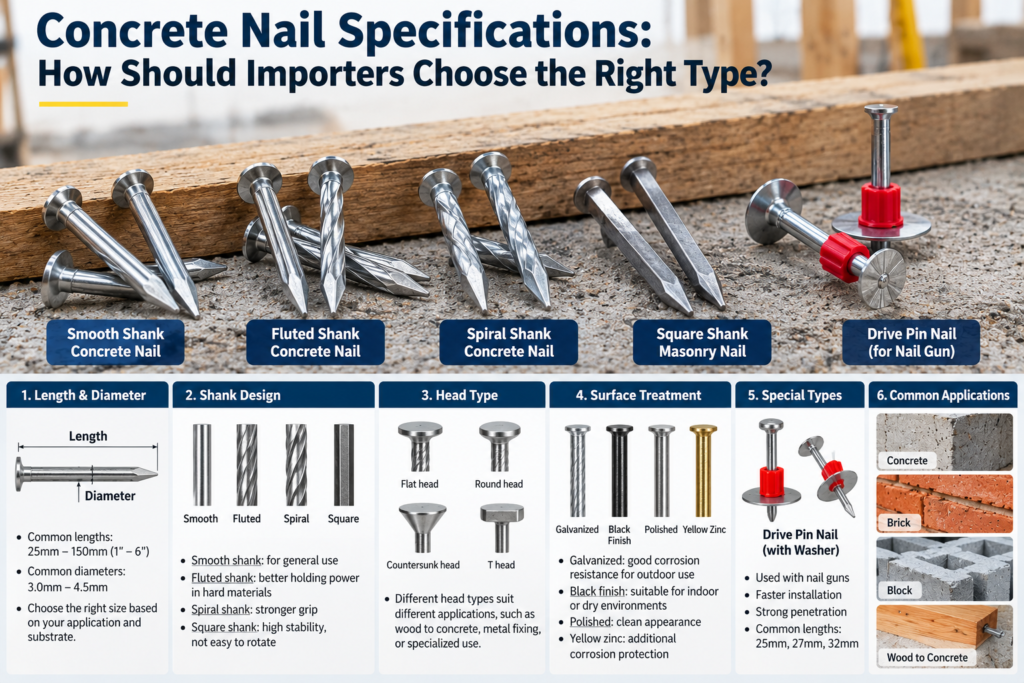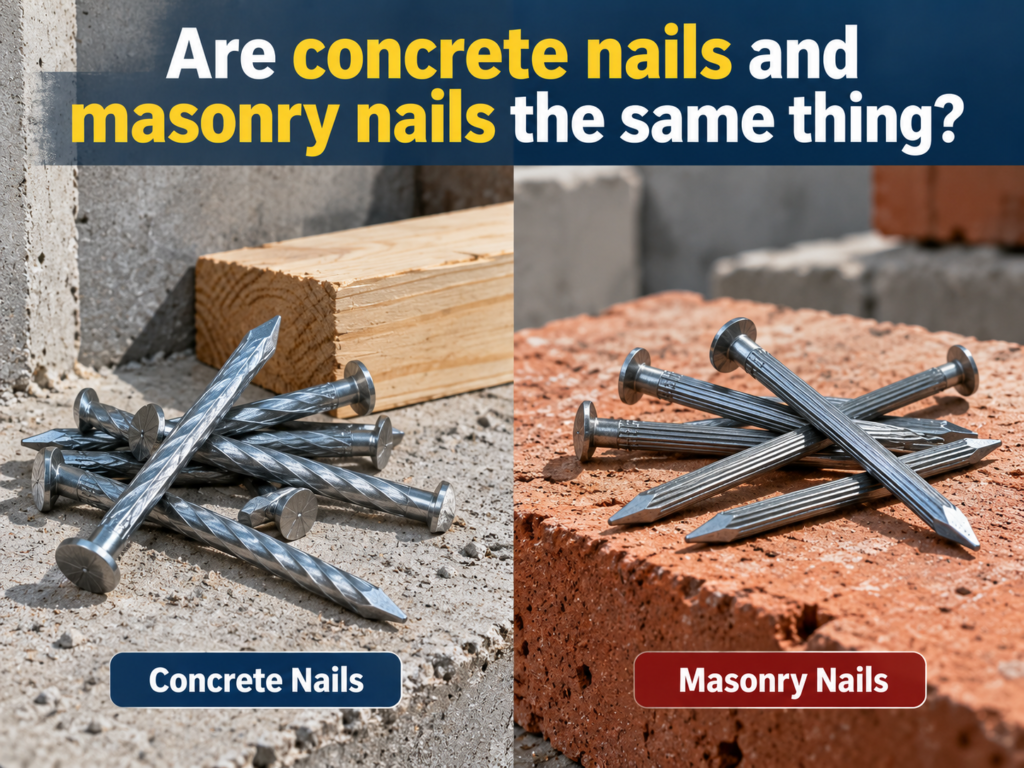
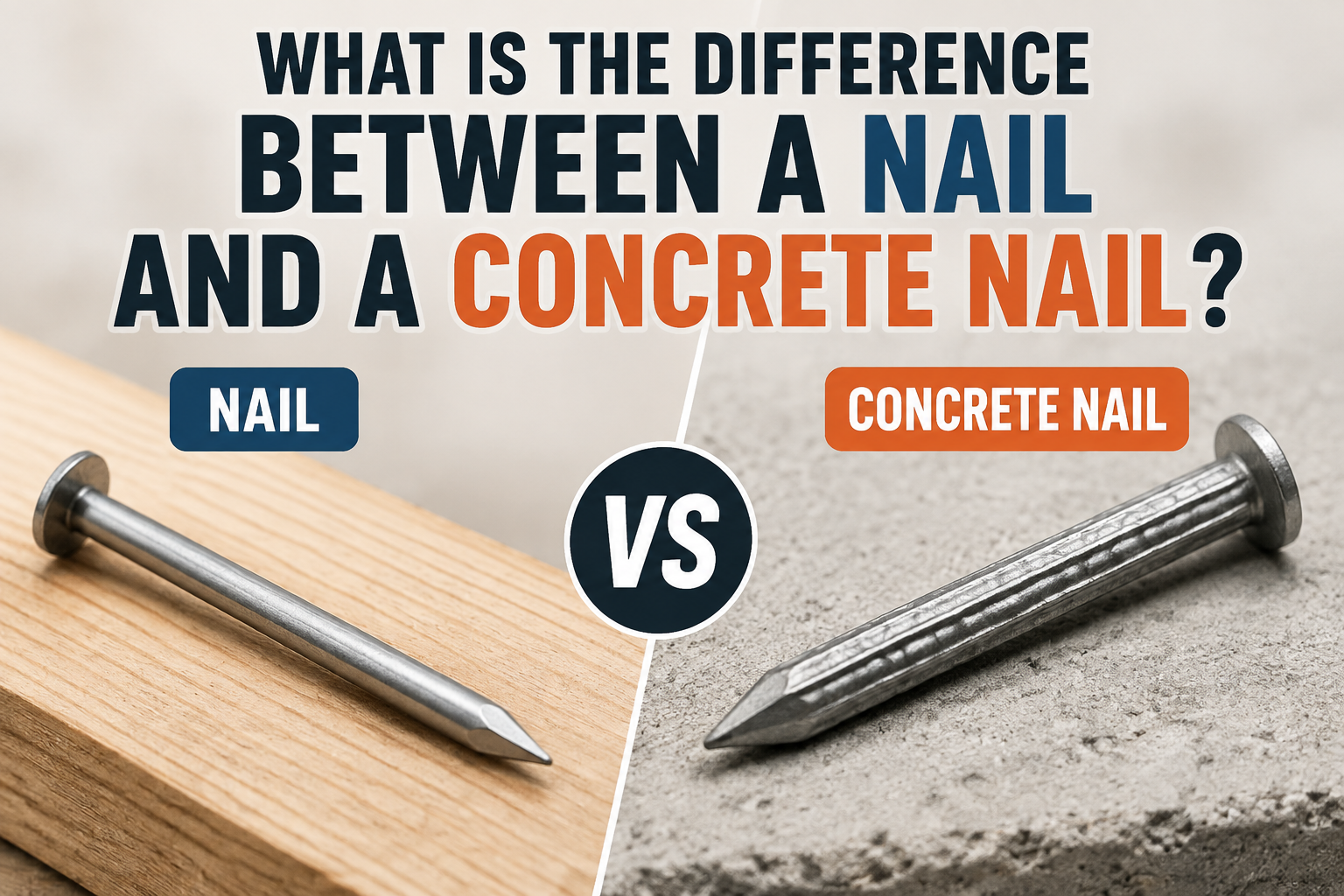
A concrete nail looks simple, but choosing the wrong nail can turn a small fastening job into bent nails, cracked surfaces, pull-outs, and customer complaints. I see this problem often when distributors compare regular nails with masonry nails only by price. The safer solution is to match the nail to the substrate first.
The main difference between a nail and a concrete nail is purpose: a regular nail is made for softer materials like wood, while a concrete nail is hardened and shaped to penetrate dense substrates such as concrete, brick, and stone.1 Regular nails usually bend in masonry; concrete nails grip better but cost more and are not always needed.2
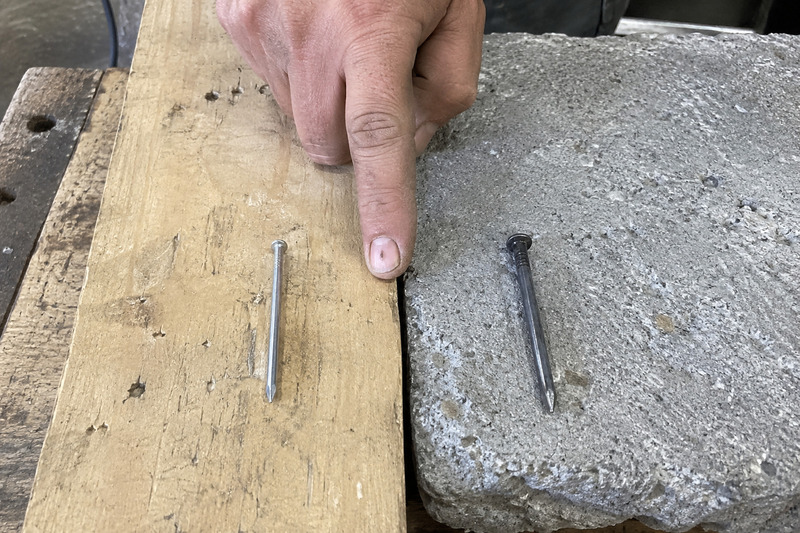
I do not treat this as a “which nail is better” question. I treat it as a product selection risk question. If a distributor sells the wrong nail to a contractor, the failure may look small, but the cost can become real through returns, complaints, and lost trust.
Why does a concrete nail perform differently from a regular nail?
Many buyers see two nails with similar length and diameter, then assume they can do the same job. That assumption creates problems. I have handled inquiries where customers wanted cheaper regular nails for masonry work, but their contractors later complained about bending and weak holding.
A concrete nail performs differently because it is designed for hard, dense surfaces. Its steel, heat treatment, and point design help it resist bending during impact and bite into concrete or brick.3 A regular steel nail is usually better for wood, where flexibility and easy driving matter more than masonry penetration.
Material choice is only the first part
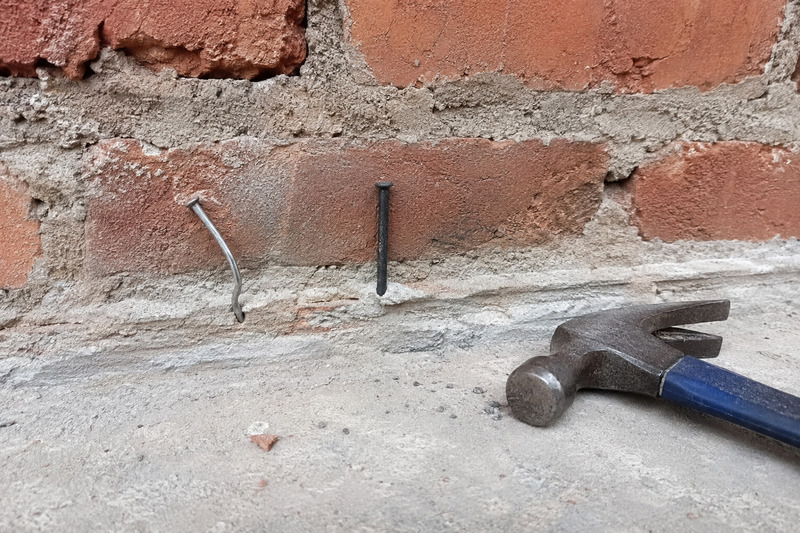
In simple terms, regular nails and concrete nails are made for different impact situations. A regular nail is usually meant to enter a material that can “give way,” such as timber, plywood, or soft board. The nail shank pushes fibers aside and holds by friction.4
Concrete does not behave like wood. It does not separate into fibers. It resists the nail.5 If the nail is too soft, it bends. If the point is not suitable, it skids or mushrooms. If the shank cannot survive the impact, it may break or fail to grip.
In our quality discussions with customers, I often explain the difference like this:
- Regular nails are more forgiving in soft materials.
- Concrete nails are harder and more aggressive for masonry.
- Harder does not always mean better for every job.
- The wrong nail fails in a visible way.
Heat treatment means hardness plus trade-offs
Many customers ask, “Is the concrete nail harder?” The short answer is yes, but that answer is incomplete. A hardened nail must balance two things:
| Factor | Regular nail | Concrete nail | Customer-visible result |
|---|---|---|---|
| Main use | Wood, boards, soft substrates | Concrete, brick, stone | Better match reduces failure |
| Impact behavior | More likely to bend in masonry | More likely to penetrate dense surfaces | Less time wasted on hard walls |
| Flexibility | Usually more forgiving | Less flexible due to hardening | Wrong use may cause breakage |
| Cost level | Lower | Higher | Price must be judged against risk |
A concrete nail is not magic. It is harder because it must survive impact against a hard substrate. However, hardening can also make steel less flexible.6 That is why I avoid telling buyers, “Use the hardest nail everywhere.” That advice can create waste or damage.
I usually tell distributors: “Do not compare nails only by hardness. Compare them by the material your customer will fasten into.”
Failure mode matters more than the product name
When a regular nail is used on concrete, several things can happen:
- The nail bends before entering the surface.
- The head deforms after repeated hammering.
- The point slips and damages the wall surface.
- The nail enters shallowly and pulls out later.
- The contractor loses time and blames the distributor.
These failures are not only technical problems. They are commercial problems. A box of cheaper nails may save money at purchase, but a complaint from a contractor can cost more than the difference.
I once handled a customer inquiry from a distributor who sold mixed hardware products. His buyer wanted nails for fixing small items to brick walls. The distributor first considered ordinary steel nails because the price looked attractive. I explained that if the wall was dense fired brick or concrete block, regular nails could create many returns. He later chose a masonry-grade product for that line and kept regular nails for wood-related orders. That is the correct way to think about selection.
When should I choose a concrete nail instead of a regular nail?
The confusing part is not the product photo. The confusing part is the job site material. If the distributor does not ask about the substrate, the buyer may choose by price alone. That choice may work on wood, but it can fail quickly on hard masonry.
You should choose a concrete nail when the fastening point is concrete, brick, stone, or another dense masonry surface, and when the installation method is suitable for impact fastening. You should choose regular nails for wood, plywood, soft boards, and other materials where masonry penetration is not required.
The substrate should guide the decision
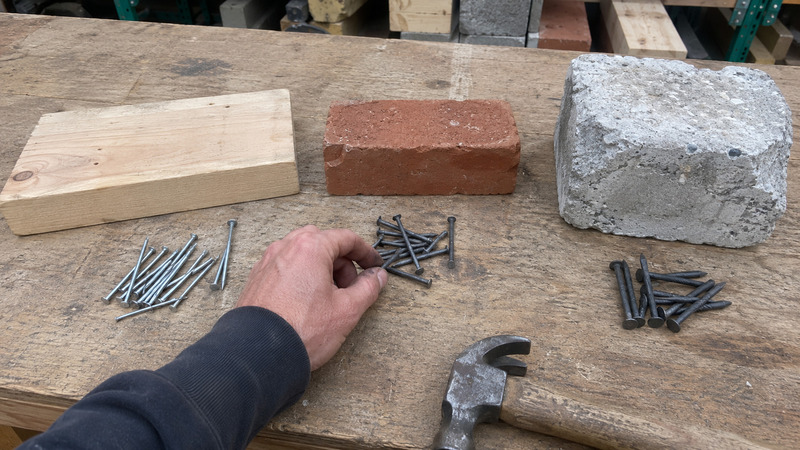
I recommend that distributors ask one simple question before quoting: “What material will the customer nail into?” This question prevents many wrong purchases.
Here is a practical selection table I use in sales conversations:
| Substrate | Better choice | Why it matters |
|---|---|---|
| Wood | Regular nail | Wood fibers allow easier driving and grip |
| Plywood | Regular nail | A masonry nail is usually unnecessary cost |
| Drywall with light backing | Regular nail or suitable anchor system | Holding depends on backing, not just nail hardness |
| Concrete wall | Concrete nail | Regular nails often bend or fail to penetrate |
| Brick wall | Concrete nail | Hard brick can reject soft nails |
| Stone surface | Concrete nail or specialized fixing method | Surface hardness and cracking risk must be checked |
| Hollow block | Case-by-case | Pull-out risk may be high; anchors may be needed7 |
This table is not a universal decision tree. Real selection depends on substrate density, thickness, installation method, and load requirement.8 Still, it gives importers and wholesalers a better starting point than comparing price per carton only.
Manual hammering and nail guns change the risk
A nail used by hand and a nail used with a fastening tool may face different stress. A contractor using a hammer may bend more nails if the surface is too hard or the angle is poor. A nail gun or powder-actuated tool may need a specific fastener type9, and distributors should not substitute products without checking the tool and application.
I stay careful here because I am a manufacturer and export sales specialist, not the project engineer on site. I can help buyers compare product types, packaging, samples, and quality control documents. For structural or safety-critical applications, I always suggest professional evaluation.
Project type also matters
Not every wall fixing has the same risk. A small temporary fixing is different from a heavy-duty installation. I advise customers to consider:
- Load type: light hanging, framing, cable fixing, or heavier use
- Surface hardness: soft block, red brick, reinforced concrete, stone
- Environment: indoor, outdoor, humid, coastal, or high-temperature areas
- Finish expectation: visible wall damage may cause customer dissatisfaction
- Removal need: temporary fastening may need a different solution
Why substitution can backfire
A common mistake is to ask, “Can I use a regular nail instead because it is cheaper?” Sometimes the real answer is yes, if the material is soft. But if the material is concrete or hard brick, the lower price can backfire.
For distributors in the Middle East, Africa, Southeast Asia, and South America, this matters because contractors often buy based on trust. If they receive nails that bend on the first job, they may not return to the same shop. The distributor then loses more than one order. He loses confidence in his own brand.
That is why I frame the difference this way:
- A regular nail is not “bad.”
- A concrete nail is not “always better.”
- The wrong nail is expensive when it causes failure.
Why do concrete nails cost more, and is the higher price justified?
Price is usually the first objection I hear. A buyer may say, “The sizes look similar, so why is the masonry nail more expensive?” If the answer is only “better material,” the customer may not be convinced. The better explanation connects price to risk reduction.
A concrete nail costs more because it usually requires harder steel, additional heat treatment, stricter process control, and packaging suited for heavier-duty use. The higher price is justified when it prevents bending, pull-out, job delays, returns, and damage to the distributor’s reputation in masonry applications.
Higher cost should be compared with failure cost
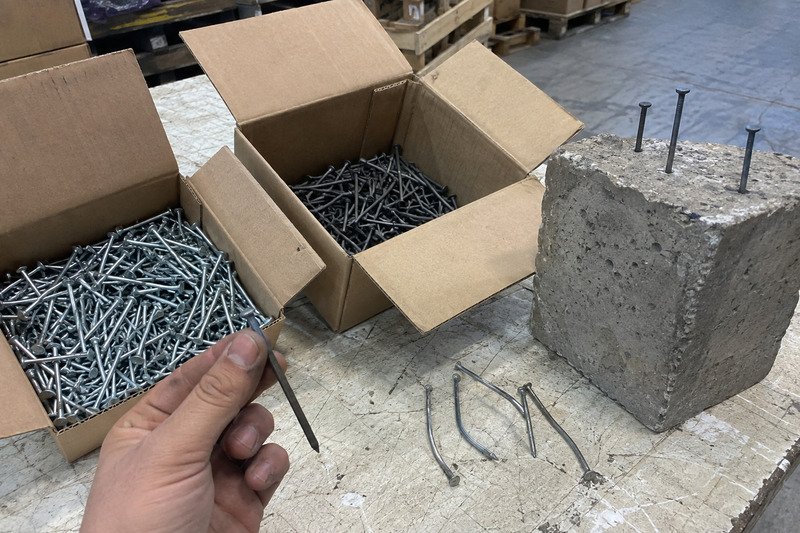
In many markets, concrete nails may cost around 1.5 to 2 times more than ordinary nails, depending on raw material cost, size, finish, packing, order volume, and FOB terms. I do not ask buyers to accept the higher price blindly. I ask them to compare it with the cost of failure.
A simple example helps:
| Cost item | Cheap regular nail used on concrete | Correct concrete nail used on concrete |
|---|---|---|
| Purchase cost | Lower | Higher |
| Bending during use | Higher risk | Lower risk |
| Contractor time loss | Higher risk | Lower risk |
| Returns or complaints | Higher risk | Lower risk |
| Repeat customer trust | Lower if failures happen | Better if product matches use |
For a distributor, the real product cost includes more than the invoice. It includes:
- Complaint handling time
- Replacement cost
- Damaged brand reputation
- Lost contractor loyalty
- Unsold stock if the market rejects the product
Quality control has commercial value
As a manufacturer, I see concrete nail quality as a combination of production control and application fit. Buyers should not only ask for the lowest FOB price. They should ask how the supplier controls common failure points.
Important evaluation points include:
-
Consistent hardness and heat treatment
The nail should be hard enough for masonry use, but not so brittle that it breaks too easily during normal impact. -
Point sharpness and shape
A poor point increases slipping, surface damage, and failed penetration.10 -
Head strength
The head should handle repeated hammer blows without deforming too quickly.11 -
Straightness of shank
Bent or poorly formed nails increase installation failure. -
Packing strength
Heavy nails in weak cartons create damage during sea freight and warehouse handling.12
Do not oversell concrete nails
I also tell customers when not to pay extra. If the buyer’s market mainly uses nails for wooden crates, furniture support, soft timber, or general carpentry, regular nails may be the better commercial choice. A masonry nail in wood may still enter, but the buyer may waste money because the product is over-specified.
This is where a distributor can build trust. Instead of pushing the expensive option every time, he can ask the contractor about the substrate and recommend the correct nail. That makes the shop look professional.
Risk insurance, not just markup
I like to describe the price difference as risk insurance. A distributor pays more for concrete nails when the application risk justifies it. This is especially important for private-label buyers who sell under their own brand. If the carton carries your logo, every failure becomes your brand’s problem.
For importers using OEM or ODM packaging, the product must match the promise on the box. If the package says “concrete nail,” customers expect performance on hard surfaces. That means the importer should request samples, check packaging clarity, and test the product in the target market before committing to larger volume.
At our factory, we can provide samples for quality checking, usually with a basic sample cost that may be discussed for return after formal order. I prefer this approach because it lets buyers reduce risk before importing container quantities.
How should distributors evaluate concrete nail suppliers before importing?
A supplier can quote a low price, but the distributor carries the market risk. If the product bends, breaks, or arrives in damaged cartons, the supplier may be far away while the importer faces the customer. I believe supplier evaluation must connect quality, packing, and trade terms.
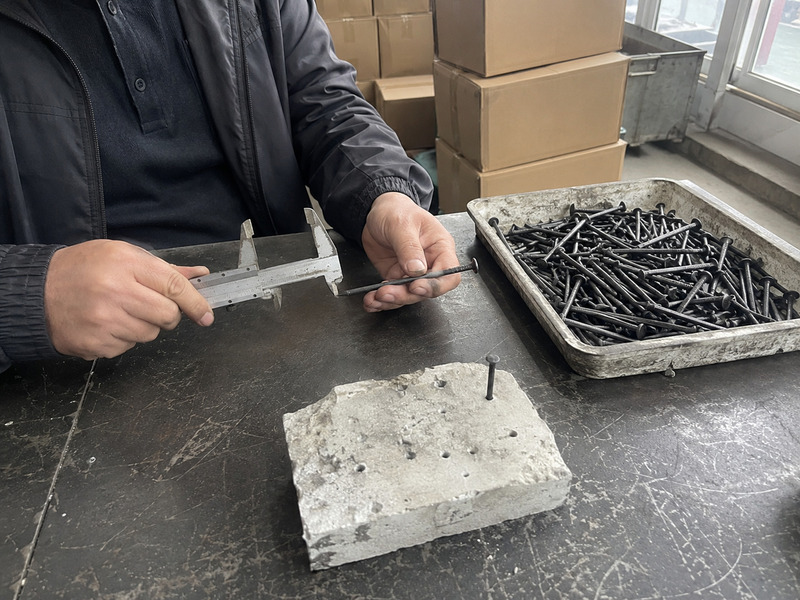
Distributors should evaluate a concrete nail supplier by checking product samples, production consistency, packing strength, FOB quotation details, realistic delivery time, and export experience in similar markets. Buyers should also verify any certifications or quality documents directly and test samples before placing larger orders.
Ask for complete quotation details
A useful nail quotation should not be only “price per ton.” I usually prepare FOB pricing based on:
- Product type
- Size and specification
- Quantity
- Packing method
- Brand or OEM requirements
- Loading method, such as FCL or LCL
- Destination market expectations
For example, a distributor in Dar es Salaam may sell mixed hardware products and have an agent in Yiwu. That buyer may need private-brand cartons, common local sizes, and packaging that looks acceptable in retail shops. A low price with weak packing may not be a good deal after sea freight and warehouse handling.
Review samples before scaling orders
I recommend sample checking because it creates a practical bridge between quotation and real market use. The buyer can examine:
| Sample check | What the buyer should look for | Why it matters |
|---|---|---|
| Nail straightness | No obvious bending | Reduces installation problems |
| Point shape | Clean, sharp, consistent | Improves penetration |
| Head shape | Even forming | Handles hammer impact better |
| Surface finish | No serious rust or defects | Supports resale quality |
| Carton design | Strong enough for export | Prevents damage and complaints |
| Label clarity | Correct size and product name | Reduces wrong sales |
I do not claim that a small sample can represent every possible job site. It cannot. But a sample can reveal obvious production or packaging problems before the buyer imports several tons.
Check the supplier’s market experience
A factory that understands emerging markets may help the distributor avoid wrong product positioning. Our main sales regions include the Middle East, Africa, Southeast Asia, and South America. These regions often value practical durability, strong packing, flexible branding, and trial-order support.
For many buyers, the minimum order quantity matters. Our usual MOQ is 5 tons or 200 cartons, depending on the product and packing. We also support trial orders, FCL, LCL, OEM/ODM packaging, and customized brand logos. Delivery is commonly 15–25 days, depending on order quantity and production schedule.
Verify documents, but do not rely on documents alone
Some buyers ask about certificates or quality documents. Documents can help procurement teams compare suppliers, but buyers should verify them directly. A certificate does not replace product testing, supplier communication, or application-specific evaluation.
I suggest this procurement checklist:
-
Confirm the application
Ask whether the nail will be used on concrete, brick, stone, wood, or mixed materials. -
Request matching samples
Do not test one size and order a completely different item without review. -
Check packing under export conditions
Weak cartons can destroy the sales value of good nails. -
Clarify FOB quotation scope
Make sure the quote includes correct product, specification, quantity, and packing. -
Discuss branding early
OEM packaging takes time and should match the target market language and style. -
Start with a trial order when possible
A trial order reduces risk before a larger repeat purchase.
Good supplier communication prevents wrong stock
A common mistake is to send only a photo and ask for “best price.” I understand why buyers do this. They are busy. However, a photo does not tell the supplier the substrate, market use, preferred packing, or expected quality level.
When a buyer gives me more context, I can guide the quote better. For example:
- “My customers use these nails for brick walls.”
- “I need a lower-cost nail for wooden crates.”
- “My market prefers black steel nails and concrete nails in small boxes.”
- “I sell under my own brand, so carton printing matters.”
- “I want to test 200 cartons first before a larger order.”
These details reduce misunderstandings. They also help the supplier recommend a product that fits the buyer’s real sales channel.
Frequently Asked Questions
Can I use a regular nail in concrete?
I do not recommend using a regular nail in concrete unless the surface is unusually soft and the fastening is not important. Regular nails often bend, deform, or fail to penetrate dense masonry. For concrete, brick, or stone, a concrete nail or another suitable fixing method is usually safer.
Can I use a concrete nail in wood?
You can sometimes drive a concrete nail into wood, but I usually see it as unnecessary cost. Concrete nails are designed for masonry impact, not cost-efficient wood fastening. For timber, plywood, and soft boards, a regular nail normally gives better value.
Why do concrete nails sometimes break?
Concrete nails can break when the substrate is too hard, the angle is wrong, the installation method is unsuitable, or the nail is too brittle. Hardness helps penetration, but it also reduces flexibility. Buyers should test samples in their target application before placing large orders.
Are concrete nails always better than regular nails?
No. A concrete nail is better only when the application needs masonry penetration. A regular nail is often better for wood and soft materials because it is cheaper and suitable for that substrate. The best nail is the one matched to the material and job requirement.
What information should I send when requesting a nail quotation?
I suggest sending product type, size, quantity, packing method, brand requirements, and target application. For FOB pricing, I also need order volume and packaging details. Clear information helps me quote accurately and avoid recommending a nail that does not fit your market.
Conclusion
The difference between a nail and a concrete nail is not just appearance or hardness. The real difference is application risk. Regular nails belong in wood and soft materials, while concrete nails are made for dense masonry where bending, pull-out, and contractor complaints are more likely. If you import or distribute hardware, I suggest you choose by substrate first, then compare price, packing, and supplier reliability. For samples, OEM/ODM packing, or FOB quotation support, you can contact us at [email protected] or WhatsApp +8618331061136.
-
"Nail (fastener)", https://en.wikipedia.org/wiki/Nail_(fastener). A general fastener reference defines masonry or concrete nails as hardened nails intended for driving into masonry materials, supporting the distinction between ordinary nails for wood and specialized nails for concrete or brick. Evidence role: definition; source type: encyclopedia. Supports: A neutral reference should define common nails and masonry or concrete nails and distinguish their intended substrates and hardening.. Scope note: Such a source supports the product-category distinction but may not address every regional nail specification. ↩
-
"Can You Use Nails in Bricks, Mortar & Cement? (Ramset Concrete Nail …", https://www.youtube.com/watch?v=WkO5AkgYuyQ. Educational construction references describe hardened masonry nails as suitable for concrete and masonry because ordinary nails can bend or fail to penetrate hard substrates, providing contextual support for the article’s performance comparison. Evidence role: general_support; source type: education. Supports: A university or educational construction reference should explain that hardened masonry nails are used for concrete or masonry where ordinary nails may bend or fail to penetrate.. Scope note: This would support the technical comparison, not a universal price ratio or all market-specific cost claims. ↩
-
"Threaded-nail Fasteners – Research and Standardization Needs", https://digitalcommons.georgefox.edu/cgi/viewcontent.cgi?referer=&httpsredir=1&article=1039&context=mece_fac. Materials-engineering sources on hardened steel fasteners explain that heat treatment increases hardness and resistance to plastic deformation, while point geometry affects penetration behavior; this supports the mechanism described for concrete nails. Evidence role: mechanism; source type: research. Supports: A materials or fastener-engineering source should explain how hardening, steel selection, and point geometry affect penetration and bending resistance.. Scope note: The source may discuss fasteners generally rather than the specific concrete nail model described in the article. ↩
-
"Wood Handbook, Chapter 08: Fastenings", https://research.fs.usda.gov/download/treesearch/37424.pdf. The USDA Forest Products Laboratory’s Wood Handbook describes nail withdrawal resistance as arising from the interaction between the nail shank and surrounding wood fibers, supporting the article’s explanation of nail holding in wood. Evidence role: mechanism; source type: government. Supports: A government wood handbook should explain how nails obtain withdrawal resistance in wood through friction and wood-fiber interaction.. ↩
-
"Effect of Treatment Methods on Material Properties and … – PMC – NIH", https://pmc.ncbi.nlm.nih.gov/articles/PMC11644647/. Materials-science teaching sources characterize concrete as a brittle cementitious composite and wood as an anisotropic fibrous material, supporting the article’s explanation that the two substrates resist nails in different ways. Evidence role: mechanism; source type: education. Supports: A university materials source should describe concrete as a brittle cementitious composite and wood as a fibrous material, explaining their different response to penetration.. Scope note: This supports the materials contrast, not the performance of a particular nail brand or size. ↩
-
"[PDF] Heat treatment and properties of iron and steel", https://nvlpubs.nist.gov/nistpubs/legacy/mono/nbsmonograph88.pdf. Materials-science references explain that heat treatment can increase steel hardness while reducing ductility, supporting the article’s caution that harder nails may be less flexible. Evidence role: mechanism; source type: education. Supports: A materials-science source should explain the trade-off between hardness and ductility in heat-treated steel.. ↩
-
"[PDF] Selection Guide Anchors for Concrete Applications – ITW Red Head", https://www.itwredhead.com/Portals/0/Documents/Catalog/61-101_Mechanical_Anchoring_Systems_Section.pdf. Masonry anchorage references note that fastener capacity in hollow masonry depends on the unit geometry, embedment, and anchor type, supporting the article’s warning that hollow block applications may require anchors rather than ordinary nails. Evidence role: general_support; source type: institution. Supports: A masonry anchorage reference should explain that hollow masonry units require appropriate anchors because pull-out capacity depends on web thickness, embedment, and load.. Scope note: The support is contextual because actual pull-out resistance depends on the specific block, fastener, embedment depth, and load. ↩
-
"Fastener Design Manual", https://ntrs.nasa.gov/api/citations/19900009424/downloads/19900009424.pdf. Fastener and anchorage design guidance treats substrate strength, member thickness or embedment, installation method, and applied load as core variables in selecting a fixing method, supporting the article’s selection framework. Evidence role: expert_consensus; source type: institution. Supports: An anchorage or fastener design guide should state that fastener selection depends on substrate characteristics, embedment or thickness, installation method, and applied loads.. Scope note: This supports the general selection principle rather than validating the article’s simplified table for all job-site conditions. ↩
-
"1915.135 – Powder actuated fastening tools.", https://www.osha.gov/laws-regs/regulations/standardnumber/1915/1915.135. OSHA and related safety guidance for powder-actuated and nail-gun tools emphasize using fasteners and charges appropriate to the tool and substrate, supporting the article’s caution against substituting incompatible fasteners. Evidence role: expert_consensus; source type: government. Supports: A government safety source should state that powered fastening tools must use appropriate fasteners and loads for the tool and substrate.. ↩
-
"Threaded-nail Fasteners – Research and Standardization Needs", https://digitalcommons.georgefox.edu/cgi/viewcontent.cgi?referer=&httpsredir=1&article=1039&context=mece_fac. Fastener standards and engineering references classify nail point forms and associate point geometry with driving and penetration behavior, supporting the article’s claim that poor point quality can contribute to slipping or failed penetration. Evidence role: mechanism; source type: institution. Supports: A fastener standard or engineering reference should describe nail point forms and their relevance to penetration and installation performance.. Scope note: The source may define point geometry and general performance mechanisms without measuring slipping for the exact nails discussed. ↩
-
"Compliance FAQs: Fastener Quality Act (FQA)", https://www.nist.gov/standardsgov/compliance-faqs-fastener-quality-act-fqa. Driven-fastener standards specify nail geometry and manufacturing requirements, including head characteristics relevant to driving performance, supporting the article’s quality-control focus on head strength. Evidence role: general_support; source type: institution. Supports: A driven-fastener standard should specify nail head dimensions, forming quality, or performance requirements relevant to driving without excessive deformation.. Scope note: The source may provide dimensional or classification requirements rather than a direct test of repeated hammer blows for a specific concrete nail. ↩
-
"ASTM D4169 Schedule A | Manual Handling Test …", https://lso-inc.com/news/astm-d4169-schedule-a/. Distribution-packaging standards such as ASTM D4169 and ISTA procedures address vibration, compression, impact, and handling hazards during transport, supporting the article’s point that weak cartons can lead to damage in sea freight and warehousing. Evidence role: general_support; source type: institution. Supports: A packaging-testing standard or transport-packaging institution should explain that packages must withstand vibration, compression, drops, and handling stresses in distribution.. Scope note: These standards support the general packaging-risk mechanism but do not quantify damage rates for concrete nail cartons specifically. ↩