

Sourcing tack strips for concrete subfloors is one of those procurement decisions that looks simple until the product arrives on-site and the installation crew discovers it won’t work. The wrong strip type causes carpet failure, wasted labor hours, and an urgent reorder — all of which eat directly into project margins.
Tack strips for concrete are a distinct product category from standard carpet tack strips. Concrete-specific strips require hardened steel pins or masonry nails capable of penetrating a cured concrete subfloor.1 Standard tack strips designed for wood subfloors use softer nails that will buckle or fail to drive into concrete entirely.2 Buyers who don’t confirm this specification before ordering frequently receive the wrong product.
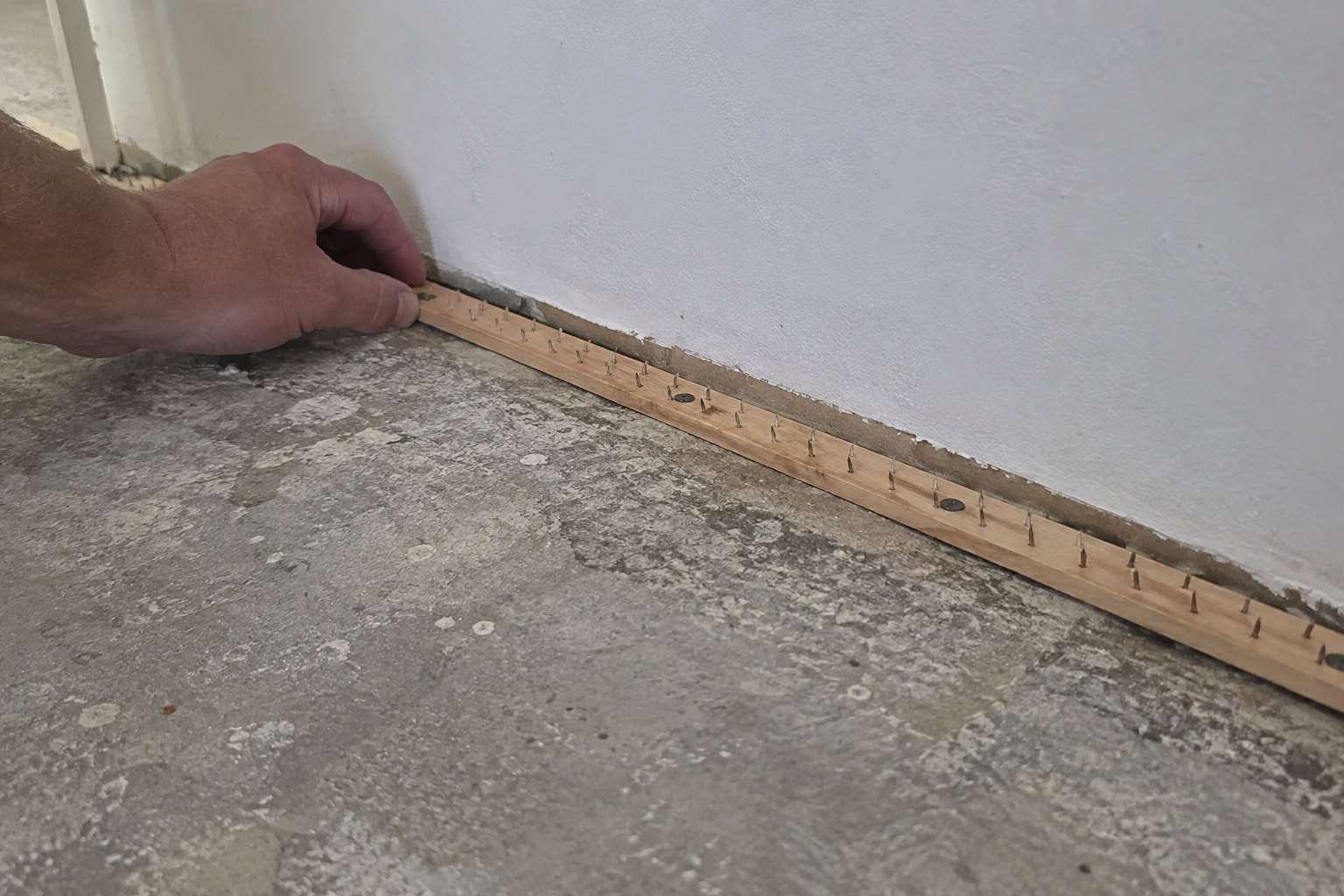
The distinction matters most when you are sourcing in volume. A wrong specification at 5 tonnes means hundreds of boxes that cannot be used as-is. The sections below break down exactly what separates concrete tack strips from standard alternatives, what to verify before you place an order, and what supplier behavior should raise a flag during the quoting process.
Are Tack Strips for Concrete Different from Standard Carpet Tack Strips?
Buyers comparing product listings often see similar dimensions and assume tack strips are a commodity. They are not. The subfloor material determines everything — strip gauge, nail type, pin hardness, and installation method all change when the subfloor changes from wood to concrete.3
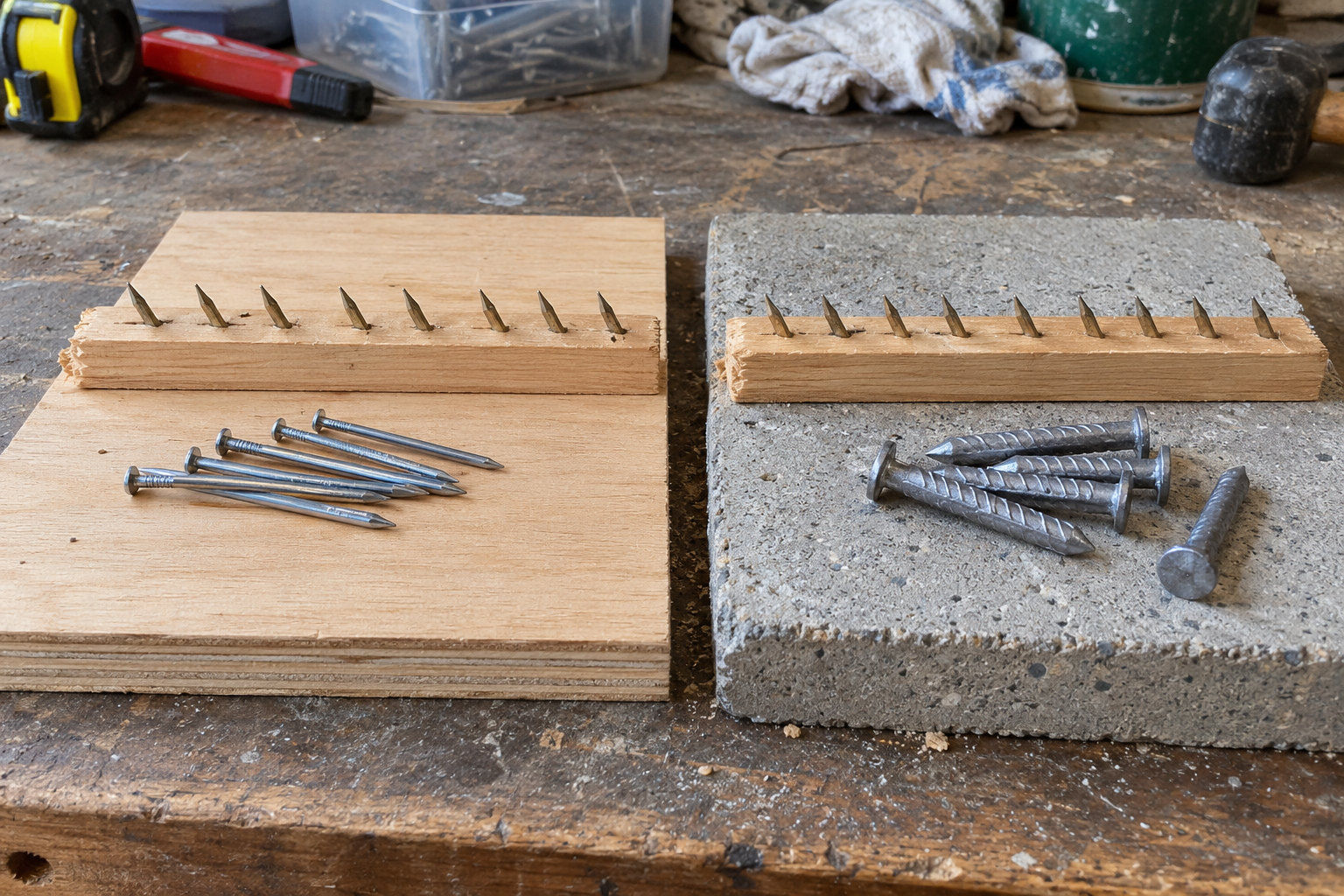
Standard carpet tack strips are manufactured for timber or plywood subfloors. The nails pre-loaded into those strips are mild steel, adequate for driving into softer materials. On a concrete subfloor, those same nails will bend, shear, or simply bounce back. The strip itself may also be thinner gauge than what a concrete application requires for stability.
What Changes When the Subfloor Is Concrete?
The core difference sits in three variables:
- Nail/pin hardness: Concrete nails are hardened steel — typically through a heat treatment process that raises Rockwell hardness well above standard wire nails.4 Mild steel nails used in wood-subfloor strips lack this treatment.
- Pin geometry: Concrete nails often have a fluted or square-shank profile that resists pull-out in a dense substrate.5 Round smooth shanks rely on friction that concrete does not provide the same way wood fiber does.
- Strip gauge: A thicker strip body is generally needed for concrete applications because the base material has no give.6 A thin strip on a hard concrete surface concentrates stress at the fixing points, making the strip more likely to crack or lift under carpet tension.
How Buyers We’ve Worked With Get This Wrong
We hear from buyers fairly regularly who ordered what their supplier listed as "carpet tack strips" — and only discovered the nail type issue when their installation crew reported failures on-site. The product photographs looked identical. The dimensions were similar. But the nail hardness specification was nowhere on the product page, and nobody asked about the subfloor before the order shipped.
In developing markets — particularly buyers in Southeast Asia, the Middle East, and parts of Africa — concrete subfloors are the default, not the exception. Residential and commercial construction in those regions almost universally uses poured concrete slabs.7 Yet a significant portion of the tack strip supply chain still defaults to wood-subfloor specifications unless the buyer explicitly requests otherwise.
Key takeaway: If your project has concrete subfloors, confirming nail hardness and pin type is not optional. It is the first specification you should lock down before any price conversation begins.
How Does Installation Method Affect the Product Specification?
Installation method is not just a site question — it directly determines which product specification you need to order. Buyers sometimes treat this as the installer’s problem, but by the time the product is on-site, it is too late to change the spec.
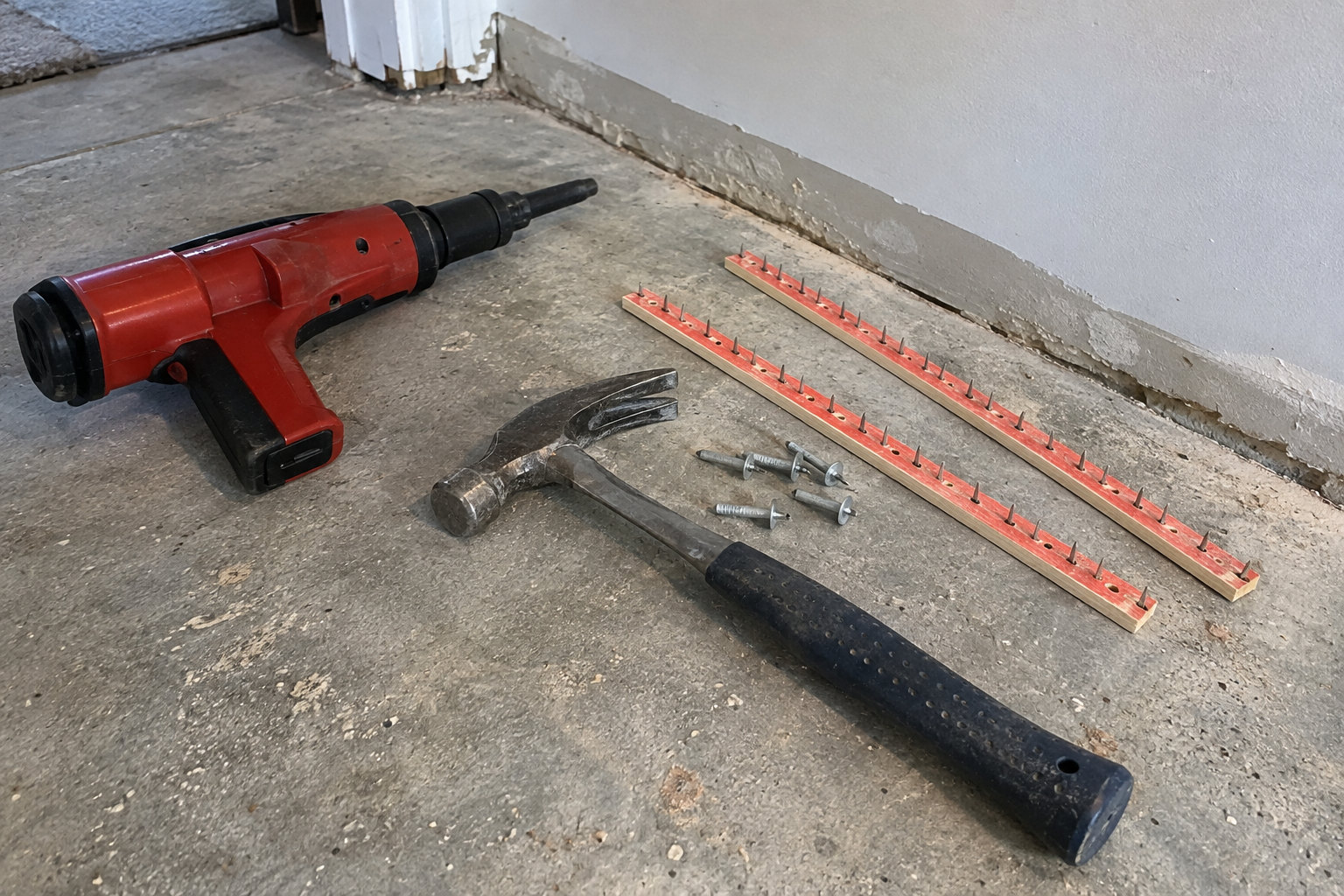
Concrete tack strips are typically installed one of two ways: driven manually with a hammer and hardened concrete nails, or fixed with a powder-actuated tool (PAT).8 The method available on-site should match the strip’s pre-drilled hole spacing, nail dimensions, and gauge.
Manual Hammer Installation
Manual installation uses hardened concrete nails driven through pre-punched holes in the tack strip into the concrete below. For this method, buyers need to confirm:
- Nail length vs. concrete depth: The nail must penetrate far enough into the concrete to anchor securely without hitting rebar or a void. Based on orders we have fulfilled for buyers in the Middle East, a common specification request is a 35mm–50mm concrete nail length for standard residential slab depths — but buyers should have their on-site team confirm the actual substrate before specifying.
- Hole spacing in the strip: Standard spacing is typically 200mm–300mm, but some installers prefer closer spacing for high-traffic areas.
- Whether nails are pre-loaded or sold separately: Some concrete tack strips are sold with pins pre-attached. Others ship as the strip only, with nails sold separately. Buyers who assume nails are included and don’t verify this discover the gap at the worst moment.
Powder-Actuated Tool (PAT) Installation
PAT installation is faster for large projects and common in commercial flooring work.9 The tool drives a pin through the strip and into the concrete in one action. If your buyer’s installation crew uses a PAT, the strip specification must accommodate:
- Correct pin shank diameter for the tool model in use
- Strip gauge compatibility — strips that are too thick may not be suitable for all PAT models
- Pre-drilled versus undrilled strips — some PAT systems require the strip to have no pre-punched hole; the pin makes its own entry
| Installation Method | Key Spec to Verify | Common Buyer Mistake |
|---|---|---|
| Hammer + concrete nail | Nail length, hardness, hole spacing | Ordering standard (mild steel) nails |
| Powder-actuated tool | Pin diameter, strip gauge, hole type | Ordering pre-punched strips for a PAT system |
| Adhesive + pin hybrid | Adhesive compatibility, climate, concrete porosity | Using in high-humidity environments without testing |
Why This Matters at Volume
For a procurement manager placing a 5-tonne order, getting the installation method specification wrong is not a minor error. A strip that ships with pre-punched holes will not work cleanly with certain PAT configurations. A nail length that’s 10mm short of what the substrate requires will result in strips pulling loose under carpet tension within weeks.10 Neither failure is visible in a product photograph or a basic price quote.
In our experience supplying buyers across Southeast Asia and the Middle East, the orders with the fewest post-delivery issues are always the ones where the buyer communicated the installation method upfront — before we quoted, not after we shipped.
What Should You Verify Before Placing a Volume Order?
The procurement decision for concrete tack strips involves more variables than most buyers expect at first. Price is the last thing to compare — not the first.
A checklist approach helps buyers avoid the most common specification gaps. Based on the orders we have fulfilled and the buyer questions we field most often, these are the variables that matter before any order is confirmed.
Pre-Order Specification Checklist
1. Subfloor condition
- Is the concrete cured and dry, or freshly poured?11
- Is the surface level, or does it have significant variation?
- Is the project residential or high-traffic commercial?
2. Nail and pin specification
- Nail material: hardened steel (for concrete) or mild steel (for wood only)?
- Nail length: measured against the slab depth on-site?
- Shank type: fluted, square, or smooth? (Fluted and square provide better pull-out resistance in concrete.)
- Are nails pre-loaded in the strip or sold separately?
3. Strip specification
- Strip gauge/thickness: typically 1.0mm–1.5mm for concrete applications, though buyers should confirm against their installation requirements
- Strip width: standard 1 inch (25mm), but project-specific variations exist
- Hole spacing and hole type: pre-punched vs. undrilled, relevant to installation method
4. Packaging and quantity
- Strips per box, boxes per carton — relevant to site logistics and storage
- MOQ compatibility: our minimum is 5 tonnes or 200 boxes
- FOB pricing basis: confirm product + specification + quantity + packaging before comparing quotes across suppliers
5. Sample verification
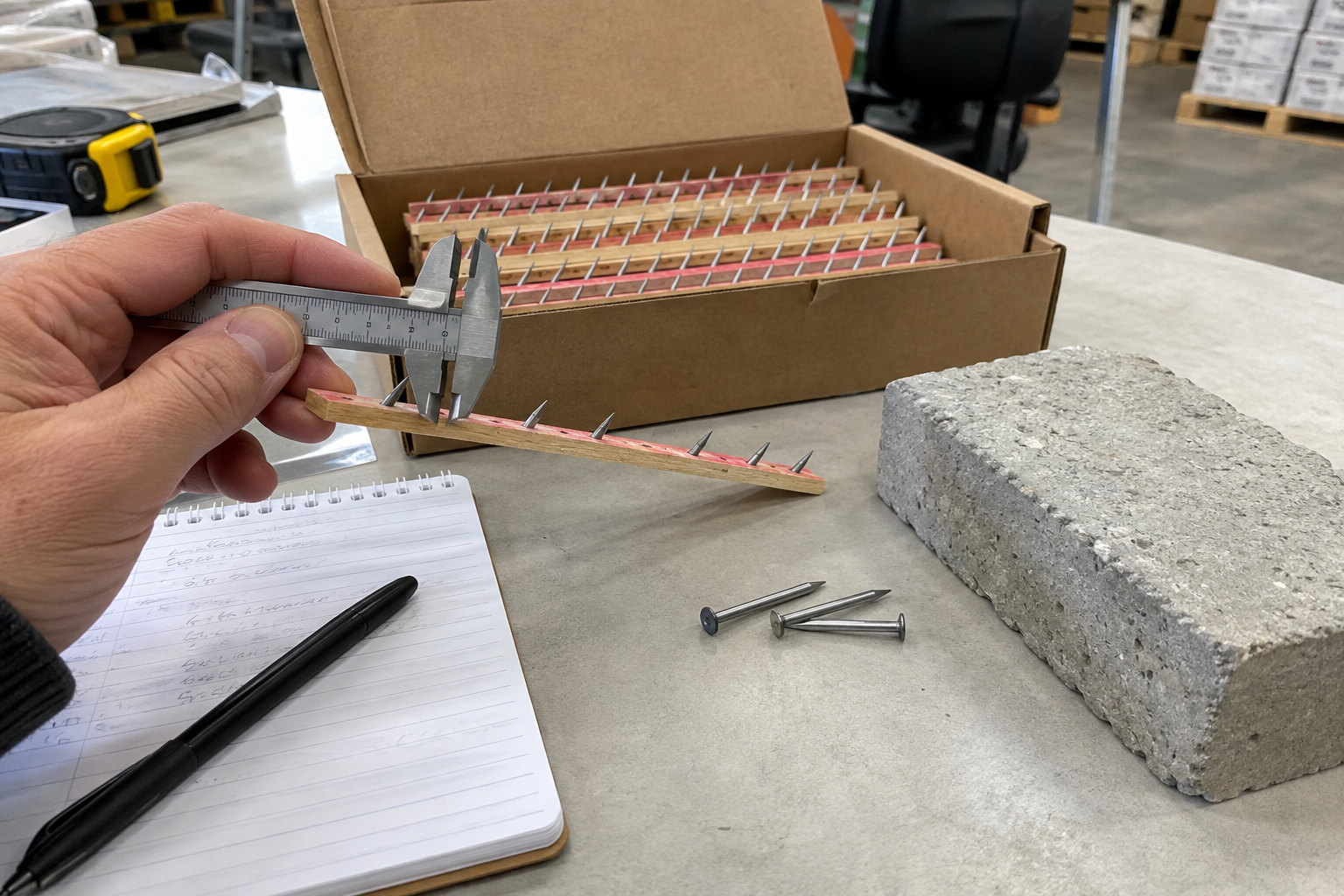
- Request a physical sample before committing to volume
- Test the nail hardness — a basic on-site test is whether a hardened concrete nail leaves a mark on mild steel; a qualified materials assessor can confirm Rockwell hardness for procurement confidence12
- We supply samples with a base fee that can be negotiated against the formal order
What Customization Is Available?
Buyers sourcing for branded flooring projects or private-label distribution in their market sometimes need customized packaging, product branding, or adjusted specifications. We support OEM/ODM for tack strip orders — including product specification adjustments, packaging design, and brand logo printing on cartons or strips. This is worth raising during the sample and quoting stage, not after production runs.
What Are the Red Flags When Evaluating a Tack Strip Supplier?
Supplier selection for technical hardware products is partly about specification competence — does the supplier understand what the product needs to do, or are they simply fulfilling a line item?
A supplier who quotes a price on tack strips without asking about subfloor type, installation method, or nail hardness is very likely selling a generic wood-subfloor product. For buyers whose projects are entirely on concrete, that is a direct path to a failed order.
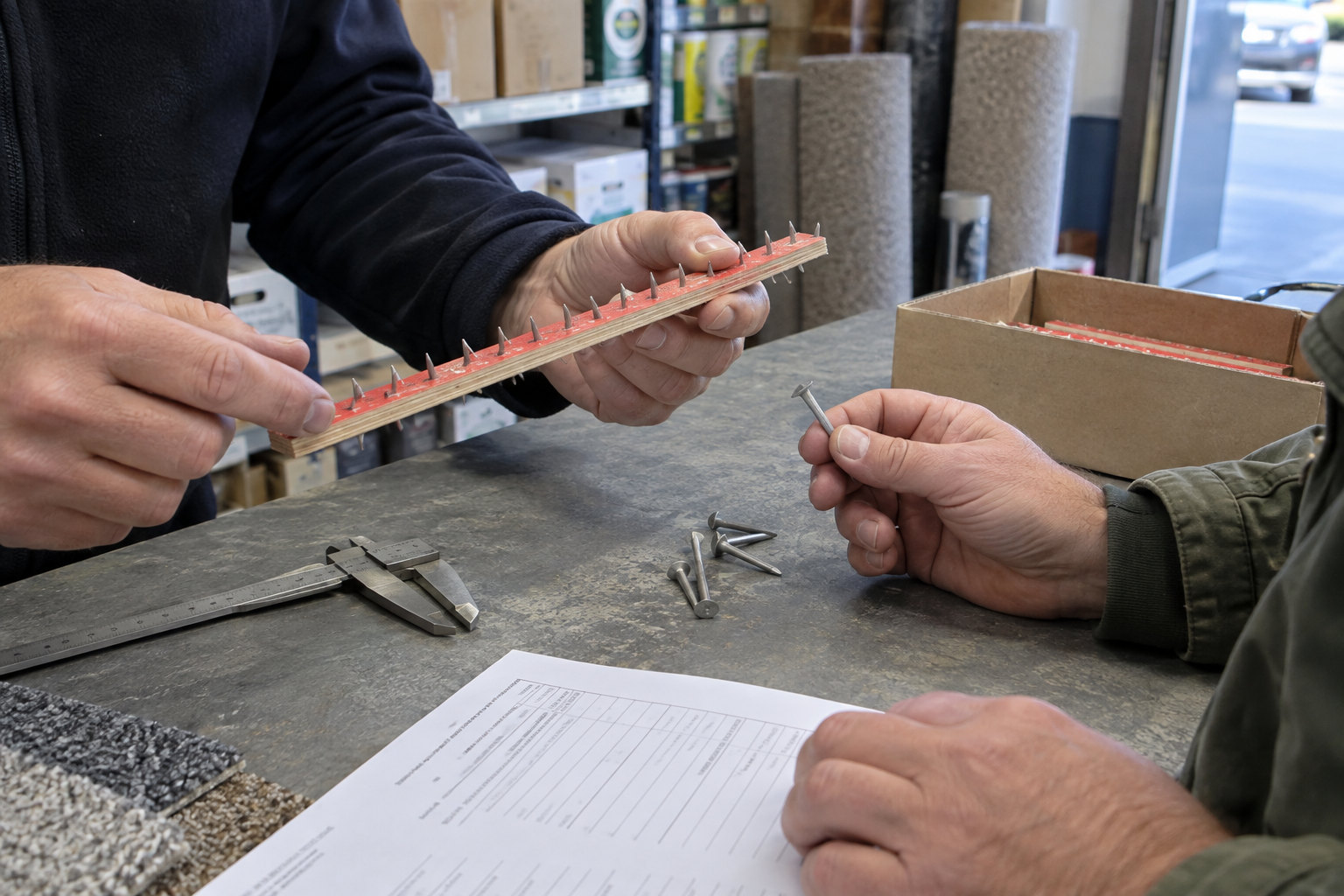
Specific Red Flags to Watch For
- No questions about application before quoting. A knowledgeable supplier should ask about subfloor type, installation method, and nail specification before generating a price. If they don’t ask, assume they don’t differentiate.
- No clear nail hardness specification on the product sheet. "Hardened steel pins" should appear explicitly in the product specification. If a supplier’s documentation only says "steel nails," that is not sufficient.
- Identical pricing for wood and concrete strip variants. Concrete-specific nail hardening adds cost. A supplier quoting identical prices for both product types may be supplying the same undifferentiated product under two labels.
- Inability to provide samples. For a volume order, sample refusal is a significant concern. Physical samples allow buyers — or their qualified on-site team — to do basic verification before committing.
- No confirmation of certifications or documentation. We present certifications as documents buyers should have verified by qualified parties. Request documentation and have it reviewed — don’t take claims at face value.
What Legitimate Supplier Communication Looks Like
Based on how we handle buyer inquiries, a straightforward procurement dialogue for concrete tack strips should cover:
- Buyer states: subfloor type, project scale, installation method available on-site
- Supplier proposes: nail specification, strip gauge, nail length, packaging format, FOB price basis
- Buyer requests: sample for on-site or lab verification
- Both parties confirm: order volume, lead time (our typical range is 15–25 days depending on quantity), and shipping method (FCL or LCL by sea)
If a supplier skips steps 1 and 2, the buyer carries all the specification risk.
Frequently Asked Questions
Can standard carpet tack strips work on concrete if I use a stronger adhesive?
Adhesive alone does not solve the core problem. Standard tack strips designed for wood subfloors have nail holes and pin placements optimized for softer substrates. On concrete, the structural issue is nail penetration and pull-out resistance — not surface adhesion. Buyers we’ve spoken with who tried this approach typically reported strip movement and carpet lifting under foot traffic.
How long does it take to receive a sample for verification before a volume order?
Sample timelines depend on your location and shipping method. We can prepare samples quickly, but international shipping to the Middle East, Southeast Asia, or Africa adds transit time. Factor two to four weeks for a sample-to-approval cycle before confirming production lead time of 15–25 days.
What is the minimum order quantity for concrete tack strips?
Our minimum order quantity is 5 tonnes or 200 boxes. For buyers testing a new specification or switching from a current supplier, we support trial orders — raise this during the initial inquiry and we can discuss what a trial volume looks like within that threshold.
Are concrete nails sold separately from the tack strips, or pre-loaded?
Both configurations exist. Some concrete tack strip products ship with pins pre-attached; others are supplied as the strip only, with concrete nails sourced separately. This is a specification variable buyers must confirm explicitly before ordering — do not assume either configuration without documentation from the supplier.
What packaging options are available for volume orders?
We support standard export carton packaging as well as OEM/ODM packaging with custom branding. For buyers distributing under their own label in regional markets, custom carton printing and product specification labeling are available — discuss this during the quoting stage, as it affects production scheduling.
Conclusion
Tack strips for concrete are not a generic hardware line item. The subfloor type changes the nail hardness required, the installation method changes the strip specification, and sourcing the wrong product on a volume order creates expensive on-site failures that could have been avoided at the specification stage. Before placing any order, confirm nail hardness, pin length, installation method compatibility, and whether nails are included with the strip.
If you are sourcing tack strips for concrete subfloor projects in Southeast Asia, the Middle East, Africa, or South America, contact Baoding Bester to discuss your specification. Reach us at [email protected], via WhatsApp at +8618331061136, or visit chinabesthardware.com. We support trial orders, sample supply, and OEM customization — and we will ask the right questions before we quote.
-
"Masonry Nails for Construction Projects", https://grip-rite.com/product/fasteners/hand-drive/nails/masonry-nails/. A construction fastening reference explains that concrete and masonry substrates require purpose-made hardened nails or fasteners because the substrate is much harder and denser than wood, supporting the need for concrete-specific tack-strip fasteners. Evidence role: mechanism; source type: institution. Supports: A neutral construction or engineering source should explain that concrete fastening typically uses hardened masonry nails or hardened steel fasteners designed to penetrate concrete.. Scope note: The source may address concrete fasteners generally rather than carpet tack strips specifically. ↩
-
"How to Drive Nails Into Concrete by Hand", https://www.thespruce.com/how-to-nail-into-concrete-by-hand-3573191. Technical construction guidance distinguishes common nails from hardened masonry or concrete nails and notes that non-hardened nails can deform when driven into hard masonry substrates, providing contextual support for the article’s warning about wood-subfloor tack-strip nails. Evidence role: mechanism; source type: education. Supports: A source should describe why common or ordinary nails are inappropriate for concrete and why hardened masonry nails are used instead.. Scope note: The support is contextual if the source discusses common nails generally rather than nails pre-installed in carpet tack strips. ↩
-
"Installing carpet strips on concrete subfloor", https://www.youtube.com/watch?v=lcv_0gpv9CE. Floor-covering installation guidance treats substrate type as a controlling condition for selecting fastening methods and related materials, supporting the article’s point that concrete subfloors require different tack-strip specifications than wood subfloors. Evidence role: expert_consensus; source type: institution. Supports: A flooring installation standard or industry manual should show that installation materials and fasteners vary according to subfloor type.. Scope note: The source may state the principle for flooring installation broadly rather than list every specification variable named in the article. ↩
-
"Hardened Steel Concrete Nails", https://www.hbcucheng.com/steel-nails/concrete-nails/hardened-steel-concrete-nails.html. Materials-engineering references describe heat treatment as a process used to increase steel hardness, and fastener specifications commonly identify masonry or concrete nails as hardened steel, supporting the article’s distinction from ordinary wire nails. Evidence role: mechanism; source type: research. Supports: A materials or fastener reference should support that heat treatment increases steel hardness and that concrete nails are hardened relative to ordinary wire nails.. Scope note: The source may not provide a direct Rockwell comparison between a specific tack-strip nail and a specific wire nail. ↩
-
"Withdrawal strength of ring-shank nails embedded in southern …", https://research.fs.usda.gov/treesearch/25675. Research and technical literature on fastener withdrawal shows that shank profile influences pull-out resistance, giving contextual support to the use of fluted or square-shank nails where mechanical grip in a dense substrate is required. Evidence role: mechanism; source type: paper. Supports: A source should explain that fastener shank geometry affects withdrawal or pull-out resistance in construction materials.. Scope note: The cited evidence may address fastener withdrawal mechanics generally and may not test carpet tack-strip nails in concrete directly. ↩
-
"Substrate Rigidity Effect on CAD/CAM Restorations at … – PMC", https://pmc.ncbi.nlm.nih.gov/articles/PMC10756807/. Engineering references on fastened joints and stress concentration explain that rigid substrates can concentrate loads around fixing points, providing contextual support for specifying a sufficiently robust tack-strip body on concrete. Evidence role: mechanism; source type: research. Supports: A source should support the general principle that rigid substrates and concentrated fastener loads affect stress and material stability.. Scope note: This would be contextual mechanical support unless the source specifically evaluates carpet tack-strip gauge on concrete. ↩
-
"Stocktaking of the Housing Sector in Sub-Saharan Africa", https://www.worldbank.org/content/dam/Worldbank/document/Africa/Report/stocktaking-of-the-housing-sector-in-sub-saharan-africa-summary-report.pdf. International housing and construction reports identify concrete and reinforced concrete as widely used structural materials across many urban markets in Asia, the Middle East, and Africa, supporting the article’s characterization of concrete subfloors as common in those regions. Evidence role: general_support; source type: institution. Supports: A source should document the prevalence of concrete or reinforced-concrete construction in the named regions.. Scope note: The wording ‘almost universally’ is stronger than most regional datasets can prove and may need to be softened unless a highly specific source is found. ↩
-
"How do I replace a carpet tack strip on a concrete floor?", https://www.reddit.com/r/DIY/comments/3jzvmg/how_do_i_replace_a_carpet_tack_strip_on_a/. Flooring installation guidance describes fastening tackless strip to concrete with concrete nails or power-driven fasteners, supporting the article’s distinction between manual nail installation and powder-actuated installation. Evidence role: expert_consensus; source type: institution. Supports: A flooring installation guide should describe accepted fastening methods for tack strips on concrete, including concrete nails and powder-actuated fasteners.. ↩
-
"1926.302 – Power-operated hand tools.", http://www.osha.gov/laws-regs/regulations/standardnumber/1926/1926.302. Occupational-safety and construction references describe powder-actuated tools as construction tools for driving fasteners into concrete, steel, and masonry, supporting the article’s statement that PAT fastening is an established method in commercial work. Evidence role: general_support; source type: government. Supports: A source should establish that powder-actuated tools are used in construction for fastening into concrete and masonry; a productivity source may support the speed claim.. Scope note: Government safety sources usually confirm use and hazards rather than directly quantify speed advantages. ↩
-
"Selection Guide Anchors for Concrete Applications", https://www.itwredhead.com/Portals/0/Documents/Catalog/61-101_Mechanical_Anchoring_Systems_Section.pdf. Concrete-fastener design literature shows that embedment depth is a key determinant of pull-out resistance, supporting the article’s warning that fasteners shorter than the substrate requires can allow tack strips to loosen under carpet tension. Evidence role: mechanism; source type: research. Supports: A source should support that reduced embedment depth lowers pull-out resistance of concrete fasteners and can lead to loosening under load.. Scope note: The source is unlikely to prove the specific ‘within weeks’ timeframe, so that timing should be treated as illustrative unless separately documented. ↩
-
"What is the acceptable moisture level in concrete", https://tramexmeters.com/learn/what-is-an-acceptable-moisture-level-in-concrete. Flooring standards and installation guidance require evaluation of concrete slab moisture and curing conditions before floor-covering installation, supporting the checklist item that distinguishes cured, dry concrete from freshly poured concrete. Evidence role: expert_consensus; source type: institution. Supports: A flooring or standards source should support checking concrete cure and moisture condition before installing floor coverings.. ↩
-
"Scratch hardness", https://en.wikipedia.org/wiki/Scratch_hardness. Materials-testing standards define Rockwell hardness as an indentation-based method for quantifying material hardness, while basic scratch testing is a qualitative indicator of relative hardness; this supports the article’s distinction between an informal on-site check and formal hardness verification. Evidence role: definition; source type: institution. Supports: A source should define Rockwell hardness testing and, ideally, explain that scratch testing is a qualitative comparison of relative hardness.. Scope note: Scratch testing can only provide a rough indication and should not be treated as a substitute for standardized laboratory hardness testing. ↩