
Choosing the right fastener is crucial for any construction project, and distinguishing between roofing nails vs concrete nails is a fundamental decision that can impact safety, durability, and cost. Many buyers, especially those managing diverse projects in regions like Africa or the Middle East, face the challenge of ensuring their downstream clients get the correct product for the job. Misunderstanding the core differences between these specialized nails can lead to costly failures and even dangerous situations, making informed selection paramount for successful construction.
The primary distinction between roofing nails and concrete nails lies in their intended application, material composition, and design1, which are engineered for vastly different base materials and stresses. Roofing nails are designed to secure roofing materials like shingles or felt to wood decking2, featuring a large, flat head and often a galvanized coating for weather resistance. Concrete nails, conversely, are made from hardened steel with a fluted or grooved shank, specifically designed to penetrate and hold securely within dense concrete, brick, or masonry without bending or breaking.

Understanding these differences isn’t just about technical specifications; it’s about making practical, project-critical decisions. Let’s delve deeper into what makes each type of nail unique and why their correct application is non-negotiable for project integrity and safety.
What are Roofing Nails, and When Do You Use Them?
Have you ever considered what makes a roof withstand years of sun, wind, and rain? The answer often lies in the seemingly simple roofing nails, which are engineered specifically for this demanding environment. However, using the wrong type or quality of nail can compromise the entire roofing system.
Roofing nails are specialized fasteners primarily used to secure roofing materials such as asphalt shingles, felt paper, and insulation boards to wood sheathing or decking. They are characterized by a wide, flat head that maximizes holding power and prevents pull-through, a relatively short shank, and often a galvanized coating to resist rust and corrosion in outdoor conditions.

Dive Deeper: The Anatomy and Application of Roofing Nails
From my experience working with various construction projects across Southeast Asia and South America, I’ve seen firsthand how critical the right roofing nail is. At 定州百斯特, our customers frequently inquire about the best options for their local climate challenges, whether it’s heavy rain or intense humidity.
Key Characteristics of Roofing Nails:
- Wide, Flat Head: This is the most distinguishing feature3. The large surface area helps to hold down roofing materials firmly, spreading the load and preventing tear-through, especially with softer materials like asphalt shingles. A typical roofing nail head can be 3/8" or 7/16" in diameter.
- Shank Design: While many roofing nails have smooth shanks, ring shank roofing nails are also popular. Ring shanks provide superior withdrawal resistance4, creating a stronger grip within the wood fibers, which is particularly beneficial in high-wind zones5.
- Length: Roofing nails are generally shorter than common framing nails, typically ranging from 1 inch to 2.5 inches6. The length needed depends on the thickness of the roofing material and the underlying sheathing, ensuring proper penetration without going through the entire roof deck unnecessarily.
- Material and Coating: Most roofing nails are made from steel. However, for outdoor applications, corrosion resistance is paramount. This is why galvanized roofing nails are the standard. Hot-dip galvanization provides a thick zinc coating that protects the steel from rust7, significantly extending the life of the roof. Other coatings, like electro-galvanization, also offer protection, though hot-dip is generally considered more durable for severe weather8.
Common Applications:
- Asphalt Shingles: The most common use, where nails are driven through the shingle to secure it to the roof deck.
- Felt Paper/Underlayment: Used to fasten waterproofing barriers beneath the primary roofing material.
- Roof Insulation Boards: Securing rigid insulation to the roof structure.
- Siding and Trim: In some cases, especially where weather resistance is crucial, wide-head galvanized nails are used for exterior siding.
Why Quality Matters:
In bustling construction markets like Dar es Salaam, I’ve observed that contractors prioritize durability. A poorly manufactured roofing nail, or one with an insufficient galvanized coating, will rust prematurely. This can lead to stains on the roof, weakening of the fastener, and ultimately, material detachment and leaks. At 定州百斯特, we manufacture Roofing Nails with robust galvanization suitable for the demanding climates of our target regions, understanding that quality directly translates to roof longevity. When evaluating suppliers, always ask about their galvanization process and verify certifications. For instance, our factory ensures consistent coating thickness and material strength through stringent quality control.
What are Concrete Nails, and Why Are They Different?
When faced with fastening something to a solid, unforgiving material like concrete, brick, or masonry, a standard nail simply won’t suffice. This is where concrete nails come into play, built for an entirely different purpose than their roofing counterparts. So, what sets them apart?
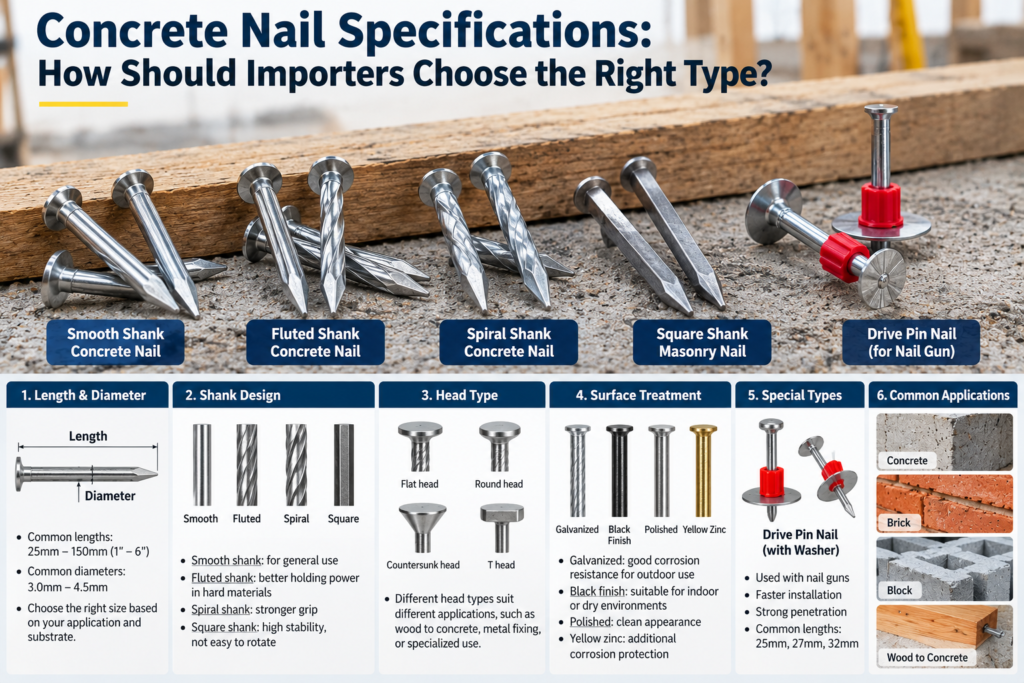
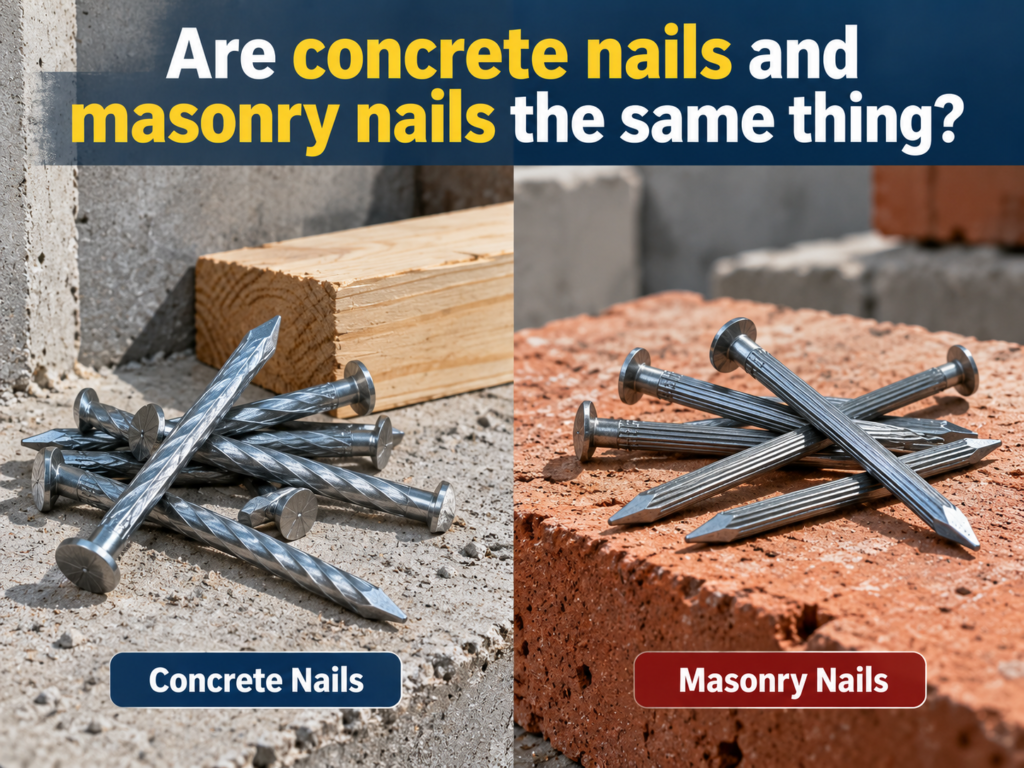
Concrete nails are specialized fasteners engineered from hardened steel9, designed to penetrate and securely anchor into dense and brittle materials such as concrete, brick, mortar, or concrete blocks. Unlike standard nails, their primary characteristics include extreme hardness, a specific shank design (often fluted or grooved), and a smaller head, all optimized for direct penetration into masonry without bending or breaking.

Dive Deeper: The Strength and Structure of Concrete Nails
From our experience supplying to construction projects in the Middle East and Africa, we know the immense strength and specific properties required for effective concrete fastening. Customers frequently ask about the best approach for securing everything from wooden battens to conduit clips to concrete walls.
Key Characteristics of Concrete Nails:
- Hardened Steel Construction: This is the most critical feature. Concrete nails undergo a special heat-treatment process (often carbon steel heat treatment) that makes them incredibly hard and brittle. This hardness allows them to penetrate dense materials without bending or mushrooming. This also means they cannot be hammered into wood, as they are likely to snap.
- Shank Design:
- Fluted/Grooved Shanks10: These are common. The flutes create channels that grip the concrete as the nail is driven in, enhancing holding power and preventing pull-out.
- Spiral Shanks: Some concrete nails feature a spiral or threaded shank, acting somewhat like a screw to provide even greater resistance to withdrawal.
- Smooth Shanks: While less common for heavy-duty concrete fastening, some smaller concrete nails may have a smooth shank for lighter applications.
- Head Design: Concrete nails typically have a smaller, often checkered or knurled, flat head compared to roofing nails. This design ensures that the hammer strike is concentrated, aiding penetration, and provides enough surface area for flush installation.
- Length: They come in various lengths, typically from 1/2 inch to 4 inches or more, depending on the depth of penetration required and the thickness of the material being attached.
Common Applications:
- Wood to Concrete: Attaching furring strips, wooden battens, or base plates to concrete slabs or walls.
- Metal to Concrete: Securing metal strapping, electrical conduit clips, or light-gauge metal track to concrete.
- General Masonry Fastening: Used in brick, block, and mortar joints for various light to medium-duty applications.
- Temporary Fixtures: Often used for temporary bracing or formwork in concrete construction due to their ease of installation compared to drilling and using anchors.
Why Professionalism is Key:
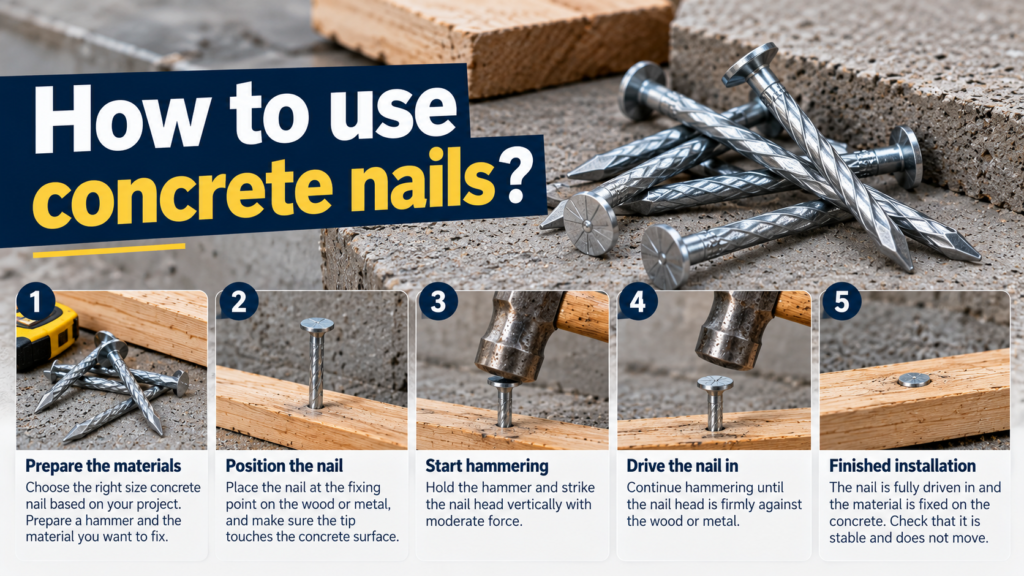
Driving a concrete nail requires specific techniques and, often, specialized tools. A heavy-duty hammer, sometimes even a powder-actuated tool for larger nails, is necessary. Safety glasses are absolutely essential due to the risk of nail fragments or concrete chips.11 Misusing concrete nails, such as attempting to drive them into oversized holes or using an insufficiently strong hammer, can cause them to bend, shatter, or ricochet. Our Concrete Nail products are manufactured to precise hardness standards, ensuring reliable performance when properly installed. When sourcing these fasteners, verifying the material specifications and heat treatment processes is paramount. As a manufacturer, 定州百斯特 provides full specifications and stands behind the quality of our hardened steel nails.
Why is Choosing the Right Nail Critical for Project Durability and Safety?
In the fast-paced world of construction, it might seem tempting to cut corners or use whatever fastener is on hand. However, the seemingly minor decision between roofing nails vs concrete nails can have catastrophic consequences, jeopardizing the entire project’s durability and the safety of its occupants. I’ve witnessed situations in Latin America where incorrect nail usage led to structural failures.
Selecting the correct nail for its intended application is not merely a preference; it is a fundamental requirement for ensuring the structural integrity, long-term durability, and safety of any construction project. Using a roofing nail in concrete or a concrete nail in wood can lead to premature material failure, compromised structural stability, property damage, and severe safety hazards.

Dive Deeper: The Perils of Mismatching Fasteners
The core thesis of my advice to wholesalers and contractors alike is that a nail is not just a nail. Each is designed for a specific purpose, and deviating from that purpose carries significant risks.
Consequences of Using Roofing Nails in Concrete:
- Bending and Failure: Roofing nails are made from softer steel than concrete nails. Attempting to drive them into concrete will almost always result in the nail bending, crumpling, or simply failing to penetrate the dense material.
- Lack of Holding Power: Even if a roofing nail somehow penetrates soft mortar, its smooth shank and softer material provide virtually no grip in concrete. It would easily pull out, offering no structural support.
- Damage to Tools and Materials: Forcefully hammering a roofing nail into concrete can damage hammers, shatter the nail, or chip the concrete, creating safety risks from flying debris.
- Compromised Structure: Any attempt to fasten something structurally important to concrete with roofing nails will result in an immediate and likely catastrophic failure of the connection.
Consequences of Using Concrete Nails in Wood or Roofing:
- Splitting Wood: Concrete nails are designed to be driven into dense, inelastic materials. When hammered into wood, especially near edges or in thinner pieces, their hardness and sharp penetration can easily cause the wood to split and crack.
- Poor Holding Power in Wood: While they might initially hold, the brittle nature of hardened steel concrete nails means they are not designed to flex with the natural movement of wood due to temperature and moisture changes. They are prone to snapping or losing their grip over time.
- Inadequate Head Size for Roofing: The smaller head of a concrete nail will easily pull through softer roofing materials like shingles or felt paper, especially under wind uplift or thermal expansion/contraction. It offers insufficient bearing surface.
- Corrosion Risk: Unless specifically coated (which most concrete nails are not for general use), the steel of a concrete nail is susceptible to rust when exposed to moisture, leading to premature failure in outdoor applications like roofing.
Real-World Examples from Our Markets:
I’ve encountered scenarios, particularly in construction sites in West Africa, where budget constraints or lack of specific product availability led to makeshift solutions. For instance, using smaller, ungalvanized concrete nails for temporary roofing repairs, only to see the roof fail after the first heavy rain due to rust and pull-through. Or, conversely, contractors attempting to secure heavy timber frames to concrete foundations with nails meant for wood, resulting in unstable structures that posed a serious safety risk to workers and future occupants. These situations underscore the importance of proper education and supplying the correct tools for the job. Investing in the right nail from the start, as supplied by a reliable factory like 定州百斯特, prevents much more expensive repairs and liabilities down the line.
How Do You Select the Best Supplier for Roofing Nails and Concrete Nails?
Once you understand the critical differences between roofing nails vs concrete nails and their applications, the next challenge for wholesalers is securing a reliable supply of high-quality products. With numerous manufacturers and distributors globally, how do you choose a partner that consistently meets your demands for quality, price, and delivery?
Selecting the best supplier for roofing nails and concrete nails involves a comprehensive evaluation of their manufacturing capabilities, quality control processes, certifications, customization options, and logistical efficiency, ensuring they can reliably meet the specific needs of your market and customers. This means looking beyond just the immediate price point to assess long-term value and partnership potential.

Dive Deeper: Partnering for Quality and Reliability
At 定州百斯特, we understand the procurement challenges faced by wholesalers, especially those operating in dynamic markets like the Middle East, Africa, and South America. From managing inventory to ensuring product suitability for local conditions, a strong supplier relationship is foundational.
Key Criteria for Supplier Evaluation:
-
Manufacturing Expertise and Quality Control (QC):
- Direct Manufacturer: Partnering with a factory like 定州百斯特 means direct access to the source, often leading to better pricing, shorter communication chains, and greater control over production. We own our production facilities, including those overseas, which provides flexibility and consistent quality.
- Material Sourcing: Inquire about their raw material sourcing. For concrete nails, the quality of high-carbon steel is paramount. For roofing nails, understanding the steel grade and galvanization process (e.g., hot-dip vs. electro-galvanized) is critical for corrosion resistance.
- In-house Testing: Does the supplier conduct rigorous testing for hardness (for concrete nails), pull-out strength, bending resistance, and coating thickness (for galvanized roofing nails)? Requesting test reports or certificates of conformity is good practice.
- Certifications: While specific certifications can vary by region, look for ISO standards (e.g., ISO 9001 for quality management) or adherence to international fastener standards. Always verify the validity of these certifications.
-
Customization and Product Range (OEM/ODM):
- Tailored to Market Needs: Do they offer a variety of sizes, gauges, head types, and finishes suitable for your specific market demands? For example, in some regions, a specific nail length for roofing or a particular coating for concrete nails might be preferred.
- OEM/ODM Capabilities: As a manufacturer, 定州百斯特 offers robust OEM/ODM support, allowing for custom product specifications, unique packaging designs, and the integration of your brand logo. This is crucial for wholesalers building their own brand presence.
- Packaging Options: Consider the practicality of packaging for your end-users. We offer various packaging solutions, from small boxes for retail to bulk cartons and drums, tailored to customer requirements.
-
Logistics, Pricing, and Samples:
- Pricing Structure: Understand the pricing mechanism. We typically offer FOB pricing, which requires clear communication about the product, specification, quantity, and packaging to provide an accurate quote. This transparent approach helps you manage your landed costs effectively.
- Minimum Order Quantity (MOQ): Our MOQ is 5 tons or 200 cartons, which is designed to support wholesale operations efficiently while reflecting production realities.
- Lead Time: Production and delivery timeframes are critical for inventory management. Our typical lead time is 15-25 days, adjustable based on order quantity. Consistent communication about production schedules is key.
- Shipping Options: We facilitate international shipping via sea freight, supporting both Full Container Load (FCL) and Less than Container Load (LCL) to cater to different order sizes and logistical needs in regions like South America and Africa.
- Sample Policy: Being able to inspect product quality firsthand is essential. We provide samples for quality inspection, with a basic fee that can be negotiated for return upon a formal order. This demonstrates confidence in our product quality.
-
Communication and Partnership:
- Responsiveness: A good supplier is responsive and communicates clearly, especially across different time zones. Our team, reachable via WhatsApp (+8618331061136) and email ([email protected]), is dedicated to prompt and clear communication.
- Support for Trial Orders: For new partnerships, the ability to place a trial order reduces risk. We actively support trial orders to establish trust and demonstrate our capabilities.
By thoroughly vetting suppliers against these criteria, wholesalers can forge strong, reliable partnerships that ensure a consistent supply of high-quality roofing nails and concrete nails, meeting diverse project demands and building trust with their own customer base.
Frequently Asked Questions
Can I use roofing nails for concrete fastening?
No, absolutely not. Roofing nails are made from softer steel and have wide heads designed for securing roofing materials to wood. They will bend, break, or fail to penetrate dense concrete12, offering no holding power and creating safety risks.
Are all concrete nails the same, or do they have different types?
Concrete nails come in various types, primarily differentiated by their shank design (fluted, spiral, smooth) and lengths. These variations are designed for different levels of holding power and specific applications within concrete, brick, or masonry.
What does "galvanized" mean for roofing nails, and why is it important?
"Galvanized" refers to a zinc coating applied to steel nails, which acts as a protective barrier against rust and corrosion. For roofing nails, this is crucial as they are constantly exposed to moisture, humidity, and varying weather conditions, ensuring the longevity of the roof.
How can I verify the quality of roofing nails or concrete nails from a new supplier?
You should request product specifications, material safety data sheets, and any relevant certifications (e.g., ISO, material test reports). Additionally, always ask for samples for visual inspection and to perform your own quality checks or send them for independent lab testing before placing a bulk order.
Conclusion
The distinction between roofing nails vs concrete nails is far more than a minor detail; it’s a critical factor in the safety, structural integrity, and long-term durability of any construction project. As we’ve explored, each nail is meticulously designed for specific materials and environments, making interchanging them a recipe for costly failures and potential hazards. Understanding these differences, from material composition to shank design and protective coatings, empowers wholesalers and contractors to make informed decisions that ensure project success.
At 定州百斯特, we pride ourselves on manufacturing high-quality Roofing Nails and Concrete Nails tailored to meet the demanding requirements of our global clients, especially across the Middle East, Africa, Southeast Asia, and South America. We invite you to leverage our expertise and reliable supply chain for your fastening needs. For specific project requirements, detailed product specifications, or to discuss OEM/ODM opportunities, please do not hesitate to contact us. We are ready to provide samples and support your procurement process with transparent FOB pricing and efficient sea freight options. Partner with us to build safer, more durable structures.
-
"Nail Application of Asphalt Shingles", https://www.asphaltroofing.org/nail-application-of-asphalt-strip-shingles-for-new-and-recover-roofing/. A construction fastener standard or technical reference distinguishes nail types by intended substrate, material properties, and geometry, supporting the general comparison between roofing nails and concrete nails. Evidence role: general_support; source type: institution. Supports: A neutral standards or technical source should support that roofing nails are specified for roof coverings or wood decking, while concrete nails are designed for masonry or concrete substrates with different material and shank requirements.. Scope note: Such a source would support the classification and design distinction generally, but may not compare these two nail types in the same explanatory wording used by the article. ↩
-
"Fact Sheet 3.3.1: Roof Systems—Sloped Roofs", https://www.fema.gov/sites/default/files/documents/fema_p-2181-fact-sheet-3-3-1-roof-systems-sloped-roofs.pdf?bdr_campaign=BDR-DIG-DIR-ROOF-KY-PHO-DIRECTORY-202510-LEXINGTONEXTERNALDIRECTORY. Building-code and roofing-installation guidance describes nails as the standard mechanical fasteners for attaching asphalt shingles and related roof layers to roof sheathing. Evidence role: general_support; source type: government. Supports: A government or building-code source should support that roofing nails are used to fasten asphalt shingles and underlayment to roof decking or sheathing.. Scope note: The source would substantiate common accepted practice, but exact nail dimensions and coatings may vary by code jurisdiction and roofing product. ↩
-
"Types of Nails", https://www.homedepot.com/c/ab/types-of-nails/9ba683603be9fa5395fab909c451e98. Fastener specifications for roofing nails identify a broad, flat head as a defining geometry used to bear against roofing materials. Evidence role: definition; source type: institution. Supports: A standards or technical reference should define roofing nails as having comparatively large heads intended to retain roofing materials.. Scope note: The citation would support the design feature, but the phrase ‘most distinguishing’ remains an editorial characterization. ↩
-
"Withdrawal strength of ring-shank nails embedded in southern …", https://research.fs.usda.gov/treesearch/25675. Engineering guidance and nail-withdrawal studies report higher withdrawal resistance for annular or ring-shank nails than for smooth-shank nails in wood substrates. Evidence role: mechanism; source type: research. Supports: A research, engineering, or government source should support that annular or ring-shank nails provide higher withdrawal resistance than smooth-shank nails in wood connections.. Scope note: The evidence usually concerns wood fastening performance generally; applicability to every roofing assembly depends on deck material, nail size, and installation quality. ↩
-
"Fact Sheet 3.3.1: Roof Systems—Sloped Roofs", https://www.fema.gov/sites/default/files/documents/fema_p-2181-fact-sheet-3-3-1-roof-systems-sloped-roofs.pdf?bdr_campaign=BDR-DIG-DIR-ROOF-KY-PHO-DIRECTORY-202510-LEXINGTONEXTERNALDIRECTORY. Wind-resistant construction guidance identifies improved nail withdrawal resistance as an important factor in roof performance under wind uplift, including the use of ring-shank or enhanced fasteners in some assemblies. Evidence role: expert_consensus; source type: government. Supports: A government wind-mitigation source should support the use of higher-withdrawal fasteners, such as ring-shank nails, for roof systems in high-wind regions.. Scope note: The source may address roof sheathing or wind mitigation broadly rather than roofing nails for every shingle product. ↩
-
"What Size Roofing Nails for Shingles? – RCAW", https://www.rcaw.com/what-size-roofing-nails-for-shingles/. Fastener specifications and roofing installation references list roofing nails in short lengths appropriate for shingle and underlayment attachment, commonly including sizes around 1 inch and longer variants for thicker assemblies. Evidence role: statistic; source type: institution. Supports: A standards or technical reference should support the common manufactured length range for roofing nails and the relationship between nail length and roof assembly thickness.. Scope note: The exact range depends on product type, roof covering, and local code requirements, so the citation would contextualize rather than exhaustively prove all market sizes. ↩
-
"The Influence of Hot-Dip Galvanizing on the Mechanical …", https://pmc.ncbi.nlm.nih.gov/articles/PMC8467660/. Materials references on hot-dip galvanizing explain that immersing steel in molten zinc creates a zinc coating that acts as a corrosion-protective barrier and sacrificial layer. Evidence role: mechanism; source type: institution. Supports: A materials or galvanizing authority should support that hot-dip galvanizing forms a zinc coating that provides corrosion protection for steel.. Scope note: The source would support the coating mechanism generally, while the service life of a specific roofing nail also depends on coating thickness, environment, and installation conditions. ↩
-
"Hot-Dip vs Electro-galvanizing: A Side-by-Side Comparison", https://southatlanticllc.com/blog/hot-dip-electro-galvanizing-differences/. Comparative corrosion references generally find that hot-dip galvanizing produces heavier zinc coatings than electro-galvanizing, which can improve durability in outdoor exposure. Evidence role: general_support; source type: research. Supports: A neutral materials source should support that hot-dip galvanizing typically produces a thicker zinc coating and greater corrosion resistance than electro-galvanizing for exposed steel fasteners.. Scope note: The comparison is contextual because actual performance depends on coating specification, zinc mass, atmospheric conditions, and contact with treated lumber or dissimilar metals. ↩
-
"Description for 3271: Concrete Block and Brick", http://www.osha.gov/sic-manual/3271. Technical references describe concrete or masonry nails as hardened steel fasteners used for attachment to concrete, brick, mortar, or masonry units. Evidence role: definition; source type: education. Supports: A neutral technical reference should define concrete or masonry nails as hardened steel nails intended for concrete and masonry substrates.. Scope note: The source would support the general definition; individual products may differ in alloy, heat treatment, and approved load capacity. ↩
-
"Withdrawal strength of ring-shank nails embedded in southern …", https://research.fs.usda.gov/treesearch/25675. Fastener engineering sources explain that fluted or grooved masonry-nail shanks improve mechanical interlock with the surrounding concrete or masonry compared with a plain shank. Evidence role: mechanism; source type: research. Supports: A technical or engineering source should support that flutes or grooves increase mechanical interlock or holding resistance in concrete or masonry substrates.. Scope note: The degree of holding power depends on concrete strength, embedment depth, installation method, and whether the fastening is intended for light-duty or structural loads. ↩
-
"1926.102 – Eye and face protection.", http://www.osha.gov/laws-regs/regulations/standardnumber/1926/1926.102. Occupational-safety guidance requires or recommends protective eyewear for construction tasks that can generate flying particles, including concrete chips or fastener fragments. Evidence role: expert_consensus; source type: government. Supports: An occupational-safety source should support the need for eye protection when work creates flying particles, chips, or fastener fragments.. Scope note: The source may address eye hazards in construction generally rather than hand-driven concrete nails specifically. ↩
-
"Nail Application of Asphalt Shingles", https://www.asphaltroofing.org/nail-application-of-asphalt-strip-shingles-for-new-and-recover-roofing/. Construction fastening references explain that concrete requires hardened masonry fasteners because ordinary steel nails are likely to bend or fail during penetration into dense concrete. Evidence role: mechanism; source type: education. Supports: A technical construction source should support that ordinary or softer steel nails are not suitable for direct driving into concrete, whereas hardened masonry nails are designed for that purpose.. Scope note: The evidence supports the general incompatibility; actual failure behavior depends on concrete hardness, nail dimensions, and driving method. ↩