Roofing Nails vs Coil Nails is a common buying question because the wrong fastener can slow installation, damage materials, or create costly rework. Many wholesalers hear mixed advice from roofers, carpenters, and contractors. I use this guide to help you compare application, tools, durability, and total cost before placing an order.
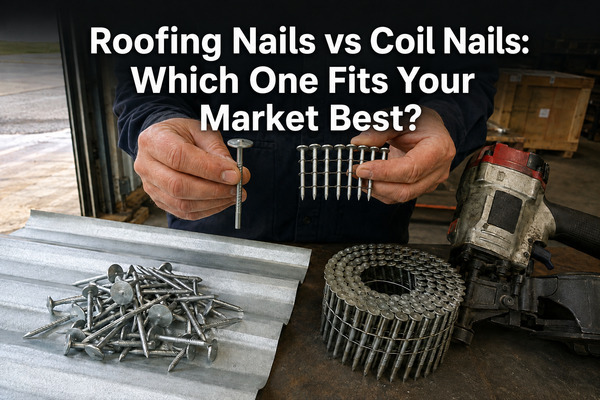
Roofing nails are mainly used to fasten roofing materials such as asphalt shingles, felt, and waterproof membranes, while coil nails are collated nails designed for nail guns and high-speed installation. The best choice depends on the job: roofing nails suit roof covering work, and coil nails suit repetitive fastening where tool efficiency matters.
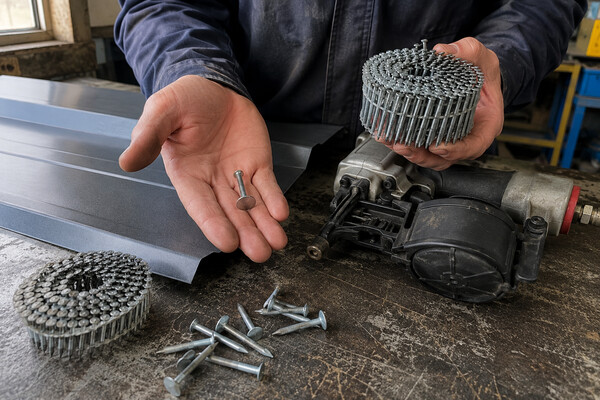
The key point is simple, but the buying decision is not always simple. Some coil nails are made for roofing nailers, while some roofing nails are sold loose for hand nailing. So I always ask buyers about the material, tool, market habit, packaging, and project scale before recommending one type.
What Is the Main Difference in Roofing Nails vs Coil Nails?
Many buyers compare these products as if they are two identical categories. That causes confusion. If I only look at the nail name, I may miss the real difference in application, head design, shank type, and installation method.
Roofing nails are defined mainly by their use in roofing systems, while coil nails are defined mainly by their collated format for pneumatic nail guns.1 In other words, roofing nails answer “where is the nail used?” and coil nails answer “how is the nail fed into the tool?”
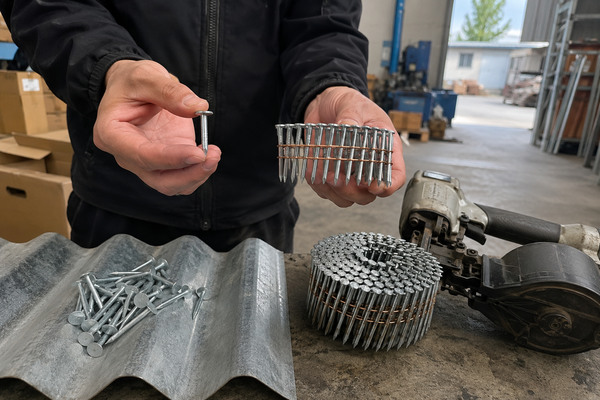
Roofing nails are application-focused
Roofing nails usually have a large flat head and a short to medium shank.2 The large head helps hold soft or layered roofing materials without tearing through them too easily.3 Common uses include:
- Asphalt shingles
- Roofing felt
- Waterproof membrane fixing
- Fiber cement roofing sheets in some markets
- Light roof covering repairs
The wide head matters because roof materials often need holding surface, not only penetration depth. If a buyer uses a small-head nail on shingles, the head may pull through under wind, heat movement, or poor installation pressure.
Coil nails are tool-focused
Coil nails are arranged in a coil and connected by wire or plastic.4 They are designed to feed into a coil nail gun. They can be used in many applications, such as:
- Pallet assembly
- Wooden crate production
- Fencing
- Sheathing
- Framing in some regions
- Roofing work when using roofing coil nails
This is why I avoid saying, “coil nails are not roofing nails.” That statement is too simple. A roofing coil nail can be both a roofing nail and a coil nail. The real question is whether the nail specification matches the job and tool.
A practical comparison table
| Factor | Roofing Nails | Coil Nails |
|---|---|---|
| Main definition | Based on roofing application | Based on collated feeding format |
| Common installation | Hand hammer or roofing nailer | Pneumatic coil nail gun |
| Typical head | Large flat head | Depends on application |
| Main advantage | Strong holding for roof coverings | High installation speed |
| Main buyer concern | Corrosion resistance and head holding | Tool compatibility and feeding stability |
| Common risk | Wrong shank or coating causes roof failure | Wrong collation angle or wire causes jams |
Why this difference matters in procurement
In my sales communication, I have seen buyers ask for “coil nails for roofing” when they actually mean roofing nails packed in bulk cartons. I have also seen buyers ask for “roofing nails” when their customer uses pneumatic roofing nail guns and needs coil-collated roofing nails.
That small misunderstanding can create big problems:
-
The nail may not fit the tool.
A coil nail gun requires the correct diameter, length, collation type, and angle.5 -
The nail may not fit the material.
A general wood coil nail may not have the right head size for roofing shingles.6 -
The coating may not fit the climate.
Coastal, humid, or high-rainfall markets often need better corrosion protection.7 -
The packaging may not fit local resale habits.
Some markets prefer small boxes for retail. Other markets prefer bulk cartons for contractors.
So when I compare Roofing Nails vs Coil Nails, I treat it as a decision about jobsite reality, not only a product name.
When Should Buyers Choose Roofing Nails vs Coil Nails for Real Projects?
Project selection becomes risky when buyers choose nails only by price. A cheaper fastener can look attractive at the warehouse level, but it can fail at the installation level. I prefer to match the nail to the material first, then review speed and cost.
Buyers should choose roofing nails for roof covering materials that need wide-head holding and weather resistance. They should choose coil nails when the project requires fast, repetitive fastening with compatible pneumatic tools. If the job is roof work with nail guns, roofing coil nails may be the correct middle option.
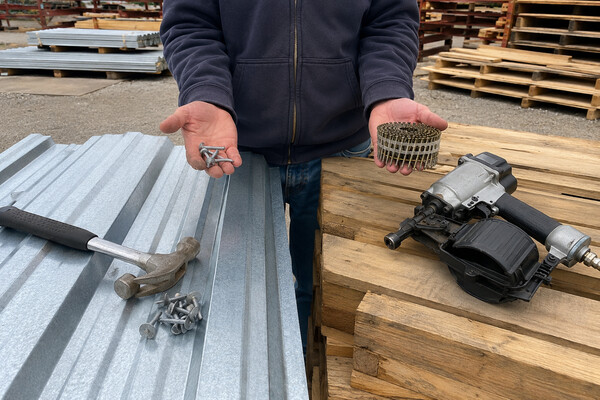
Match the nail to the material
The most important question is: What material will the nail fasten?
For roofing applications, the fastener must hold materials that face sun, rain, wind uplift, and temperature changes. A nail that works well in dry wood may not be suitable for roof coverings.
For wood assembly, the priority may be different. The buyer may need speed, penetration, withdrawal resistance, and stable tool feeding. In pallet factories or crate workshops, coil nails often help workers maintain output throughout the day.
Common use-case guide
| Project or Material | Better Choice | Why I Recommend It |
|---|---|---|
| Asphalt shingles | Roofing nails or roofing coil nails | Large head helps hold shingle layers |
| Roofing felt | Roofing nails | Wide head reduces tearing risk |
| Wooden pallets | Coil nails | Fast feeding improves production speed |
| Wooden crates | Coil nails | Good for repetitive fastening |
| Small roof repair | Loose roofing nails | Simple hand tools may be enough |
| Large roof installation | Roofing coil nails | Faster than hand nailing when tools are available |
| General carpentry | Coil nails or other construction nails | Depends on nail gun and wood thickness |
Why roofing nails should not be replaced casually
Some customers ask if they can use general coil nails for roofing because they already have stock. I usually advise them to be careful. A general coil nail may have:
- A smaller head
- A different shank profile
- A coating not suitable for outdoor exposure
- A length designed for wood assembly, not roofing layers
- A collation format for a different nail gun
If a contractor installs the wrong nail on roofing material, the result may not fail on day one. The problem may appear months later as loosening, leaks, or wind damage. That is why buyers should consider long-term performance, not only the invoice price.
My field-style experience with wrong selection
In one sales discussion, a buyer from a hot and humid market asked for a low-cost nail for roof covering work. The customer focused only on length and price. I asked about the roofing material, rainfall, and installation method. After that conversation, we found that a better-coated roofing nail was more suitable than the cheaper general nail they first requested.
That type of conversation is common. Buyers often know the target price clearly, but they may not receive complete technical feedback from the final installer. As a supplier, I cannot replace a professional project engineer, but I can help buyers ask better questions before they commit to container quantities.
Questions I suggest wholesalers ask customers
Before selling either option, I suggest asking:
- What material are you fastening?
- Will workers use a hammer or pneumatic nail gun?
- What nail size does the tool manual require?
- Is the project indoor, outdoor, coastal, or high-humidity?
- Does the local market prefer galvanized, black, or other finishes?
- Is this for retail resale or direct contractor use?
These questions reduce complaints. They also help wholesalers look more professional to their customers.
How Do Roofing Nails vs Coil Nails Compare on Speed, Tools, and Labor?
Labor cost can change the real price of a fastener. A nail that costs less per carton may cost more on the roof or in the workshop if it slows workers down. I always compare product cost with tool efficiency.
Coil nails usually provide faster installation because they feed continuously through pneumatic nail guns.8 Loose roofing nails can be practical for small jobs and repairs, but large roofing projects may benefit from roofing coil nails when workers have the correct nailer and air supply.
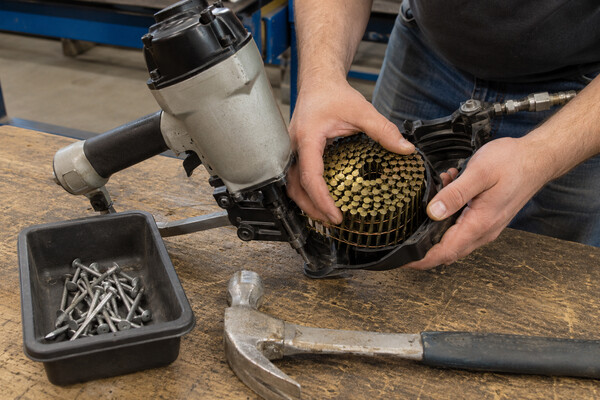
Tool compatibility decides real efficiency
Coil nails are not automatically efficient. They are efficient only when the nail matches the tool. Buyers should verify:
- Nail length range
- Nail diameter range
- Coil angle
- Wire collation or plastic collation
- Head diameter
- Shank type
- Magazine capacity
- Air pressure requirements
If the nail is slightly wrong, the user may face jamming, misfiring, bending, or tool wear.9 These problems can erase the expected labor savings.
Hand nailing still has a place
Loose roofing nails remain useful in many markets because they need only a hammer. This matters in regions where:
- Pneumatic tools are less common
- Contractors work on small roof repairs
- Electricity or compressor access is limited
- Retail customers buy in small quantities
- Labor cost is lower than tool investment
For wholesalers in Africa, the Middle East, Southeast Asia, and South America, I often see mixed demand. Some professional contractors want coil systems. Small builders and local shops still request loose nails because they are simple to sell and easy to use.
Speed comparison in practical terms
The exact speed depends on worker skill, tool quality, and jobsite layout. Still, the difference is clear.
| Installation Method | Typical Advantage | Typical Limitation |
|---|---|---|
| Hammer with loose roofing nails | Low tool cost and simple use | Slower on large areas |
| Roofing nail gun with roofing coil nails | Fast and consistent fastening | Requires tool, compressor, and correct nail specs |
| General coil nail gun with wood coil nails | High output in wood production | Not suitable for every roof material |
| Manual fastening in repair work | Flexible for small jobs | Lower productivity |
Total cost is more than nail price
When I help buyers compare Roofing Nails vs Coil Nails, I often suggest a simple total cost view:
Total cost = nail cost + tool cost + labor time + waste + rework risk + delivery reliability
This formula helps buyers avoid a common mistake. A low-price nail can become expensive if it causes:
- Frequent tool jams
- Higher rejection rate
- Worker delays
- Material damage
- Customer complaints
- Roof repair claims
When coil nails make strong business sense
Coil nails are especially useful when the buyer serves customers with regular production or large installation needs. Examples include:
-
Pallet and crate manufacturers
These users care about speed and repeatability. -
Large roofing contractors
These users may prefer roofing coil nails because they reduce hand nailing time. -
Timber workshops
These users often need consistent feeding and stable packaging. -
Government or commercial projects
These users may prioritize schedule control and uniform installation.
When loose roofing nails make better sense
Loose roofing nails can still be the better choice when:
- The project is small
- The end user does not own nail guns
- The market sells mostly through retail hardware shops
- Buyers need flexible carton distribution
- Local installers prefer traditional methods
- The project specification requires hand fastening
This is why I do not push one product as “better” in every case. The better fastener is the one that matches the buyer’s customer base and working conditions.
How Do Roofing Nails vs Coil Nails Perform Long Term?
A fastener does not finish its job when it enters the material. It must continue holding under weather, vibration, load, and time. If buyers ignore long-term performance, they may win the first sale but lose customer trust later.
Roofing nails need strong head holding and suitable corrosion resistance for outdoor exposure. Coil nails need consistent shank quality, coating, and collation strength for reliable fastening. Long-term performance depends on material, finish, shank design, installation quality, and the environment.
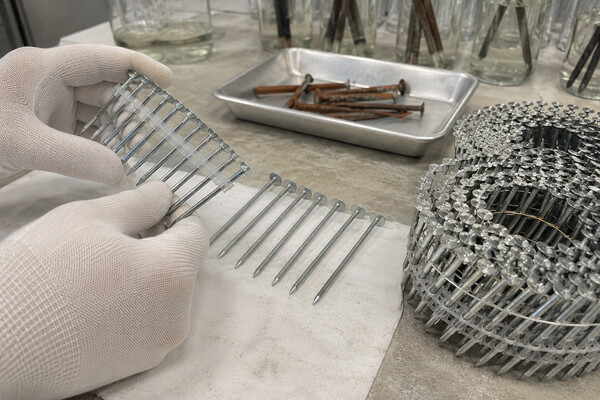
Corrosion resistance matters by market
Many of my customers sell into hot, humid, rainy, or coastal regions. In those markets, corrosion protection is not a small detail. Rust can weaken the nail and stain surrounding material.10 For roofing, corrosion can also contribute to leaks or loosened coverings.
Common finish options include:
- Bright finish for dry indoor use or low-corrosion needs
- Electro-galvanized finish for moderate corrosion resistance
– Hot-dip galvanized finish for stronger outdoor protection11 - Black finish where the market accepts it for specific uses
- Custom coating depending on buyer requirements
Buyers should not rely only on product names. They should request samples, check coating appearance, and verify documents where needed. For critical or regulated projects, they should also seek qualified professional evaluation.
Shank type affects holding power
The shank design changes how the nail grips the material.12
| Shank Type | Holding Character | Common Buying Note |
|---|---|---|
| Smooth shank | Easier driving | Lower withdrawal resistance |
| Ring shank | Stronger holding | Useful where pull-out resistance matters |
| Spiral shank | Better grip in some materials | May require careful tool matching |
| Screw shank | Strong holding action | Often used in special applications |
For roofing, the head and coating often receive the most attention, but shank choice also matters. In windy areas, weak holding can become a serious issue. For wood applications, ring or spiral shank coil nails may improve grip and reduce loosening.
Consistency is a hidden quality factor
Many buyers compare visible features first: length, diameter, head, and finish. Those are important. However, consistency is just as important in bulk procurement.
For coil nails, consistency affects tool performance. A small variation in collation or wire welding can lead to jamming. For roofing nails, inconsistent head shape or length can affect installation quality.
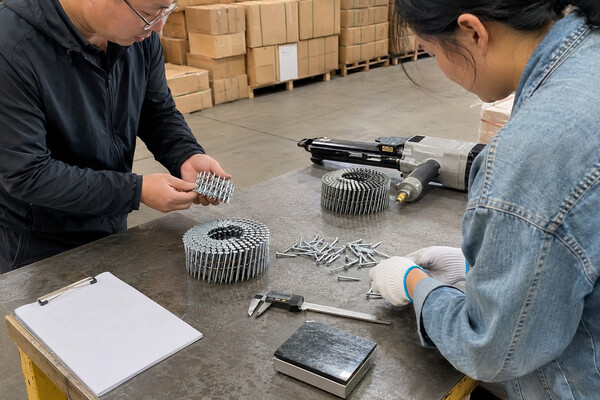
When I discuss trial orders, I usually suggest buyers check:
- Nail length tolerance
- Wire diameter consistency
- Head centering
- Point sharpness
- Coating uniformity
- Coil tightness and collation strength
- Carton strength for sea shipment
- Rust condition after storage testing
Rework risk is part of long-term cost
If a roof fails because of poor fastener selection, the nail cost is only a small part of the loss. The buyer may face:
- Replacement labor
- Damaged roofing materials
- Delayed project handover
- End-customer complaints
- Reduced trust in the wholesaler’s brand
That is why I always encourage wholesalers to think beyond initial unit price. A stable, suitable nail protects the buyer’s reputation. This is especially important for wholesalers who supply repeat contractors.
A practical quality control checklist
Before larger purchases, I suggest using a simple inspection plan:
- Confirm the application and nail specification.
- Request samples for physical checking.
- Test nails with the actual tool if coil nails are involved.
- Check packaging strength for sea freight.
- Review finish and corrosion expectations.
- Confirm production lead time and shipment plan.
- Keep a retained sample for future comparison.
This process is not complicated, but it helps buyers avoid many avoidable problems.
How Should Wholesalers Source Roofing Nails vs Coil Nails Reliably?
Sourcing becomes stressful when the supplier can quote a low price but cannot keep stable quality or delivery. I have seen buyers lose sales momentum because the second shipment did not match the first. Reliability is part of product value.
Wholesalers should source Roofing Nails vs Coil Nails by checking application fit, factory capability, sample quality, packaging options, lead time, and market demand. A good supplier should help confirm specifications, support trial orders, and provide consistent production for repeat business.
Start with your local market habit
A good sourcing decision starts with demand. Before buying, I suggest wholesalers review:
- Which nail sizes sell fastest
- Whether customers use hammers or nail guns
- Whether contractors prefer galvanized nails
- Which carton weight is easiest to resell
- Whether retail buyers request branded packaging
- Whether the market accepts OEM or private label
In some regions, loose roofing nails sell steadily through hardware shops. In other regions, large contractors may prefer coil nails because they already own pneumatic tools. The right product mix depends on local behavior.
Verify supplier production capability
For industrial fasteners, buyers should not evaluate only by catalog. They should also confirm whether the supplier can maintain stable production. At Dingzhou Best, we operate as a manufacturing factory and supply nails such as concrete nails, black steel nails, lost head nails, roofing nails, and related hardware fasteners. We also support OEM/ODM customization for product, packaging, and brand logo.
Still, I always advise buyers to verify the details they need:
| Sourcing Item | What Buyers Should Confirm |
|---|---|
| Product specification | Length, diameter, head, shank, finish |
| Application | Roofing, wood, pallet, crate, or other use |
| Packaging | Bulk carton, small box, buyer logo, label |
| MOQ | Whether the quantity matches purchasing plan |
| Lead time | Production time and shipment schedule |
| Sample policy | Whether samples can be tested before order |
| Shipment method | FCL or LCL by sea |
| Documentation | Certificates or inspection reports when required |
Understand MOQ, price, and delivery
For my business context, the usual minimum order quantity is 5 tons or 200 boxes. The normal quotation method is FOB, and the price depends on:
- Product type
- Specification
- Quantity
- Packaging method
- Custom branding requirements
Typical lead time is 15–25 days, depending on order quantity and production schedule. Shipping is mainly by sea, and both FCL and LCL can be discussed based on the buyer’s plan.
These details matter because a wholesaler must balance inventory risk and market demand. A trial order can be useful when the buyer wants to test a new size, finish, or packaging style before scaling up.
Samples reduce uncertainty
I support sample testing because it helps buyers avoid blind purchasing. Samples usually carry a basic cost, and this cost can often be discussed for return or deduction in the formal order. More important, samples allow buyers to check real product performance before committing to bulk shipment.
For coil nails, sample testing should include tool feeding. For roofing nails, sample testing should include head shape, finish, and material holding. If the application is critical, I recommend that buyers ask a qualified installer, engineer, or technical professional to review suitability.
Supplier selection questions I would ask
If I were buying from a new supplier, I would ask:
- Can you produce the exact size and finish my market uses?
- Can you provide samples before mass production?
- Can you keep packaging consistent across repeat orders?
- What is your normal delivery time?
- Do you support OEM/ODM branding?
- How do you control rust prevention before shipment?
- Can you support both FCL and LCL shipping?
These questions help buyers judge more than price. They reveal whether the supplier understands real trade needs.
Frequently Asked Questions
Are roofing nails and coil nails the same?
No. Roofing nails are defined by their roofing application, while coil nails are defined by their coil-collated format for nail guns. However, some products are roofing coil nails, meaning they are roofing nails supplied in coil form for pneumatic roofing nailers.
Can I use coil nails for roofing?
You can use coil nails for roofing only if they are designed as roofing coil nails and match the nail gun, roofing material, size, head diameter, shank, and coating requirements. General wood coil nails should not be used as a direct replacement without professional confirmation.
Which is cheaper, roofing nails or coil nails?
Loose roofing nails may have lower tool requirements, while coil nails may reduce labor time on large projects. The cheaper option depends on total cost, including nail price, tool cost, installation speed, waste, and rework risk. Buyers should not compare only carton price.
What coating should I choose for roofing nails?
The coating depends on climate, project requirements, and local market expectations. For outdoor roofing, galvanized options are commonly preferred because corrosion resistance matters. In coastal or humid areas, buyers should be more careful and verify coating quality through samples or testing.
Do coil nails require special packaging?
Yes. Coil nails need packaging that protects coil shape and collation stability during storage and sea shipment. Poor packaging can cause deformation, feeding issues, or rust. Buyers should confirm carton strength, inner packing, labels, and pallet requirements before mass orders.
Conclusion
Roofing Nails vs Coil Nails is not only a product comparison. It is a decision about application, installation method, long-term performance, and supply reliability. I recommend choosing roofing nails for roof covering needs, coil nails for high-speed tool-based fastening, and roofing coil nails when both requirements overlap. If you are sourcing for the Middle East, Africa, Southeast Asia, or South America, I can help you review specifications, samples, packaging, and FOB pricing. Contact Dingzhou Best at [email protected] or WhatsApp +8618331061136 to discuss a trial order.
-
"Nail (fastener)", https://en.wikipedia.org/wiki/Nail_(fastener). A general fastener reference distinguishes roofing nails by their roofing applications and coil nails by their coiled collation for pneumatic nailers, supporting the article’s category distinction. Evidence role: definition; source type: encyclopedia. Supports: A neutral reference should define roofing nails by their roofing use and coil nails by their collated format for nail guns.. Scope note: Such a source supports terminology and classification, not product suitability for a particular roof or tool. ↩
-
"073113 – Asphalt Shingles – UNH Scholars Repository", https://scholars.unh.edu/cgi/viewcontent.cgi?article=1006&context=pdch_5_07. Residential roofing guidance and code provisions describe roofing nails for asphalt shingles in terms of minimum shank and head dimensions, providing support for the description of roofing nails as broad-headed fasteners. Evidence role: definition; source type: institution. Supports: A code or technical guide should document typical roofing nail characteristics such as broad heads and specified shank dimensions.. Scope note: The cited dimensions may apply specifically to asphalt shingles or a jurisdictional code and may not cover every roofing material or regional product variant. ↩
-
"Fact Sheet 3.3.1: Roof Systems—Sloped Roofs", https://www.fema.gov/sites/default/files/documents/fema_p-2181-fact-sheet-3-3-1-roof-systems-sloped-roofs.pdf?bdr_campaign=BDR-DIG-DIR-ROOF-KY-PHO-DIRECTORY-202510-LEXINGTONEXTERNALDIRECTORY. Government roofing guidance on asphalt-shingle wind resistance identifies fastener placement and head characteristics as factors in preventing shingle pull-through and wind-related damage. Evidence role: mechanism; source type: government. Supports: A technical source should connect roofing fastener head size with resistance to pull-through, tearing, or wind-uplift failure.. Scope note: This supports the mechanism in the context of shingle roofing; it may not directly test every soft or layered roofing material mentioned in the article. ↩
-
"Plastic-Collated Coil Nails – margreiter shop", https://margreiter-shop.com/Plastic-Collated-Coil-Nails-c176010333. A fastener reference describes coil nails as collated nails supplied in a coiled strip for nail guns, with collation methods including wire or plastic connections. Evidence role: definition; source type: encyclopedia. Supports: A reference source should explain that coil nails are collated nails held together in coil form, commonly by wire or plastic.. Scope note: The source supports the general product format but may not enumerate all proprietary collation systems used by manufacturers. ↩
-
"1926.302 – Power-operated hand tools.", http://www.osha.gov/laws-regs/regulations/standardnumber/1926/1926.302. Occupational safety guidance for pneumatic nailers states that users should follow tool specifications and use compatible fasteners, supporting the need to match nail diameter, length, collation, and angle to the nail gun. Evidence role: expert_consensus; source type: government. Supports: A tool-safety source should support that pneumatic nailers must be used with compatible fasteners specified for the tool.. Scope note: Safety guidance usually states compatibility principles rather than listing specifications for each individual nailer model. ↩
-
"Asphalt Shingles – International Residential Code Sections", https://www.summervillesc.gov/DocumentCenter/View/5960. Building-code provisions for asphalt shingles specify corrosion-resistant fasteners with minimum shank and head dimensions, supporting the caution that generic wood coil nails may not meet roofing-shingle requirements. Evidence role: expert_consensus; source type: institution. Supports: A roofing code or standard should show that asphalt-shingle fasteners require specified head dimensions, making generic wood nails potentially unsuitable.. Scope note: The support is strongest for asphalt-shingle roofing and does not determine suitability for all roofing products without consulting the relevant product specification. ↩
-
"[PDF] Corrosion Protection for Metal Connectors and Fasteners in …", https://www.corpuschristitx.gov/media/edrogkxb/devser-tb-8-rev.pdf. Government corrosion guidance identifies moisture and chloride-rich coastal exposure as accelerants of steel corrosion, supporting the need for enhanced corrosion protection in humid or coastal roofing markets. Evidence role: mechanism; source type: government. Supports: A corrosion or building-science source should explain that moisture, humidity, rainfall, and marine salts accelerate steel corrosion and increase the need for protective coatings.. Scope note: The source provides environmental corrosion context and may not prescribe a single coating choice for every nail specification. ↩
-
"A Biomechanical Assessment of Hand/Arm Force with … – PMC", https://pmc.ncbi.nlm.nih.gov/articles/PMC4548925/. Construction productivity literature describes pneumatic nailers as tools that increase fastening speed by driving collated nails repeatedly without individual hand placement. Evidence role: general_support; source type: research. Supports: A research or occupational source should show that pneumatic nailers using collated nails can reduce manual fastening time compared with hand nailing.. Scope note: The exact time savings depend on worker skill, task type, tool condition, and jobsite layout, so the source should be used for general support rather than a universal speed estimate. ↩
-
"Straight Talk About Nail-Gun Safety", https://stacks.cdc.gov/view/cdc/13688. Pneumatic nailer safety materials discuss misfires and jams as hazards associated with nail-gun operation and emphasize using the correct fasteners for the tool. Evidence role: mechanism; source type: government. Supports: A safety or technical source should connect incorrect fastener selection with nailer malfunction risks such as jams or misfires.. Scope note: The source may address jamming and misfiring more directly than long-term tool wear, so the latter may remain a contextual inference. ↩
-
"Carbon Steel vs Stainless Steel Screws – SFS USA", https://us.sfs.com/learn-more/carbon-vs-stainless-screws. Materials-science guidance explains that rust is the corrosion product of iron or steel, consuming base metal and often leaving visible staining on adjacent surfaces. Evidence role: mechanism; source type: education. Supports: An educational corrosion source should explain that rust is corrosion of steel that consumes metal and can produce visible staining.. Scope note: The source supports the corrosion mechanism generally and may not quantify strength loss for a specific nail size, coating, or exposure duration. ↩
-
"Guidelines for Selecting Materials & Coatings", https://www.strongtie.com/products/connectors/wood-construction-connectors/technical-notes/corrosion-info/materials-and-coatings. Galvanizing standards and corrosion references describe hot-dip galvanizing as a zinc-coating process that provides sacrificial protection for steel in outdoor environments. Evidence role: expert_consensus; source type: institution. Supports: A standards or corrosion institution should support that hot-dip galvanizing creates a zinc coating used for durable outdoor corrosion protection.. Scope note: Actual service life depends on coating thickness, exposure category, installation damage, and local atmospheric conditions. ↩
-
"Withdrawal strength of ring-shank nails embedded in southern …", https://research.fs.usda.gov/treesearch/25675. Wood-fastener research reports that nail withdrawal resistance varies with shank geometry, including differences between smooth and deformed shanks. Evidence role: mechanism; source type: research. Supports: A wood-fastener research source should show that shank geometry affects withdrawal resistance and holding behavior.. Scope note: Most research data are material- and test-specific, so results for one wood species or panel product may not transfer exactly to all roofing or pallet applications. ↩