Masonry nails are often confused with concrete nails, and that confusion can lead to wrong stock decisions, weak fixing, or customer complaints. I hear this question often from hardware buyers and contractors. The simple solution is to compare the nail design, base material, and job requirement before purchase.
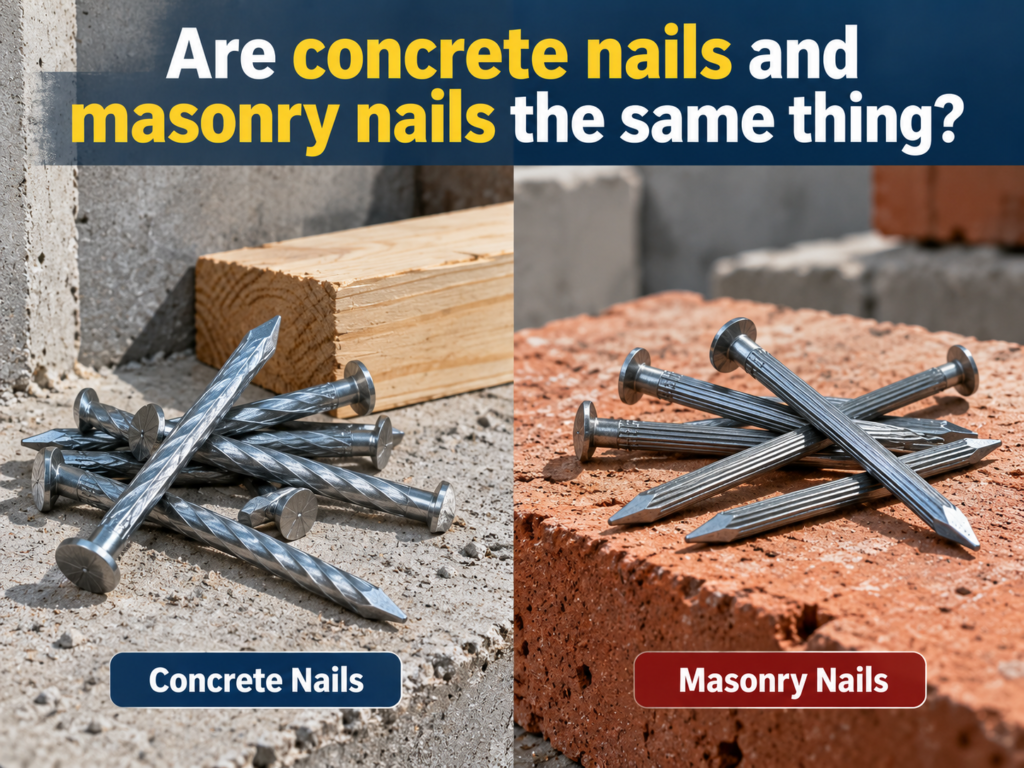
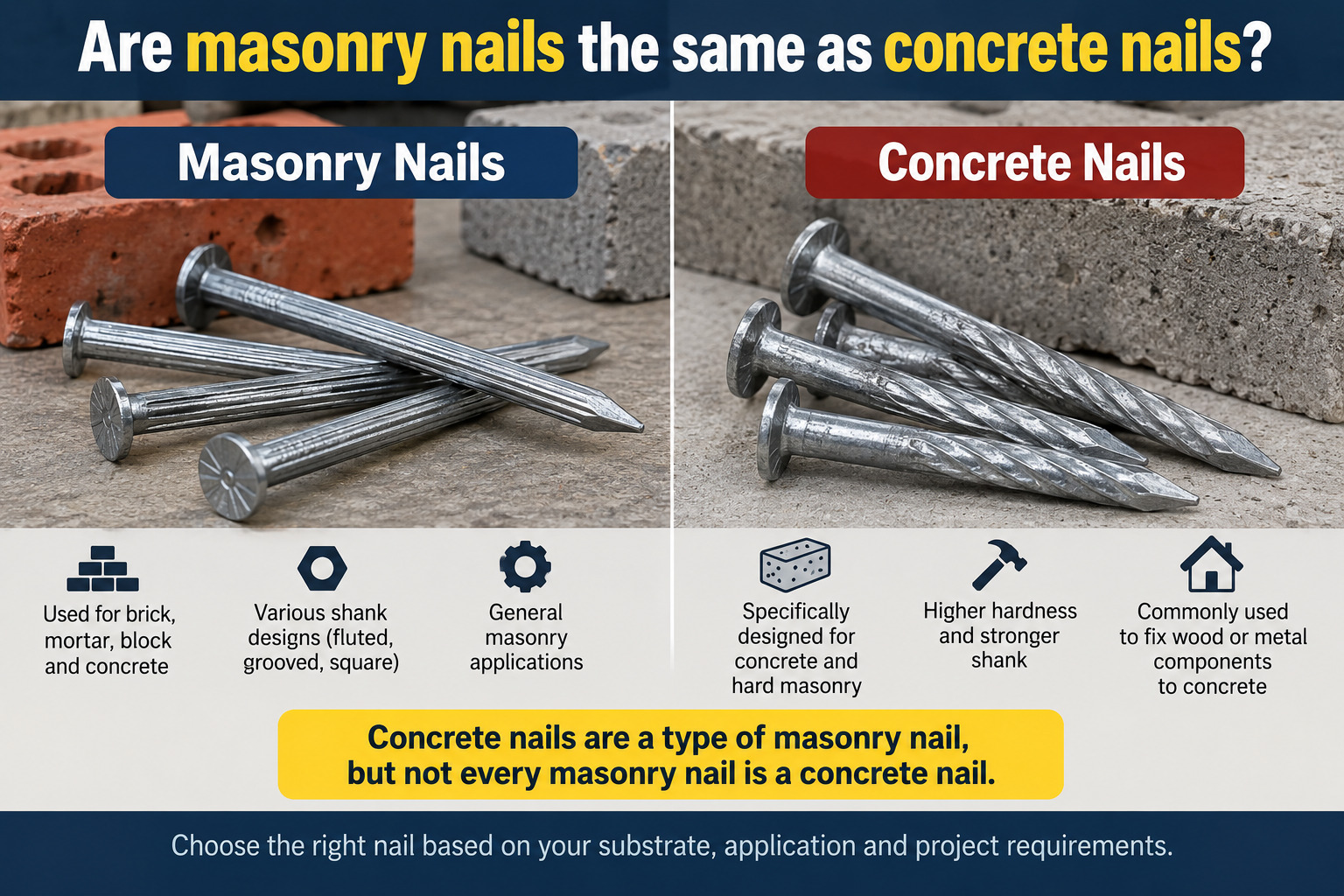
Masonry nails are not the same as concrete nails.1 Masonry nails are generally selected for brick, block, and mortar-joint fixing, while concrete nails are designed for harder cured concrete. They differ in steel hardness, shank design, penetration behavior, holding performance2, and the risks created when used in the wrong wall material.
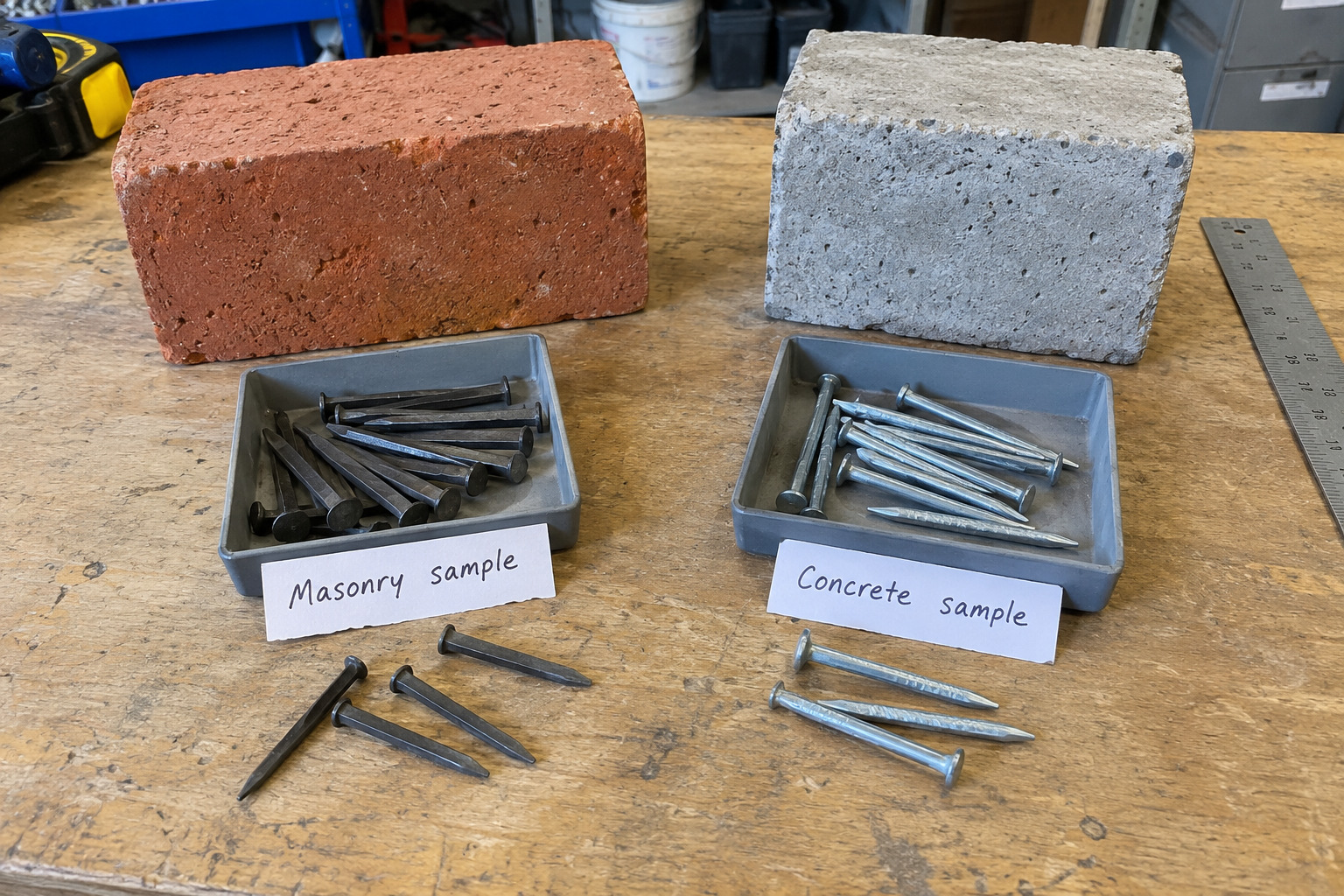
Many wholesalers ask this question because the names sound similar in daily trade. However, the difference matters when a customer is fixing timber battens, cable clips, light frames, or temporary construction materials. I will explain it from a manufacturer’s practical view, with a focus on buying, quality checks, and supplier selection.
How are masonry nails different from concrete nails in material and manufacturing?
Masonry nails can look similar to concrete nails at first glance, so buyers may treat them as interchangeable. That creates a problem because appearance does not always show hardness, heat treatment, or shank behavior. I always suggest checking how the nail is made before judging only by name or surface finish.
Masonry nails and concrete nails differ mainly in steel selection, heat treatment, hardness target, shank shape, and intended penetration behavior. Concrete nails are usually engineered for harder cured concrete3, while masonry nails are chosen for brick, block, and mortar-related fixing where the material response is different.
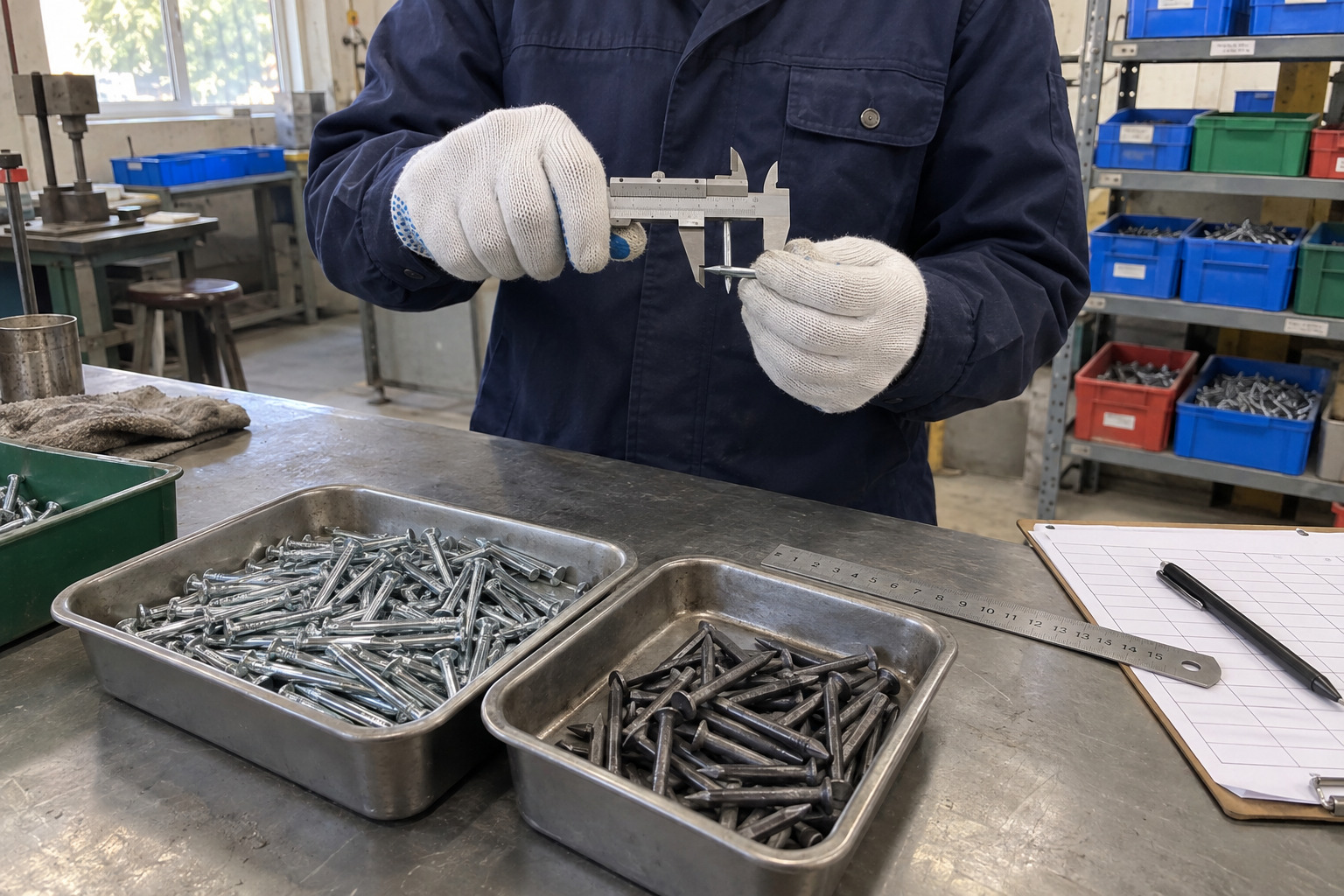
The difference starts before the nail reaches the wall
In nail manufacturing, the final performance is not created by one step only. It comes from a chain of decisions:
- Wire material selection
- Nail forming
- Head and point shaping
- Heat treatment or hardening process
- Surface treatment
- Sorting and packaging
- Factory quality inspection
I work with customers who often ask, “Can I sell this as both masonry and concrete nail?” My answer is careful: sometimes markets use names loosely, but the product should still match the base material. A nail that performs well in mortar joints may not survive the same way in dense concrete.
Material and hardness are not just technical details
Concrete is dense and abrasive.4 A nail entering cured concrete faces high impact resistance. If the nail is too soft, it can bend. If the nail is too brittle, it can snap.5 This is why concrete nails are commonly associated with hardened steel and stricter control of toughness.
Masonry materials are broader. “Masonry” may mean:6
- Fired clay brick
- Cement block
- Hollow block
- Stonework
- Mortar joints
- Plaster over block or brick
These materials do not respond the same way as poured cured concrete. Some are brittle. Some are porous. Some are hollow inside.7 So the nail design must balance penetration and holding without destroying the base.
Practical comparison for buyers
| Factor | Masonry Nails | Concrete Nails | Buyer’s Evaluation Point |
|---|---|---|---|
| Common target base | Brick, block, mortar joints | Cured concrete | Match nail to wall material |
| Main performance need | Penetration without excess cracking | High hardness and impact resistance | Ask supplier for intended use |
| Risk if unsuitable | Loose fixing or broken masonry edge | Bending, snapping, poor penetration | Test samples in local material |
| Quality concern | Consistent shank and point | Hardness and toughness balance | Verify sample behavior before bulk order |
| Procurement focus | Application range and packaging | Material strength and heat treatment control | Request clear product description |
Why manufacturing consistency matters
For wholesalers and purchasing managers, the issue is not only “which nail is stronger?” The better question is, “Is every carton consistent enough for my customers’ jobs?”
I have seen buyers focus only on price per carton. That is understandable in competitive markets. However, inconsistent nails can create hidden losses:
- More bent nails on site
- More customer returns
- More complaints from contractors
- More damaged wall surfaces
- More confusion at retail counters
A supplier should explain the nail’s intended application clearly. For example, a concrete nail should not be described only as “hard nail.” A masonry nail should not be sold without telling the buyer whether it is more suitable for brick, block, or mortar joint applications.
From a manufacturer’s perspective, the safest procurement habit is simple: do not buy by name only. Buy by base material, fixing purpose, sample result, and packaging requirement.
For large orders, I recommend sample checking before final confirmation. Samples cannot replace project engineering evaluation, but they help buyers confirm basic behavior in the wall materials common in their local market.
Where should masonry nails and concrete nails be used?
Masonry nails create confusion because many customers use “masonry” as a general word for hard walls. That can lead store owners to recommend one product for every surface. The risk is that brick, block, mortar, and concrete have different densities, and the wrong nail may fail during installation.
Masonry nails are generally used for brickwork, blocks, and mortar joints, while concrete nails are used for cured concrete surfaces. The best choice depends on the actual base material, fixing load, installation method, and whether the application is temporary, light-duty, or more demanding.
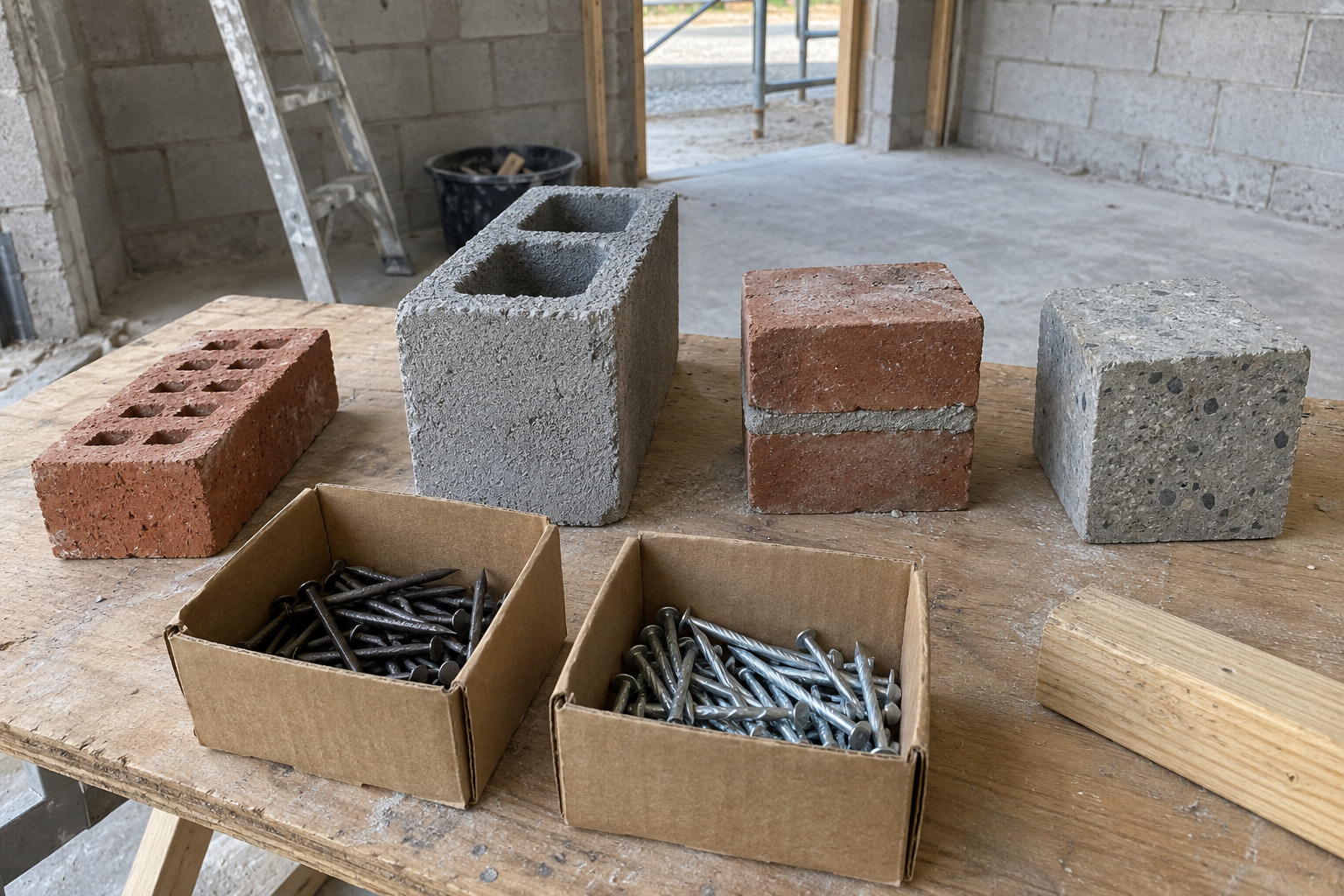
The wall material decides the nail
I like to start with one question when customers ask for advice: “What wall are you fixing into?” This question is more useful than asking only for nail size.
Different wall materials behave differently:
- Cured concrete is dense and hard.
- Solid brick can be hard but may chip at edges.
- Hollow block may crack or break if hit too hard.
- Mortar joints can accept nails more easily but may have lower holding strength.
- Plastered masonry can hide the real base material.
For procurement teams, this matters because the end user may not describe the wall correctly. A customer may say “cement wall” when the actual base is hollow block with plaster. A contractor may say “concrete” when the fixing is really into mortar between blocks.
Application examples
| Application | Better Starting Choice | Reason |
|---|---|---|
| Fixing light wood strip to cured concrete | Concrete nail | Higher resistance needed for dense base |
| Attaching cable clips to brick wall | Masonry nail | Brick or mortar may accept masonry fixing better |
| Temporary site fixing into mortar joint | Masonry nail | Easier penetration in joint material |
| Fixing into dense structural concrete | Concrete nail | Masonry nail may bend or fail to penetrate |
| Fixing near brick edge | Use caution; test first | Edge cracking risk depends on brick quality |
| Fixing into hollow block | Use caution; consider anchors | Nail may not have enough holding area |
Why “hard wall” is not specific enough
A wall can feel hard at the surface but still be weak inside. This is common in some block and plaster systems. If a buyer sells the wrong nail into this situation, the nail may enter but not hold well. The installer may blame the nail, even if the real issue is the base material.
This is why I advise hardware store owners to train counter staff with simple questions:
- Is the wall concrete, brick, block, or mortar?
- Is the fixing light, medium, or load-bearing?
- Is the fixing temporary or permanent?
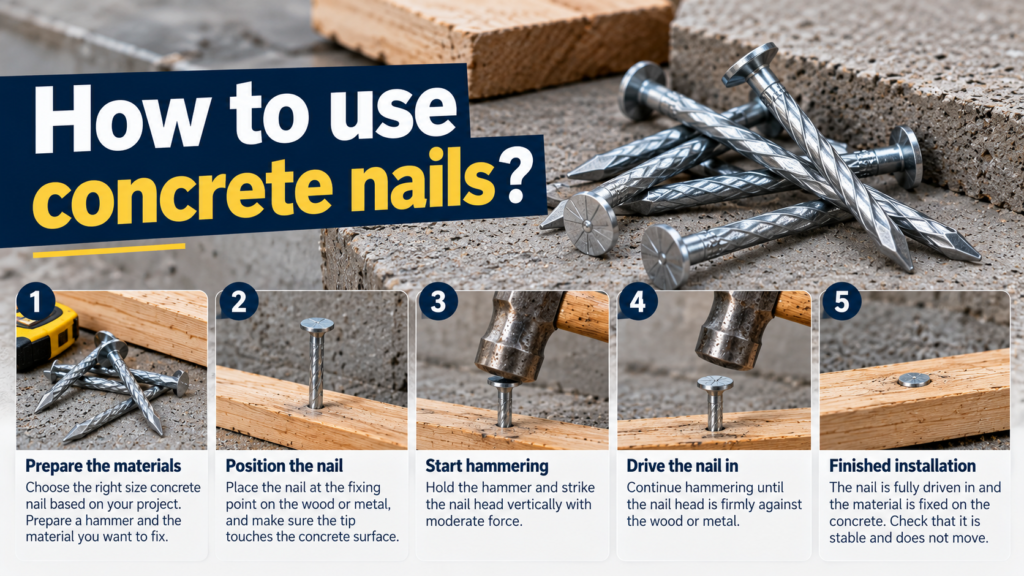
- Will the nail be installed by hammer or tool?
- Is cracking of the wall surface a major concern?
These questions help prevent overpromising. They also help customers select a better product or ask an engineer when the job is structural.
Load and safety need careful language
I avoid telling buyers that one nail is “safe for all construction.” That is not responsible. Holding power depends on:8
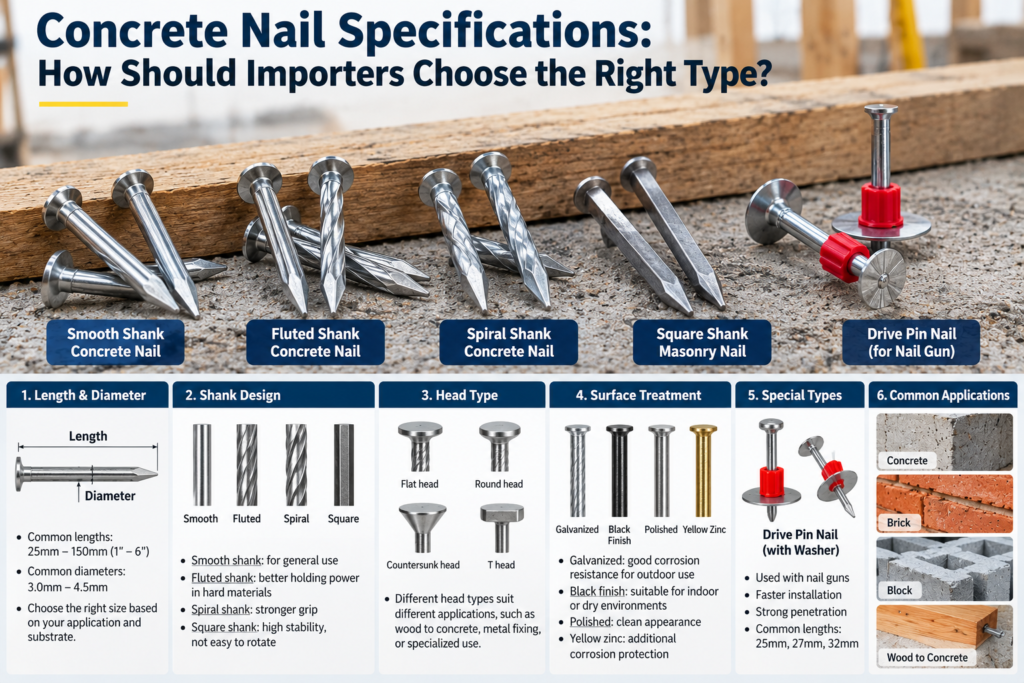
- Nail diameter and length
- Shank design
- Wall density
- Embedment depth
- Installation angle
- Edge distance
- Moisture exposure
- Vibration
- Load direction
For example, pull-out resistance is different from shear resistance9. A nail may resist sideways force better than direct pulling force. A light cable clip has a very different requirement from a structural bracket. In application-specific decisions, especially for safety-critical fixing, a qualified professional should evaluate the fastening system.
For wholesalers, the practical point is clear: stock both product categories if your customers work across concrete, brick, and block. If you sell only one type as a universal solution, you may create more complaints than savings.
What happens if you use masonry nails instead of concrete nails?
Masonry nails may enter some hard surfaces, so users may think they are suitable for concrete. The problem appears when the nail bends, mushrooms at the head, cracks the surface, or fails to hold under load. This is where a small purchasing mistake becomes a performance and safety issue.
If masonry nails are used in cured concrete, they may bend, break, fail to penetrate fully, or provide weak holding. If concrete nails are used in brittle masonry, they may cause cracking or surface damage. The wrong nail can reduce durability, installation speed, and fixing reliability.
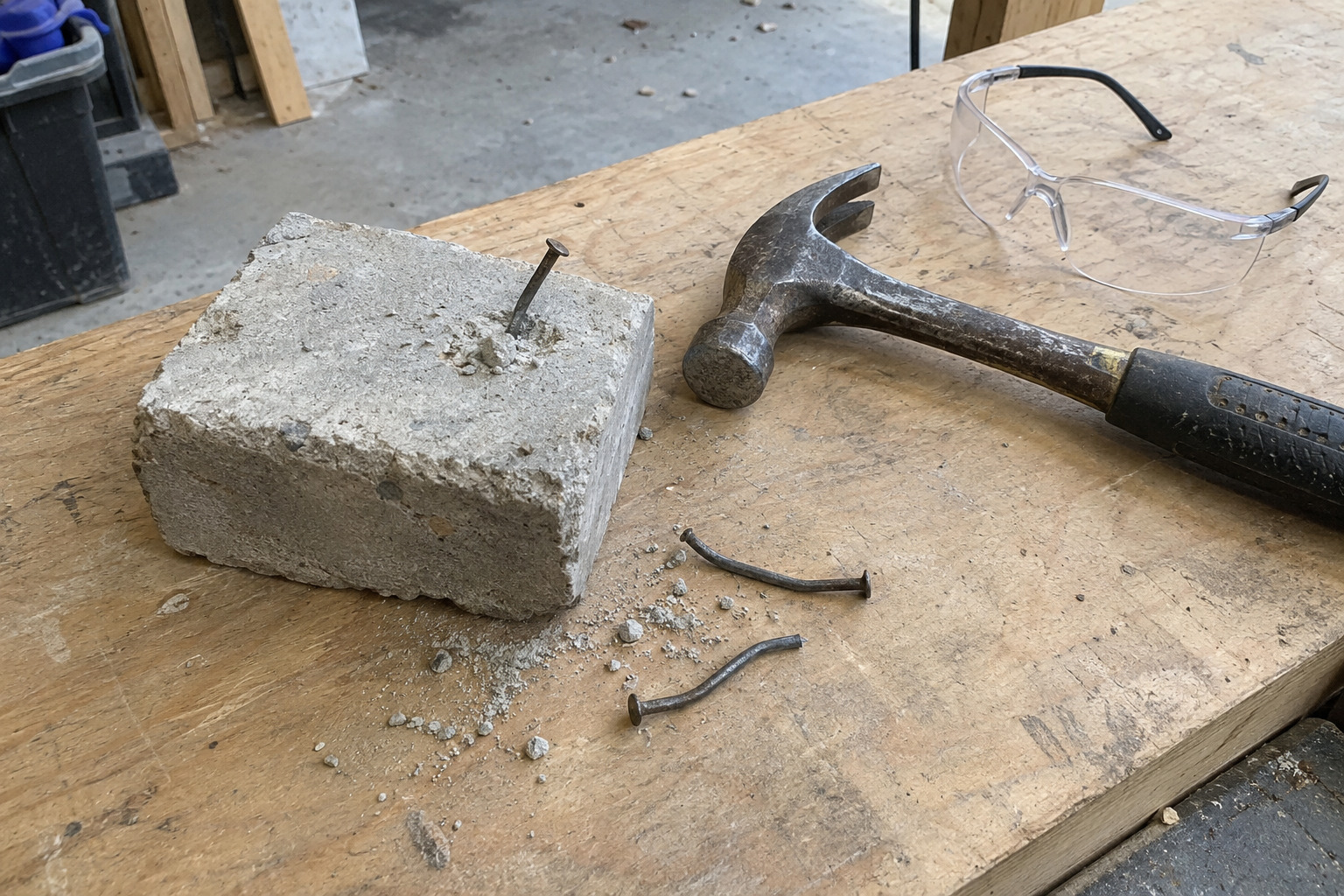
The wrong nail often fails during installation first
The most visible failure is bending. When a nail is not designed for the base material, the installer may need more hammer force. More force increases the chance of:
- Bent shank
- Damaged nail head
- Broken point
- Surface spalling
- Cracked brick or block
- Poor embedment depth
- Injury risk from flying fragments
I have heard sales teams report that customer complaints often start with one sentence: “The nail is not hard enough.” Sometimes that is true. Sometimes the nail was simply used in the wrong base material. This is why I encourage buyers to document the intended material clearly before confirming orders.
Performance is more than penetration
A nail can enter the wall and still perform badly.10 This is important for contractors and store owners to understand. Good fixing performance includes:
-
Penetration
The nail must enter without bending or excessive damage. -
Holding power
The nail must resist pull-out under expected use. -
Shear strength
The nail must resist sideways force where relevant. -
Durability
The nail must maintain performance under site conditions. -
Wall integrity
The base material should not crack in a way that weakens the fixing.
Practical failure comparison
| Wrong Use | Common Result | Commercial Impact |
|---|---|---|
| Masonry nail into dense concrete | Bending, incomplete penetration | More wasted nails and installer frustration |
| Masonry nail into load-demanding concrete fixing | Weak holding | Safety concern and possible job failure |
| Concrete nail into brittle brick edge | Cracking or chipping | Customer complaint about damaged wall |
| Concrete nail into hollow block | Poor grip or breakage | Product blamed although base is unsuitable |
| Any nail into unknown plastered wall | Unpredictable result | Need site testing or alternate fastener |
What buyers should tell customers
For wholesale and retail trade, clear communication reduces returns. I suggest using simple product notes on carton labels or sales sheets:
- “For concrete surface use”
- “For brick/block/mortar fixing”
- “Not for structural load without professional evaluation”
- “Test on actual material before bulk use”
- “Use correct nail length and diameter for application”
These notes do not need to be complicated. They help hardware stores guide new builders who may not know the difference.
Safety needs a conservative approach
In many construction markets, nails are used for light fixing, temporary work, or general site tasks. However, some customers may use them in more demanding ways. That is where safety language matters.
A manufacturer can explain product intention, material, packaging, and general performance expectations. A manufacturer should not replace a structural engineer or project fastening specialist. If the fixing supports weight, resists vibration, or affects public safety, the buyer should recommend professional evaluation.
This is especially important in large projects, public buildings, and applications involving overhead loads. Even the correct nail type may be unsuitable if the base concrete is weak, cracked, wet, or too close to an edge.
How can buyers identify and select masonry nails correctly?
Masonry nails can be selected more confidently when buyers look beyond the carton name. The problem is that many markets use mixed terminology, and suppliers may translate product names differently. This can cause purchasing teams to compare unlike products and choose only by price.
Buyers should identify masonry nails by intended base material, shank design, hardness expectation, point quality, finish, packaging, and sample performance. The best selection process starts with the wall material and application, then confirms size, quantity, packing, and supplier quality control.
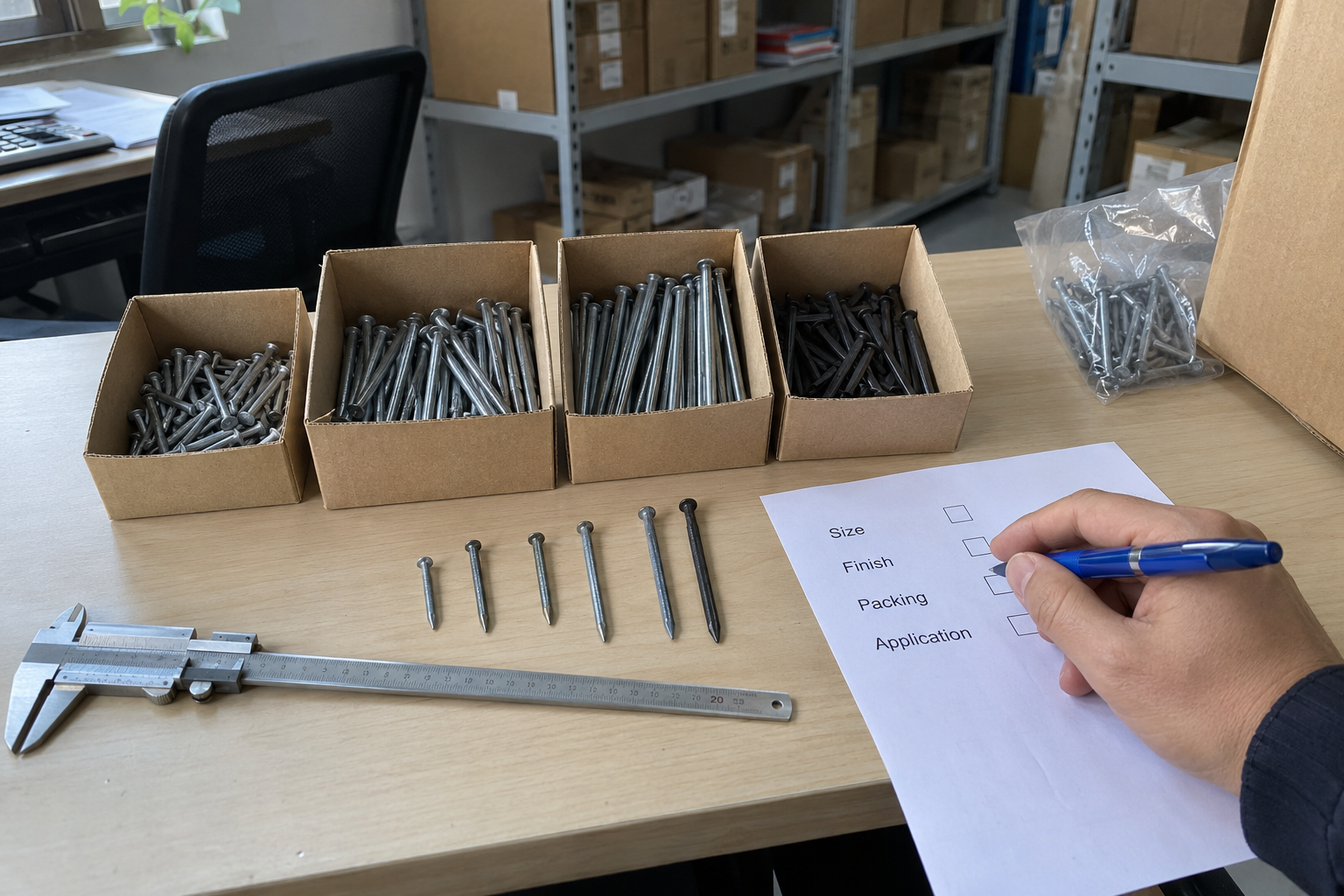
Start with the buying question, not the product name
When I help buyers prepare an inquiry, I prefer this format:
Product + specification + quantity + packaging method + intended application
For example, a clear inquiry may include:
- Nail type: masonry nail or concrete nail
- Size: length and diameter required
- Quantity: by tons, cartons, or container plan
- Packaging: bulk box, small box, branded carton, or OEM packing
- Market: hardware retail, contractor supply, project tender
- Application: brick, block, mortar, or concrete
This is much stronger than asking, “Give me price for hard wall nails.” That phrase may mean different things to different suppliers.
Physical signs to check
A buyer can inspect samples before placing a trial order. The sample check should not replace formal lab testing, but it can reveal obvious quality or suitability issues.
Look at:
-
Straightness
Nails should not show visible bending before use. -
Point consistency
Poor point shape affects penetration and breakage risk. -
Head shape
The head should be suitable for hammering and the intended fixing. -
Shank surface
Flutes, grooves, or surface texture may affect grip depending on design. -
Finish quality
Black, bright, galvanized, or other finishes should match the market need. -
Packaging strength
Export cartons should protect the nails during sea shipment and handling.
Selection checklist for wholesalers
| Buyer Question | Why It Matters | What to Ask Supplier |
|---|---|---|
| What material will customers fix into? | Base material decides nail type | “Is this for concrete, brick, block, or mortar?” |
| What load will the fixing carry? | Light and structural uses differ | “Is professional evaluation needed?” |
| What size sells in my market? | Local habits affect stock turnover | “Can I order mixed sizes?” |
| What packing does my market need? | Retail and project supply differ | “Can packaging be customized?” |
| Can I test samples first? | Reduces bulk-order risk | “What is the sample policy?” |
| What is the delivery plan? | Stock timing matters | “What is the production lead time?” |
Supplier evaluation for procurement teams
For B2B nail purchasing, I suggest evaluating suppliers on more than unit price. Price matters, especially in competitive markets like the Middle East, Africa, Southeast Asia, and South America. Still, buyers should also compare:
- Manufacturing experience
- Product range
- Sample availability
- Export packing quality
- OEM/ODM capability
- Minimum order quantity
- Lead time
- FOB quotation clarity
- Communication speed
- Willingness to explain application limits
In my business context, typical nail procurement discussions include product type, specification, quantity, and packing method before a stable FOB quotation can be prepared. That is because a small change in packaging or size mix affects cost and loading.
Trial orders reduce risk
A trial order is useful when a buyer enters a new market segment or changes supplier. It allows the buyer to check:
- Local customer feedback
- Carton durability during transport
- Size accuracy
- Finish appearance
- Nail performance in common wall materials
- Retail acceptance of packaging
For many industrial products, one sample cannot prove long-term field performance. However, sample testing and trial orders help buyers avoid obvious mismatches. I view them as practical procurement tools, not as marketing decoration.
A simple decision guide
Use this quick guide before confirming purchase:
- If the wall is cured concrete, start by evaluating concrete nails.
- If the wall is brick, block, or mortar, start by evaluating masonry nails.
- If the wall is hollow or weak, consider whether nails are suitable at all.
- If the fixing is load-bearing, ask for qualified technical evaluation.
- If customers use different wall types, stock and label both categories clearly.
This approach helps wholesalers avoid the common mistake of treating every hard-wall nail as the same product.
Frequently Asked Questions
Are masonry nails stronger than concrete nails?
Masonry nails are not automatically stronger or weaker than concrete nails. They are designed for different base materials. Concrete nails are usually chosen for harder cured concrete, while masonry nails are used for brick, block, and mortar-related applications. Strength should be evaluated in the actual wall material.
Can I use concrete nails in brick walls?
You can sometimes use concrete nails in brick, but it is not always the best choice. Hard nails may crack brittle brick, especially near edges. The result depends on brick quality, nail size, and installation force. For safer selection, test samples in the actual brick before bulk use.
Why do nails bend when used in concrete?
Nails bend in concrete when the nail is not hard enough, the concrete is too dense, the nail size is unsuitable, or the installation angle is poor. A masonry nail used in cured concrete may bend because it was not engineered for that level of penetration resistance.
How should hardware stores explain the difference to customers?
Hardware stores can explain it simply: masonry nails are for brick, block, and mortar, while concrete nails are for cured concrete. Staff should ask what wall material the customer has and what the fixing will hold. This prevents wrong recommendations and reduces returns.
Should I test samples before buying bulk quantities?
Yes, sample testing is a practical step for B2B buyers. Samples help confirm point quality, bending resistance, finish, packaging, and basic performance in local wall materials. Samples do not replace professional project evaluation, but they reduce procurement risk before larger orders.
Conclusion
Masonry nails are not the same as concrete nails, and the difference affects installation quality, holding performance, and customer satisfaction. I recommend choosing by base material first, then confirming size, finish, packaging, and sample results. If you need to compare nail options for your market, you can contact 定州百斯特 at [email protected] or WhatsApp +8618331061136 to discuss specifications, packaging, samples, and FOB quotation details.
-
"educational reference guide displaying twelve different …", https://www.facebook.com/61554977615841/posts/educational-reference-guide-displaying-twelve-different-types-of-construction-na/122259505754165920/. A standards or construction-reference source classifies driven fasteners by intended base material and performance requirements, supporting the distinction between masonry and concrete nail applications. Evidence role: definition; source type: institution. Supports: A neutral construction or standards source should support that fasteners are classified by intended substrate and that masonry and concrete uses are not automatically interchangeable.. Scope note: Such a source would support the classification context, but individual products may vary by manufacturer specification and local trade naming. ↩
-
"Withdrawal strength of ring-shank nails embedded in southern …", https://research.fs.usda.gov/treesearch/25675. Research on driven fasteners shows that fastener geometry, material properties, and substrate characteristics affect penetration and withdrawal resistance, supporting the article’s comparison of hardness, shank design, and holding performance. Evidence role: mechanism; source type: paper. Supports: Research or standards documentation should support that nail material hardness, shank geometry, and substrate interaction influence penetration and withdrawal or holding resistance.. Scope note: The evidence may address driven fasteners generally and may not compare every commercial masonry nail directly with every concrete nail. ↩
-
"Properties of Concrete – CIVL 1101 – The University of Memphis", https://www.ce.memphis.edu/1101/notes/concrete/section_3_properties.html. Technical guidance on concrete fastening notes that fastener performance depends on the strength and density of the concrete substrate, supporting the article’s statement that concrete nails are designed for cured concrete conditions. Evidence role: general_support; source type: institution. Supports: A fastening or construction standards source should support that fasteners for cured concrete require material and design characteristics suited to dense, high-strength substrates.. Scope note: This would provide contextual support for the design rationale rather than proving the specifications of every nail sold as a concrete nail. ↩
-
"Concrete Materials Database", https://www.nist.gov/publications/concrete-materials-database. Civil-engineering materials references describe concrete as a cementitious composite containing mineral aggregates with substantial density and abrasion resistance, supporting the article’s explanation of high penetration resistance. Evidence role: mechanism; source type: education. Supports: A materials science or civil engineering source should support that concrete has relatively high density and abrasive mineral aggregate content affecting penetration and wear.. Scope note: This supports the material-property rationale and not a specific nail failure rate. ↩
-
"Alloy and composition dependence of hydrogen embrittlement …", https://pmc.ncbi.nlm.nih.gov/articles/PMC5468724/. Materials-engineering references explain that increasing steel hardness can reduce ductility and toughness, while insufficient strength increases plastic deformation, supporting the article’s bend-versus-snap explanation. Evidence role: mechanism; source type: education. Supports: A materials engineering source should support that steel hardness, toughness, and ductility must be balanced to avoid plastic bending or brittle fracture under impact.. Scope note: This is general mechanical support and does not specify the exact heat-treatment range for masonry or concrete nails. ↩
-
"Masonry", https://en.wikipedia.org/wiki/Masonry. An encyclopedic definition of masonry identifies it as construction using units such as brick, stone, or concrete block, commonly bonded with mortar, supporting the article’s broad use of the term. Evidence role: definition; source type: encyclopedia. Supports: An encyclopedia or construction glossary should support that masonry is a broad building method using units such as brick, stone, concrete block, and mortar.. ↩
-
"Experimental study on basic mechanical properties of … – PMC", https://pmc.ncbi.nlm.nih.gov/articles/PMC12318078/. Masonry-unit standards and engineering references distinguish solid and hollow units and describe variable absorption and strength properties, supporting the article’s point that masonry substrates do not behave uniformly. Evidence role: general_support; source type: institution. Supports: A masonry standard or civil engineering source should support that masonry units differ in porosity, void structure, and mechanical behavior.. Scope note: This supports variation among masonry materials generally, not the condition of any particular wall on a jobsite. ↩
-
"Shear Headed Anchors with Large Diameter and Deep …", https://repository.lib.ncsu.edu/server/api/core/bitstreams/9bb88274-9320-4443-9730-5a2929b86c87/content. Engineering guidance for fasteners and anchors identifies embedment depth, base-material strength, spacing and edge distance, environmental exposure, and load direction as variables affecting resistance, supporting the article’s multifactor description of holding power. Evidence role: expert_consensus; source type: institution. Supports: A fastening design guide or building-code evaluation document should support that fastener resistance is affected by geometry, embedment, base material, spacing or edge distance, environmental exposure, and load direction.. Scope note: The source would support the general engineering principle; actual nail capacity requires product-specific testing in the relevant substrate. ↩
-
"Code-check of anchors (AISC)", https://www.ideastatica.com/support-center/support-center-knowledge-base/design-check-of-anchors-according-to-aisc. Structural fastening guidance evaluates tension or pull-out resistance separately from shear resistance, supporting the article’s distinction between direct withdrawal and sideways loading. Evidence role: definition; source type: institution. Supports: A structural fastening or anchor design source should support that withdrawal or tension resistance and shear resistance are different load modes requiring separate evaluation.. Scope note: Anchor-design standards provide the conceptual distinction but may not prescribe design values for ordinary loose nails without tested product data. ↩
-
"7-Day Fastener Pull-Out Resistance Test | ASTM D7332-B", https://isaarchitectural.com/isa-insights-1/f/7-day-fastener-pull-out-resistance-test-%7C-astm-d7332-b. Fastener evaluation guidance treats penetration, embedment, pull-out resistance, shear resistance, and base-material failure as separate performance considerations, supporting the article’s statement that entry into the wall is not sufficient proof of performance. Evidence role: mechanism; source type: institution. Supports: A fastening design or building-code evaluation source should support that installed fasteners are evaluated by resistance modes such as pull-out, shear, embedment, and substrate failure, not merely penetration.. Scope note: Most formal guidance concerns anchors or power-driven fasteners and may not directly test all hand-driven nail applications. ↩