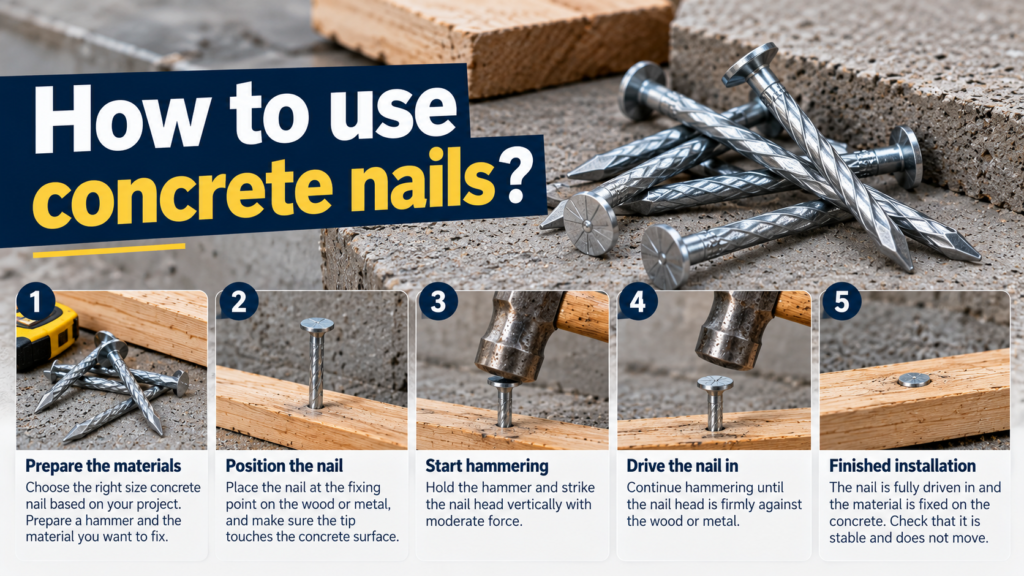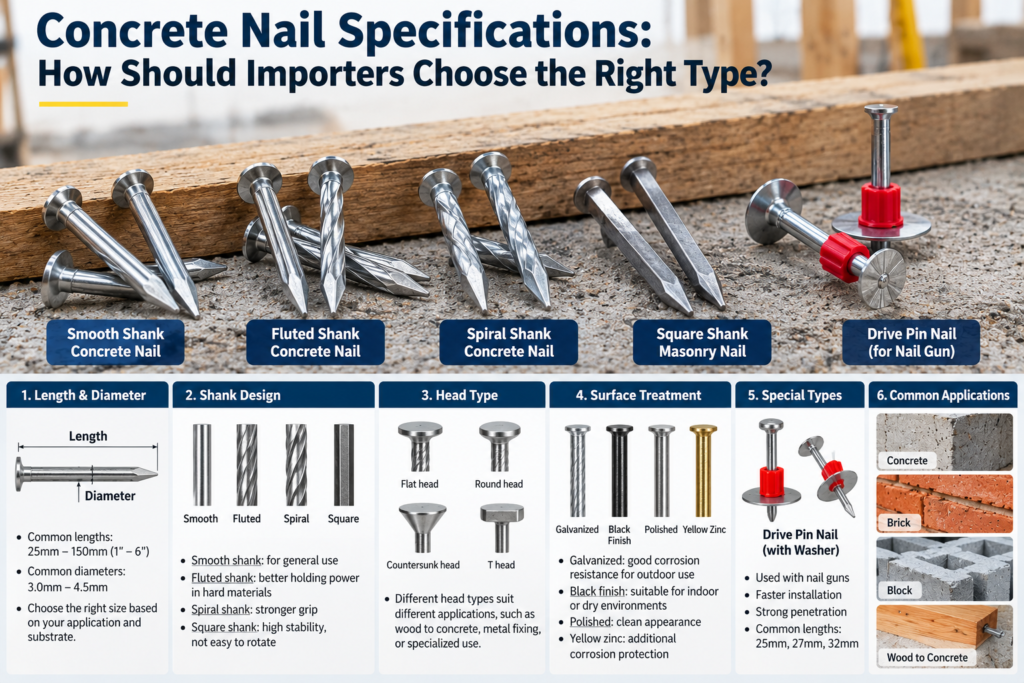
Nails manufactured in a factory look simple, but bulk buyers know one problem can become expensive fast. If diameter, length, head shape, carton weight, or packaging is inconsistent, wholesalers face complaints and slow resale. I see nail manufacturing as a controlled export process, not just a machine running wire.
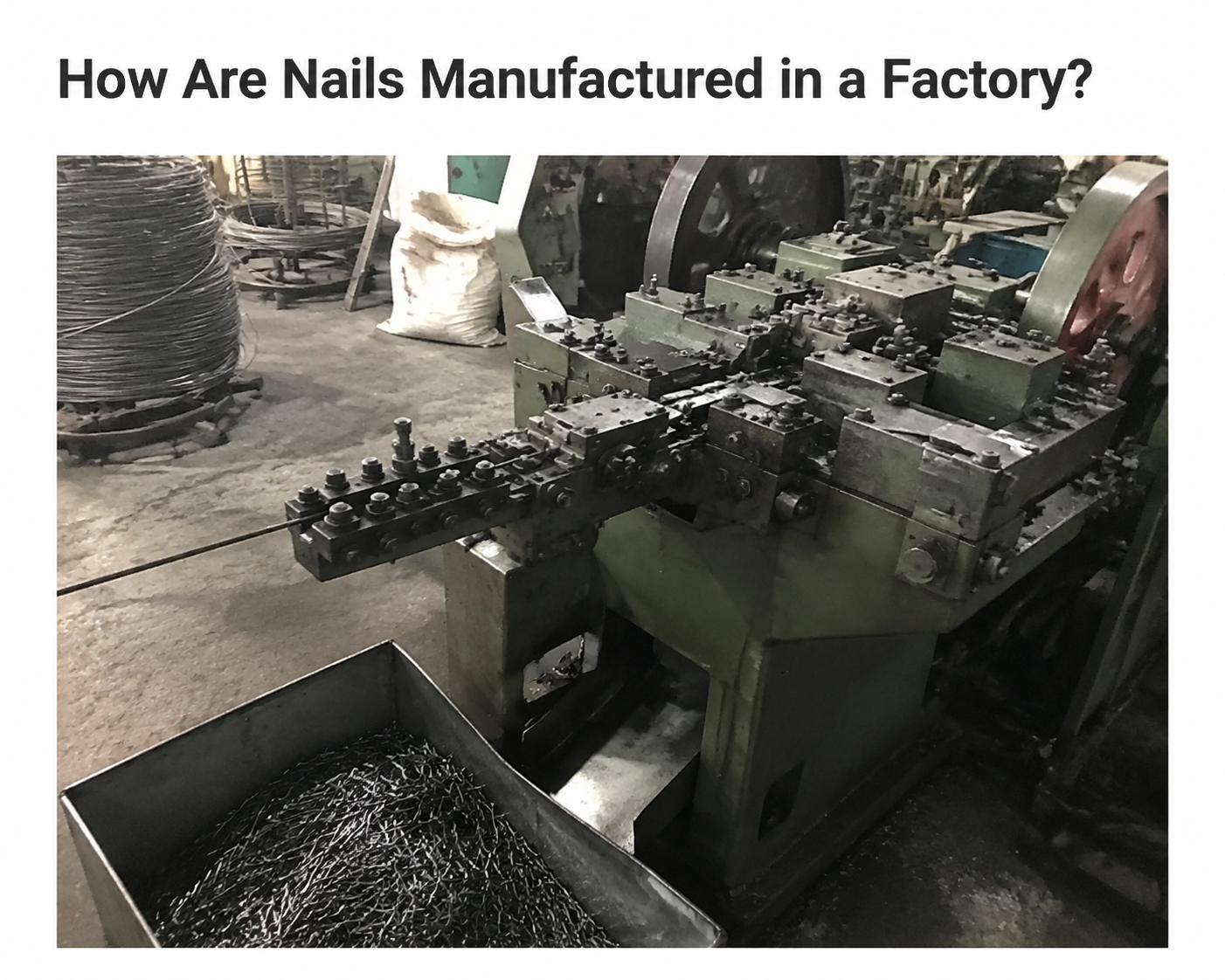
Nails are manufactured by selecting suitable wire rod, drawing it to the required diameter, feeding it into nail-making machines, forming the head and point, applying any surface treatment, inspecting size and appearance, then weighing or counting, packing, labeling, and preparing goods for shipment1. For buyers, consistency across bulk cartons matters most.
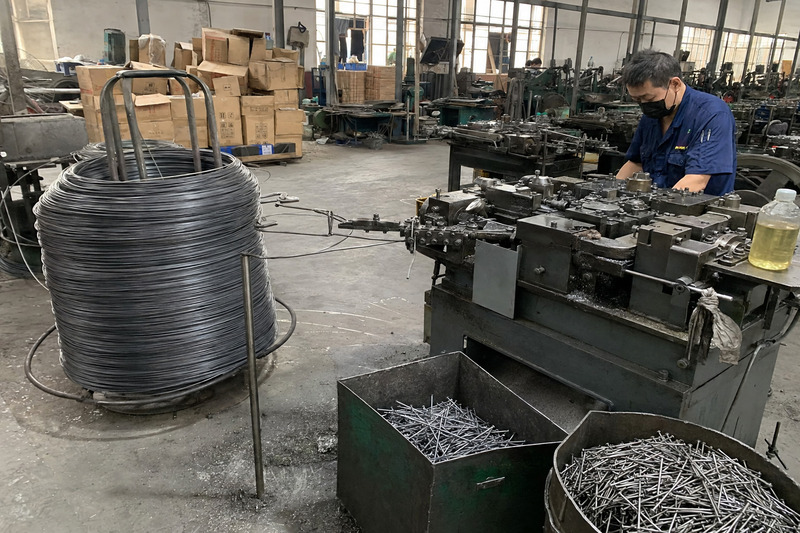
A factory tour can show machines, workers, and stacks of cartons. However, I always tell buyers that the real test is whether the finished bulk goods match the agreed specification, packaging method, and order quantity. The sections below explain where quality is created and where problems usually begin.
What order details decide how nails are manufactured?
Nails manufactured for export start with the buyer’s order details, not with the machine. If the specification is unclear, the factory may quote wrongly, use the wrong wire, or pack goods in a way the buyer cannot sell. I always confirm details before production begins.
The main order details are nail type, diameter, length, head, point, surface finish, quantity, usage, packaging, carton weight, label, and shipping terms. These details decide production setup, cost, inspection focus, packing method, and delivery schedule.2 Clear specifications reduce disputes and help the factory maintain bulk-order consistency.3
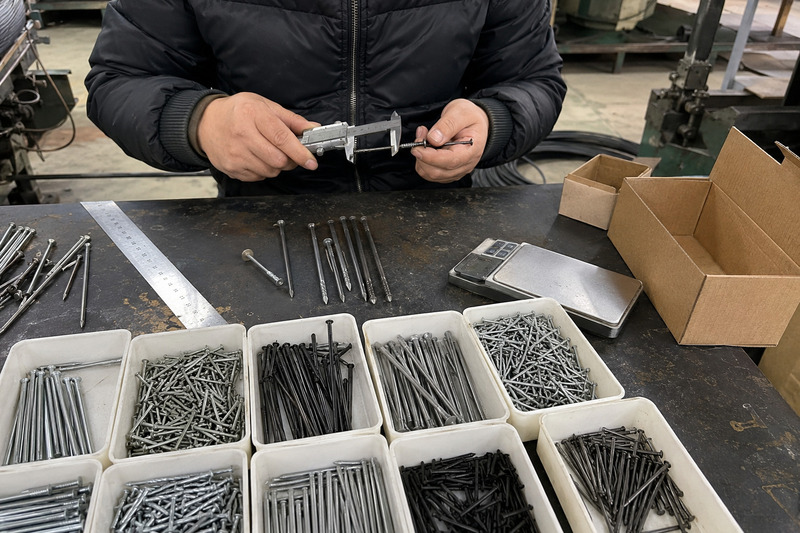
Why the quotation starts with specifications
In my work with hardware wholesalers, the first question is rarely “How many machines do you have?” The first useful question is usually, “What exactly do you need to sell?” A concrete nail, black steel nail, lost head nail, and roofing nail do not follow the same buyer expectation. Even when two buyers ask for the same nail length, they may need different packaging, surface finish, or carton weight.
A practical nail inquiry should include:
- Product type: concrete nail, roofing nail, black steel nail, lost head nail, or another type
- Diameter and length: usually the most important physical specification
- Head style: flat head, lost head, umbrella head, or other required head
- Point shape: sharpness and consistency matter for installation
- Surface: bright, black, galvanized, polished, or other finish when applicable
- Usage: concrete, wood, roofing sheet, general construction, or resale hardware
- Quantity: our normal MOQ is 5 tons or 200 cartons, depending on product and packaging
- Packing: bulk carton, small box, branded carton, woven bag, or buyer’s private label
- Trade term: we usually quote by FOB based on product, specification, quantity, and packaging
- Destination market: many of our regular shipments go to the Middle East, Africa, Southeast Asia, and South America
How order details affect production risk
I have seen that many new buyers focus only on price per ton. Price is important, but order clarity protects the buyer more than a small price difference. For example, if a buyer requests “2-inch nails” without confirming wire diameter, two suppliers may quote two different products. One price may look cheaper, but the carton may contain lighter nails or a count that does not match local resale habits.
| Order detail | Why it matters in production | Buyer risk if unclear |
|---|---|---|
| Diameter | Decides wire drawing size and strength feel | Nail may feel too light or bend too easily |
| Length | Controls cutting and forming setup | Mixed lengths can cause customer complaints |
| Head style | Affects machine setting and end use | Head may be too small, irregular, or unsuitable |
| Surface finish | Adds process requirements and cost | Rust, wrong color, or resale mismatch |
| Carton weight/count | Controls packing and buyer margin | Short weight or wrong count affects trust |
| Label/brand | Supports wholesale resale | Wrong label can delay distribution |
A typical anonymous order workflow
A common order in my factory starts with a WhatsApp message or email from a wholesaler. The buyer may send photos, old carton labels, or a local market sample. I check the nail type, size, packing, estimated quantity, and destination port. Then I prepare an FOB quotation based on the agreed product and packaging.
If the buyer wants to verify quality first, we can provide samples for testing. Samples usually have a basic charge, and this cost can be discussed again when a formal order is placed. After confirmation, we prepare production according to the approved specification. This approach is not complicated, but it prevents many avoidable mistakes.
How are nails manufactured from wire rod?
Nails manufactured from wire rod go through several connected steps. If the wire is not stable, the nail machine cannot create stable finished nails. Poor input material can cause size variation, weak points, irregular heads, and high rejection. I treat wire preparation as the first quality checkpoint.
Nails are manufactured from wire rod by selecting suitable steel wire material, drawing it down to the required diameter, straightening it, cutting and forming it in nail-making machines, shaping the head and point, and then finishing, inspecting, and packing the finished nails. Each stage affects final consistency.
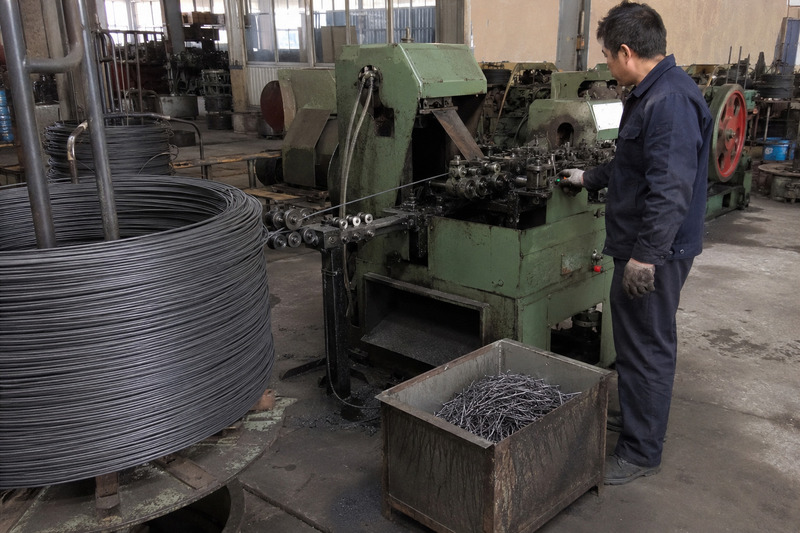
Step 1: Wire rod selection
The process starts with steel wire rod or wire material suitable for the target nail type. I do not present myself as a metallurgical laboratory, so I avoid making unsupported steel-grade claims. However, from a factory production view, I know that wire consistency is critical. The material must be suitable for drawing, forming, and the intended application.
For export buyers, the practical question is not only “What steel is used?” The better question is:
“Can the supplier keep the same wire quality and finished nail specification across the full order?”
A small sample may look good. A full container must also stay consistent.
Step 2: Wire drawing
Wire drawing reduces the wire to the required diameter.4 This step has a direct relationship with nail thickness, finished weight, and how the nail feels in the buyer’s hand. If the drawing process is not controlled well, the diameter may vary.5 That variation can affect nail forming, carton weight, and buyer confidence.
Common buyer concerns include:
- Nails feel lighter than expected
- Nails are not uniform in thickness
- Carton weight does not match agreement
- Local customers compare them poorly with previous stock
In my factory communication, I prefer to confirm diameter before quoting. This keeps the price and product aligned.
Step 3: Nail forming
After wire drawing, the wire feeds into nail-making machines. The machine cuts the wire and forms the head and point.6 This is the stage most people imagine when they ask how nails are produced. It is important, but it is not the whole story.
During forming, the factory must monitor:
- Length consistency
- Head centering
- Head shape
- Point sharpness
- Bent or damaged nails
- Machine wear
- Scrap rate
Different nail types may require different tooling or process adjustments.7 A roofing nail, for example, has different head and application expectations from a lost head nail. A concrete nail also has a different market expectation from a common black steel nail.
Step 4: Surface treatment when required
Some nails need a surface process, depending on the product and buyer request. This may relate to appearance, storage condition, or resale preference. I keep this point practical because surface requirements vary by nail type and market. Buyers should confirm whether they need bright finish, black finish, galvanized finish, or another finish before price comparison.
| Surface requirement | Buyer reason | Procurement note |
|---|---|---|
| Bright or polished appearance | Better retail look | Confirm whether appearance or low price matters more |
| Black steel finish | Common market preference for some nails | Confirm color and packing protection |
| Galvanized finish | Corrosion resistance expectation8 | Ask supplier to specify process and verify samples |
| Custom finish | Brand or market differentiation | Test before bulk order |
Step 5: Inspection and packing
Final inspection is important, but I do not rely only on final inspection. Good quality should be built step by step. If wire drawing and machine settings are wrong, final inspection can only remove some bad pieces. It cannot make the full order stable.
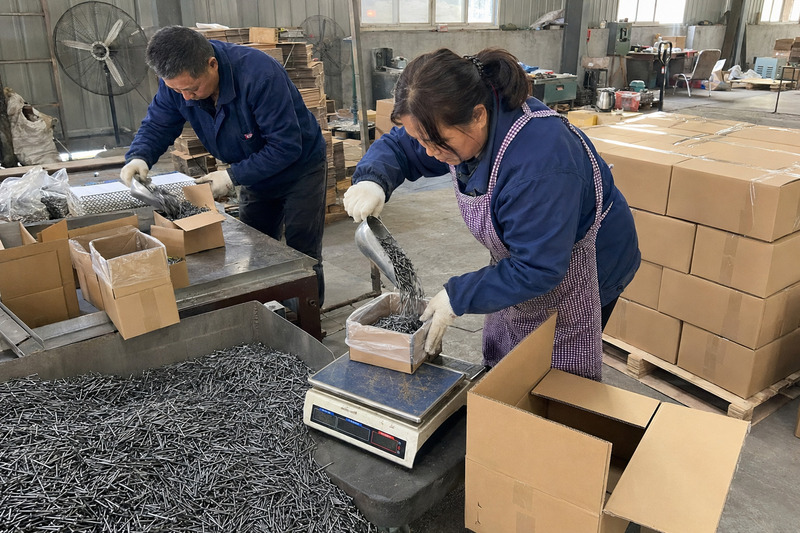
After forming and finishing, workers inspect, weigh or count, pack, label, and prepare the goods for loading. For wholesalers, this last part is very important. A nail that looks fine but arrives in weak cartons or wrong labels still creates a business problem.
Where can quality problems appear during nail manufacturing?
Nails manufactured in bulk can show quality problems at many points, not only at the final inspection table. If a factory only checks finished cartons, it may miss the root cause. I prefer to control risk from incoming wire to loading preparation.
Quality problems in nail manufacturing can appear during wire selection, wire drawing, machine forming, head and point shaping, surface finishing, weighing or counting, carton packing, labeling, and loading. Buyers should evaluate whether the supplier controls these risk points, not only whether the sample looks acceptable.
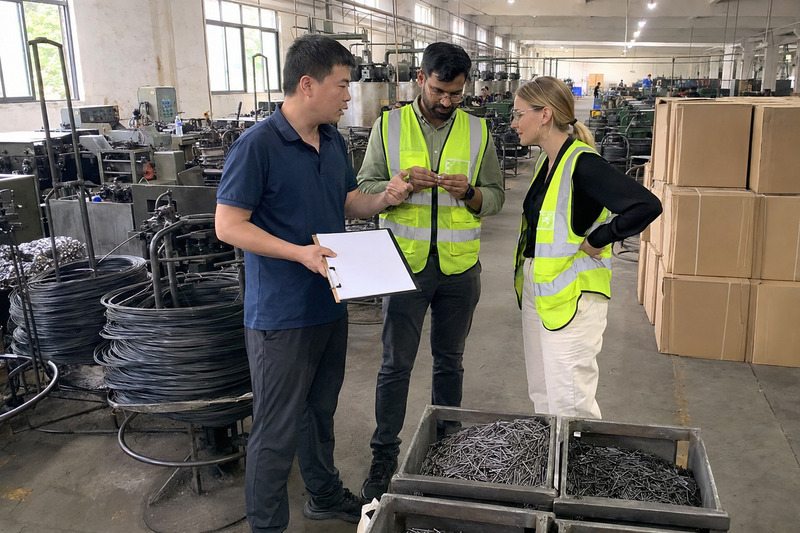
Common production quality risks
I often explain quality risk in simple terms: a nail is small, but a shipment contains a huge number of pieces. A tiny variation repeated across many cartons becomes a real claim.9 A buyer may not check every nail, but their customers will notice if the goods feel different from the previous shipment.
Common defects include:
- Irregular nail length
- Uneven wire diameter
- Off-center head
- Weak or incomplete head
- Blunt point
- Bent shank
- Surface rust or stains
- Mixed sizes
- Short weight carton
- Wrong carton mark or label
- Weak packaging during sea transport
Some defects affect use. Others affect resale. Both matter for importers.
Why final inspection is not enough
Final inspection can catch visible problems, but it has limits.10 If the wire diameter has been inconsistent for several tons of production, the factory cannot solve the problem by looking at the final carton. If the carton weight is wrong, the buyer may not discover the problem until the goods arrive and are distributed.
A better quality approach checks several stages:
- Before production: confirm sample, specification, and packing method
- During wire drawing: monitor diameter stability
- During forming: check head, length, point, and machine condition
- Before packing: remove obvious defective nails
- During packing: control weight, count, carton strength, and label accuracy
- Before loading: confirm marks, quantity, and shipment arrangement
This does not mean every factory must use expensive laboratory systems for every nail order. It means the supplier should have a practical control process that matches the order value and buyer requirements.
What buyers can ask a supplier
When buyers evaluate a nail supplier, I suggest asking questions that connect directly to order risk. These questions reveal more than a simple factory photo.
| Buyer question | What it helps verify |
|---|---|
| Can you confirm diameter, length, and packing before quotation? | Whether the supplier prices the correct product |
| Can you provide samples before bulk order? | Whether the buyer can check quality locally |
| How do you control carton weight or count? | Whether resale margin is protected |
| Can you customize carton, brand, or logo? | Whether OEM/ODM needs can be supported |
| What is your normal production lead time? | Whether delivery planning is realistic |
| Do you support trial orders? | Whether the buyer can reduce first-order risk |
In our case, we support OEM/ODM for product, packaging, and brand logo. We also support trial orders, because many new buyers want to confirm market acceptance before scaling up. Lead time is usually 15–25 days, depending on quantity and order details.
How to judge a sample correctly
A sample is useful, but a sample is not the whole shipment. I recommend that buyers check samples with the same thinking they use for bulk goods:
- Measure several pieces, not only one.
- Compare weight and size with local market goods.
- Check head shape and point sharpness.
- Review surface appearance.
- Confirm packing design before mass production.
- Keep one approved sample for comparison.
If the product is for a specific technical application, the buyer should arrange suitable professional testing or local evaluation. A nail factory can support production and export supply, but application-specific performance decisions should be verified by qualified people.
How are manufactured nails inspected, counted, and packed for export?
Manufactured nails can lose value if inspection, counting, or packing is careless. Even good nails can create complaints when cartons are underweight, labels are wrong, or packaging fails during sea shipping. I always connect packing control with the buyer’s resale needs.
Manufactured nails are inspected for size, head, point, surface, bending, mixed goods, carton weight or count, packing strength, label accuracy, and shipment marks. For export orders, packing must match the agreed method because wholesalers depend on correct cartons, branding, and predictable quantity.
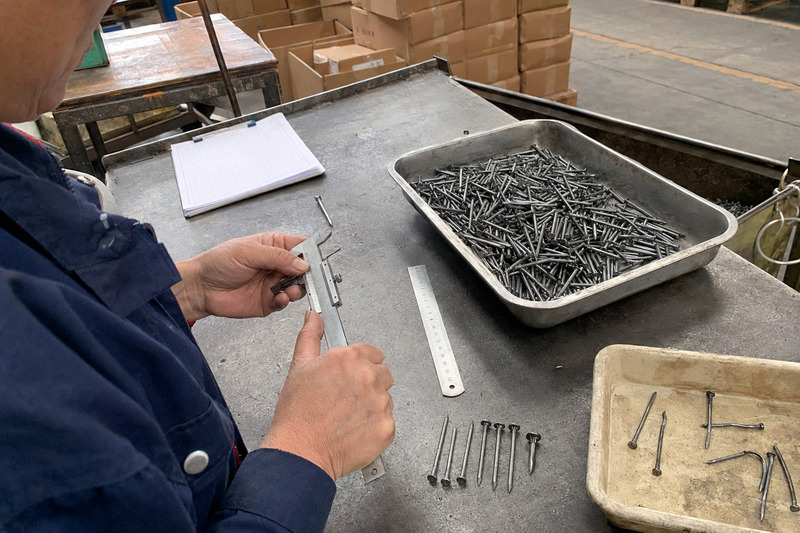
Inspection before packing
Inspection usually starts before the nails enter final cartons. Workers remove obvious defective pieces and check whether the production matches the order. For regular export orders, the most practical inspection points are visual consistency, size, weight, and packaging accuracy.
Key inspection items include:
- Diameter and length: match approved specification
- Head: correct shape, no serious damage, stable forming
- Point: sharp enough for intended use
- Surface: matches finish requirement, no unacceptable stains or rust
- Straightness: avoid bent nails in bulk
- Mixing: avoid different sizes or types in one carton
- Carton weight/count: match buyer agreement
- Label: correct brand, size, quantity, and shipping mark
Counting versus weighing
Many bulk nail orders are controlled by weight because exact piece counting for every carton may not be practical. However, the buyer and factory must agree on the packing method. Some retail or small-box orders may need more count control, while large wholesale cartons may focus on net weight or gross weight.
| Packing control method | Common use | Buyer concern |
|---|---|---|
| By weight | Bulk wholesale cartons | Carton weight must be stable |
| By count | Small boxes or retail packs | Piece quantity must match label |
| Mixed packaging | Brand or market-specific orders | Factory must follow instructions carefully |
For wholesalers, carton consistency protects downstream relationships. A buyer in Dar es Salaam, for example, may sell to many small hardware shops. If one carton feels short or the label does not match, the complaint travels back quickly.
Export-ready packaging
Export packaging must survive handling, warehouse storage, and sea transport.11 I do not treat packaging as decoration only. Packaging is part of product quality because it protects the nails and supports the buyer’s brand.
Common export packaging options include:
- Bulk carton packing
- Small box inside master carton
- Woven bag packing
- Buyer’s branded carton
- Custom label or logo
- OEM/ODM packaging design
The best option depends on local selling style. Some markets prefer simple heavy cartons for wholesale. Other buyers want private brand packaging to build market recognition. In our factory, we can discuss custom product, packaging, and brand logo requirements before production.
Loading preparation
After packing, the factory prepares goods for shipment. Most export nail orders move by sea freight. We support FCL and LCL shipment arrangements depending on order size. For larger orders, full container loading may reduce handling risk. For trial orders or mixed product shipments, LCL can be practical.
Before loading, the supplier should confirm:
- Total cartons or bags
- Total gross and net weight
- Shipping marks
- Packing list
- Product name and specification
- Destination port
- Buyer’s agent contact if needed
- Loading plan
Many of our customers have agents in Yiwu or other China trading hubs. I find this normal in hardware wholesale. Clear communication between buyer, agent, and factory helps prevent document and loading mistakes.
How should buyers evaluate a nail manufacturing factory?
Nail manufacturing suppliers can look similar from a distance. Many factories can show machines and quote prices. The real challenge for buyers is choosing a supplier who can keep specifications stable, communicate clearly, and prepare export goods correctly. I suggest evaluating both production and service discipline.
Buyers should evaluate a nail manufacturing factory by checking specification confirmation, sample support, production control, packaging accuracy, MOQ, lead time, export experience, OEM/ODM capability, shipment method, and communication quality. The best supplier is not always the lowest quote; it is the supplier who reduces bulk-order risk.
Factory capability is more than output
Production capacity matters, but capacity alone does not protect the buyer. A fast machine can still produce inconsistent nails if setup and inspection are weak. A large warehouse can still ship wrong labels if order management is careless.
When I evaluate an order from the factory side, I focus on three questions:
- Can we produce the specification correctly?
- Can we pack it exactly as agreed?
- Can we ship within the promised schedule?
These questions sound basic, but they decide whether the buyer can resell smoothly.
Practical supplier evaluation checklist
Buyers can use this checklist before placing a first order:
| Evaluation area | What to check | Why it matters |
|---|---|---|
| Product match | Nail type, size, surface, head, point | Prevents wrong product quotation |
| Sample policy | Sample availability and cost | Allows quality testing before order |
| MOQ | Minimum order quantity | Helps buyer plan cash flow |
| Packaging | Carton, label, brand, small box | Supports local wholesale resale |
| OEM/ODM | Product and packaging customization | Builds buyer’s own brand |
| Lead time | Normal production schedule | Prevents stock shortage |
| Shipment | FCL or LCL sea freight | Matches order volume and budget |
| Communication | Fast, clear answers | Reduces misunderstandings |
| Documents | Business and export documents | Buyers should verify before payment |
For our business, the normal MOQ is 5 tons or 200 cartons. Our usual lead time is 15–25 days, depending on order quantity and packaging. We quote mainly by FOB because price depends on product, specification, quantity, and packaging method.
Why buyers should verify documents and samples
I recommend that buyers verify supplier documents, samples, and order details before sending large payments. If certificates, business licenses, or special compliance documents are important for the destination market, the buyer should request copies and verify them. A supplier can provide information, but the buyer should make the final procurement decision based on proper checking.
A careful first order can include:
- Sample confirmation
- Clear proforma invoice
- Exact product specification
- Packing design approval
- Shipping mark confirmation
- Agreed lead time
- Payment terms
- Pre-shipment inspection if required
Some buyers also use third-party inspection. This can be useful for larger or first-time orders. I see it as a normal procurement tool, not as a sign of distrust.
The value of trial orders
A trial order helps both sides. The buyer tests the supplier’s real delivery ability. The factory learns the buyer’s market expectations. For many hardware wholesalers in Africa, the Middle East, Southeast Asia, and South America, trial orders are a practical way to reduce risk before container-level cooperation.
A good trial order should still be professional. It should not be vague. The buyer should confirm size, packing, label, carton weight, and destination. The factory should produce the trial order with the same discipline used for larger orders. This creates a reliable foundation for repeat business.
Frequently Asked Questions
What raw material is used when nails are manufactured?
Most common nails are manufactured from steel wire material that is drawn to the required diameter before forming. The exact material depends on nail type, market requirement, and buyer specification. Buyers should confirm size, finish, and intended use with the supplier before placing a bulk order.
How long does nail manufacturing take for an export order?
In our normal export workflow, production lead time is usually 15–25 days, depending on order quantity, nail type, packaging, and customization. Buyers should confirm the schedule before payment, especially when using branded cartons, OEM packaging, or mixed product shipments.
Can a nail factory make custom packaging and private label cartons?
Yes, many nail factories can support custom packaging. In our case, we support OEM/ODM, including product requirements, packaging design, and brand logo. Buyers should provide artwork, carton details, label information, and packing method before production starts.
Should buyers choose nails by weight or by piece count?
Bulk wholesale nails are often packed by weight, while small boxes may require piece count control.12 The best method depends on local resale habits. Buyers should confirm net weight, gross weight, carton size, and label information before ordering.
How can I check nail quality before a full order?
Buyers can request samples, compare them with local market products, measure size, check head and point consistency, and test the nails in real use. For application-specific performance, buyers should arrange qualified professional testing or local evaluation before confirming a large order.
Conclusion
Nail manufacturing is a full process from order confirmation to wire drawing, forming, inspection, packing, labeling, and shipment preparation. For overseas wholesalers, the key question is not only how fast a factory can produce. The real value is whether bulk nails match the agreed specification, carton weight or count, packaging, and delivery plan. If you need concrete nails, black steel nails, lost head nails, roofing nails, or custom OEM packaging, contact us at [email protected] or WhatsApp +8618331061136 to discuss your next order.
-
"Nail (fastener)", https://en.wikipedia.org/wiki/Nail_(fastener). A manufacturing reference describes wire nails as products formed from drawn wire that is cut, headed, pointed, and then finished or packaged, supporting the article’s overview of the production sequence; the source supports the general process rather than the practices of any specific factory. Evidence role: general_support; source type: education. Supports: A neutral manufacturing or educational source should support the general sequence of producing wire nails from drawn steel wire, including cutting, heading, pointing, finishing, and packaging.. Scope note: Contextual support only; it does not verify the individual factory workflow described in the article. ↩
-
"ISO 9001 for Manufacturers: Requirements, Benefits, and …", https://usersolutions.com/blog/iso-9001-manufacturers. Quality-management guidance treats customer and product requirements as inputs for production planning, process control, inspection, packaging, and delivery activities, supporting the article’s statement that order details shape the production workflow; the source is general quality-management evidence rather than nail-specific proof. Evidence role: expert_consensus; source type: institution. Supports: A quality-management or manufacturing-planning source should show that customer specifications and documented requirements determine production controls, inspection criteria, packaging requirements, and delivery planning.. Scope note: Contextual support; it applies broadly to manufacturing systems, not specifically to nail exports. ↩
-
"Procurement Specification Gaps Cause Delays and Disputes", https://www.linkedin.com/posts/ibrahim-al-saffar-50774298_the-cost-of-poor-specification-in-procurement-activity-7414562123814637568-f45d. Procurement and quality-management literature identifies clear product requirements and documented acceptance criteria as controls that reduce nonconformity and misunderstanding between buyers and suppliers, supporting the article’s emphasis on clear specifications; the evidence is general rather than specific to nails. Evidence role: expert_consensus; source type: institution. Supports: A procurement or quality-management source should support that clear specifications and customer requirements help prevent nonconformity, misunderstandings, and disputes.. Scope note: Contextual support; it does not quantify dispute reduction for nail shipments. ↩
-
"The Influence of Temperature in the Wire Drawing Process on the Wear …", https://pmc.ncbi.nlm.nih.gov/articles/PMC11509344/. Engineering references define wire drawing as a process in which wire is pulled through a die to reduce its diameter or cross-sectional area, directly supporting the article’s description of the drawing step. Evidence role: definition; source type: education. Supports: An engineering source should define wire drawing as pulling wire through dies to reduce its cross-sectional area or diameter.. ↩
-
"(PDF) THEORY OF WIREDRAWING", https://www.academia.edu/7871380/THEORY_OF_WIREDRAWING. Research on wire drawing reports that process parameters, die geometry, lubrication, and tool condition influence dimensional accuracy in drawn wire, supporting the article’s claim that inadequate control can produce diameter variation. Evidence role: mechanism; source type: paper. Supports: A technical paper should support that wire drawing parameters and die condition affect dimensional accuracy and variation in drawn wire.. Scope note: The source would support the mechanism in wire drawing generally, not measured variation in the article’s specific production line. ↩
-
"Nail (fastener)", https://en.wikipedia.org/wiki/Nail_(fastener). Reference descriptions of wire-nail manufacture state that machines cut wire into lengths and shape the head and point, supporting the article’s explanation of the forming stage. Evidence role: mechanism; source type: encyclopedia. Supports: A neutral reference should explain that wire nails are made by feeding wire into machinery that cuts the shank and forms the head and point.. ↩
-
"Nail (fastener)", https://en.wikipedia.org/wiki/Nail_(fastener). Fastener standards distinguish nails by dimensions, head forms, shank features, point types, and intended uses, supporting the article’s statement that different nail types may require different tooling or process adjustments. Evidence role: general_support; source type: institution. Supports: A fastener standard or technical reference should document that nails are classified by differing head forms, shank features, points, sizes, and applications.. Scope note: The source supports product differences that imply process changes; it may not describe every tooling adjustment used by a particular factory. ↩
-
"Galvanization", https://en.wikipedia.org/wiki/Galvanization. Materials references on galvanization explain that zinc coatings protect steel from corrosion through barrier protection and sacrificial action, supporting the article’s association of galvanized finish with corrosion-resistance expectations. Evidence role: mechanism; source type: institution. Supports: A materials or galvanizing source should explain that zinc coatings protect steel from corrosion, including by acting as a barrier and sacrificial coating.. Scope note: The source supports the general corrosion-protection mechanism; actual nail performance depends on coating thickness, exposure conditions, and applicable standards. ↩
-
"6.1.2. What are Process Control Techniques?", https://www.itl.nist.gov/div898/handbook/pmc/section1/pmc12.htm. Statistical quality-control references describe how process variation and repeated nonconformities in high-volume production can materially affect outgoing product quality, supporting the article’s warning that small repeated variations can become shipment-level claims. Evidence role: mechanism; source type: government. Supports: A statistical quality-control source should explain how process variation and repeated nonconformities accumulate in mass production and affect outgoing quality.. Scope note: The source supports the statistical principle; it does not document actual customer claims for nail cartons. ↩
-
"Statistical process control", https://en.wikipedia.org/wiki/Statistical_process_control. Quality-management literature distinguishes inspection from process control and emphasizes that quality is more reliably achieved by controlling processes during production, supporting the article’s claim that final inspection has inherent limits. Evidence role: expert_consensus; source type: research. Supports: A quality-management source should support that relying only on end-of-line inspection is less effective than controlling production processes throughout manufacturing.. Scope note: The evidence is a general manufacturing-quality principle, not a nail-specific defect study. ↩
-
"Packing | BETA – International Trade Administration", https://beta.trade.gov/article?id=Packing. International cargo-packing guidance states that goods and packaging should be suitable for the handling, storage, and transport stresses expected during shipment, supporting the article’s statement that export packaging must withstand sea-transport conditions. Evidence role: expert_consensus; source type: institution. Supports: An international transport or export-packaging source should support that cargo packaging must be suitable for handling, storage, and transport conditions, including containerized sea transport.. Scope note: The source supports export cargo packaging generally, not nail cartons specifically. ↩
-
"NIST HB130-IV-A. Uniform Packaging and Labeling Regulation", https://www.nist.gov/document/2026-hb-130-section-iv. Weights-and-measures guidance recognizes net quantity declarations by weight, count, or other units depending on the commodity and package type, providing contextual support for the article’s distinction between bulk weight control and small-package count control. Evidence role: general_support; source type: government. Supports: A weights-and-measures or packaging source should support that packaged goods may declare net quantity by weight, count, or other measure depending on the commodity and selling format.. Scope note: Contextual support; such guidance may not state that bulk nails are often packed by weight in every market. ↩