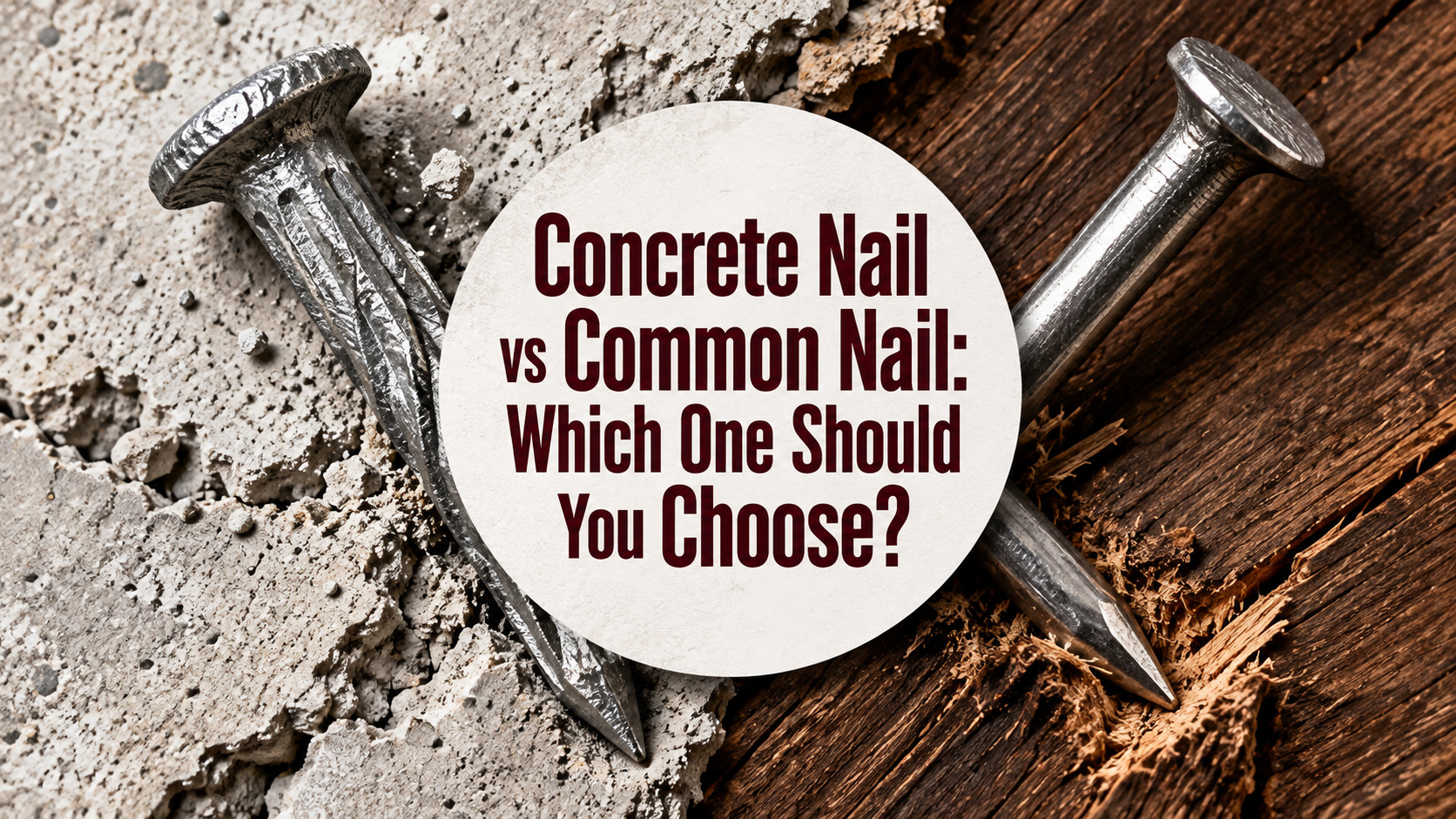
Concrete nail vs common nail is a question I hear often from buyers who want to avoid wrong stock, job-site complaints, or poor fastening results. The problem starts when two nails look similar in length or diameter. The risk grows when price becomes the first comparison. The solution is simple: confirm the base material first.
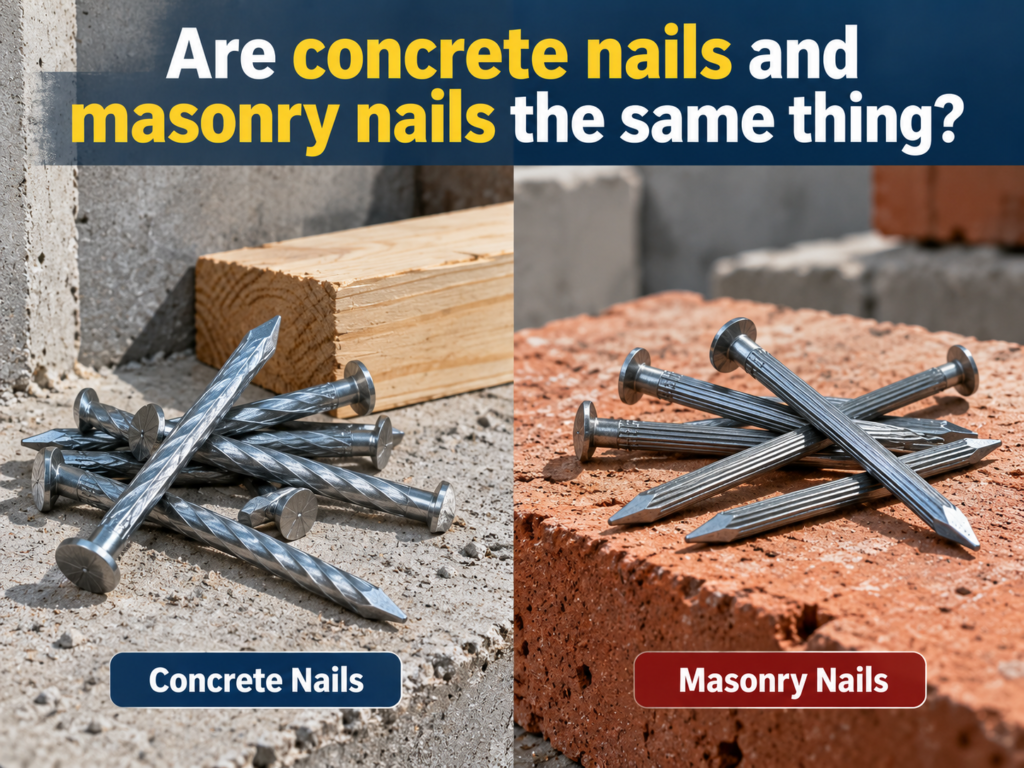
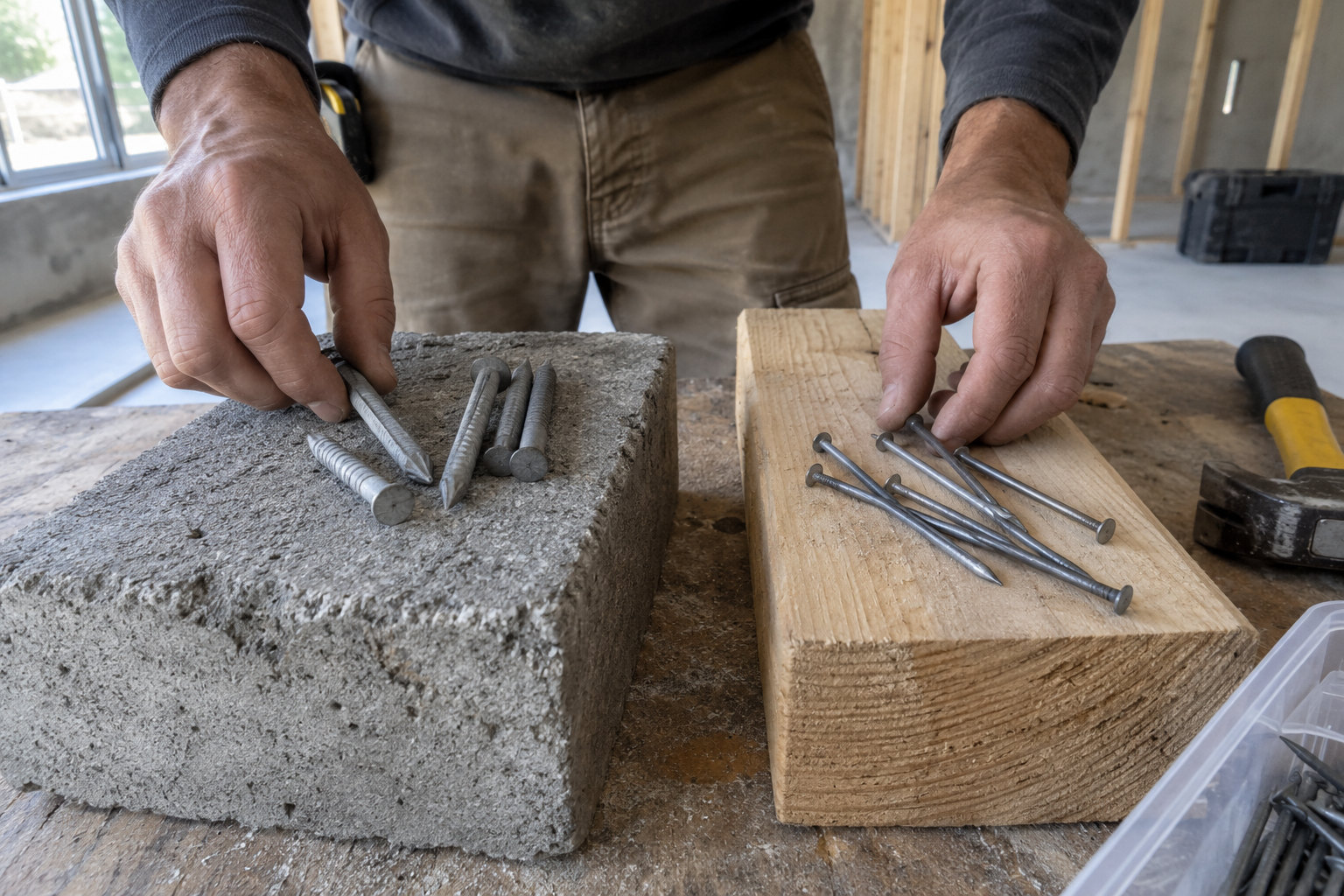
Concrete nails are mainly used for harder base materials such as concrete, masonry, and brick-like surfaces, while common nails are usually used for wood and general fastening. They are not interchangeable just because they share the same length, diameter, head style, or finish. The correct choice depends first on what material you are fastening into.
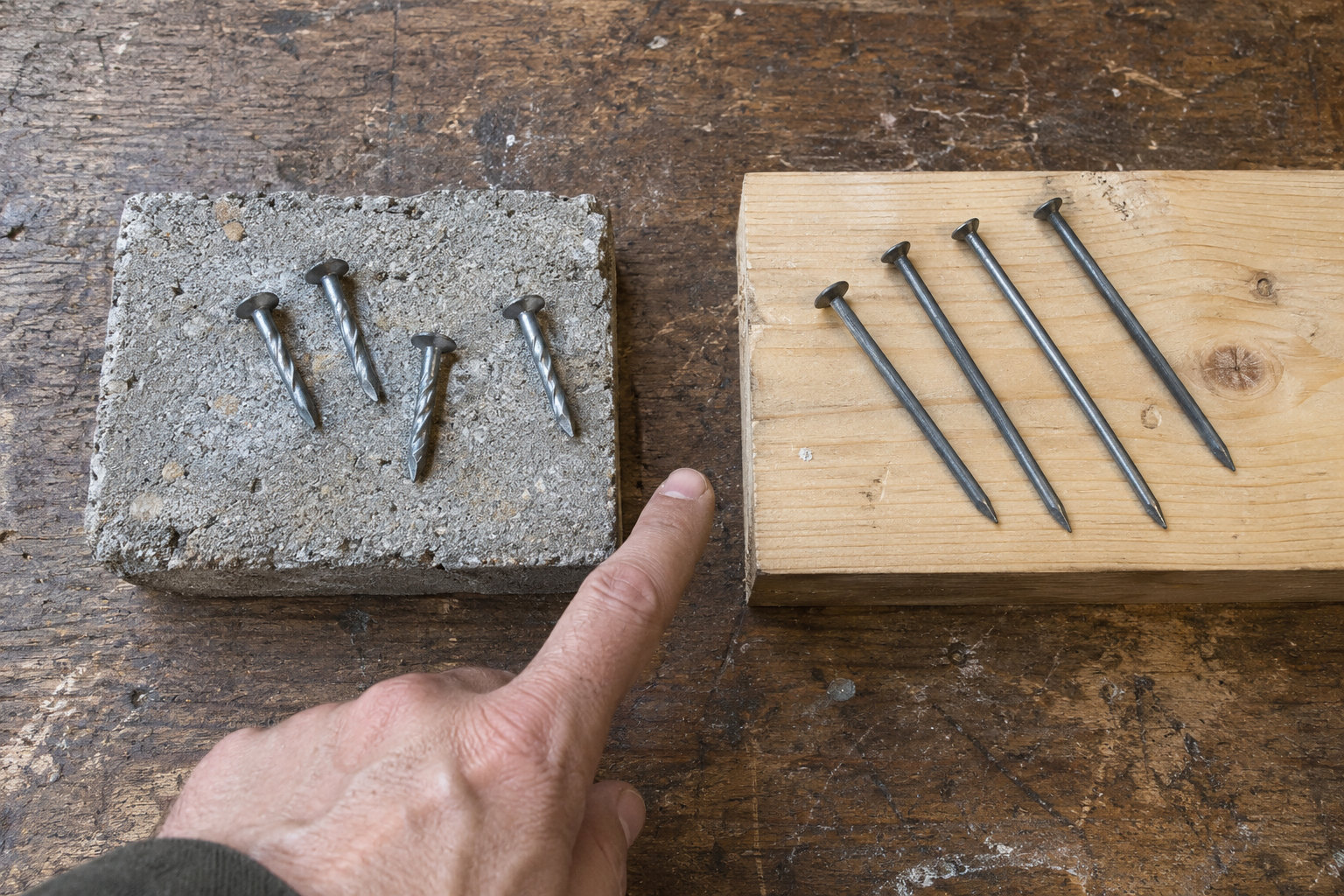
I usually answer this question by asking one question back: “Where will the nail be used?” That question saves time. It also prevents buyers from comparing only size, price, or packaging before they understand the actual application.
Concrete Nail vs Common Nail: What Is the Main Difference?
Many buyers feel confused because both products are simple fasteners. The problem is that a nail can look correct on paper but fail in use. The frustration usually appears after shipment, when a customer says the nail bends, splits the material, or does not hold well.
The main difference between a concrete nail and a common nail is the intended base material. Concrete nails are selected for harder surfaces like concrete and masonry, while common nails are selected mainly for wood and general construction fastening. The buying decision should start with application, not size.
Start With the Surface, Not the Size
In my daily sales communication, I often see buyers start with these questions:
- “Do you have 2-inch nails?”
- “What is the price for 3-inch nails?”
- “Can I use this nail instead of that one?”
- “Which one is cheaper?”
- “Can I order the same diameter with a different head?”
These questions are normal. I ask similar questions when I buy unfamiliar industrial products. However, for nails, they are not the first questions I need to answer. The first filter is always:
What are you fastening into?
A common nail is typically used for wood fastening. It is common in carpentry, framing, packing, pallet work, and general wood applications. A concrete nail is designed for tougher base materials such as concrete, masonry, or similar hard surfaces. It normally needs greater hardness and a structure suited to that type of use.
Why Size Alone Can Mislead Buyers
Two nails may share a similar length, such as 2 inches or 50 mm. They may also look close in diameter. Still, they may behave very differently because their materials, hardness, shank design, and intended use are different.
Here is a simple comparison that I often use when explaining the selection logic:
| Buying Question | Concrete Nail | Common Nail |
|---|---|---|
| First application filter | Concrete, masonry, hard wall-like materials | Wood and general fastening |
| Main buyer risk | Buying a nail that bends or does not enter the surface well | Using it in hard material and expecting concrete-nail performance |
| Size comparison | Useful only after confirming application | Useful only after confirming application |
| Price comparison | Should follow material and use confirmation | Should follow material and use confirmation |
| Typical customer | Hardware distributors, contractors, building supply shops | Timber users, general hardware stores, packing and construction buyers |
A Practical Sales-Side Example
I once spoke with a buyer who asked whether a common nail could replace a concrete nail because the length and head looked similar in his catalog. I did not answer yes or no immediately. I asked him whether the end user was fastening into wood, block, or concrete. After a few messages, we found that the nail was for a hard wall surface. The size was not the real issue. The application was.
That is why I do not treat concrete nail vs common nail as a contest. It is not about which nail is “better.” It is about which nail matches the job. A nail that works well in wood may be the wrong product for a hard wall. A concrete nail may also be unnecessary or unsuitable for a simple wood application where a common nail already does the job.
For importers, wholesalers, and hardware distributors, this distinction matters because the wrong product creates practical problems:
- Customer complaints from contractors or retail buyers.
- Slow-moving inventory because the local market wanted another type.
- Price pressure when buyers compare products that are not equivalent.
- Incorrect packaging decisions because the target user is not clear.
- Repeat-order loss when the nail performs poorly in the real application.
So, before I discuss length, diameter, finish, or carton details, I prefer to confirm the base material. This small step makes the rest of the purchase conversation much more accurate.
Concrete Nail vs Common Nail: Can They Replace Each Other?
Substitution sounds attractive when a buyer wants to reduce stock types or lower cost. The problem is that a similar-looking nail may not perform the same in the actual material. If the replacement fails, the distributor or contractor may face complaints that cost more than the price difference.
Concrete nails and common nails should not be treated as direct substitutes. A common nail is generally not chosen for concrete or masonry fastening, while a concrete nail is not automatically the best choice for every wood or general fastening job. Substitution depends on the base material and working conditions.
The Wrong Question: “Are They the Same Size?”
When customers ask me about replacement, I usually hear one of these points first:
- Same length
- Similar wire diameter
- Similar head shape
- Similar surface finish
- Lower price
- Available packaging
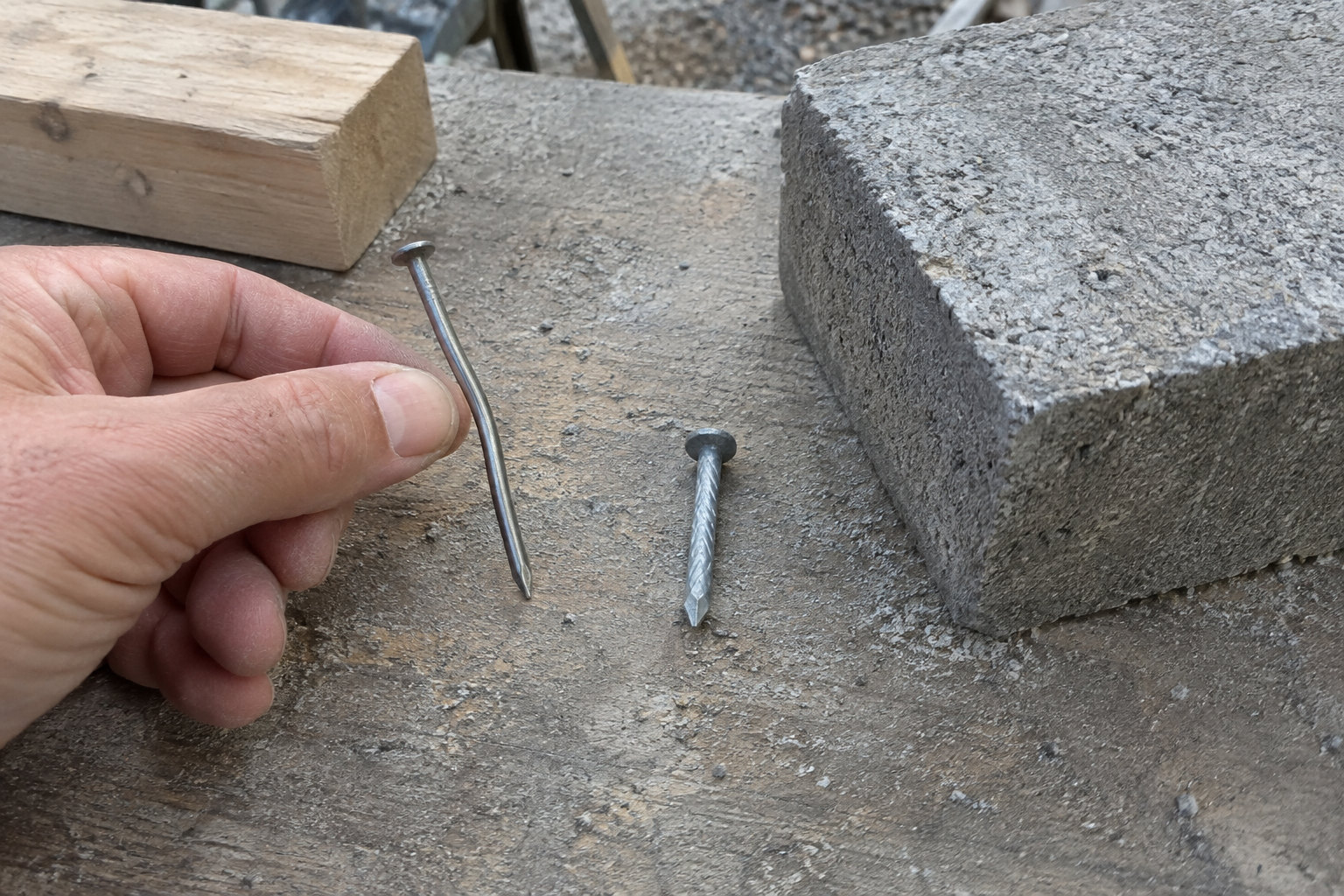
These points matter, but they do not decide substitution. A nail’s visible size does not tell the full story. The product is made for a certain use scenario. If the base material changes, the required product behavior changes too.
For example, a common nail may work well when driven into wood. Wood has different resistance, fiber structure, and holding behavior. Concrete and masonry are much harder and less forgiving. If a buyer uses a product made for wood in a hard surface, the nail may bend, deform, or fail to enter properly.
At the same time, I avoid saying that concrete nails are a universal solution. Different wall materials and construction habits vary by market. A customer in the Middle East may ask for one style. A distributor in Africa or Southeast Asia may stock another type based on local contractor habits. A South American buyer may focus more on retail packaging and common sizes. The correct answer still begins with the actual surface and end use.
A Better Substitution Checklist
When a buyer asks whether one nail can replace another, I prefer to walk through a short checklist:
| Step | Question | Why It Matters |
|---|---|---|
| 1 | What is the base material? | This is the first filter for nail type. |
| 2 | What is being fastened? | The load and object affect product choice. |
| 3 | Is the use temporary or permanent? | Some jobs need stronger long-term holding. |
| 4 | How will the nail be installed? | Hand driving and tool use may affect selection. |
| 5 | What local type do end users expect? | Market habits affect repeat orders. |
| 6 | What size and packaging are required? | These details matter after the application is clear. |
Why Distributors Should Be Careful With “Replacement” Stock
For B2B buyers, the substitution question is not only technical. It is also commercial. If a distributor stocks the wrong nail, the problem can spread across many customers. Retail hardware shops may receive returns. Contractors may stop buying. Wholesalers may need to discount inventory that does not fit the local market.
I have seen inquiries where the buyer wanted to combine two nail types into one order line to simplify purchasing. That approach can work for some products, but nails should be separated by actual use. It is safer to stock the correct product category than to depend on customers figuring it out later.
Here are practical risks when common nails and concrete nails are treated as interchangeable:
- Application mismatch: The nail does not match the base material.
- Performance complaints: The end user reports bending, poor entry, or weak holding.
- Wrong market positioning: The carton label or brand claim does not match local use.
- Price confusion: Buyers compare non-equivalent products and choose only by cost.
- Repeat-order problems: The first shipment sells slowly or receives negative feedback.
When Professional Evaluation Matters
For ordinary product selection, a supplier can explain differences and ask useful questions. However, I do not position myself as an engineer, laboratory tester, or building-code authority. If the application involves safety-critical fastening, structural work, special loads, or strict local regulations, the buyer should consult a qualified professional or test the product under real conditions.
At our factory side, we can support sample checking, OEM or ODM packaging discussions, and order planning. But application-specific decisions should be confirmed by the buyer, contractor, or technical professional responsible for the project.
This is the balanced way to answer concrete nail vs common nail. They may look related, but replacement is not automatic.
What Should Buyers Confirm Before Ordering Concrete Nail vs Common Nail?
A wrong order often starts with an incomplete inquiry. The buyer may send only size and quantity, but the supplier still needs application details. If those details are missing, both sides may spend time discussing price without confirming whether the product is correct.
Before ordering, buyers should confirm base material, usage scenario, nail size, quantity, packaging, target market, and whether samples are needed. For concrete nail vs common nail decisions, the base material should be confirmed first. After that, size, finish, packing, and price become meaningful.
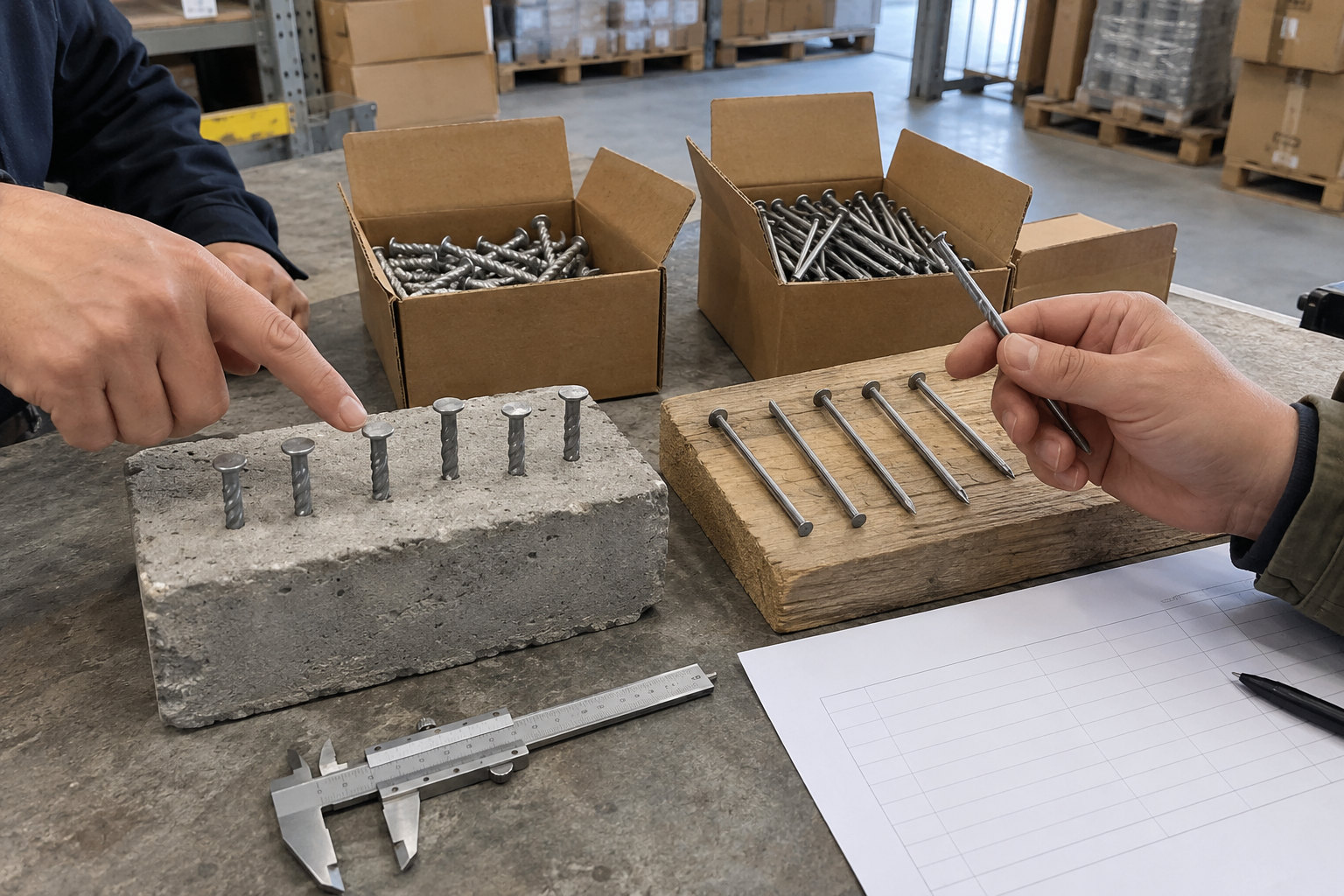
The First Filter: “What Are You Fastening Into?”
I like to make this point very plain. A buyer should not begin with “What size do I need?” The better first question is:
“What material will receive the nail?”
This question separates concrete nail demand from common nail demand. It also helps the supplier understand whether the buyer serves contractors, retail shops, construction supply stores, furniture workshops, or general hardware channels.
The Main Inquiry Details I Recommend
A clear B2B nail inquiry should include these details:
-
Product type
- Concrete nail
- Common nail
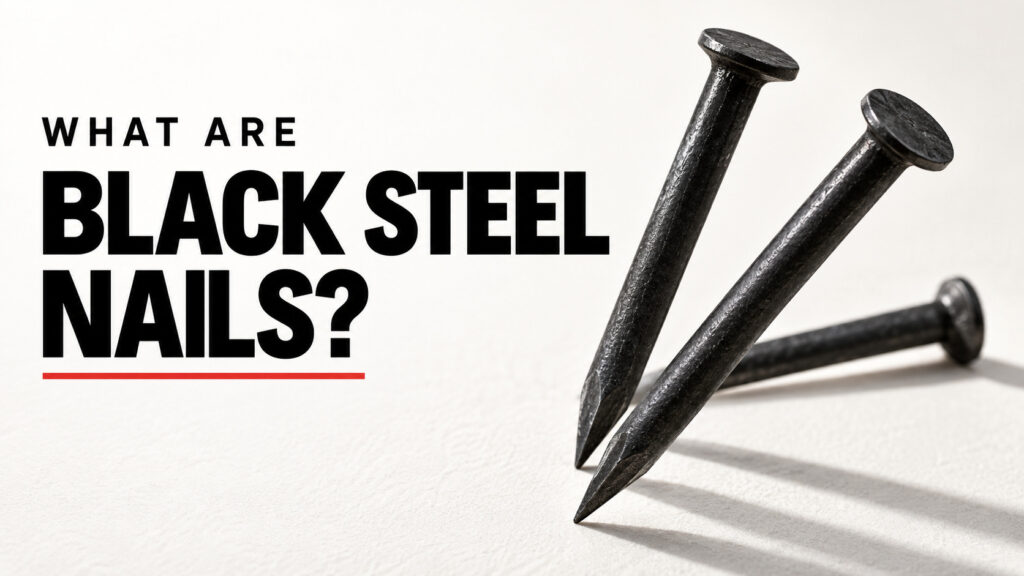
- Other nail type if needed, such as roofing nail, lost head nail, or black steel nail
-
Base material
- Wood
- Concrete
- Masonry
- Block
- Other local wall material
-
Use scenario
- General wood fastening
- Wall fastening
- Construction site use
- Retail hardware resale
- Contractor supply
-
Size
- Length
- Diameter
- Head type if required
- Shank type if required
-
Quantity
- Trial order
- Full container order
- Mixed sizes
- Long-term repeat order plan
-
Packaging
- Bulk carton
- Small box
- Branded packaging
- OEM label
- Local language requirements
-
Target market
- Middle East
- Africa
- Southeast Asia
- South America
- Specific country or region
Why Target Market Matters
Local habits matter more than many new buyers expect. A nail that sells well in one market may not be the standard choice in another. Retail buyers may prefer small boxes. Contractors may prefer larger bulk packaging. Importers may need brand printing or private labels. Some markets may prefer certain finishes or size ranges because local users are used to them.
At Dingzhou Best, we often discuss details such as product type, specification, quantity, and packaging before giving a FOB quotation. This is not because we want to make the conversation longer. It is because the final price depends on the exact product and packing method. Our usual minimum order quantity is around 5 tons or 200 cartons, and trial orders can be discussed when the buyer wants to test the market.
How Samples Fit Into the Buying Process
Samples are useful when a buyer wants to check size, appearance, packaging, or basic quality before placing a larger order. In my experience, sample checking is especially helpful when the buyer is comparing concrete nail vs common nail for a new sales channel.
A practical sample process may include:
- Confirming the product type and size first
- Confirming the intended base material
- Checking appearance, head, shank, and finish
- Reviewing packaging design if OEM is needed
- Discussing whether sample fees can be handled in the formal order
I always recommend that buyers test samples in their own market conditions. A supplier can provide product knowledge and manufacturing details, but local use habits and job-site conditions are best confirmed by the buyer.
A Simple Inquiry Template
Buyers can save time by sending a clear inquiry like this:
| Inquiry Item | Example Information |
|---|---|
| Product | Concrete nail or common nail |
| Application | Fastening into concrete wall / wood frame |
| Size | Length and diameter |
| Quantity | 5 tons, 200 cartons, or trial order |
| Packaging | Bulk carton, small box, OEM brand |
| Market | Ghana, UAE, Philippines, Peru, etc. |
| Shipping | FCL or LCL by sea |
| Required delivery time | 15–25 days depending on order quantity |
This format makes the conversation more productive. It helps both sides avoid comparing the wrong items. It also helps the supplier quote more accurately.
Concrete Nail vs Common Nail: How Do Size, Finish, and Price Affect the Decision?
Buyers naturally compare size, finish, and price because these details are visible and easy to list. The problem appears when these details become the whole decision. A cheaper nail is not cheaper if it creates returns, complaints, or poor performance in the wrong material.
Size, finish, and price matter after the application is confirmed. For concrete nail vs common nail selection, buyers should first identify the base material, then compare dimensions, surface finish, packaging, and FOB price. A low unit price cannot fix a nail type that does not match the job.
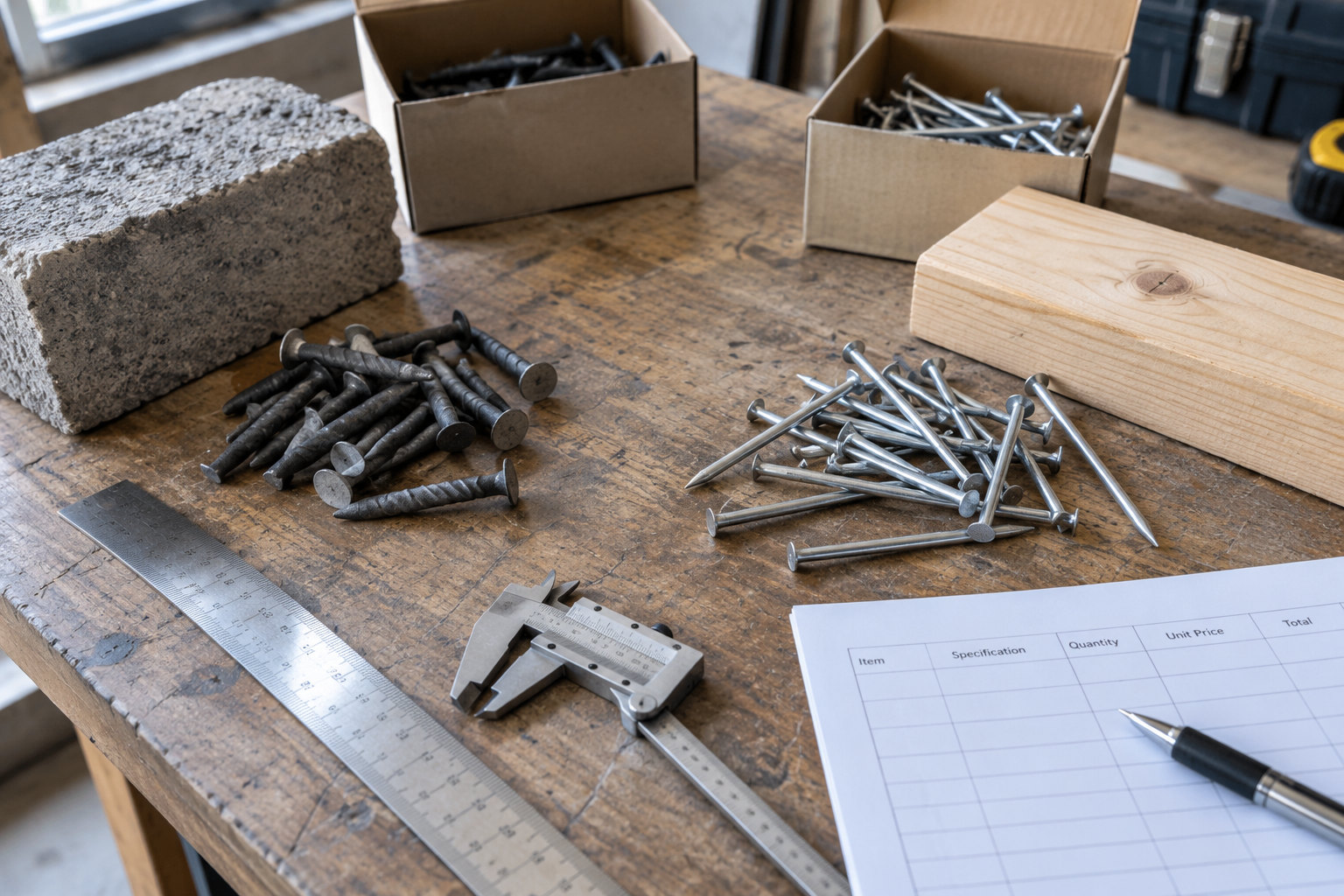
Size Is a Specification, Not the Whole Answer
Length and diameter are important. They affect how the nail is used, how it is packed, and how it is quoted. However, size does not define the product by itself.
A 50 mm nail for wood and a 50 mm nail for hard material may not be the same product. A buyer who compares only the length may miss the difference in intended use. That mistake is common in early inquiries. I do not blame buyers for it. Nail catalogs often make products look simple. But in real purchasing, the base material must come first.
Finish and Head Type Need Context
Surface finish and head type also matter. Buyers may ask for black, bright, galvanized, or other finishes depending on market demand. They may also care about the head shape because local customers recognize certain styles.
Still, these choices should follow application. For example:
| Detail | Why Buyers Ask | What I Confirm First |
|---|---|---|
| Length | To match local size demand | Base material and use |
| Diameter | To match strength and local habit | Product type and application |
| Head type | To meet market preference | Whether it fits the job |
| Finish | To match appearance or corrosion expectations | Use environment and buyer requirement |
| Packaging | To serve wholesale or retail sales | Target market and sales channel |
| Price | To compare suppliers | Whether items are truly equivalent |
FOB Price Needs Complete Information
In our export communication, FOB quotations usually depend on:
- Product type
- Specification
- Quantity
- Packaging method
- Customization requirements
- Current material and production conditions
That is why I hesitate when a buyer asks for “the price of nails” without details. A concrete nail, common nail, roofing nail, black steel nail, and lost head nail are different product categories. Even within one category, size and packaging can change the final quotation.
For B2B buyers, I recommend comparing prices only after the product specification is aligned. Otherwise, a buyer may compare a concrete nail from one supplier with a common nail from another supplier and think one is more expensive. In reality, the comparison may not be fair.
Packaging Can Change the Commercial Result
Packaging is not only decoration. It affects retail appeal, warehouse handling, carton weight, brand positioning, and customer expectations. Hardware stores may need small boxes. Wholesalers may prefer bulk cartons. Importers may want OEM or ODM packaging with their own brand logo.
Common packaging decisions include:
- Bulk packing for wholesale distribution
- Small box packing for retail shops
- OEM label or private brand design
- Mixed sizes in one shipment
- Carton markings for local language or market needs
For distributors, packaging should match how the nail is sold. A high-quality product in the wrong package can still be difficult to move. I have seen buyers focus heavily on nail price and then realize later that their retail customers expected different box sizes. So I try to discuss packaging early, but only after product type and application are clear.
Price Should Not Be the First Filter
I understand price pressure. Many of our customers sell in competitive markets across the Middle East, Africa, Southeast Asia, and South America. Buyers need workable margins. However, price should not be the first filter when comparing concrete nail vs common nail.
A better decision order is:
- Confirm the base material.
- Confirm the product type.
- Confirm the use scenario.
- Confirm size and finish.
- Confirm packaging and branding.
- Confirm quantity and shipping method.
- Compare price between equivalent products.
This order reduces risk. It also helps buyers negotiate more clearly because they know they are comparing the same product type.
How Should Distributors Stock Concrete Nail vs Common Nail for Their Market?
Stocking nails looks simple until inventory sits in the warehouse. The problem is not always quality. Sometimes the product is correct in itself but wrong for the target customers. That is why distributors need to connect product choice with local demand.
Distributors should stock concrete nails and common nails based on their customer base, local building materials, common job types, and retail habits. Concrete nail vs common nail stocking should begin with market application, then move to size range, packaging, trial quantity, and repeat-order planning.
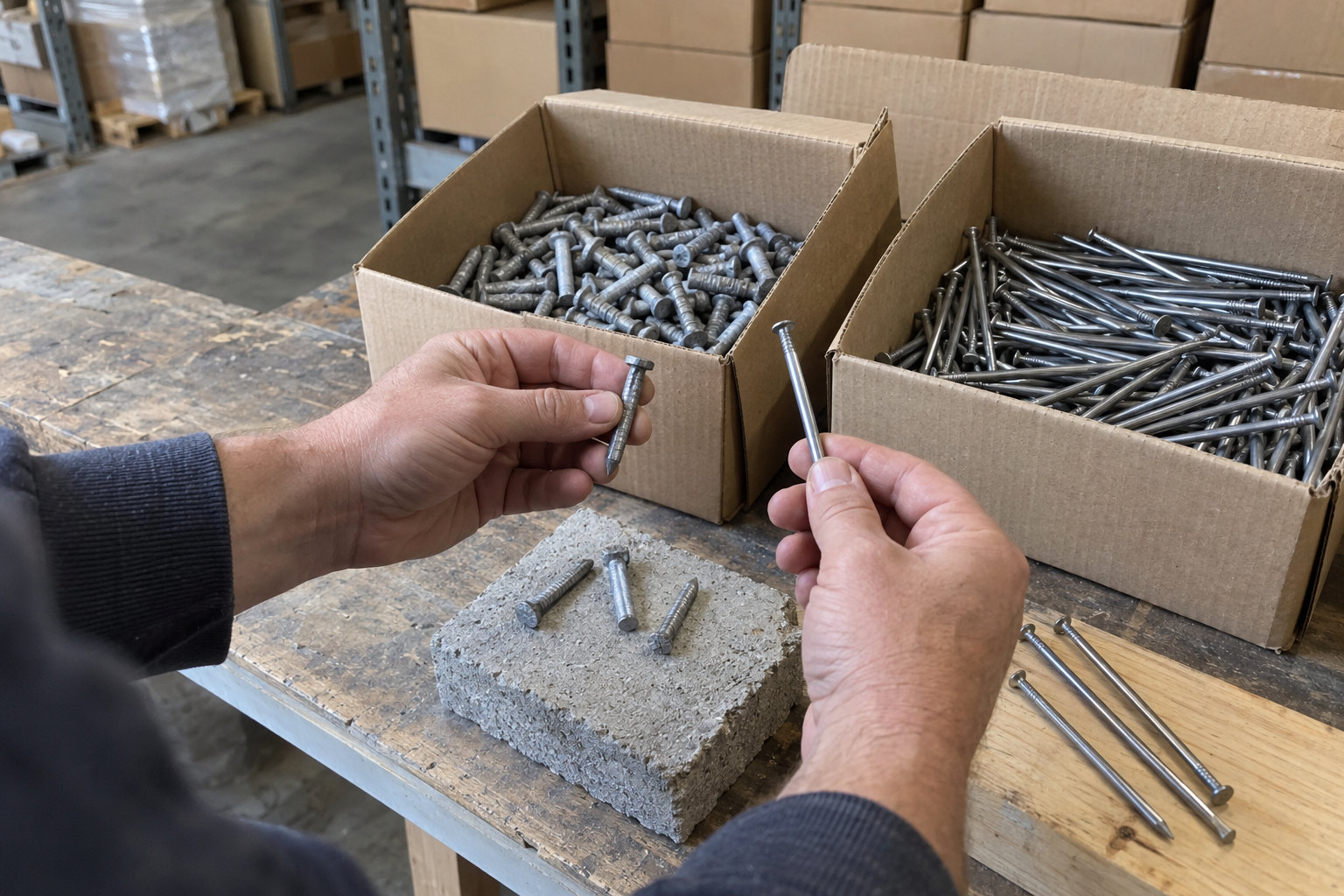
Match Inventory to Customer Type
A contractor-focused buyer may need different stock from a retail hardware shop. A wholesaler serving construction supply stores may need broader size coverage. A distributor selling to wood workshops may sell more common nails than concrete nails.
Here is a simple way to think about customer type:
| Customer Type | Likely Buying Focus | Stocking Consideration |
|---|---|---|
| Contractor supplier | Job-site performance and availability | Keep practical sizes and reliable packaging |
| Retail hardware shop | Small boxes and recognizable products | Focus on shelf-ready packaging |
| Wholesaler | Volume, price, and repeat demand | Balance MOQ with fast-moving sizes |
| Wood-related user | Common nail demand | Confirm wood fastening applications |
| Masonry or wall-work user | Concrete nail demand | Confirm local wall materials and habits |
Use Trial Orders When the Market Is Unclear
When a buyer enters a new market segment, I prefer a careful trial order over a very large first order. Our business can support trial cooperation, and normal production lead time is usually around 15–25 days, depending on order quantity and details. Shipping is mainly by sea, with both FCL and LCL options depending on order planning.
A trial order can help the buyer check:
- Whether the nail type matches customer demand
- Whether the size range is correct
- Whether the packaging sells well
- Whether the price level fits the local market
- Whether repeat orders are likely
This approach is especially useful when buyers are unsure about concrete nail vs common nail demand in their region. It reduces the risk of choosing too much of the wrong product.
Do Not Overpromise to End Users
I also recommend that distributors describe products accurately. A concrete nail should not be sold as a universal wall-fastening solution for every wall, every load, and every local condition. A common nail should not be sold as suitable for hard concrete just because it is strong enough for wood.
Clear product positioning protects the seller. It also helps end users buy with the right expectations.
A simple product description may say:
- “Common nails for wood and general fastening.”
- “Concrete nails for selected hard base materials such as concrete or masonry.”
- “Please confirm application and local installation method before use.”
This language is honest and commercially useful. It avoids exaggerated claims. It also builds trust with repeat buyers.
How I Would Plan a First Purchase
If I were helping a new distributor plan a first nail purchase, I would ask for the following information before recommending product direction:
- Which country or region will you sell in?
- Are your main customers contractors, shops, wholesalers, or DIY users?
- Are they fastening into wood, concrete, masonry, or mixed materials?
- What sizes already sell well in your market?
- Do you need bulk packing or retail boxes?
- Do you want OEM branding or neutral packaging?
- Do you want a trial order before larger container planning?
These questions create a practical buying map. They also make the supplier’s job easier. When I understand the market, I can discuss production, packing, MOQ, and shipping more clearly.
For Dingzhou Best, the goal is not to push one nail type to every buyer. The goal is to help buyers select the product that fits their application and market. That is the best way to build repeat business.
Frequently Asked Questions
Is a concrete nail stronger than a common nail?
A concrete nail is made for harder base materials such as concrete or masonry, while a common nail is usually for wood and general fastening. I would not describe one as always stronger or better. The correct choice depends on the base material, use scenario, and local installation conditions.
Can I use a common nail in concrete?
I generally would not recommend treating a common nail as a concrete fastening product. Common nails are normally selected for wood. If the job involves concrete or masonry, buyers should evaluate concrete nails or another suitable fastening solution and confirm the application with a qualified professional when needed.
Can I use a concrete nail in wood?
A concrete nail may enter some wood, but that does not make it the best or most economical choice. Common nails are usually selected for wood fastening. Buyers should consider the actual job, cost, holding needs, and local user habits before replacing one product with another.
What information should I send when asking for a nail quotation?
I recommend sending the product type, base material, use scenario, size, quantity, packaging method, target market, and shipping plan. For example, tell the supplier whether the nail is for wood, concrete, or masonry. This helps avoid wrong comparisons and improves quotation accuracy.
Are concrete nails suitable for every wall?
No. Concrete nails should not be treated as a universal solution for every wall. Wall materials, installation methods, local construction habits, and job requirements can vary. Buyers should confirm the actual base material and test samples when needed before placing a larger order.
Conclusion
Concrete nail vs common nail is not a question of which nail is better. It is a selection problem based on base material, use scenario, and buying risk. I always recommend starting with one question: What are you fastening into? After that, buyers can compare size, finish, packaging, quantity, and FOB price more accurately. If you are an importer, wholesaler, or hardware distributor, contact Dingzhou Best at [email protected] or WhatsApp +8618331061136 to discuss samples, OEM/ODM packaging, and trial orders.