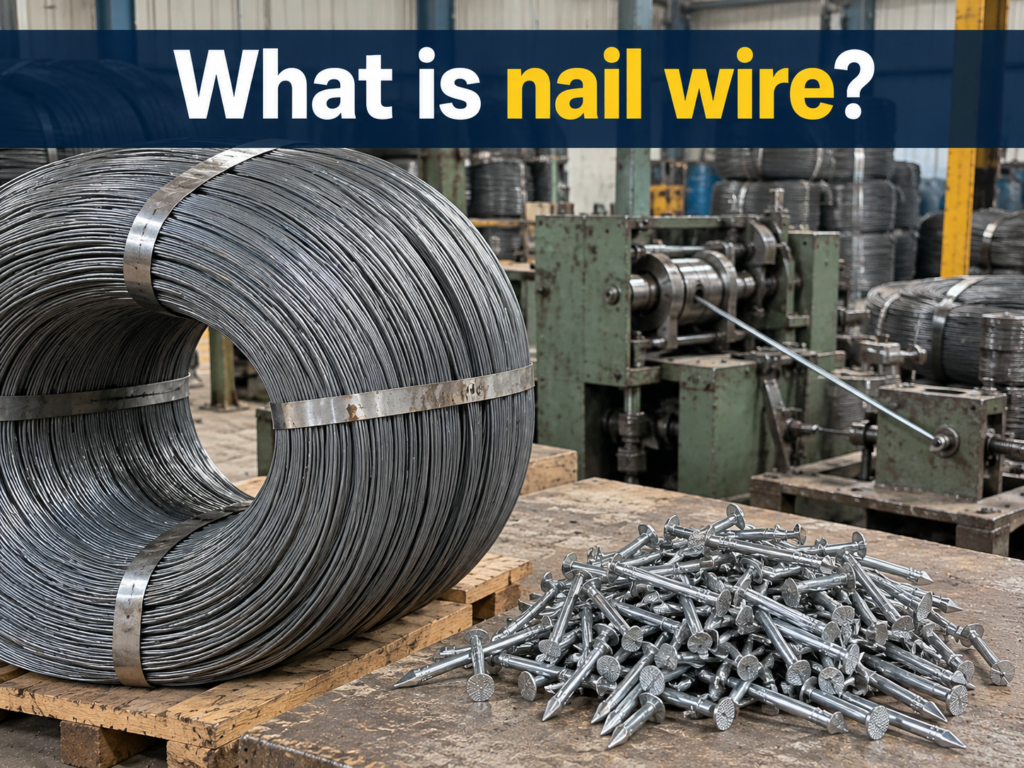
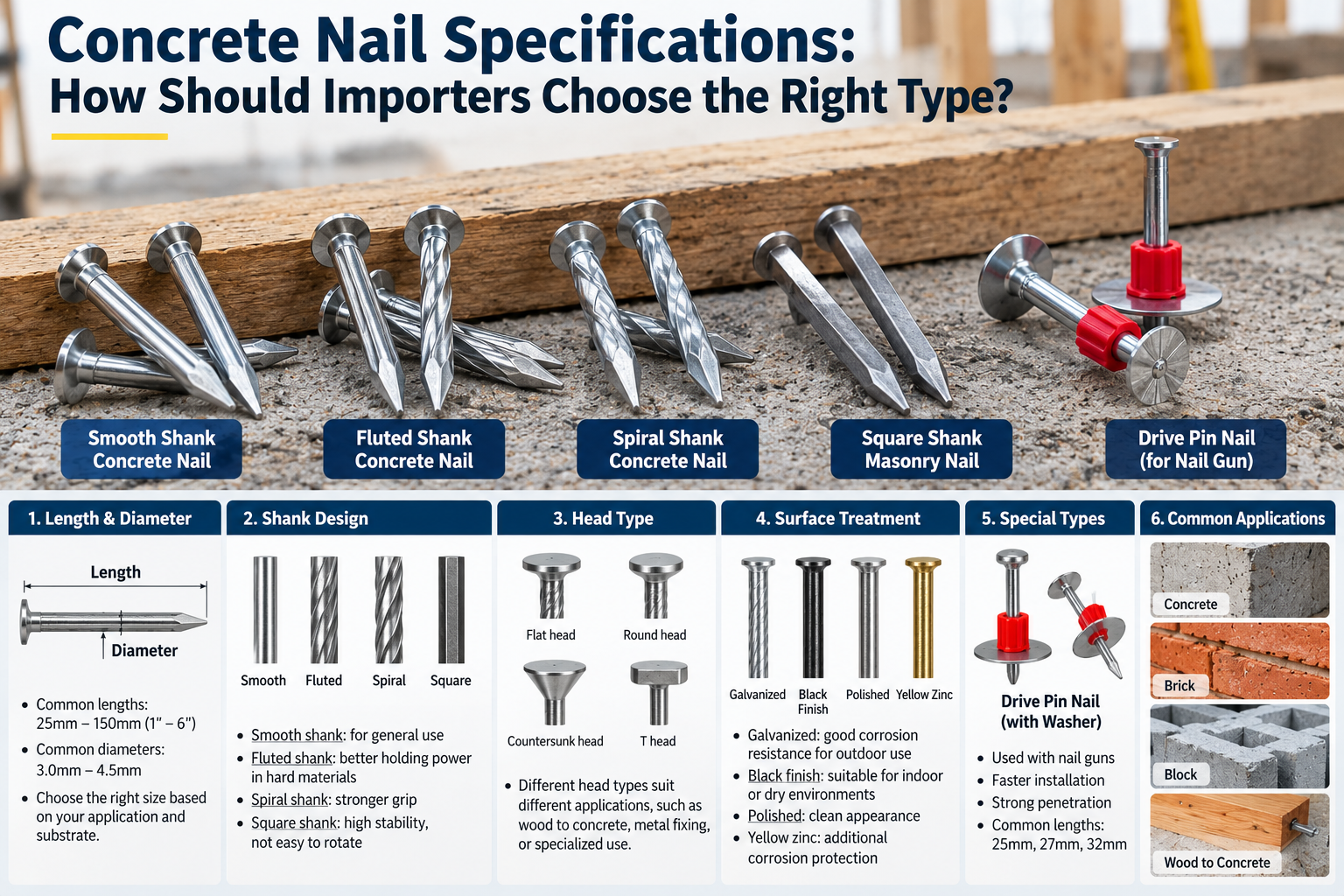
Concrete nail specifications can look simple on a catalog page, but the wrong choice can create bent nails, broken points, weak fixing, and customer complaints. For importers and wholesalers, that small technical mistake can become a costly business problem. I usually recommend starting with the application first, then matching the nail size, hardness, finish, and packaging.
Concrete nail specifications should include length, diameter, head type, point type, surface treatment, hardness, material, packaging, quantity, and intended use. B2B buyers should choose specifications according to the substrate, fixing material thickness, required holding strength, local market habits, and export purchasing needs such as MOQ, carton weight, loading plan, and delivery time.
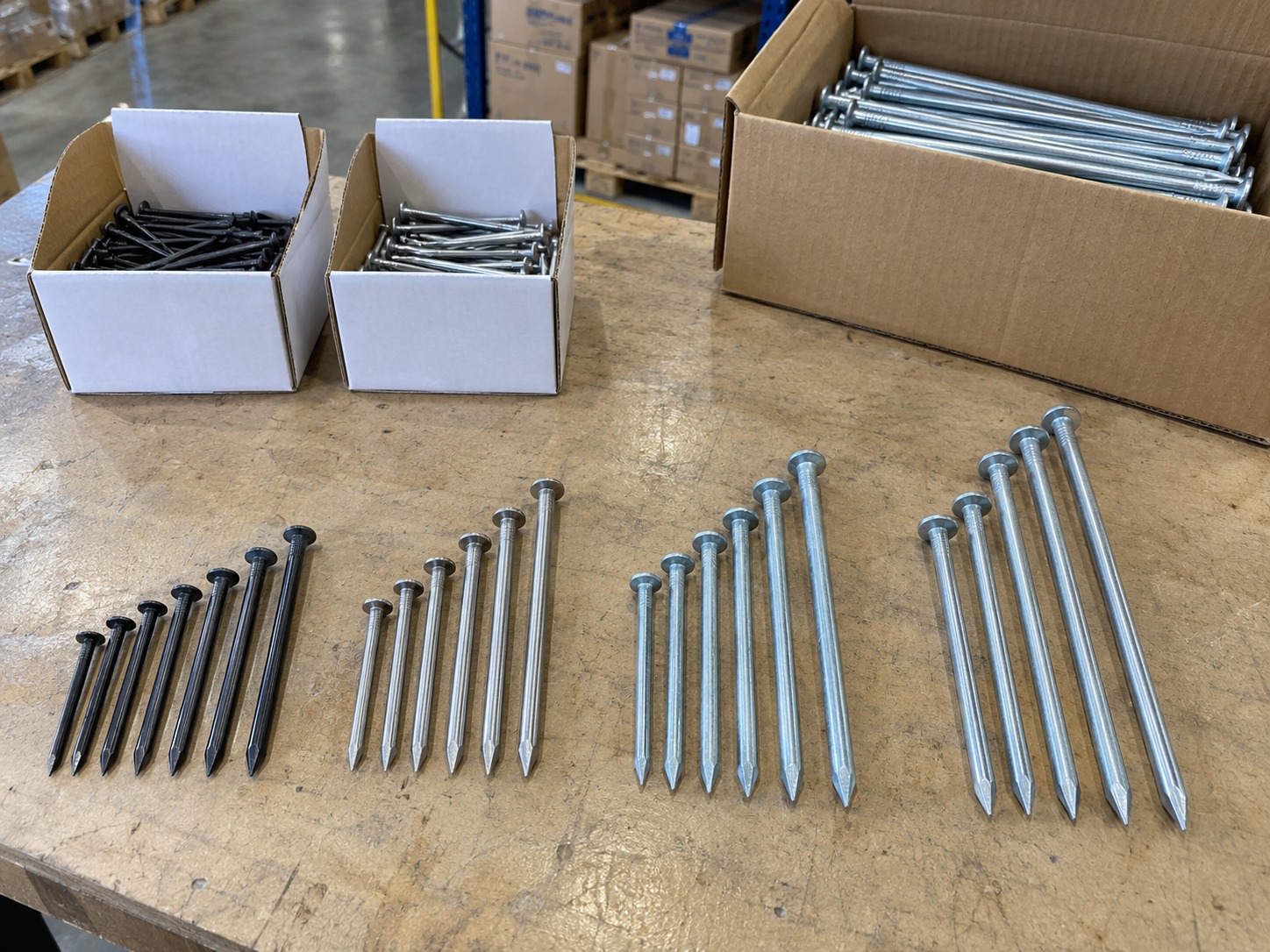
In real customer inquiries, many buyers first ask me only for price or length. However, a concrete nail is not selected by length alone. The better question is: where will the nail be used, what will it fix, and how will it be sold in the buyer’s market?
What Should Concrete Nail Specifications Include for Export Purchasing?
Many purchasing mistakes start with an incomplete inquiry. A buyer may ask for “2-inch concrete nails,” but this does not tell me the diameter, surface finish, packaging, head type, or market use. That gap can lead to wrong quotations, unstable samples, and delays.
Concrete nail specifications for export purchasing should include length, shank diameter, head type, point shape, surface treatment, material, hardness level, quantity, packaging method, carton requirements, and target application. These details help a factory quote accurately, control production, arrange packing, estimate loading quantity, and reduce the risk of complaints after distribution.
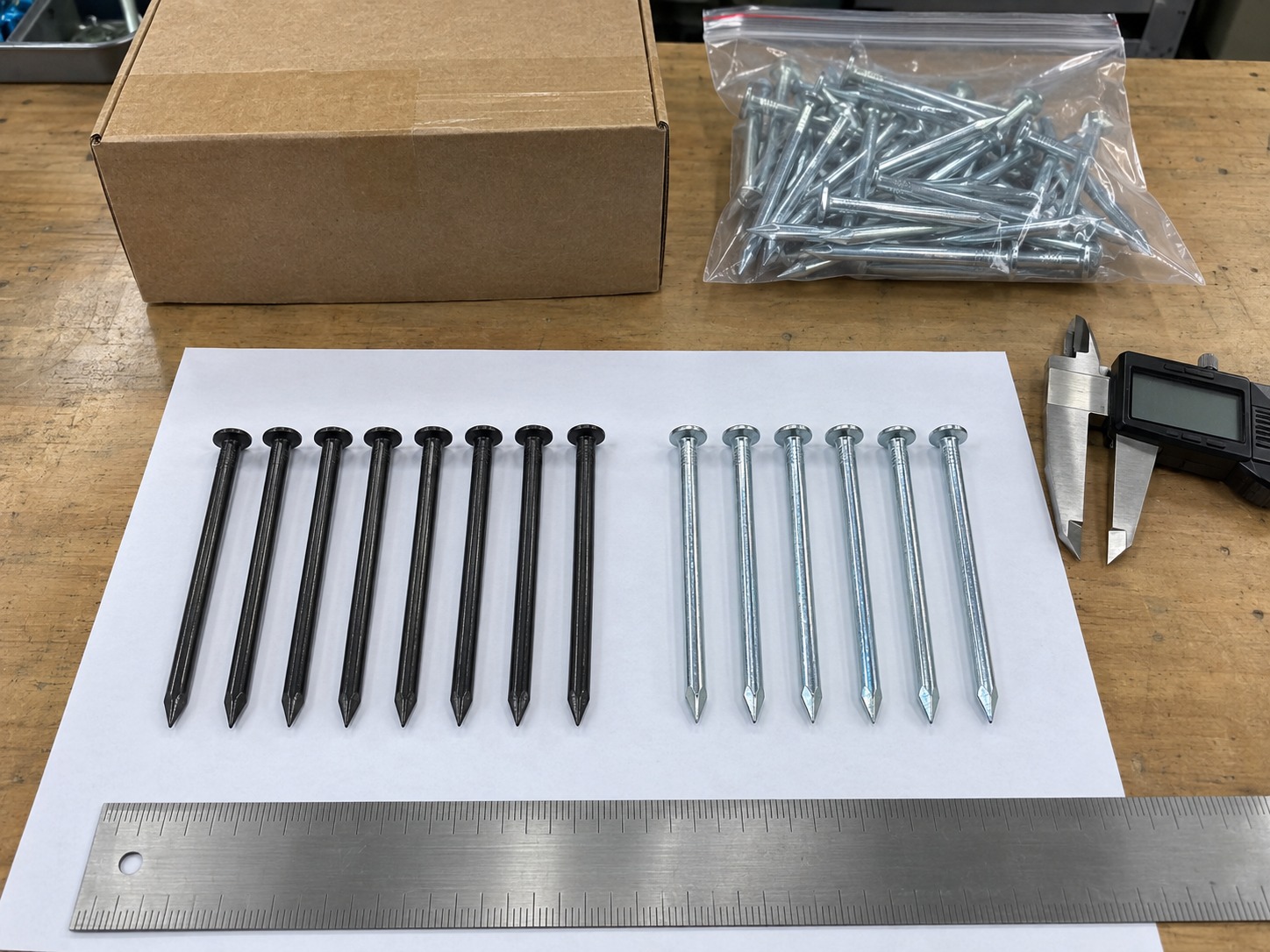
The Core Specification Items Buyers Should Confirm
When I receive inquiries from importers in the Middle East, Africa, Southeast Asia, and South America, I usually ask several questions before giving a firm FOB quotation. I do this because concrete nail specifications affect both production cost and market suitability.
Here are the main items I recommend buyers confirm:
| Specification Item | Why It Matters for Buyers | Example Detail |
|---|---|---|
| Length | Affects penetration depth and fixing strength | 1", 1.5", 2", 2.5", 3", 4" |
| Diameter | Affects strength, bending resistance, and cost | 2.0 mm, 2.5 mm, 3.0 mm, 3.5 mm |
| Head type | Affects holding area and installation appearance | Flat head, countersunk head |
| Point type | Affects penetration into masonry or concrete | Diamond point, sharp point1 |
| Surface treatment | Affects corrosion resistance and appearance | Bright, black, galvanized |
| Material and hardness | Affects penetration, brittleness, and bending | High carbon steel, heat treated |
| Packaging | Affects retail sale, handling, and freight | Bulk carton, small box, plastic bag |
| Quantity | Affects MOQ, unit price, and loading plan | 5 tons, 200 boxes, FCL, LCL |
| Market use | Affects recommended size and packaging | Construction, wholesale, retail hardware |
Why “Length Only” Is Not Enough
I often see buyers request a quotation like this:
“Please quote 2-inch concrete nail, best price.”
This inquiry is too broad. A 2-inch nail can have different diameters, different hardness, different finishes, and different packaging. Those differences affect:
- Raw material consumption
- Heat treatment cost
- Surface treatment cost
- Carton weight
- Loading quantity
- Breakage risk during use
- Customer satisfaction in the buyer’s market
For example, a 2-inch concrete nail with a thicker shank may cost more than a thinner one, but it may also resist bending better in harder masonry. A black steel finish may be common in one market, while galvanized concrete nails may be preferred in another because buyers expect better moisture resistance2.
A Practical Inquiry Template
For a faster and more accurate quotation, I suggest using this format:
- Product: Concrete nail
- Length: For example, 2 inch or 50 mm
- Diameter: For example, 3.0 mm
- Head type: Flat head or other requested type
- Point type: Sharp point or diamond point
- Surface: Black, bright, or galvanized
- Packaging: 1 kg box, 25 kg carton, bulk carton, or customized packaging
- Quantity: Tons, cartons, or container quantity
- Market use: Brick wall, masonry, ordinary concrete, or resale market
- Branding: Neutral packing, OEM, ODM, or buyer’s logo
At Dingzhou Best, our FOB quotation usually depends on product + specification + quantity + packaging method. Our MOQ is generally 5 tons or 200 boxes, and we support trial orders when buyers want to test market response first. I also recommend sample testing before a formal order, especially when the buyer is changing suppliers or launching a new specification.
How Do Concrete Nail Specifications Change by Substrate and Fixing Task?
A nail that performs well in one wall may fail in another. Buyers sometimes assume that one concrete nail specification can fit all surfaces. That assumption is risky because brick, masonry, ordinary concrete, and harder concrete have different resistance levels.
Concrete nail specifications should change according to the substrate hardness and the material being fixed. Softer brick may accept a thinner or shorter nail, while harder concrete may require better hardness, suitable diameter, and stronger point quality. The fixing material thickness also affects the required nail length and holding strength.
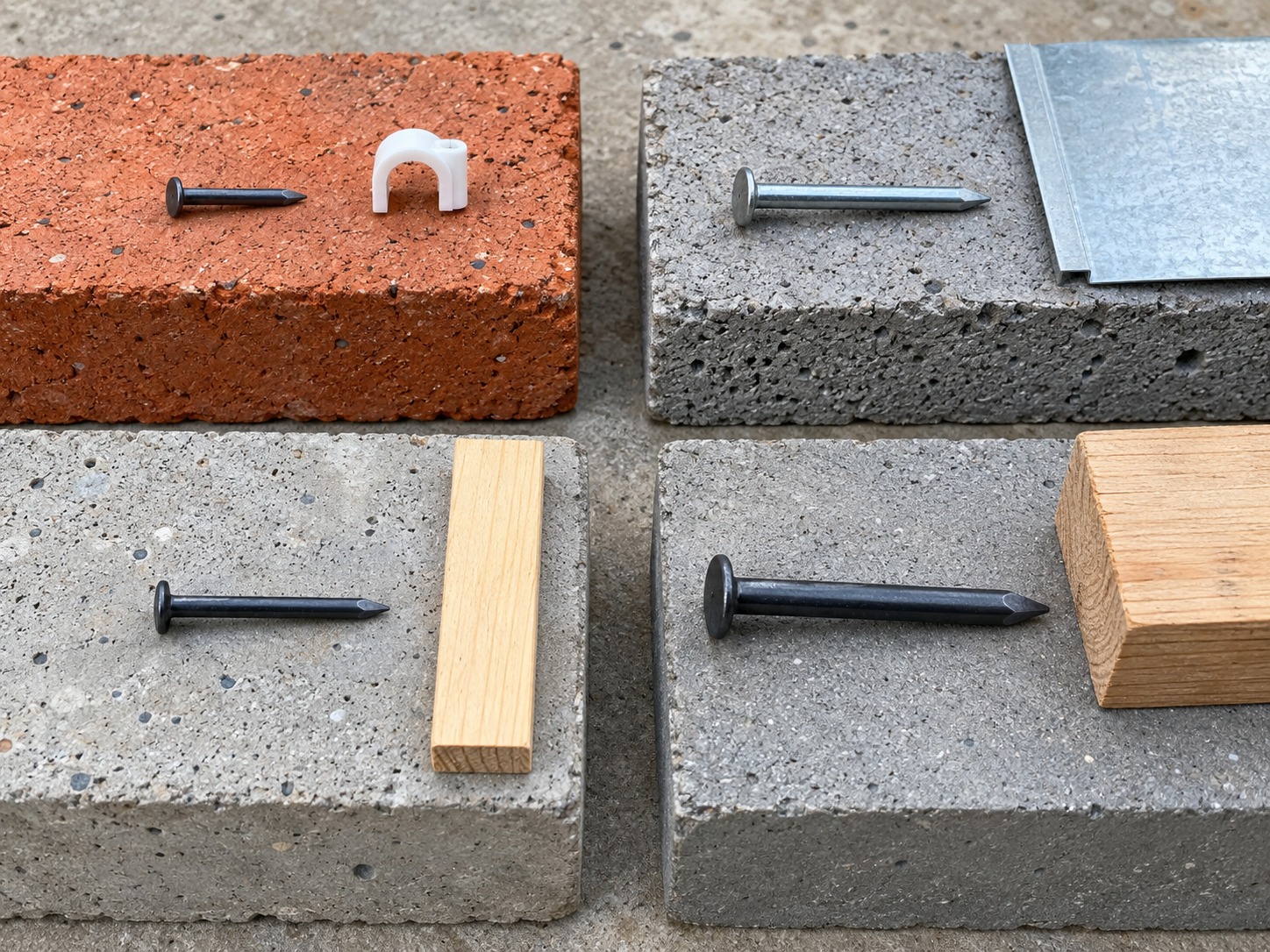
Start With the Substrate
Before I recommend a size, I usually ask: What surface will the nail enter?
This question matters because each substrate behaves differently.
| Substrate | Typical Buyer Concern | Specification Consideration |
|---|---|---|
| Brick wall | Easy penetration but possible cracking | Moderate length and controlled impact |
| Masonry | Mixed hardness and uneven resistance | Reliable point and consistent shank |
| Ordinary concrete | Higher penetration resistance | Stronger hardness and suitable diameter |
| Harder concrete | Higher bending or breaking risk | Careful sample testing and quality control |
No manufacturer should responsibly say that one nail is suitable for every concrete condition. Concrete quality can change by country, construction method, aggregate, age, moisture, and wall thickness3. So, I prefer to treat specification selection as a procurement decision based on application, not only a catalog choice.
Match Nail Length to the Fixing Task
The thickness of the fixed material is just as important as the wall type. A buyer may need concrete nails for:
- Wood strips
- Cable trunking
- Metal sheets
- Plastic clips
- Light framing accessories
- General building hardware resale
If the fixed material is thick, the nail needs enough remaining length to penetrate the base material. If the nail is too short, the holding strength may be weak. If the nail is too long for a hard wall, the user may face more bending, more difficult driving, or unnecessary cost.
A simple procurement logic is:
Nail length = fixed material thickness + required penetration depth into the substrate4.
This is not a structural engineering formula. It is a practical purchasing approach. For safety-critical applications, buyers should consult a qualified professional or test according to local requirements.
Common Length Ranges and Use Logic
Different markets use different size habits, but many concrete nail orders fall into familiar ranges.
| Approx. Length | Common Use Logic | Purchasing Note |
|---|---|---|
| 1 inch / 25 mm | Thin clips, light fixing | Check diameter and head size |
| 1.5 inch / 38 mm | Cable trunking, small wood strips | Common wholesale item |
| 2 inch / 50 mm | General fixing tasks | Often requested by distributors |
| 2.5 inch / 63 mm | Thicker wood or deeper fixing | Check bending resistance |
| 3 inch / 75 mm | Heavier fixing tasks | Sample testing is important |
| 4 inch / 100 mm | Special or heavy applications | Confirm substrate suitability |
I have seen buyers order a popular length because competitors sell it, not because they checked the end use. That can work for general resale, but it can also create inventory that does not match local demand. A hardware distributor should ask local contractors which sizes move fastest, then build a mixed order around those sizes.
Do Not Ignore Diameter
Diameter affects more than price. It affects how the nail behaves during installation. A thinner shank may be cheaper and easier to drive in some materials, but it may bend more easily. A thicker shank may provide stronger resistance, but it may require more driving force5 and can increase cost.
When discussing concrete nail specifications, I like to balance three factors:
- Penetration ability
- Bending resistance
- Market price acceptance
A very cheap nail that bends often can damage the buyer’s brand. A very strong nail that is too expensive may move slowly in price-sensitive markets. The right specification sits between performance and market demand.
Which Quality Factors Make Concrete Nail Specifications Reliable?
A specification on paper does not guarantee stable performance. If raw material, hardness, heat treatment, or surface quality is inconsistent, the same size can behave differently from batch to batch. That inconsistency can become a serious issue for importers and wholesalers.
Reliable concrete nail specifications depend on consistent wire material, correct hardness, controlled shank diameter, sharp and uniform points, proper head forming, suitable surface treatment, and stable packaging weight. Buyers should evaluate samples, check supplier production capability, and confirm quality expectations before placing larger repeat orders.
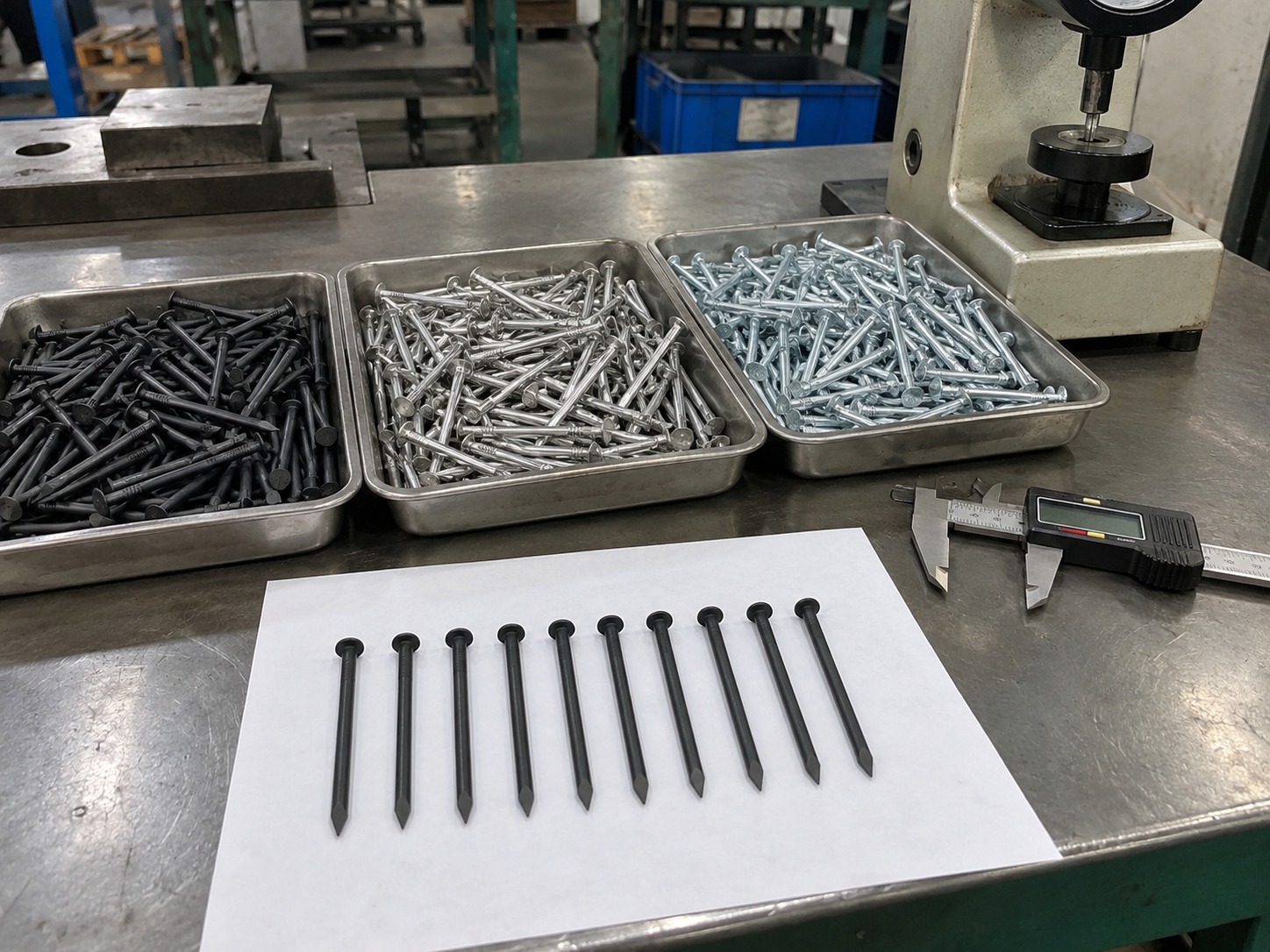
Hardness: Too Soft or Too Brittle Both Create Problems
Concrete nails usually require higher hardness than common wire nails because they must enter harder substrates. However, hardness must be controlled. If a nail is too soft, it may bend before penetrating. If it is too brittle, it may break during hammering6.
This is why I do not like discussing only price at the beginning. Price is important, but it follows the specification. A lower price may come from thinner wire, lower material consistency, weak heat treatment control, or lighter packaging. Those differences may not be visible in a simple product photo.
A buyer should consider these quality risks:
- Bending during installation
- Broken points
- Cracked heads
- Inconsistent diameter
- Uneven surface treatment
- Rust before sale
- Incorrect carton weight
- Mixed sizes in one batch
Surface Treatment and Market Expectations
Surface treatment affects both appearance and market acceptance. Common options include:
| Surface Treatment | Typical Feature | Buyer Consideration |
|---|---|---|
| Bright finish | Clean metallic appearance | Suitable for dry storage and general use |
| Black finish | Common for black steel concrete nails7 | Popular in many wholesale markets |
| Galvanized finish | Better corrosion resistance than untreated finishes | Often costs more and should be specified clearly |
A galvanized nail is not automatically the right choice for every order. Some markets prefer black concrete nails because of habit, price, or contractor preference. Other buyers may need galvanized concrete nails because goods stay longer in warehouses or are used in more humid environments.
The important point is simple: surface treatment must match the selling market and storage conditions.
Head and Point Consistency
The head and point may look like small details, but they affect real use. A poorly formed head can deform easily. A weak point can fail to start properly on masonry or ordinary concrete. If the point is not centered, the nail may deflect during driving.
For B2B buyers, these issues create downstream costs:
- Retailers receive complaints.
- Contractors reject the product.
- Wholesalers discount slow-moving stock.
- Importers lose repeat orders.
- Brand reputation suffers.
I usually recommend buyers evaluate samples by checking several pieces, not only one or two. They should look at the shape, surface, hardness feeling during driving, carton marking, and packaging condition. This is not a formal laboratory test, but it gives a practical first screening.
Packaging Quality Is Part of Specification Quality
Many buyers think packaging is separate from the nail specification. In export business, I see packaging as part of the product. A good nail in weak packaging can still create claims.
Packaging affects:
- Carton breakage
- Warehouse handling
- Retail display
- Carton weight accuracy
- Container loading
- Brand image
- Moisture exposure during sea freight
At Dingzhou Best, we support customized packaging, including OEM/ODM options, buyer brand logo, and different carton or box formats. For importers and distributors, this matters because the same nail may be sold in bulk to contractors or in small boxes to hardware shops.
How Should Concrete Nail Specifications Affect Quotation, MOQ, Packaging, and Delivery?
A quotation is only useful when the specification is clear. If a buyer changes diameter, finish, packing, or carton weight after receiving a price, the quotation may change. This is normal because each detail affects production and logistics.
Concrete nail specifications affect FOB price, MOQ, packaging cost, carton weight, container loading quantity, shipping method, and delivery schedule. A complete inquiry helps the supplier calculate material cost, production time, packing method, and loading plan. It also helps buyers compare offers fairly between different factories.
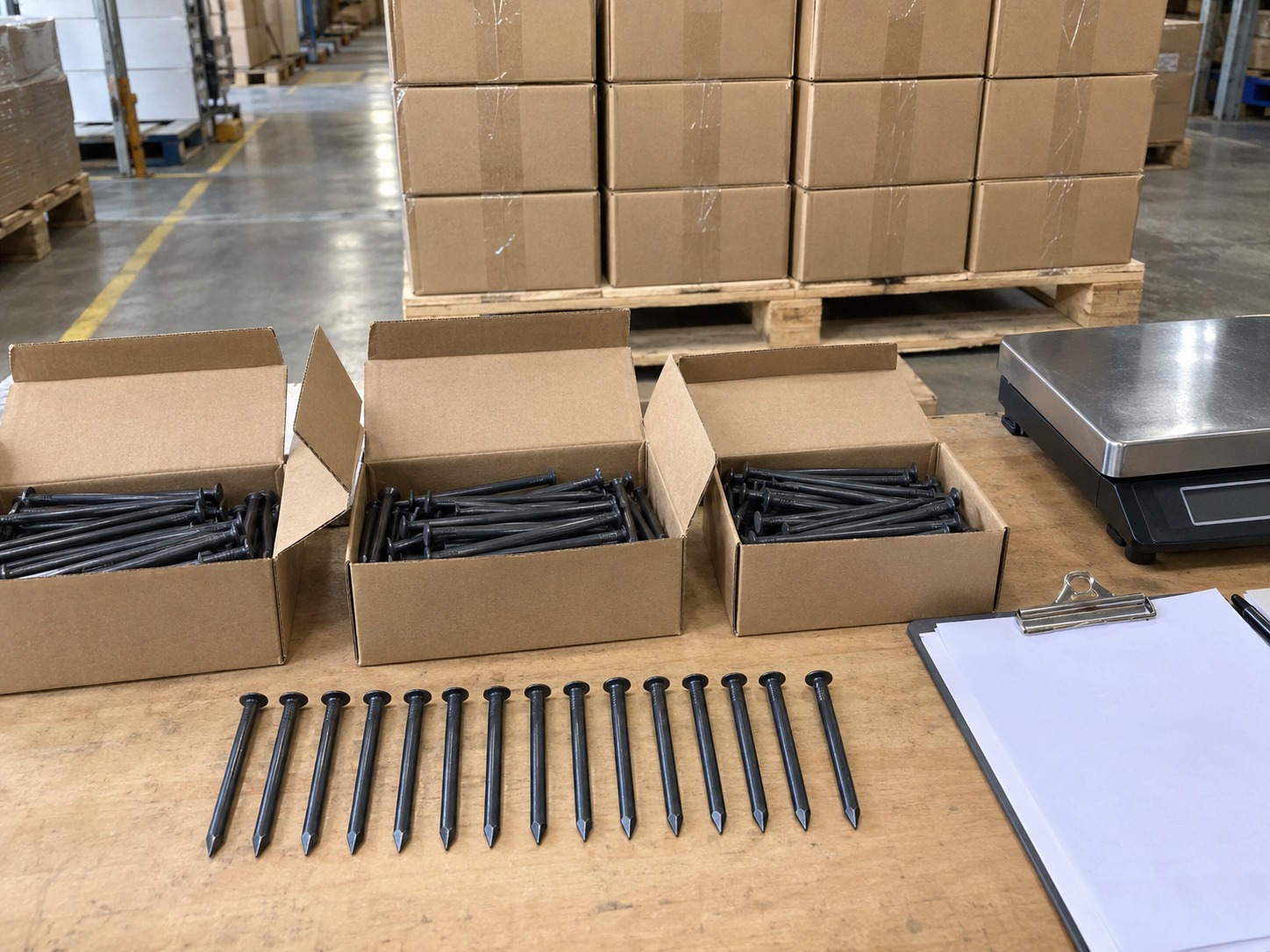
Why FOB Quotation Needs Full Details
Our quotation method is usually based on:
Product + specification + quantity + packaging method
For example, these two inquiries are not the same:
| Inquiry | Why the Price May Differ |
|---|---|
| 2-inch concrete nail, bulk carton | Lower packaging cost, heavier carton handling |
| 2-inch concrete nail, 1 kg boxes with logo | Higher packaging cost, printing cost, more labor |
| 2-inch galvanized concrete nail | Different surface treatment cost |
| 2-inch thicker diameter nail | More raw material consumption |
This is why I ask buyers to share complete concrete nail specifications before I quote. A fast price without enough details may look attractive, but it can cause problems later when the buyer compares samples or confirms packaging.
MOQ and Trial Orders
For our factory, the usual MOQ is 5 tons or 200 boxes, depending on product and packaging. This level helps control production efficiency and export handling costs. However, we also support trial orders when a buyer wants to test market demand.
A trial order is useful when:
- The buyer is testing a new supplier.
- The buyer is entering a new local market.
- The buyer wants to compare several sizes.
- The buyer needs samples before a container order.
- The buyer is developing private-label packaging.
Samples can be provided for quality checking. In many cases, samples carry a basic cost, and this cost can be discussed for return or adjustment in a formal order. I recommend sample checking especially for buyers who sell to contractors, because actual user feedback is valuable.
Packaging Choices for Different Sales Channels
Packaging should match the buyer’s distribution model.
| Sales Channel | Suitable Packaging Direction | Main Benefit |
|---|---|---|
| Importer warehouse | Bulk carton or standard export carton | Efficient handling and lower packing cost |
| Wholesaler | Medium box or carton packing | Easy resale and inventory control |
| Retail hardware shops | Small box, branded packing, barcode option | Better shelf display and brand recognition |
| Project supply | Strong bulk packing | Lower unit packing cost |
A buyer should also consider carton weight. If cartons are too heavy, workers may complain or cartons may break during handling. If cartons are too light, packaging cost may increase. The right balance depends on local labor habits, warehouse handling, and resale format.
Delivery and Shipping Planning
Our normal delivery time is generally 15–25 days, depending on order quantity, packaging complexity, and production schedule. For sea freight, we support both:
- FCL: Full Container Load
- LCL: Less than Container Load
For heavy goods such as nails, loading plan matters. A container can reach weight limits before it reaches volume limits8. So, carton size, gross weight, and pallet requirements should be discussed early.
Buyers should confirm:
- Required delivery date
- Destination port
- FCL or LCL plan
- Carton dimensions and weight
- Shipping marks
- Packing list format
- Label or logo requirements
- Inspection or sample approval process
A well-prepared order reduces delays. It also helps both sides avoid last-minute changes that affect cost or shipment timing.
Frequently Asked Questions
What are the most common concrete nail specifications for wholesalers?
Common concrete nail specifications often include lengths from 1 inch to 4 inches, with different diameters, black or bright finishes, sharp points, and flat heads. However, the best-selling size depends on the local market, substrate type, contractor habits, packaging format, and price level accepted by customers.
How do I choose the right concrete nail length?
I suggest choosing concrete nail length according to the fixed material thickness plus required penetration depth into the base material. A thin cable trunking may need a shorter nail, while a thicker wood strip may need a longer one. For demanding applications, buyers should test samples first.
Why do concrete nails bend during use?
Concrete nails may bend because the substrate is too hard, the nail diameter is too thin, the hardness is too low, the point quality is poor, or the selected length is unsuitable9. Bending can also happen when users apply incorrect hammering angles or choose one specification for all surfaces.
Can I order customized concrete nail packaging?
Yes. At Dingzhou Best, we support OEM/ODM packaging, including customized boxes, cartons, brand logo, and market-specific packing methods. Buyers should provide quantity, artwork requirements, box weight, carton weight, and shipping mark details before quotation because packaging affects cost and delivery time.
What information should I send to get an accurate FOB quotation?
You should send the nail length, diameter, head type, point type, surface treatment, quantity, packaging method, destination port, and expected market use. A complete inquiry allows the factory to calculate material cost, packing cost, production schedule, carton weight, and loading plan more accurately.
Conclusion
Concrete nail specifications should never be treated as a simple size chart. I recommend buyers start with the substrate, fixing task, material thickness, market habit, and packaging need before comparing prices. The right specification reduces bending, breakage, complaints, and inventory risk. If you are sourcing concrete nails for wholesale or distribution, Dingzhou Best can support samples, OEM/ODM packaging, FOB quotation, trial orders, and sea shipment. Contact us at [email protected] or WhatsApp +8618331061136 to discuss your required specification.
-
"Assessment of the nail penetration of antifungal agents … – PMC", https://pmc.ncbi.nlm.nih.gov/articles/PMC7046211/. Fastener engineering literature indicates that point geometry significantly affects the force required for penetration and the degree of substrate cracking or displacement, with cut or diamond points generally producing different stress distributions in brittle masonry materials compared to tapered wire points. Evidence role: mechanism; source type: research. Supports: That nail point geometry influences penetration force, substrate displacement, and holding strength in masonry and concrete applications. Scope note: Systematic comparative research specifically on concrete nail point types is limited; much available literature addresses wood fasteners or powder-actuated fasteners, requiring contextual inference for hand-driven concrete nails. ↩
-
"Galvanic corrosion", https://en.wikipedia.org/wiki/Galvanic_corrosion. Corrosion science and fastener coating standards confirm that zinc galvanizing protects steel through both barrier and cathodic mechanisms, substantially extending service life in humid or corrosive environments relative to uncoated bright or black-finish steel. Evidence role: mechanism; source type: institution. Supports: That zinc galvanizing provides cathodic protection and a physical barrier that significantly improves corrosion resistance of steel fasteners compared to uncoated or black-oxide-treated steel. Scope note: The degree of protection depends on coating thickness, application method (hot-dip vs. electrogalvanizing), and specific environmental conditions, which vary by product grade and standard. ↩
-
"Investigating the Causes of Substandard Concrete Strength", https://pmc.ncbi.nlm.nih.gov/articles/PMC11901104/. Civil engineering research documents that concrete compressive strength and surface hardness are influenced by aggregate type, water-cement ratio, curing duration, ambient moisture, and mix design, resulting in significant variability in penetration resistance across different construction contexts. Evidence role: mechanism; source type: research. Supports: That concrete mechanical properties, including surface hardness and penetration resistance, vary substantially depending on mix design, aggregate type, water-cement ratio, curing age, and moisture content. Scope note: Research typically reports compressive strength rather than nail penetration resistance specifically; the relationship between compressive strength and fastener penetration resistance requires additional inference. ↩
-
"GENERAL NOTES", https://www.portland.gov/ppd/documents/general-structure-notes/download. Construction and building standards generally specify minimum fastener embedment depths into masonry or concrete substrates, supporting the principle that total fastener length must account for both the thickness of the attached material and the required penetration into the base substrate. Evidence role: general_support; source type: government. Supports: That nail or fastener length selection for masonry fixing is based on the combined thickness of the fixed element and a minimum required embedment depth into the base material, as reflected in construction standards. Scope note: The article explicitly notes this is a practical purchasing approach rather than a structural engineering formula; specific minimum embedment depths vary by application, load type, substrate class, and applicable national building code. ↩
-
"Lateral Resistance of Ring-shank Nail Connections in …", https://digitalcommons.georgefox.edu/cgi/viewcontent.cgi?article=1040&context=mece_fac. Structural mechanics principles establish that a nail’s resistance to lateral bending loads increases with the fourth power of its diameter (via the area moment of inertia), while penetration resistance also increases with cross-sectional area, explaining the tradeoff between bending strength and ease of driving as shank diameter changes. Evidence role: mechanism; source type: education. Supports: That nail shank diameter governs bending resistance through its relationship to cross-sectional moment of inertia, and that larger diameter increases both lateral load capacity and the axial force required for penetration. Scope note: This citation applies general beam and column mechanics; empirical data specific to concrete nail driving in masonry substrates would require experimental fastener research for precise quantification. ↩
-
"Technique to reduce bending issues in Rockwell B scale …", https://pmc.ncbi.nlm.nih.gov/articles/PMC6759927/. Materials science literature establishes that as carbon steel hardness increases, ductility decreases, making over-hardened fasteners prone to brittle fracture under impact, while under-hardened fasteners are susceptible to plastic deformation (bending) before achieving full penetration. Evidence role: mechanism; source type: education. Supports: That increasing hardness in steel reduces ductility, creating a tradeoff between resistance to bending and susceptibility to brittle fracture under impact loading. Scope note: General metallurgical principles apply; specific failure thresholds for concrete nails depend on alloy composition, heat treatment process, and loading conditions not addressed in general references. ↩
-
"Construction Nails Market Size ($21.8 Billion) 2030", https://www.strategicmarketresearch.com/market-report/construction-nails-market. Fastener industry references and hardware trade catalogues identify black or black-oxide finish as a standard surface treatment category for steel construction nails, commonly specified alongside bright and galvanized options in wholesale and distribution channels. Evidence role: general_support; source type: institution. Supports: That black or dark oxide finishes are a recognized and commercially common surface treatment category for steel construction fasteners including concrete nails. Scope note: Market preference data by region is not systematically published in neutral academic or government sources; this citation supports the existence of the product category rather than quantifying regional demand. ↩
-
"ISO 668", https://en.wikipedia.org/wiki/ISO_668. ISO container specifications define maximum gross weight limits (typically 20,320–30,480 kg for standard 20-foot containers depending on type), and industry logistics guidance confirms that high-density goods such as steel fasteners frequently reach payload weight limits well before volumetric capacity is reached. Evidence role: general_support; source type: institution. Supports: That ISO standard shipping containers have defined maximum gross weight limits that dense commodities such as steel fasteners can reach before the container’s volumetric capacity is exhausted. Scope note: Actual weight limits vary by container type, shipping line, and destination port regulations; this citation provides general context rather than commodity-specific loading data. ↩
-
"Literature Review of the In-Plane Behavior of Masonry Walls", https://pmc.ncbi.nlm.nih.gov/articles/PMC8200034/. Fastener engineering and construction research identifies nail bending during masonry installation as a multi-factor failure mode influenced by substrate compressive strength, nail slenderness ratio, material hardness, point geometry, and alignment during driving, with any single factor capable of initiating buckling or plastic deformation. Evidence role: mechanism; source type: research. Supports: That nail bending during masonry installation is associated with a combination of substrate resistance, fastener geometry, material hardness, and point condition, consistent with documented fastener failure modes. Scope note: Systematic published failure analysis specifically for hand-driven concrete nails is limited; much relevant research addresses powder-actuated or mechanically driven fasteners, requiring contextual application to hand-driven nails. ↩