
A screw or nail can both fail when buyers choose by habit instead of application. That mistake becomes expensive in bulk orders, because one wrong fastener type can cause complaints, rework, or delayed projects. I usually answer this question by checking load direction, material, installation speed, and whether the fixing must be removed later.
A screw does not always hold better than a nail, and a nail does not always hold better than a screw. Screws usually resist pull-out force better, while nails often perform well under lateral or shear force.1 The better choice depends on the job, the base material, installation method, and project cost.
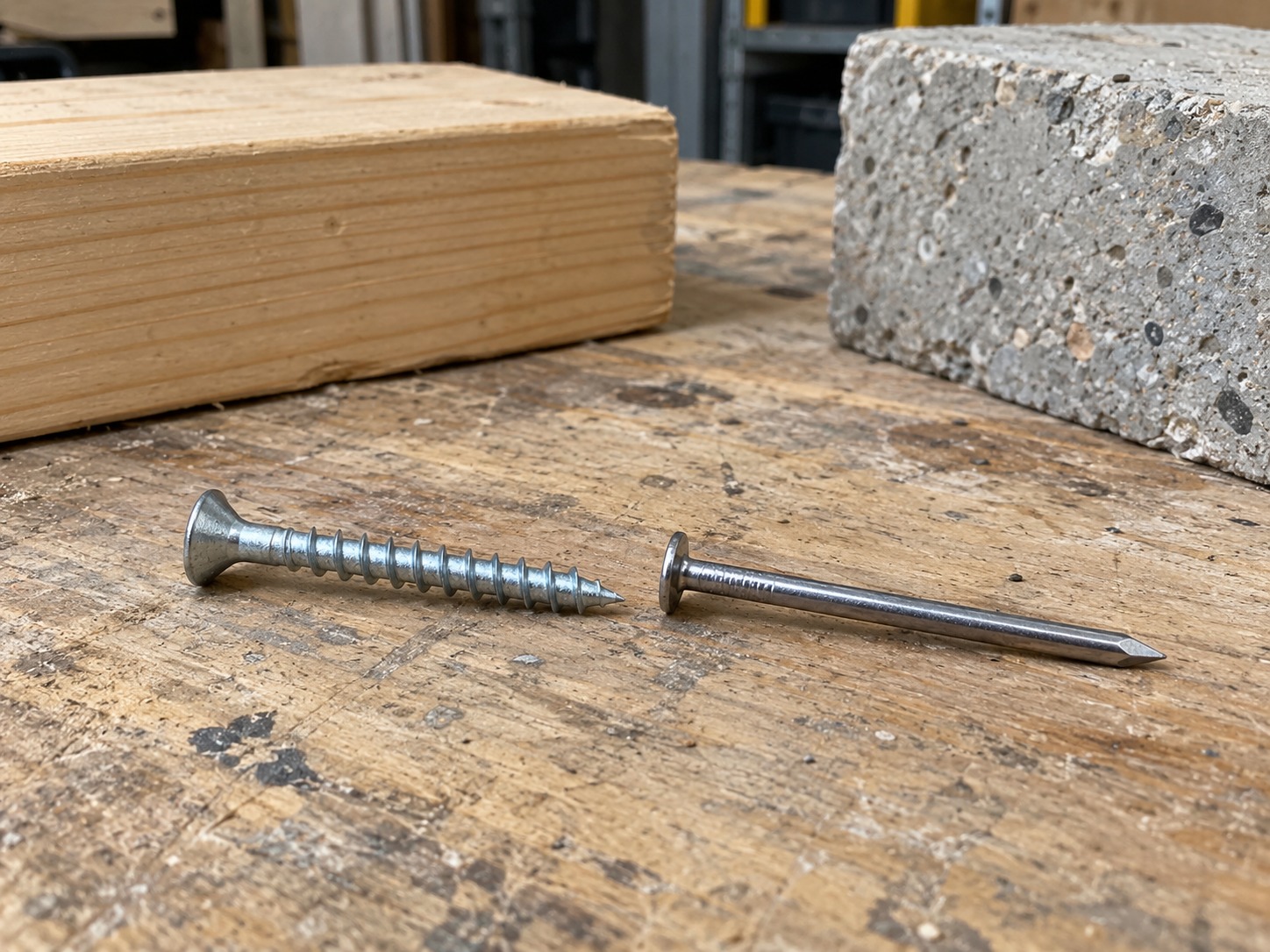
When buyers from the Middle East, Africa, Southeast Asia, and South America ask me this question, I rarely start with “which is stronger?” I start with “what are you fixing, and how will the force act on it?” That one clarification usually changes the whole discussion.
How should buyers compare a screw or nail for holding power?
Many procurement teams compare a screw or nail as if both fasteners do the same job. That creates confusion. A fastener may look strong on paper but fail in the field when the load direction, substrate, or installation method does not match the product.
The correct way to compare a screw and a nail is to separate withdrawal strength from shear strength.2 Screws usually hold better against pull-out force because of their threads. Nails often handle side force well because their shank can bend before breaking, especially in framing and sheathing applications.
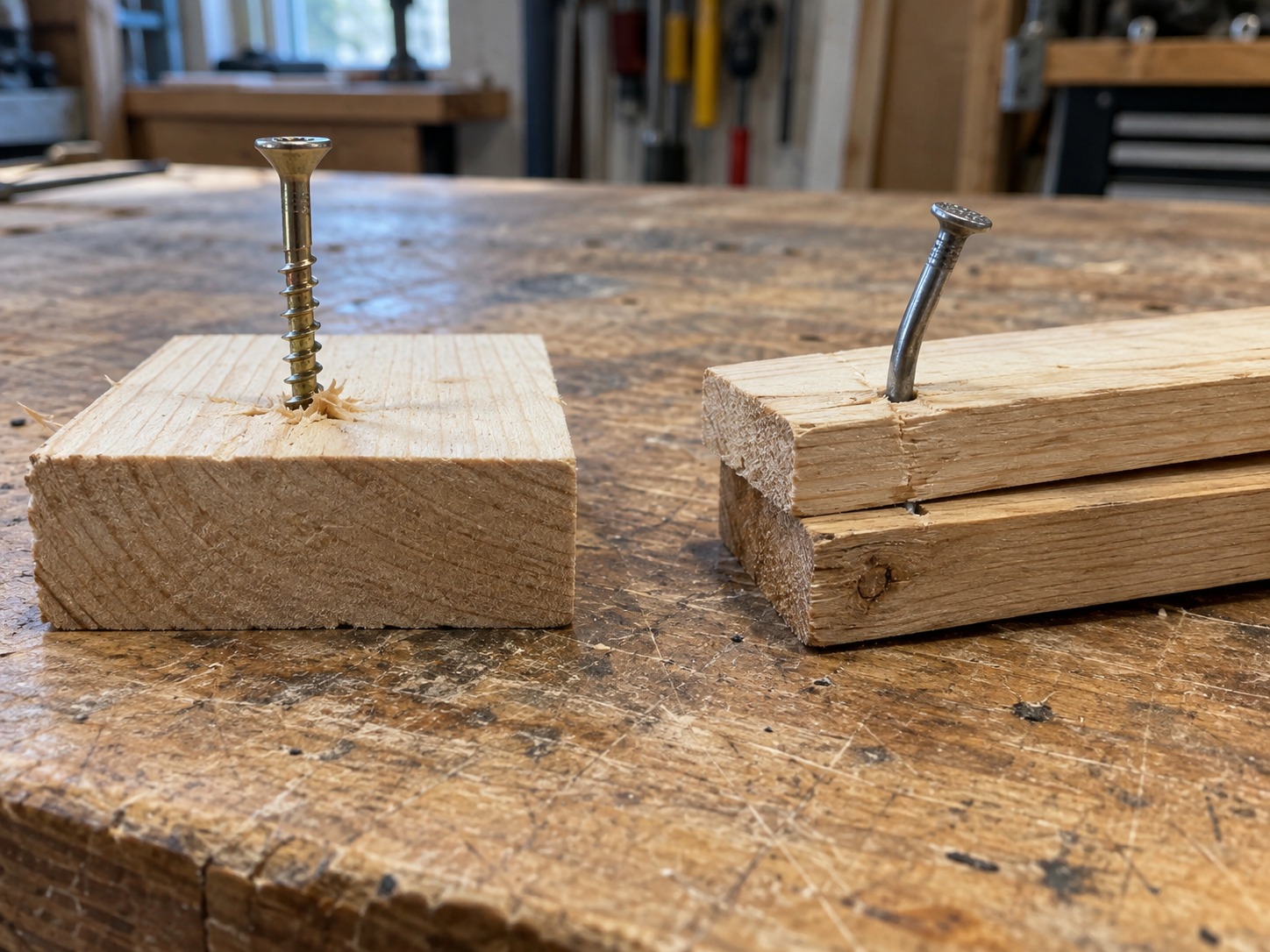
Withdrawal load vs. shear load
In real purchasing conversations, I see many buyers ask, “Which one is stronger?” I then ask whether the fastener will be pulled straight out or pushed from the side. These are different forces.
- Withdrawal load means the fastener is pulled out along its length.
- Shear load means the fastener is pushed sideways across its body.
- Combined load means both forces happen together.
This difference matters because screws and nails hold in different ways. A screw uses threads to grip the material.3 That thread engagement often gives strong resistance when something tries to pull the fastener out. A nail relies more on friction, shank shape, surface coating, and how tightly the material grips the nail.4
In many construction jobs, nails remain practical because loads are not always straight pull-out loads. Framing, sheathing, temporary formwork, crates, pallets, and roofing applications often involve side pressure, vibration, or fast installation. Nails can perform well when the application matches their strength.
A simple buying comparison
| Evaluation point | Nail advantage | Screw advantage | Buyer note |
|---|---|---|---|
| Pull-out resistance | Moderate, depends on shank and material | Usually stronger because of threads | Check substrate and thread type |
| Shear resistance | Often strong and ductile | Can be strong but may snap depending on type | Do not compare only by diameter |
| Installation speed | Fast by hammer or nail gun | Slower, needs driving tool | Important for large projects |
| Removal | Difficult, may damage material | Easier to remove | Useful for repair or temporary work |
| Unit cost | Usually lower | Usually higher | Total labor cost also matters |
| Masonry fixing | Concrete nails are practical | Screws may need plugs or anchors | Application-specific choice |
For bulk buyers, this comparison is more useful than asking for one universal winner. I have seen buyers change their order specification after realizing that their main risk was not “weak holding.” Their real risk was choosing a fastener that did not match how the structure would be loaded.
My practical rule is simple: I do not compare fasteners without asking about material, load direction, installation tools, and removal needs.
When does a nail hold better than a screw?
A screw or nail decision often favors nails when the project needs fast installation, good lateral resistance, and lower cost at scale. This is common in high-volume construction and packaging work, where labor speed and practical field conditions matter as much as theoretical pull-out strength.
A nail may hold better than a screw when the main force is lateral or shear, when the material grips the nail tightly, or when fast installation is necessary. Nails are widely used for framing, sheathing, roofing, pallets, crates, and masonry fixing with concrete nails.
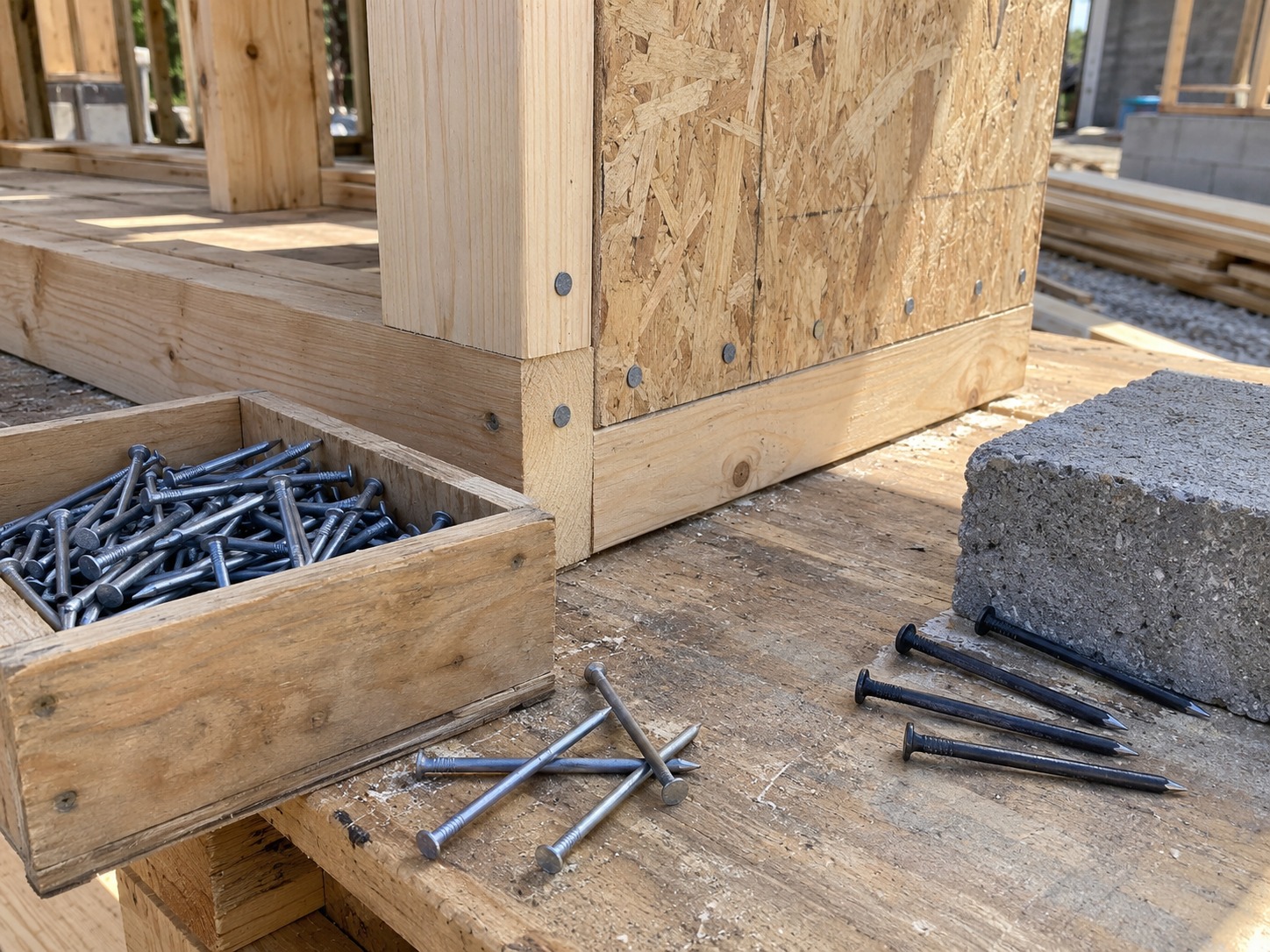
Where nails perform well
Nails are not “weaker screws.” They are different fasteners. In many field applications, a nail gives the right balance of holding, flexibility, speed, and price. This is one reason nails remain widely used in construction-heavy markets.
From our customer inquiries at Dingzhou Best Hardware, buyers often choose nails for these applications:
-
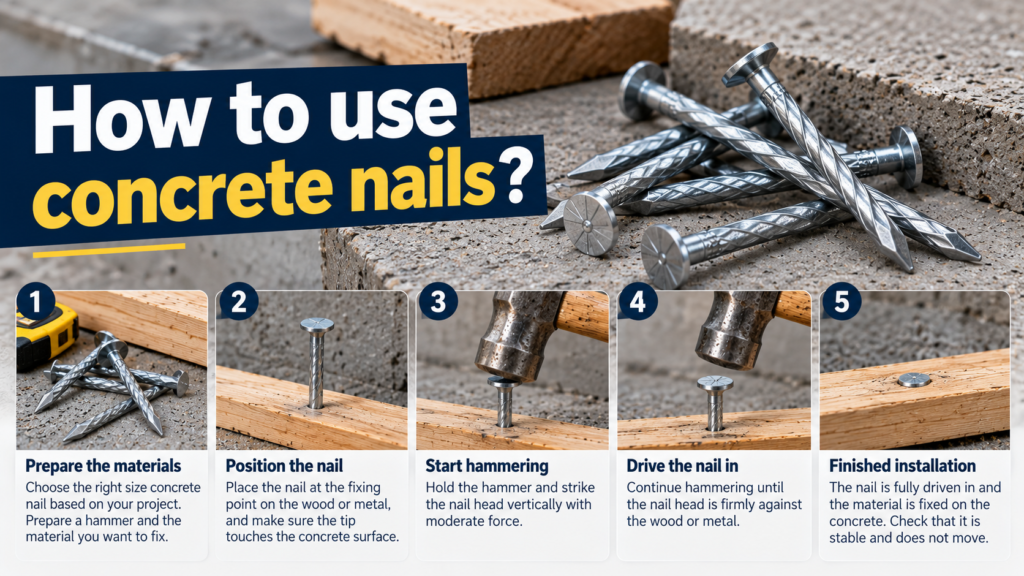
Concrete and masonry fixing
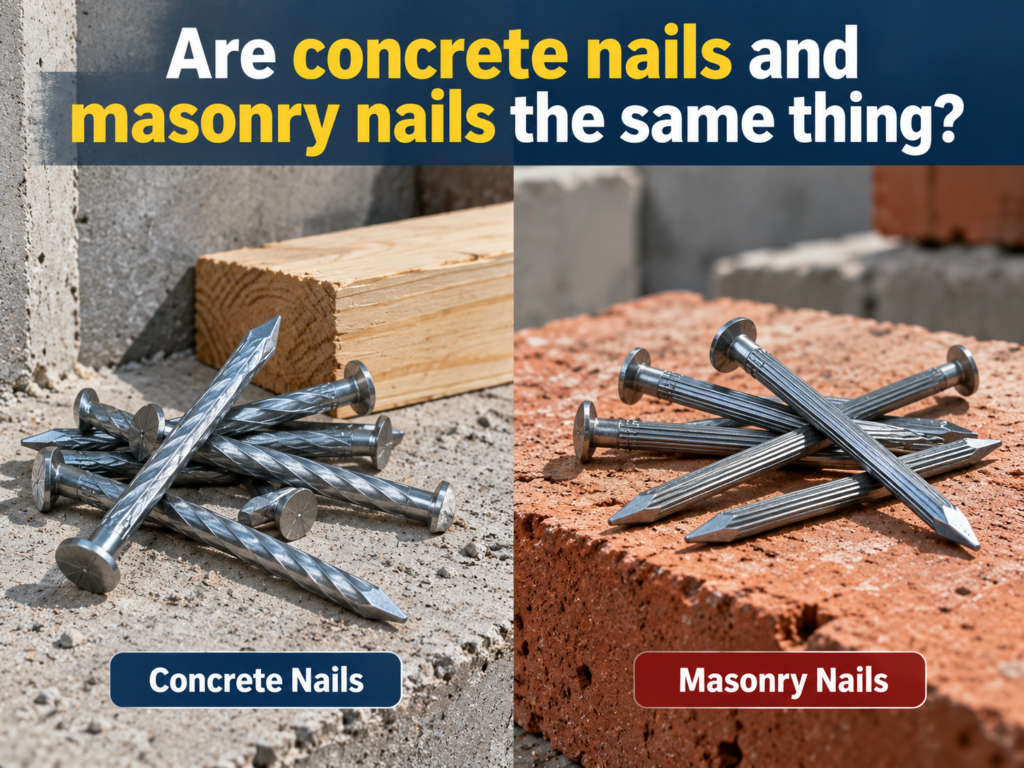
Concrete nails are common where buyers need a direct fixing into masonry or concrete surfaces. Screws may require plugs, anchors, drilling, or additional preparation.5 In many job sites, concrete nails are faster and more practical. -
Wood framing and sheathing
Nails are often used where lateral loads are common. The nail shank can bend slightly under stress, which may help in some construction conditions.6 Buyers should still follow local construction requirements and project specifications. -
Roofing work
Roofing nails are selected for roof sheets, felt, shingles, or related coverings depending on the market and system. Head size, shank type, coating, and corrosion resistance matter here.7 -
Crates, pallets, and packaging
Nails are fast, economical, and easy to apply at volume. For export packaging, speed and cost per unit often drive the decision. -
Temporary formwork
Nails can be installed quickly and removed with tools, although removal may damage the timber more than screws.
Nail types buyers often compare
| Nail type | Common use | Buyer evaluation point |
|---|---|---|
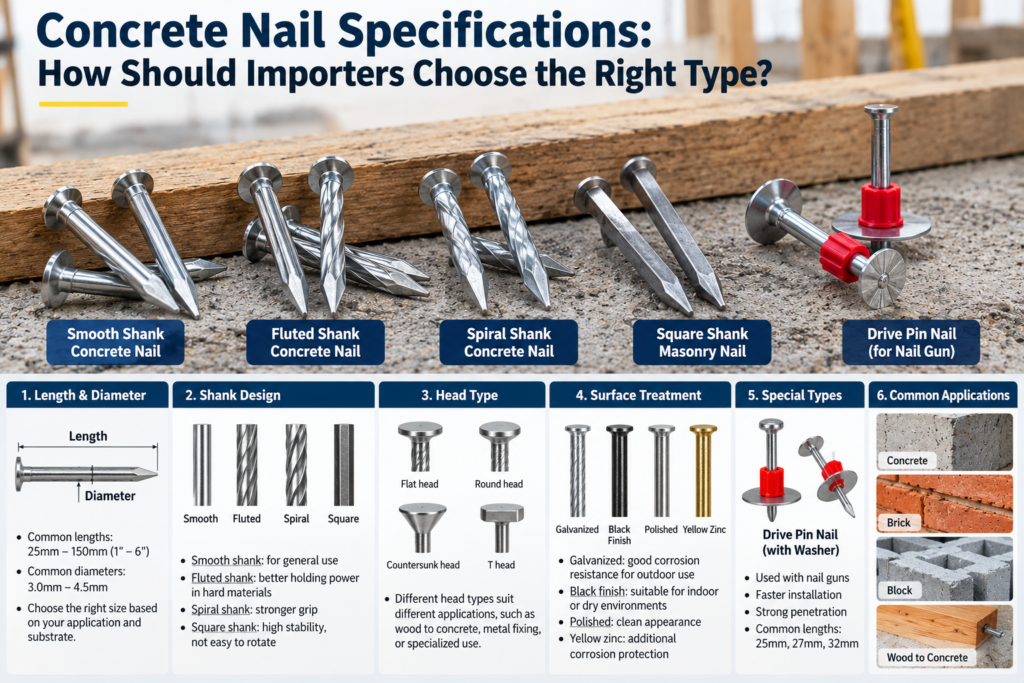
| Concrete nail | Masonry and concrete fixing | Hardness, shank straightness, breakage rate |
| Black steel nail | General construction and industrial use | Surface finish, packing, diameter tolerance |
| Lost head nail | Wood finishing and light joinery | Small head, clean appearance |
| Roofing nail | Roof coverings and sheet fixing | Head size, coating, shank type |
When buyers ask me whether nails hold better, I explain that nails can be the better commercial choice even if a screw has higher withdrawal resistance. A project does not only pay for holding strength. It also pays for installation time, tool availability, worker skill, damage rate, and rework risk.
For example, if a contractor needs to install thousands of fasteners per day, a nail gun or hammer process may be more realistic than screw driving. If the job site has inconsistent electricity or limited tool support, nails may also reduce delays. In many of our target markets, this practical issue is not small. It directly affects project delivery.
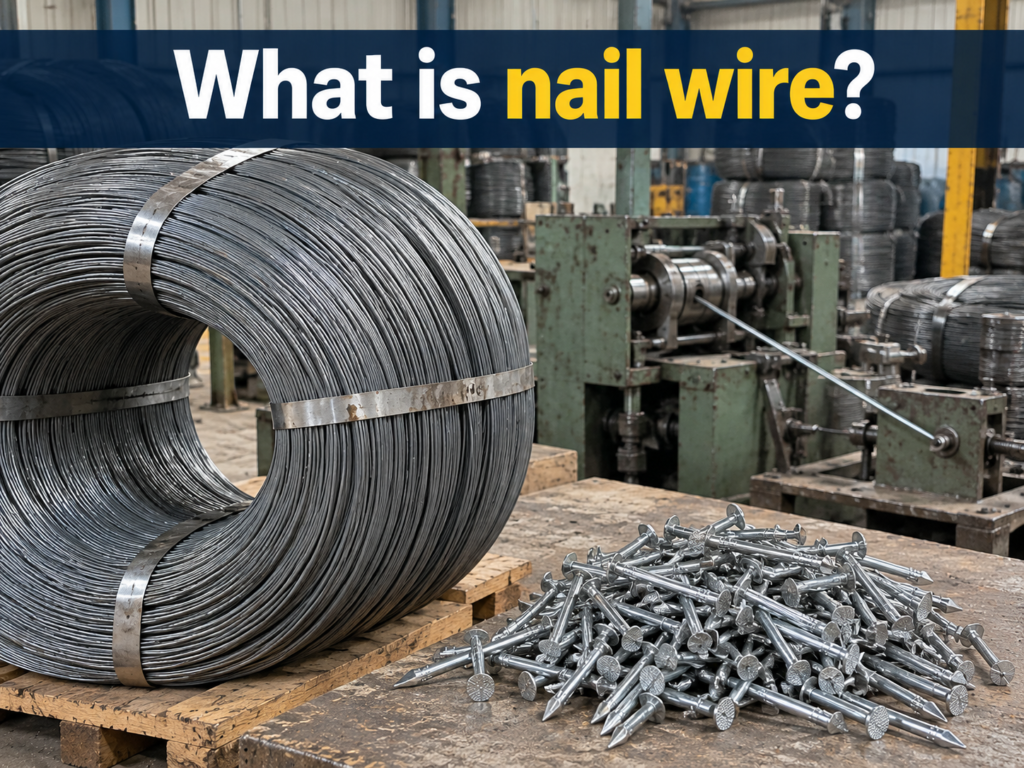
That said, buyers should not use nails blindly. A smooth shank nail, ring shank nail, concrete nail, and roofing nail do not behave the same way. Diameter, length, wire material, heat treatment, surface coating, and packing quality all influence performance. For any structural or safety-critical use, I recommend qualified project evaluation rather than relying only on supplier statements.
When does a screw hold better than a nail?
A screw or nail comparison often favors screws when the main concern is pull-out resistance, adjustment, or future removal. Buyers who need repair access, temporary assembly, or strong clamping force often find that screws give more control during installation.
A screw usually holds better than a nail when the force tries to pull the fastener straight out. Threads bite into wood, board, plastic, or plug material and resist withdrawal. Screws are also better when the assembly may need adjustment, disassembly, or replacement later.
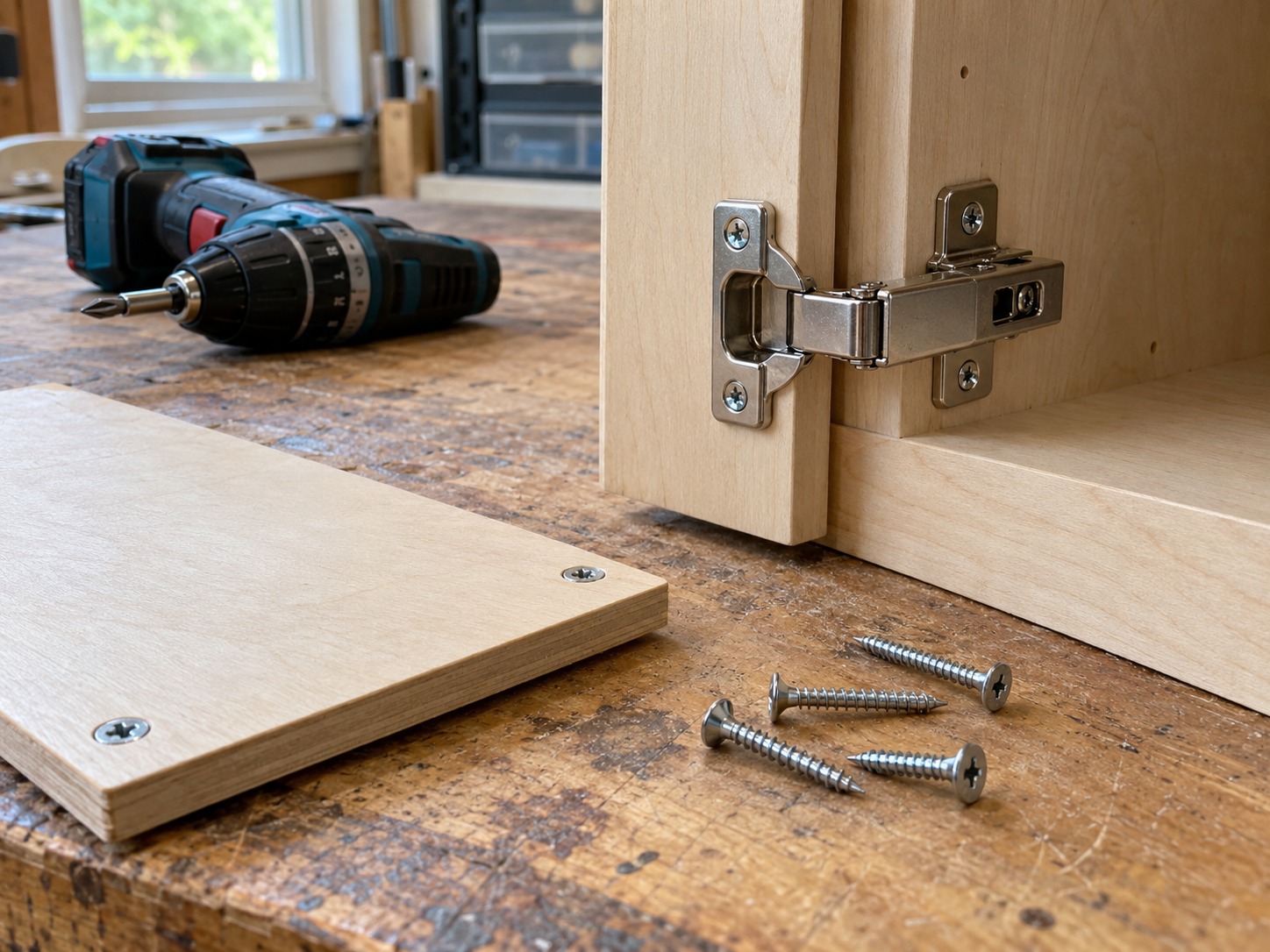
Why threads matter
A screw has a thread. That thread increases contact with the material and creates mechanical grip. When a load pulls outward, the screw must tear through the engaged material before it comes loose. This is why screws are often preferred for:
- Cabinetry and fixtures
- Hinges and hardware
- Repair work
- Temporary structures
- Assemblies that need tightening
- Products that may be disassembled
A nail can hold well, but it does not usually provide the same controlled clamping force. A screw can pull two materials together as it is driven. This matters for many manufactured assemblies.
Reversibility is not a small detail
In procurement, I often notice that buyers ignore reversibility until the first complaint appears. They focus on initial holding power. Then the job site needs to adjust a panel, remove a fixture, or repair a connection. At that point, the fastener choice becomes obvious.
Screws are easier to remove with less damage. Nails are more permanent.8 This does not make screws “better.” It means screws fit jobs where future access matters.
| Project condition | Better fit | Reason |
|---|---|---|
| Permanent low-cost fixing | Nail | Fast and economical |
| Adjustable installation | Screw | Can be loosened or tightened |
| Repair and maintenance access | Screw | Easier removal |
| High-volume wood packaging | Nail | Faster installation |
| Strong pull-out resistance | Screw | Thread engagement |
| Masonry without anchors | Concrete nail | Faster direct fixing in many cases |
Where screws are not always practical
Even when screws hold better in pull-out, they may not be the best bulk purchasing choice. Screws often cost more per piece. They may need electric tools, bits, drilling, plugs, or more skilled labor. If the project is large, the total installed cost can rise quickly.
Buyers should also watch for screw brittleness. Some screws are hard but less ductile. Under strong lateral force, certain screws may snap instead of bend.9 This is why it is risky to compare a screw and a nail only by diameter or length. The steel grade, heat treatment, thread design, coating, and application method all matter.
I also remind buyers that screws in masonry often require a complete system. A screw may need a wall plug, anchor, pre-drilled hole, or matching substrate. A concrete nail may be simpler in some applications. However, the correct choice depends on base material condition and load requirements.
For engineered projects, I recommend checking project specifications, local standards, and qualified technical advice. Supplier experience can help buyers narrow options, but it should not replace structural evaluation.
How do material, speed, and cost change the screw or nail decision?
A screw or nail choice changes when the buyer considers base material, installation speed, and total cost. This is where many procurement decisions become practical instead of theoretical. A fastener that looks stronger may still be wrong if it slows the project or requires tools the crew does not have.
Material, speed, and cost can change the best fastener choice completely. Nails often win in fast, high-volume, cost-sensitive work. Screws often win where removal, pull-out resistance, or precision matters. Concrete, hardwood, softwood, composites, and treated lumber all require separate evaluation.
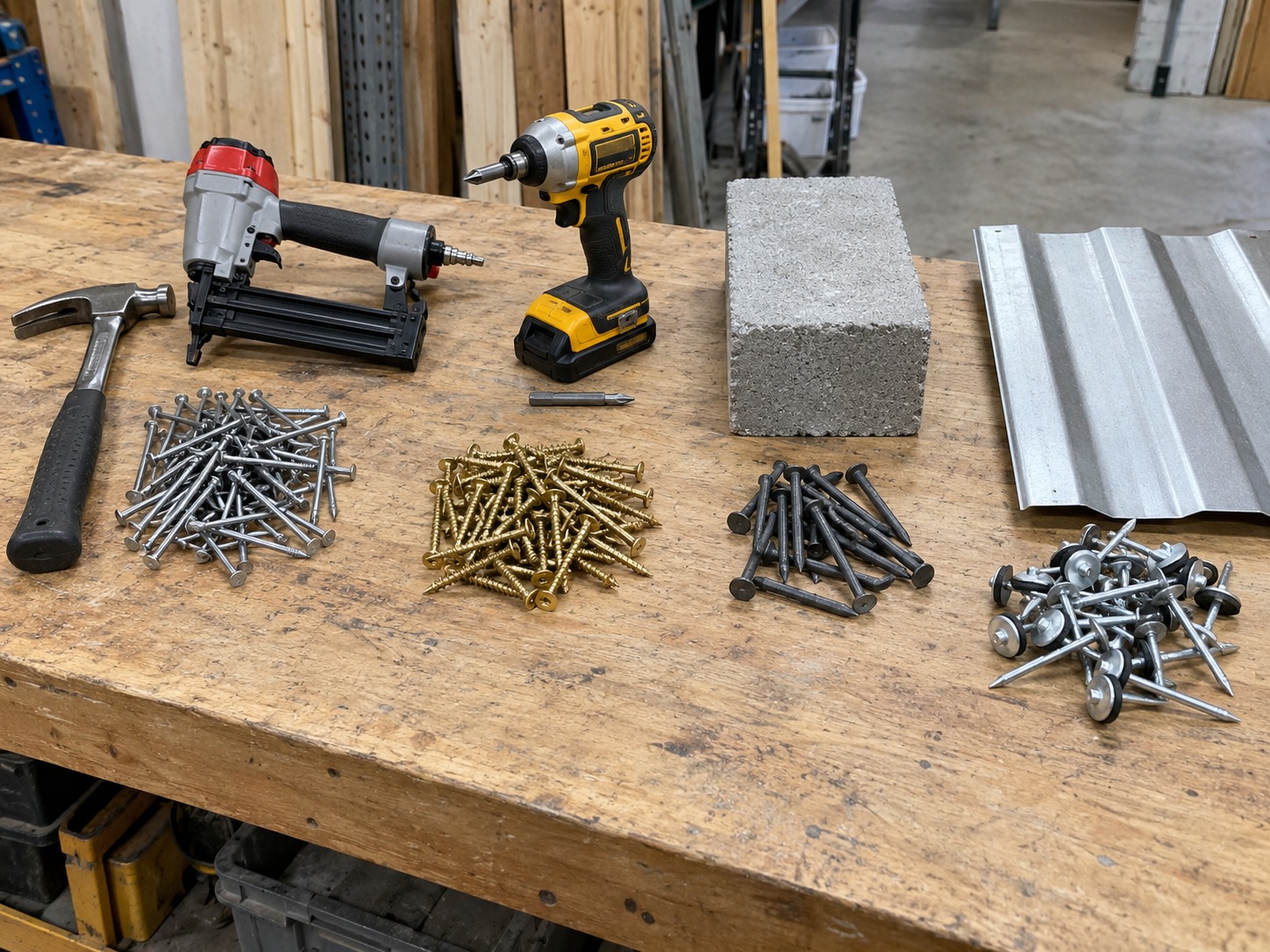
Material pairing changes the answer
A fastener does not hold in the air. It holds inside a material. That material may be soft, hard, brittle, wet, treated, dense, or uneven. This is why one answer cannot fit every market or project.
Common material considerations include:
- Concrete and masonry: Concrete nails can be practical for direct fixing. Screws may need drilling, plugs, or anchors.
- Softwood: Nails often install quickly and grip well enough for many construction uses. Screws give stronger pull-out resistance.
- Hardwood: Nails may bend or split the wood if not selected correctly. Screws may need pilot holes.
- Treated lumber: Coating and corrosion resistance matter. Buyers should check chemical compatibility.10
- Composite boards: Screws may provide more controlled fastening, but splitting and edge distance still matter.
- Metal sheets: Roofing nails or screws may both be used depending on sheet type, washer need, and weather exposure.
Installation speed is a real cost
In many markets we serve, labor speed drives the final decision. I hear this often from distributors and contractors. They are not only buying fasteners. They are buying job-site productivity.
A nail can be driven quickly by hammer or pneumatic tool. A screw needs driving time, torque control, bits, and sometimes pre-drilling.11 At small scale, this difference may not matter. At container or project scale, it becomes a major cost factor.
Here is a simple commercial view:
| Cost factor | Nail impact | Screw impact |
|---|---|---|
| Unit price | Usually lower | Usually higher |
| Installation speed | Faster | Slower |
| Tool requirement | Hammer or nail gun | Driver, bits, possible drilling |
| Worker training | Often simpler | More control needed |
| Rework flexibility | Lower | Higher |
| Material damage during removal | Higher | Lower |
Procurement risk is bigger at volume
A wrong fastener choice is painful when the order is small. It is much more painful when the buyer imports tons of product. At Dingzhou Best Hardware, our typical minimum order is 5 tons or 200 boxes, so I prefer to clarify the application before pricing.
For FOB quotation, buyers normally need to confirm:
-
Product type
Example: concrete nail, black steel nail, lost head nail, roofing nail. -
Specification
Diameter, length, head type, shank type, surface finish, and packing. -
Quantity
Total tons, cartons, boxes, or container loading plan. -
Packaging method
Bulk packing, small box packing, branded packaging, or customized carton. -
Market requirements
Local preferences in the Middle East, Africa, Southeast Asia, or South America may affect sizes and packaging.
I always prefer when buyers request samples before a larger order. Samples cannot replace full project testing, but they help buyers check finish, hardness, straightness, packaging, and general workmanship. Our samples usually carry a basic fee, and buyers can discuss refund arrangements during formal order negotiation.
How should bulk buyers specify a screw or nail before ordering?
A screw or nail order should not be specified only by length and price. Bulk buyers need to define the application, base material, load direction, finish, packing, and inspection expectations. Clear specifications reduce disputes and help factories quote accurately.
Bulk buyers should specify the fastener by product type, size, material, finish, shank or thread design, packaging, quantity, and intended application. They should also request samples, verify supplier documents, and perform application-specific testing before confirming a large order.
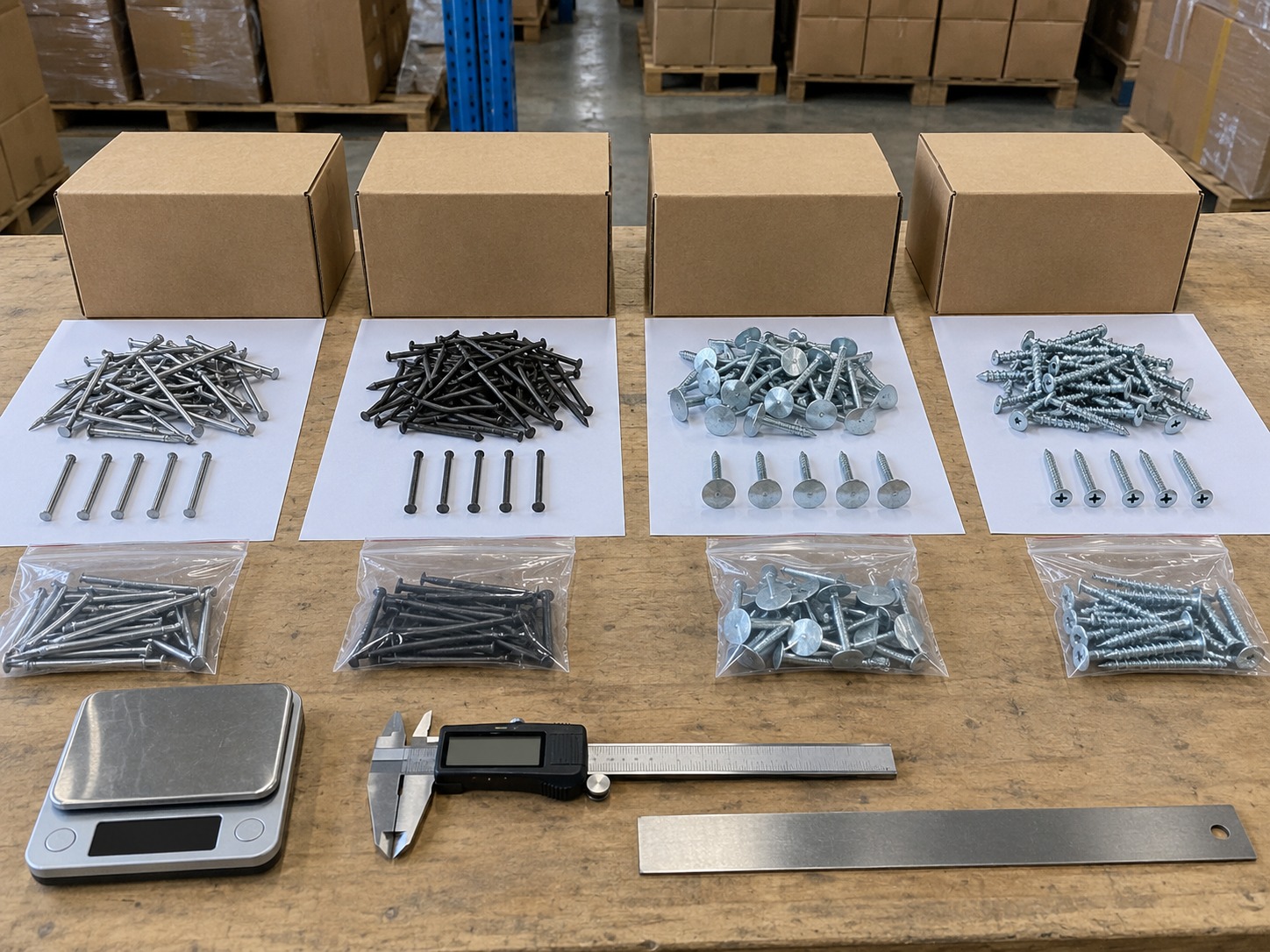
A practical inquiry checklist
When I receive a serious nail inquiry, I usually ask questions before sending a final price. Some buyers want only the lowest number. However, a low number without clear specifications can create problems later.
For nail products, buyers should prepare:
- Application: concrete, roofing, wood, packaging, finishing, or general construction.
- Size: length, diameter, head size, and tolerance if required.
- Material: steel type or required hardness range where applicable.
- Surface finish: black, polished, galvanized, coated, or other finish.
- Shank type: smooth, fluted, ring, spiral, or application-specific design.
- Packing: bulk carton, small box, plastic bag, branded box, or OEM packaging.
- Quantity: tons, boxes, pallets, container plan, or trial order volume.
- Destination port: needed for FOB discussion and shipping planning.
- Inspection need: sample check, third-party inspection, or buyer-side testing.
Supplier evaluation points
A fastener supplier should not be judged only by price. Price matters, especially in competitive construction markets, but quality consistency matters more over repeat orders.
I suggest buyers evaluate:
| Supplier factor | Why it matters |
|---|---|
| Factory status | Direct production can improve communication and control |
| Product range | A focused nail supplier understands market differences |
| Sample availability | Buyers can inspect before volume purchase |
| OEM/ODM ability | Useful for distributors with private brands |
| Packaging control | Important for retail and wholesale resale |
| Lead time | Affects project planning |
| Export experience | Reduces communication and documentation issues |
| Trial order support | Helps reduce first-order risk |
At Dingzhou Best Hardware, we produce and supply nail products such as concrete nails, black steel nails, lost head nails, and roofing nails. We support OEM/ODM customization, including product, packaging, and brand logo. Our normal lead time is about 15–25 days, depending on order quantity and production schedule. We mainly serve markets such as the Middle East, Africa, Southeast Asia, and South America.
Quality control before shipment
Buyers should verify quality with clear checks. I do not recommend accepting vague words like “good quality” as a purchase standard. Better checks include:
-
Dimension inspection
Measure length, diameter, head size, and tolerance. -
Visual inspection
Check rust, burrs, bent nails, broken heads, and coating uniformity. -
Packing inspection
Confirm box weight, carton strength, label accuracy, and pallet condition. -
Application trial
Test the fastener in the actual or similar material. -
Document verification
If certificates or inspection documents are required, buyers should verify them before shipment.
For technical or safety-critical uses, buyers should involve qualified engineers or project professionals.12 A supplier can help with product selection, but the final application decision should match project requirements and local standards.
Frequently Asked Questions
Is a screw stronger than a nail?
A screw is usually stronger against pull-out force because its threads grip the material. A nail may perform better under side or shear force in many construction applications. The stronger choice depends on load direction, material, fastener type, and installation quality.
Why are nails still used if screws hold better in pull-out?
Nails are still used because they are fast, economical, and practical for high-volume work. They often perform well in framing, sheathing, roofing, packaging, and masonry applications. In many projects, installation speed and total cost matter as much as pull-out strength.
Are concrete nails better than screws for masonry?
Concrete nails can be better for simple direct fixing into masonry or concrete when the application allows it. Screws may require drilling, plugs, or anchors. Buyers should check the base material, load requirement, and project specification before choosing either option.
Should I choose screws or nails for temporary structures?
Screws are often better for temporary structures because they can be removed and adjusted with less damage. Nails can be faster and cheaper, but removal may damage the material. The best choice depends on whether speed or reversibility matters more.
What information should I send before requesting a nail quotation?
You should send product type, size, quantity, packing method, surface finish, destination port, and intended application. For example, an FOB nail quotation usually depends on product, specification, quantity, and packaging. Clear details help the factory quote accurately.
Conclusion
A screw or nail does not hold better in every situation. Screws usually resist pull-out better, while nails often fit shear loads, masonry fixing, fast installation, and cost-sensitive bulk work. The right choice depends on load direction, material, reversibility, tools, and procurement risk. If you are sourcing concrete nails, black steel nails, lost head nails, or roofing nails for your market, contact Dingzhou Best Hardware at [email protected] or WhatsApp +8618331061136 to discuss samples, OEM/ODM packaging, and trial orders.
-
"Wood Handbook, Chapter 08: Fastenings", https://research.fs.usda.gov/download/treesearch/37424.pdf. Wood-fastener design references distinguish withdrawal and lateral design values and generally show threaded screws developing strong withdrawal resistance through thread engagement, while nails are commonly used in laterally loaded connections. Evidence role: general_support; source type: institution. Supports: An authoritative wood design or fastener reference should show that threaded fasteners are commonly evaluated for withdrawal resistance and that nails are widely designed for lateral loading in wood connections.. Scope note: The support is general; actual capacity depends on fastener dimensions, wood species, moisture, installation quality, and governing design standard. ↩
-
"Wood Handbook, Chapter 08: Fastenings", https://research.fs.usda.gov/download/treesearch/37424.pdf. Wood engineering references treat withdrawal loading and lateral or shear loading as distinct design cases for mechanical fasteners, supporting the article’s separation of these strength measures. Evidence role: definition; source type: government. Supports: A government or standards-based wood engineering source should define withdrawal and lateral loading as separate fastener design considerations.. Scope note: The source establishes the engineering distinction but does not by itself rank every screw and nail product. ↩
-
"Wood Handbook, Chapter 08: Fastenings", https://research.fs.usda.gov/download/treesearch/37424.pdf. Technical wood-fastener references describe screw withdrawal resistance as arising from thread engagement with the surrounding material, which supports the explanation that threads provide mechanical grip. Evidence role: mechanism; source type: government. Supports: A technical source should explain that screw threads engage the surrounding material and are a major factor in withdrawal resistance.. Scope note: The mechanism applies most directly to wood and similar substrates; performance in masonry, metal, or plastics depends on the full fastening system. ↩
-
"Wood Handbook: Wood as an Engineering Material", https://research.fs.usda.gov/fpl/wood-handbook. Wood-fastener literature reports that nail withdrawal resistance is affected by shank form, surface condition, and the holding action of the surrounding wood fibers, supporting the article’s description of nail holding mechanisms. Evidence role: mechanism; source type: government. Supports: A wood engineering source should identify nail withdrawal resistance as dependent on shank type, surface condition, and the interaction with the surrounding material.. Scope note: The evidence is strongest for wood connections and may not fully describe nail behavior in concrete, masonry, or composite materials. ↩
-
"How to Install Masonry Screws in Concrete | Fasteners 101", https://www.youtube.com/watch?v=9h_5a7uTl2E. Construction fastening guides distinguish direct-driven concrete nails from masonry screw or anchor systems that typically require pre-drilled holes or compatible inserts, supporting the article’s practical comparison. Evidence role: general_support; source type: education. Supports: A university or neutral construction guide should explain common masonry fastening methods, including direct concrete nails and screw systems that require drilling or anchors.. Scope note: The source would describe common methods; suitability for a specific masonry substrate still depends on load, edge distance, embedment, and condition of the base material. ↩
-
"Properties of wood shear walls connected by wood nails", https://bioresources.cnr.ncsu.edu/resources/properties-of-wood-shear-walls-connected-by-wood-nails/. Studies of laterally loaded nailed wood connections describe yielding and bending of nail shanks as part of the connection failure mechanism, providing contextual support for the article’s statement about nail ductility. Evidence role: mechanism; source type: paper. Supports: A research paper or engineering study should document nail yielding or bending behavior in laterally loaded wood connections.. Scope note: The source would support a common mechanism, not prove that bending is beneficial in every construction condition. ↩
-
"Fact Sheet 3.3.1: Roof Systems—Sloped Roofs", https://www.fema.gov/sites/default/files/documents/fema_p-2181-fact-sheet-3-3-1-roof-systems-sloped-roofs.pdf?bdr_campaign=BDR-DIG-DIR-ROOF-KY-PHO-DIRECTORY-202510-LEXINGTONEXTERNALDIRECTORY. Roofing installation and code guidance commonly specifies fastener dimensions and corrosion resistance for roofing applications, supporting the article’s statement that head size, shank type, coating, and corrosion performance are relevant selection factors. Evidence role: general_support; source type: government. Supports: A building-code or government roofing guide should show that roofing fastener specifications include dimensions, shank characteristics, and corrosion resistance.. Scope note: The support is system-dependent; individual roof products and local codes may impose additional or different fastener requirements. ↩
-
"Wood Handbook, Chapter 08: Fastenings", https://research.fs.usda.gov/download/treesearch/37424.pdf. Construction education materials describe screws as removable threaded fasteners that can be backed out, whereas nail removal generally requires prying and may damage the surrounding wood, supporting the article’s reversibility comparison. Evidence role: general_support; source type: education. Supports: A carpentry or construction education source should explain that screws can be backed out with tools while nails are commonly pried out and may damage the surrounding material.. Scope note: The comparison is general; damage during removal depends on fastener type, head condition, substrate, and removal method. ↩
-
"Wood Handbook, Chapter 08: Fastenings", https://research.fs.usda.gov/download/treesearch/37424.pdf. Fastener testing literature reports that screw failure mode varies with material and heat treatment, and that some hardened screws can fracture with limited ductile bending under lateral loading. Evidence role: mechanism; source type: paper. Supports: A materials or structural testing paper should document that some hardened screws exhibit lower ductility and may fracture under lateral or shear loading.. Scope note: The evidence would apply to particular screw types and test conditions; it should not be generalized to all structural screws. ↩
-
"Corrosion of Fasteners in Wood Treated with Newer Wood …", https://research.fs.usda.gov/download/treesearch/43848.pdf. University extension and building guidance on preservative-treated lumber notes that treatment chemicals can affect fastener corrosion and that compatible corrosion-resistant coatings or materials should be used. Evidence role: expert_consensus; source type: education. Supports: A university extension or code guidance source should state that preservative-treated wood can accelerate corrosion and that compatible corrosion-resistant fasteners are required or recommended.. Scope note: Specific compatibility depends on the preservative formulation, exposure environment, fastener coating, and local code requirements. ↩
-
"How Much Time Is Safety Worth? A Comparison of Trigger …", https://pmc.ncbi.nlm.nih.gov/articles/PMC2430644/. Construction productivity research and technical guidance indicate that pneumatic nailing can reduce fastening time compared with more controlled screw-driving operations, supporting the article’s installation-speed comparison. Evidence role: general_support; source type: research. Supports: A construction productivity or technical source should support the idea that driven nails, especially using pneumatic tools, can be installed faster than screws that require controlled driving or pre-drilling.. Scope note: The support is contextual; actual productivity varies with crew skill, tool availability, substrate, fastener size, and required quality control. ↩
-
"general structural notes", https://bid.oregonstate.edu/opportunity/viewFile/4344/SMSU%20Kitchen%20Hood%20Replacement%20ITB%20-%20Appendix%202.8%20Structural%20Drawings.pdf?1400097606. Building-code and engineering-practice documents place structural connection requirements within project specifications and the work of qualified design professionals, supporting the article’s caution for safety-critical fastener uses. Evidence role: expert_consensus; source type: institution. Supports: A building-code or engineering-practice source should support the need for qualified professional evaluation of structural or safety-critical fastening decisions.. Scope note: This supports the need for professional evaluation but does not determine the correct fastener for any particular project. ↩