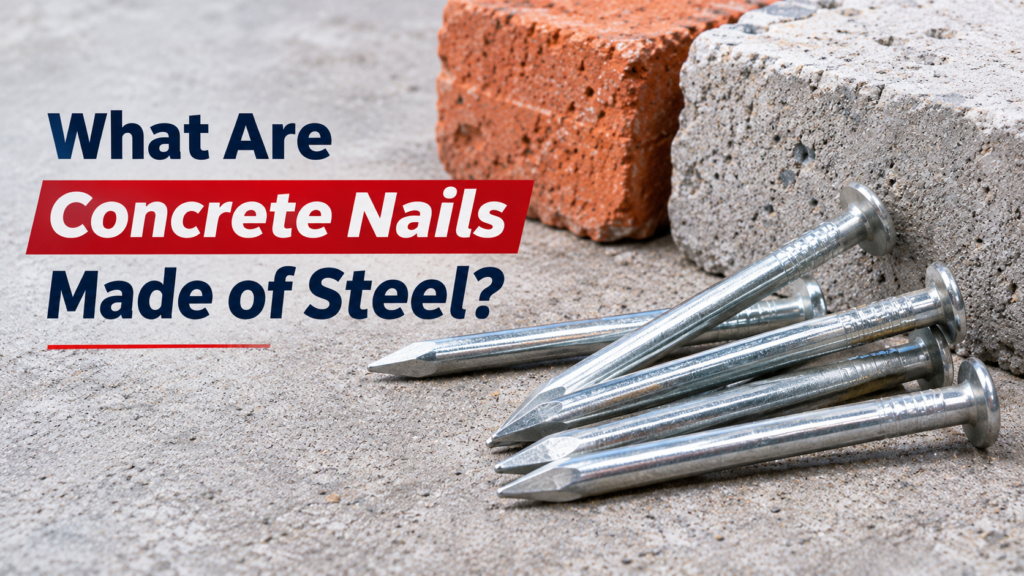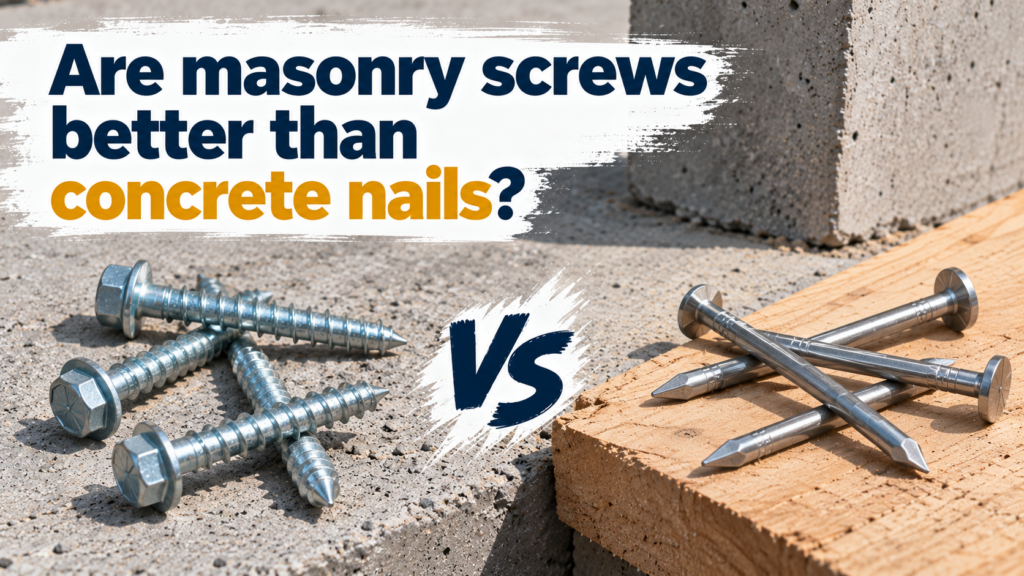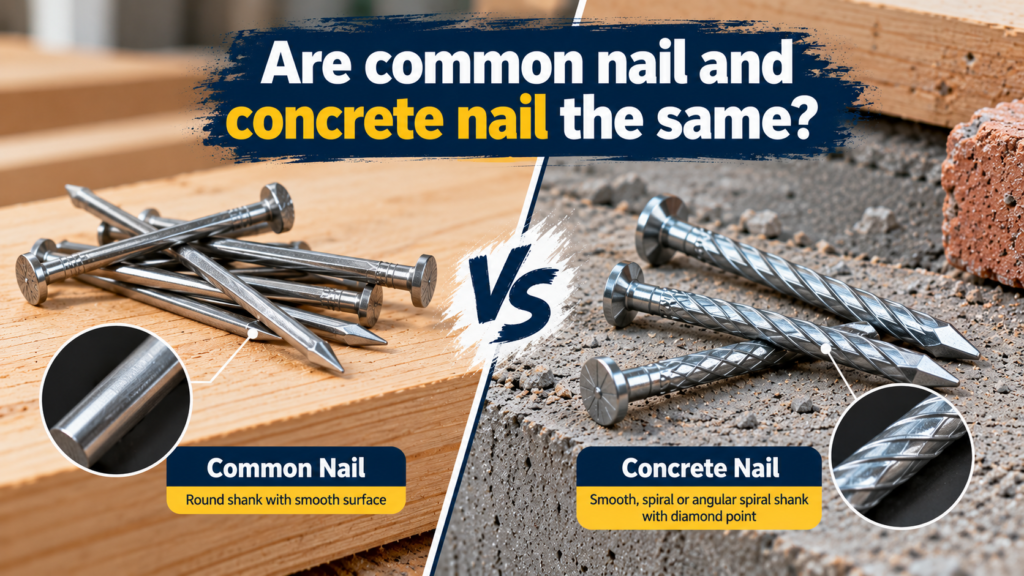

When buyers ask me whether it is better to nail or screw into concrete, the real problem is usually not the fastener itself. The problem is uncertainty about concrete grade, load direction, and installation cost. If you choose only by “which is stronger,” you may overspend, slow the job, or blame a good product used in the wrong application.
It is better to nail into concrete for fast, high-volume, low-to-medium load work where the main force is shear, such as wood strips, framing, or temporary fixing on cured concrete. It is better to screw into concrete when pull-out resistance, adjustability, or removal matters. The best choice depends on concrete condition, load type, and installation method.
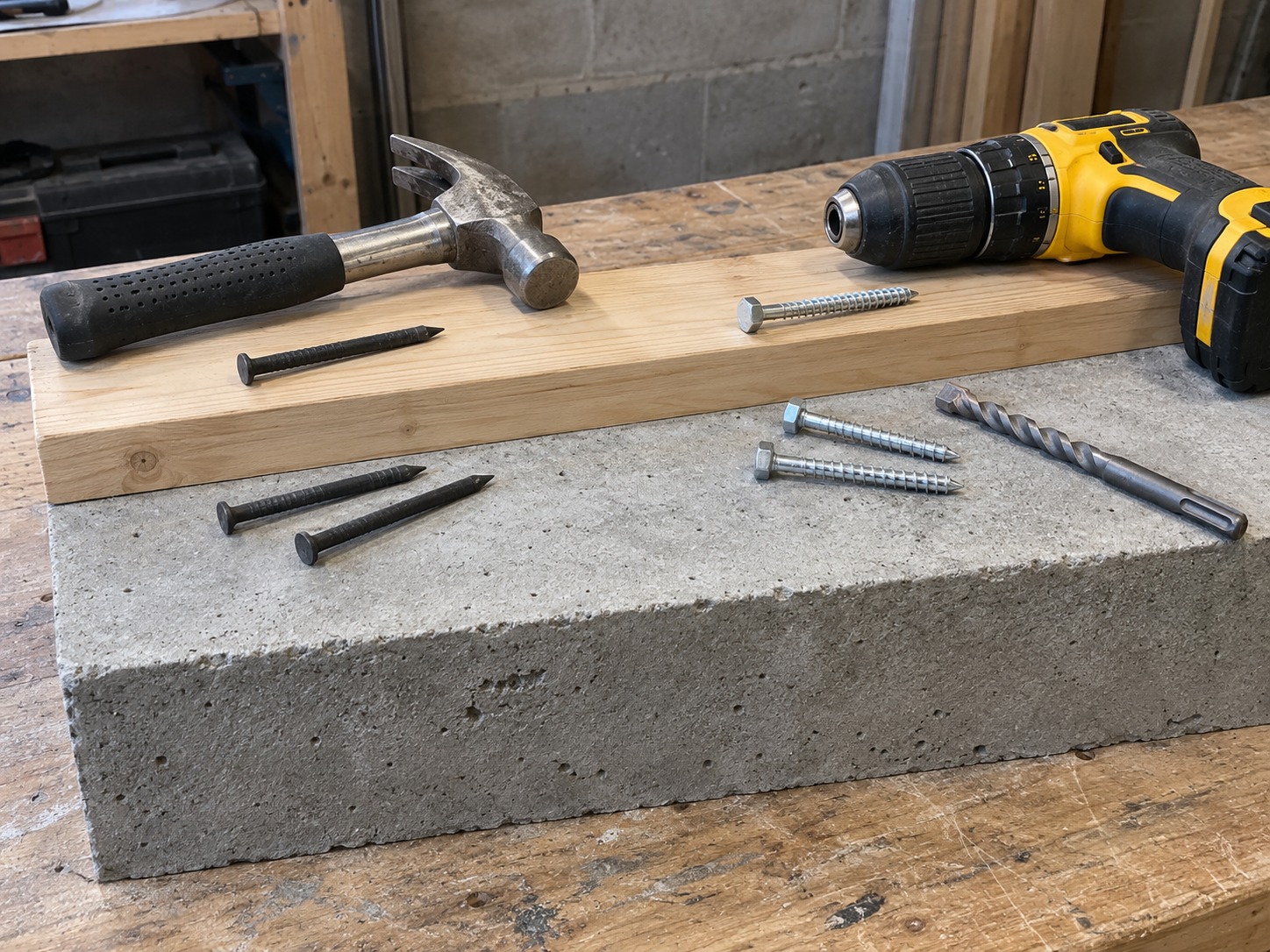
I handle buyer inquiries for concrete fasteners every week, and I see the same pattern often. A buyer asks for “the strongest option,” but the successful projects usually start with a better question: What is the concrete like, and what will the fastener actually do?
Should you nail or screw into concrete for your project?
Choosing whether to nail or screw into concrete can feel simple at first. Then the project starts, and the hidden details appear. The concrete may be too young, too hard, too weak, or inconsistent. The wrong fastener can loosen, bend, crack the surface, or waste labor time.
The best choice is based on three checks: concrete condition, load direction, and installation constraints. Concrete nails often work well for fast shear-load fixing in cured concrete. Concrete screws are usually better for pull-out loads, removable fixing, and applications where adjustment is needed after installation.
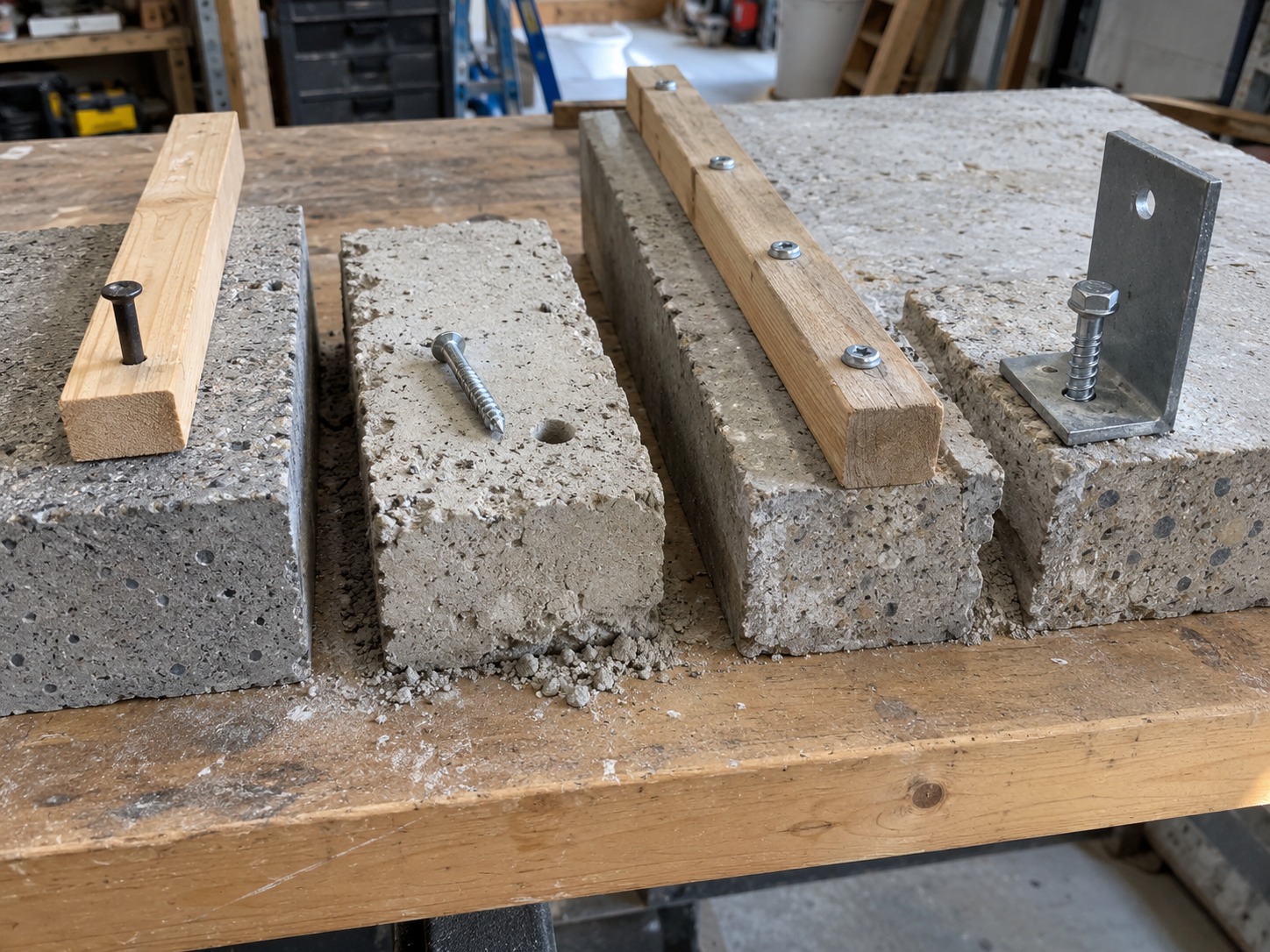
Start with the job, not the product
In my experience, buyers often begin with a product name. They ask for concrete nails, black steel nails, or concrete screws before describing the project. I understand why. Procurement teams need a clear item to quote. But the better buying process starts with the job condition.
Before selecting a concrete fastener, I suggest asking:
-
What is being fixed?
Wood strip, metal bracket, conduit clip, formwork, roofing batten, or light partition? -
What kind of force will act on the fastener?
Will the load pull the fastener out of the surface, or will it push sideways along the surface? -
What is the concrete condition?
Is it fresh, fully cured, old, cracked, weak, dense, or high grade? -
How many pieces will workers install?
A few hundred fasteners and tens of thousands of fasteners have very different labor costs. -
Does the fixing need to be removed or adjusted?
Screws usually offer more control here.
This is why I do not like the simple statement, “screws are stronger than nails.” Threads help a screw resist pull-out, but that does not automatically make a screw better for every concrete fixing job. A concrete nail can perform very well when the job depends mainly on shear holding and fast installation.
A practical decision path
Here is a better way to think about the choice.
| Job factor | What it means for selection | Common direction |
|---|---|---|
| Cured, dense concrete | A hardened base can grip a quality concrete nail well | Nail may be efficient |
| Young or weak concrete | The base may not hold impact-driven fasteners well | Screw may be safer after evaluation |
| Shear load | Force runs parallel to the concrete surface | Nail often works well |
| Pull-out load | Force pulls away from the surface | Screw often has advantage |
| High-volume installation | Labor time becomes a major cost | Nail may reduce total cost |
| Need for adjustment | Fixing may need repositioning or removal | Screw is usually easier |
| Brittle or unknown base | Surface cracking or inconsistent holding is a risk | Test samples first |
This table is not a universal rule. It is a screening tool. For structural or safety-critical applications, a qualified engineer or project professional should evaluate the fastening method. Procurement teams should also verify product documents, test reports, and certifications with the supplier before ordering.
A buyer case I remember
One contractor from a Southeast Asia warehouse project told us that workers were using screws for wood-to-concrete attachment across a large area. The screw held well, but installation was slow because every fixing needed drilling and cleaning. After sample testing with concrete nails on the same cured slab, the contractor switched part of the job to nails and reported a much faster installation pace.
I would not claim that nails were “stronger.” That was not the point. The point was that the fastener matched the application better. The load was mainly sideways, the concrete was cured, and the installation volume was high. In that situation, the total project result improved.
Why is concrete type so important when you nail or screw into concrete?
Concrete looks solid, so many buyers treat it as one material. That assumption causes trouble. A fastener that works well in one slab may fail in another. The same nail or screw can behave differently in fresh concrete, aged concrete, C20 concrete, C30 concrete, hollow areas, or repaired surfaces.
Concrete type matters because it controls grip, cracking risk, impact resistance, and pull-out performance. Before deciding to nail or screw into concrete, buyers should check age, grade, density, moisture, surface condition, and whether the concrete is cracked or reinforced near the fixing point.
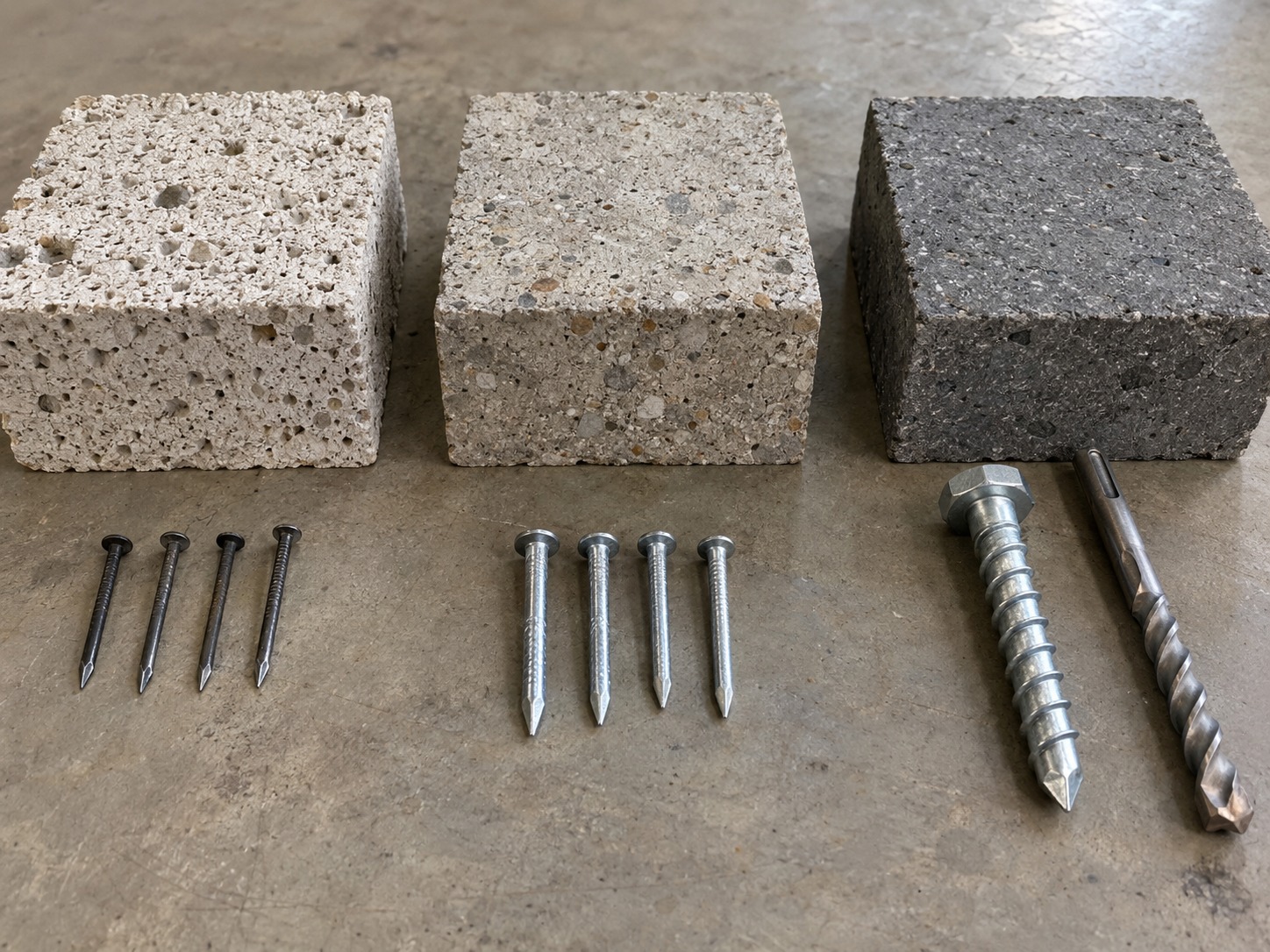
Concrete is not one standard surface
When I talk with buyers in the Middle East, Africa, Southeast Asia, and South America, I often hear one phrase: “It is normal concrete.” That is understandable, but it is not enough for fastener selection. “Normal concrete” can mean many things on a construction site.
Concrete differences may include:
- Age: Fresh concrete has not reached full strength. Many mixes are designed around 28-day strength, but field curing changes results.
- Grade: C20 and C30 concrete do not behave the same under impact or drilling.
- Aggregate: Hard aggregate can make drilling slow and can bend poor-quality nails.
- Curing quality: Poor curing may leave weak zones or dusty surfaces.
- Cracks: Cracked concrete reduces predictable holding.
- Surface layer: Plaster, skim coat, or repair mortar may hide the real base.
- Rebar location: Steel reinforcement can stop drilling or deflect fasteners.
A buyer who chooses between nails and screws without asking about concrete is making the decision backward. The base material should come first.
Fresh concrete versus cured concrete
Fresh or young concrete is a common source of fastening problems. It may look hard from the outside, but it may not have enough internal strength to grip the fastener properly. If a nail is driven into young concrete, the surrounding material may crush or loosen. The nail may feel tight at first, then move later under vibration or load.
Concrete screws also depend on the base material, but they can sometimes offer better control because they cut or engage the hole after drilling. Still, they are not magic. If the concrete is weak, dusty, or poorly cured, even a screw may not hold as expected.
For procurement teams, this creates a simple action point:
Do not approve bulk fastener selection based only on drawings. Ask for site concrete information and run sample installation before full purchase.
C20 versus C30 and site reality
Concrete grade affects installation, but site reality also matters. A C30 design mix may not perform like perfect C30 concrete if curing, mixing, or pouring conditions were poor. On the other side, old concrete can be very hard and may require more effort for drilling.
In hard, aged concrete, a properly hardened concrete nail may provide strong grip for simple fixing tasks. It also avoids the time needed for pre-drilling. This is one reason concrete nails remain popular for many construction markets. They are practical, fast, and cost-efficient when the application fits.
Concrete screws may be preferred where:
- The base is too brittle for impact driving.
- The fixture must be removable.
- The load has a stronger pull-out component.
- The installer needs more positioning control.
- The project requires a specific tested fastening system.
What I ask buyers before quoting
At Dingzhou Best, when buyers ask for concrete nails, black steel nails, or customized nail packaging, I usually try to clarify the application before giving a final recommendation. My questions are simple:
| Question I ask | Why it matters |
|---|---|
| What material are you fixing to concrete? | Wood, metal, and plastic clips behave differently |
| Is the concrete new or old? | Age affects grip and cracking |
| Is the job indoor or outdoor? | Corrosion and exposure matter |
| What nail size or screw size do workers use now? | Existing practice gives useful clues |
| Did the previous fastener fail? How? | Pull-out, bending, cracking, or loosening mean different problems |
| What packaging do you need? | Bulk, box, brand logo, or OEM affects procurement |
This process also helps avoid overbuying. If a buyer only needs fast fixing for light wood strips on cured concrete, a screw may increase cost without adding useful value. If the buyer needs removable brackets with pull-out resistance, a nail may be the wrong shortcut.
Does load direction matter more than choosing a nail or screw into concrete?
Many buyers compare fasteners as if strength is one number. Real job sites are not that simple. A fastener may resist sideways force well but perform poorly when pulled straight out. If the load direction is unclear, the choice between a nail and a screw becomes a guess.
Load direction often matters more than the product category. Nails can work well for shear loads, where force runs parallel to the concrete surface. Screws usually have an advantage for pull-out loads, where force pulls away from the concrete because threads increase mechanical engagement.
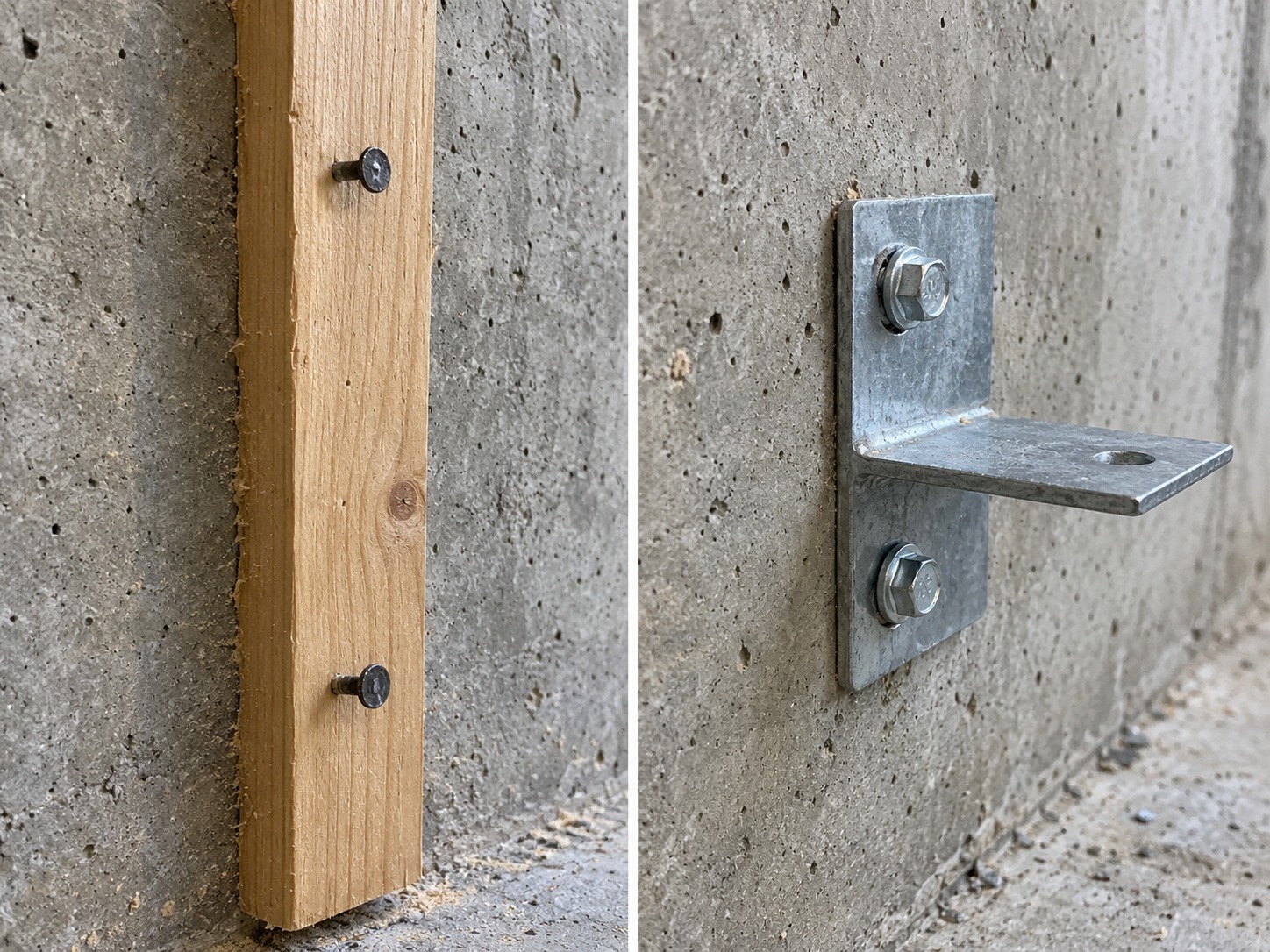
Shear load: where nails can be very efficient
A shear load pushes sideways across the fastener. Common examples include:
- Wood strip fixed to a concrete wall
- Light framing attached to a slab
- Temporary support fixed during construction
- Cable or conduit accessories with low sideways loads
- Certain warehouse or interior fit-out tasks
In these cases, the fastener is not mainly being pulled straight out. The concrete around the shank and the contact between fixture and base help resist movement. A concrete nail may perform well, especially in cured concrete and non-critical fixing work.
This is where the “screw is always stronger” idea becomes misleading. A screw thread gives better pull-out engagement, but that benefit may not matter much when the job is mostly shear. If the screw requires drilling, cleaning, and slower installation, the buyer may pay for a feature that the job does not need.
Pull-out load: where screws often make sense
A pull-out load pulls the fastener away from the concrete surface. Examples include:
- Hanging brackets
- Suspended supports
- Fixtures under vibration
- Applications where the attached item tries to peel away
- Fixings where safety depends on withdrawal resistance
In these applications, thread engagement can be valuable. A screw can create a stronger mechanical connection with the drilled hole, if the hole diameter, depth, and concrete condition are correct. The installer can also remove or adjust the screw more easily than a nail.
However, screws still require good installation practice. A poorly drilled hole, too much dust, wrong diameter, or weak concrete can reduce holding. Buyers should not treat concrete screws as a way to ignore site conditions.
Mixed loads are common
Most real projects have mixed forces. A fastener may experience shear, pull-out, vibration, and bending at different times. This is why a simple online answer cannot replace professional evaluation for critical applications.
For non-structural work, buyers can still use a practical screening method:
- If the fixture mainly slides or shifts sideways, consider concrete nails first for speed and cost.
- If the fixture may pull away from the surface, consider concrete screws or another anchoring system.
- If people’s safety depends on the fixing, ask a qualified professional to specify the fastener.
- If the concrete condition is unknown, test both options before ordering in bulk.
- If workers need removal or adjustment, screws usually reduce rework.
Why failure stories are useful
I remember a buyer who used nails in relatively young concrete for a fixing that had some pull-out force. The nails installed quickly, but some fixings loosened after use. The buyer first thought the nail quality was the only issue. After discussing the site details, the better explanation was application mismatch: young concrete, load direction, and impact installation did not fit well.
That kind of case is important because it shows why fastener selection should not be emotional. The product may be acceptable, but the application may be wrong. Good procurement protects both the buyer and the supplier by defining conditions clearly before the order.
How do installation cost and speed affect the nail or screw into concrete decision?
Buyers often compare only unit price. That can be a costly mistake. A screw may have a reasonable price per piece, but drilling time, drill bit wear, electricity, worker skill, and hole cleaning can raise the real installed cost. A nail may cost less and install faster when conditions are suitable.
Installation cost can change the best choice. Concrete nails are often more cost-efficient for high-volume, low-load fixing because they install quickly and usually cost less per unit. Concrete screws may cost more in labor but add value when adjustability, removal, or pull-out resistance is needed.
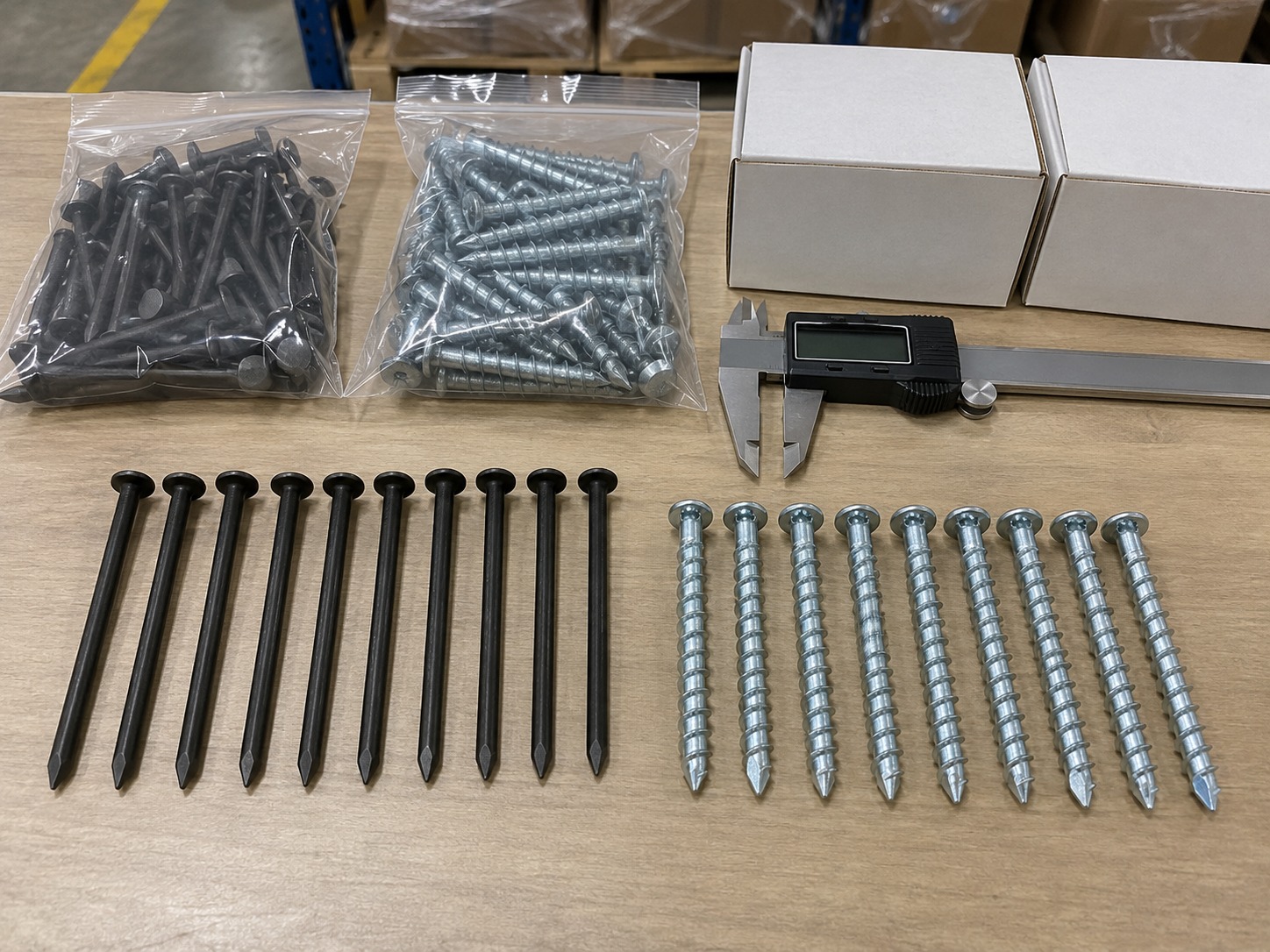
Unit price is not total cost
Procurement managers are trained to negotiate price. That is important. But for concrete fasteners, the cheapest piece is not always the cheapest installed solution. I usually encourage buyers to calculate the full cost.
Total installed cost may include:
- Fastener unit price
- Drill bits or driving tools
- Worker time per fixing
- Rework from failed installation
- Broken or bent fasteners
- Surface damage
- Packaging and handling time
- Project delay risk
For high-volume fixing, a few seconds per point can become a major cost. If workers install 20,000 fasteners, saving even 10 seconds per fixing equals more than 55 labor hours. This is why concrete nails can be attractive in markets where construction speed and labor coordination are critical.
Where nails often reduce cost
Concrete nails are commonly chosen for:
- Wood-to-concrete fixing
- Formwork-related tasks
- Light construction attachment
- General non-structural fastening
- Jobs where workers need simple tools
- Projects with many repeated fixing points
Quality matters here. A concrete nail must have proper hardness, consistent shank, good point formation, and suitable packaging. Poor nails may bend, crack the surface, or slow workers down. That is why buyers should request samples before bulk purchase.
At Dingzhou Best, we can provide samples for quality checking. Samples usually carry a basic cost, and buyers can discuss whether that cost is returned or adjusted in a formal order. This is practical because a real site test is more useful than a beautiful product photo.
Where screws justify the extra cost
Concrete screws can justify higher installation cost when the project needs:
- Removal after temporary use
- Fine adjustment of fixture position
- Better pull-out performance
- Less impact on brittle surfaces
- More controlled installation
- Compatibility with specified systems
For example, a buyer fixing brackets that may need future maintenance might prefer screws. The workers can remove and replace them more easily. If the fixing position must be exact, screws also give more control than impact-driven nails.
The key is not to avoid screws because they cost more. The key is to use screws where their benefits matter.
Procurement shortcut: compare installed cost
Here is a simple way I suggest buyers compare options during sourcing.
| Cost question | Why it matters |
|---|---|
| How many fixing points are in the project? | High volume favors faster installation |
| How long does one fixing take? | Labor can exceed fastener price |
| Is pre-drilling required? | Drilling adds time and tool wear |
| What is the failure rate in sample testing? | Rework can erase savings |
| Can workers install consistently? | Skill level affects results |
| Does the fixture need adjustment? | Screws may reduce future labor |
For our export orders, the minimum order quantity is usually 5 tons or 200 boxes, depending on the product and packing method. Because that is a serious quantity, I prefer buyers to test first. We support trial orders, OEM/ODM customization, and customized packaging with brand logo when the project and market demand are clear.
Our quotations are usually based on FOB pricing with product, specification, quantity, and packaging method confirmed. Lead time is often 15–25 days, depending on order quantity. Sea shipping can be arranged by full container load or less-than-container load.
What quality checks should buyers make before ordering concrete fasteners?
A buyer can choose the right fastener type and still face problems if product quality is inconsistent. This is common in price-sensitive markets. A nail that bends too easily or a screw with poor threading can create site delays, even when the application choice is correct.
Buyers should check material consistency, hardness, dimensions, point quality, finish, packaging, and sample performance before ordering. They should also verify supplier documents, factory capability, export experience, and whether the supplier can support trial orders and customized packing.
Check the fastener, not only the catalogue
Catalogues are useful, but concrete fastening is physical work. Small quality differences matter. For concrete nails, buyers should pay attention to:
- Hardness: The nail needs enough hardness to enter concrete, but it should not be too brittle.
- Straightness: Bent nails slow installation and increase waste.
- Point shape: A clean point improves driving performance.
- Head consistency: Poor heads may affect hammering or tool use.
- Surface finish: Black, bright, galvanized, or other finishes should match storage and exposure conditions.
- Packing strength: Export cartons must survive handling and sea shipping.
For screws, buyers should check:
- Thread consistency
- Head recess quality
- Coating quality
- Drilling hole requirements
- Recommended embedment depth
- Compatibility with tools and bits
Buyers should request product photos, samples, and relevant documents. If certifications or test reports are provided, buyers should verify the documents and confirm whether they apply to the exact product being purchased.
Sample testing is worth the time
I know some buyers want to skip samples to save time. I understand that pressure. But when the order is several tons, sample testing is a small cost compared with shipment risk.
A useful sample test should include:
- Actual site concrete, not only a loose test block.
- Real workers, because installation technique affects results.
- The intended fixture material, such as wood or metal.
- The same tool method, such as hammering, nail gun, or drilling.
- Observation after installation, including bending, cracking, loosening, and holding feel.
This does not replace engineering testing for critical applications. But it helps buyers catch obvious mismatch before bulk order.
Supplier selection matters
Concrete fasteners are not only commodities. A good supplier should ask about your application instead of only pushing a size and price. If a supplier gives the same answer for every concrete type and every load condition, buyers should be cautious.
When evaluating a factory, I suggest checking:
| Supplier factor | Why buyers should care |
|---|---|
| Manufacturing experience | Consistency improves with process control |
| Product range | Nails, black steel nails, roofing nails, and related items may support mixed orders |
| Export market experience | Packing and shipping requirements differ by region |
| OEM/ODM support | Useful for distributors building their brand |
| Sample policy | Shows confidence and supports testing |
| MOQ clarity | Prevents misunderstanding before payment |
| Lead time transparency | Helps project scheduling |
Dingzhou Best is a manufacturing factory, and we also have overseas factory capacity. Our main nail products include concrete nails, black steel nails, lost head nails, and roofing nails. Our main markets include the Middle East, Africa, Southeast Asia, and South America. We focus on practical construction needs in these regions rather than developed European or North American markets.
Packaging and specification are part of quality
Many buyers focus on the fastener and forget packaging. But packaging affects resale, storage, and site use. A good concrete nail in weak packaging can arrive with broken cartons, mixed sizes, or rust risk from poor handling.
For export orders, buyers should confirm:
- Nail or screw size
- Box quantity
- Carton strength
- Inner packing method
- Brand logo design
- Pallet requirement, if needed
- Shipping mark
- Moisture protection
- Container loading plan
OEM and ODM customization can help distributors protect their market. Custom packaging also reduces confusion on site. When workers can quickly identify size and application, installation errors decrease.
Frequently Asked Questions
Can I hammer a normal nail into concrete?
A normal nail is usually not suitable for concrete. It may bend, fail to penetrate, or damage the surface. Concrete nails are hardened and shaped for masonry-type fixing. Even then, the concrete condition and load type must fit the application.
Are concrete screws stronger than concrete nails?
Concrete screws often provide better pull-out resistance because their threads engage the drilled hole. However, that does not mean they are better in every application. For shear loads in cured concrete, concrete nails may be faster and cost-efficient with suitable holding performance.
Do I need to pre-drill for concrete nails?
Many concrete nails are designed for direct installation into suitable cured concrete, but results depend on nail quality, concrete hardness, and tool method. Very hard, brittle, or unknown concrete may require testing first. Buyers should follow supplier guidance and site safety practices.
Why do concrete nails loosen after installation?
Concrete nails may loosen because the concrete is too young, weak, cracked, dusty, or unsuitable for impact fixing. Load direction can also be the issue. If the force pulls outward, a screw or anchor system may perform better after professional evaluation.
Can I order custom concrete nails with my brand packaging?
Yes. At Dingzhou Best, we support OEM/ODM customization for products, packaging, and brand logos. Our usual MOQ is 5 tons or 200 boxes, and we can provide samples for quality checking before bulk orders.
Conclusion
The best answer to nail or screw into concrete is not “nail” or “screw.” The better answer is: match the fastener to the concrete condition, load direction, and installation cost. Nails can be fast and economical for many shear-load jobs in cured concrete. Screws can be better for pull-out loads, adjustment, and removal. If you are sourcing concrete nails or comparing fastening options for a project, contact Dingzhou Best at [email protected] or WhatsApp +8618331061136 to discuss specifications, samples, FOB pricing, and trial orders.